


Hot-Weather Setting
High concrete temperatures can accelerate hydration and reduce the time available for transport, placement and finishing.
POLYVIA™ Sodium Gluconate is a high-purity concrete set retarder used to regulate early cement hydration, extend setting time and maintain the required working window in concrete production. It is suitable for PCE-based admixture formulations where setting behavior must be balanced with water reduction, workability and actual production conditions.
Controlled Setting · Extended Workability · Hot-Weather Concrete · PCE Formulations
Sodium gluconate (CAS 527-07-1) is the sodium salt of gluconic acid, widely used as a set-retarding component in concrete admixtures. It regulates early cement hydration to control setting time and extend concrete workability.
In formulated admixture systems, sodium gluconate can be used with Polycarboxylate Ether (PCE) Superplasticizers to combine setting-time control with high-range water reduction and cement dispersion.
Concrete setting behavior must match temperature, transport time, placement sequence and admixture design. Sodium gluconate provides a practical route to controlled retardation when additional working time is required.
High concrete temperatures can accelerate hydration and reduce the time available for transport, placement and finishing.
Extended delivery times can reduce workable time before concrete reaches the jobsite for discharge and placement.
Large pours, pumping and staged placement can require additional time between batching, placement and final finishing.
PCE-based systems may require additional retardation to balance high water reduction with the target setting profile.
Controlled Interaction with Early Cement Hydration
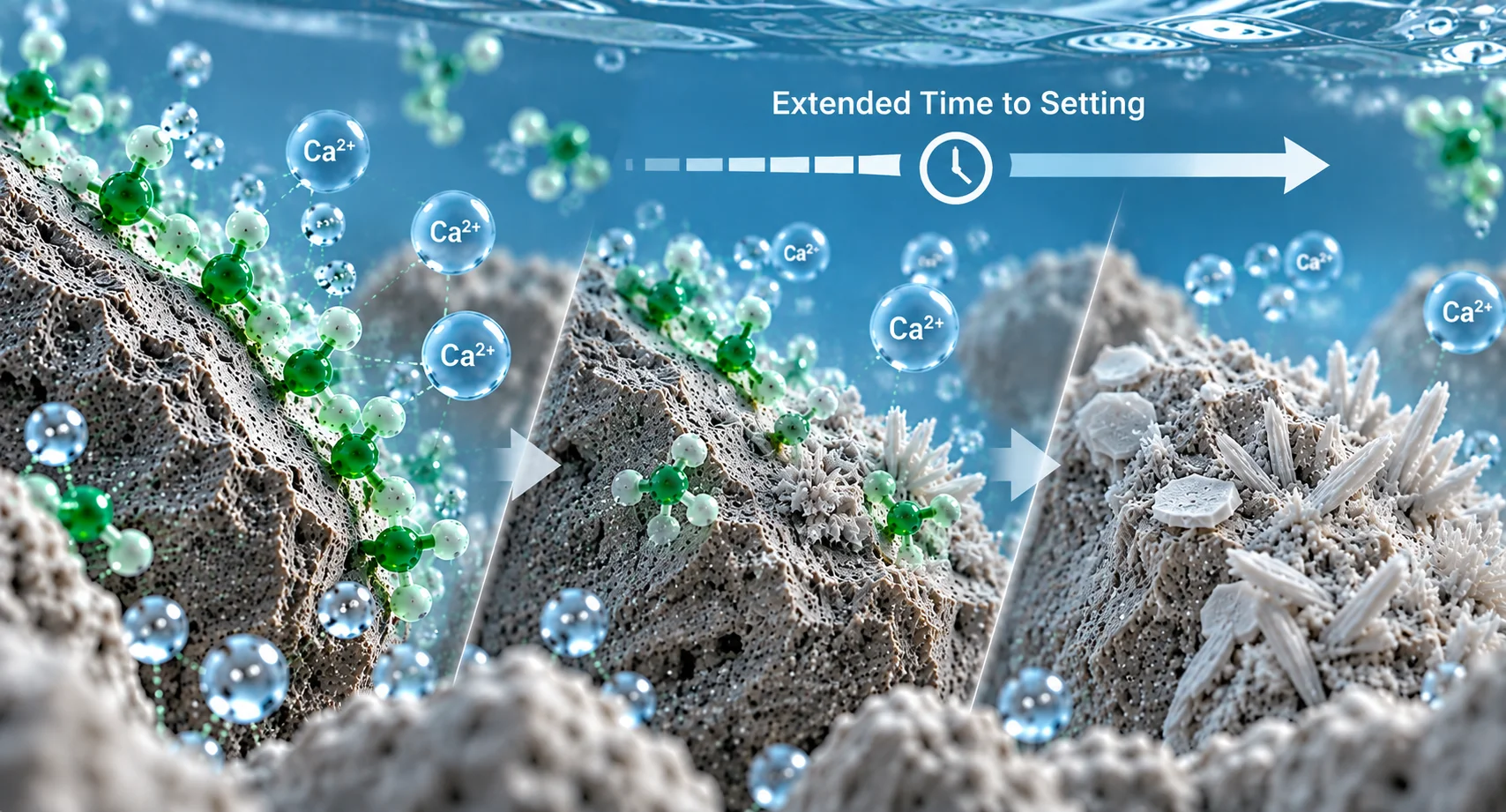
Sodium gluconate dissolves in mixing water and disperses throughout the cement pore solution.
Gluconate species interact with cement surfaces and dissolved calcium ions during early hydration.
These interactions slow early hydration and delay the development of hydration products associated with setting.
Slower early hydration extends the time before significant setting and hardening develop.
| Items | Standard |
|---|---|
| Appearance | White to Yellowish White Crystalline Powder |
| Content | ≥99.0% |
| Reducing Sugars | ≤0.5% |
| Loss on Drying | ≤0.5% |
| Chloride | ≤0.05% |
| Sulfate | ≤0.05% |
| Arsenic Salt | ≤3 ppm |
| Lead Salt | ≤10 ppm |
| Heavy Metals | ≤20 ppm |
For ready-mix concrete requiring controlled working time through batching, transportation, discharge and placement.
For concrete produced at elevated temperatures where accelerated hydration can reduce available working and placement time.
For extended delivery routes where setting behavior must be matched to the required transportation and discharge period.
For pumping operations requiring suitable fresh-concrete behavior throughout transfer, pumping and final placement.
For large-volume placements where batching, delivery, casting and finishing require coordinated setting-time control.
For low-W/B and multi-component binder systems requiring balanced retardation with PCE, SCMs and fresh-state performance.
For precast systems requiring additional casting or finishing time before targeted setting and early-strength development.
For PCE-based water reducers and superplasticizer formulations requiring an independently adjustable retarding component.
Sodium gluconate dosage alone does not determine concrete setting behavior. Its retarding performance can vary with cement chemistry, temperature, PCE chemistry and binder composition.
For reliable formulation, evaluate sodium gluconate within the complete cementitious and admixture system under representative production conditions.
Cement source, clinker composition, sulfate balance and fineness can influence the response to sodium gluconate.
Concrete temperature affects hydration kinetics and can change the retardation required for the target working and setting window.
PCE type and formulation can influence fresh-concrete behavior and setting response when used with sodium gluconate.
Water-to-binder ratio and binder composition influence hydration conditions and should be considered during dosage optimization.
Fly ash, slag, silica fume and other SCMs can modify system response and should be included in compatibility testing.
Required time across the production and placement sequence should be considered when defining the target setting profile.
Sodium gluconate can be incorporated into PCE-based concrete admixture formulations where high-range water reduction must be balanced with the required working and setting window.
| Component | Primary Function | Formulation Objective | Key Performance Checks |
|---|---|---|---|
| PCE Superplasticizer | Cement dispersion & high-range water reduction | Achieve target flowability at controlled water demand | Water reduction · Initial flow · Slump retention |
| Sodium Gluconate | Early hydration control & set retardation | Adjust the working and setting window | Initial set · Final set · Early-age strength |
| PCE + Sodium Gluconate | Combined formulation control | Balance flowability, working time and setting development | Fresh-state behavior · Setting profile · Strength development |
Evaluate sodium gluconate as part of the complete PCE–cement system rather than as an isolated retarder. Cement chemistry, PCE type, retarder dosage, SCMs and concrete temperature can all influence fresh-state behavior and setting response.
Equivalent to approximately 0.2–1.0 kg/MT.
This range is recommended as a starting point for laboratory evaluation. Final dosage should be established through trial mixes using the actual cementitious system, concrete temperature and required setting window.
Important: Excessive dosage may result in prolonged setting and delayed early-age strength development.
Sodium gluconate can be dissolved in the formulation water before final blending with compatible admixture components.
Water → Sodium Gluconate → Complete Dissolution → PCE → Other Components → Final Adjustment
Evaluate the completed admixture using the actual cement, SCMs, aggregates and production water.
Confirm performance through laboratory and plant trials before transferring the formulation to full-scale production.
Do not evaluate sodium gluconate only by solution stability.
The final admixture should be assessed through actual concrete performance, including fresh properties, slump retention, setting time and strength development.
Product specification and technical information.
Download ↓Handling, storage and safety information.
Download ↓Batch-specific quality-control results.
Download ↓Concrete Retarder & PCE Formulation Guide
Download ↓Sodium gluconate is primarily used as a set-retarding component in concrete admixtures. It moderates early cement hydration and delays setting, providing additional time for transportation, placement and finishing.
Typical applications include ready-mix concrete, hot-weather concrete, long-haul delivery and PCE-based admixture formulations.
A practical starting range for laboratory trials is approximately 0.02–0.10% by mass of total cementitious material, equivalent to about 0.2–1.0 kg/MT.
This is a starting range, not a universal dosage. Final dosage should be established with the actual cement, binder system, PCE formulation, concrete temperature and required setting time.
Yes. Sodium gluconate can be used as a retarding component in PCE-based concrete admixture formulations.
PCE primarily provides cement dispersion and high-range water reduction, while sodium gluconate provides an adjustable means of controlling early hydration and setting time. Compatibility should be verified with the actual cement and PCE system.
Sodium gluconate can extend the practical working window by delaying early hydration, but it should not be treated as a direct substitute for a dedicated slump-retention PCE.
For extended slump retention, PCE chemistry and retarder dosage should be optimized together within the complete admixture formulation.
Yes. Sodium gluconate can be considered when ready-mix concrete requires additional transportation and placement time, particularly under elevated temperatures or extended delivery conditions.
The required dosage should be determined according to transport duration, concrete temperature, cement chemistry and the complete admixture system.
Because sodium gluconate delays early hydration and setting, excessive retardation can delay early-age strength development.
The effect depends on dosage, cement chemistry, temperature and curing conditions. Setting time and early strength should therefore be checked during formulation trials.
Different cements can respond differently because of variations in clinker composition, sulfate balance, fineness and overall binder chemistry.
A dosage established with one cement source should therefore be rechecked when the cement or binder system changes.
Excessive dosage can result in over-retardation, prolonged setting and delayed early-age strength development.
Start with controlled laboratory trials and adjust dosage progressively according to measured setting time, fresh-concrete performance and early strength.
Match the retarding system to your cement chemistry, concrete temperature, PCE formulation and required production window.