
Insufficient Viscosity
Build the required viscosity and body for consistent processing and application performance.

POLYVIA™ Hydroxyethyl Cellulose (HEC) is a nonionic, water-soluble cellulose ether for viscosity control, rheology modification and suspension stability in water-based formulations.
Designed for paints & coatings, detergents, construction materials, oilfield fluids and other aqueous systems.



Hydroxyethyl Cellulose (HEC) is a nonionic, water-soluble cellulose ether used as a thickener, rheology modifier and stabilizer in water-based formulations.
HEC helps control viscosity, flow and suspension stability, supporting consistent formulation performance across paints & coatings, detergents, oilfield fluids, construction materials, adhesives and other aqueous systems.
HEC helps address common viscosity, suspension, flow and stability challenges in water-based systems. Formulation problems often appear as low body, settling, uncontrolled flow or inconsistent system behavior. The right HEC grade helps bring these variables under control.
Build the required viscosity and body for consistent processing and application performance.

Support uniform distribution of pigments, particles and other components throughout the formulation.

Manage flow and consistency for more controlled processing, handling and application.

Control water movement to support more stable and consistent formulation performance.
POLYVIA™ HEC is available in a range of viscosity grades designed for different thickening, flow control and suspension requirements. The appropriate grade depends not only on target viscosity, but also on formulation composition, HEC dosage, processing conditions and required application performance.
| Grade | Viscosity Class | Selection Focus | Typical Applications |
|---|---|---|---|
| HEC 5K | Low | Moderate viscosity build with good flow and easier processing | Liquid detergents, cleaners, low-viscosity aqueous formulations |
| HEC 30K | Medium | Balanced thickening and flow control for general-purpose formulation needs | Water-based coatings, adhesives, detergents, industrial formulations |
| HEC 60K | Medium–High | Stronger viscosity build with enhanced suspension and rheology control | Paints & coatings, adhesives, construction materials, specialty aqueous systems |
| HEC 100K | High | High thickening efficiency for formulations requiring greater viscosity and suspension control | High-build coatings, construction formulations, oilfield fluids |
| HEC 150K | Very High | Very high viscosity build for systems requiring greater body and stronger rheological control | Oilfield fluids, high-viscosity coatings, specialty industrial formulations |
Viscosity alone does not determine the optimum HEC grade. Formulation composition, use level, solids content, temperature, shear conditions and required flow behavior can all influence HEC performance in the final system.
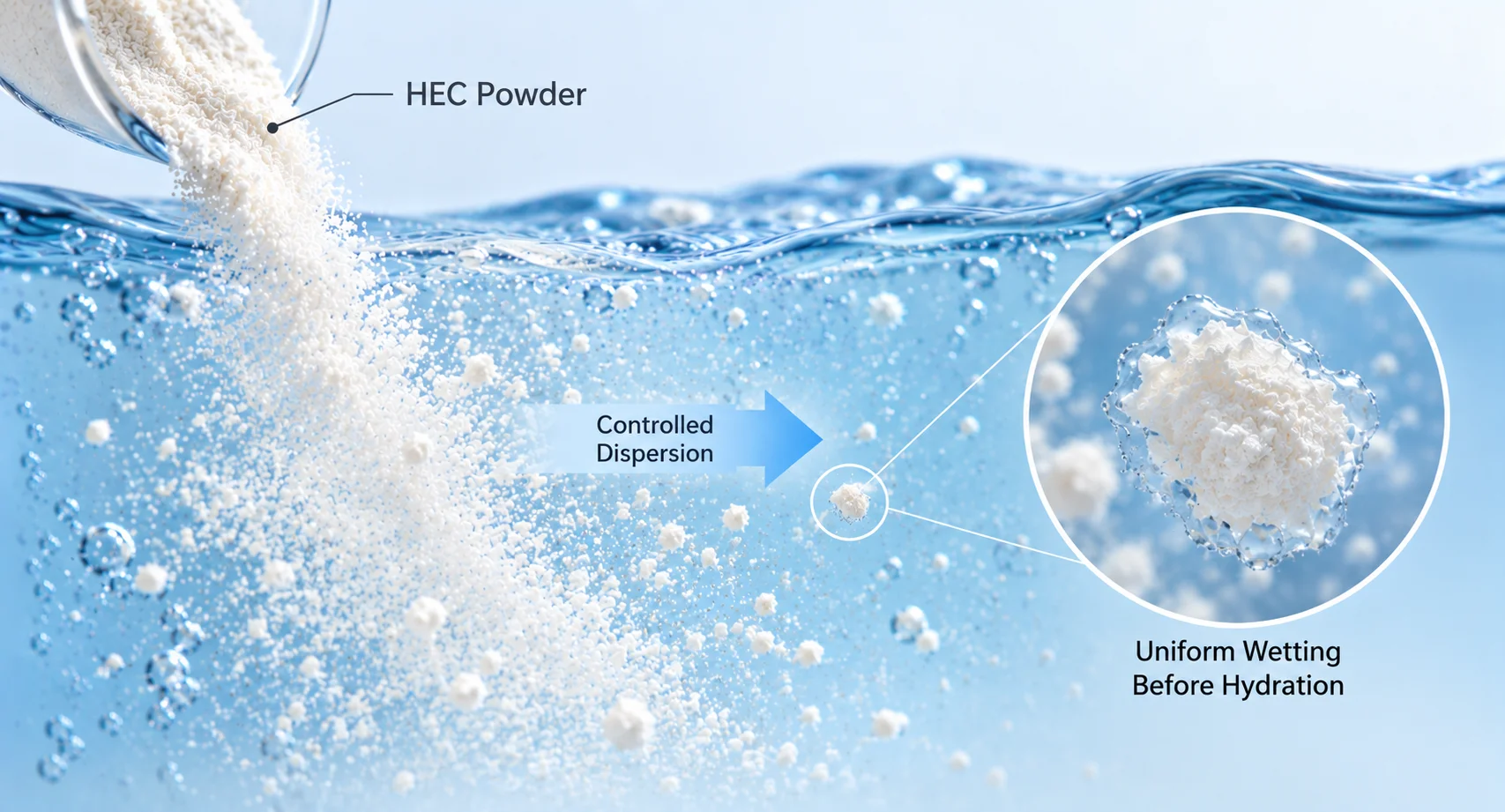
HEC powder disperses throughout the aqueous phase, allowing cellulose ether particles to become uniformly wetted before hydration.
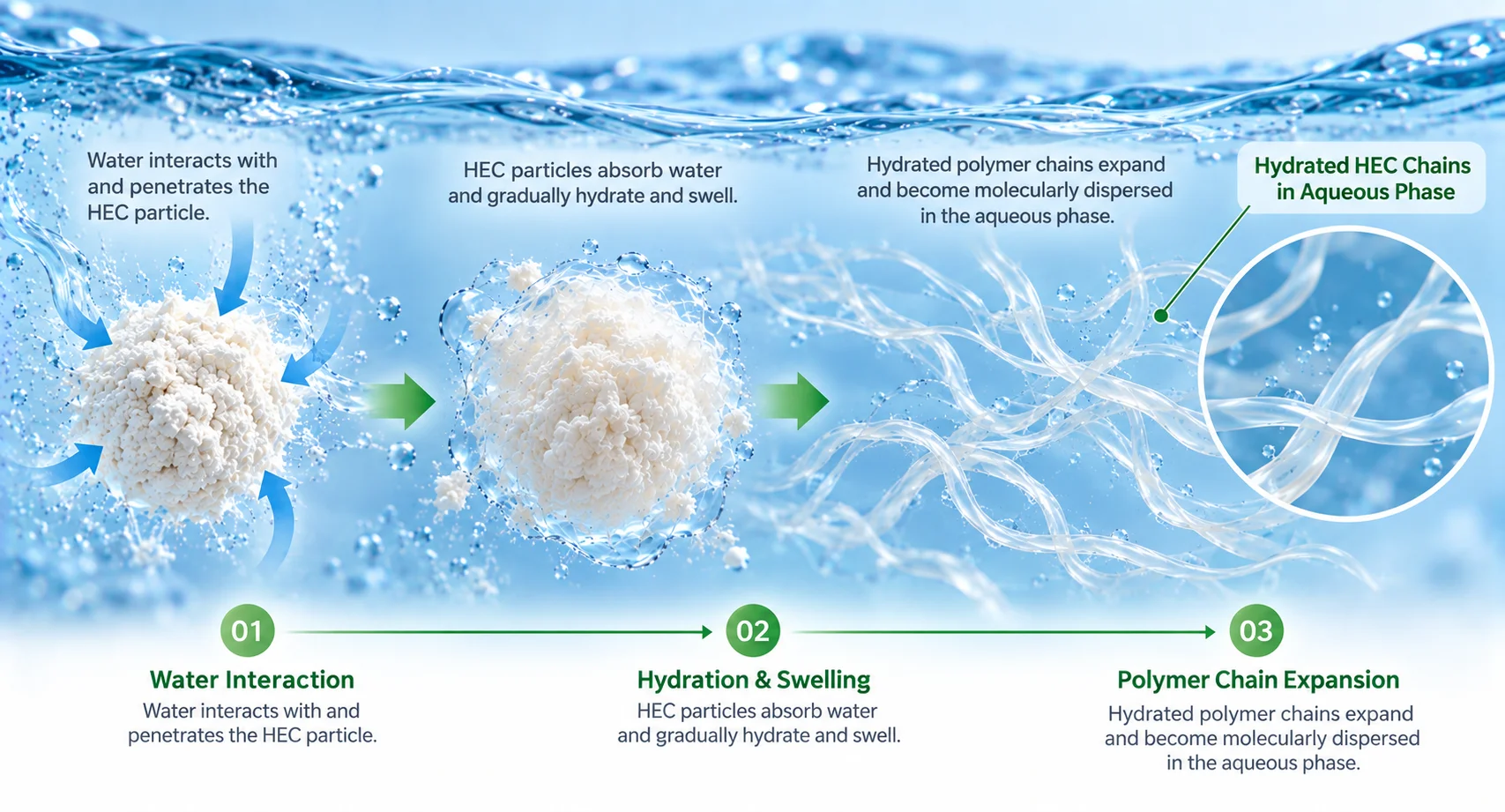
HEC polymer chains absorb and interact with water molecules, gradually expanding into a soluble polymer structure.
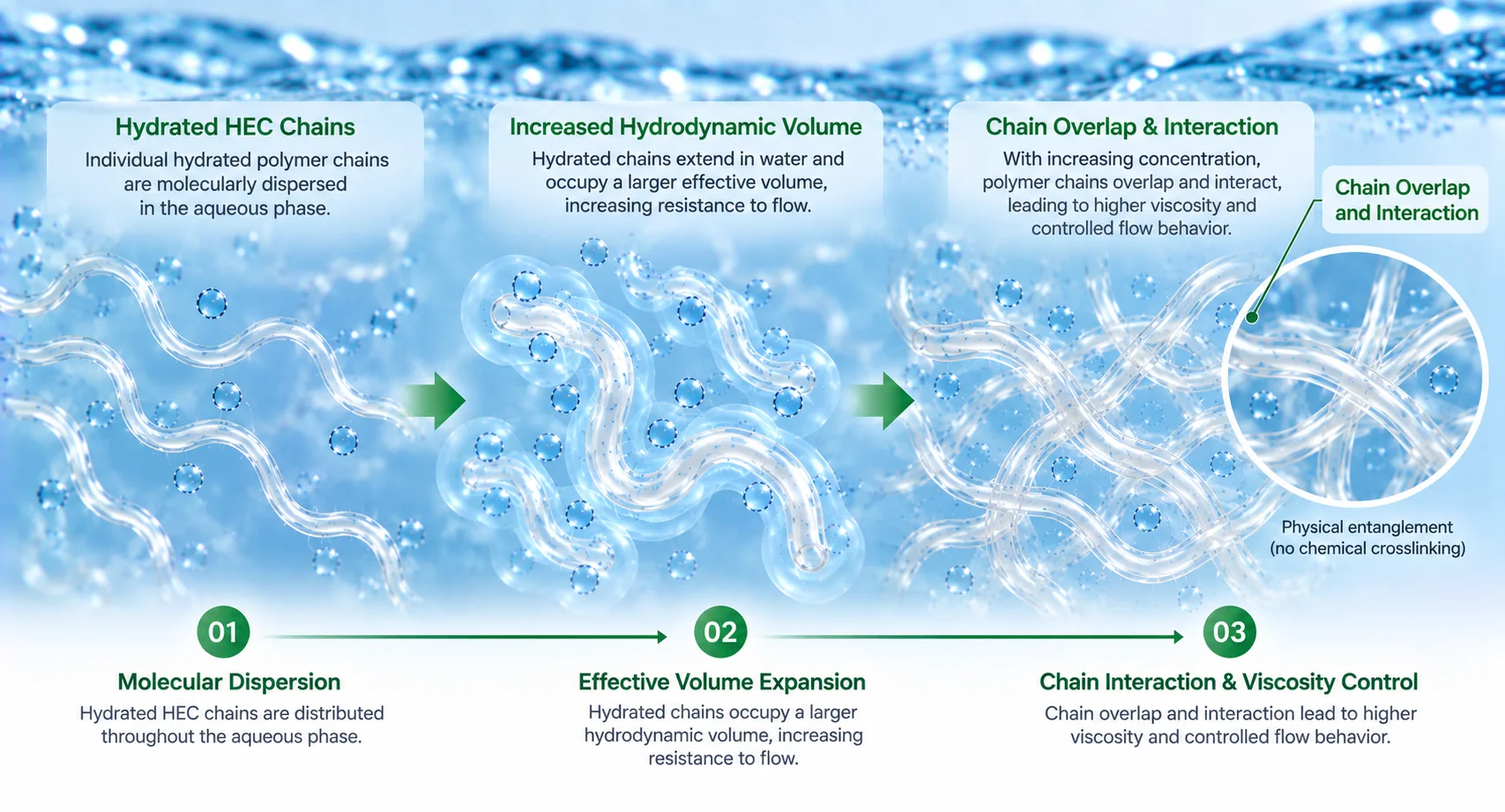
Hydrated HEC molecules increase hydrodynamic volume and polymer chain interaction, controlling viscosity and flow characteristics.
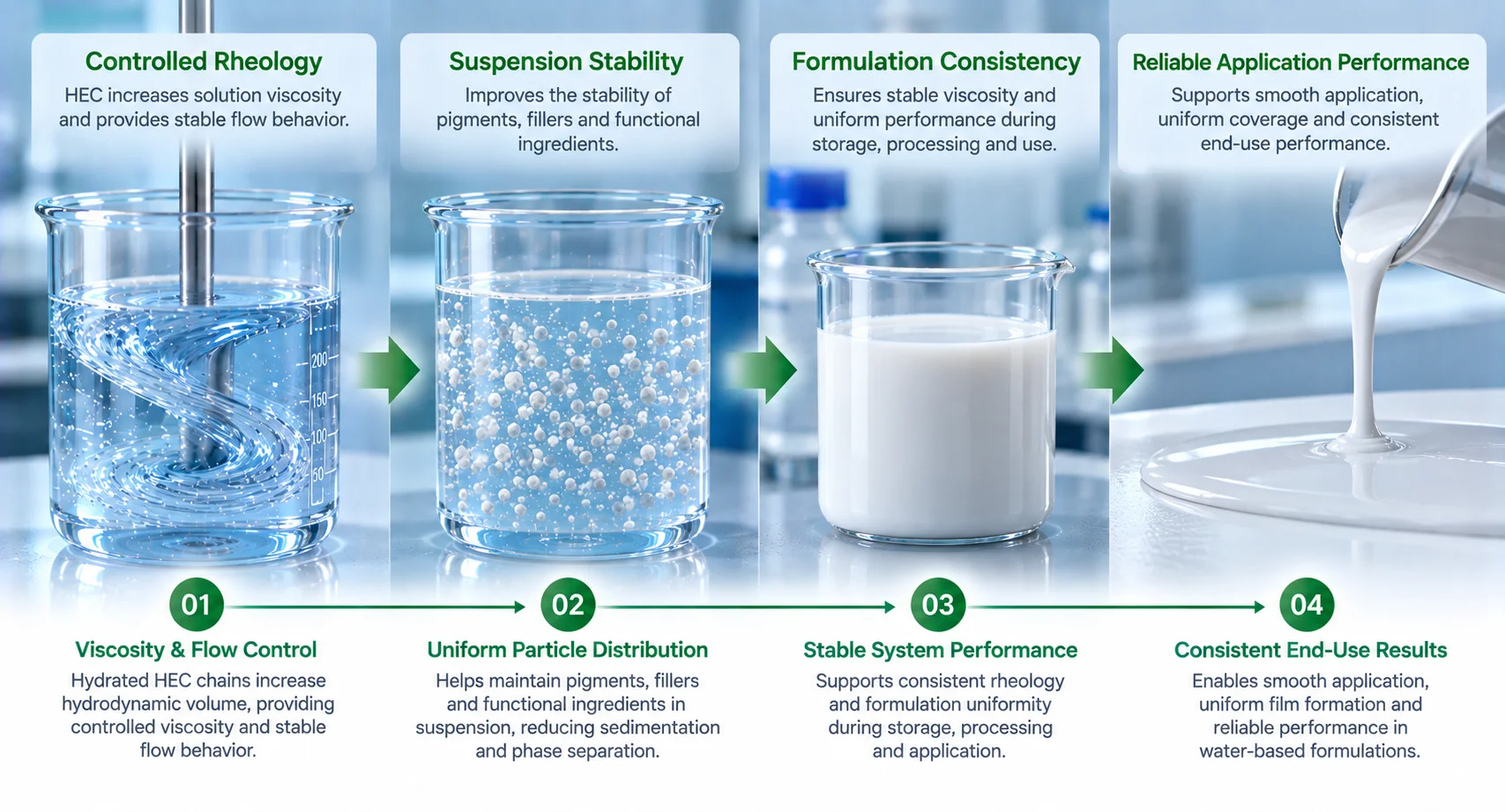
Controlled rheology supports suspension stability, formulation consistency and reliable application performance
| Property | POLYVIA™ HEC 5K | POLYVIA™ HEC 30K | POLYVIA™ HEC 60K | POLYVIA™ HEC 100K | POLYVIA™ HEC 150K |
|---|---|---|---|---|---|
| Appearance | White Powder | White Powder | White Powder | White Powder | White Powder |
| Viscosity (2% solution, 25°C) | 4,000–6,000 mPa·s | 24,000–36,000 mPa·s | 48,000–72,000 mPa·s | 80,000–120,000 mPa·s | 120,000–180,000 mPa·s |
| Molar Substitution (MS) | 1.8–2.5 | 1.8–2.5 | 1.8–2.5 | 1.8–2.5 | 1.8–2.5 |
| Moisture | ≤5.0% | ≤5.0% | ≤5.0% | ≤5.0% | ≤5.0% |
| Ash Content | ≤5.0% | ≤5.0% | ≤5.0% | ≤5.0% | ≤5.0% |
| pH Value | 6.0–8.5 | 6.0–8.5 | 6.0–8.5 | 6.0–8.5 | 6.0–8.5 |
POLYVIA™ HEC provides application-specific thickening, rheology control, suspension stability and water management across coatings, detergents, oilfield fluids and other water-based formulations. Grade selection should be matched to the required viscosity, processing conditions and end-use performance.

HEC controls viscosity and rheology in water-based paints and coatings, helping maintain pigment suspension, leveling, application consistency and storage stability in architectural and aqueous coating formulations.

As a thickener and rheology modifier for liquid detergents, HEC helps achieve controlled viscosity, stable consistency and suspension in dishwashing liquids, laundry products and selected household cleaning formulations.

In water-based drilling and oilfield fluids, HEC builds viscosity and regulates fluid rheology, supporting suspension, carrying capacity and formulation stability under application-specific operating conditions.

In selected gypsum-based and cementitious construction materials, HEC improves water retention and controls consistency, supporting workable rheology in gypsum products, cement renders, coatings and specialty formulations.

HEC modifies viscosity, rheology and texture in selected personal care formulations, including shampoos, cleansers and other aqueous systems requiring consistent flow and formulation stability.

HEC regulates viscosity and flow in water-based adhesive formulations, supporting processing consistency, application control and stable formulation rheology.

In water-based ceramic glaze formulations, HEC helps suspend solids and regulate rheology, supporting uniform material distribution, processing consistency and controlled application behavior.

HEC can be used in selected water-based ink formulations to adjust viscosity, support pigment suspension and help maintain controlled flow behavior during processing and application.
Engineered for Controlled Formulation Performance
Develop the required viscosity and formulation body through application-matched HEC grades and dosage levels.
Control viscosity and flow behavior across processing, storage and application for more consistent formulation performance.
Help maintain uniform distribution of pigments, particles and other dispersed components for improved formulation stability.
Help regulate water mobility and retention within appropriately designed aqueous and cementitious formulation systems.
Support controlled spreading, coating, pouring, pumping and other application behaviors through optimized formulation rheology.
Non-ionic HEC chemistry supports broad formulation flexibility across coatings, detergents, adhesives and other water-based systems.
Performance Note: Actual performance depends on HEC grade, dosage, hydration, formulation composition, pH, temperature, electrolyte level, processing conditions and application method.
Selecting the right Hydroxyethyl Cellulose grade requires more than matching a viscosity value. The optimum HEC grade depends on the target rheology, formulation environment, processing conditions and required application performance.
Application Requirement → Performance Target → HEC Grade Selection → Dosage Optimization → Performance Validation
Define the required viscosity range according to the desired flow, consistency and application behavior of the final formulation.
Consider the required flow, leveling, suspension and handling characteristics rather than viscosity as a single value.
Optimize the HEC use level to achieve the required viscosity and rheological response without unnecessarily over-thickening the formulation.
Consider pigments, fillers and other dispersed solids when determining the rheology needed to maintain uniform suspension and limit settling.
Evaluate HEC within the complete formulation, including surfactants, binders, polymers and other functional ingredients that may influence system behavior.
Consider salt concentration and ionic strength in formulations where electrolytes may influence viscosity, hydration or overall system performance.
Evaluate HEC under the actual pH and temperature conditions expected during formulation, processing, storage and application.
Control addition sequence, mixing, shear and hydration time to support effective HEC dispersion, hydration and viscosity development.
Selection Note: HEC performance should be validated in the complete formulation under representative processing and application conditions.
HEC and HPMC are both nonionic, water-soluble cellulose ethers, but their application strengths differ. HEC is commonly selected for rheology control in water-based formulations, while HPMC is widely used for water retention and workability in dry-mix construction systems.
| Selection Factor | HEC | HPMC |
|---|---|---|
| Primary Function | Thickening & rheology control | Water retention & rheology modification |
| Application Focus | Water-based formulations | Cementitious & gypsum-based systems |
| Rheology | Viscosity, flow & suspension control | Consistency, workability & application control |
| Water Retention | Application-dependent | Key function in dry-mix mortar |
| Typical Applications | Coatings, detergents, oilfield fluids, water-based adhesives | Tile adhesives, renders, skim coats, gypsum mortars |
| Thermal Behavior | No characteristic HPMC-type thermogelation | Reversible thermal gelation in aqueous solution |
| Selection Focus | Rheology & formulation stability | Water retention & construction workability |
HEC and HPMC are not generally interchangeable on a 1:1 basis. Select the cellulose ether according to the formulation system and performance target first, then optimize the viscosity grade through application testing.
POLYVIA™ supports HEC grade selection, formulation compatibility evaluation, dosage optimization and laboratory validation to achieve application-specific rheology and performance targets.

Product specifications and typical technical properties.
Download ↓
Safety, handling and storage information.
Download ↓
Typical quality-control parameters for reference.
Download ↓
Practical guidance for HEC selection, dispersion, hydration and formulation evaluation.
Download ↓Hydroxyethyl Cellulose, commonly abbreviated as HEC, is a nonionic, water-soluble cellulose ether widely used as a thickener, rheology modifier and stabilizer in water-based formulations.
HEC is used across paints and coatings, detergents and home care, construction materials, oilfield fluids, adhesives, personal care, water-based inks and other specialty aqueous systems.
After dispersion and hydration, HEC polymer chains expand and interact within the aqueous phase, increasing viscosity and developing controlled rheological behavior.
Both are nonionic cellulose ethers, but their substitution chemistry and performance characteristics differ. HEC is widely used in water-based coatings, detergents and industrial aqueous systems, while HPMC is particularly established in construction applications. Selection should be based on the complete formulation and required performance.
HEC and MHEC differ in chemical substitution and resulting formulation behavior. MHEC is widely used in cementitious and gypsum dry-mix systems, while HEC has particularly broad use in paints, coatings and other water-based formulations.
Do not select HEC by viscosity alone. Consider target consistency, thickening efficiency, hydration behavior, rheological profile, formulation chemistry, processing conditions and final application requirements.
HEC functions primarily as a rheology modifier and thickener in water-based coatings, helping control viscosity, suspension, in-can stability, application behavior, sag resistance and leveling.
Yes. Application-specific HEC grades are used in water-based oilfield fluids where viscosity development and rheological control are required. Grade selection should consider fluid chemistry and operating conditions.
Different formulations require different rheological solutions. Tell us your application, current formulation, target viscosity, processing conditions and performance requirements. POLYVIA™ can support HEC grade selection and formulation evaluation for your specific system.