
High Water Demand
Reduce mixing water while maintaining the required flow and workability.
Recommended:
High Water Reduction Grade (PCE 840)

POLYVIA™ PCE Powder is a high-performance polycarboxylate ether superplasticizer developed for dry-mix mortar and concrete systems requiring high water reduction, controlled flow and efficient cement dispersion.
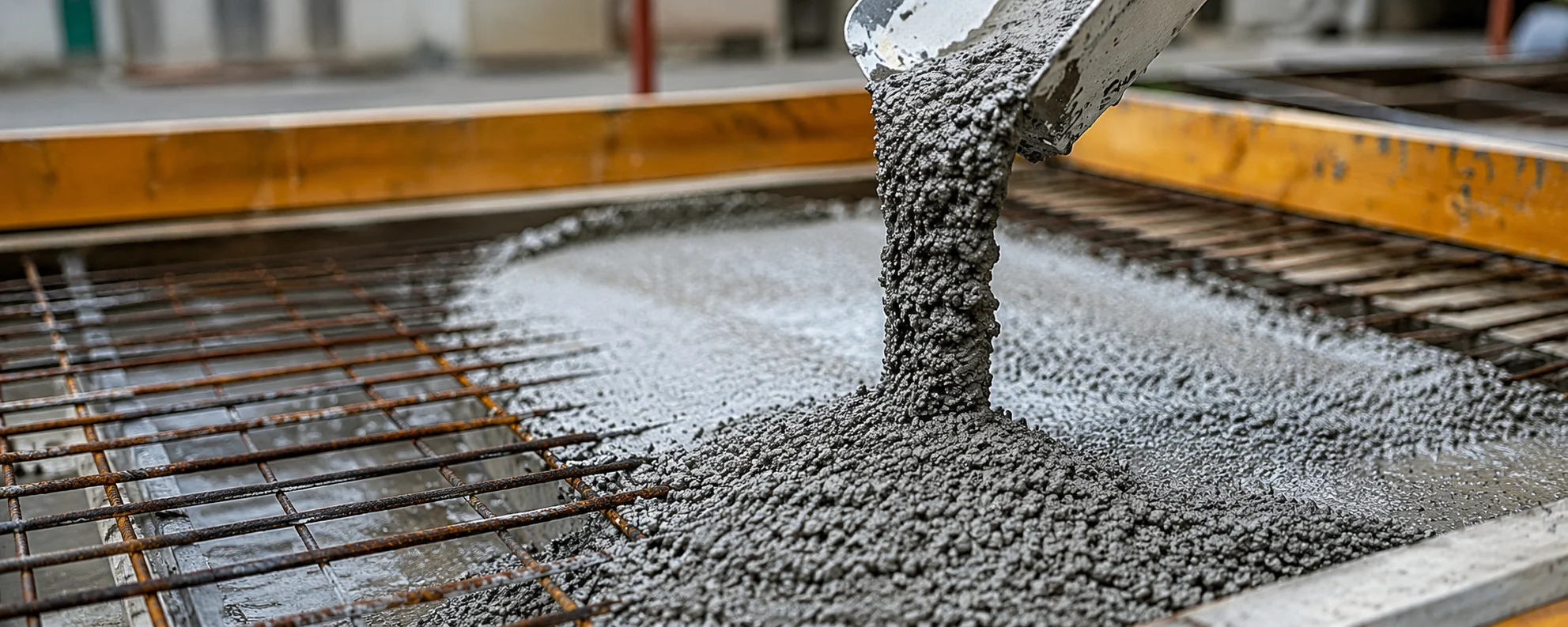



PCE Powder is a powdered polycarboxylate ether superplasticizer used to improve cement dispersion, reduce water demand and control flow in concrete and dry-mix formulations.
Available in application-matched grades for water reduction, slump retention, balanced performance, viscosity control and early strength.
Start with the performance problem—then select the PCE chemistry and grade that best fits your formulation.
Reduce mixing water while maintaining the required flow and workability.

Improve dispersion efficiency and fluidity in flowable cementitious formulations.

Maintain workable consistency where extended processing or application time is required.

Support lower water-to-binder ratios and faster early strength development.
Different performance challenges require different polymer architectures. Grade selection should consider cement chemistry, W/B ratio, formulation composition and target application performance.
From polymer adsorption to cement dispersion, PCE Powder modifies particle interactions to reduce water demand and control fresh-system performance.
PCE Powder is either dissolved for liquid admixture preparation or blended into dry-mix formulations before water addition, enabling uniform polymer distribution within cementitious systems.
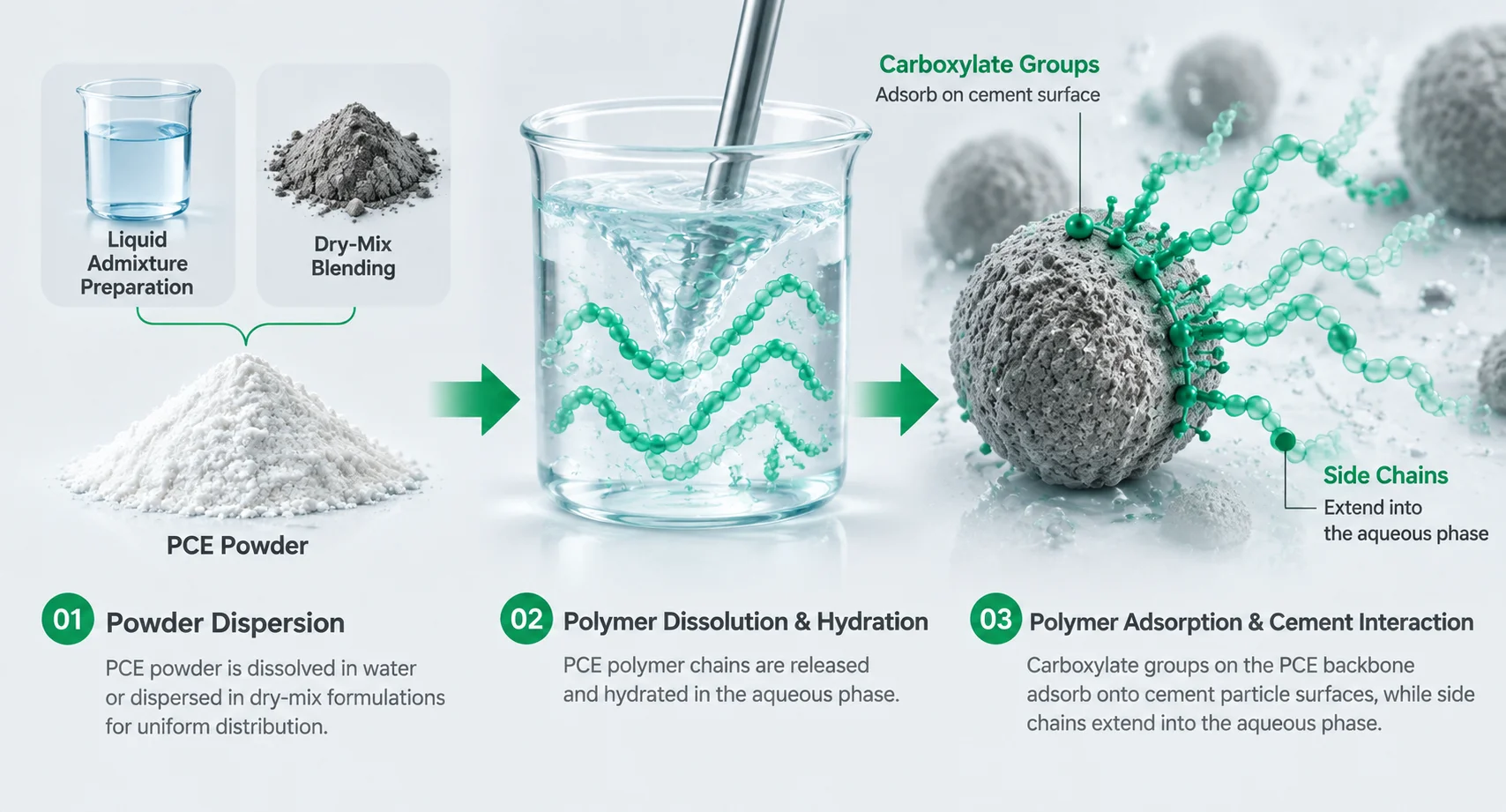
After dissolution, carboxylate groups on the PCE polymer backbone adsorb onto cement particle surfaces, while side chains extend into the aqueous phase.
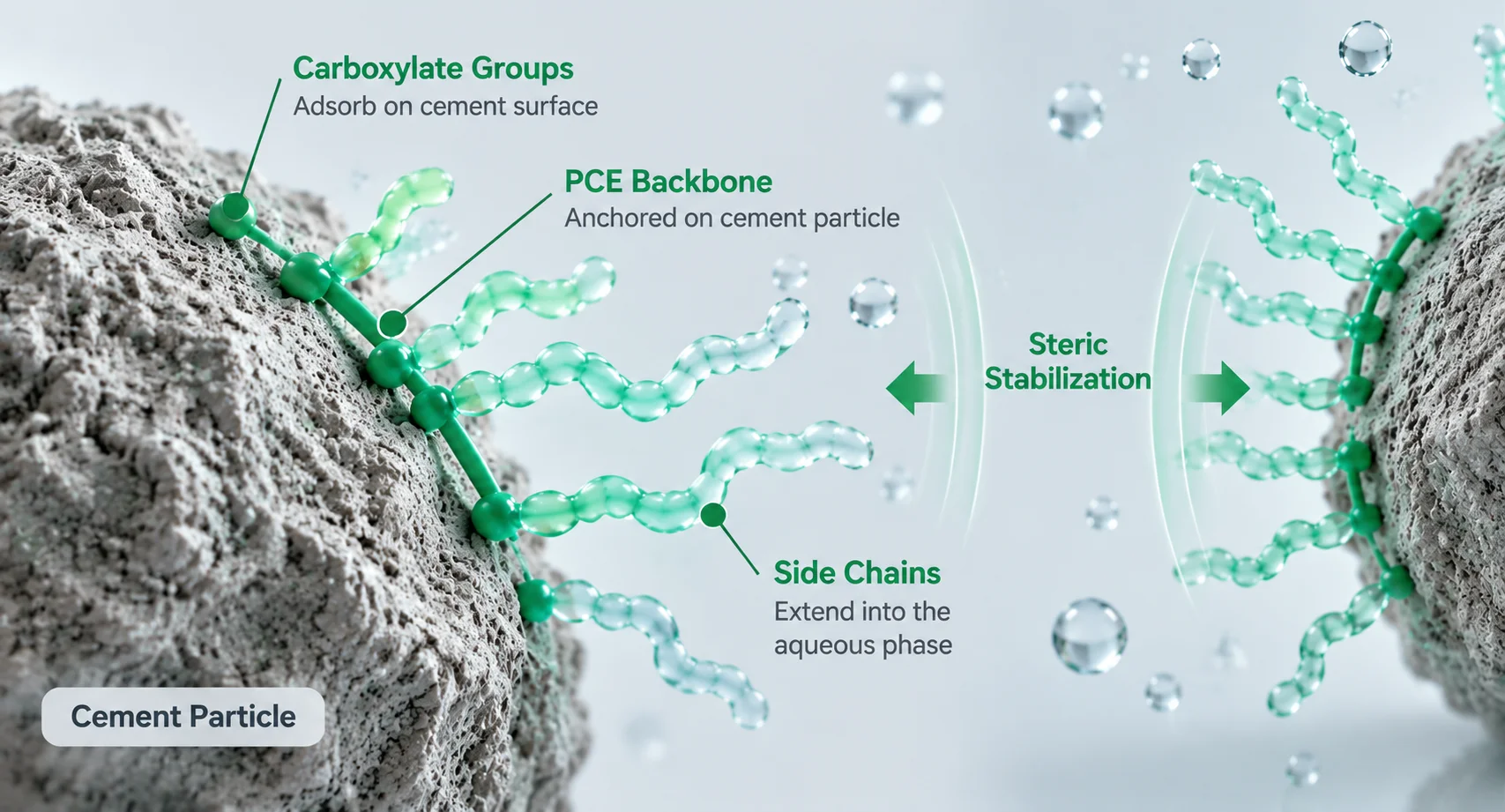
Hydrated PCE side chains create steric stabilization around cement particles, reducing flocculation and improving dispersion efficiency for better flowability and lower water demand.
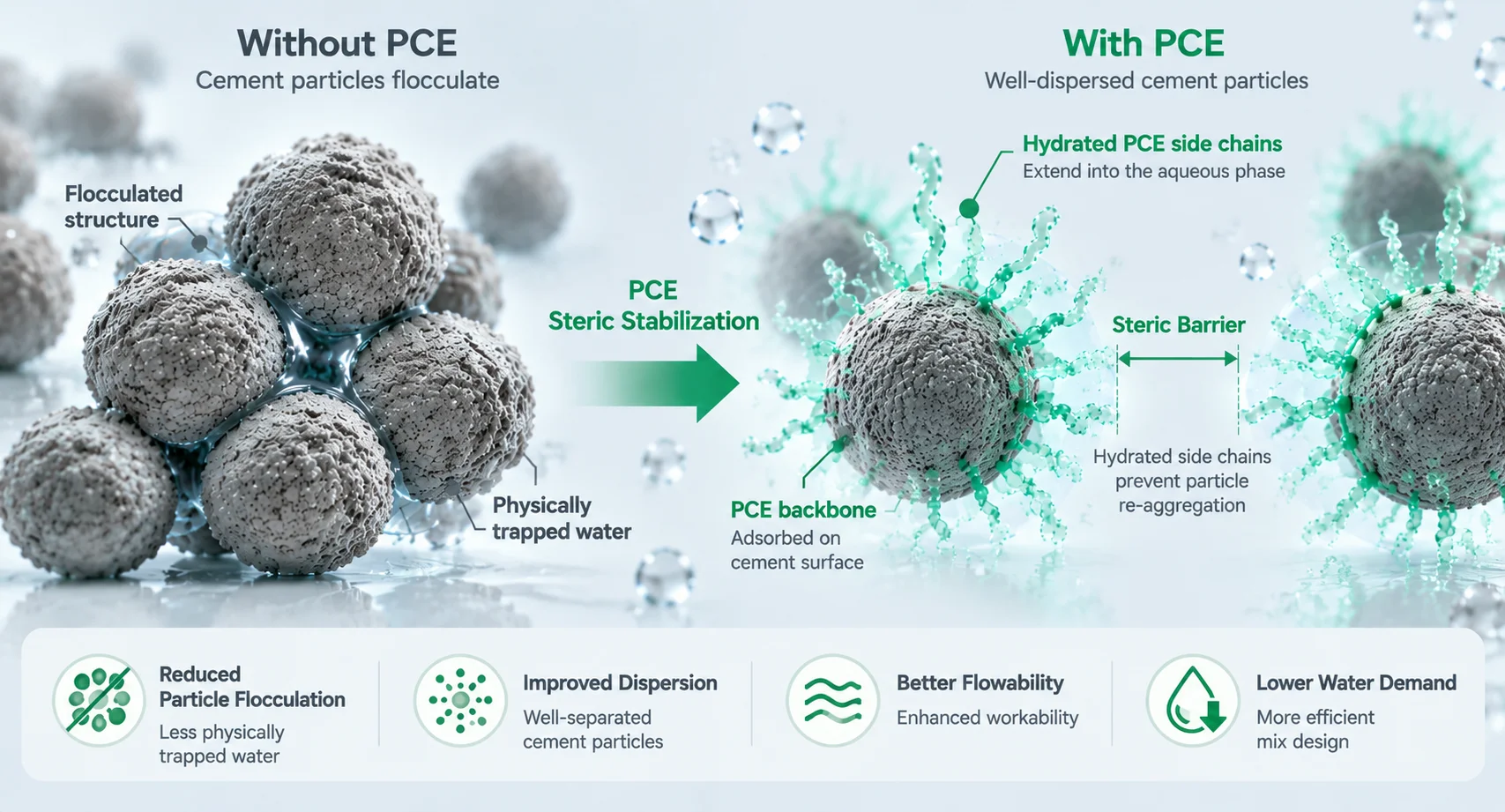
Improved cement dispersion releases physically trapped water, enabling lower water-to-binder ratios, more efficient particle packing and balanced concrete or mortar performance.
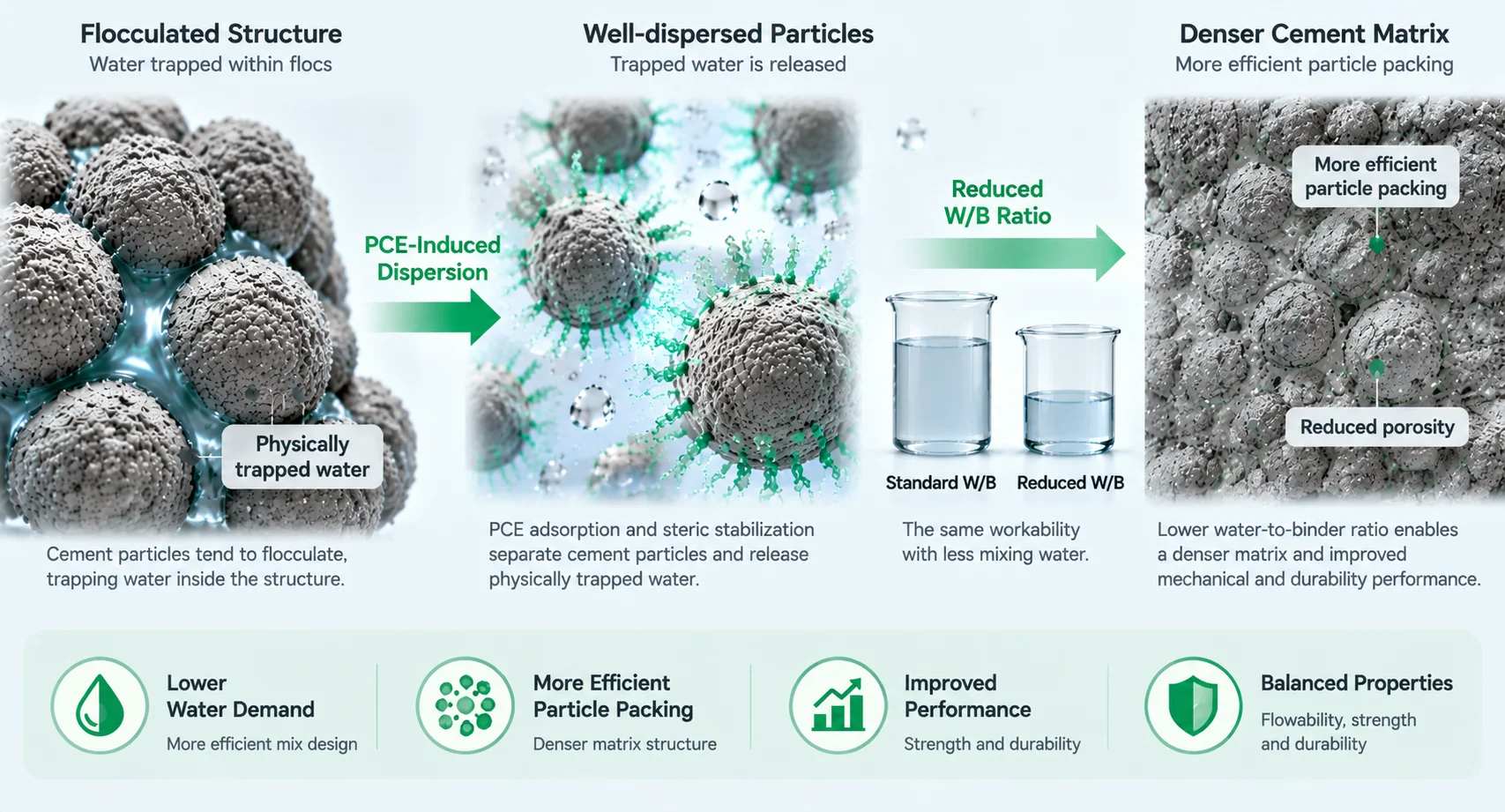
The resulting performance depends on polymer structure, cement and SCM chemistry, dosage, temperature and the complete formulation system.
POLYVIA™ PCE Powder grades are designed with different performance profiles to meet specific concrete and mortar requirements, including water reduction, slump retention, viscosity control and early-strength development.
| Grade | Performance Focus | Water Reduction | Retention | Early Strength | Recommended Applications |
|---|---|---|---|---|---|
| POLYVIA™ PCE 840 | Maximum Water Reduction | ●●●● | ●● | ●●● | Self-Leveling / High-Flow Mortar / HPC |
| POLYVIA™ PCE 850 | Excellent Slump Retention | ●●● | ●●●● | ●● | Ready-Mix / Long Workability / Hot Weather |
| POLYVIA™ PCE 860 | Balanced / Hybrid Performance | ●●● | ●●● | ●●● | Dry-Mix Mortar / Grout / General Concrete / Shotcrete |
| POLYVIA™ PCE 870 | Low Viscosity High Performance Concrete | ●●●● | ●●● | ●● | UHPC / HPC / Precast / Prestressed / PHC |
| POLYVIA™ PCE ES980 | Early Strength & Fast Demolding | ●●●● | ●● | ●●●● | Precast / Prestressed / PHC Spun Pile |
| POLYVIA™ PCE PW888 | Specialty Early-Strength PCE | ●●●● | ●●● | ●●● | Early strength development and sea-sand compatibility for PHC spun piles |
Need another supply form?
Explore POLYVIA™ PCE Liquid for ready-to-use admixture systems or POLYVIA™ PCE Flake for concentrated shipping and local liquid preparation.
Match water reduction, flow retention and early-strength performance to your formulation and application requirements.
| Items | 840 | 850 | 860 | 870 | ES980 | PW888 |
|---|---|---|---|---|---|---|
| Appearance | White Powder | White Powder | White Powder | White powder | White Powder | White Powder |
| Solid Content | ≥ 95.0 | ≥ 95.0 | ≥ 98.0 | ≥ 98.0 | ≥ 98.0 | ≥ 95.0 |
| Density, kg/m³ | 450-650 | 450-650 | 450-650 | 450-650 | 450-650 | 450-650 |
| Moisture, % | ≤ 5.0% | ≤ 5.0% | ≤ 2.0% | ≤ 2.0% | ≤ 2.0% | ≤ 5.0% |
| pH Value | 7.0±1.0 | 7.0±1.0 | 7.0±1.0 | 5.0 ± 1.0 | 4.0 ± 1.0 | 4.0 ± 2.0 |
| Chloride Content, % | ≤ 0.02 | ≤ 0.02 | ≤ 0.02 | ≤ 0.02 | ≤ 0.02 | ≤ 0.02 |
| Water Reduction Rate, % | ≥ 25-40 | ≥ 25-40 | ≥ 25-40 | ≥ 27-40 | ≥ 27-43 | ≥ 25 |
PW888 — Sea-Sand Compatible PCE
Designed for cementitious systems where chloride-containing or challenging sand sources require specialized PCE compatibility evaluation.
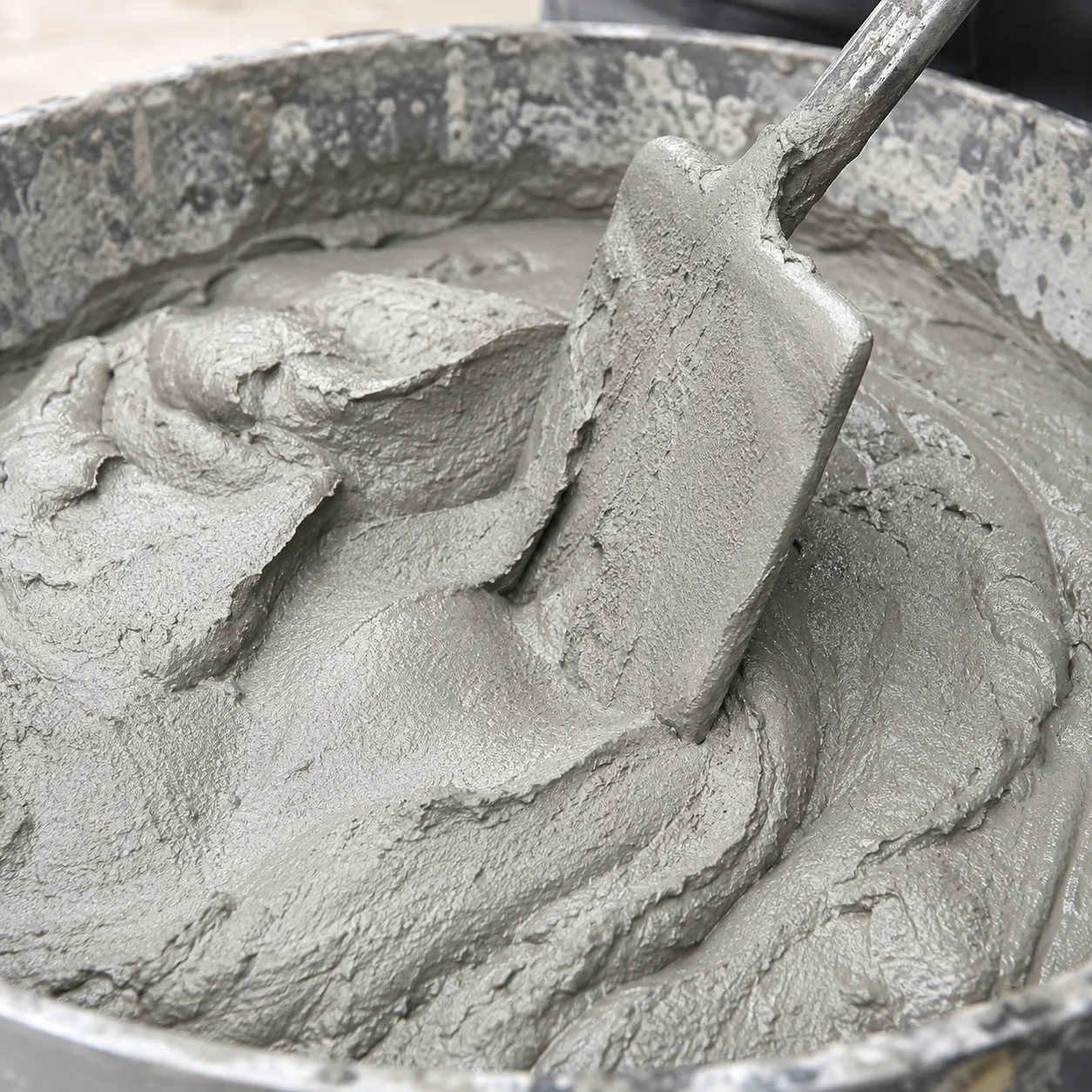
Supports factory-blended dry-mix mortar systems with efficient cement dispersion, high flowability, reduced water demand and consistent performance after blending with cementitious materials.
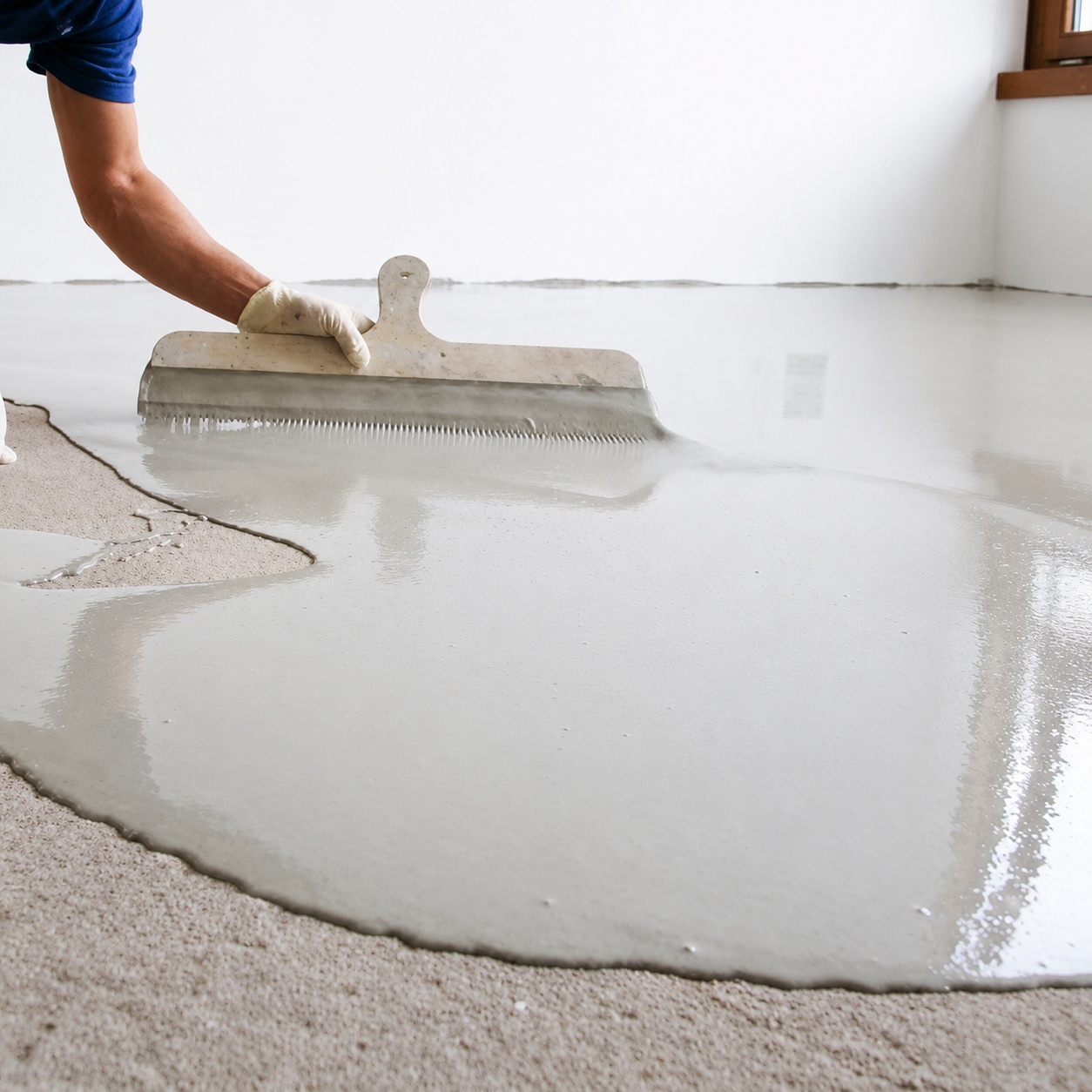
Designed for cement-based self-leveling mortar systems requiring high flowability, smooth surface finishing, controlled water demand and stable application performance.

Suitable for gypsum-based formulations requiring improved dispersion, controlled flowability, reduced water demand and optimized material performance.
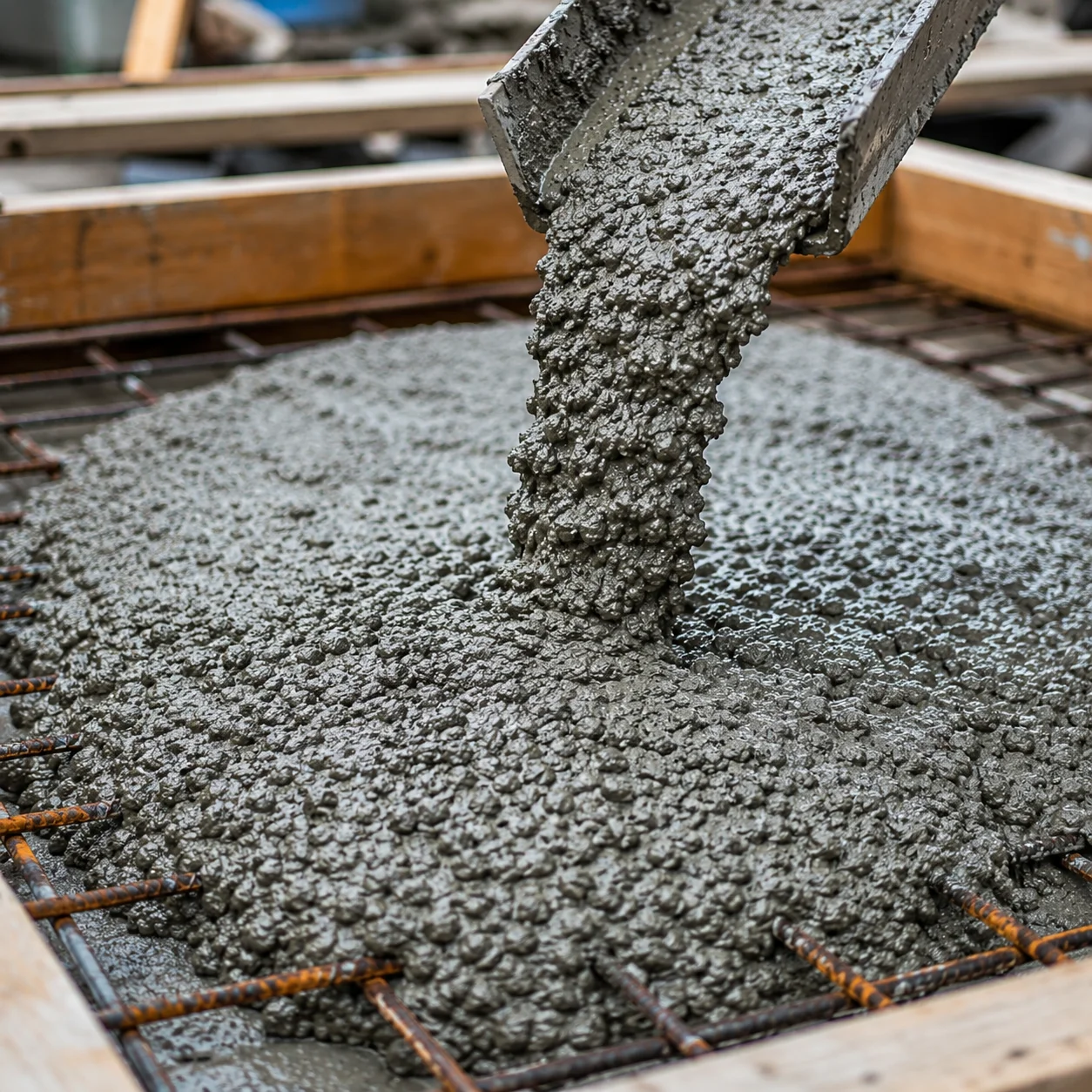
Designed for ready-mix concrete systems requiring water reduction, workability retention and consistent performance during transportation and placement.
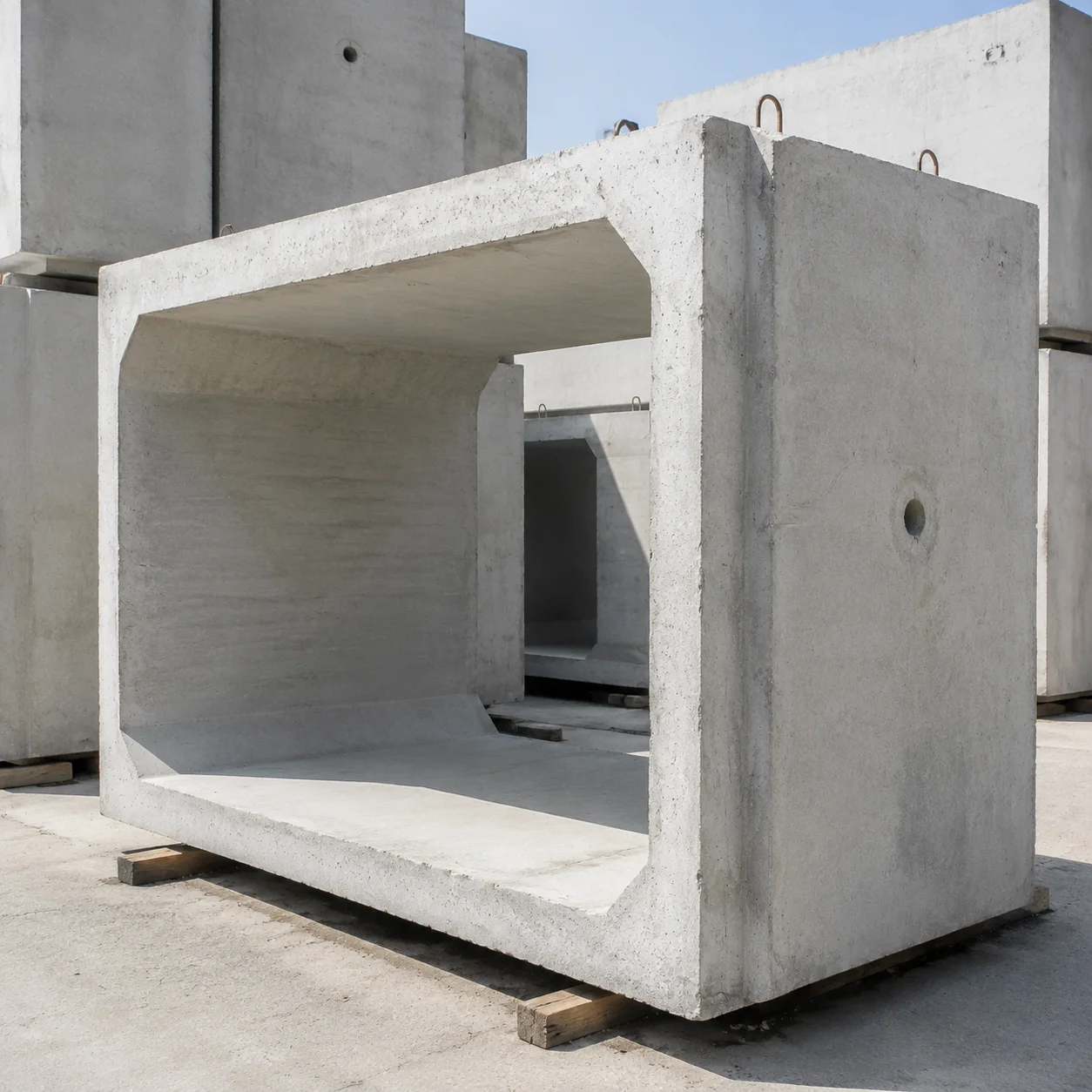
Designed for PCE Powder applications in precast concrete production, supporting low water-binder ratio concrete, dense matrix formation, early strength development and faster demolding cycles.
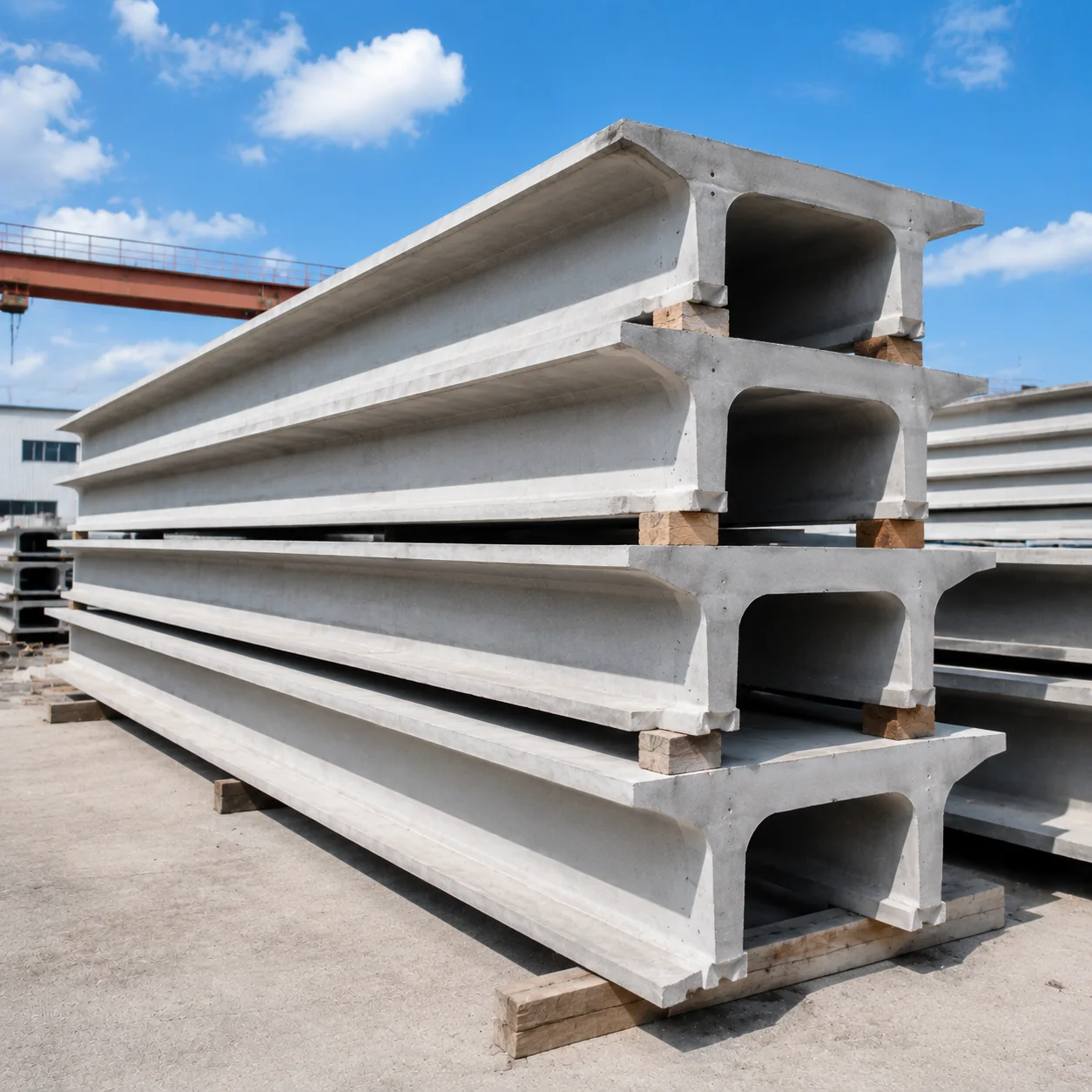
Used in ultra-high performance concrete (UHPC) formulations requiring efficient cement dispersion, ultra-low water-binder ratios, optimized particle packing and high-performance concrete design.
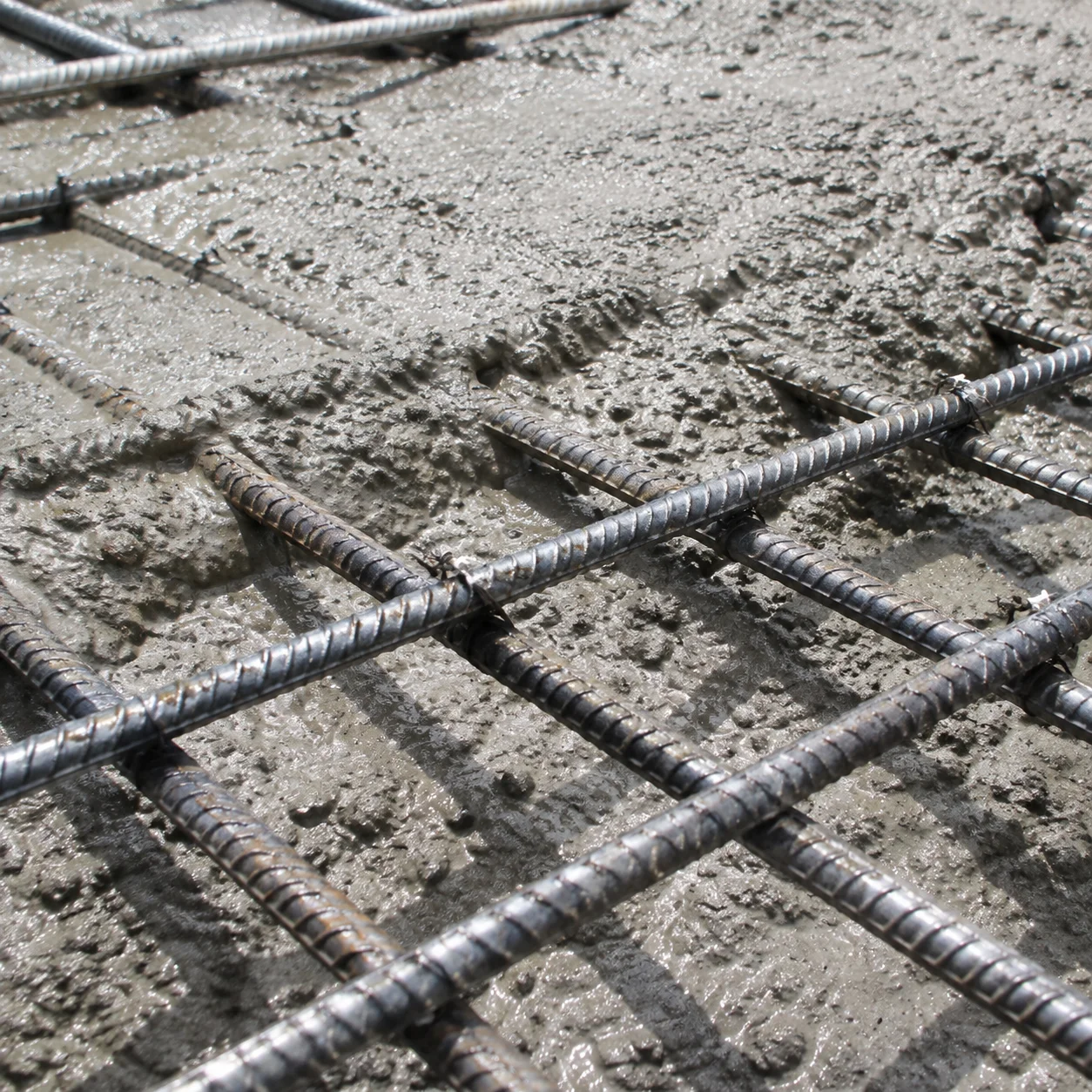
Supports self-compacting concrete (SCC) systems requiring high flowability, excellent passing ability and balanced viscosity control without excessive mixing water.
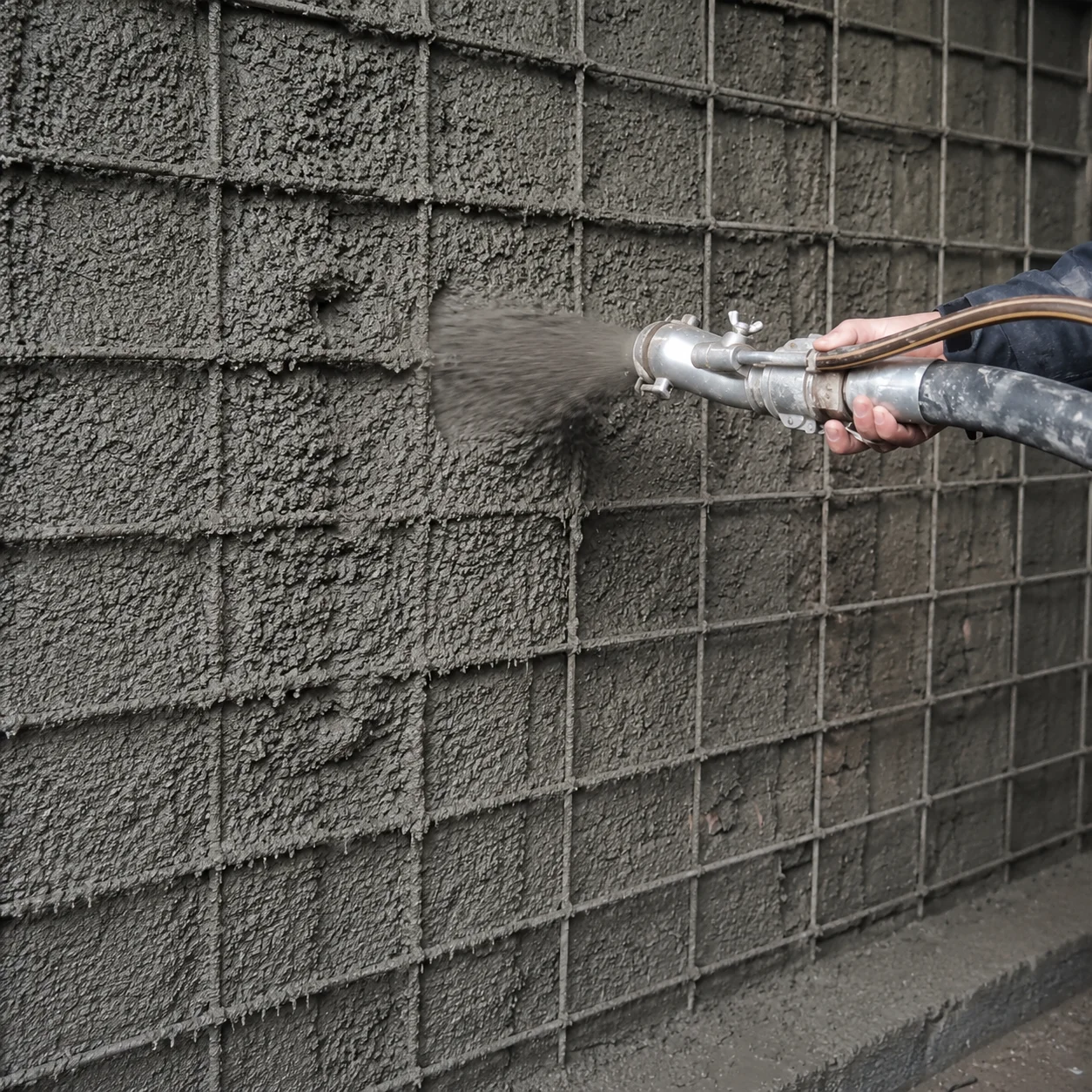
Designed for dry-mix shotcrete applications requiring effective cement dispersion, controlled water demand and stable spraying performance in demanding construction environments.
PCE Powder selection starts with understanding the performance requirements of each cementitious system.
Different applications require different balances between water reduction, flowability, rheology control, early strength development and workability retention. Cement chemistry, binder composition, water-to-binder ratio and admixture compatibility also influence final concrete performance.
POLYVIA™ provides application-oriented PCE solutions to help customers match the right technology with specific construction and formulation requirements.
| Application | Primary Challenge | Key Performance Focus |
|---|---|---|
| Dry-Mix Mortar | Maintaining consistent workability after factory blending | Cement dispersion, flowability control and formulation stability |
| Self-Leveling Compound | Achieving smooth leveling with controlled fluidity | High flowability, water reduction efficiency and rheology balance |
| Grouting Mortar | Filling narrow gaps while maintaining strength development | Fluidity, reduced water demand and dense matrix formation |
| Precast Concrete | Improving production efficiency and demolding cycles | Early strength development, low W/B ratio and concrete densification |
| Ultra-High Performance Concrete (UHPC) | Achieving ultra-low water content and high mechanical performance | Advanced dispersion, particle packing optimization and extreme water reduction |
| Self-Compacting Concrete (SCC) | Maintaining high flow without segregation | Flowability, passing ability and viscosity control |
| Shotcrete | Ensuring stable pumping and spraying performance | Dispersion efficiency, water demand control and admixture compatibility |
| High Performance Concrete (HPC) | Balancing strength, durability and workability | Water reduction, dispersion efficiency and long-term performance |
Efficient particle dispersion translates polymer functionality into measurable improvements in fresh and hardened cementitious systems.
Reduce water demand while maintaining the required workability.
Improve binder utilization through optimized particle dispersion.
Support flowable and self-leveling cementitious formulations.
Enable strength-oriented formulation design with reduced water-to-binder ratios.
Balance initial flow and processing-time requirements through appropriate grade selection.
Designed for accurate dosing and homogeneous incorporation into factory-produced powder formulations.
PCE performance is shaped by the complete cementitious system, including binder chemistry, water-to-binder ratio, aggregates, polymers and functional additives.
Dispersion · Rheology · Flow · Retention · Setting · Strength
Cement chemistry and fineness influence PCE demand, dispersion efficiency and flow response.
Fly ash, slag, silica fume and gypsum can change water demand, rheology and PCE performance.
Lower W/B ratios increase the need for efficient particle dispersion and precise dosage control.
Sand grading, fines and mineral fillers influence water demand, flow behavior and formulation stability.
HPMC and MHEC can change mortar viscosity, water retention and flow behavior, affecting PCE dispersion, dosage and workability.
RDP and other polymer additives can modify rheology, adhesion and water demand, which may influence PCE dosage and dispersion.
Defoamers, retarders and accelerators can affect air content, setting behavior and the overall response of PCE in the formulation.
PCE dosage should be optimized according to target flow, retention, setting behavior, strength requirements and formulation efficiency.
Formulation Note: PCE Powder should be evaluated within the complete formulation. In dry-mix systems, HPMC can influence water retention, rheology and PCE response, while other polymers and functional additives may also affect overall performance.
Proper dosing and uniform distribution are essential for consistent PCE Powder performance. The addition method should be selected according to the product grade, formulation type and production process.
Recommended Dosage: 0.10–0.35%
Dry-Mix Incorporation
Blend PCE Powder with compatible dry ingredients to achieve uniform distribution before adding mixing water. Suitable for validated dry-mix formulations, including mortar and grout systems.
Pre-Dissolved Addition
For compatible grades, dissolve PCE Powder completely in clean water before dosing into the mix. Include the dissolution water in the total mixing-water calculation.
01. Calculate Dosage
Determine the required PCE Powder quantity based on binder content and the selected trial dosage.
02. Add & Distribute
Introduce the product using the selected addition method and mix until uniformly distributed.
03. Evaluate Performance
Check initial flow, workability retention and setting or strength requirements as applicable. Adjust the dosage according to trial results.
POLYVIA™ supports customers with Grade Selection, Mix Compatibility Evaluation, Dosage Optimization and Application Trials.

Product properties and recommended application guidance.
Download ↓
Handling, storage and safety information.
Download ↓
Selection, dosage and formulation recommendations.
Download ↓
Batch-specific quality documentation.
Download ↓PCE Powder is a powdered polycarboxylate ether superplasticizer designed to improve cement dispersion and reduce water demand in cementitious formulations. It is particularly suitable for factory-produced dry-mix systems where liquid admixtures are inconvenient to use.
PCE Liquid is typically preferred where liquid admixture dosing systems are already established, while PCE Powder is particularly suitable for dry-mix and powder-based production processes. For precast applications, the appropriate PCE form depends on the production process, dosing system and formulation requirements.
Typical Dosage: 0.1–0.35% of total cementitious binder, depending on the PCE grade, cement chemistry and formulation.
The optimum dosage should be established through laboratory trials.
Cement composition, fineness, supplementary cementitious materials, sand, gypsum and functional additives can significantly affect PCE adsorption and dispersion.
Cellulose ethers, retarders, accelerators and defoamers may also influence flow, air content, setting behavior and strength development. For this reason, PCE should always be evaluated as part of the complete formulation.
PCE Powder can be used together with HPMC, but their interaction must be tested in the complete formulation. HPMC type, viscosity, modification level and dosage can affect flow, air content, water retention and setting behavior.
Grade selection depends on the application and required balance of initial flow, water reduction, flow retention and early strength.
POLYVIA offers application-matched grades for dry-mix mortar, self-leveling compounds, grouting mortar, gypsum plaster, precast concrete, UHPC, SCC and dry-mix shotcrete. Final selection should be confirmed using the customer’s actual raw materials.
PCE Powder can reduce the water-to-cement ratio while maintaining the required workability, which can contribute to higher early strength development. Its effect depends on cement type, water-to-cement ratio, curing conditions, dosage and the overall concrete formulation. For precast and PHC Spun Pile applications, proper PCE selection and dosage optimization can help achieve the required early strength and improve production efficiency.
PCE Powder is typically dry-blended with cementitious materials and other compatible powder components before water is added. Proper mixing sequence, uniform distribution, dosage, and compatibility with other additives should be evaluated during formulation development to ensure consistent dispersion and concrete or mortar performance.
For new formulations, dosage and mixing conditions should be optimized according to the cementitious system, aggregate characteristics, water-to-binder ratio, and target workability and strength requirements. Polyvia can provide technical support for formulation optimization and application trials when required.
Share your application, cement system, target water reduction, workability and performance requirements. Our technical team can help evaluate your formulation and recommend a suitable PCE powder grade.