
PCE Powder for Self-Leveling Mortar
High Fluidity · Lower Water Demand · Controlled Flow · Consistent Leveling
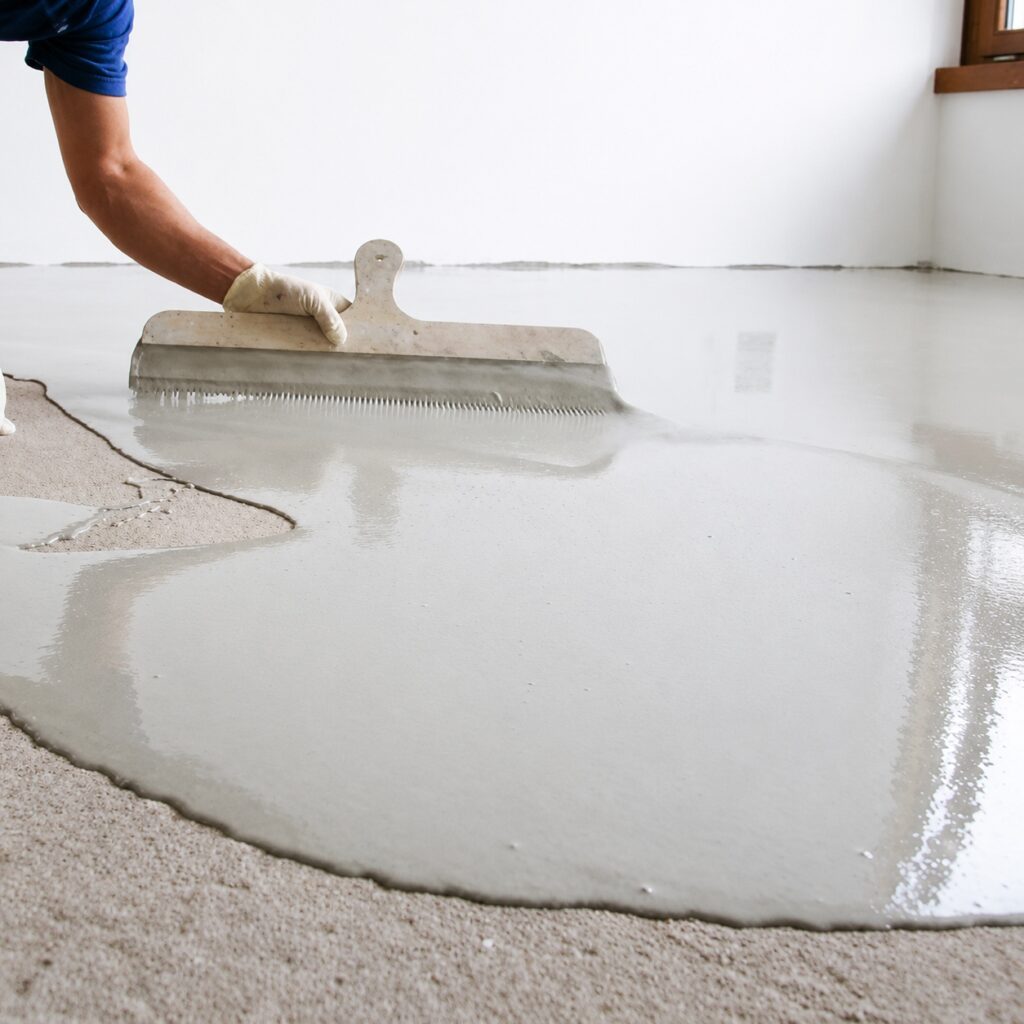
PCE powder for self-leveling mortar is used to reduce water demand and improve particle dispersion, helping cementitious self-leveling compounds achieve high flowability, stable spreading and consistent leveling performance. POLYVIA™ PCE 860 is recommended for dry-mix self-leveling mortar formulations where fluidity, water reduction and flow stability must be balanced.
The Real Challenge in Self-Leveling Mortar
High Flow Is Not Enough
Self-leveling mortar must spread under its own weight, level naturally and form a uniform surface with minimal manual finishing.
The challenge is that flow, stability, workable time and hardened performance must be achieved simultaneously.
Too Little Dispersion
→ Insufficient Flow
→ Poor Spreading
→ Poor Leveling
Too Much Water
→ Higher Initial Flow
→ Higher W/B
→ Bleeding / Segregation Risk
→ Potential Strength & Surface Problems
Excessive Viscosity
→ Better Stability
→ Slower Spreading
→ Poor Natural Leveling
The objective is therefore not maximum flow.
The target is sufficient fluidity for natural leveling while maintaining stability, workable time, surface quality and hardened performance.
This is where PCE 860 becomes part of the complete self-leveling formulation rather than simply a flow-enhancing additive.
Common Problems in Self-Leveling Mortar
01 — Insufficient Flow and Poor Leveling
One of the most common problems in cementitious self-leveling mortar is insufficient spreading after mixing.
Typical symptoms include:
- Limited flow spread
- Poor edge leveling
- Visible flow marks
- Uneven surface formation
- Excessive manual assistance during placement
The first reaction is often to add more water.
This may improve initial flow, but it does not necessarily solve the formulation problem.
The actual system should be checked for:
PCE Dosage · Water Demand · Binder Chemistry · Filler Content · Sand Grading · HPMC · Rheology
POLYVIA™ PCE 860 for self-leveling mortar improves dispersion of cementitious particles, helping generate the required fluidity at controlled water demand.
Create Flow Through Dispersion — Not Excess Water.
02 — Adding Water Improves Flow but Creates New Problems
Water is an effective way to increase initial flow, but excessive water can disturb the balance of a self-leveling system.
More Water
→ Higher Initial Flow
→ Higher Water-to-Binder Ratio
→ Bleeding / Settlement / Segregation Risk
→ Potential Surface & Strength Problems
A suitable PCE superplasticizer for self-leveling mortar allows formulators to develop high fluidity without relying primarily on additional mixing water.
PCE 860 improves particle dispersion so that the required spreading performance can be achieved at a controlled W/B ratio.
03 — High Initial Flow but Poor Stability
A mortar can show excellent initial flow and still be poorly balanced.
Warning signs include:
Bleeding · Sand or Filler Settlement · Paste Separation · Water Accumulation · Non-Uniform Surface
These indicate that mobility and stability are not working together.
The complete formulation should be evaluated:
Water + PCE 860 + Binder + Filler + Sand + HPMC + Other Functional Additives
Increasing PCE dosage alone may create more flow without correcting the underlying stability problem.
High fluidity without sufficient stability is not successful self-leveling performance.
04 — Good Initial Flow but Rapid Flow Loss
Some self-leveling mortars spread well immediately after mixing but become noticeably thicker before placement is complete.
This can affect:
Mixing → Pumping → Distribution → Spreading → Leveling
Rapid flow loss may be influenced by:
- Binder chemistry and hydration
- Cement / calcium aluminate / gypsum balance
- PCE compatibility
- Temperature
- HPMC
- Water content
- Setting-control additives
- Mixing and waiting time
For this reason, initial flow and retained flow should be evaluated separately.
The objective is not unnecessarily long flow retention, but sufficient workable flow throughout the actual application period.
05 — Mortar Is Too Sticky to Level Naturally
Self-leveling mortar requires sufficient cohesion to resist segregation, but excessive viscosity can restrict spreading.
Typical symptoms include:
Slow Flow · Poor Edge Leveling · Flow Marks · Poor Surface Closure · Excessive Manual Assistance
Check:
HPMC Viscosity & Dosage · Fine Materials · Filler · Binder System · Water · PCE Dosage
Cellulose ether contributes to water retention and rheological control, but excessive thickening can work against self-leveling performance.
The practical balance is:
Enough viscosity for stability — enough mobility for natural leveling.
This is particularly important when selecting a low-viscosity HPMC for self-leveling formulations.
06 — Air Bubbles, Pinholes and Surface Defects
A high-flow mortar must also release entrapped air effectively.
Poor air control can contribute to:
Air Bubbles · Pinholes · Small Craters · Irregular Surface Texture
Air behavior can be influenced by:
PCE · HPMC · RDP · Mixing · Water · Defoamer · Application Conditions
PCE should therefore not automatically be identified as the sole cause of surface defects.
Where excessive entrapped air is confirmed, a compatible Powder Defoamer can be evaluated as part of the complete formulation.
The objective is controlled air content and effective air release without sacrificing flow or stability.
07 — Good Flow but Poor Hardened Performance
Flow is only one part of self-leveling mortar performance.
A formulation may level successfully but later show:
- Insufficient strength
- Weak surface
- Poor adhesion
- Excessive shrinkage
- Cracking
- Unsatisfactory durability
This is why formulation development should never stop at the flow-spread result.
PCE 860 primarily supports dispersion and water reduction. Hardened performance also depends on:
Binder System · RDP · W/B · Air Content · Setting · Curing · Substrate · Application Thickness
A successful self-leveling formulation must perform in both the fresh and hardened states.
Why POLYVIA PCE 860 for Self-Leveling Mortar?
Practical Dispersion Technology for Dry-Mix Formulation
Efficient Particle Dispersion
PCE 860 improves dispersion of cementitious particles and reduces particle agglomeration, supporting high mortar fluidity.
High Flow at Controlled Water Demand
The required spreading and leveling behavior can be achieved without relying solely on increased mixing water.
Powder Form for Dry-Mix Production
PCE 860 can be incorporated directly into factory-produced dry-mix formulations:
Raw Materials → Dry Blending → Bagged Self-Leveling Mortar → Water Addition → Mixing → Placement
This makes powder PCE practical for industrial dry-mix mortar production.
Formulation-Oriented Performance
PCE 860 can be evaluated together with:
Low-Viscosity HPMC · RDP · Powder Defoamer · Setting-Control Additives
Each component performs a different function and should be optimized as part of the complete formulation.
How PCE 860 Works in Self-Leveling Mortar
Dispersion Creates Flow with Less Water
PCE molecules adsorb onto cementitious particles and create steric effects that reduce particle agglomeration.
PCE 860
→ Adsorption on Cementitious Particles
→ Steric Dispersion
→ Reduced Particle Agglomeration
→ Lower Water Demand
→ Higher Fluidity at Controlled W/B
→ Improved Self-Leveling Performance
This is the fundamental role of a polycarboxylate ether for self-leveling mortar.
However:
PCE primarily controls dispersion and water demand. Rheology, air, setting, adhesion and surface performance depend on the complete formulation.
PCE 860 + HPMC + RDP
Different Additives. Different Functions.
Self-leveling mortar normally requires several functional additives working together.
| Additive | Primary Function | Main Formulation Value |
|---|---|---|
| PCE 860 | Particle dispersion / water reduction | High flow at controlled water demand |
| Low-Viscosity HPMC | Water retention / rheology control | Flow–stability balance |
| RDP | Polymer modification | Adhesion, flexibility and hardened performance |
| Powder Defoamer | Air control | Air release and surface quality |
These materials are complementary—not interchangeable.
PCE 860 provides dispersion and water reduction.
HPMC helps control water retention and rheological behavior.
RDP modifies the hardened polymer-cement matrix and contributes to properties such as adhesion and flexibility.
Powder Defoamer helps control entrapped air and surface defects where required.
The final performance comes from the balance of the complete formulation.
PCE 860 Dosage for Self-Leveling Mortar
Practical Starting Range: 0.15–0.35% of Total Binder
For cementitious self-leveling mortar, a practical starting dosage range for POLYVIA™ PCE 860 is:
0.15–0.35% of Total Binder
The dosage is calculated based on the total mass of cementitious binder materials in the formulation.
A practical trial sequence can start at:
0.15% → 0.20% → 0.25% → 0.30% → 0.35%
This makes it possible to evaluate the relationship between PCE dosage, water demand, initial flow, retained flow and stability while keeping the other major formulation variables controlled.
Dosage Calculation
PCE 860 (kg) = Total Binder (kg) × PCE Dosage (%)
For example:
| Total Binder | PCE 860 Dosage | PCE 860 Required |
|---|---|---|
| 400 kg | 0.15% | 0.60 kg |
| 400 kg | 0.20% | 0.80 kg |
| 400 kg | 0.25% | 1.00 kg |
| 400 kg | 0.30% | 1.20 kg |
| 400 kg | 0.35% | 1.40 kg |
For a 1,000 kg dry-mix mortar batch containing 400 kg total binder, this corresponds to approximately:
0.60–1.40 kg PCE 860 per MT of finished dry mix
The actual kg/MT addition changes with the binder percentage of the formulation.
Do not select the final dosage from initial flow alone.
Evaluate:
Initial Flow
→ Flow Retention
→ Bleeding & Segregation
→ Leveling Behavior
→ Air Release & Surface Quality
→ Setting
→ Hardened Performance
The optimum PCE 860 dosage is the lowest practical dosage that achieves the required flow and leveling performance while maintaining stability, workable time and hardened properties.
The 0.15–0.35% of total binder range should therefore be treated as a practical starting window. Final dosage should be verified with the actual raw materials and production conditions.
Thailand Self-Leveling Mortar Case
Improving Flowability Through Formulation Balance
A dry-mix mortar producer in Thailand required improved flowability in a cementitious self-leveling mortar system.
The Problem
The existing formulation did not provide the required spreading and natural leveling performance.
Simply increasing mixing water was not considered the preferred solution because it could alter the balance between fluidity, stability and hardened properties.
Formulation Diagnosis
The problem was evaluated as a complete formulation issue, rather than treating PCE dosage as the only variable.
The additive system needed to balance:
Particle Dispersion
Water Demand
Rheology
Water Retention
Polymer Modification
POLYVIA Solution
The selected additive system included:
POLYVIA™ PCE 860
For particle dispersion, water reduction and improved fluidity.
POLYVIA™ HPMC — 4,000 mPa·s Viscosity Grade
For water retention and rheological balance suitable for the self-leveling system.
POLYVIA™ RDP
For polymer modification and required hardened-mortar performance.
Result
After formulation adjustment using PCE 860 together with 4,000 mPa·s HPMC and RDP, the customer achieved the required improvement in self-leveling mortar flowability and proceeded with the selected additive system.
Technical Takeaway
The project demonstrates an important formulation principle:
When self-leveling flow is insufficient, the solution is not necessarily more water or more PCE. Dispersion, rheology and the complete additive system should be evaluated together.
This case represents a specific customer formulation. Actual performance depends on raw materials, dosage, formulation, production and application conditions.
Practical Formulation Trial with PCE 860
Change One Variable at a Time
01 — Establish the Base Dry Mix
Fix the main raw materials:
Binder · Sand · Filler · HPMC · RDP · Defoamer · Setting-Control Additives
Record the formulation accurately.
02 — Fix Water Addition
Keep water addition constant when comparing PCE dosage levels.
Changing water and PCE simultaneously makes the results difficult to interpret.
03 — Establish the PCE 860 Dosage Window
Start within the practical 0.15–0.35% of total binder range.
Evaluate dosage incrementally.
04 — Measure Initial Flow
Measure flow or spread using the applicable test method.
Record both the numerical result and the actual spreading behavior.
05 — Measure Flow Retention
Repeat the test at the required working time.
This identifies formulations that show good initial flow but lose leveling ability before application is complete.
06 — Evaluate Stability
Observe:
Bleeding · Segregation · Sand Settlement · Paste Separation
Higher flow should not be accepted if stability deteriorates.
07 — Check Air Release and Surface Formation
Observe:
Bubbles · Pinholes · Craters · Flow Marks · Surface Closure
If excessive air remains, evaluate the air-control system rather than automatically changing PCE dosage.
08 — Check Setting Behavior
Confirm that the formulation maintains suitable setting behavior for the intended self-leveling application.
09 — Verify Hardened Performance
According to the product and applicable specification, evaluate relevant properties such as:
Compressive Strength · Flexural Strength · Adhesion · Shrinkage · Surface Quality
Finally, confirm the formulation under actual dry-mix production and site application conditions.
Self-Leveling Mortar Troubleshooting Guide
Diagnose the Problem Before Changing the PCE
| Observed Problem | Check First | Formulation Direction |
|---|---|---|
| Flow too low | PCE dosage, water, binder demand | Evaluate PCE 860 within trial range |
| Poor natural leveling | Rheology, HPMC, fines, PCE | Rebalance flow and viscosity |
| Mortar too sticky | HPMC, filler, fines, water | Reduce excessive viscosity |
| Flow drops rapidly | Binder chemistry, temperature, additive interaction | Check compatibility and working time |
| Bleeding | Water, PCE, fines, HPMC | Improve stability |
| Segregation | Excessive flow, grading, viscosity | Rebalance complete formulation |
| Air bubbles | Mixing, HPMC, RDP, PCE | Evaluate air-control system |
| Pinholes / craters | Entrapped air, defoaming, substrate | Optimize defoamer and application |
| Setting delayed | PCE, retarder, binder chemistry | Check additive interaction |
| Strength too low | Water, air, segregation, binder | Diagnose complete system |
| Poor adhesion | RDP, binder, substrate | Evaluate polymer and substrate system |
A useful troubleshooting rule is:
First identify whether the limiting factor is dispersion, viscosity, stability, air, setting or hardened performance—then adjust the responsible formulation variable.
What PCE 860 Cannot Fix Alone
Self-Leveling Mortar Is a Complete Formulation System
PCE 860 is an important tool for controlling dispersion and water demand, but it cannot independently compensate for:
Incorrect Binder Balance
Poor Sand or Filler Grading
Excessive Mixing Water
Excessive HPMC Viscosity or Dosage
Incorrect RDP Selection
Poor Air Control
Incorrect Setting-Control System
Poor Substrate Preparation
Incorrect Application Thickness
For example, if a mortar has sufficient initial flow but remains too sticky because the rheology system is excessively viscous, simply increasing PCE dosage may not solve the root problem.
Likewise, pinholes caused by entrapped air should be addressed through the mixing and air-control system rather than treating PCE dosage as the only variable.
Applications
Cement-Based Self-Leveling Underlayment
For leveling substrates before installation of tile, vinyl, wood flooring or carpet.
Performance Priority: Flow · Leveling · Surface Uniformity
Self-Leveling Floor Screed
For efficient leveling of larger floor areas requiring controlled spreading and uniform surface formation.
Performance Priority: Fluidity · Stability · Working Time
Pumpable Self-Leveling Mortar
For mechanically mixed and pumped self-leveling systems used over larger floor areas.
Performance Priority: Pumpability · Flow Retention · Leveling
Fast-Setting Self-Leveling Compound
For systems designed around rapid setting and shorter construction cycles.
PCE supports dispersion and flow, while setting behavior must be controlled through the binder and setting-control system.
Performance Priority: Flow · Setting Balance · Early Performance
High-Strength Self-Leveling Mortar
For systems where high fluidity must be achieved without relying on excessive mixing water.
Performance Priority: Water Reduction · Flow · Strength Development
Renovation & Floor Repair Systems
For leveling uneven substrates during renovation and floor-repair work.
Performance Priority: Leveling · Adhesion · Surface Quality
Industrial Floor Leveling
For industrial flooring systems requiring consistent placement over larger areas.
Performance Priority: Flow Consistency · Surface Performance · Strength
Pre-Bagged Self-Leveling Compound
For factory-produced dry-mix products where powder additives are incorporated during manufacturing and controlled water is added at the jobsite.
Performance Priority: Dry-Mix Compatibility · Consistency · Easy Application
Frequently Asked Questions
1. What does PCE Powder do in self-leveling mortar?
PCE Powder improves dispersion of cementitious particles and reduces water demand, helping self-leveling mortar achieve high fluidity without relying on excessive mixing water.
The complete formulation must still provide suitable rheology, stability, air control, setting behavior and hardened performance.
2. Which POLYVIA PCE grade is recommended for self-leveling mortar?
POLYVIA™ PCE 860 can be evaluated for cementitious self-leveling mortar and self-leveling compound formulations requiring efficient particle dispersion and high fluidity at controlled water demand.
Final performance should be verified with the actual binder, filler, sand and additive system.
3. What is the recommended dosage of PCE 860 for self-leveling mortar?
A practical starting range is approximately 0.15–0.35% of total binder.
The optimum dosage depends on binder chemistry, water demand, filler and sand, HPMC, RDP, defoamer, setting-control additives and required self-leveling performance.
4. Why not simply add more water to improve self-leveling mortar flow?
Additional water can increase initial flow, but it also increases the water-to-binder ratio and may increase the risk of bleeding, settlement, segregation and reduced hardened performance.
PCE 860 improves flow through particle dispersion, allowing the formulation to achieve the required fluidity at controlled water demand.
5. Can PCE 860 be used with HPMC and RDP?
PCE 860 can be evaluated in formulations containing HPMC and RDP.
The three additives perform different functions: PCE primarily controls dispersion and water demand, HPMC contributes to water retention and rheology, and RDP modifies adhesion, flexibility and other hardened properties.
Compatibility should be verified in the complete formulation.
6. Why does self-leveling mortar have good initial flow but lose flow quickly?
Rapid flow loss may be related to binder chemistry, hydration rate, temperature, PCE compatibility, HPMC, setting-control additives, water content or working time.
Initial flow and retained flow should therefore be measured separately during formulation development.
7. Why do pinholes and air bubbles appear in self-leveling mortar?
Pinholes and bubbles can result from entrapped air, mixing conditions, surfactant effects, HPMC, RDP, PCE, inadequate defoaming or application conditions.
Where excessive air is identified, the mixing process and a compatible powder defoamer should be evaluated.
8. How should PCE 860 be evaluated in a self-leveling mortar formulation?
Keep the base dry-mix formulation and water addition controlled, then evaluate PCE 860 incrementally within the 0.15–0.35% of total binder starting range.
Compare initial flow, retained flow, leveling, bleeding, segregation, air release, surface formation, setting and hardened performance before validating the formulation under actual production and application conditions.
Technical Support for Self-Leveling Mortar
Start with the Actual Formulation
For technical evaluation, provide:
Binder Type & Proportion
Cement / Calcium Aluminate / Gypsum System
Total Binder
Filler & Sand Grading
Water Addition
Current PCE & Dosage
HPMC Grade & Dosage
RDP Grade & Dosage
Defoamer
Retarder / Accelerator
Initial Flow
Flow after Required Working Time
Observed Bleeding / Segregation
Setting Time
Strength Requirement
Application
POLYVIA can use these parameters to support evaluation of PCE 860 together with HPMC, RDP and other functional additives for the actual self-leveling mortar formulation.
Share Your Formulation · Request Technical Data · Get a Quote
| Column 1 | Column 2 | Column 3 |
|---|