
PCE Powder for Non-Shrink Grout
High Flowability · Lower Water Demand · Stable Grouting · Controlled W/B Ratio
POLYVIA™ PCE Powder (Polycarboxylate Ether) is a powder polycarboxylate superplasticizer for cementitious non-shrink grout. It improves particle dispersion and reduces the water required to achieve flowable consistency, supporting precision grouting where filling ability, grout stability and controlled water-to-binder ratio are critical.
For formulations requiring strong water reduction and high flow, POLYVIA™ PCE 840 – High Water Reduction Type can be evaluated for base plate grout, machinery grout, anchor bolt grout and other high-flow cementitious grout systems.
The Real Challenge in Non-Shrink Grout
High Flow Is Required—but More Water Is Not the Solution
Non-shrink grout must flow beneath base plates, around anchor bolts and through confined spaces while remaining sufficiently stable during placement.
Adding more mixing water may increase initial fluidity, but it can also raise the water-to-binder ratio and increase the risk of bleeding, segregation and reduced hardened performance.
The formulation objective is therefore not maximum flow. It is to achieve the required filling ability at controlled water demand.
Insufficient Filling Ability
Grout with insufficient mobility may fail to completely fill narrow gaps beneath machinery bases, bearing plates or structural connections.
The required consistency should therefore be determined by the actual gap geometry and placement method.
Excessive Water Demand
When water becomes the primary means of improving workability, the W/B ratio can rise beyond the intended formulation target.
A high-range water reducer provides a more controlled approach by improving particle dispersion instead of relying on additional water.
Bleeding & Segregation
Highly fluid grout must remain homogeneous during placement. Excess water or an unbalanced binder system can lead to free-water separation, settlement or segregation.
Fresh vs. Hardened Performance
A practical grout formulation must balance:
Flowability · Filling Ability · Water Demand · Stability · Working Time · Strength Development · Dimensional Performance
What Is PCE Powder for Non-Shrink Grout?
A Powder Polycarboxylate Superplasticizer for Cementitious Grout
PCE Powder, or Polycarboxylate Ether, is a powder-form high-range water-reducing admixture used to disperse cementitious particles and reduce the amount of water required to reach the target grout consistency.
Unlike increasing mixing water to obtain fluidity, a polycarboxylate superplasticizer powder generates flow through more efficient particle dispersion.
This makes PCE particularly suitable for high-flow non-shrink grout, precision grout and pumpable cementitious grout where water demand and W/B ratio must be carefully controlled.
Its primary functions are:
Particle Dispersion → Water Reduction → Required Flow → Controlled W/B Ratio
PCE does not create non-shrink performance by itself. Shrinkage compensation and dimensional stability depend on the complete binder, expansive system and curing conditions.
How PCE Water Reduction Works in Non-Shrink Grout
Create Flow Through Dispersion—not Excess Water
Fine cementitious particles naturally form agglomerates during mixing. These agglomerates can trap part of the available water and increase the water required to reach a workable consistency.
A PCE water reducer adsorbs onto cementitious particle surfaces and creates steric separation between particles. Reduced agglomeration allows the available mixing water to contribute more effectively to grout mobility.
As a high-range water reducer (HRWR), PCE can therefore help produce high flow at lower water demand.
Particle Dispersion
More effective separation of cementitious particles improves suspension mobility and reduces unnecessary water demand.
Controlled W/B Ratio
Water reduction allows the grout designer to pursue the required consistency without depending primarily on additional mixing water.
Stable Grout Performance
Water reduction alone is not the final objective. PCE dosage must also be compatible with the binder, aggregate grading, expansive system and other additives.
The target is the required grout flow at controlled water demand—not the highest possible laboratory spread.
Match PCE Performance to the Grouting Requirement
Solve the Formulation Problem First
Different grout formulations require different balances of water reduction, flow, working time and stability.
Where high water demand and insufficient flow are the primary challenges, POLYVIA™ PCE 840 – High Water Reduction Type can be evaluated as the starting PCE grade.
High Water Demand
PCE 840 provides strong particle dispersion to reduce the amount of water required for workable grout consistency.
Difficult Filling
For narrow gaps, congested anchor zones and large equipment bases, improved grout mobility can support more reliable placement.
Controlled W/B Ratio
High-range water reduction is particularly valuable where the formulation requires high flow without increasing the water-to-binder ratio unnecessarily.
Strength-Oriented Formulations
PCE should not be treated as a direct strength-producing additive. Its role is to support the required workability at controlled water demand.
Actual compressive strength depends on the complete binder system, W/B ratio, particle packing and curing.
POLYVIA™ PCE 840 — High Water Reduction Type
Product Type: Powder Polycarboxylate Superplasticizer
Primary Function: High Water Reduction & Particle Dispersion
Application: Non-Shrink Grout · Precision Grout · High-Flow Cementitious Grout
Selection Focus: Water Demand · Flowability · W/B Ratio · Stability
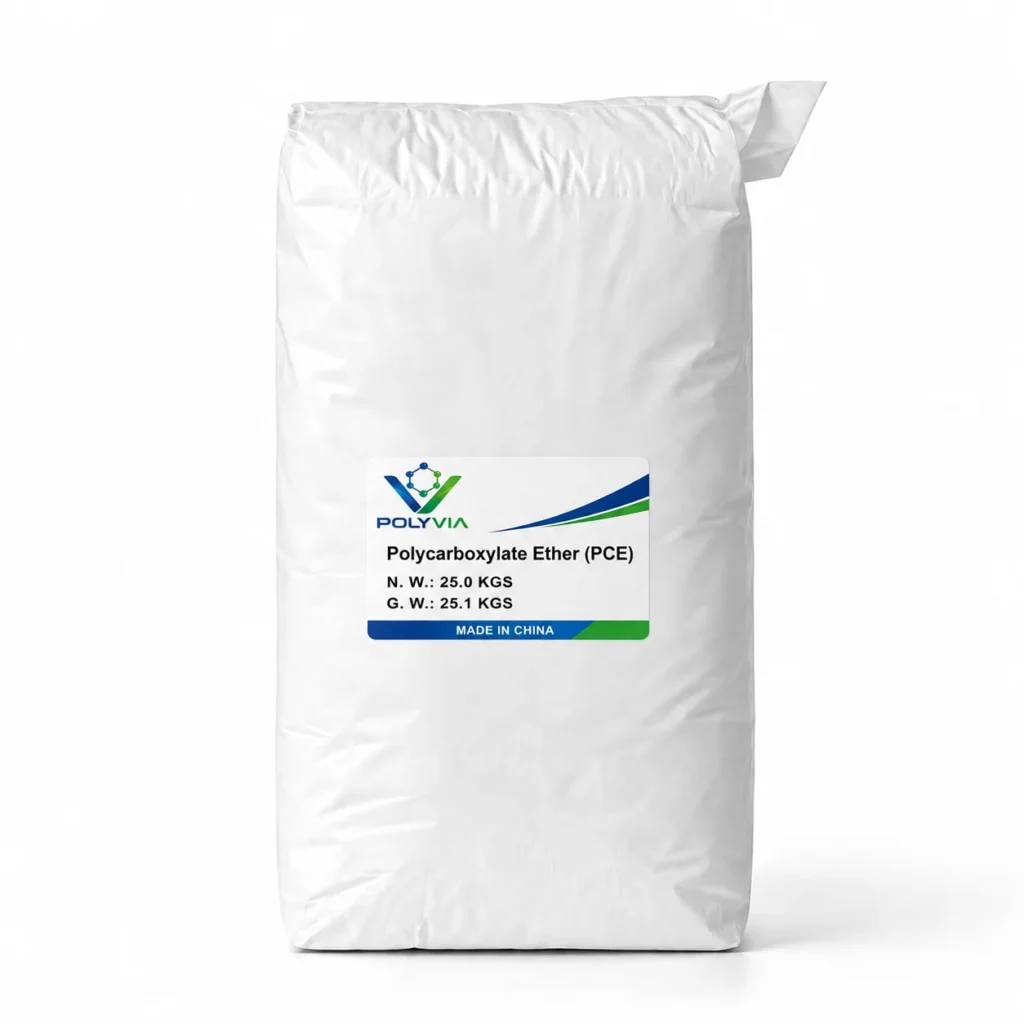
PCE Powder Applications in Non-Shrink Grout Systems
PCE Technology for Precision and Structural Grouting
PCE Powder can be used across cementitious grout systems where sufficient mobility must be achieved without excessive mixing water.
Base Plate Grouting
A PCE superplasticizer for base plate grout helps the grout move through confined gaps beneath steel plates while maintaining controlled water demand.
Key Requirement: Filling Ability · Bearing Contact · Controlled Flow
Machinery Foundation Grouting
Machinery and equipment bases require accurate placement beneath components together with the specified hardened properties.
Key Requirement: Precision Placement · Stability · Controlled W/B
Anchor Bolt Grouting
Anchor pockets and bolt assemblies create narrow and irregular spaces that require sufficient grout mobility.
Key Requirement: Confined-Space Filling · Flow Around Anchors · Placement Control
Column Base & Bearing Plate Grouting
Structural bases require reliable interface filling between the supported component and substrate.
Key Requirement: Interface Filling · Stable Placement · Load Transfer
Precast Connection Grouting
Precast joints, sleeves and congested connection zones can require highly flowable cementitious grout.
A powder high-range water-reducing admixture can support filling performance while limiting unnecessary water addition.
Pumpable Non-Shrink Grout
A PCE water reducer for pumpable grout should be evaluated for more than initial flow.
Key Requirement: Pumpability · Flow Retention · Working Time · Stability
High-Flow Precision Grout
Precision grouting beneath machinery and structural components may require grout capable of traveling through narrow spaces under gravity.
Key Requirement: High Flow · Precision Filling · Water Reduction
High-Strength Non-Shrink Grout
A high-range water reducer for high-strength grout helps reconcile low W/B requirements with practical placement consistency.
Key Requirement: Controlled W/B · Workability · Hardened Performance
Rail & Track Grouting
Selected rail and track-support systems require controlled placement beneath base plates and supporting components.
Key Requirement: Base Support · Filling · Dimensional Performance
Control Flow Without Losing Stability
High Flow Is Only Useful When the Grout Remains Stable
A common formulation mistake is to treat flow value as the primary measure of PCE performance.
The required flow should instead be determined by the placement method, gap geometry and travel distance.
Control Bleeding
High fluidity should not result in unacceptable free-water separation. Water content, particle grading, binder composition and admixture dosage should be evaluated together.
Maintain Segregation Resistance
Fluid grout must remain sufficiently homogeneous during mixing, transport and placement.
Consider Flow Retention
For large equipment bases or longer grouting operations, the grout may need to maintain usable consistency beyond the initial flow measurement.
Evaluate:
Initial Flow · Flow Retention · Working Time · Bleeding · Segregation
Reliable filling is more important than maximum flow.
Match Grout Consistency to the Placement Method
Flowable, Fluid and Pumpable Grout Require Different Performance
There is no universal consistency for non-shrink grout.
Flowable Grout
Suitable where gravity placement requires sufficient mobility beneath base plates, machinery foundations or structural components.
Fluid Grout
Used where narrow gaps or longer flow distances require greater mobility. Strong water reduction can help achieve fluid consistency without relying on excessive water.
Pumpable Grout
Pumpability depends on the complete formulation, including particle grading, rheology, working time and consistency retention.
Controlled-Flow Grout
Not every application requires maximum fluidity. Anchor pockets and localized grouting may benefit from a more controlled consistency.
The selection sequence should therefore be:
Application → Placement Method → Gap Geometry → Required Consistency → Water Demand → PCE Selection
Dosage and Formulation Guidance
Optimize PCE Around the Complete Grout Formulation
The optimum PCE dosage for non-shrink grout depends on cement chemistry, binder composition, fillers, expansive components, target consistency and W/B ratio.
For POLYVIA™ PCE 840, the final dosage should be established through formulation trials using the actual raw materials.
Start with the Performance Target
A practical formulation sequence is:
Target Flow → Initial W/B → PCE Dosage → Stability → Working Time → Hardened Performance
Consider Binder Compatibility
PCE demand can change with:
Cement Type · Cement Fineness · SCM Content · Fillers · Expansive Components · Aggregate Grading
Changing the cement or fine mineral system can therefore change the optimum dosage of the polycarboxylate water reducer.
Recommended Mixing
For dry-mix grout:
Dry Components → PCE Powder → Uniform Dry Blending → Water Addition → Mechanical Mixing → Performance Check
Uniform dry blending helps distribute the powder admixture throughout the formulation before water is introduced.
Avoid Overdosage
Increasing PCE beyond the optimum level does not necessarily improve the grout.
Excessive dosage may influence:
Flow Behavior · Bleeding · Segregation · Setting · Air Content · Early-Age Performance
Build the Complete Non-Shrink Grout System
Each Additive Has a Different Function
PCE controls primarily dispersion, water demand and flow. Other grout properties require other components.
PCE + Expansive System
PCE → Dispersion & Water Reduction
Expansive System → Shrinkage Compensation & Dimensional Control
The two functions should not be confused.
PCE + Powder Defoamer
A compatible powder defoamer may be used where unwanted air needs to be controlled in fluid or dense grout formulations.
PCE + Retarder
Longer placement procedures or high ambient temperatures may require additional working time.
Evaluate:
Initial Flow · Flow Retention · Setting Time · Early Strength
PCE + Early-Strength System
Where rapid turnaround is required, the formulation should balance:
Placement Time · Required Flow · Early Strength Development
PCE + Mineral Components
Slag, fly ash, silica fume, limestone filler and other fine materials can change surface area and PCE demand.
Dosage should therefore be re-evaluated when the binder composition changes.
A successful grout formulation comes from balancing the complete additive system—not maximizing one component.
Which PCE Is Right for Your Non-Shrink Grout?
Select by Performance Window—not Water Reduction Alone
High Water Reduction
When the main challenge is achieving high flow at controlled W/B, PCE 840 High Water Reduction Type can be evaluated as the starting grade.
Pumpable Grout
Prioritize:
Pumpability · Flow Retention · Working Time · Stability
A grade producing excellent initial flow may not necessarily provide the best pumping performance.
High-Strength Grout
Use the following selection logic:
Strength Target → W/B Requirement → Required Workability → PCE Selection → Verification
Extended Working Time
For large-volume placement or hot-weather grouting, evaluate the interaction between PCE chemistry, cement and the setting-control system.
Binder Compatibility
Unexpected flow loss, abnormal setting, excessive air, bleeding or unstable dosage response can indicate that the complete binder–admixture system requires adjustment.
Application → Placement → Flow → W/B → Working Time → Stability → PCE Grade → Dosage → Verification
Verify the Complete Grout Performance
Do Not Evaluate the Water Reducer in Isolation
After selecting the PCE grade and dosage, test the complete formulation under the intended mixing, placement and curing conditions.
Fresh-Grout Performance
Verify:
Initial Flow · Filling Ability · Flow Retention · Bleeding · Segregation · Working Time
Setting Behavior
Confirm that the available placement window and setting profile match the construction requirement.
Compressive Strength
Measure both required early-age and specified-age strength using the final formulation.
Dimensional Performance
PCE itself does not make a grout non-shrink.
Verify dimensional behavior using the final:
Binder System · Expansive Components · Water Content · PCE Dosage · Curing Conditions
ASTM C1107/C1107M
ASTM C1107/C1107M applies to the complete packaged dry hydraulic-cement non-shrink grout, rather than PCE Powder as an individual raw material.
Accordingly, the technically appropriate positioning is:
PCE 840 can be used as a high-range water-reducing admixture in non-shrink grout formulations designed and tested to applicable performance requirements such as ASTM C1107/C1107M.
Do not describe PCE 840 itself as “ASTM C1107 compliant.”
Frequently Asked Questions
1. What is PCE Powder used for in non-shrink grout?
PCE Powder is used as a polycarboxylate superplasticizer to improve cement particle dispersion, reduce water demand and achieve the required grout flow at a controlled W/B ratio.
2. Why use a high-range water reducer in non-shrink grout?
A high-range water reducer creates workability through more efficient particle dispersion, reducing the need to increase mixing water simply to obtain flow.
3. What is the recommended PCE dosage for non-shrink grout?
PCE dosage depends on the product grade, cement, binder composition, expansive system, required flow and W/B ratio. For PCE 840, determine the final dosage through formulation trials using the actual raw materials.
4. Can PCE increase grout flow without adding more water?
Yes. A PCE water reducer can improve fluidity at the same water content or help achieve the required consistency at lower water demand.
5. Does PCE make grout non-shrink?
No. PCE controls mainly dispersion, water reduction and flow. Shrinkage compensation depends on the complete binder and expansive system.
6. Can PCE 840 be used for precision grout?
Yes. PCE 840 can be evaluated for precision and high-flow grout where strong water reduction and controlled W/B ratio are required.
7. Is PCE suitable for pumpable grout?
Yes, but the complete formulation should be evaluated for pumpability, flow retention, working time and stability, not only initial flow.
8. Can PCE be combined with an expansive agent?
Yes. PCE provides water reduction and dispersion, while the expansive system provides shrinkage compensation. Their interaction should be verified in the final grout formulation.
9. Does more PCE always improve performance?
No. Excessive dosage can change flow, setting behavior, air content, bleeding and segregation. The optimum dosage is the amount required to achieve the target performance window.
10. Does PCE increase grout strength?
PCE is not a direct strength-producing additive. Efficient water reduction can support a lower W/B ratio while maintaining workability, but actual strength depends on the complete grout formulation.
11. What is the difference between PCE and Polycarboxylate Superplasticizer?
PCE commonly refers to Polycarboxylate Ether, the polymer chemistry used in many modern polycarboxylate superplasticizers. Powder-form products may also be described as PCE Powder, PCE superplasticizer, polycarboxylate superplasticizer powder or high-range water-reducing admixture.
12. Does PCE Powder comply with ASTM C1107/C1107M?
ASTM C1107/C1107M evaluates the complete non-shrink grout rather than PCE Powder itself. PCE can be incorporated into a grout formulation designed and tested to the applicable standard.
Formulation Support for Non-Shrink Grout
Share Your Grout Requirement—We Help Define the PCE Starting Point
The performance of a polycarboxylate superplasticizer varies with cement chemistry, binder composition, expansive system, water content and other additives.
For applications requiring high water reduction and high flow at a controlled W/B ratio, POLYVIA™ PCE 840 High Water Reduction Type can be evaluated as the starting PCE grade.
For more targeted formulation guidance, share:
Grout Application · Binder Composition · Current W/B Ratio · Required Consistency · Target Flow · Working Time · Early/Final Strength · Expansive System · Current Additives
From Formulation Problem to PCE Selection
Grouting Requirement → Identify the Problem → Review Binder & Additives → Define Flow and W/B Target → Select PCE Chemistry → Optimize Dosage → Verify Complete Grout Performance
The objective is not simply to add a stronger water reducer—it is to build a stable non-shrink grout formulation around the required placement and performance conditions.
Request TDS · Discuss Your Formulation · Request Sample · Get a Quote
POLYVIA™ · Construction Chemical Materials & Formulation Technologies
| Column 1 | Column 2 | Column 3 |
|---|
| Column 1 | Column 2 | Column 3 |
|---|
| Column 1 | Column 2 | Column 3 |
|---|
| Column 1 | Column 2 | Column 3 |
|---|