
Demolding Strength & Production Cycle Control for Precast Tunnel Segments
Achieve Reliable Early Strength for Faster and More Consistent Mold Turnover
Optimize precast tunnel segment production by balancing low W/B, concrete workability, PCE performance, cement reactivity and curing conditions to achieve the required demolding strength within the planned mold cycle.
Define the Demolding Target
Optimize Strength at the Required Demolding Time
For precast tunnel segments, final compressive strength is only one part of the production requirement.
The concrete must also develop sufficient early-age strength for demolding, handling and mold turnover at the required production time.
The practical control point is:
Required Demolding Strength + Planned Demolding Time = Mold-Cycle Target
This is more useful than evaluating early-strength performance only through conventional 1-day strength.
Faster Setting Is Not Faster Demolding
A concrete mix can set quickly without developing sufficient strength for safe stripping and handling.
Therefore:
Setting Time ≠ Demolding Strength
The relevant question is whether the concrete reaches the specified demolding condition within the actual curing and production cycle.
At the same time, premature stripping can increase the risk of damage around:
Edges · Corners · Gasket Grooves · Connection Areas · Concrete Surfaces
The required demolding strength should therefore follow the applicable segment specification, project requirement and plant procedure, rather than a universal MPa value.
Before optimization, define:
| Production Parameter | Required Definition |
|---|---|
| Demolding Strength | Project / plant requirement |
| Demolding Time | Planned mold-cycle point |
| Target W/B | Concrete performance requirement |
| Casting Workability | Mold filling and compaction |
| Curing Method | Actual plant process |
| Handling Requirement | Post-demolding operation |
| Final Strength | Segment specification |
The objective is not maximum early strength. It is reliable demolding at the required production time without compromising tunnel segment quality.
Why Tunnel Segment Production Misses the Planned Mold Cycle
Find the Real Bottleneck Before Changing the Admixture System
When tunnel segments cannot be demolded on schedule, insufficient early strength should not automatically be blamed on the PCE.
The complete system should be reviewed:
Actual W/B · Mold Filling · Compaction · Cement–PCE Response · Setting · Temperature · Curing · Production Consistency
Actual W/B Is Higher Than Intended
Aggregate moisture variation, water-correction errors or additional water used to restore workability can increase the actual W/B.
The concrete may become easier to cast while taking longer to reach the intended early-age strength.
Before changing the admixture or curing program, verify the actual water entering the mix.
Low-W/B Concrete Is Difficult to Process
The opposite condition is also common.
Insufficient dispersion at the required W/B can produce concrete that is difficult to fill and compact, increasing the risk of:
Entrapped Air · Local Voids · Poor Surface Definition · Incomplete Filling
Adding water is not the preferred correction.
The better question is whether the cement–PCE system provides sufficient workability at the required W/B.
Cement–PCE Response Has Changed
Changes in cement source, lot, fineness or binder composition can alter:
PCE Demand · Workability · Setting · Early Strength Development
Maintaining the same nominal PCE dosage therefore does not guarantee identical production performance after the binder changes.
Setting Is Delayed
If fresh concrete remains workable but strength development begins later than expected, evaluate:
PCE Type & Dosage · Cement Compatibility · Retarding Components · Concrete Temperature
Delayed setting can shift the strength-development curve, but setting time and demolding strength should still be evaluated separately.
The Curing Cycle No Longer Matches the Concrete
A curing program that previously worked may respond differently after changes in cement, W/B, admixture system or concrete temperature.
Review the complete sequence:
Pre-Curing → Temperature Rise → Accelerated / Steam Curing → Cooling → Strength Verification
Increasing curing intensity without identifying the underlying cause may not solve the production problem.
Production Variation May Be the Real Cause
| Observed Problem | Check First |
|---|---|
| Demolding strength consistently low | W/B · cement · setting · curing |
| Demolding time varies between batches | Moisture · dosing · mixing · temperature |
| Concrete too stiff for the mold | W/B · PCE response · cement demand |
| Good workability but slow strength | Setting · cement–PCE response · curing |
| Problem begins after cement change | Cement–PCE compatibility |
| Lab performance good, plant performance poor | Scale-up · mixing · temperature · curing |
A delayed mold cycle is a system problem until the actual bottleneck has been identified.
Follow the Tunnel Segment Mold Cycle
Control Concrete Performance Across the Complete Production Sequence
Tunnel segment production is a continuous mold-based process:
Batching → Mixing → Casting & Compaction → Pre-Curing → Accelerated Curing → Strength Verification → Demolding → Handling → Mold Preparation → Next Segment
A problem introduced at one stage can appear several steps later.
Batching & Mixing
Control:
Aggregate Moisture · Actual Water · PCE Dosage · Mixing Sequence · Mixing Time · Concrete Temperature
The objective is repeatable concrete entering the mold—not merely a correct nominal formulation.
Casting & Compaction
Fresh concrete must reliably form around:
Edges · Corners · Gasket Grooves · Connection Zones · Embedded Details
Insufficient mobility can cause incomplete filling and entrapped air, while excessive mobility may reduce stability.
The target is:
Sufficient Mobility + Effective Compaction + Stable Concrete
Pre-Curing & Accelerated Curing
Curing should be coordinated with the actual setting and strength-development behavior of the concrete.
The relevant sequence is:
Pre-Curing → Heating → Holding → Cooling → Demolding-Strength Verification
The purpose is not simply to heat the concrete faster, but to reach the required production condition reliably.
Demolding & Handling
The specified strength should be confirmed according to the plant's quality-control procedure before stripping.
After demolding, inspect the actual segment—not only the strength result.
Pay particular attention to:
Edges · Corners · Gasket Grooves · Connection Areas · Surface Quality
A segment that reaches the strength target but suffers unacceptable stripping damage has not achieved an effective production cycle.
Trace Problems Backward
When production becomes unstable, troubleshoot backward:
Demolding Problem
← Strength Development
← Curing
← Setting
← Casting & Compaction
← Fresh-Concrete Rheology
← W/B & PCE Response
← Batching
Optimize the complete mold cycle—not one isolated concrete property.
Balance Low W/B, Mold Filling & Demolding Strength
Find the Practical Performance Window
Tunnel segment concrete frequently needs to satisfy three requirements simultaneously:
Low W/B ↔ Mold Filling & Compaction ↔ Demolding Strength
Reducing W/B can support strength and dense concrete, but inadequate dispersion may make the mix difficult to process.
Increasing water may improve immediate mobility but moves the concrete away from its intended strength-development condition.
The goal is therefore a balanced production window.
Low W/B Must Remain Production-Ready
At insufficient workability, low-W/B concrete can create:
Slow Filling · Difficult Compaction · Entrapped Air · Surface Voids
Rather than restoring workability through additional water, optimize dispersion and rheology while maintaining the required W/B.
High Flow Does Not Guarantee Good Mold Filling
Mold-filling performance depends on the interaction between:
Mobility · Viscosity · Stability · Air Release · Compaction Response
Therefore:
Flowability ≠ Mold-Filling Quality
Excessive mobility may also increase bleeding, segregation or paste separation.
Connect Early Strength to Production Time
Do not optimize only for the highest 1-day strength.
Evaluate the complete path:
Target W/B
→ Mold Filling
→ Compaction
→ Setting
→ Curing
→ Demolding Strength
→ Safe Stripping
The optimum concrete is the system that performs reliably across this sequence.
Optimize the Curing–Demolding Window
Accelerate Mold Turnover Without Sacrificing Segment Quality
Accelerated or steam curing can support rapid strength development, but the objective is not the shortest possible curing time.
The practical target is:
Controlled Curing + Required Demolding Strength + Safe Stripping
Start with the Concrete Before Curing
Curing performance depends partly on the condition of the concrete entering the curing stage:
Concrete Temperature · Setting Development · Cement Reactivity · PCE Response · Actual W/B
If these variables change, the same curing program may no longer produce the same result.
Control the Pre-Curing Window
Where a pre-curing period is used, its timing should be coordinated with the actual setting behavior of the concrete and the approved plant procedure.
The question is not simply:
How soon can accelerated curing begin?
but:
When should accelerated curing begin for this concrete system?
Evaluate the Complete Curing Profile
Consider:
Pre-Curing → Temperature Rise → Holding Period → Cooling → Strength Verification
More intensive curing is not automatically better.
Curing Time Is a Process Parameter. Demolding Strength Is a Performance Requirement.
The selected curing profile should be validated against both the required strength and the condition of the actual segment after stripping.
Protect Segment Quality During Fast Production
Separate Casting Defects from Demolding Defects
Shorter mold turnover is valuable only when the resulting segment remains acceptable.
Similar visible defects can originate at very different stages.
Defects Formed Before Demolding
Possible influences include:
Poor Mold Filling · Inadequate Compaction · Entrapped Air · Unstable Rheology · Segregation · Bleeding
These problems should first be investigated through the fresh-concrete and casting system.
Defects Created During Demolding
Possible influences include:
Insufficient Demolding Strength · Premature Stripping · Form Adhesion · Demolding Procedure
These require a different correction path.
Do not correct a casting defect by simply increasing early strength, and do not correct a demolding defect by simply increasing concrete flow.
Surface Voids & Honeycombing
Check:
Rheology · Entrapped Air · Aggregate Grading · Casting Sequence · Compaction
Pay particular attention around geometrically demanding areas such as gasket grooves and connection zones.
Edge & Corner Damage
When damage occurs during stripping, check:
Demolding Strength · Timing · Curing Consistency · Mold Condition · Form Adhesion
Earlier demolding is useful only when the segment can be removed reliably.
Mold Release Is Part of the Demolding System
Where excessive form adhesion occurs, review:
Mold Cleaning · Mold Condition · Release-Agent Application · Demolding Procedure
A suitable water-based concrete mold release agent can support clean separation when correctly selected and applied.
Diagnose by Production Stage
| Observed Defect | Check First |
|---|---|
| Surface voids / pinholes | Rheology · air · compaction |
| Honeycombing | Filling · grading · compaction |
| Incomplete groove filling | Rheology · casting sequence |
| Bleeding / segregation | Water · PCE response · stability |
| Edge / corner damage | Demolding strength · timing · adhesion |
| Difficult mold release | Mold condition · release agent · strength |
| Early handling damage | Early-age strength · handling |
| Batch-to-batch defects | Moisture · dosing · mixing · temperature |
Defect → Identify Production Stage → Diagnose Cause → Adjust the Relevant Variable
Do not solve every surface problem by increasing PCE dosage.
Match the PCE Strategy to the Production Bottleneck
Select PCE According to the Actual Requirement
PCE selection should begin with the production bottleneck rather than product form or maximum laboratory performance.
| Production Requirement | PCE Direction | Relevant POLYVIA Grade |
|---|---|---|
| Low W/B + insufficient workability | High water reduction | PCE 840 Powder |
| Demolding strength develops too slowly | Early-strength PCE | PCE ES980 Powder |
| Early strength + liquid dosing | Early-strength liquid PCE | PCE ES-50 / ES-40 |
PCE 840 — High Water Reduction
PCE 840 can be evaluated where effective dispersion and high water reduction are required to maintain suitable fresh-concrete performance at low W/B.
Its role is not simply to create maximum flow.
Final mold-filling performance still depends on:
W/B · Paste Rheology · Aggregate Grading · Compaction
PCE ES980 — Early Strength
Where fresh concrete performance is acceptable but demolding strength develops too slowly, PCE ES980 can be evaluated as an early-strength-oriented powder grade.
Performance should be assessed at the actual planned demolding time under the plant curing cycle, rather than from 1-day strength alone.
PCE ES-50 / ES-40 — Liquid Early-Strength Route
For plants or admixture systems requiring liquid dosing, ES-50 and ES-40 provide early-strength-oriented PCE options.
Selection between powder and liquid should consider:
Required Performance · Formulation Route · Plant Dosing System
When Both Workability and Early Strength Matter
Compare candidate systems using the same:
Cement · W/B · Aggregate System · Temperature · Mixing · Compaction · Curing
Then evaluate:
Mold Filling → Setting → Curing Response → Demolding Strength → Stripping Quality
The preferred system is the one that creates the most reliable overall production window—not necessarily the grade with the highest isolated water-reduction or early-strength value.
For detailed grade selection and dosage guidance, see Polycarboxylate Superplasticizer for Precast Concrete Tunnel Segments.
Validate the Tunnel Segment Production Window
Move from Laboratory Performance to Repeatable Plant Production
A tunnel segment concrete system should not be considered optimized because one laboratory mix achieves high flow or high early strength.
Final validation should confirm that the complete system works under actual production conditions.
Step 1 — Establish a Laboratory Baseline
Define:
Cement & Binder · Aggregate System · Target W/B · PCE Grade & Dosage · Mixing Procedure · Concrete Temperature
Measure:
Fresh Workability · Stability · Setting · Early Strength · Strength at Demolding Time
Step 2 — Test at the Actual Production Time
If the plant intends to demold before conventional 1-day testing, strength should also be evaluated at the actual production control point.
Test at the Production Time—not Only at Standard Test Ages
Step 3 — Reproduce the Intended Curing Cycle
Keep the curing procedure controlled while comparing formulations:
Pre-Curing → Heating → Holding → Cooling → Strength Test
Step 4 — Conduct a Plant Trial
Scale-up introduces additional variables:
Aggregate Moisture · Batching Accuracy · Mixer Efficiency · Material Temperature · Casting · Compaction · Actual Curing
The plant trial should therefore evaluate the complete process.
Validate the Segment—not Only the Cube
Inspect:
Mold Filling · Surface Quality · Edges · Corners · Gasket Grooves · Connection Areas · Demolding Behavior · Early Handling
Concrete strength is a validation parameter. The finished tunnel segment is the production result.
Step 5 — Confirm Repeatability
One successful batch is not enough.
Repeat trials under representative production conditions and check whether normal variation in moisture, cement, temperature or dosing significantly shifts the result.
The preferred system should provide a reasonably robust operating window.
Record the Final Operating Window
| Control Parameter | Production Record |
|---|---|
| Cement / Binder System | Approved production materials |
| Target W/B | Validated operating target |
| PCE Grade | Selected performance type |
| PCE Dosage & Basis | Actual dosage and calculation basis |
| Concrete Temperature | Validated production range |
| Casting Workability | Plant control target |
| Compaction Method | Validated procedure |
| Pre-Curing | Plant procedure |
| Accelerated / Steam Curing | Validated profile |
| Demolding Strength | Project / plant requirement |
| Demolding Time | Planned production point |
| Segment Quality | Surface / edge / groove acceptance |
| Handling | Post-demolding requirement |
| Mold Turnover | Validated production cycle |
Revalidate the operating window after significant changes in:
Cement · Binder · Aggregate · PCE · W/B · Temperature · Curing Procedure
Final Validation Path
Define Demolding Target
→ Fix Target W/B
→ Select PCE Strategy
→ Validate Mold Filling & Compaction
→ Apply the Intended Curing Cycle
→ Measure Demolding Strength
→ Demold & Inspect the Segment
→ Repeat Under Plant Conditions
→
Establish the Tunnel Segment Production Window
The objective is a stable production window that delivers the required demolding strength, reliable segment quality and repeatable mold turnover under actual plant conditions.
Frequently Asked Questions
1. What is the required demolding strength for precast tunnel segments?
There is no universal demolding-strength value for all precast tunnel segments. The required strength should follow the segment design, project specification, handling requirement and plant quality-control procedure.
The practical production control point is required demolding strength at the planned demolding time.
2. Why do tunnel segments fail to reach demolding strength on time?
Common factors include high actual W/B, cement reactivity, cement–PCE compatibility, setting delay, concrete temperature, curing conditions and production variation.
Identify the limiting variable before increasing PCE dosage or curing intensity.
3. Which PCE is suitable for precast tunnel segments?
For high water reduction and low-W/B concrete, PCE 840 Powder can be evaluated.
Where early strength and demolding-cycle efficiency are the main requirements, PCE ES980 Powder can be evaluated.
For liquid early-strength systems, PCE ES-50 or ES-40 can be considered.
4. What is the typical PCE dosage for precast tunnel segments?
Practical laboratory starting ranges include:
PCE Powder: 0.10–0.35% of total cementitious material
Approximately 1.0–3.5 kg/MT of binder
PCE ES-50 Liquid (50% solids): 0.60–1.50% as supplied
Approximately 6.0–15.0 kg/MT of binder
These are starting ranges for laboratory evaluation, not universal production dosages. Final dosage should be optimized according to the PCE grade and solids, cement chemistry, target W/B, required workability, curing conditions and demolding target.
5. Can PCE help reduce W/B in tunnel segment concrete?
Yes. High-range water-reducing PCE can improve cement-particle dispersion and reduce the water required for suitable workability.
However, the objective should be a production-ready low-W/B system, not simply the lowest possible W/B.
6. Does steam curing improve tunnel segment demolding strength?
Accelerated or steam curing can support early strength development when properly matched to the cement, W/B, PCE system, setting behavior and concrete temperature.
The curing profile should be validated against both the required demolding strength and actual segment quality.
7. Why can changing cement affect PCE performance and demolding time?
Different cement characteristics can alter PCE demand, water reduction, workability, setting and early strength development.
After a significant cement change, the PCE dosage-response and curing–demolding window should be revalidated.
8. How can surface defects and edge damage be reduced?
First identify when the defect occurs.
For surface voids, honeycombing or incomplete filling, check rheology, air, grading, casting and compaction.
For edge or corner damage during stripping, check demolding strength, curing, timing, mold condition and release-agent application.
Related Products
PCE 840 — High Water Reduction PCE Powder
For low-W/B precast concrete requiring strong water reduction and effective cement dispersion.
PCE ES980 — Early-Strength PCE Powder
For precast systems where early strength development and demolding-cycle efficiency are important.
PCE ES-50 / ES-40 — Early-Strength PCE Liquid
For early-strength precast systems requiring liquid dosing or liquid admixture formulation.
Related Application
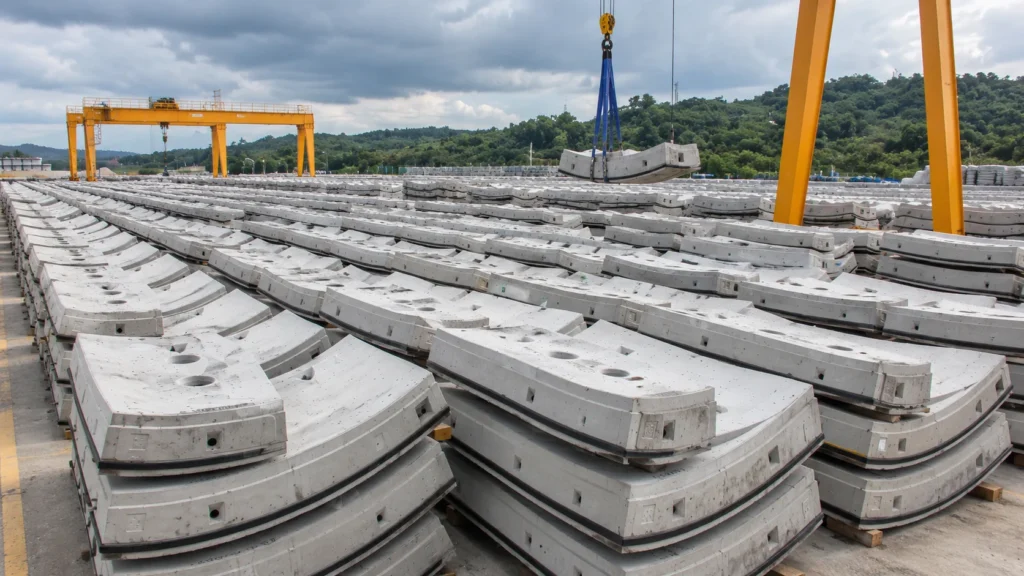
Polycarboxylate Superplasticizer for Precast Concrete Tunnel Segments
Explore detailed guidance on PCE grade selection, starting dosage and application performance for TBM tunnel segments and segmental tunnel linings.
Explore the Tunnel Segment Application →
Related Solutions
Early Strength for Precast Concrete
Optimize early-age strength through W/B control, PCE selection, cement reactivity and curing.
PCE Compatibility with Cement & Cementitious Materials
Diagnose changes in PCE demand, workability, setting and strength after binder changes.
PCE Dosage Optimization for Concrete
Establish an effective PCE dosage range through controlled dosage-response testing and production validation.
Technical Support
Optimize Your Precast Tunnel Segment Production
Experiencing delayed demolding, insufficient early strength, difficult mold filling, surface defects or inconsistent mold turnover?
Share your:
Segment Type · Cement & Binder · Target W/B · PCE Grade & Dosage · Casting Workability · Curing Cycle · Required Demolding Strength · Planned Demolding Time · Current Production Problem
Discuss Your Tunnel Segment Concrete →
POLYVIA™ · Materials Engineered for Better Concrete