
PCE Powder for Low Cement & Ultra-Low Cement Refractory Castables
Low Water Demand · Efficient Dispersion · Controlled Flow · Dry-Mix Compatibility
Polycarboxylate Superplasticizer (PCE) Powder provides high-efficiency dispersion and water reduction for low cement (LCC) and ultra-low cement (ULCC) refractory castables, helping achieve the required flowability with reduced mixing water.
POLYVIA™ PCE 840 and PCE 860 can be evaluated in calcium aluminate cement (CAC) systems for high-alumina, corundum and self-flow refractory castables, including dry premix formulations.
Why Water Demand Matters in LCC & ULCC
Control Mixing Water Without Sacrificing Castable Flow
Low cement and ultra-low cement refractory castables combine refractory aggregates, calcium aluminate cement (CAC), alumina fines, microsilica and other fine or ultrafine powders.
These high-surface-area particles require efficient dispersion. Without it, additional mixing water may be needed to obtain workable consistency.
Excess water, however, must later be removed during curing, drying and heat-up and can contribute to a more porous castable structure.
The formulation target is therefore not simply the lowest possible water addition, but:
Minimum Water Required for Reliable Dispersion, Flow and Placement
Water content should be optimized together with particle packing, CAC content, ultrafine powders and dispersant dosage.
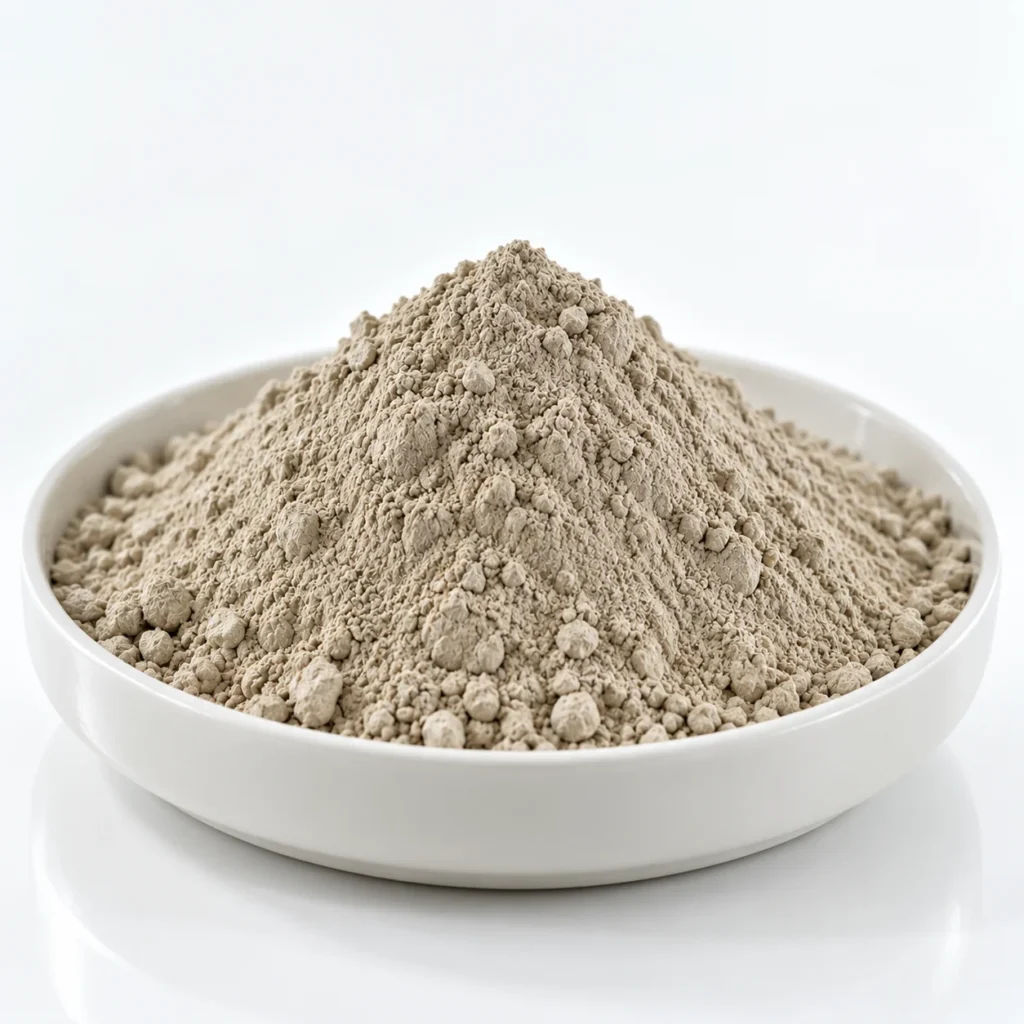
How PCE Works in Refractory Castables
Disperse Fine Particles With Less Mixing Water
In LCC and ULCC systems, PCE acts as a high-efficiency dispersing and water-reducing admixture within the fine-particle matrix.
After mixing with water, PCE improves the dispersion of compatible CAC particles, microsilica, alumina fines and other refractory powders, reducing agglomeration and improving the efficiency of available mixing water.
Dispersion Mechanism
PCE Dispersion → Reduced Particle Agglomeration → Lower Water Demand → Controlled Flow
The objective is not maximum fluidity. The castable must retain sufficient cohesion and stability for reliable mixing and placement.
PCE performance is therefore influenced by the complete formulation:
CAC Chemistry · Microsilica · Reactive Alumina · Particle-Size Distribution · Water Content · PCE Dosage · Temperature
A PCE that performs well in conventional Portland cement concrete should not automatically be assumed to behave identically in a refractory castable.
PCE for Different Refractory Castable Systems
Match Dispersion Performance to the Formulation
Different refractory castable systems place different demands on the dispersant.
| Refractory System | Main Challenge | PCE Selection Focus |
|---|---|---|
| Low Cement Castable (LCC) | Reduce water while maintaining workable consistency | Water reduction · Dispersion · Controlled flow |
| Ultra-Low Cement Castable (ULCC) | Fine-powder-rich system with low CAC content | Fine-particle dispersion · Compatibility |
| Self-Flow Castable | Develop flow without excessive water | Flowability · Flow retention · Stability |
| High-Alumina Castable | Balance CAC and alumina-rich fines | CAC compatibility · Water demand · Setting |
| Corundum Castable | Dense refractory powder system | Dispersion efficiency · Controlled flow |
For LCC, the practical balance is:
Low Water Demand + Reliable Flow + Stable Setting
For ULCC, PCE selection becomes particularly sensitive to particle packing and fine-powder interactions.
For self-flow refractory castables, sufficient mobility must be achieved without moving the formulation outside its stable rheological window.
Flowability, Flow Retention & Castable Stability
Maintain Workable Flow Without Excess Mixing Water
Good PCE performance involves more than high initial flow.
The refractory castable should remain workable throughout the practical application window:
Mixing → Handling → Placement → Finishing
Initial Flow
Efficient dispersion allows the required consistency to develop without simply increasing water addition, particularly in systems rich in microsilica, reactive alumina and ultrafine powders.
Flow Retention
Rapid flow loss can make placement difficult and may encourage additional water at the jobsite, changing the designed formulation.
PCE selection should therefore consider both initial flow and flow retention under actual temperature and material conditions.
Self-Flow Stability
For self-flow castables:
Higher flow is not automatically better performance.
Excessive fluidity without adequate cohesion can increase the risk of bleeding or segregation.
The practical target is:
Low Water Demand + Sufficient Flow + Usable Working Time + Castable Stability
PCE Compatibility with Calcium Aluminate Cement
Evaluate Dispersion, Flow and Setting as One System
Calcium aluminate cement (CAC) has different hydration chemistry from ordinary Portland cement, and its interaction with PCE can vary significantly with cement type, formulation and temperature.
For this reason, refractory PCE performance should be evaluated through three connected parameters:
Dispersion → Flow Behavior → Setting Response
Important variables include:
CAC Chemistry · CAC Content · Reactive Alumina · Microsilica · Ultrafine Powders · PCE Dosage · Temperature
Poor compatibility may appear as:
High Water Demand · Insufficient Flow · Rapid Flow Loss · Unstable Response · Unsuitable Setting Behavior
Increasing PCE dosage is not automatically the correct solution.
The best PCE for a refractory castable is not necessarily the grade with the highest water reduction—it is the grade that provides the best balance of dispersion, flow and setting in the actual CAC-based formulation.
Refractory Castable Applications
From LCC and ULCC to Factory Dry Premix Systems
POLYVIA™ PCE powder can be evaluated across several compatible refractory castable systems.
Low Cement Refractory Castables
For reduced water demand and controlled placement consistency in LCC formulations.
Ultra-Low Cement Refractory Castables
For efficient dispersion in low-CAC, fine-powder-rich formulations.
Self-Flow Refractory Castables
For controlled self-flow behavior at reduced mixing-water levels.
High-Alumina Refractory Castables
For formulations containing CAC, alumina-rich raw materials and fine refractory powders.
Corundum-Based Castables
For dense formulations containing corundum aggregates, reactive alumina, microsilica and other fine powders.
Dry Premix Refractory Castables
Powder-form PCE can be incorporated directly into factory-produced dry refractory castable formulations, providing a practical option for premixed products where water is added during final mixing.
PCE 840 vs PCE 860 for Refractory Castables
Select by Formulation Performance, Not Castable Name
POLYVIA™ PCE 840 and PCE 860 can both be evaluated in compatible LCC and ULCC formulations.
| Grade | Positioning | Evaluation Focus |
|---|---|---|
| PCE 840 | High water-reduction type | Water demand · Initial flow · Dispersion efficiency |
| PCE 860 | Balanced-performance type | Controlled flow · Working time · Formulation balance |
PCE 840
PCE 840 is a practical starting option where stronger water reduction and efficient dispersion are the primary requirements.
PCE 860
PCE 860 can be evaluated where the formulation requires a broader balance between water reduction, flow behavior and usable working time.
Do not define:
840 = LCC
860 = ULCC
Instead:
Select the PCE by formulation performance—not by LCC or ULCC classification alone.
The recommended screening sequence is:
Set Formulation → Set Water Target → Compare 840 / 860 → Measure Flow → Check Flow Retention → Check Setting
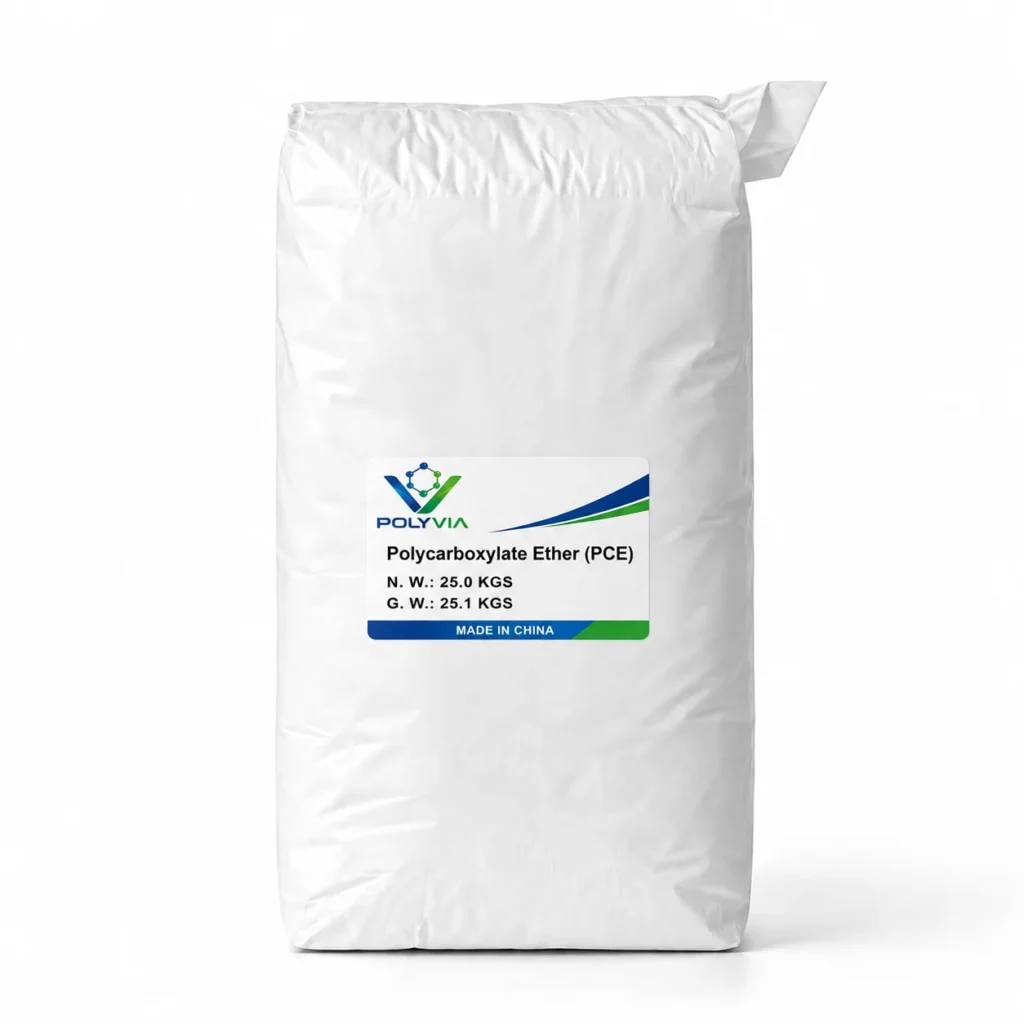
PCE Dosage & Formulation Optimization
Determine the Optimum Addition Level Through Controlled Trials
There is no universal PCE dosage for all refractory castables.
The optimum addition depends on:
CAC Type & Content · Microsilica · Reactive Alumina · Fine-Powder Content · Particle Packing · Water Target · Required Flow · Temperature
For a new formulation, compare several PCE addition levels while keeping the raw materials, water target and mixing procedure unchanged.
Evaluate:
PCE Dosage → Initial Flow → Flow Retention → Stability → Setting Response
The objective is:
Optimum Dispersion — Not Maximum PCE Dosage
Always Define the Dosage Basis
A PCE percentage is meaningful only when its calculation basis is clear.
Confirm whether dosage is expressed relative to:
Total Dry Mix · Binder System · Cementitious Binder · Fine-Powder Fraction
This is especially important when comparing formulations, laboratory results or supplier recommendations.
Troubleshooting Refractory Castable Performance
Diagnose the Formulation Before Changing PCE Dosage
| Problem | Check First | Optimization Direction |
|---|---|---|
| High Water Demand | PCE, particle packing, CAC, fine powders | Improve dispersion before adding water |
| Poor Initial Flow | PCE efficiency, water level, mixing | Optimize dispersion and mixing |
| Rapid Flow Loss | CAC, temperature, PCE compatibility | Compare grade and dosage |
| Excessive Retardation | PCE dosage, CAC interaction, temperature | Re-optimize dosage or grade |
| Bleeding / Segregation | Water, PCE, grading, fines | Rebalance flow and stability |
| Raw-Material Change | CAC, microsilica, reactive alumina | Repeat compatibility trials |
High Water Demand
Before increasing mixing water, determine whether the formulation is genuinely short of water or whether the fine particles are insufficiently dispersed.
Rapid Flow Loss
Compare PCE 840 and PCE 860 under identical raw materials, water content and temperature rather than automatically increasing dosage.
Excessive Retardation
Evaluate PCE dosage, CAC interaction and temperature together. The target is sufficient working time followed by reliable setting—not maximum retardation.
Bleeding or Segregation
Review the complete rheological system:
Water Content + PCE Dosage + Particle Grading + Fine-Powder Content + Mixing Procedure
Production & Formulation Validation
Verify PCE Performance With the Actual Refractory Raw Materials
For a new LCC or ULCC formulation, use a controlled validation sequence:
1. Confirm Raw Materials
CAC, refractory aggregates, microsilica, reactive alumina and other fines.
2. Establish Water Target
Define the intended mixing-water level before comparing PCE grades.
3. Screen PCE 840 & PCE 860
Use identical formulation and mixing conditions.
4. Measure Initial Flow
Determine whether target consistency is achieved.
5. Measure Flow Retention
Evaluate consistency through the required working period.
6. Observe Stability
Check bleeding, segregation and overall homogeneity.
7. Evaluate Setting
Confirm acceptable working and setting behavior.
8. Verify Hardened Properties
Where required, evaluate bulk density, apparent porosity and relevant mechanical properties according to the established refractory testing procedure.
Raw Materials → Water Target → PCE Grade → Dosage → Flow → Flow Retention → Setting → Hardened Performance
Frequently Asked Questions
1. What is the best superplasticizer for low cement refractory castables?
A suitable superplasticizer should reduce water demand while providing effective fine-particle dispersion, controlled flow and acceptable setting behavior. PCE 840 and PCE 860 can both be evaluated, with final selection based on the actual CAC and refractory formulation.
2. Can PCE be used with calcium aluminate cement?
Yes, in compatible formulations. Because CAC chemistry differs from Portland cement, PCE compatibility should be verified by evaluating water demand, flow, flow retention and setting response.
3. How does PCE reduce water demand in refractory castables?
PCE improves dispersion of compatible fine particles and reduces agglomeration, allowing the required consistency to be achieved with less unnecessary mixing water.
4. Can ordinary concrete PCE be used in refractory castables?
Not automatically. Performance in Portland cement concrete does not guarantee the same behavior in CAC-based LCC or ULCC systems. Actual refractory-formulation testing is required.
5. Can PCE powder be used in ULCC?
Yes. PCE powder can be evaluated in ultra-low cement castables where efficient dispersion and low water demand are required. Final grade and dosage depend on the actual fine-powder system.
6. Which PCE is suitable for self-flow refractory castables?
PCE selection should balance water reduction, initial flow, flow retention and stability. PCE 840 and PCE 860 should be compared under the actual formulation conditions.
7. Can PCE powder be added to dry premix refractory castables?
Yes, powder PCE can be incorporated into compatible factory dry-premix formulations. Uniform dry blending and accurate low-level dosing should be verified during production trials.
8. What is the recommended PCE dosage for LCC and ULCC?
There is no universal dosage. The optimum level depends on CAC, ultrafine powders, water target and required flow. The dosage basis must also be clearly defined before comparing percentage values.
Technical Support for Refractory Castables
Match PCE Performance to the Actual LCC or ULCC Formulation
POLYVIA™ supports the evaluation of PCE 840 and PCE 860 for low cement, ultra-low cement and compatible self-flow refractory castable formulations.
Technical evaluation can focus on:
CAC Compatibility · PCE Grade Selection · Water-Demand Reduction · Dosage Optimization · Initial Flow · Flow Retention · Setting Behavior · Dry Premix Formulation
Final PCE selection should be validated using the customer's actual calcium aluminate cement, refractory aggregates, microsilica, reactive alumina and fine-powder system before full-scale production.