Fiber Distribution
Fibers disperse throughout the matrix in multiple orientations, creating distributed reinforcement across potential stress and crack paths.

POLYVIA™ Aramid Fiber is a high-strength, high-modulus synthetic reinforcement fiber combining low density with excellent thermal resistance. It is designed for concrete, cementitious materials and demanding engineering applications requiring mechanical reinforcement, durability and performance under elevated temperatures.
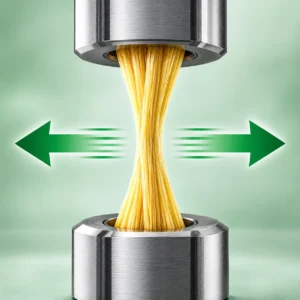
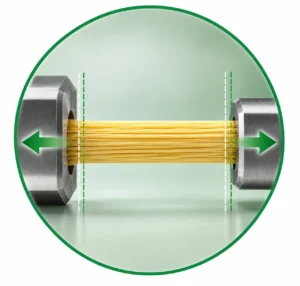

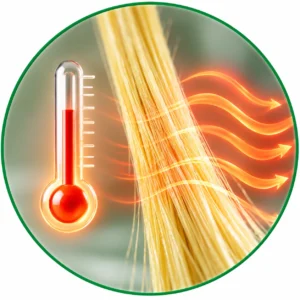
POLYVIA™ Aramid Fiber is a high-performance para-aramid fiber based on poly-p-phenylene terephthalamide (PPTA), with ≥85% para-position bonds according to the product specification.
Combining high tensile strength, high modulus and low density, the fiber provides lightweight reinforcement for compatible concrete and cementitious systems. Its strong fibrous structure helps distribute tensile stresses and supports reinforcement performance without significantly increasing material weight.
When properly dispersed, Aramid Fiber forms distributed reinforcement throughout the matrix. Its reinforcing mechanism can be understood through four connected stages.
Fibers disperse throughout the matrix in multiple orientations, creating distributed reinforcement across potential stress and crack paths.
Stress within the surrounding matrix is transferred to embedded fibers through the fiber–matrix interface, enabling effective load transfer between the two materials.
Fibers intersecting a developing crack remain engaged across the crack plane, helping transfer tensile stress as the crack begins to open.
Bridging fibers transfer stress away from localized crack regions, helping redistribute tensile forces through a broader region of the reinforced matrix.
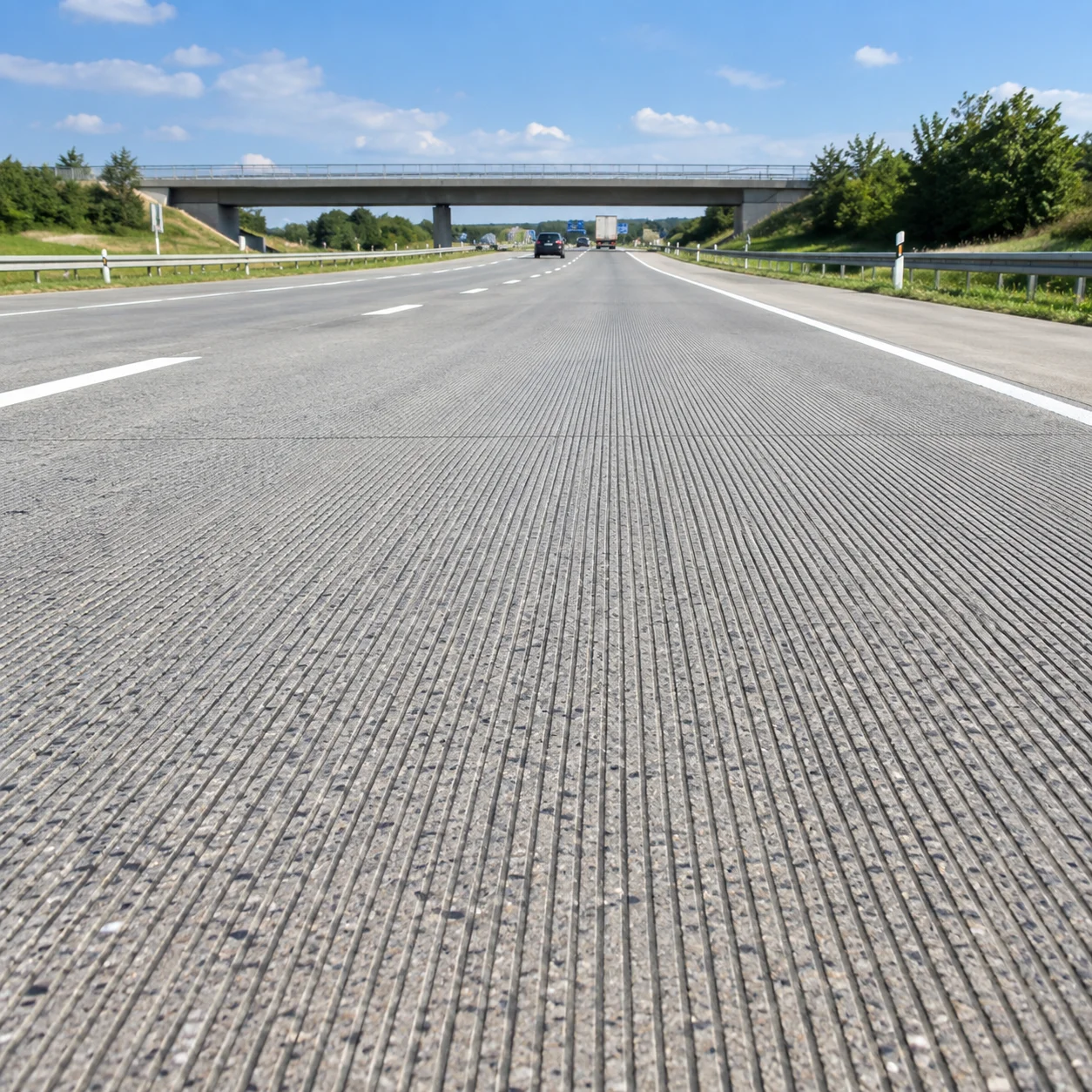
For concrete pavement systems requiring distributed Aramid Fiber reinforcement to support crack control, tensile stress distribution and long-term pavement performance.
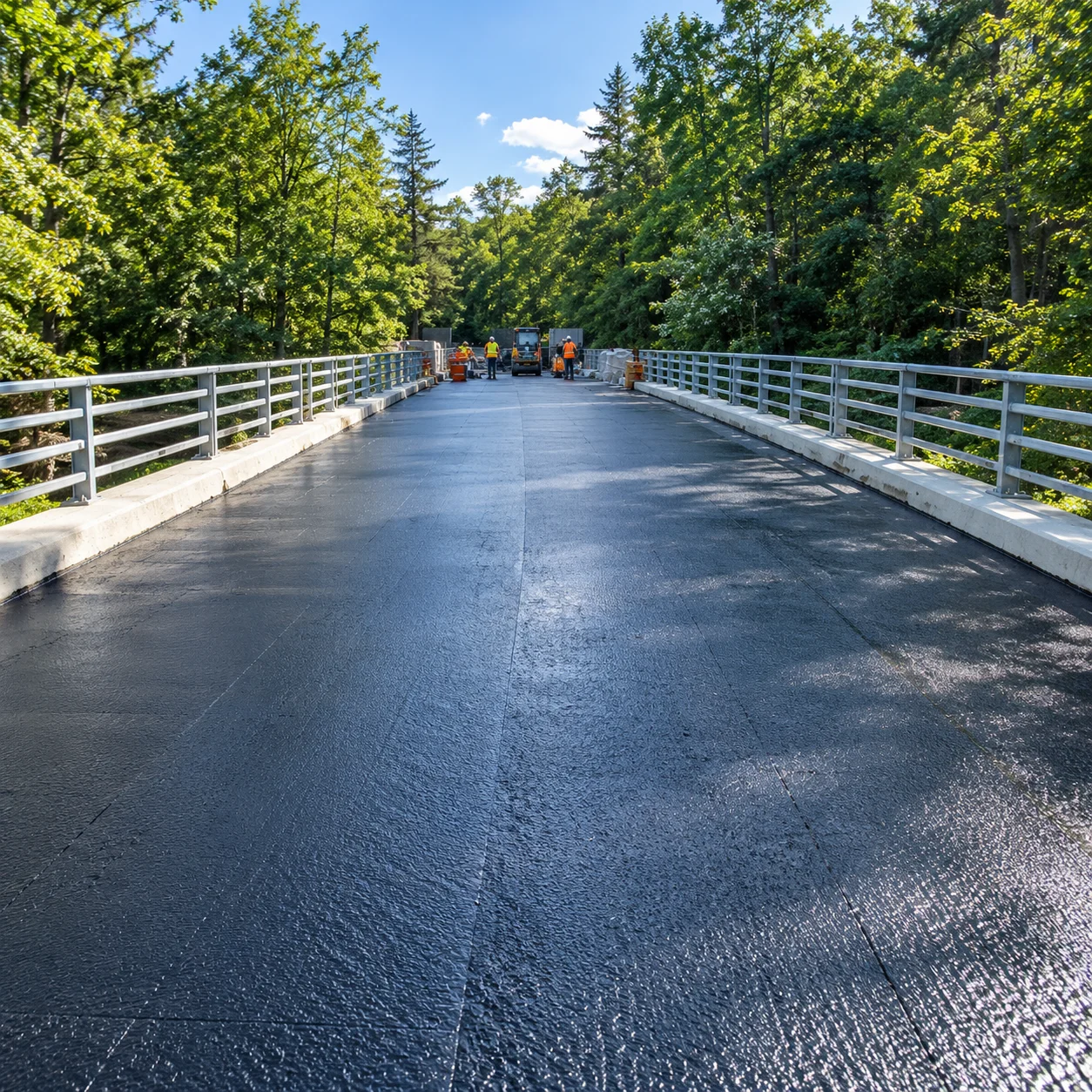
For bridge deck concrete requiring fiber reinforcement to support crack control, tensile stress distribution and performance under repeated service loading.

For airport runway concrete requiring high-performance distributed reinforcement to support crack control and material performance under demanding loading conditions.

For industrial concrete floors requiring distributed fiber reinforcement to support crack control, stress distribution and performance under repeated operational loading.
For compatible tunnel linings and cementitious structures requiring high-strength Aramid Fiber reinforcement to support crack control and internal stress distribution.
For compatible underground concrete and cementitious systems requiring lightweight distributed fiber reinforcement to support crack control and structural material performance.
For reservoirs, dams and water-retaining concrete structures requiring distributed fiber reinforcement to support crack control and durable material performance.
For compatible marine and waterfront concrete structures requiring distributed reinforcement to support crack control and performance under demanding exposure conditions.
POLYVIA™ Aramid Fiber combines high tensile strength, high modulus, low density and elevated-temperature resistance for demanding fiber-reinforced material systems.
Provides high tensile performance to support stress transfer and distributed reinforcement within compatible material systems.
Provides high fiber stiffness to support stress transfer and deformation resistance within compatible reinforced matrices.
Combines low material density with high mechanical performance, providing a favorable strength-to-weight profile for lightweight reinforcement systems.
Provides fiber-level resistance to elevated temperatures within the specified range, subject to exposure conditions and matrix compatibility.
The performance of Aramid Fiber depends not only on the fiber itself, but also on its interaction with the surrounding matrix and processing conditions. Four factors should be evaluated when developing or optimizing a fiber-reinforced formulation.
Compatible Matrix → Uniform Fiber Dispersion → Effective Fiber–Matrix Interface → Controlled Processing → Verified Performance
Matrix composition, rheology and workability influence fiber incorporation, dispersion and overall composite performance. Compatibility should be evaluated within the intended concrete or cementitious system.
Uniform fiber distribution helps create consistent distributed reinforcement throughout the matrix while minimizing localized fiber concentration or agglomeration.
Effective stress transfer depends on the interaction between the Aramid Fiber surface and surrounding matrix. Interface behavior should therefore be verified using the actual formulation and application conditions.
Mixing sequence, mixing time and equipment should support uniform fiber incorporation and dispersion without adversely affecting mixture consistency or production stability.
| Items | Specification |
|---|---|
| Para-Position Bonds | ≥85% |
| Density | 1.44–1.45 Mg/m³ |
| Elongation at Break | 2.7–2.9% |
| Temperature Resistance | 200–300°C |
| Thermal Conductivity | 0.2–0.3 W/(m·K) |
| Elastic Modulus | 125–135 GPa |
| Tensile Strength | 2250–2750 MPa |
| Specific Heat | 1350–1450 J/(kg·K |
| Coefficient of Thermal Expansion | (-4)–(-2) × 10⁻⁶/K |

Product specifications and technical properties.
Download ↓
Safety, handling and storage information.
Download ↓
Batch-specific inspection and quality data.
Request COA ↓
Guidance for fiber incorporation, mixing, dispersion and application evaluation.
Download ↓Aramid Fiber is a high-performance aromatic polyamide fiber engineered for applications requiring high tensile strength, low weight and dimensional stability. POLYVIA™ Aramid Fiber is a para-aramid fiber based on poly-p-phenylene terephthalamide (PPTA).
POLYVIA™ Aramid Fiber has a specified tensile strength of 2250–2750 MPa, an elastic modulus of 125–135 GPa, and elongation at break of 2.7–2.9%.
Yes. Aramid Fiber can be incorporated into compatible concrete, mortar and other cementitious systems as distributed fiber reinforcement. Final performance depends on fiber dispersion, matrix compatibility, fiber–matrix interaction and mix design.
A typical addition sequence is:
Aggregate → Aramid Fiber → Cement → Water → Mixing → Final Water Adjustment
The fiber should be introduced and mixed sufficiently to achieve uniform dispersion throughout the concrete matrix.
For fiber-reinforced mortar and concrete, an additional 30–60 seconds of mixing may be used where required to achieve uniform dispersion. Actual mixing time should be adjusted according to the mixer, batch size and mix consistency.
The specified temperature-resistance range is 200–300°C. Suitability for elevated-temperature applications should be evaluated according to exposure temperature, duration, surrounding matrix and actual service conditions.
Aramid Fiber can be evaluated for concrete pavements, bridge decks, airport runways, industrial floors, tunnel engineering, underground construction, hydraulic structures, and marine or waterfront infrastructure where distributed fiber reinforcement is required.
Selection should consider the matrix system, reinforcement objective, fiber dimensions, dispersion requirements, processing method and service environment. Laboratory or production-scale testing with the actual formulation is recommended before final specification.
Tell us about your application and material system. Our technical team can provide guidance on dosage, dispersion, mixing and formulation compatibility.