
Why Does GRC Require AR Glass Fiber?
Understanding Alkali Resistance and Long-Term Fiber Performance
Cement-based materials create a highly alkaline environment that can degrade unsuitable glass fibers. Discover why alkali-resistant (AR) glass fiber is essential for conventional GRC, how it supports reinforcement performance, and what to verify when selecting fibers.
Why Is Alkali Resistance Important in GRC?
Glass Fiber Reinforced Concrete (GFRC), also known as Glassfibre Reinforced Concrete (GRC), combines a cementitious matrix with glass-fiber reinforcement. In conventional Portland cement-based GRC, selecting a suitable alkali-resistant (AR) glass fiber is essential because the highly alkaline cementitious environment can attack glass compositions that lack adequate resistance.
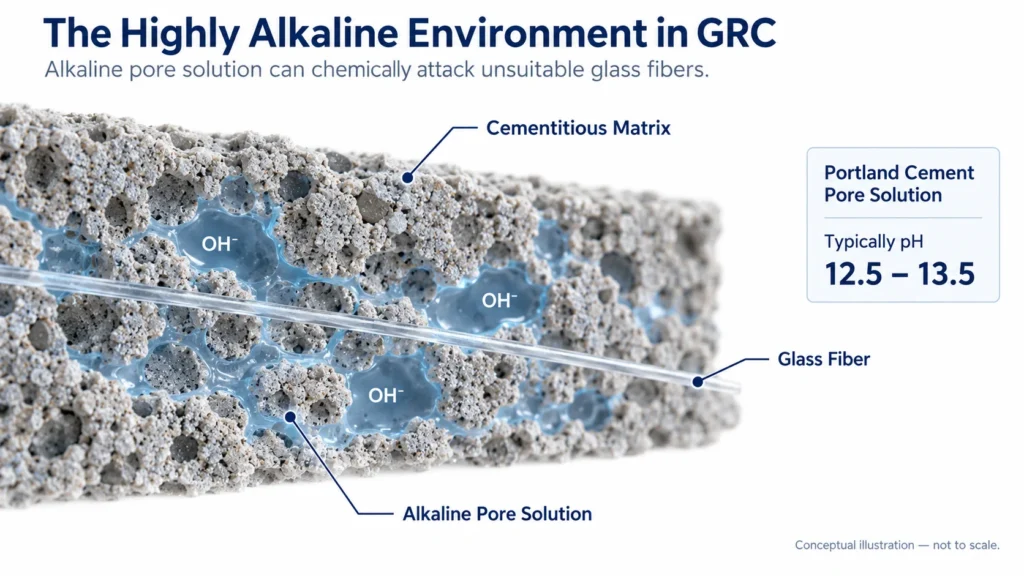
Such degradation can affect the fibers' ability to reinforce the matrix and may compromise the long-term reliability of the composite. AR glass fibers are specifically formulated to improve resistance to alkaline exposure, making them the established reinforcement choice for conventional GRC systems.
However, alkali resistance alone does not determine the performance or service life of a finished GRC component. Fiber configuration, matrix composition, manufacturing quality, curing and exposure conditions must also be considered.
This guide explains why alkali resistance matters, what distinguishes AR glass fiber, how to interpret relevant specifications and what manufacturers should verify when selecting reinforcement materials for GRC production.
What Happens When Unsuitable Glass Fibers Are Used?
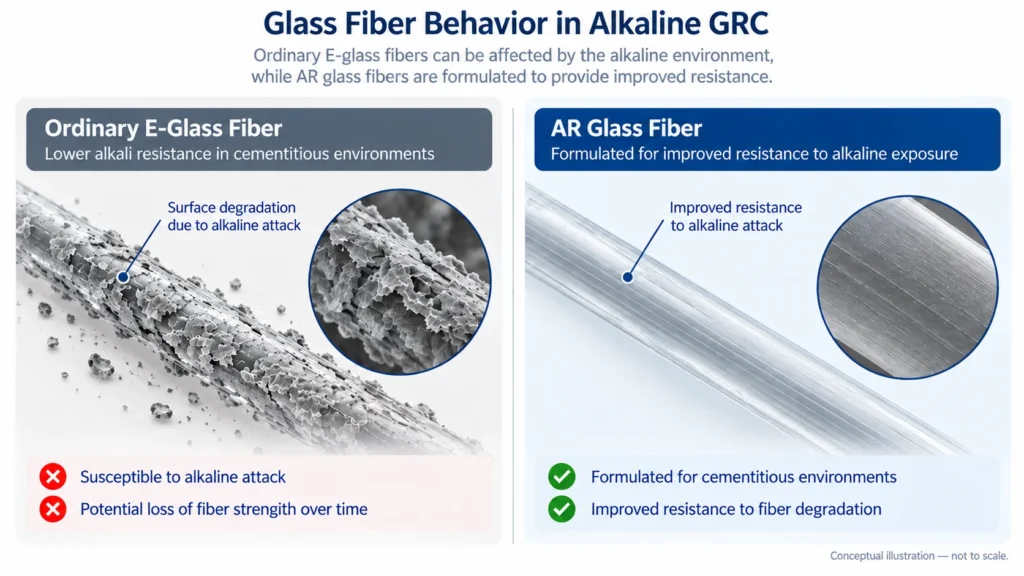
When glass fiber lacks sufficient resistance to alkaline exposure, chemical attack may alter its surface and reduce its mechanical performance. The rate and extent of deterioration depend on the glass composition, matrix chemistry, moisture, temperature and exposure duration.
This matters because GRC relies on effective stress transfer between the fibers and the surrounding cementitious matrix.
Potential consequences include
Reduced reinforcement capability: Degradation may reduce the fiber's ability to carry tensile stress.
Changes in fiber–matrix interaction: Changes at the fiber surface may influence stress transfer.
Less reliable composite performance: Deterioration may affect flexural behavior and post-cracking performance.
Long-term durability concerns: Initial test results alone may not establish performance after prolonged exposure.
These are potential risks, not inevitable outcomes for every formulation. Their significance depends on the materials, manufacturing process and service conditions.
The practical lesson is that glass fibers should not be selected for conventional GRC based solely on initial tensile strength, appearance or price. Their suitability for alkaline cementitious materials must also be established.
What Makes AR Glass Fiber Different?
Alkali-resistant (AR) glass fiber is formulated to improve resistance to alkaline attack in cementitious environments.
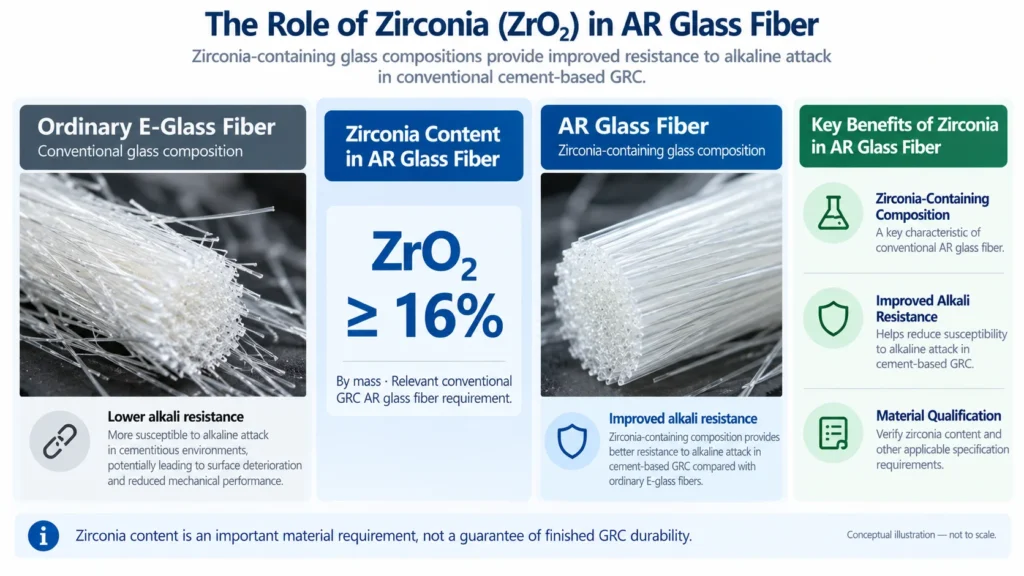
A key compositional characteristic of conventional AR glass fiber is its zirconium dioxide (ZrO₂) content. Zirconia-containing glass compositions are used to improve resistance to alkaline exposure compared with unsuitable conventional glass compositions.
The International Glassfibre Reinforced Concrete Association (GRCA) identifies a minimum zirconium dioxide content of 16% by mass as a key requirement for AR glass fiber suitable for conventional GRC. ASTM C1666/C1666M also specifies a minimum zirconia content of 16% by mass and addresses other relevant material and conformity requirements.
The applicable specification and edition should be confirmed for the intended product and market.
Why Is Zirconia Content Important?
Zirconia content is an important compositional criterion when evaluating AR glass fiber. However, it should not be treated as a complete guarantee of the finished composite's performance or service life.
A sound material evaluation should consider:
- Compliance with the applicable AR glass fiber specification
- Relevant physical and mechanical properties
- Fiber form and configuration
- Supporting test or conformity documentation
- Suitability for the intended GRC manufacturing process
Do not qualify an AR glass fiber solely by its zirconia content. The applicable specification, relevant properties and conformity evidence must be reviewed together.
How Does AR Glass Fiber Contribute to GRC Performance?
AR glass fiber addresses a fundamental requirement: the reinforcement must be suitable for the alkaline environment of conventional GRC.
Once incorporated into the matrix, glass fibers can help transfer tensile stress and influence crack development. Fibers crossing a developing crack may transfer stress across the crack faces and affect crack opening and post-cracking behavior.
The effectiveness of this mechanism depends on the complete composite system, including:
Fiber composition and mechanical properties
Fiber length, configuration and content
Fiber distribution within the matrix
Fiber–matrix interaction
Matrix composition and curing
Manufacturing consistency and component design
AR glass fiber helps address the chemical compatibility requirement, but it does not independently determine the final mechanical performance of GRC.
A suitable fiber must be combined with an appropriate matrix, manufacturing process and quality-control system. The finished composite should be evaluated against the requirements of its intended application.
How Should GRC Manufacturers Evaluate AR Glass Fiber?
Material approval should distinguish three separate questions: whether the fiber meets the relevant material specification, whether it is compatible with the manufacturing process, and whether the finished GRC product achieves its required performance.
1. Verify the Applicable Specification
Identify the specification relevant to the fiber, product type, manufacturing method and destination market.
ASTM C1666/C1666M covers AR glass fibers intended for GFRC spray-up, premix GFRC, fiber-reinforced concrete and other cementitious products. It addresses relevant material requirements, including zirconia content, physical and mechanical properties, and conformity testing.
GRCA guidance provides additional industry context for selecting AR glass fibers in conventional GRC.
These documents serve related but distinct purposes. Confirm the applicable edition and requirements rather than assuming that one specification automatically covers every product or project.
2. Review the Technical Documentation
Request technical documentation that identifies the actual product and supports its intended use. Depending on the fiber type and applicable specification, relevant information may include:
Glass composition and zirconia content
Fiber form and configuration
Nominal fiber dimensions, where applicable
Relevant physical and mechanical properties
Applicable conformity or test documentation
Product identification and batch traceability
The documentation should correspond to the specific fiber being supplied. Requirements for chopped strands, continuous strands and other reinforcement forms may differ.
3. Match the Fiber to the Manufacturing Process
Spray-up and premix GRC can impose different requirements on fiber configuration and processing behavior.
For spray-up systems, the fiber must be suitable for the intended feed, chopping and deposition process. For premix systems, incorporation, dispersion and compatibility with the mixing process are important considerations.
A fiber grade that works in one production system should not automatically be assumed suitable for another. The selected grade should be evaluated under representative processing conditions.
4. Evaluate Compatibility With the Complete Formulation
The selected fiber should be assessed with the actual cementitious materials, admixtures and production process.
Changes in cement source, fiber characteristics, mixture composition or mixing equipment can affect processing behavior and composite performance. Material substitutions should therefore be evaluated through appropriate trials rather than assumed to be equivalent.
5. Verify Finished-Product Performance
Compliance of the fiber is not the same as verification of the finished GRC component.
A fiber specification establishes relevant requirements for the reinforcement material. It does not independently demonstrate that a particular GRC formulation or component will meet every mechanical or durability requirement.
Depending on the intended product, finished-product evaluation may include flexural performance, dimensional characteristics, curing and relevant durability assessments.
The applicable test methods and acceptance criteria should be defined for the actual product and service conditions.
Common Mistakes When Selecting AR Glass Fiber
Mistake 1: Assuming Any Glass Fiber Is Suitable for GRC
Not all glass fibers are suitable for conventional Portland cement-based GRC. The selected fiber must have appropriate resistance to the alkaline environment and meet the relevant material requirements.
Mistake 2: Relying Only on Initial Tensile Strength
Initial tensile strength does not establish resistance to alkaline exposure or performance retention over time. Chemical compatibility and relevant conformity evidence must also be considered.
Mistake 3: Treating Zirconia Content as a Complete Durability Guarantee
Zirconia content is an important compositional criterion, but it does not independently establish the service life of the finished composite. Specification compliance, matrix properties, manufacturing quality and exposure conditions remain relevant.
Mistake 4: Assuming One Fiber Grade Fits Every Production Process
Fiber form, length, incorporation characteristics and process requirements should be considered together. Suitability for one GRC process does not automatically establish suitability for another.
Mistake 5: Treating Fiber Compliance as Proof of Finished-Product Performance
A compliant fiber is an important starting point, not a substitute for evaluating the complete GRC formulation and component. Manufacturers should verify finished-product performance against the relevant requirements.
Frequently Asked Questions
Why Does Conventional GRC Require AR Glass Fiber?
Conventional Portland cement-based GRC creates a highly alkaline environment that can degrade unsuitable glass fibers. AR glass fiber is formulated to improve resistance to alkaline exposure and is the established reinforcement choice for conventional GRC systems.
What Does AR Mean in AR Glass Fiber?
AR stands for alkali-resistant. It identifies glass fiber formulated to provide improved resistance to alkaline environments, including those found in cement-based materials.
Why Is Zirconia Used in AR Glass Fiber?
Zirconium dioxide is an important component of conventional AR glass compositions because it contributes to improved resistance to alkaline attack. The applicable product specification and conformity evidence should be reviewed for the intended application.
What Zirconia Content Is Required for AR Glass Fiber Used in GRC?
GRCA identifies a minimum zirconium dioxide content of 16% by mass as a key requirement for AR glass fiber suitable for conventional GRC. ASTM C1666/C1666M also specifies a minimum zirconia content of 16% by mass. Manufacturers should confirm the applicable specification and requirements for their product and market.
Can Ordinary E-Glass Fiber Replace AR Glass Fiber in Conventional GRC?
Ordinary E-glass fiber without demonstrated suitability for alkaline cementitious exposure should not be treated as a direct substitute for AR glass fiber in conventional GRC. Selection should follow the relevant specification and application requirements.
Does AR Glass Fiber Prevent GRC From Cracking?
No. AR glass fiber helps address the chemical compatibility requirement and can contribute to reinforcement performance, but it does not eliminate cracking. Crack development depends on the complete formulation, component design, loading and service conditions.
Does AR Glass Fiber Guarantee Long-Term Durability?
No. Alkali resistance is an important material requirement, but long-term durability also depends on the matrix, curing, manufacturing quality, component design and exposure conditions.
How Should GRC Manufacturers Verify AR Glass Fiber Quality?
Manufacturers should review the applicable specification, technical documentation, relevant composition and conformity evidence, supplier consistency and suitability for the intended process. The finished GRC product should also be evaluated against its applicable performance requirements.
Conclusion
Alkali resistance is a fundamental consideration when selecting glass-fiber reinforcement for conventional GRC. The highly alkaline environment of Portland cement-based materials can degrade unsuitable glass compositions, potentially affecting reinforcement performance and the long-term behavior of the composite.
AR glass fiber is formulated to improve resistance to alkaline exposure and is the established reinforcement choice for conventional GRC when supported by appropriate specifications and conformity evidence.
Reliable GRC production, however, depends on more than fiber composition. Manufacturers must also consider fiber configuration, matrix compatibility, manufacturing conditions, curing, quality control and the performance requirements of the finished component.
For manufacturers evaluating reinforcement materials, POLYVIA™ AR Glass Fiber can be considered as part of a technical material-selection process. Product selection should be based on verified specifications, the intended manufacturing method and application-specific performance requirements.