
What Is PCE Powder? A Technical Guide to Polycarboxylate Superplasticizer Powder
Understanding Its Dispersion Mechanism, Six Product Grades, Technical Characteristics and Application in Cementitious Materials.
PCE Powder is a concentrated solid-form polycarboxylate ether superplasticizer designed to improve cement particle dispersion, reduce water demand and control workability in compatible cementitious formulations. Its performance depends on polymer characteristics, product grade, incorporation method and material compatibility.
What Is PCE Powder?
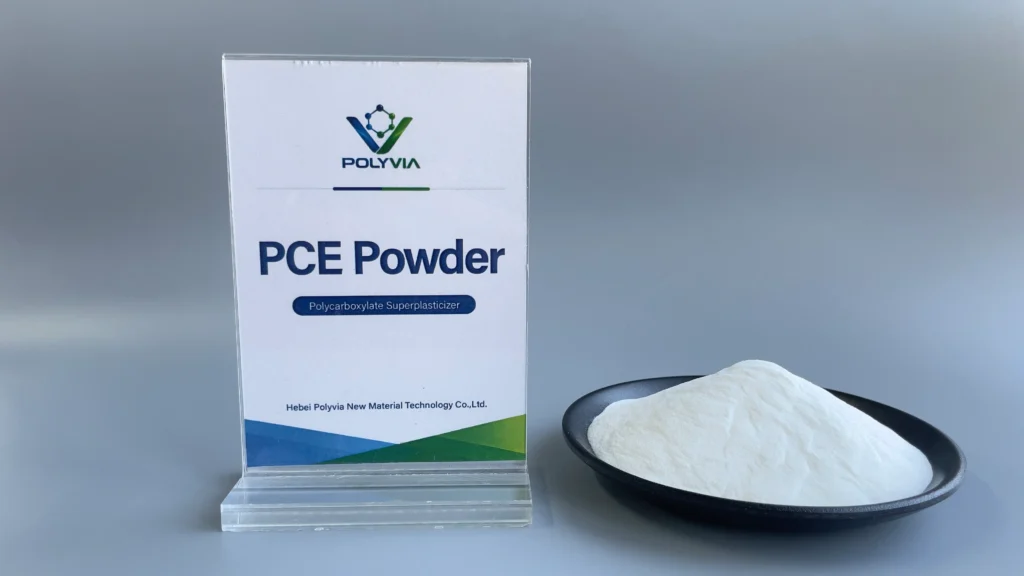
PCE Powder is a solid-form polycarboxylate ether (PCE) superplasticizer used to improve the dispersion of cementitious particles, reduce water demand and control the workability of cement-based formulations. It is supplied as a concentrated dry product that can be incorporated into compatible dry-mix formulations or dissolved in water before use in selected production systems.
PCE Powder combines the dispersing functionality of polycarboxylate-based polymers with the handling and formulation advantages of a dry product.
Its main functions include:
- Reducing water demand at a specified workability target.
- Improving cement particle dispersion.
- Supporting higher flowability in suitable cementitious mixtures.
- Enabling lower water-to-binder ratio formulations.
- Providing different performance profiles, including high water reduction, slump retention, balanced performance, low viscosity and early strength.
PCE Powder is not a single standardized product with identical performance characteristics across all grades. Different formulations may have different polymer architectures, physical characteristics and performance objectives.
For dry-mix mortar and construction chemical manufacturers, powder form allows the superplasticizer to be incorporated into factory-prepared dry formulations. In selected concrete and precast production systems, certain grades can also be prepared as aqueous solutions before dosing.
The appropriate processing method depends on the individual product grade.
How Does PCE Powder Work?
PCE Powder provides its dispersing function after the polymer becomes available in the aqueous phase of the cementitious mixture.
The working mechanism involves polymer adsorption, particle dispersion and changes in the interactions between cementitious particles.
1. Polymer Adsorption
PCE molecules typically have an anionic polymer backbone containing functional groups that can interact with cement particles and early hydration products.
The adsorption behavior depends on polymer architecture, cement composition and the chemical environment of the cement pore solution.
2. Steric Hindrance and Particle Dispersion
Many PCE superplasticizers have a comb-like molecular architecture consisting of a polymer backbone and polyether side chains.
After adsorption, hydrated side chains extend into the surrounding aqueous phase and create steric hindrance.
This helps reduce particle flocculation and improves cement particle dispersion.
Electrostatic interactions may also contribute, although their relative importance depends on the polymer structure and cement system.
3. Reduced Water Demand
When cement particles are dispersed more effectively, water trapped within particle flocs can become available for flow.
This allows a formulation to achieve a specified workability target with potentially less mixing water.
The practical benefits may include:
- Reduced water demand.
- Improved fresh-state flowability.
- Lower water-to-binder ratios.
- More efficient cementitious particle dispersion.
- Better control of formulation performance.
However, improved dispersion does not automatically guarantee higher compressive strength or better durability. Final performance depends on the complete formulation, water content, binder composition and curing conditions.
What Are the Six POLYVIA™ PCE Powder Grades?
POLYVIA™ offers six PCE Powder grades designed for different performance requirements.
| Model | Main Performance Focus | Physical Form | Recommended Addition |
|---|---|---|---|
| 840 | High Water Reduction | Fine powder | Direct dry-mix |
| 850 | Slump Retention | Fine powder | Direct dry-mix |
| 860 | Balanced Performance | Fine powder | Direct dry-mix |
| 870 | Low Viscosity | Fine powder | Direct dry-mix |
| ES980 | Early Strength | Coarse powder | Pre-dissolution |
| PW888 | Early Strength | Fine powder | Direct dry-mix |
1. POLYVIA™ 840 — High Water Reduction
POLYVIA™ 840 is designed for formulations where reducing water demand while achieving the required flowability is the main objective.
Its high-water-reduction positioning makes it a candidate for cementitious systems requiring efficient particle dispersion and controlled water demand.
The actual water reduction achieved must be verified using the intended cementitious materials and testing conditions.
2. POLYVIA™ 850 — Slump Retention
POLYVIA™ 850 is designed for formulations where maintaining workability over time is an important consideration.
Its selection should focus on time-dependent flow or slump measurements rather than initial flow alone.
Temperature, dosage, cement characteristics and testing time should be controlled when evaluating retention performance.
3. POLYVIA™ 860 — Balanced Performance
POLYVIA™ 860 is positioned for balanced performance.
It is intended for formulations requiring a suitable balance between water reduction and workability behavior.
Its suitability should be established according to actual performance requirements rather than assuming that balanced positioning guarantees the same results across different cement systems.
4. POLYVIA™ 870 — Low Viscosity
POLYVIA™ 870 is designed for low-viscosity performance requirements.
Flowability and viscosity are related but different properties. A mixture may achieve a satisfactory flow measurement while still exhibiting undesirable resistance during mixing, pumping or placement.
Therefore, evaluation should consider both flow measurements and relevant rheological or production requirements.
Low-viscosity positioning does not establish a universal numerical viscosity value for every formulation.
5. POLYVIA™ ES980 — Coarse-Powder Early-Strength PCE
POLYVIA™ ES980 is a coarse-powder early-strength grade with a specified solid content of at least 98%.
Its recommended addition method is pre-dissolution.
ES980 must not be treated as a standard direct dry-blending product.
For concrete and precast applications, early-strength performance must be evaluated in relation to cement type, water-to-binder ratio, dosage, temperature and curing conditions.
6. POLYVIA™ PW888 — Fine-Powder Early-Strength PCE
POLYVIA™ PW888 is a fine-powder early-strength grade with a specified solid content of at least 95%.
Unlike ES980, PW888 is recommended for direct dry-mix addition.
It provides an option for manufacturers requiring early-strength-oriented PCE functionality in compatible factory-blended dry formulations.
Its actual contribution to early-age strength must be verified through testing at defined ages and under the intended formulation and curing conditions.
Important distinction: ES980 and PW888 belong to the same early-strength performance category, but they have different physical forms and recommended incorporation methods.
What Are the Technical Specifications of POLYVIA™ PCE Powder?
The following table summarizes the specifications provided in POLYVIA™ PCE Powder technical documentation.
| Parameter | 840 | 850 | 860 | 870 | ES980 | PW888 |
|---|---|---|---|---|---|---|
| Appearance | White powder | White powder | White powder | White powder | White coarse powder | White powder |
| Solid Content, % | ≥95 | ≥95 | ≥95 | ≥95 | ≥98 | ≥95 |
| Density, kg/m³ | 450–650 | 450–650 | 450–650 | 450–650 | 450–650 | 450–650 |
| Moisture, % | ≤5 | ≤5 | ≤5 | ≤5 | ≤2 | ≤5 |
| pH, 10 wt% solution, 25°C | 7±1 | 7±1 | 7±1 | 6±1 | 4±1 | 6±1 |
| Chloride, % | ≤0.02 | ≤0.02 | ≤0.02 | ≤0.02 | ≤0.02 | ≤0.02 |
| Water Reduction Rate, % | ≥25 | ≥15 | ≥25 | ≥25 | ≥25 | ≥25 |
Understanding the Specifications
Solid Content
The five fine-powder grades have specified solid contents of at least 95%, while ES980 is specified at at least 98%.
Solid content is useful for product characterization and mass-balance calculations. It should not automatically be interpreted as a verified active-polymer percentage unless the analytical definition confirms this.
Moisture Content
The specified moisture limit is no more than 2% for ES980 and no more than 5% for the other five grades.
Moisture control is important for powder handling, storage and dry-blend consistency.
pH Value
The reported pH values are measured using a 10 wt% aqueous solution at 25°C.
They are not measurements of the dry powder itself and should not be compared directly with results obtained using different solution concentrations or temperatures.
Water Reduction Rate
The technical specifications list minimum water-reduction values of 15% or 25%, depending on the grade.
These are product specification figures, not guaranteed results in every cement, mortar or concrete formulation.
A meaningful comparison requires the applicable test method, reference formulation, dosage basis, flow target and testing conditions.
Early-Strength Performance Specifications
The supplied early-strength product data also list the following strength ratios:
| Parameter | ES980 / PW888 | ES40 / ES50 |
|---|---|---|
| 1-Day Strength Ratio | ≥180% | ≥160% |
| 3-Day Strength Ratio | ≥160% | ≥145% |
These values belong to the broader POLYVIA™ Early-Strength PCE technical data, which includes both powder and liquid products.
They are not interchangeable with the PCE Powder water-reduction specifications above.
The applicable reference mixture, test method, specimen, curing regime and strength-ratio calculation must be confirmed before these figures are used as quantitative performance claims in published marketing or technical materials.
How Is PCE Powder Incorporated into Cementitious Formulations?
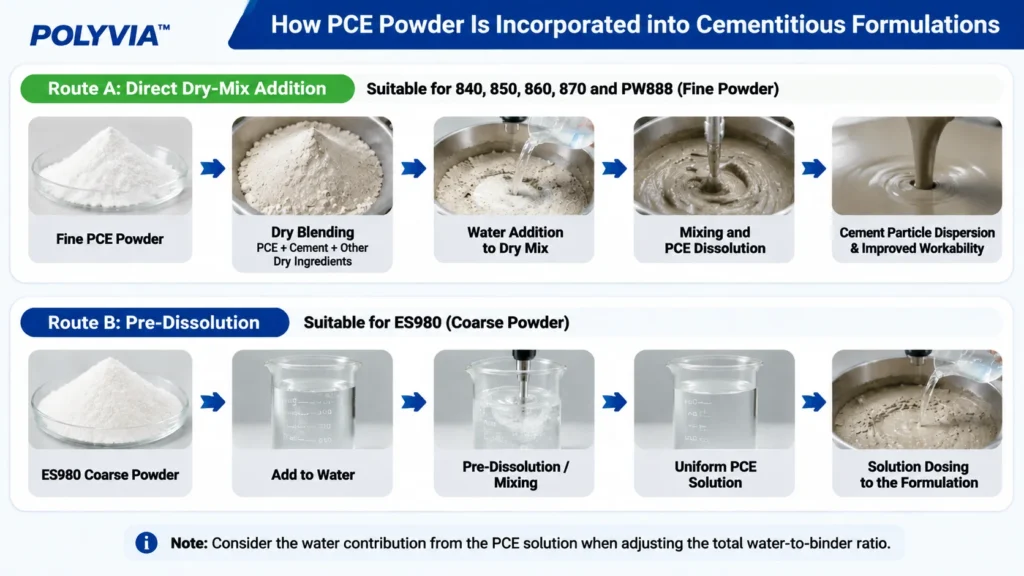
POLYVIA™ PCE Powder has two principal incorporation approaches, depending on the product grade and intended production process.
1. Direct Dry-Mix Addition
POLYVIA™ 840, 850, 860, 870 and PW888 are recommended for direct dry-mix addition.
A general manufacturing sequence is:
- Prepare and inspect the dry raw materials.
- Accurately weigh the PCE Powder and other formulation components.
- Blend the ingredients using suitable mixing equipment.
- Verify blend uniformity.
- Package the finished dry formulation.
- Add the specified water during application and mix according to the formulation instructions.
Important production controls include:
- Accurate weighing.
- Dry-blend uniformity.
- Moisture control.
- Mixing equipment and time.
- Storage conditions.
- Dispersion after water addition.
Direct dry-mix addition does not mean that PCE can function without becoming available in water. The polymer must become sufficiently dispersed in the aqueous phase before it can perform its intended role in the cementitious system.
2. Pre-Dissolution
POLYVIA™ ES980 is recommended for pre-dissolution.
A general preparation procedure involves:
- Calculating the required ES980 quantity.
- Preparing a suitable amount of clean water.
- Adding the powder according to the verified preparation procedure.
- Mixing until the solution is sufficiently uniform.
- Checking for undissolved material or abnormal appearance.
- Incorporating the prepared solution into the intended formulation.
- Accounting for water introduced by the solution.
The actual water ratio, concentration, mixing time and solution stability should be established through product instructions and factory trials.
Do not assume that ES980 has the same dissolution behavior as fine-powder grades.
3. Powder-to-Liquid Mass-Balance Example
When a compatible PCE Powder is prepared as an aqueous solution, its theoretical solid content can be calculated using mass balance.
Consider 1,000 kg of PCE Powder with a solid content of 98%, mixed with 1,000 kg of water.
PCE solids:
1,000 × 98% = 980 kg
Total prepared solution mass:
1,000 + 1,000 = 2,000 kg
Theoretical solution solid content:
980 ÷ 2,000 × 100% = 49%
Therefore:
1,000 kg of 98% PCE Powder + 1,000 kg of water = 2,000 kg of theoretically 49% solids solution.
This is a theoretical mass-balance calculation. It does not guarantee dissolution quality, solution stability or performance equivalence to a commercially manufactured liquid PCE.
The prepared solution must be checked before production use.
Where Is PCE Powder Used?
PCE Powder can be evaluated in different cementitious and construction-material systems when the selected grade and incorporation method are compatible with the formulation.
1. Dry-Mix Mortar
In factory-produced dry-mix mortar, compatible PCE Powder grades can be incorporated with cement, fillers and other powdered additives.
Their function is to help control water demand and workability after water is added.
The required grade depends on the formulation, application requirements, setting characteristics and compatibility with other additives.
2. Cement-Based Self-Leveling Compounds
Self-leveling formulations require a balance between flowability, stability and resistance to segregation.
PCE Powder may be evaluated to support the required flow at controlled water content.
Its performance should be assessed together with other formulation components, including cellulose ethers, defoamers, retarders and mineral fillers.
High flow alone does not establish a successful self-leveling formulation.
3. Cementitious Grout
Cementitious grout formulations may require high flowability at a controlled water-to-binder ratio.
PCE Powder can be evaluated to reduce water demand and improve cement particle dispersion.
Selection must also consider bleeding, segregation, volume stability, strength development and the specific grout application.
4. UHPC and High-Performance Concrete
UHPC and high-performance concrete require careful control of water demand, particle packing and rheology.
PCE technology can support efficient dispersion in these systems, but the selected powder grade must be evaluated against the binder composition, fine materials, mixing procedure and target rheological properties.
A grade suitable for ordinary mortar should not automatically be assumed suitable for UHPC.
5. Precast and Prestressed Concrete
PCE Powder may be considered for selected precast and prestressed concrete production systems.
Where early-strength performance is an important objective, PW888 and ES980 provide two different product options.
The choice depends partly on whether direct dry-mix addition or pre-dissolution is more suitable for the factory process.
Early-age compressive strength, setting behavior, curing conditions and demolding requirements must be evaluated together.
How Should Manufacturers Select the Right PCE Powder Grade?
PCE Powder selection should begin with the main performance requirement rather than the product number alone.
| Main Requirement | POLYVIA™ Grade | Main Evaluation Focus |
|---|---|---|
| High water reduction | 840 | Water demand and target flow |
| Slump retention | 850 | Flow retention over time |
| Balanced performance | 860 | Water reduction and workability balance |
| Low viscosity | 870 | Fresh-system viscosity and handling |
| Early strength with pre-dissolution | ES980 | Solution preparation and early-age performance |
| Early strength with direct dry blending | PW888 | Dry-blend compatibility and early-age performance |
Before selecting a grade, manufacturers should consider:
1. Cement and Binder Characteristics
Cement mineral composition, fineness, sulfate balance and supplementary cementitious materials can influence PCE adsorption and performance.
2. Water-to-Binder Ratio
Low w/b formulations may require more careful control of dispersion, viscosity and workability stability.
3. Manufacturing Process
Determine whether the factory uses direct dry blending, solution preparation or liquid dosing.
4. Required Fresh-State Performance
Identify whether the main priority is initial flow, retention, balanced performance or viscosity control.
5. Strength Development
Where early strength is important, define the required testing age and curing conditions rather than relying only on the product category.
6. Compatibility with Other Additives
Evaluate PCE together with the actual formulation components. Compatibility should not be assumed from individual product descriptions.
Final product selection and dosage should be established through laboratory trials and, where necessary, production validation.
What Factors Can Affect PCE Powder Performance?
Even when the same PCE Powder grade is used, performance may vary between formulations.
Important influencing factors include:
- Cement mineral composition.
- Cement fineness.
- Sulfate balance.
- Supplementary cementitious materials.
- Aggregate and filler characteristics.
- Clay contamination.
- Water-to-binder ratio.
- Temperature.
- Mixing sequence.
- Mixing energy and duration.
- Other chemical admixtures.
- PCE dosage and addition method.
A common mistake is to attribute every change in flowability to PCE dosage.
For example, poor initial flow may be associated with cement compatibility, incomplete polymer dissolution, inadequate dry-blend distribution or changes in raw materials.
Increasing dosage without identifying the underlying cause may not solve the problem and could introduce other formulation issues.
A controlled evaluation should maintain the same raw materials, water content, mixing procedure and testing conditions wherever practical.
How Should PCE Powder Be Stored and Quality-Controlled?
PCE Powder should be stored in a dry environment and protected from moisture.
Recommended handling practices include:
- Keep the product in its original sealed packaging.
- Avoid exposure to rain, water and humid environments.
- Store in a dry, well-ventilated warehouse.
- Prevent contamination from other materials.
- Avoid unnecessary packaging damage.
- Follow the manufacturer's stated storage conditions and shelf life.
- Recheck product condition if packaging has been damaged or exposed to moisture.
For dry-mix manufacturers, quality control should also include:
- Incoming material inspection.
- Product model verification.
- Batch identification.
- Moisture monitoring where required.
- Accurate weighing.
- Mixing uniformity.
- Finished-product consistency.
For pre-dissolved ES980, additional checks should include preparation records, solution appearance, concentration and suitability for the intended production process.
Storage conditions and solution stability must follow applicable product instructions rather than an assumed universal shelf-life period.
FREQUENTLY ASKED QUESTIONS
1. What Is PCE Powder Used For?
PCE Powder is used as a high-performance water-reducing admixture in cement-based and other compatible cementitious materials. Its main functions include reducing water demand, improving cement particle dispersion and controlling fresh-state workability. Common applications include dry-mix mortar, cement-based self-leveling compounds, cementitious grout, UHPC and precast concrete. The appropriate PCE grade depends on the formulation, production process and required performance.
2. What Is the Recommended Dosage of PCE Powder?
There is no universal dosage for PCE Powder. The required amount depends on the PCE grade, cement characteristics, binder composition, water-to-binder ratio and target flowability. For suitable powder formulations, 0.10–0.35% of total binder mass can be used as an initial evaluation reference. The optimum dosage should be determined through laboratory trials using the actual formulation.
3. How Do You Dissolve PCE Powder in Water?
PCE Powder can be prepared as an aqueous solution by adding it to water under suitable mixing conditions. The required water ratio, mixing time and preparation procedure depend on the powder grade and its physical characteristics. Coarse-powder grades may require a different preparation approach from fine-powder grades. Check solution uniformity before production use.
4. Why Does PCE Powder Sometimes Lose Its Effectiveness?
Reduced performance may be associated with incomplete dissolution, cement incompatibility, changes in raw materials, unsuitable dosage, incorrect water content or inadequate mixing. Cement composition, sulfate balance, fineness and supplementary cementitious materials can also influence PCE performance. The cause should be investigated through controlled testing rather than simply increasing the dosage.
5. Can PCE Powder Be Used in Dry-Mix Mortar?
Yes. PCE Powder is particularly suitable for compatible factory-produced dry-mix formulations because it can be blended with cement, fillers and other powdered additives before packaging. Its suitability depends on dry-blend uniformity, dissolution after water addition and compatibility with other formulation components.
6. Is PCE Powder Compatible with All Types of Cement?
No. PCE performance can vary with cement composition, fineness, sulfate balance, alkali content and other material characteristics. A grade that performs well with one cement source may behave differently with another. Compatibility should be evaluated using the intended cement and actual formulation before production.
7. Why Does Cement Mortar Lose Flowability After Adding PCE Powder?
Flow loss may result from cement–PCE incompatibility, changes in temperature, hydration reactions, insufficient dissolution, unsuitable PCE selection or interactions with other additives. Initial flow and flow retention should be measured separately. A controlled comparison using consistent water content, dosage and mixing conditions helps identify the main contributing factors.
8. What Is the Difference Between PCE Powder and Liquid PCE?
PCE Powder is supplied in dry form and is suitable for incorporation into compatible dry-mix formulations or preparation as an aqueous solution. Liquid PCE is supplied as an aqueous admixture and is commonly used in liquid dosing systems. The choice depends on production processes, storage, transportation, dosing requirements and the performance characteristics of the specific grade.
CONCLUSION
PCE Powder is a concentrated solid form of polycarboxylate ether superplasticizer designed to provide cement particle dispersion and water-reduction functionality in compatible cementitious formulations.
Its engineering value is not determined by solid content alone. Product grade, polymer characteristics, physical form, incorporation method, cement compatibility, dosage and production conditions all influence the final performance.
POLYVIA™ offers six PCE Powder grades—840, 850, 860, 870, ES980 and PW888—to address different formulation requirements, including high water reduction, slump retention, balanced performance, low viscosity and early strength.
Understanding the differences between these grades is an important first step toward selecting an appropriate PCE Powder for a specific manufacturing process and application.
POLYVIA™ — PCE Solutions for Advanced Concrete and Cementitious Materials.
REFERENCES
- Liu, X. et al. (2014). Preparation, Characterization and Performances of Powdered Polycarboxylate Superplasticizer with Bulk Polymerization. Materials, 7(9), 6169–6183. https://doi.org/10.3390/ma7096169
- Yoon, J., Choi, B. I., & Kim, J. H. (2022). Adsorption properties of polycarboxylate ether-based superplasticizer on cement particles and their resultant dispersion. Frontiers of Structural and Civil Engineering, 16, 506–514. https://doi.org/10.1007/s11709-022-0813-5
- Xia, Y. et al. (2024). Synthesis and Modification of Polycarboxylate Superplasticizers—A Review. Materials, 17(5), 1092. https://doi.org/10.3390/ma17051092