
Liquid PCE Superplasticizer for Decorative Precast Concrete Cladding
Water Reduction, Mold Filling and Workability Control for Wet-Cast Production
Explore how liquid PCE superplasticizers can improve workability at controlled water content in decorative wet-cast concrete. Learn practical methods for admixture dosing, effective water correction, detailed mold filling and production qualification.
Why Liquid PCE Is a Practical Choice for Decorative Wet-Cast Concrete
Decorative precast concrete cladding includes architectural façade panels, cast stone, textured wall panels and other cement-based components manufactured in reusable molds.
For wet-cast production, cementitious materials, aggregates, mixing water and admixtures are combined to form a workable mixture before placement.
The mixture may be prepared using conventional concrete with coarse aggregate or a fine-aggregate cement mortar, depending on the product geometry and required surface finish.
In detailed decorative casting, the mixture must reproduce mold textures, fill narrow recesses, maintain aggregate stability and produce a consistent visible surface.
Liquid polycarboxylate ether (PCE) superplasticizers provide a practical admixture supply form for this process because they can be incorporated into the mixing water or introduced into the wetted mixture using controlled dosing equipment.
Unlike dry-mix mortar production, where concentrated PCE powder may be incorporated into a packaged dry formulation, a wet-cast production line can use a compatible liquid PCE without a separate powder-dissolution stage.
However, physical form alone does not determine performance. The polymer chemistry, concentration, cement compatibility and complete mixture design remain critical.
1. The Main Production Requirements
A decorative wet-cast mixture should satisfy four interdependent requirements.
Filling Ability
The mixture must move into corners, recesses and detailed mold features without leaving unfilled regions.
Cohesion
Cement paste and aggregate particles must remain sufficiently uniform during placement and consolidation.
Stability
The mixture must resist unacceptable bleeding, segregation and paste migration.
Consistent Workability
The mixture must maintain suitable consistency throughout the required mixing-to-casting interval.
A high flow value does not guarantee that all four requirements are satisfied.
A mixture may spread readily on a test surface but still retain air inside detailed molds or exhibit aggregate settlement during vibration.
The objective is therefore not maximum fluidity. It is reliable mold filling with sufficient mixture stability and appropriate hardened performance.
1.2. Why Additional Water Is Not Always the Right Solution
Increasing water content may improve apparent flow, but it also changes the effective water-to-cementitious-materials ratio.
Excessive water may increase bleeding and capillary porosity, reduce strength potential and contribute to inconsistent surface appearance.
A compatible liquid PCE superplasticizer can provide an alternative approach by improving cementitious particle dispersion.
This allows the manufacturer to investigate improved workability at constant water content or reduced water demand at comparable consistency.
Nevertheless, liquid PCE cannot independently correct unsuitable sand grading, insufficient paste volume, inappropriate consolidation or mold-interface problems.
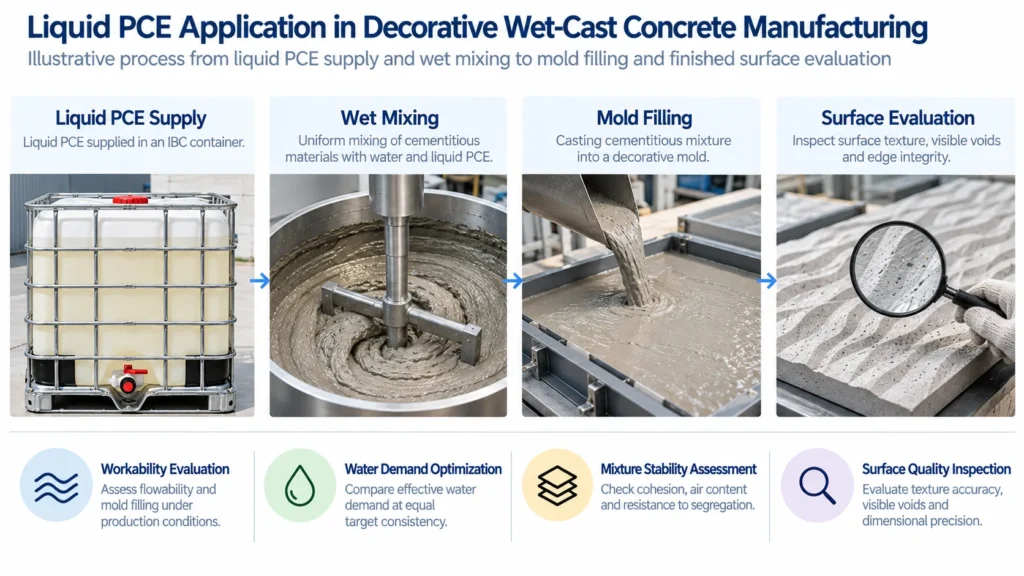
How PCE Liquid Controls Workability
Liquid PCE contains polycarboxylate-based dispersing polymers in an aqueous formulation.
The principal mechanism involves polymer adsorption onto cementitious particle surfaces and steric effects that reduce particle flocculation.
Improved dispersion allows the available mixing water to contribute more effectively to fresh-mixture mobility.
1. Improving Flow at Constant Water Content
Where the reference mortar is too stiff to fill detailed molds, an appropriate liquid PCE dosage may improve its flow without increasing effective water content.
This approach can be evaluated while keeping the cement, sand, water and other ingredients constant.
The improvement should be assessed together with cohesion, bleeding and segregation behavior.
2. Reducing Water at Comparable Consistency
Where reduced water demand is the main objective, compare mixtures at a defined target consistency.
The reference and PCE-modified mixtures should use comparable materials and controlled mixing procedures.
Any calculated water reduction must be based on measured effective water content, not merely on a change in admixture dosage.
Lower water content is beneficial only if the resulting mixture continues to meet the required casting and hardened-performance criteria.
3. Flowability and Viscosity Must Be Considered Together
Fresh cementitious mixtures exhibit rheological behavior that cannot be represented completely by one flow test.
Yield stress influences the initiation of flow, while plastic viscosity describes resistance during continued movement within an applicable rheological model.
A liquid PCE can change these properties through particle dispersion.
However, excessive dispersion relative to the mixture's particle structure may contribute to instability.
For decorative casting, the selected formulation must balance mobility with adequate cohesion.
4. Why Cement and Fine Aggregate Matter
Liquid PCE performance depends on cement chemistry, cement fineness, sulfate balance, supplementary cementitious materials, aggregate characteristics and admixture chemistry.
Fine aggregates containing certain clay minerals can interfere with PCE dispersion.
If workability changes significantly after switching cement or sand suppliers, check material compatibility before automatically increasing liquid PCE dosage.
Selecting the Right POLYVIA™ Liquid PCE Grade
For decorative wet-cast production, liquid PCE selection should begin with the main manufacturing problem.
The initial candidate is often a high water-reduction grade, while early-strength or slump-retention functionality can be evaluated when the production process requires it.
1. HWR50 and HWR40 — Initial Water-Reduction Candidates
POLYVIA™ HWR50 and HWR40 are liquid PCE grades oriented toward high water reduction.
They are appropriate initial screening candidates when the manufacturer needs better workability at controlled water content.
The nominal solids contents are approximately 50% and 40%, respectively, subject to the actual product specification.
HWR50 and HWR40 should not be compared solely by the mass of commercial liquid added.
Different concentrations require appropriate conversion, and their actual dispersion efficiencies must be verified.
A higher solids content does not automatically establish superior performance in decorative cement mortar.
2. ES50 and ES40 — Candidates for Early-Strength-Oriented Production
When a production line aims to shorten mold turnover, early-strength-oriented liquid PCE may be evaluated alongside an HWR grade.
POLYVIA™ ES50 and ES40 are potential candidates for this purpose.
However, liquid PCE cannot independently guarantee a specific demolding time.
Early-age performance depends on cement hydration, effective water content, temperature history, component geometry and handling requirements.
The selected mixture must retain sufficient casting time while meeting the actual release criteria.
3. SR50 and SR40 — When Workability Retention Is Necessary
Slump-retention-oriented liquid PCE may be useful where mixed material remains in a holding vessel or is distributed across several casting stations.
The required retention period should match the actual production schedule.
Where the mixture is placed immediately after mixing, additional retention functionality may provide limited benefit.
The effect on setting and early-age performance should also be evaluated.
4. Application-Based Grade Selection
| Manufacturing requirement | Initial liquid PCE candidate | Main trial criteria |
|---|---|---|
| Low initial flow | HWR50 / HWR40 | Flow, cohesion and stability |
| Reduce water at target consistency | HWR50 / HWR40 | Effective water demand |
| Short production cycle | Compare HWR with ES50 / ES40 | Workability and early-age performance |
| Extended casting interval | SR50 / SR40 | Timed flow retention and setting |
| Unstable mixture | Review formulation before changing grade | Bleeding, segregation and particle grading |
These recommendations are starting points for evaluation, not claims that the listed products have already been validated for every decorative precast formulation.
For detailed product characteristics, see POLYVIA™ PCE Liquid.
How to Dose Liquid PCE Correctly
Liquid PCE dosing requires accurate product identification, concentration control, effective-water correction and consistent mixing.
This is particularly important when comparing products with different nominal solids contents.
1. Dose by Mass for Controlled Laboratory Comparisons
For laboratory trials, weighing liquid PCE is generally preferable to using uncalibrated volume measurements.
Commercial-product dosage can be expressed as:
Liquid PCE Dosage (%) = Mass of Liquid PCE / Mass of Cementitious Materials × 100
The dosage basis must be stated clearly.
A dosage calculated from commercial liquid mass cannot be directly compared with a powder dosage calculated from dry product mass unless the relevant composition is accounted for.
For factory volumetric dosing, the product density and dosing system must be calibrated at the relevant conditions.
2. Understand the Difference Between 50% and 40% Solids
Consider a simplified calculation involving two hypothetical liquid PCE preparations.
Suppose the objective is to introduce 100 g of total nonvolatile solids.
At 50% solids:
100 / 0.50 = 200 g of liquid product
At 40% solids:
100 / 0.40 = 250 g of liquid product
| Calculation | 50% solids liquid | 40% solids liquid |
|---|---|---|
| Target nonvolatile solids | 100 g | 100 g |
| Required liquid product | 200 g | 250 g |
| Assumed volatile fraction | 100 g | 150 g |
This calculation assumes the volatile fraction is water and that the stated concentrations are exact.
It illustrates mass balance only.
Equal total solids do not necessarily mean equal active PCE polymer content or equal dispersion performance.
Different liquid PCE grades may contain different polymer structures or auxiliary ingredients.
Therefore, this 1.25 mass-conversion factor must not be treated as a proven functional substitution ratio between HWR50 and HWR40.
3. Account for Water Introduced by Liquid PCE
Liquid PCE contributes water to the mixture.
For a simplified aqueous product containing 50% solids by mass:
Water from Liquid PCE = Liquid PCE Mass × 0.50
For example, 200 g of such a liquid contributes approximately 100 g of water under the stated assumptions.
This quantity should be included in the total mixing-water calculation.
When comparing different liquid concentrations, failure to correct for carrier water can distort the interpretation of water-reduction performance.
4. Correct Aggregate Moisture
Fine aggregate moisture can significantly affect decorative mortar consistency.
For aggregates referenced to the saturated-surface-dry condition, effective water includes free surface moisture above SSD.
If aggregates are below SSD, their absorption demand must be considered.
The laboratory should document the moisture reference condition and apply the same accounting method throughout the trial program.
5. Use a Consistent Addition Sequence
The appropriate liquid PCE addition sequence depends on product formulation, mixer performance and cementitious materials.
A controlled initial approach is:
- Introduce cementitious materials and aggregates according to the established mixing procedure.
- Add a measured portion of the mixing water and begin wet mixing.
- Introduce the weighed liquid PCE into the wetted mixture or through the remaining mixing water, according to the product's verified instructions.
- Continue mixing until the material is adequately homogeneous.
- Measure consistency at a defined elapsed time.
Avoid pouring concentrated liquid PCE onto dry cement or dry aggregate unless the specific product procedure has been validated for that sequence.
Do not assume that changing the addition sequence is performance-neutral.
Mixing duration, addition timing and water distribution should remain constant during comparative trials.
If other admixtures are used, confirm compatibility and the appropriate addition procedure before combining them. Do not premix concentrated products merely because both are liquids.
Practical Liquid PCE Optimization Program
The following program is intended for manufacturers developing or improving a decorative wet-cast mortar or concrete formulation.
It is a proposed engineering test method, not a record of completed POLYVIA™ experiments.
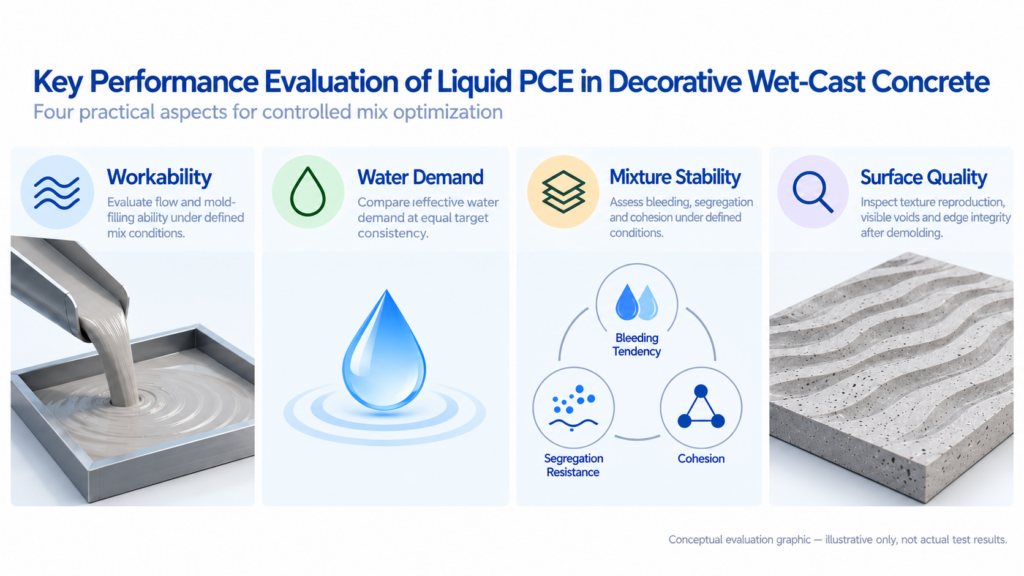
Once the key performance criteria are defined, liquid PCE optimization should proceed through a controlled testing sequence. The following workflow separates dosage screening from water-demand comparison and final product validation.
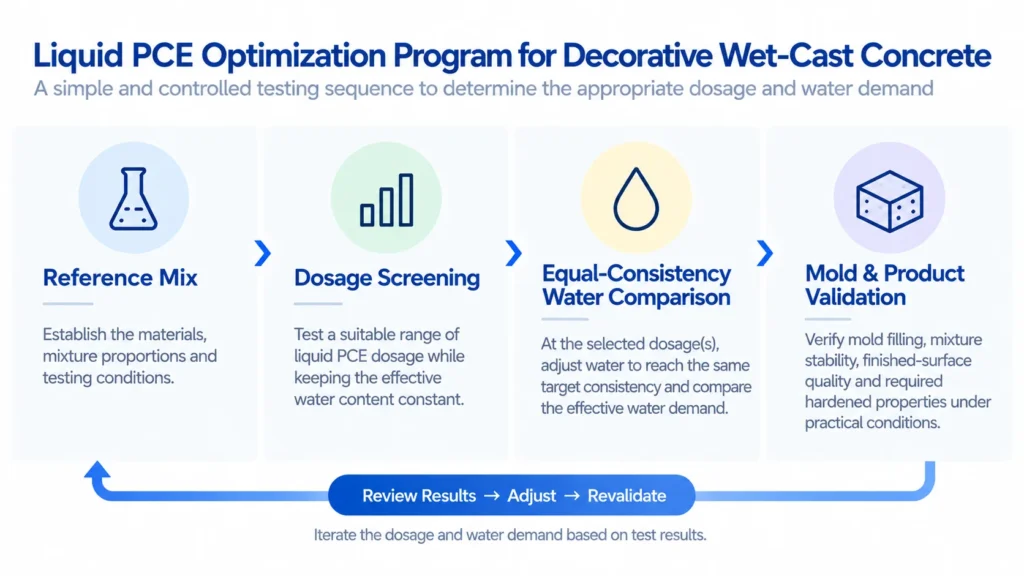
Stage A — Establish a Controlled Reference Mixture
Prepare a representative reference formulation using the intended cement, aggregates, pigments and other approved materials.
Record:
Cementitious material type and mass.
Aggregate grading, absorption and moisture.
Effective mixing water.
Existing admixture identities and dosage.
Mixer type, mixing sequence and duration.
Material temperature.
Initial consistency and stability.
Representative casting performance.
The reference mixture must be repeatable before it is used for comparative testing.
Stage B — Screen Liquid PCE Dosage at Constant Effective Water
Select HWR50 or HWR40 as the initial candidate.
Establish an appropriate dosage range from the actual product's technical guidance and preliminary compatibility assessment.
Prepare several batches while maintaining constant effective water, cementitious materials, aggregate proportions and mixing conditions.
Change only the selected liquid PCE dosage and make the necessary correction for its contribution to effective water.
Record the results using a consistent test method and measurement timing.
| Trial record | Measurement or observation |
|---|---|
| Liquid PCE dosage | Mass and percentage of cementitious materials |
| Product identification | Grade, batch and specified solids |
| Effective water | Total corrected mixing-water mass |
| Initial consistency | Method, result and elapsed time |
| Consistency at casting time | Same documented method |
| Stability | Bleeding, segregation and settlement |
| Mixing conditions | Temperature, sequence and time |
The useful dosage range is the range that improves casting suitability without unacceptable instability or unnecessary admixture consumption.
Stage C — Compare Water Demand at Equal Target Consistency
After identifying promising dosage conditions, establish a suitable target consistency.
For each candidate condition, determine the effective water mass necessary to reach the defined target within an agreed measurement tolerance.
The percentage change in effective water demand is calculated as:
Water Reduction (%) = (Reference Effective Water − Trial Effective Water) / Reference Effective Water × 100
For example:
Reference effective water: 4.00 kg
Trial effective water: 3.80 kg
Calculated reduction: 5.0%
These figures illustrate the calculation method only. They are not a tested POLYVIA performance result.
Both mixtures must meet comparable consistency requirements, and the trial must maintain appropriate control over materials, proportions and stability.
Stage D — Compare HWR50 and HWR40 Correctly
When comparing HWR50 and HWR40, first determine whether the objective is to compare:
Equal commercial-product mass.
Equal total nonvolatile solids.
Equal verified active-polymer dosage.
Equal target casting consistency.
These are different comparison bases and may produce different conclusions.
For application qualification, the most meaningful practical comparison is often the product dosage and effective water requirement needed to satisfy the same defined casting and product-performance criteria.
Record the actual liquid product consumption and concentration for each accepted formulation.
Stage E — Validate Representative Mold Filling
Use a mold representing the intended product's geometry and surface texture.
Keep the casting procedure consistent.
Examine:
Filling of narrow grooves and corners.
Reproduction of detailed textures.
Visible surface voids after demolding.
Evidence of bleeding or segregation.
Edge and corner integrity.
Surface appearance after curing and drying.
The best laboratory flow value should not automatically determine the preferred formulation.
Stage F — Confirm Hardened and Production Performance
Test the required hardened properties using methods appropriate to the material and finished product.
Where early demolding is required, apply suitable release-age acceptance criteria and evaluate representative product handling.
Repeat the selected formulation under actual or representative production conditions before adopting it for routine manufacturing.
Mold Filling and Surface Stability with Liquid PCE
Liquid PCE can improve mixture mobility, but finished decorative quality depends on the complete casting system.
1. Filling Detailed Silicone Molds
Flexible silicone molds are often used to reproduce architectural textures.
Their recessed features, corners and surface details may create locations where mortar flow is restricted or air becomes trapped.
Adequate PCE dispersion can assist mixture mobility, but successful filling also depends on paste volume, aggregate grading, viscosity and placement procedure.
When mold details are not fully reproduced, determine whether the dominant limitation is mixture mobility, trapped air or inadequate consolidation.
2. Preventing Excessive Bleeding and Segregation
Increasing liquid PCE dosage may improve fluidity, but excessive dispersion relative to the mixture's cohesion can lead to instability.
Potential symptoms include water separation, sand settlement and nonuniform paste distribution.
These defects should be investigated through controlled dosage and mixture-design adjustments.
Do not increase liquid PCE simply to maximize spread diameter.
3. Understanding Surface Bubbles
Visible surface voids can originate from mixing, placing, consolidation and mold-interface conditions.
Liquid PCE may affect rheology and air behavior, but it is not a dedicated air-removal solution.
If adequate flow is already achieved, additional PCE may not resolve surface voids and may introduce other problems.
Review the mixing procedure, mold orientation, release-agent application and consolidation method before changing the admixture dosage.
4. Adjusting Consolidation
The appropriate vibration or consolidation procedure depends on mixture consistency and product geometry.
Insufficient consolidation can leave cavities or incompletely filled details.
Excessive consolidation can cause settlement and paste migration in unstable mixtures.
Establish a repeatable procedure using representative molds and the actual production equipment.
Troubleshooting Liquid PCE in Decorative Wet Casting
When a production problem occurs, identify the dominant cause before changing the admixture formulation.
| Observed problem | First checks | Recommended direction |
|---|---|---|
| Low initial flow | Effective water, HWR dosage, mixing | Evaluate controlled dosage adjustment |
| Rapid flow loss | Cement compatibility, temperature, waiting time | Evaluate retention requirement |
| High flow with bleeding | Water content, cohesion, PCE dosage | Restore stability |
| Incomplete mold filling | Rheology, aggregate grading, trapped air | Conduct representative casting trials |
| Surface bubbles | Mixing, air, vibration, release agent | Investigate air management |
| Delayed hardening | Cement system, PCE dosage, other additives | Verify setting and early-age properties |
| Batch-to-batch variation | Sand moisture, liquid concentration, dosing | Improve raw-material and process control |
1. If HWR50 Does Not Provide Sufficient Flow
First verify the effective water calculation and liquid PCE dosage.
Check whether the product was distributed uniformly and whether mixing was sufficient.
Then evaluate a controlled adjustment within the product's suitable dosage range.
If the response remains inadequate, investigate cement compatibility and the mixture's fine-particle demand.
2. If the Mixture Loses Flow Too Quickly
Measure consistency at defined intervals rather than relying only on an initial reading.
Check material temperature, cement compatibility and the actual waiting period before casting.
Where extended retention is genuinely required, evaluate SR functionality.
Increasing HWR dosage may improve initial flow without adequately correcting the retention problem.
3. If the Mixture Is Too Fluid or Unstable
Review liquid PCE dosage and effective water content.
Return to a previously stable formulation and examine aggregate grading, paste structure and consolidation.
Do not accept an over-fluid mixture merely because it fills molds rapidly.
4. If Surface Quality Remains Poor
Determine whether the problem is incomplete filling, entrapped air, bleeding, pigment distribution or the mold interface.
These causes should not be treated as interchangeable.
The corrective measure must match the diagnosed problem.
Early-Strength and Short-Cycle Production Considerations
Some decorative precast factories operate with limited mold inventories and aim to shorten the interval between casting and demolding.
Where controlled-temperature curing is used, liquid PCE selection must be coordinated with cement hydration and the required release-age performance.
1. HWR and ES Grades Serve Different Selection Priorities
HWR-type liquid PCE is primarily evaluated for efficient dispersion and water reduction.
Early-strength-oriented liquid PCE is evaluated where early-age development is an additional formulation priority.
Neither designation guarantees a specific strength or demolding time.
The two grades should be compared using the actual cement, curing cycle and representative product requirements.
2. Setting Is Not the Same as Demolding Readiness
A cementitious mixture may have set without developing sufficient mechanical integrity for safe mold removal.
Demolding readiness depends on the finished component's geometry, strength, stiffness, edge condition and handling procedure.
A laboratory mortar-cube strength result alone cannot establish safe demolding of a thin or complex architectural product.
3. Evaluate the Actual Curing Process
When heated curing is used, document the curing temperature history, initial resting period, moisture conditions and cooling procedure.
The actual concrete or mortar temperature may differ from the curing chamber's air temperature.
Do not infer a guaranteed demolding time from the liquid PCE grade or nominal water-reduction capability.
Detailed curing and rapid-demolding optimization should be treated as a separate engineering topic.
Production Qualification and Quality Control
A liquid PCE formulation is ready for routine manufacturing only when it produces acceptable and repeatable results under representative production conditions.
1. Establish Measurable Acceptance Criteria
| Control parameter | Recommended verification |
|---|---|
| Liquid PCE concentration | Supplier specification and appropriate QC |
| Dosage accuracy | Calibrated weighing or dosing equipment |
| Aggregate moisture | Measurement and batch-water correction |
| Fresh consistency | Defined and repeatable test method |
| Workability retention | Measurement at required casting time |
| Mixture stability | Bleeding and segregation assessment |
| Mold filling | Representative product inspection |
| Surface appearance | Approved reference and defect criteria |
| Release properties | Product-specific acceptance criteria |
| Hardened performance | Applicable product specifications |
The acceptance limits must be developed for the actual decorative product.
They should not be copied from unrelated ready-mix concrete or structural precast applications.
2. Use Appropriate Testing Methods
For hydraulic-cement mortars within its scope, ASTM C1437 provides a standardized method for determining mortar flow.
Alternative spread procedures can be useful for internal comparative testing, but the method, equipment and timing must be documented.
Results obtained by different methods should not be treated as directly interchangeable.
Relevant hardened-property testing should be selected according to the mixture type and intended product.
3. Verify Scale-Up Performance
A formulation performing satisfactorily in a small laboratory mixer may behave differently in production equipment.
Before routine use, verify the effect of:
- Batch size and mixing efficiency.
- Liquid PCE addition sequence.
- Material temperature.
- Aggregate moisture variation.
- Time between mixing and placement.
- Mold preparation and consolidation.
- Curing and demolding conditions.
The approved production procedure should specify the conditions under which the formulation has been qualified.
4. Maintain Production Records
For each qualification trial, document the raw-material sources, effective water, liquid PCE grade and dosage, mixing conditions, consistency, casting behavior, surface appearance and required hardened properties.
Include unsuccessful trials and the corrective measures evaluated.
These records help identify the operating range that produces stable, repeatable manufacturing performance.
Final Engineering Recommendations
For decorative wet-cast concrete cladding, liquid PCE is a practical supply form because it can be incorporated into controlled wet-mixing operations without a separate dry-powder dissolution process.
The first technical priority is to select a compatible HWR grade and establish reliable fresh-mixture performance.
POLYVIA™ HWR50 and HWR40 are appropriate initial candidates for controlled evaluation.
Where early mold turnover or extended workability retention is required, ES or SR grades may be compared under the actual production conditions.
Liquid PCE dosing must account for product concentration, carrier water and aggregate moisture.
Laboratory screening should separate dosage optimization from equal-consistency water-demand comparison.
Representative mold trials should then confirm filling ability, mixture stability and finished surface quality.
Finally, the selected formulation must satisfy the finished product's mechanical requirements and demonstrate acceptable production repeatability.
The optimum liquid PCE formulation is not the one that produces the highest initial flow. It is the one that delivers reliable mold filling, adequate stability and consistent decorative product quality at an efficient water and admixture demand.
For application-specific evaluation, manufacturers can contact the POLYVIA™ technical team with their cement type, aggregate characteristics, existing admixtures, mold details and production requirements.
Frequently Asked Questions
1. Is liquid PCE suitable for decorative precast concrete cladding?
Yes. Liquid PCE is a practical admixture supply form for wet-cast decorative concrete and cementitious mortar. It can be incorporated into controlled wet-mixing operations, subject to grade compatibility and production trials.
2. Which POLYVIA liquid PCE grade should be tested first?
HWR50 or HWR40 is a reasonable initial candidate when the main objective is improved workability and controlled water demand. ES or SR grades may be evaluated where early-strength or retention requirements justify them.
3. What is the difference between HWR50 and HWR40?
They are nominally different solids-concentration versions within the high water-reduction category. Actual product consumption and performance must be evaluated using the verified composition and the intended cementitious system. Higher solids content alone does not guarantee better dispersion.
4. How much liquid PCE should be added to decorative cement mortar?
There is no universal dosage. The correct amount depends on product concentration, polymer chemistry, cement compatibility, aggregate characteristics and the required casting performance. Establish dosage through controlled trials using the selected product's technical guidance.
5. Should liquid PCE be added before or after mixing water?
The correct sequence depends on the product and mixer. A suitable initial trial procedure is to introduce liquid PCE into the mixing water or wetted mixture, followed by sufficient mixing for uniform distribution. The selected sequence must be verified and kept consistent.
6. Does liquid PCE improve silicone mold filling?
A compatible liquid PCE can improve cementitious particle dispersion and fresh-mixture mobility, potentially supporting better mold filling. However, actual results depend on mixture rheology, aggregate grading, mold geometry, placement and consolidation.
7. Can liquid PCE eliminate surface bubbles?
No. Surface voids may be associated with entrapped air, mixing conditions, consolidation, mold geometry and release-agent application. Liquid PCE is not a universal substitute for air-management control.
8. Can early-strength liquid PCE guarantee rapid demolding?
No. Early-strength-oriented liquid PCE may be evaluated for short-cycle production, but demolding readiness must be confirmed using the actual mixture, curing process, product geometry and handling requirements.
Technical References
1. ASTM C1437-26 — Standard Test Method for Flow of Hydraulic Cement Mortar. ASTM International.
https://store.astm.org/c1437-26.html
2. ASTM C109/C109M — Standard Test Method for Compressive Strength of Hydraulic Cement Mortars (Using 2-in. or [50-mm] Cube Specimens). ASTM International.
https://www.astm.org/
3. ACI 212.3R — Report on Chemical Admixtures for Concrete. American Concrete Institute.
https://www.concrete.org/
4. PCI MNL-117 — Manual for Quality Control for Plants and Production of Architectural Precast Concrete Products. Precast/Prestressed Concrete Institute.
https://www.pci.org/
5. Plank, J., Sakai, E., Miao, C. W., Yu, C., & Hong, J. X. (2015). Chemical admixtures—Chemistry, applications and their impact on concrete microstructure and durability. Cement and Concrete Research, 78, 81–99.
Technical Note: This article provides engineering guidance for selecting and evaluating liquid PCE in wet-cast cementitious systems. Product grade recommendations are initial screening suggestions, not validated performance guarantees. Numerical examples illustrate mass balance and calculation methods; they are not POLYVIA™ decorative precast test results.