
ile Adhesive Formula: 1,000 kg Dry-Mix Recipes, Raw Materials and Performance Testing
Four Practical Reference Formulas for C1, C1TE, C2 and C2TE
Explore four mass-balanced 1,000 kg tile adhesive formulations derived from years of practical dry-mix mortar experience in China. Compare the exact cement, silica sand, RDP and HPMC dosages, understand their technical functions, and discover how to evaluate adhesive performance before commercial production.
Introduction
A practical tile adhesive formula combines cement, graded silica sand, Redispersible Polymer Powder (RDP), Hydroxypropyl Methylcellulose (HPMC), and selected functional additives. For a 1,000 kg dry-mix batch, the ingredient quantities depend on the intended adhesive classification, material compatibility, and application requirements. This guide provides four complete, mass-balanced reference formulations targeting C1, C1TE, C2, and C2TE cementitious tile adhesives.
The POLYVIA™ formulations are derived from recipes with a history of practical use in China's dry-mix mortar market. Selected quantities have been rounded and rebalanced to produce easy-to-follow 1,000 kg reference batches.
These published compositions are practical starting points for formulation development. They should not be treated as independently retested copies of the original production recipes or as evidence of conformity with EN 12004 or ISO 13007.
1,000 kg Tile Adhesive Formulas: C1, C1TE, C2 and C2TE
A typical cementitious tile adhesive contains a hydraulic binder, graded mineral aggregates, polymer powder, cellulose ether, and functional additives selected to achieve the required fresh-mortar and hardened properties.
The following four formulas provide exact ingredient quantities for a 1,000 kg dry-mix batch.
1. POLYVIA™ Tile Adhesive Reference Formulations
Four Tile Adhesive Recipes — kg per 1,000 kg Dry Mix
| Raw Material | C1 | C1TE | C2 | C2TE |
|---|---|---|---|---|
| CEM I 42.5R Cement | 360 | 351 | 376 | 369 |
| Silica Sand, 40–70 mesh | 340 | 341 | 317 | 319 |
| Silica Sand, 70–120 mesh | 279.5 | 281 | 267 | 258 |
| VAE Redispersible Polymer Powder (RDP) | 12 | 16 | 25 | 35 |
| Hydroxypropyl Methylcellulose (HPMC) | 3.5 | 4.0 | 4.0 | 4.5 |
| Calcium Formate | 3.0 | 3.0 | 7.0 | 7.0 |
| Hydroxypropyl Starch Ether (HPS) | 1.5 | 2.5 | 2.0 | 3.5 |
| Wood Fiber (Optional) | — | 1.0 | — | 2.0 |
| Defoamer (Optional) | 0.5 | 0.5 | 2.0 | 2.0 |
| Total Dry Mix (kg) | 1,000 | 1,000 | 1,000 | 1,000 |
Formulation notes
- Each formulation totals exactly 1,000 kg, including the listed optional ingredients.
- Dosages refer to the mass of commercial dry materials.
- Mixing water is added separately and is not included in the 1,000 kg total.
- Wood fiber and defoamer are optional components, not mandatory requirements of the relevant classification.
- C1, C1TE, C2, and C2TE identify intended performance targets. Actual classification requires appropriate testing.
The formulations reflect practical reference designs, not universal ingredient ratios prescribed by international standards.
2. Which Reference Formula Should You Choose?
Formula Selection Overview
| Formula | RDP Dosage | HPMC Dosage | Primary Qualification Target |
|---|---|---|---|
| C1 | 12 kg | 3.5 kg | Normal cementitious adhesion |
| C1TE | 16 kg | 4.0 kg | Normal adhesion, reduced slip, extended open time |
| C2 | 25 kg | 4.0 kg | Improved cementitious adhesion |
| C2TE | 35 kg | 4.5 kg | Improved adhesion, reduced slip, extended open time |
All quantities are expressed per 1,000 kg of dry mix.
The most appropriate starting formula depends on the target product classification, available raw materials, production cost, and installation requirements.
A higher RDP dosage does not automatically make one formulation suitable for every installation. Properties such as deformability, resistance to specific exposures, and compatibility with the installation system must be considered separately.
3. How Should Optional Additives Be Handled?
If an optional ingredient is omitted, an equivalent dry mass must be added elsewhere to preserve the 1,000 kg batch total.
For initial formulation trials, the 70–120 mesh silica sand fraction can serve as the mass-balancing component.
Fine Sand Adjustment When All Optional Additives Are Omitted
| Formula | Fine Sand in Reference Formula | Fine Sand Without Optional Additives |
|---|---|---|
| C1 | 279.5 kg | 280 kg |
| C1TE | 281 kg | 282.5 kg |
| C2 | 267 kg | 269 kg |
| C2TE | 258 kg | 262 kg |
All other non-optional ingredients remain unchanged.
These adjustments maintain the correct total dry mass but do not guarantee unchanged fresh-mortar or hardened properties.
Removing a defoamer may affect air content, while removing wood fiber may influence mortar structure, water demand, and application behavior. Each modified formula should therefore be evaluated as a separate trial variant.
Practical note: The approved reference compositions should remain unchanged in technical records. Any adjustment should be identified with a separate trial number or formulation revision.
Understanding C1, C1TE, C2 and C2TE Performance Requirements
C1, C1TE, C2, and C2TE are classifications based on finished-product performance, not ingredient percentages.
Under EN 12004-1:2017:
- C1 — Normal cementitious adhesive.
- C2 — Improved cementitious adhesive.
- T — Reduced slip.
- E — Extended open time.
For normal-setting cementitious adhesives, C1 and C2 are distinguished primarily by their specified tensile adhesion requirements.
1. C1 and C2 Adhesion Requirements
Selected EN 12004-1:2017 Classification Requirements
| Performance Property | C1 / C1TE | C2 / C2TE |
|---|---|---|
| Initial tensile adhesion strength | ≥0.5 MPa | ≥1.0 MPa |
| Adhesion after water immersion | ≥0.5 MPa | ≥1.0 MPa |
| Adhesion after heat ageing | ≥0.5 MPa | ≥1.0 MPa |
| Adhesion after freeze–thaw cycles | ≥0.5 MPa | ≥1.0 MPa |
| Basic open time, at least 20 minutes | ≥0.5 MPa | ≥0.5 MPa |
| Extended open time (E), at least 30 minutes | ≥0.5 MPa, where claimed | ≥0.5 MPa, where claimed |
| Reduced slip (T) | ≤0.5 mm, where claimed | ≤0.5 mm, where claimed |
The table summarizes selected requirements for normal-setting cementitious adhesives. The complete applicable standard governs test conditions, classification, and assessment.
An important distinction is that C1 adhesives must also meet the specified adhesion requirements after water immersion, heat ageing, and freeze–thaw cycling. Passing the initial adhesion test alone is not sufficient.
2. Extended Open Time Is Not the Same as Pot Life
Open time refers to the period after an adhesive has been applied during which a tile can still be placed and the required adhesion performance achieved under the specified test procedure.
Pot life describes how long the mixed material remains usable under defined conditions.
Adjustment time refers to the period during which a placed tile can be repositioned satisfactorily.
These properties are related to application behavior but are not interchangeable.
For the E designation, the required tensile adhesion must be demonstrated after an open time of at least 30 minutes.
Likewise, the T designation requires standardized slip testing. A mortar that simply appears thick or sticky does not automatically qualify.
3. Does C2TE Mean an Adhesive Is Suitable for Every Installation?
No.
C2TE describes improved adhesion with reduced slip and extended open time. It does not independently guarantee suitability for exterior façades, large-format tiles, permanently wet areas, heated floors, or moving substrates.
The complete installation system, including substrate, tile type, exposure conditions, and project requirements, must be considered.
Where a deformability classification such as S1 or S2 is required, it must be verified separately.
Tile Adhesive Raw Materials: Functions and Grade Selection
The performance of a dry-mix tile adhesive depends on how the raw materials interact.
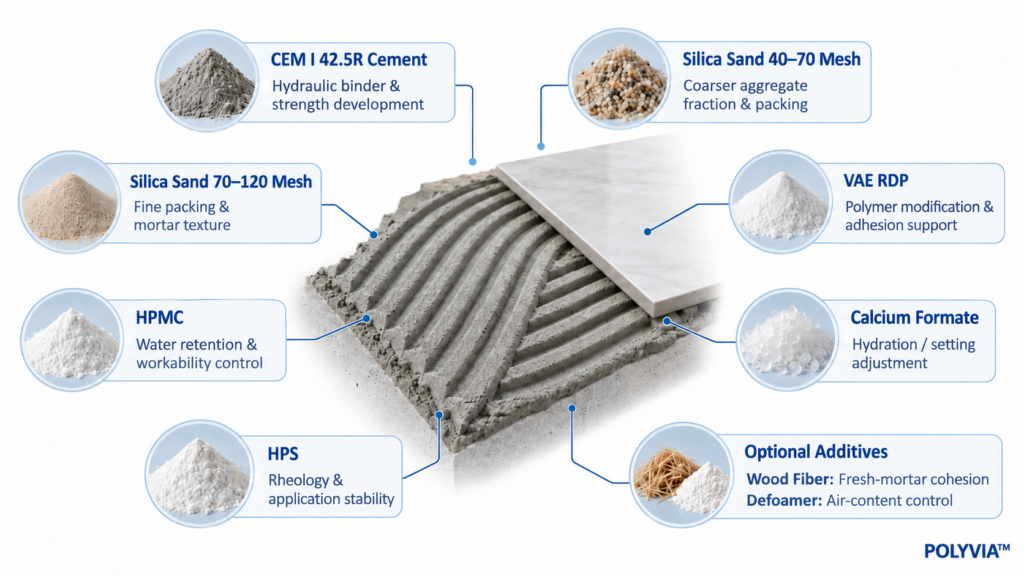
Cement provides the hydraulic binding system. Graded aggregates help establish mortar structure and application consistency. RDP modifies the cementitious matrix, while HPMC and HPS control important aspects of fresh-mortar behavior.
1. What Does Each Raw Material Do?
Main Raw Materials and Their Functions
| Ingredient | Primary Function | Key Selection Factors |
|---|---|---|
| CEM I 42.5R Cement | Hydraulic binding and strength development | Cement chemistry, fineness, setting, compatibility |
| Silica Sand 40–70 mesh | Coarser aggregate structure | Grading, particle shape, cleanliness |
| Silica Sand 70–120 mesh | Finer aggregate packing and mortar texture | Particle distribution, fines, water demand |
| VAE RDP | Polymer modification and adhesion-related performance | Polymer grade, redispersion, film formation |
| HPMC | Water retention and consistency control | Viscosity, substitution characteristics, compatibility |
| Calcium Formate | Modification of hydration and setting behavior | Cement compatibility, dosage, working time |
| HPS | Rheological control and application stability | Thickening behavior, grade, slip performance |
| Wood Fiber (Optional) | Fresh-mortar structure and cohesion | Fiber dimensions, dispersion, water demand |
| Defoamer (Optional) | Control of undesirable air entrainment | Compatibility, air content, application behavior |
2. Cement and Silica Sand
The reference formulas use 351–376 kg of CEM I 42.5R cement per metric ton of dry mix.
Cement strength class is only one selection parameter. Differences in clinker composition, sulfate balance, fineness, and setting characteristics may affect hydration, water demand, additive compatibility, and adhesion development.
The reference sand system combines two nominal particle-size fractions:
- 40–70 mesh: a coarser aggregate fraction.
- 70–120 mesh: a finer aggregate fraction.
The purpose is to obtain an appropriate aggregate structure and consistent application behavior.
However, mesh descriptions alone do not define the complete particle-size distribution. Sand particle shape, moisture, fine-particle content, and contamination should also be evaluated.
Manufacturers transferring the formulation to another production site should verify actual aggregate grading rather than assuming that identically labeled sand fractions are equivalent.
3. VAE Redispersible Polymer Powder
The four references use VAE RDP at 12, 16, 25, and 35 kg/MT.
After mixing with water, a suitable RDP redistributes polymer particles throughout the mortar. During hardening and drying, polymer film formation and interactions with the cementitious matrix can contribute to adhesion-related properties and mechanical behavior.
The effects depend on polymer chemistry, powder composition, cement compatibility, dosage, and curing conditions.
RDP selection should therefore focus on finished-mortar performance rather than polymer dosage alone.
4. HPMC: Confirmed Viscosity and Application Function
The POLYVIA™ reference formulations use hydroxypropyl methylcellulose (HPMC) with a viscosity of 50,000–100,000 mPa·s, measured using a Brookfield viscometer at 20°C in a 2% aqueous solution.
The HPMC quantities are:
| Formula | HPMC Dosage |
|---|---|
| C1 | 3.5 kg/MT |
| C1TE | 4.0 kg/MT |
| C2 | 4.0 kg/MT |
| C2TE | 4.5 kg/MT |
HPMC supports water retention, mixing consistency, trowelability, and application stability.
Its water-retention function is particularly important because the applied mortar may lose water through evaporation or absorption into the substrate.
However, higher HPMC viscosity does not automatically mean better tile adhesive performance.
Excessive or unsuitable rheological modification may increase spreading resistance and reduce effective tile contact.
The confirmed viscosity range should be interpreted with its measurement conditions. More precise grade-to-grade comparison may require the Brookfield spindle and rotational speed specified in the supplier's complete test procedure.
5. Calcium Formate, HPS and Optional Additives
Calcium Formate
The C1/C1TE references contain 3 kg/MT, while the C2/C2TE references contain 7 kg/MT.
Calcium formate may influence cement hydration and early strength development, but the response is cement-dependent.
For a formulation targeting extended open time, its effect on setting and working time must be evaluated rather than assumed to be beneficial.
Hydroxypropyl Starch Ether (HPS)
The HPS addition rates range from 1.5 to 3.5 kg/MT.
HPS contributes rheological modification and may influence fresh-mortar stability and tile slip.
These quantities are specific to the reference designs. Their suitability depends on the commercial HPS grade and its interaction with HPMC, cement, and the rest of the formulation.
Wood Fiber
Wood fiber is optional in the C1TE and C2TE reference designs. It may influence mortar cohesion, fresh-state structure, and water demand.
Defoamer
Defoamer is optional in all four designs.
The C2 and C2TE references each list 2 kg/MT. These higher quantities should not be regarded as universal recommendations for all defoamer products.
The need for defoamer, its compatibility, and its effects on air content and adhesion should be assessed using the actual commercial grade.
RDP Dosage: How Much Polymer Powder Is Needed?
RDP is one of the most important formulation variables in polymer-modified cementitious tile adhesives.
However, different RDP dosage calculations can produce very different-looking percentages.
1. RDP Percentage of Dry Mix vs. Cement
RDP / Dry Mix (%) = RDP Powder Mass ÷ Total Dry-Mix Mass × 100
RDP / Cement (%) = RDP Powder Mass ÷ Cement Mass × 100
RDP Dosage Comparison
| Formula | Cement (kg) | RDP (kg) | RDP / Dry Mix | RDP / Cement |
|---|---|---|---|---|
| C1 | 360 | 12 | 1.20% | 3.33% |
| C1TE | 351 | 16 | 1.60% | 4.56% |
| C2 | 376 | 25 | 2.50% | 6.65% |
| C2TE | 369 | 35 | 3.50% | 9.49% |
Both ratios are calculated using the mass of commercial RDP powder. The RDP-to-cement values are not precise active-polymer-to-cement ratios unless the active-polymer content of each powder is taken into account.
2. Does Higher RDP Dosage Always Improve Performance?
Not necessarily.
Increasing RDP can modify the polymer-to-cementitious-material balance and influence adhesion, cohesion, rheology, air entrainment, and cost.
However, improvements are not automatically proportional to dosage.
For example, a higher RDP addition may provide limited benefit if the polymer grade is unsuitable for the cement system or if inadequate tile wetting controls the failure.
There is also no universal minimum RDP dosage in EN 12004 or ISO 13007 that independently guarantees C1 or C2 classification.
The correct dosage must be evaluated through finished-adhesive performance tests.
3. Practical RDP Grade Selection
Manufacturers should compare RDP grades according to:
- Polymer chemistry and film-forming behavior.
- Compatibility with the selected cement.
- Redispersion and commercial powder characteristics.
- Effects on mixing consistency and air content.
- Adhesion after required conditioning procedures.
- Total formulation cost at the qualified dosage.
Glass transition temperature (Tg) and minimum film-forming temperature (MFFT) can support grade screening but do not independently predict tile adhesive classification.
A useful first comparison is to test candidate RDP grades at the same commercial powder dosage while holding the other ingredients and testing conditions constant.
Only after grade compatibility has been assessed should separate dosage optimization be performed.
Selection principle: The objective is not the highest polymer addition, but a suitable RDP grade and dosage that allow the complete formulation to achieve the required performance reliably and economically.
HPMC and Starch Ether: Balancing Workability, Slip and Open Time
HPMC and HPS influence mortar behavior during mixing, trowelling, ridge formation, and tile placement.
Their functions overlap in rheology but are not identical.
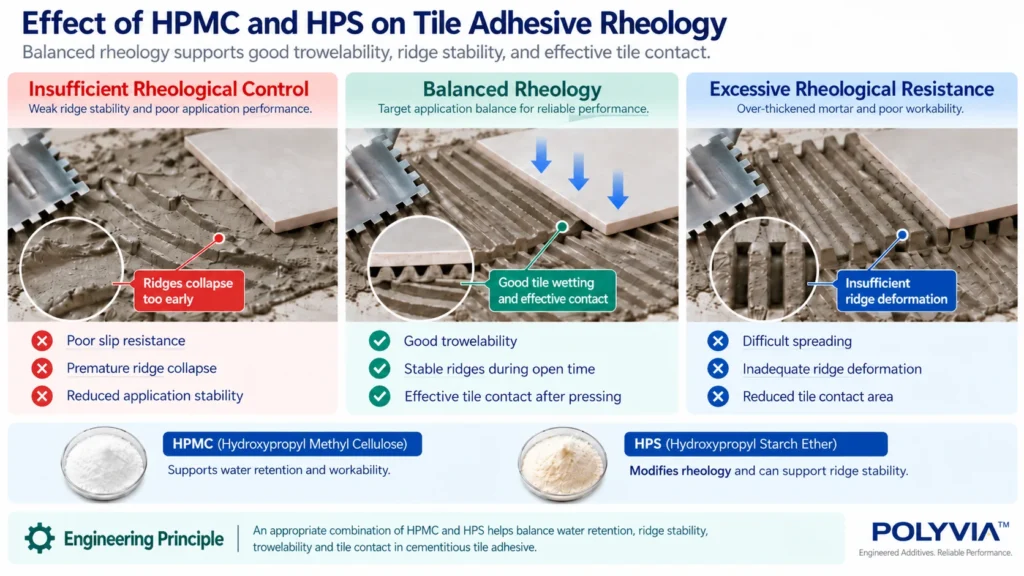
HPMC primarily contributes water retention and consistency control, while HPS provides additional rheological modification that may influence application stability and slip resistance.
1. HPMC–HPS Quantities in the Four Formulas
HPMC and HPS Dosages
| Formula | HPMC (kg) | HPS (kg) | Combined Dosage |
|---|---|---|---|
| C1 | 3.5 | 1.5 | 5.0 kg |
| C1TE | 4.0 | 2.5 | 6.5 kg |
| C2 | 4.0 | 2.0 | 6.0 kg |
| C2TE | 4.5 | 3.5 | 8.0 kg |
The HPMC grades fall within the specified 50,000–100,000 mPa·s Brookfield viscosity range (2% aqueous solution, 20°C).
These addition rates are formulation-specific and should not be interpreted as universal recommendations for every HPMC or HPS product.
2. Why Good Water Retention Does Not Guarantee Extended Open Time
Water retention helps limit premature moisture loss from the adhesive during application.
Nevertheless, extended open-time adhesion also depends on:
- Surface drying and skin formation.
- Cement hydration and setting behavior.
- Tile wetting and adhesive transfer.
- RDP and additive compatibility.
- Ambient temperature, humidity, and airflow.
A mortar may demonstrate good water retention but still fail the standardized E test.
Therefore, water retention should be used as one formulation indicator rather than a substitute for open-time adhesion testing.
3. Why Maximum Viscosity Is Not the Goal
Wall-tile adhesive should resist excessive downward movement after placement, yet remain workable enough to spread and establish sufficient contact with the tile.
If rheological resistance is too low, the adhesive may lack ridge stability or allow tile slip.
If it is too high, the adhesive may become difficult to spread, and the ridges may not collapse adequately when the tile is pressed into place.
The desired behavior is a balance of:
- Trowelability.
- Water retention.
- Adhesive ridge stability.
- Tile wetting and transfer.
- Reduced slip, where required.
- Adequate open-time adhesion.
For C1TE and C2TE products, both T and E performance must be established through the relevant tests.
Mixing Water: How Much Should Be Added?
The 1,000 kg reference formulas describe dry ingredients only.
The appropriate mixing-water quantity depends on the cement, aggregate grading, RDP and cellulose ether grades, desired application consistency, and preparation procedure.
1. Understanding the Water-to-Dry-Mix Ratio
Water-to-Dry-Mix Ratio (%) = Water Mass ÷ Dry Powder Mass × 100
The following values illustrate how a water ratio translates into practical batch quantities.
Illustrative Water-Dosage Calculations
| Water / Dry Mix | Water for 1 kg Dry Powder | Water for 25 kg Dry Powder | Water for 1,000 kg Dry Powder |
|---|---|---|---|
| 21% | 210 g | 5.25 kg | 210 kg |
| 22% | 220 g | 5.50 kg | 220 kg |
| 23% | 230 g | 5.75 kg | 230 kg |
| 24% | 240 g | 6.00 kg | 240 kg |
Important: The 21–24% values are calculation examples and a possible laboratory screening arrangement. They are not measured water requirements, approved operating ranges, or validated mixing instructions for the four POLYVIA™ reference formulas.
2. Determining the Correct Water Dosage
A practical laboratory procedure should:
- Prepare a representative dry-mix sample using the reference formula.
- Select and record an initial water dosage.
- Mix using controlled equipment and consistent preparation conditions.
- Evaluate spreading, ridge stability, consistency, and tile contact.
- Compare separate trial batches with defined water variations.
- Verify the relevant adhesion, open-time, and slip requirements using the selected water dosage.
Preparation details such as mixing sequence, mixing duration, resting period, and remixing should be recorded.
Where standardized testing is performed, the applicable standard's preparation procedure must be followed.
3. What Happens If the Water Dosage Is Incorrect?
Insufficient mixing water may produce stiff mortar, high spreading resistance, and inadequate tile contact.
Excessive water may cause ridge slump, reduced application stability, or undesirable changes in hardened properties.
Adding water to mortar after it has stiffened does not necessarily restore its original performance.
A commercial adhesive should be supplied with water-addition instructions established using the final qualified formulation, not a generic water percentage copied from another product.
Formula Adjustment and Troubleshooting
A tile adhesive reference formula should be used as a controlled baseline when changes are required.
The first step is to identify the actual performance problem rather than automatically increasing water, polymer powder, or cellulose ether.
1. Practical Troubleshooting Guide
Common Tile Adhesive Problems and Initial Checks
| Problem | Possible Contributing Factors | Recommended First Evaluation |
|---|---|---|
| Difficult spreading | Water demand, sand grading, HPMC/HPS characteristics | Check water dosage and consistency |
| Excessive stickiness | Rheology system or additive interaction | Compare HPMC and HPS grades |
| Poor ridge stability | Water content, aggregate grading, rheology | Evaluate fresh-mortar structure |
| Tile slip | Insufficient structural resistance | Check rheology and standardized slip |
| Poor tile contact | Stiff mortar, inadequate ridge collapse, surface drying | Inspect tile transfer |
| Rapid surface drying | Low water retention, heat, airflow, absorbent substrate | Review HPMC system and site conditions |
| Low adhesion after water immersion | Polymer compatibility, mortar structure, test conditions | Review RDP grade and conditioning results |
| Inconsistent production | Raw-material variation, weighing, mixing | Audit production controls |
These are initial investigation priorities, not confirmed diagnoses.
2. Adjusting a Formula While Maintaining 1,000 kg
When the quantity of an additive changes, the mass of another ingredient must be adjusted to retain the correct batch total.
For example, the C2 reference formulation contains:
- RDP: 25 kg.
- Silica sand, 70–120 mesh: 267 kg.
A separate experimental variant using 27 kg RDP and 265 kg fine sand would still total 1,000 kg, provided the remaining ingredients are unchanged.
This example illustrates mass balancing only. It is not a recommendation to modify the approved C2 formula.
The revised material must be evaluated because the adjustment may influence workability, adhesion, and other properties.
3. A Controlled Formula Adjustment Method
Step 01 — Identify the performance gap. Define whether the problem concerns consistency, slip, open time, initial adhesion, conditioned adhesion, or production repeatability.
Step 02 — Confirm the baseline. Use documented raw materials, water dosage, and preparation conditions.
Step 03 — Change a controlled variable. Evaluate an appropriate grade or dosage change while keeping unrelated variables stable where practical.
Step 04 — Verify the trade-offs. Check whether improvements in one property have compromised other required characteristics.
Once individual variables have been evaluated, structured multivariable trials may be used to investigate interactions.
A successful formulation adjustment must improve the relevant property without creating unacceptable losses elsewhere.
Performance Testing Under EN 12004 and ISO 13007
A tile adhesive classification must be supported by finished-product test results.
A formulation's history of practical use does not eliminate the need to confirm the relevant performance requirements when claiming conformity with an international standard.
1. Classification Standards and Test Methods
Relevant Technical Standards
| Standard | Main Purpose |
|---|---|
| EN 12004-1:2017 | Product requirements, classification, and related conformity provisions |
| EN 12004-2:2017 | Test methods for ceramic tile adhesives |
| ISO 13007-1:2014 | Terms, definitions, and adhesive specifications |
| ISO 13007-2:2013 | Test methods for adhesives |
EN 12004-2:2017 addresses open time in Section 8.1, slip in Section 8.2, tensile adhesion of cementitious adhesives in Section 8.3, and transverse deformation in Section 8.6.
The laboratory must follow the complete applicable procedures for specimen preparation, conditioning, equipment, measurement, and result evaluation.
2. Qualification Plan for the Four Formulas
Performance Verification Matrix
| Test / Property | C1 | C1TE | C2 | C2TE |
|---|---|---|---|---|
| Initial tensile adhesion | Required | Required | Required | Required |
| Adhesion after water immersion | Required | Required | Required | Required |
| Adhesion after heat ageing | Required | Required | Required | Required |
| Adhesion after freeze–thaw cycles | Required | Required | Required | Required |
| Basic open time | Required | Required | Required | Required |
| Extended open time (E) | — | Required | — | Required |
| Reduced slip (T) | — | Required | — | Required |
| Transverse deformation (S1/S2) | If specified | If specified | If specified | If specified |
The matrix summarizes key requirements for the stated classification targets. The full applicable standard determines the complete test program and reporting requirements.
Passing initial tensile adhesion is insufficient if another mandatory adhesion condition fails.
A C1TE or C2TE formula must also demonstrate the additional properties represented by T and E.
3. Test Records and Technical Evidence
Reliable qualification records should include:
- Formula version and complete ingredient quantities.
- Raw-material grades, suppliers, and batch numbers.
- Sand grading and material moisture conditions.
- Mixing-water dosage and preparation procedure.
- Test equipment and environmental conditions.
- Standard designation and edition.
- Individual test results and relevant failure observations.
- Final evaluation and approval status.
If a mandatory performance requirement is not met, the formulation should remain under development until corrective changes have been evaluated and the relevant tests repeated.
A technical data sheet for RDP or HPMC supports ingredient selection but does not establish the classification of the finished adhesive.
Similarly, a laboratory test report should not automatically be described as third-party certification unless the applicable certification or conformity-assessment basis has been demonstrated.
From Reference Formula to Commercial Production
A formulation that performs reliably with one set of raw materials may behave differently when transferred to another factory or country.
Changes in cement chemistry, sand grading, commercial additive grades, water quality, and mixing equipment can influence the complete adhesive system.
1. Adapting the Formula to Local Raw Materials
Before adopting one of the four POLYVIA™ references, a manufacturer should confirm:
Cement compatibility: Verify the local cement type, chemistry, setting characteristics, and interaction with the additives.
Aggregate grading: Confirm the actual sand particle-size distribution, moisture, cleanliness, and suitability for the intended mortar.
Additive equivalence: Assess the exact commercial RDP, HPMC, and HPS grades rather than assuming products with similar generic descriptions are interchangeable.
Water demand: Determine a suitable ratio using the local raw materials.
Application conditions: Consider expected temperature, humidity, substrates, tiles, and installation requirements.
Successful formulation transfer requires reproducible performance, not merely identical ingredient quantities.
2. Production-Scale Consistency
Laboratory qualification should be followed by representative production trials.
Important considerations include:
- Accurate dosing of low-addition-rate ingredients.
- Uniform distribution of RDP, HPMC, HPS, and other powders.
- Moisture control of incoming aggregates.
- Prevention of segregation during handling and packaging.
- Consistent batch preparation and quality-control procedures.
For example, 3.5 kg HPMC in a 1,000 kg batch represents only 0.35% of the dry mix. Accurate weighing and adequate distribution are important at this addition rate.
3. POLYVIA™ Five-Stage Formulation Qualification Workflow
Reference Formula to Commercial Production
| Stage | Main Activity | Expected Outcome |
|---|---|---|
| 01 — Select | Choose the reference formula and target classification | Defined development objective |
| 02 — Screen | Assess local cement, aggregates, and additives | Suitable raw-material combination |
| 03 — Validate | Conduct controlled mixing and performance tests | Documented laboratory evidence |
| 04 — Scale Up | Confirm pilot-production uniformity and performance | Repeatable manufacturing process |
| 05 — Control | Establish approved specifications and quality checks | Managed commercial production |
The final commercial formula should have validated water-addition instructions, appropriate performance evidence, documented raw-material specifications, and a practical quality-control plan.
4. Technical Support for Tile Adhesive Manufacturers
POLYVIA™ supplies functional construction-chemical additives, including redispersible polymer powder and cellulose ether products used in cementitious dry-mix mortar systems.
Manufacturers can use these four reference formulas as starting points when evaluating RDP and HPMC grades for their own production lines.
For more relevant technical discussions, provide your target adhesive classification, cement type, aggregate grading, current additives, and application requirements.
Conclusion
A reliable tile adhesive formula must combine accurate raw-material quantities, compatible functional additives, controlled mixing-water demand, and verified performance.
The four POLYVIA™ reference formulations provide clearly defined 1,000 kg dry-mix starting points for C1, C1TE, C2, and C2TE development. Their commercial VAE RDP dosages are 12, 16, 25, and 35 kg per metric ton, respectively.
The formulations build on reported practical application experience in China's dry-mix mortar market. Their simplified published quantities should be evaluated with the intended production materials and tested before any international classification is claimed.
The most effective tile adhesive formula is not necessarily the one with the highest polymer content or the lowest ingredient cost. It is the formulation that delivers the required performance consistently at a commercially practical cost.
Need suitable RDP or HPMC grades for your tile adhesive production?
Contact POLYVIA™ to discuss additive selection, sample evaluation, and formulation compatibility for your intended adhesive class.
Frequently Asked Questions (FAQ)
1. What is a typical tile adhesive formula for a 1,000 kg dry-mix batch?
The POLYVIA™ C1-target reference formula contains 360 kg CEM I 42.5R cement, 619.5 kg graded silica sand, 12 kg VAE RDP, 3.5 kg HPMC, 3 kg calcium formate, 1.5 kg HPS, and 0.5 kg optional defoamer.
These ingredients total exactly 1,000 kg of dry mix.
The recipe is a formulation reference and does not independently guarantee C1 classification.
2. How much RDP is used in C1 and C2 tile adhesive?
The POLYVIA™ C1-target reference contains 12 kg RDP/MT (1.2%), while the C2-target reference contains 25 kg/MT (2.5%).
The C1TE and C2TE references contain 16 kg/MT and 35 kg/MT, respectively.
These are reference quantities, not standardized minimum RDP dosages. Actual requirements depend on the polymer grade and verified finished-mortar performance.
3. What is the difference between C1TE and C2TE tile adhesive?
Both target reduced slip (T) and extended open time (E).
C1TE is based on normal cementitious adhesion requirements, while C2TE is based on improved adhesion requirements.
The full classification must be established through the applicable adhesion, slip, and open-time tests.
4. How much water should be added to a 25 kg bag of tile adhesive?
The quantity depends on the final validated water-to-dry-mix ratio.
For example, a 23% ratio corresponds to 5.75 kg of water per 25 kg bag.
This is a calculation example, not a confirmed mixing-water recommendation for every POLYVIA™ reference formulation.
5. What HPMC viscosity is suitable for these tile adhesive formulas?
The four POLYVIA™ reference formulas specify 50,000–100,000 mPa·s HPMC, measured by Brookfield viscometer using a 2% aqueous solution at 20°C.
The corresponding HPMC dosages range from 3.5 to 4.5 kg/MT.
Final grade selection must consider water retention, workability, open-time performance, and compatibility with the full formulation.
6. Can tile adhesive be manufactured without wood fiber or defoamer?
Yes. Both are optional in these reference designs.
If omitted, the removed mass can be replaced with the specified fine sand fraction to maintain the 1,000 kg total.
The modified formulation should be evaluated because air content, water demand, and application behavior may change.
7. Can the same tile adhesive formula be used in different countries?
It can provide a practical starting point, but identical quantities may produce different results with local cement, aggregates, or additive grades.
Manufacturers should evaluate local material compatibility, establish an appropriate mixing-water ratio, and verify the required adhesive properties before commercial adoption.
8. Does a tile adhesive recipe automatically comply with EN 12004 or ISO 13007?
No.
Classification depends on the finished adhesive meeting the applicable requirements under specified test conditions.
Ingredient percentages, RDP dosage, or a history of practical use cannot replace the required performance evidence.
References
[1] EN 12004-1:2017. Adhesives for ceramic tiles — Part 1: Requirements, assessment and verification of constancy of performance, classification and marking.
Standard information: https://www.nen.nl/en/nen-en-12004-1-2017-en-230833
[2] EN 12004-2:2017. Adhesives for ceramic tiles — Part 2: Test methods.
Standard information: https://www.nen.nl/en/nen-en-12004-2-2017-en-230792
[3] ISO 13007-1:2014. Ceramic tiles — Grouts and adhesives — Part 1: Terms, definitions and specifications for adhesives.
Official publication: https://www.iso.org/standard/60880.html
[4] ISO 13007-2:2013. Ceramic tiles — Grouts and adhesives — Part 2: Test methods for adhesives.
Official publication: https://www.iso.org/standard/60881.html
Formulation Experience and Data Disclosure
The POLYVIA™ reference formulations are derived from tile adhesive recipes reported to have been used in practical dry-mix mortar applications in China over multiple years.
The published formulas use simplified, mass-balanced quantities. Where these differ from the original production recipes, equivalent performance has not been independently established in this guide.
The reference compositions are provided for technical evaluation and formulation development. No unpublished laboratory performance results, third-party product certification, or independently verified EN 12004 / ISO 13007 classification is claimed.