
Water-Soluble Additives in Gypsum Plaster
Functions, Compatibility and Formulation Selection
Discover the functions of HPMC, MHEC, HPS, RDP and other functional additives in gypsum plaster. Learn how different materials influence water retention, rheology, workability, setting behavior and finished performance, and how to select compatible additives for different gypsum-based formulations.
Introduction: What Are Water-Soluble Additives in Gypsum Plaster?
Water-soluble additives are functional materials used in gypsum plaster formulations to control water retention, consistency, rheology and application performance. HPMC and MHEC are common water-soluble cellulose-based polymers, while modified starch and gypsum retarders provide additional formulation functions. Other materials, including redispersible polymer powder (RDP), powder defoamers and selected PCE superplasticizers, contribute to adhesion, foam control and flowability but are not all strictly water-soluble.
Gypsum plaster is widely used in interior construction because of its smooth finishing characteristics, convenient application and relatively rapid hardening. However, the properties of the gypsum binder alone may not satisfy all production and construction requirements.
Depending on the formulation, manufacturers may need to optimize:
- Water retention and fresh mortar consistency.
- Workability and application time.
- Sag resistance on vertical surfaces.
- Initial and final setting times.
- Surface smoothness and finishing behavior.
- Adhesion to suitable substrates.
- Compressive and flexural strength.
Different additives perform different functions. Selecting the correct combination requires an understanding of gypsum chemistry, raw material characteristics, additive compatibility and application requirements.
The most effective formulation is not necessarily the one containing the greatest number of additives. It is the one that achieves the required fresh and hardened performance through appropriate material selection, compatibility testing and dosage optimization.
Understanding Gypsum Plaster and Its Binder Characteristics
Before selecting additives, manufacturers should understand the type and characteristics of the gypsum binder. Different gypsum materials exhibit different hydration, setting and rheological behaviors. These differences directly influence additive selection and formulation performance.
1. Hemihydrate Gypsum
Calcium sulfate hemihydrate is a commonly used gypsum binder. When mixed with water, it hydrates and forms calcium sulfate dihydrate crystals.
Two common forms are:
Alpha Hemihydrate
Alpha hemihydrate generally has lower water demand than beta hemihydrate under comparable material and processing conditions. Its particle and crystal characteristics contribute to differences in fresh and hardened properties.
Beta Hemihydrate
Beta hemihydrate generally has higher water demand because of differences in particle morphology and crystal characteristics.
These differences influence water requirements, fresh consistency, setting behavior and hardened properties. An additive dosage developed for one gypsum source should therefore not automatically be transferred to another.
2. Anhydrite Gypsum
Anhydrite is an anhydrous form of calcium sulfate. Its hydration behavior depends on its origin, reactivity, particle characteristics and activation system.
Anhydrite-based formulations may require different activation and setting-control strategies compared with hemihydrate-based gypsum plaster.
3. Why Binder Characterization Matters
Before optimizing additives, manufacturers should evaluate:
- Gypsum type and source.
- Binder purity and soluble impurities.
- Particle size distribution.
- Water demand.
- Initial and final setting behavior.
- Temperature and storage conditions.
These characteristics influence additive compatibility and help explain why the same HPMC, HPS or retarder grade may perform differently with different gypsum binders.
Main Additives Used in Gypsum Plaster
The term water-soluble additives primarily refers to materials that dissolve in water and modify the fresh plaster system.
However, the broader category of gypsum plaster additives also includes materials that hydrate, swell, disperse, redisperse or perform other formulation functions without being strictly water-soluble.
| Material | Technical Classification | Main Function |
|---|---|---|
| HPMC | Water-soluble cellulose-based polymer | Water retention and thickening |
| MHEC | Water-soluble cellulose-based polymer | Water retention and rheology modification |
| HPS | Modified starch additive | Rheology and application modification |
| Gypsum Retarder | Setting-control additive | Setting-time regulation |
| RDP | Water-redispersible polymer powder | Adhesion and flexibility |
| Powder Defoamer | Foam-control additive | Excessive air and foam control |
| PCE Superplasticizer | Dispersing admixture | Flowability and water-demand optimization |
The classification is important because water solubility, swelling and redispersion are different material behaviors.
Not every additive listed above is strictly water-soluble, and not every gypsum plaster formulation requires all of them.
HPMC and MHEC: Water Retention and Rheology Control
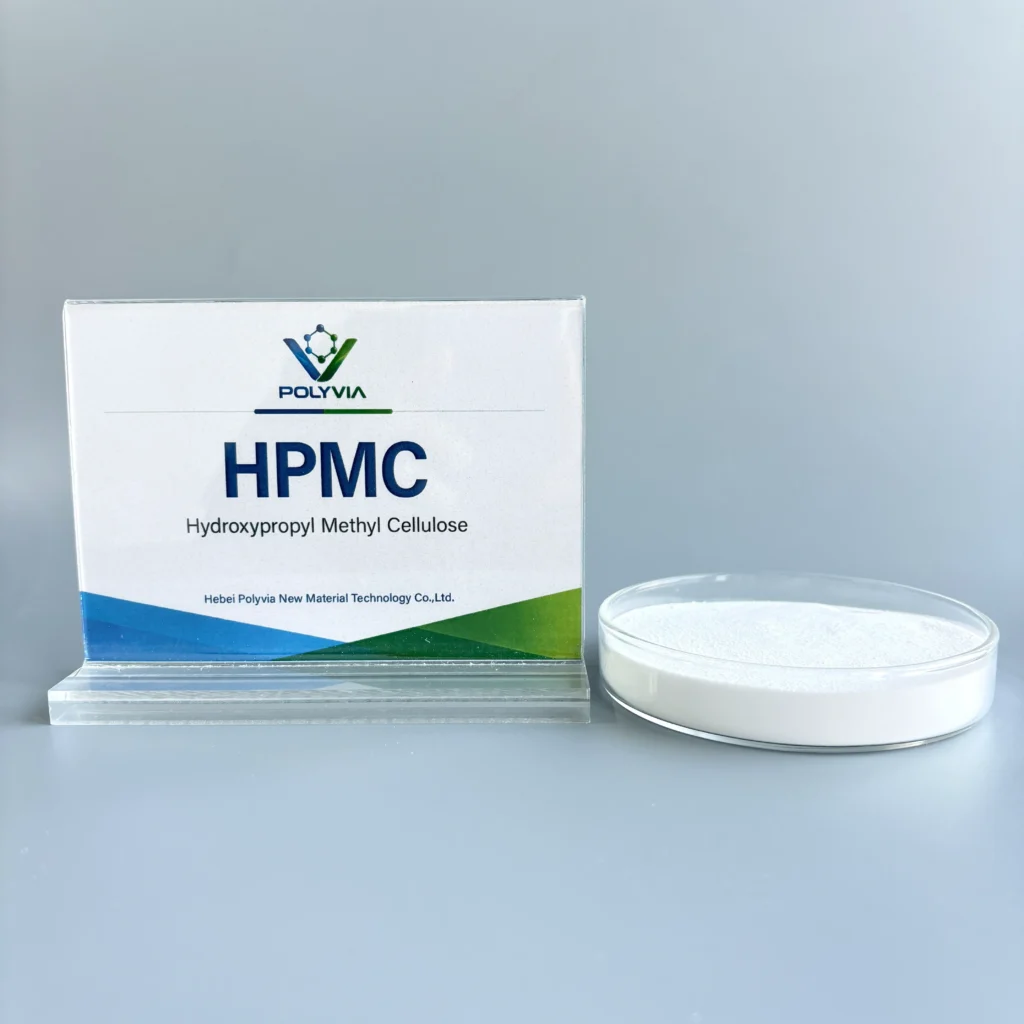
Hydroxypropyl Methyl Cellulose (HPMC) and Methyl Hydroxyethyl Cellulose (MHEC) are water-soluble cellulose-based polymers widely used in construction dry-mix formulations.
Their primary functions in gypsum plaster include water retention, thickening and modification of fresh mortar rheology.
1. Water Retention
Gypsum plaster requires sufficient water during mixing and application to maintain suitable consistency and allow proper placement.
HPMC and MHEC help retain water within the fresh mixture, reducing premature water loss to absorbent substrates and supporting more consistent application.
Water retention performance depends on:
- Polymer grade and viscosity.
- Dosage.
- Gypsum particle characteristics.
- Water-to-binder ratio.
- Substrate absorption.
- Temperature and application conditions.
Higher viscosity does not automatically mean better overall performance. Excessive thickening may reduce workability and make application more difficult.
2. Thickening and Consistency
HPMC and MHEC increase the viscosity of the aqueous phase and influence the rheological behavior of fresh gypsum plaster.
Appropriate selection can help manufacturers achieve the required consistency for manual application, machine application and surface finishing.
3. Open Time and Application Workability
Water retention and rheological modification can influence the time during which plaster remains suitable for handling and application.
However, open time is not controlled by cellulose-based additives alone. Gypsum hydration kinetics, retarder chemistry, temperature and formulation compatibility also play important roles.
4. How to Select HPMC or MHEC
The selection should be based on actual formulation requirements rather than viscosity values alone.
Manufacturers should compare:
- Water retention under defined test conditions.
- Fresh mortar consistency.
- Mixing and application behavior.
- Compatibility with the gypsum binder.
- Setting-time changes.
- Surface finishing performance.
POLYVIA™ Product Solutions
- POLYVIA™ HPMC – Hydroxypropyl Methyl Cellulose for water retention and rheology control.
- POLYVIA™ MHEC – Methyl Hydroxyethyl Cellulose for water management, consistency and application control.
The appropriate grade should be selected and verified using the customer's actual gypsum formulation.
HPS: Modified Starch for Rheology and Anti-Sag Performance
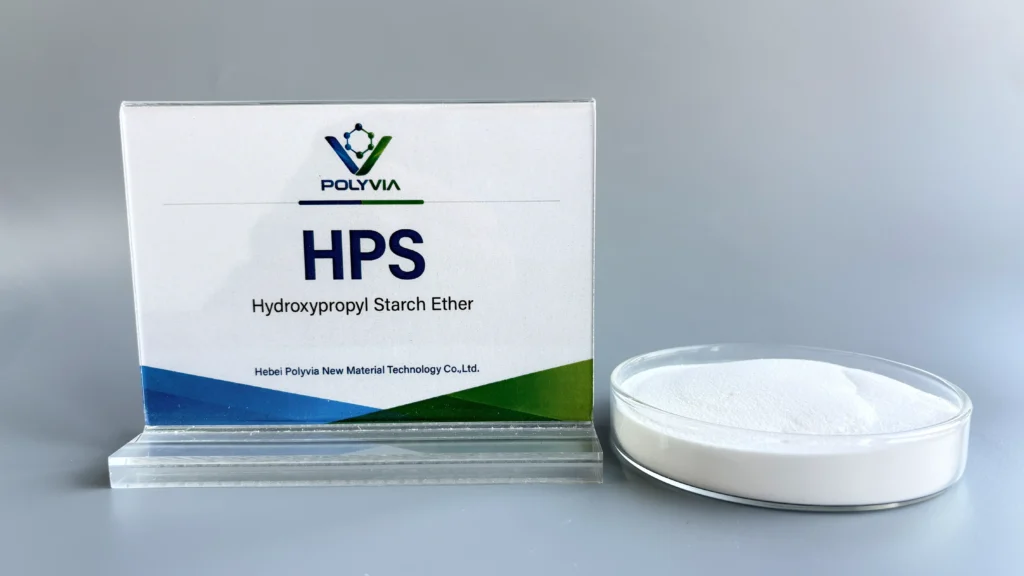
Hydroxypropyl Starch (HPS) is a modified starch additive used in selected construction dry-mix formulations.
It differs from HPMC and MHEC in chemical composition, hydration behavior and functional characteristics. Depending on its modification and grade, HPS may hydrate, swell or exhibit different dispersion and solubility characteristics in water.
In gypsum plaster, suitable HPS grades can modify fresh mortar rheology and influence application performance.
1. Rheology Modification
HPS can help adjust the consistency and deformation behavior of fresh gypsum plaster.
Its effect depends on starch modification, dosage, water content and interactions with other formulation components.
2. Anti-Sag Performance
In suitable formulations, HPS can contribute to improved resistance to downward movement of fresh plaster on vertical surfaces.
Anti-sag performance should be evaluated using the actual application thickness, substrate and environmental conditions.
3. Application Feel
HPS can influence the handling and spreading characteristics of gypsum plaster.
Its use may help manufacturers adjust application behavior without relying exclusively on increasing cellulose-based thickener dosage.
4. HPS and HPMC: Complementary but Not Interchangeable
| Comparison | HPMC | HPS |
|---|---|---|
| Material Type | Cellulose-based polymer | Modified starch |
| Main Function | Water retention and thickening | Rheology modification |
| Water Retention | Primary function | Not its principal design function |
| Consistency Control | Yes | Yes |
| Anti-Sag Contribution | Formulation-dependent | Formulation-dependent |
| Combined Use | Possible | Possible |
Using both materials may provide a more balanced formulation, but the result depends on their individual grades, dosage and compatibility.
POLYVIA™ Product Solution
POLYVIA™ Hydroxypropyl Starch (HPS) for construction dry-mix applications.
Gypsum Retarders: Setting-Time Control
Gypsum plaster typically develops its hardened structure through the hydration and crystallization of calcium sulfate.
For practical construction applications, the setting process must provide sufficient time for mixing, transportation, spreading and surface finishing.
Gypsum retarders are used to regulate this process.
1. Main Functions
A suitable retarder can:
- Extend the working time of fresh gypsum plaster.
- Adjust initial and final setting times.
- Support manual and machine application.
- Improve production consistency when raw materials and processing conditions vary.
2. Retarder Chemistry and Compatibility
Different retarder chemistries interact with gypsum hydration through different mechanisms.
Organic acids and their salts, proteins and other specialized compounds may be used in gypsum-based systems.
Their effectiveness depends on gypsum purity, soluble impurities, binder reactivity, dosage and temperature.
3. Why Excessive Retardation Is a Problem
An excessively delayed setting process may reduce production efficiency and affect early strength development.
In some formulations, excessive retarder dosage can also negatively influence the hardened structure.
Manufacturers should therefore evaluate both setting time and mechanical performance rather than optimizing working time alone.
RDP: Polymer Modification for Adhesion and Flexibility
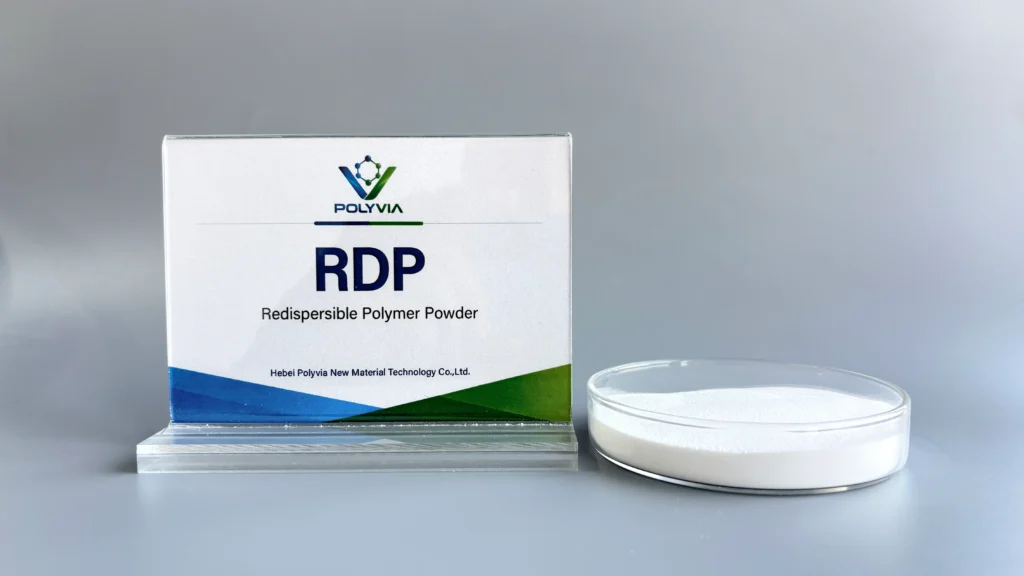
Redispersible Polymer Powder (RDP) is a polymer-based dry-mix additive.
RDP is water-redispersible rather than strictly water-soluble. When mixed with water, it redistributes into a polymer dispersion. During the drying process, polymer particles can coalesce to form a film, depending on polymer composition and formulation conditions.
In selected gypsum-based formulations, RDP may contribute to several performance improvements.
1. Improved Adhesion
RDP can improve bonding performance on suitable substrates when the polymer is compatible with the gypsum system.
2. Flexibility and Deformation Behavior
Polymer modification can influence the flexibility and deformation characteristics of hardened gypsum-based materials.
3. Cohesion and Surface Performance
Appropriate polymer selection may improve the cohesion and integrity of the finished material.
4. When Is RDP Necessary?
RDP is not a mandatory ingredient in every standard gypsum plaster formulation.
It should be considered when additional adhesion, cohesion or flexibility is required beyond what can be achieved with the gypsum binder and other additives.
Selection should consider:
- Polymer composition.
- Glass transition temperature (Tg).
- Minimum film-forming temperature (MFFT).
- Redispersion characteristics.
- Compatibility with the gypsum system.
POLYVIA™ Product Solution
POLYVIA™ Redispersible Polymer Powder (RDP) – VAE-based polymer powder for construction dry-mix applications.
Powder Defoamer: Controlling Excessive Air and Surface Defects
Air entrainment can influence the density, surface quality and mechanical properties of hardened gypsum plaster.
Some air may be introduced during mixing and application. The objective is not necessarily to eliminate all air, but to control excessive and undesirable air content.
Powder defoamers are used in suitable formulations to help control foam and excessive air entrainment.
1. Foam Control
A compatible defoamer can help reduce excessive foam generated during mixing and application.
2. Surface Quality
Excessive air may contribute to pinholes, surface irregularities and other finishing defects.
Appropriate defoamer selection can help control these problems.
3. Hardened Density and Strength
Excessive air voids can reduce hardened density and may negatively affect mechanical properties.
However, the effect depends on the air-void structure, formulation and other raw materials.
4. Dosage Optimization
Too little defoamer may not provide sufficient foam control, while excessive dosage can negatively affect other properties.
Manufacturers should evaluate fresh air content, surface appearance, density and mechanical performance during formulation trials.
POLYVIA™ Product Solution
POLYVIA™ Powder Defoamer – a dry-form foam-control additive for cementitious and gypsum-based formulations, subject to application-specific compatibility testing.
PCE Superplasticizers in Gypsum-Based Materials: Opportunities and Limitations
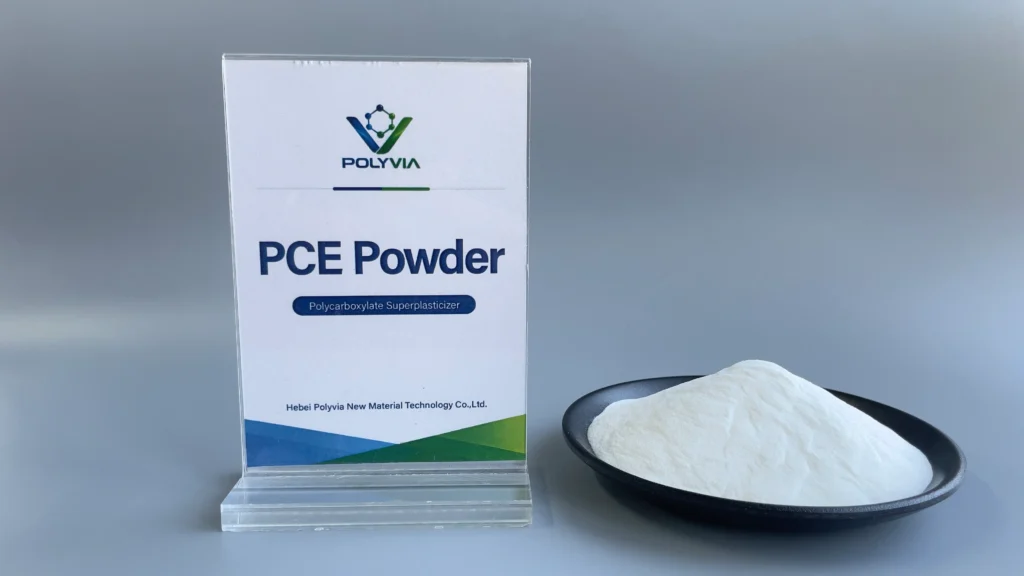
Polycarboxylate superplasticizers are widely used as dispersing admixtures in concrete and selected cement-based materials.
Certain PCE formulations can also be evaluated in gypsum-based systems, particularly gypsum-based self-leveling mortar.
Their main purpose in these applications is to improve particle dispersion and flowability while optimizing water demand.
However, PCE performance in gypsum cannot be assumed from its performance in cement concrete.
1. Flowability Improvement
Suitable PCE grades can increase the flowability of gypsum-based mixtures.
This can be useful in self-leveling formulations requiring controlled spreading and leveling behavior.
2. Water Demand Optimization
A compatible dispersing agent may help achieve the target flow at a lower water content.
However, water reduction must be balanced against setting behavior, segregation resistance and hardened strength.
3. Effects on Setting and Strength
PCE can interact with gypsum hydration and crystal development.
The response varies with gypsum type, PCE chemistry, dosage and formulation composition. A dosage that improves flowability may also affect setting time and mechanical performance.
4. Why Cement-Based PCE Grades Should Not Automatically Be Used in Gypsum
Different gypsum systems have different chemical and hydration characteristics.
A PCE product designed for concrete may not automatically provide suitable performance in gypsum plaster or gypsum-based self-leveling mortar.
Before commercial use, manufacturers should evaluate:
- Initial flowability.
- Flow retention.
- Water demand.
- Initial and final setting time.
- Segregation and bleeding.
- Hardened compressive and flexural strength.
POLYVIA™ Product Solutions
POLYVIA™ PCE Superplasticizer Product Range – including powder, liquid and flake forms for different concrete admixture applications.
For gypsum-based self-leveling materials, a suitable PCE grade should only be selected after application-specific compatibility and performance testing.
Gypsum Plaster and Gypsum-Based Self-Leveling Mortar: Different Formulation Requirements
One important formulation mistake is treating all gypsum-based materials as the same product category.
Conventional gypsum plaster and gypsum-based self-leveling mortar have different application requirements.
| Performance Requirement | Gypsum Plaster | Gypsum-Based Self-Leveling Mortar |
|---|---|---|
| Application | Manual or machine plastering | Pouring and spreading |
| Main Fresh Property | Workability and consistency | High flowability and stability |
| Water Retention | Important | Formulation-dependent |
| Sag Resistance | Important for vertical application | Generally less relevant |
| Flow Retention | Important during application | Critical for spreading and leveling |
| Setting Control | Important | Critical |
| Foam Control | Important | Important |
| Segregation Resistance | Important | Critical |
| Surface Finish | Smooth plaster finish | Level and uniform floor surface |
1. Conventional Gypsum Plaster
Conventional gypsum plaster typically requires a balanced combination of water retention, workability, sag resistance and controlled setting time.
Cellulose-based additives, modified starch and gypsum retarders may be important depending on the application.
2. Gypsum-Based Self-Leveling Mortar
Gypsum-based self-leveling mortar requires high flowability while maintaining sufficient stability against segregation and bleeding.
Its formulation may include suitable dispersing agents, retarders, foam-control additives and rheology modifiers.
A successful self-leveling formulation must balance initial flow, flow retention, setting behavior and hardened mechanical performance.
Important: Gypsum-based self-leveling mortar is different from cement-based self-leveling mortar. Their binder chemistry, hydration behavior and additive compatibility requirements must be evaluated separately.
How to Select Additives for Different Gypsum Applications
The following matrix provides a practical starting point for additive selection.
| Application | Main Requirements | Additives to Evaluate |
|---|---|---|
| Hand-Applied Gypsum Plaster | Water retention, workability and sag resistance | HPMC / MHEC, HPS, retarder |
| Machine-Applied Gypsum Plaster | Consistency, pumpability and working time | HPMC / MHEC, HPS, retarder |
| Gypsum Finishing Plaster | Smooth application and surface quality | HPMC / MHEC, HPS, defoamer |
| Lightweight Gypsum Plaster | Rheology, density and air control | Cellulose-based additives, HPS, defoamer |
| Modified Gypsum Plaster | Adhesion and flexibility | RDP, HPMC / MHEC |
| Gypsum-Based Self-Leveling Mortar | Flowability, stability and setting control | Suitable PCE, retarder, defoamer and rheology modifiers |
These combinations are formulation starting points rather than universal recipes.
The appropriate additive package depends on gypsum source, raw material properties, production process and target performance.
How to Evaluate Additive Compatibility in Gypsum Plaster
A reliable gypsum formulation requires systematic laboratory evaluation.
Manufacturers should avoid selecting additives solely according to supplier descriptions or isolated performance claims.
The following testing sequence provides a practical framework.
Step 1: Characterize the Gypsum Binder
Determine gypsum type, source, purity, particle size distribution, water demand and baseline setting behavior.
Step 2: Establish a Reference Formulation
Prepare a control mixture without the additive being evaluated.
Maintain consistent binder content, water content, mixing procedure and environmental conditions.
Step 3: Evaluate Individual Additives
Introduce one additive at a time to understand its individual influence.
For combination trials, evaluate interactions between cellulose-based additives, modified starch, retarders, polymer powders, dispersing agents and defoamers.
Step 4: Evaluate Fresh Mortar Properties
Recommended tests include:
- Water retention.
- Fresh consistency or flow.
- Mixing and application behavior.
- Sag resistance for vertical applications.
- Air content where relevant.
- Initial and final setting time.
Step 5: Evaluate Hardened Properties
Depending on the intended application, assess:
- Compressive strength.
- Flexural strength.
- Adhesion strength.
- Hardened density.
- Surface quality.
- Dimensional stability where relevant.
Step 6: Conduct Application Trials
Laboratory results should be followed by practical trials using the intended application method, substrate and environmental conditions.
Machine-applied plaster and self-leveling mortar should be evaluated under their respective production and application conditions.
Step 7: Optimize the Complete Formulation
Once individual additive behavior is understood, optimize the combination to achieve a suitable balance of fresh and hardened properties.
Standards and Technical Evaluation
Gypsum plaster and gypsum-based self-leveling materials should be evaluated according to the applicable product category and market requirements.
For Chinese-market gypsum-based self-leveling mortar, JC/T 1023-2021, Gypsum-Based Self-Leveling Mortar, is a relevant industry product standard.
For application and construction guidance, JC/T 60021-2024, Technical Specification for Application of Gypsum-Based Self-Leveling Mortar, provides an additional reference for gypsum-based self-leveling systems in China.
JC/T 60021-2024 applies to the design, construction, quality inspection and acceptance of gypsum-based self-leveling mortar floors in specified indoor building environments. It is not a universal standard for conventional gypsum plaster.
Other markets may apply different national standards, product specifications and test procedures.
Manufacturers should identify the applicable standard before establishing acceptance criteria and conducting product qualification tests.
Frequently Asked Questions
1. What Are Water-Soluble Additives in Gypsum Plaster?
Water-soluble additives are materials that dissolve in water and modify the fresh gypsum plaster system. HPMC and MHEC are common examples, mainly used for water retention, thickening and rheology control. Other functional additives may be dispersible or redispersible rather than strictly water-soluble.
2. What Is the Most Important Additive in Gypsum Plaster?
There is no single additive that is essential for every gypsum plaster formulation. HPMC or MHEC is commonly used when water retention and consistency control are required, while retarders, HPS and other additives are selected according to the application and gypsum characteristics.
3. What Is the Difference Between HPMC and HPS in Gypsum Plaster?
HPMC is primarily used for water retention and thickening. HPS is a modified starch additive mainly used to modify rheology and application behavior. Their functions overlap in some areas, but they are not interchangeable.
4. Can HPMC and HPS Be Used Together in Gypsum Plaster?
Yes. They can be evaluated together to balance water retention, consistency and application performance. However, the optimum combination depends on the gypsum binder, additive grades, dosage and compatibility.
5. Does RDP Dissolve in Water?
RDP (Redispersible Polymer Powder) can be mixed with water and redisperse into a polymer dispersion. It is technically classified as water-redispersible rather than strictly water-soluble. Unlike HPMC, which dissolves in water to form a polymer solution, RDP redistributes into fine polymer particles in water. During drying, these polymer particles can coalesce to form a film, contributing to adhesion, cohesion and flexibility in suitable construction mortar formulations.
6. Why Is a Retarder Used in Gypsum Plaster?
A gypsum retarder regulates the hydration and setting process, providing sufficient working time for mixing, application and finishing. Its dosage must be controlled because excessive retardation can affect production efficiency and strength development.
7. Can PCE Superplasticizer Be Used in Gypsum Plaster?
Certain PCE formulations can be used in selected gypsum-based materials, particularly self-leveling mortar. However, compatibility must be verified because PCE may influence flowability, setting time and hardened strength. A grade designed for concrete should not automatically be considered suitable for gypsum.
8. What Additives Are Used in Gypsum-Based Self-Leveling Mortar?
Depending on the formulation, gypsum-based self-leveling mortar may use suitable dispersing agents, retarders, foam-control additives and rheology modifiers. The formulation must balance flowability, flow retention, segregation resistance, setting behavior and hardened strength.
9. How Can Manufacturers Improve Gypsum Plaster Workability?
Workability can be improved through appropriate selection and optimization of water-retention agents, rheology modifiers and setting-control additives. Water content, gypsum characteristics and mixing procedures must also be considered.
10. How Should Manufacturers Test Gypsum Plaster Additives?
Use a consistent control formulation and evaluate water retention, fresh consistency, setting time, sag resistance, adhesion and hardened strength as appropriate. For self-leveling materials, include initial flow, flow retention and segregation resistance.
Conclusion
Water-soluble polymers and other functional additives play important roles in modern gypsum plaster formulations.
HPMC and MHEC support water retention and consistency control. Modified starch can adjust rheology and application behavior. Gypsum retarders regulate setting time, while RDP and powder defoamers provide additional functions in selected formulations. Suitable PCE dispersing agents may also be evaluated for gypsum-based self-leveling materials.
The most effective formulation is not necessarily the one containing the greatest number of additives. It is the formulation that achieves the required application and hardened performance through appropriate raw material selection, compatibility testing and dosage optimization.
POLYVIA™ supplies construction chemical solutions, including HPMC, MHEC, hydroxypropyl starch, redispersible polymer powder, powder defoamers and polycarboxylate superplasticizers.
For gypsum plaster and dry-mix mortar manufacturers, product selection should always be based on actual binder characteristics, formulation requirements and laboratory performance.
Contact Hebei Polyvia New Material Technology Co., Ltd. for product information, technical data sheets, samples and application-oriented support for construction dry-mix formulations.