
How to Improve Early Demolding in Heat-Cured Decorative Precast Concrete
Thermal Curing, Release Strength and Mold Turnover Optimization
Premature demolding can damage thin edges, detailed ornaments and textured architectural components. Explore practical methods for controlling heated curing, verifying demolding readiness and improving mold turnover without compromising finished-product quality.
Why Early Demolding Is Challenging in Decorative Precast Concrete
Decorative precast concrete manufacturing often relies on reusable molds to produce architectural cladding panels, cast-stone elements, ornamental details and textured cementitious components.
For manufacturers operating multiple casting cycles, mold occupancy time can affect production capacity and scheduling.
However, reducing curing time does not automatically improve productivity.
Removing a component before it has developed adequate mechanical integrity can result in chipped edges, cracked ornamental features, distortion or damage during handling.
These risks are particularly important for thin panels, projecting details and components manufactured using flexible or highly textured molds.
1. Setting Is Not Demolding Readiness
A cementitious mixture can reach final setting without possessing sufficient strength or stiffness to withstand mold removal.
Setting describes a stage of material development. Demolding readiness depends on the mechanical demands placed on the actual component.
For example, a thin decorative panel may be sensitive to bending, while an ornamental casting may experience concentrated forces around recessed patterns or projecting features.
A single setting-time result cannot establish whether either product can be safely removed.
2. Define the Real Production Objective
The goal should be to reduce the time required to produce an acceptable component, not merely to shorten the heating stage.
The complete cycle includes casting, initial resting, thermal curing, cooling, mold release and any handling necessary before the mold becomes available again.
A proposed change is only beneficial when it satisfies product requirements and improves the complete manufacturing process.
Engineering objective: Establish the shortest repeatable mold cycle that meets the required release criteria without unacceptable product damage.
Understand the Effects of Heated Curing
Elevated-temperature curing can accelerate cement hydration and early-age strength development.
This may help manufacturers reach the properties needed for mold release earlier than under cooler curing conditions.
However, temperature also affects moisture behavior, temperature-related stresses and the development of later-age properties.
The objective is not maximum heating temperature, but an appropriate temperature and moisture history for the actual product.
1. Heated-Air Curing Is Not Steam Curing
Heated-air chambers and atmospheric steam-curing systems should not be treated as identical.
Steam curing supplies heat together with a moist environment.
A heated-air chamber may increase temperature while allowing exposed surfaces to lose moisture unless adequate protection is provided.
Premature drying can interfere with continued hydration and may contribute to surface-related problems.
For heated-air curing, evaluate humidity conditions, suitable coverings or other moisture-retention methods as part of the manufacturing procedure.
2. Measure Product Temperature
Chamber air temperature does not necessarily represent the temperature experienced by the cast component.
Product temperature depends on thickness, mold material, chamber airflow, arrangement within the chamber and hydration heat.
During qualification, monitor representative product locations using appropriately installed and calibrated temperature sensors.
The sensor arrangement should reflect the product geometry and any relevant differences between exposed surfaces and thicker sections.
3. Protect Later-Age Performance
Elevated curing temperatures may improve early strength while adversely affecting later-age strength development under certain conditions.
A curing change should therefore be evaluated at the intended release age and at the later ages required by the product specification.
The selected thermal cycle must meet both requirements.
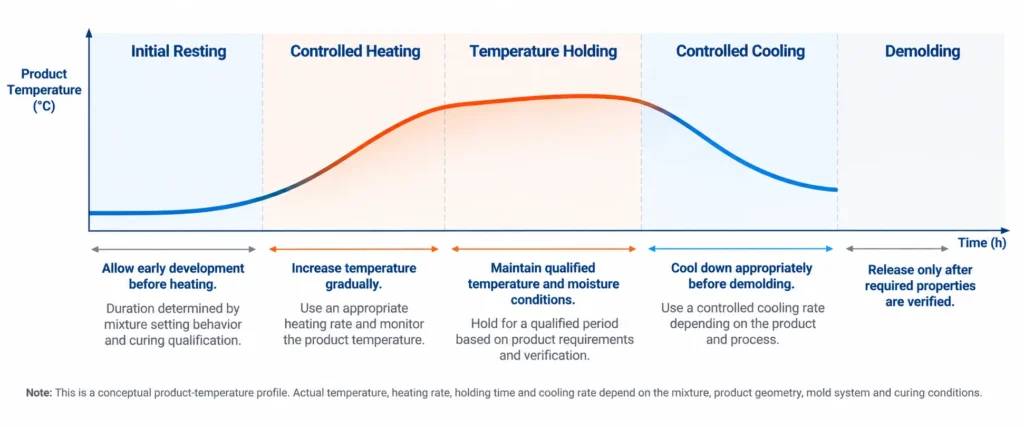
Establish a Controlled Thermal Curing Cycle
A practical heated-curing procedure consists of four stages: initial resting, controlled heating, temperature holding and cooling.
Each stage requires defined conditions and verification.
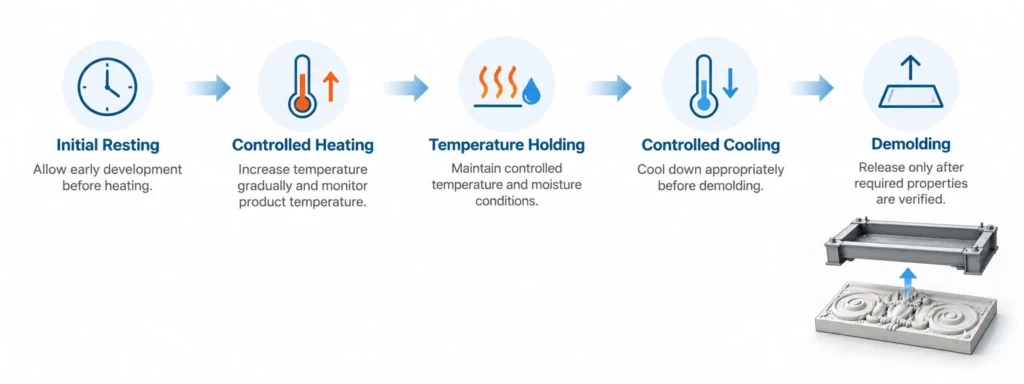
Initial Resting
After casting, allow an appropriate period for early structural development before substantial heating.
Record the time from casting to heating, initial material temperature and relevant setting characteristics.
Protect the product against premature moisture loss.
The appropriate resting time must be established for the specific mixture and should not be selected solely from a generic schedule.
Controlled Heating
Increase chamber temperature according to the proposed curing procedure.
Monitor the response of representative components.
Avoid heating conditions that create unacceptable temperature differences, surface drying or other adverse effects.
Select the heating rate and target temperature from product-specific trials rather than copying conditions used for unrelated precast systems.
Temperature Holding
Maintain the product under defined temperature and moisture conditions while early-age properties develop.
Evaluate the actual product temperature history and strength development.
Holding duration should be sufficient to satisfy the release criteria without unnecessary thermal exposure.
Controlled Cooling
Establish an appropriate cooling procedure before demolding.
Review product temperature, mold conditions, relevant temperature differences and possible effects on release and handling.
Cooling must be included when calculating the complete mold cycle.
Thermal Curing Control Matrix
| Curing stage | What to control | What to verify |
|---|---|---|
| Initial resting | Time, temperature, moisture protection | Suitability for heating |
| Heating | Rate and product temperature response | No unacceptable thermal effects |
| Holding | Product temperature history and duration | Required early-age properties |
| Cooling | Product temperature and cooling conditions | Readiness for mold removal |
| Release | Mechanical criteria and demolding method | Component integrity |
Key principle: The qualified process must be based on the temperature and condition of the component, not chamber settings alone.
Establish Product-Specific Demolding Criteria
Safe demolding requires sufficient mechanical capacity to withstand mold separation and subsequent handling.
The relevant properties depend on the product.
Decorative cladding panels, architectural ornaments and cast-stone units should not automatically share the same release-strength requirement.
1. Identify the Critical Release Conditions
Before establishing acceptance criteria, examine the actual demolding process.
| Product characteristic | Critical consideration |
|---|---|
| Thin panel | Bending and stiffness during release |
| Projecting decorative feature | Local tensile damage |
| Sharp or delicate edge | Chipping during mold separation |
| Detailed flexible mold | Release resistance and local distortion |
| Large architectural component | Support, lifting and handling loads |
The required release properties and applicable acceptance limits should be established by the responsible qualified technical professional.
Where a component has structural, lifting or anchorage requirements, these must be accounted for explicitly.
2. Use Suitable Strength Evidence
Compressive strength can provide useful information about cementitious material development, but it does not represent every failure mechanism during demolding.
For some decorative components, flexural behavior, stiffness or local tensile resistance may be particularly important.
Select test methods appropriate to the material and product.
Fine cementitious mortars and conventional coarse-aggregate concrete may require different specimen types and testing procedures.
When laboratory specimens are used to support production release decisions, establish their relationship to actual product performance.
Their temperature and moisture histories should be sufficiently representative of the manufactured component.
3. Use Concrete Maturity Methods Within Their Scope
For applicable concrete mixtures, a calibrated maturity method can support estimates of in-place compressive-strength development from measured temperature history.
The method requires a strength–maturity relationship established for the specific mixture.
It must be supplemented by appropriate verification and does not independently demonstrate safe flexural handling, edge integrity or compliance with all later-age requirements.
Its suitability for a particular fine decorative mortar must be established rather than assumed.
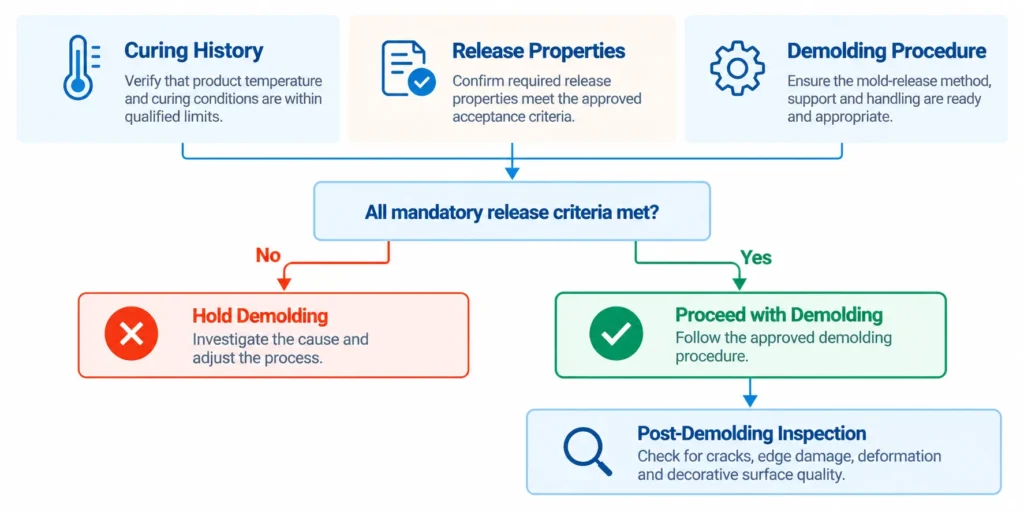
4. A Practical Release Decision
A release decision should be based on mandatory conditions, not a single elapsed-time target.
| Release requirement | Acceptance condition | Decision if not satisfied |
|---|---|---|
| Material and mixture | Within qualified specification | Hold and investigate |
| Curing history | Within approved operating limits | Hold and assess |
| Required release properties | Verified against product-specific criteria | Do not demold |
| Mold-release procedure | Approved equipment, support and method | Correct before release |
| Product condition | No disqualifying damage or abnormal condition | Hold or reject as appropriate |
Release rule: A component may proceed to demolding only when every applicable mandatory release condition has been satisfied.
Demolding, lifting and stacking may have different acceptance requirements. Approval for mold removal should not automatically be treated as approval for unrestricted handling.
How Liquid PCE Fits into the Optimization Process
Liquid PCE superplasticizers can help decorative wet-cast mixtures achieve suitable workability at controlled effective water content.
In an appropriate formulation, reduced water demand may support strength-oriented mixture design.
However, water reduction and accelerated early strength are not equivalent.
The actual response depends on cement chemistry, PCE formulation, dosage and curing conditions.
1. High Water-Reduction Candidates
POLYVIA™ HWR50 and HWR40 may be screened when efficient dispersion and controlled water demand are the principal requirements.
Their suitability for heat-cured decorative concrete must be verified using the actual mixture and curing process.
2. Early-Strength-Oriented Candidates
POLYVIA™ ES50 and ES40 may be evaluated where early-age development is an important production priority.
Their performance should be compared with an appropriate reference formulation.
An early-strength-oriented designation does not guarantee a particular release age.
3. Separate the Effects of PCE Chemistry and Water Content
When comparing PCE grades, clearly define the experimental basis.
If the objective is to evaluate differences in admixture chemistry, use controlled mixture conditions, including a consistent effective water content and appropriate dosage basis.
If the objective is to compare practical formulations at equal casting consistency, measure the effective water demand for each formulation.
When the resulting water contents differ, do not attribute all differences in early strength solely to the PCE polymer.
For available product characteristics, refer to POLYVIA™ PCE Liquid.
Practical Factory Trial and Acceptance Program
An early-demolding optimization program should answer three questions:
- Does the proposed change maintain acceptable casting and curing conditions?
- Does the component meet every required release and later-age performance criterion?
- Does the change improve usable production output consistently?
The following stages provide a controlled evaluation procedure.
Stage A — Establish the Reference Process
Use the existing qualified formulation and curing cycle.
Record the product geometry, raw materials, effective water content, admixture dosage, casting procedure, product temperature history and current release criteria.
Also record actual mold occupancy time, demolding damage and relevant hardened properties.
Repeat the baseline sufficiently to understand ordinary production variation.
Stage B — Evaluate Mixture or PCE Changes
Keep the curing cycle unchanged while screening one defined mixture or admixture change.
For example, compare an HWR formulation with an early-strength-oriented candidate using a documented comparison basis.
Measure fresh consistency, effective water content, relevant early-age properties and specified later-age performance.
Do not change the curing cycle at the same time and then attribute the result solely to the PCE.
Stage C — Evaluate the Curing Cycle
Using an accepted formulation, evaluate selected curing variables.
Potential factors include the initial resting condition, heating rate, holding conditions, moisture protection and cooling procedure.
During preliminary screening, change one primary factor at a time where practical.
If several factors are changed together, use an appropriate experimental design capable of separating their effects.
Record actual product temperature histories and relevant strength and quality results.
Stage D — Validate Representative Components
Manufacture representative products using the selected trial conditions.
Evaluate the actual demolding and handling sequence.
Record release-age evidence, edge condition, cracking, deformation, detailed surface integrity and handling performance.
Include relevant later-age testing.
A trial cannot pass solely because the planned demolding time has been achieved.
Stage E — Confirm Production Repeatability
Repeat the preferred process across independent production batches.
Check normal variations in materials, starting temperature, curing conditions and mold-release operations.
Establish acceptable operating limits and define corrective actions when those limits are exceeded.
Factory Trial Acceptance Matrix
| Assessment | Pass criterion | Failure response |
|---|---|---|
| Fresh mixture | Meets specified casting consistency and stability | Reject or reformulate |
| Curing process | Within approved temperature and moisture limits | Hold and investigate |
| Release properties | Meets all required mechanical criteria | Do not demold |
| Product integrity | No disqualifying cracks, edge damage or deformation | Reject or investigate |
| Later-age performance | Meets the relevant product specification | Do not qualify process |
| Repeatability | Meets defined limits across qualification batches | Continue trials |
| Cycle efficiency | Improves usable output without reducing compliance | Accept only if all other criteria pass |
The acceptance limits must be defined before reviewing trial outcomes.
This prevents a manufacturer from lowering its performance requirements simply because a faster cycle appears commercially attractive.
Making the Final Decision
Only formulations and curing cycles that pass all mandatory requirements should advance to an efficiency comparison.
Among those qualified options, compare complete mold-cycle time, accepted product output, energy use, labor requirements and repair or rejection rates.
The selected process should be documented as a qualified operating window rather than an isolated successful experiment.
Troubleshooting Early-Demolding Failures
An unsuccessful demolding operation does not necessarily mean that the concrete simply needs more heat.
The observed defect should guide the investigation.
| Observed problem | First investigation | Potential correction |
|---|---|---|
| Inadequate release-age strength | Mixture, actual product temperature, moisture conditions | Reassess mix or curing cycle |
| Broken corners or ornaments | Release resistance, local stresses, detail geometry | Adjust mold release and handling |
| Cracking in thin panels | Bending, stiffness, support conditions | Review release properties and supports |
| Surface damage after heating | Moisture loss, temperature history, mold interface | Improve curing and surface protection |
| Variable release strength | Raw materials, batching, curing uniformity | Improve process control |
| Faster curing but higher rejection | Complete product acceptance and handling | Reject proposed cycle |
Diagnose Before Increasing Temperature
If strength is insufficient, verify that the actual product experienced the intended curing cycle.
Check whether moisture protection, mixture consistency, cement source or liquid PCE dosage changed.
Increasing chamber temperature without resolving these uncertainties may introduce additional problems.
Separate Material Weakness from Release Damage
If components exhibit adequate measured material strength but still break at specific edges or decorative features, the release procedure or local geometry may govern the failure.
Review mold flexibility, adhesion, separation direction and temporary support.
A longer curing cycle may not fully resolve damage caused primarily by mechanical release conditions.
Final Engineering Recommendations
Improving early demolding in heat-cured decorative precast concrete requires coordinated control of curing conditions, material development and the actual mold-release process.
Begin with a stable reference formulation and documented curing cycle.
Identify the mechanical properties required for the specific component.
Measure representative product temperature history and protect the cementitious material against unsuitable moisture loss.
Evaluate mixture and curing changes separately, then verify performance using representative products.
Finally, compare only qualified processes for mold occupancy time, production efficiency and operating cost.
The optimum process is the shortest qualified and repeatable curing cycle that allows safe demolding while preserving decorative detail, dimensional integrity and the required finished-product properties.
For liquid PCE grade evaluation and formulation support, manufacturers may contact the POLYVIA™ technical team.
Frequently Asked Questions
1. How can decorative precast manufacturers improve early demolding?
Establish product-specific release criteria, verify the current curing process, evaluate controlled mixture and temperature adjustments, and confirm performance with representative components.
2. Does higher curing temperature always shorten safe demolding time?
No. Elevated temperatures can accelerate early hydration, but the response depends on the mixture and curing conditions. Excessive or poorly controlled heating may introduce other performance problems.
3. What is the difference between heated-air curing and steam curing?
Heated-air curing supplies heat but may require separate moisture protection. Atmospheric steam curing provides a heated, moist environment. The two processes should not be assumed to use identical operating conditions.
4. Why is initial resting important before thermal curing?
An appropriate resting period permits early material development before substantial heating. Its duration should be validated for the specific mixture and curing process.
5. Can an early-strength liquid PCE guarantee faster demolding?
No. Early-strength-oriented PCE may be evaluated as part of an optimized mixture, but actual release readiness depends on the complete formulation, curing history and product requirements.
6. Is compressive strength enough to determine demolding readiness?
Not always. Thin panels and detailed ornaments may also require verification of flexural behavior, local damage resistance, stiffness and handling conditions.
7. Can maturity measurements be used for decorative precast concrete?
A calibrated maturity method can support strength estimation for applicable concrete mixtures. Its use for a particular decorative mortar requires validation, and it cannot replace all product-level release checks.
8. How can manufacturers tell whether a shorter curing cycle is successful?
The new process must meet every mandatory release and finished-product requirement, remain repeatable across batches, and improve usable production output without unacceptable damage or rejection.
Technical References
1. American Concrete Institute (ACI). How Does the Temperature Influence Curing? Technical guidance on temperature-dependent hydration and strength development.
2.ASTM C1074-19e1. Standard Practice for Estimating Concrete Strength by the Maturity Method. ASTM International.
3. Precast/Prestressed Concrete Institute (PCI). Manual for Quality Control for Plants and Production of Architectural Precast Concrete Products (MNL-117-13). Including relevant addenda where applicable.
4. ACI 308R-16. Guide to External Curing of Concrete. American Concrete Institute.
POLYVIA™ accelerated-curing test results. No universal demolding time, curing temperature or release-strength threshold is specified. Final requirements must be established for the actual material, product and manufacturing procedure.