
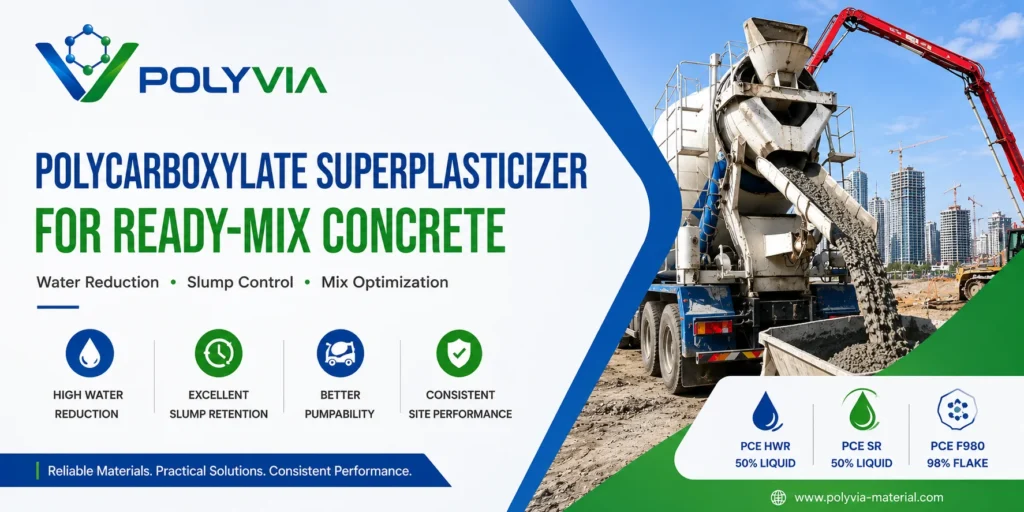
Polycarboxylate Superplasticizer for Ready-Mix Concrete: Water Reduction, Slump Control and Mix Optimization
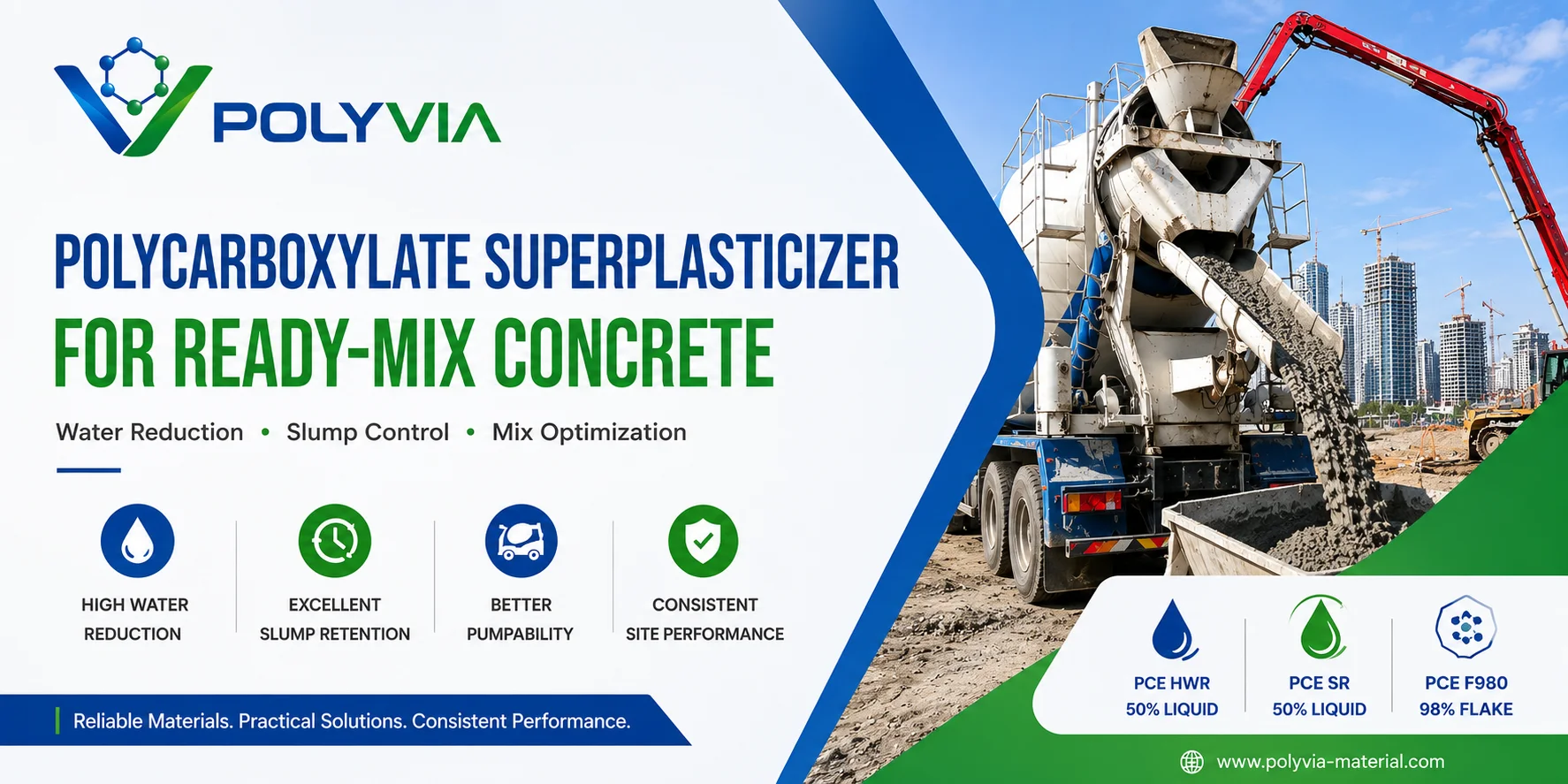
Ready-mix concrete is not evaluated only at the batching plant. A concrete mixture may show excellent initial slump immediately after mixing, yet behave very differently after transportation, waiting, pumping and placement. For ready-mix producers, the real challenge is therefore not simply achieving high initial fluidity. It is maintaining a controlled and usable concrete performance profile from the batching plant to the jobsite.
This is why the selection of a polycarboxylate superplasticizer (PCE) for ready-mix concrete should consider the complete operating cycle:
Water Reduction → Initial Workability → Transportation → Slump Retention → Pumping → Jobsite Consistency
Temperature, cement characteristics, supplementary cementitious materials, aggregate moisture, transportation time and other admixtures can all influence how a PCE performs in real production.
For this reason, Polyvia provides different PCE performance types and supply forms for ready-mix concrete, including:
- PCE HWR — High Water Reduction Type, 50% liquid
- PCE SR — Slump Retention Type, 50% liquid
- PCE F980 — High Water Reduction Type, approximately 98% flake
PCE F980 is supplied as a high-solids flake product and can be dissolved in water to prepare a liquid PCE solution for subsequent admixture formulation and use.
The most suitable option depends not only on concrete performance requirements, but also on transportation conditions, climate, storage, local formulation capability and supply-chain economics.
Ready-Mix Concrete Is a Time-Dependent Performance System
For precast production, concrete is normally mixed and placed within a relatively controlled production environment.
Ready-mix concrete is different.
After batching, the concrete may spend a significant period in a transit mixer before reaching the point of placement. Traffic, project scheduling, pumping conditions and temperature can introduce further variability.
This makes time-dependent workability one of the most important considerations in ready-mix PCE selection.
A useful way to view the application is:
Batching Plant → Transit Mixer → Jobsite Arrival → Concrete Pump → Placement
At each stage, the required concrete behavior may be different.
At the plant, sufficient initial dispersion is required.
During transportation, excessive slump loss should be controlled.
At the jobsite, the concrete should remain within the required workability range.
During pumping, adequate flowability must be balanced with cohesion and stability.
The best PCE system is therefore not necessarily the product producing the highest initial slump.
The better question is:
Which PCE system gives the required concrete performance when the concrete actually reaches the pump and placement point?
Polyvia PCE Options for Ready-Mix Concrete
Polyvia can supply ready-mix producers and admixture formulators with different PCE performance profiles and physical forms.
PCE HWR — High Water Reduction Type
Form: Liquid
Solid content: 50%
Primary role: High water reduction and strong initial dispersion
PCE HWR is designed for applications where efficient cement dispersion and high water-reduction capability are important.
In ready-mix concrete, an HWR-oriented PCE can be particularly useful where:
- strong initial water reduction is required;
- transportation time is relatively controlled;
- the concrete does not suffer severe rapid slump loss;
- lower water-binder ratio is an important mix-design objective;
- initial concrete flowability needs to be improved;
- concrete is pumped but does not require unusually long workability retention.
However, an HWR product should not be selected solely from the initial slump result.
If transportation becomes longer, temperatures increase or the cement system shows rapid slump loss, an HWR-only formulation may need to be rebalanced with a slump-retention component.
PCE SR — Slump Retention Type
Form: Liquid
Solid content: 50%
Primary role: Workability and slump-retention control
PCE SR is intended for ready-mix systems where maintaining usable concrete workability over time is a major requirement.
Typical situations include:
- longer transportation distances;
- variable delivery times;
- urban traffic conditions;
- jobsite waiting periods;
- warm-weather concrete production;
- concrete that shows rapid slump loss with the existing admixture system.
The objective of PCE SR is not simply to create an extremely high initial slump.
Instead, it is used to help develop a more suitable workability-retention profile.
This distinction is important.
For a concrete producer, the best result is usually not:
Maximum slump at T0
but rather:
Adequate slump at T0 + controlled slump evolution + usable workability at placement
PCE SR can therefore be used as part of an admixture formulation where time-dependent workability is more important than maximum initial dispersion alone.
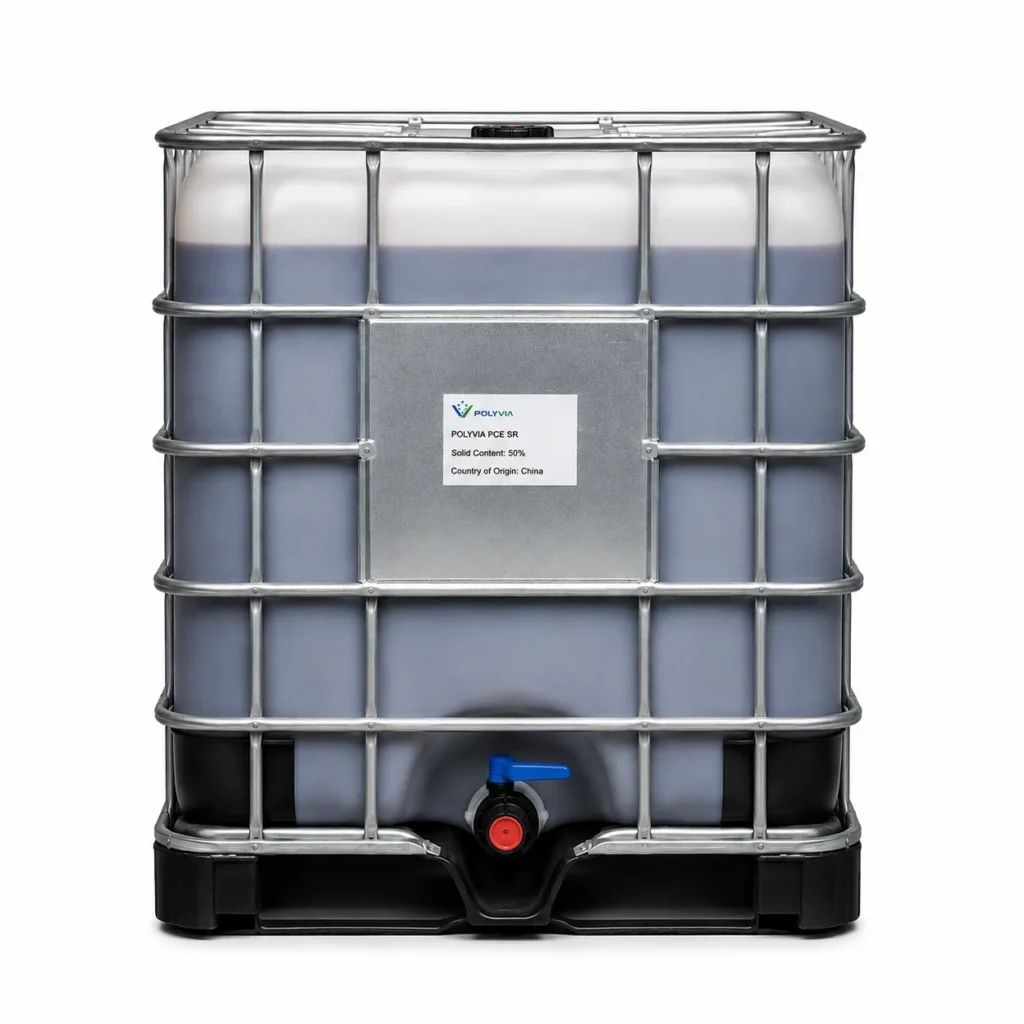
PCE HWR + PCE SR: Why Ready-Mix Producers Often Need a Balanced System
Ready-mix concrete rarely requires only one performance characteristic.
A producer may need:
- strong water reduction at the batching plant;
- sufficient initial slump;
- controlled slump retention during transportation;
- acceptable pumpability;
- stable concrete at the jobsite.
This is why an optimized HWR + SR system can be more practical than relying entirely on one PCE performance type.
Conceptually:
PCE HWR
provides the main high-water-reduction and initial-dispersion contribution.
while
PCE SR
provides additional workability-retention capability.
The appropriate balance depends on the actual concrete system.
For example:
Short Transport + Strong Water Reduction Requirement
The formulation may place greater emphasis on PCE HWR.
Longer Transportation + Significant Slump Loss
The system may require a greater PCE SR contribution.
Variable Transportation Conditions
A balanced HWR/SR formulation may provide greater flexibility.
Hot Weather + Long Transport
Slump retention normally becomes a more important design consideration, although temperature management, cement compatibility and total mix design must also be evaluated.
There is no universal HWR/SR blending ratio suitable for every ready-mix plant.
The final balance should be determined through laboratory and plant trials using the customer’s own cementitious materials and aggregates.
PCE F980 Flake for Ready-Mix Concrete Admixture Production
Polyvia also supplies PCE F980, a high-water-reduction PCE in flake form.
Form: Flake
Solid content: 98%
Performance orientation: High Water Reduction Type / Excellent Slump Retention Type
Unlike a 50% liquid PCE mother liquor, F980 contains very little transport water.
The flakes can be dissolved in water to prepare a liquid PCE solution, which can then be used as a raw material for concrete admixture formulation.
This creates a different supply-chain model.
Instead of transporting a large quantity of water together with the PCE, an admixture producer can purchase concentrated flake material, transport it to the destination market and prepare the required liquid solution locally.
For customers with suitable dissolution and formulation capability, this can be an important practical advantage.
PCE Liquid vs. PCE F980 Flake: Which Is Better for Ready-Mix Concrete?
Neither physical form is universally better.
The choice depends on whether the customer prioritizes direct use and operational simplicity or high active-material concentration and local formulation flexibility.
| Factor | PCE HWR / PCE SR Liquid | PCE F980 Flake |
|---|---|---|
| Physical form | Liquid | White to light yellow Flake |
| Solids | 50% | 98% |
| Main advantage | Ready for liquid admixture formulation/use | High concentration for transport and local dissolution |
| Water transported | Higher | Much lower |
| Local dissolution required | No | Yes |
| Dosing operation | Easy with liquid metering systems | Must first be dissolved into liquid solution |
| Formulation flexibility | Convenient for direct blending | High flexibility after local solution preparation |
| Logistics efficiency per active material | Lower than concentrated flake | Higher |
| Suitable customer | Ready-mix plant or admixture producer seeking convenience | Formulator/distributor with dissolution capability |
| Storage/handling focus | Liquid tank and pump management | Dry storage plus dissolution management |
| Start-up complexity | Lower | Higher |
Advantages of PCE Liquid for Ready-Mix Producers
For many ready-mix plants, liquid PCE remains the simplest operational option.
1. Ready for Liquid Dosing
PCE HWR and PCE SR can be integrated directly into an existing liquid admixture production or dosing system.
There is no separate dissolution stage.
2. Easier Automation
Ready-mix batching plants normally use automated liquid dosing systems.
Liquid PCE therefore fits naturally into conventional plant operations.
3. Faster Product Changeover
Where a producer needs to adjust HWR/SR balance according to project or seasonal requirements, liquid components can be reformulated relatively easily.
4. Lower Preparation Requirement
Customers do not need separate flake dissolution equipment or additional dissolution procedures.
For plants prioritizing operational simplicity, liquid PCE is often the more convenient option.
Advantages of PCE F980 Flake
F980 addresses a different customer need.
Its major advantage is not that the final PCE mechanism in concrete becomes fundamentally different simply because the product was shipped as a flake.
Its advantage is primarily the high-concentration supply form.
1. High Solids Content
At approximately 98% solids, F980 contains significantly less water than a 50% liquid PCE.
This means a greater proportion of the shipped material is active PCE material rather than carrier water.
2. Potential Logistics Advantage
For long-distance international transportation, transporting less water can improve freight efficiency per unit of active PCE.
This can be particularly relevant for overseas admixture manufacturers and distributors.
3. Local Solution Preparation
Customers can dissolve the flake locally and prepare the concentration required for their formulation system.
This provides additional flexibility for admixture formulators.
4. Useful for Local Admixture Production
Instead of importing a finished liquid admixture, a local formulator can use F980 as a concentrated PCE raw material and build its own ready-mix admixture formulations.
This makes F980 especially relevant to:
- concrete admixture manufacturers;
- construction chemical formulators;
- regional distributors with formulation capability;
- customers where international freight cost is an important consideration.
Important: F980 Must Be Properly Dissolved Before Liquid Use
PCE F980 should not be treated as though the flakes are simply equivalent to a ready-to-dose liquid product.
The flakes must first be dissolved completely in water to produce a uniform PCE solution.
The final working concentration can then be selected according to the customer’s formulation and production system.
Important operational considerations include:
- adequate dissolution equipment;
- sufficient mixing;
- complete dissolution before use;
- clean water quality;
- controlled preparation procedures;
- appropriate storage of the prepared solution.
The solution should be uniform before it is incorporated into a commercial admixture formulation.
A specific dissolution concentration, mixing time or production procedure should be confirmed according to the customer’s equipment and formulation requirements rather than assumed as a universal standard.
How Climate Changes PCE Selection for Ready-Mix Concrete
Climate is one of the most important practical variables in ready-mix production.
The same PCE formulation may not behave identically throughout the year.
Hot Climate and Summer Concrete
Higher concrete and material temperatures generally make slump-retention control more demanding.
Under hot conditions, a ready-mix producer may experience:
- faster workability loss;
- greater variation between batching and jobsite slump;
- increased sensitivity to transportation time;
- increased difficulty maintaining pumping consistency;
- greater dependence on cement–PCE compatibility.
For these conditions, a formulation focused only on initial high water reduction may not be sufficient.
A greater slump-retention contribution may need to be evaluated.
The optimization logic becomes:
HWR + Temperature Effect + Transport Time + SR Requirement
rather than:
Maximum HWR alone
Concrete temperature, aggregate temperature, mixing water temperature, delivery time and cement behavior should all be considered during summer trials.
Moderate Climate Conditions
Under moderate and relatively stable temperatures, the ready-mix producer may have more flexibility in balancing HWR and SR components.
Where transportation is short and predictable, an HWR-oriented formulation may provide sufficient performance.
Where deliveries are longer or variable, additional slump-retention capability may still be beneficial.
The important point is that climate should not be considered independently of transportation.
For example:
Moderate Temperature + Long Transport
can still require significant slump retention.
Likewise:
Hot Temperature + Very Short Transport
may require a different strategy from hot-weather concrete traveling over a much longer delivery cycle.
Cool or Cold Climate Conditions
Lower temperatures change cement hydration and concrete workability development.
Under cooler conditions, a formulation designed for hot summer operation may not necessarily provide the same desirable performance profile.
Excessive retention should also be avoided where it is unnecessary.
Ready-mix producers operating across strong seasonal temperature changes should therefore avoid assuming that one fixed PCE blend will always be optimal throughout the year.
A more practical approach is to establish:
Summer formulation and Cool-season formulation
where local conditions justify the adjustment.
The final formulation should still be verified against setting requirements, strength development and actual jobsite behavior.
Climate, Transportation and PCE Selection Matrix
| Operating Condition | Main Risk | Recommended Evaluation Direction |
|---|---|---|
| Short transport + moderate temperature | Initial performance | HWR-oriented system |
| Long transport + moderate temperature | Slump loss | HWR/SR balance |
| Short transport + hot weather | Faster workability loss | Evaluate retention requirement |
| Long transport + hot weather | Significant workability-retention challenge | Stronger focus on SR + compatibility + temperature |
| Variable traffic / jobsite waiting | Uncertain discharge time | Wider workable retention window |
| Pumped concrete + long delivery | Slump + rheology + pumpability | Balanced HWR/SR system |
| Strong seasonal temperature variation | Changing PCE response | Seasonal formulation evaluation |
This table represents general selection logic only.
Actual PCE formulation should be verified using the local cement, supplementary cementitious materials, aggregates and production conditions.
Water Reduction vs. Slump Retention: Initial Slump Is Not the Final Target
One of the most common mistakes in ready-mix admixture evaluation is selecting a PCE almost entirely from initial slump.
Imagine two systems.
System A
Very high initial slump
↓
Rapid workability reduction
↓
Insufficient slump at jobsite
System B
Controlled initial slump
↓
Gradual workability evolution
↓
Suitable slump at jobsite
For a transported ready-mix concrete application, System B may deliver better commercial performance even though System A appears more impressive during the first few minutes of laboratory testing.
Therefore, PCE selection should focus on the workability curve.
The key question becomes:
What happens to the concrete between T0 and the actual placement time?
Why the Same PCE Can Perform Differently with Different Cement
PCE performance depends strongly on the cementitious environment.
Ready-mix producers sometimes encounter a situation where:
Same PCE + Same nominal dosage + Different cement = Different concrete behavior
This does not necessarily mean the PCE quality changed.
Possible factors include:
- cement composition;
- sulfate conditions;
- cement fineness;
- supplementary cementitious materials;
- fine particle characteristics;
- clay contamination;
- water demand;
- concrete temperature.
This is why Polyvia recommends evaluating PCE with the customer’s actual raw materials rather than selecting a product only from a generic specification sheet.
PCE Selection for Pumped Ready-Mix Concrete
Pumpability should not be reduced to one number such as slump.
A concrete mix may have high slump but still pump poorly.
Pumping behavior also depends on:
- paste volume;
- mortar volume;
- aggregate grading;
- fine material content;
- cohesion;
- viscosity;
- water-binder ratio;
- pipe configuration;
- pumping distance.
PCE contributes to concrete flowability, but it cannot compensate for every poor mix-design condition.
For pumped ready-mix concrete, the preferred approach is therefore:
PCE selection + rheology optimization + aggregate optimization + stability control
rather than simply increasing PCE dosage.
A Practical PCE Selection Framework for Ready-Mix Concrete
| Customer Situation | Main Requirement | Polyvia Selection Direction |
|---|---|---|
| Strong initial water reduction | Water reduction | PCE HWR 50% Liquid |
| Long transportation | Slump retention | PCE SR 50% Liquid / HWR + SR system |
| Variable transport time | Balanced workability | HWR + SR optimized system |
| Pumped ready-mix concrete | Flow + retention + stability | Balanced system after trial |
| Hot climate | Slump-retention control | Increase focus on SR and compatibility |
| Short transport | Initial performance | HWR-oriented system may be suitable |
| Overseas admixture formulator | Logistics + local formulation | PCE F980 98% Flake |
| Customer without dissolution capability | Ease of operation | PCE Liquid |
| Customer with local formulation plant | Concentrated raw material | PCE F980 Flake |
| Variable cement source | Compatibility | Comparative PCE/cement trial required |
There is no universal PCE grade or dosage for all these situations.
Final selection should be based on actual raw materials and production trials.
How Polyvia Evaluates a Ready-Mix PCE Requirement
A meaningful PCE recommendation should start with the concrete application rather than simply asking:
“Do you need HWR or SR?”
Polyvia prefers to evaluate several variables together.
Cementitious Materials
What cement is being used?
Are fly ash, slag, silica fume or other supplementary cementitious materials included?
Required Concrete Performance
What is the target initial workability?
What workability is required when the concrete reaches the jobsite?
Transportation
How long is the normal delivery cycle?
How variable is that transportation time?
Climate
What are the normal summer and winter production temperatures?
Does the plant experience strong seasonal changes?
Pumping
Will the concrete be pumped?
Are there current problems with stickiness, pressure or stability?
Current Admixture System
Is the customer using a high-water-reduction PCE, slump-retention PCE or blended admixture?
Supply Preference
Does the customer prefer:
Ready-to-use liquid PCE
or
High-solids PCE flake for local dissolution and formulation?
These questions allow PCE selection to become an engineering decision rather than simply a price comparison.
Ready-Mix PCE Trial-Mix Procedure
A proper trial should reproduce actual production conditions as closely as practical.
The evaluation should follow:
Initial Mixing → Transportation Simulation → Jobsite Workability → Pumping/Placement Evaluation
Important observations include:
- initial slump or flow;
- workability evolution;
- concrete cohesion;
- bleeding;
- segregation tendency;
- apparent stickiness;
- pumping behavior where relevant;
- setting behavior;
- strength development where required.
Most importantly, the PCE should not be judged only from the first test result.
The time-dependent performance curve is usually more relevant to ready-mix production.
Common Ready-Mix Problems and Optimization Directions
| Problem | Possible Cause | What to Check | Optimization Direction |
|---|---|---|---|
| Rapid slump loss | Insufficient retention, temperature, cement compatibility | Time-based slump, cement, temperature | Evaluate SR contribution |
| Very high initial slump but poor retention | Excessive initial dispersion | HWR level and workability curve | Rebalance HWR/SR |
| Poor pumpability | Rheology, aggregates, fines | Mortar volume, grading, cohesion | Optimize mix + PCE together |
| Sticky concrete | Binder/fines/PCE interaction | Paste system and PCE level | Adjust complete rheological system |
| Bleeding | Excessive fluidity or poor stability | Water, grading, PCE | Rebalance concrete system |
| Summer slump loss | High concrete temperature | Material temperature and transport | Strengthen hot-weather retention strategy |
| Batch inconsistency | Moisture or raw-material variation | Aggregate moisture and cement changes | Improve production control |
| Performance changes after cement change | Cement–PCE compatibility | Comparative trials | Re-optimize PCE system |
The principle should always be:
Identify the cause → verify it → adjust the formulation
rather than immediately increasing the PCE dosage.
Liquid PCE or F980 Flake: A Procurement Decision as Well as a Technical Decision
The physical form of PCE influences more than concrete performance.
It also influences purchasing, logistics and local production strategy.
For customers who want maximum convenience:
PCE HWR 50% Liquid / PCE SR 50% Liquid
may be more appropriate.
For customers that already operate an admixture formulation plant and can prepare PCE solutions locally:
PCE F980 98% Flake
may provide a more efficient concentrated supply option.
This creates two different supply models.
Model A — Import Liquid PCE
Polyvia → PCE Liquid → Customer Plant → Admixture Formulation / Ready-Mix
Advantages:
- simple;
- no dissolution;
- easy pumping and dosing;
- low preparation requirement.
Model B — Import PCE Flake
Polyvia → F980 Flake → Local Dissolution → PCE Solution → Admixture Formulation → Ready-Mix
Advantages:
- high solids;
- less transported water;
- local concentration adjustment;
- potentially improved international logistics efficiency.
The better model depends on the customer’s equipment, formulation capability, freight structure and production volume.
What Should a Ready-Mix Producer Evaluate When Choosing a PCE Supplier?
A serious PCE supplier should provide more than a product specification and quotation.
Ready-mix producers should evaluate whether the supplier can support:
- HWR and slump-retention product selection;
- HWR/SR formulation balance;
- cement compatibility;
- transportation requirements;
- seasonal formulation changes;
- pumping performance;
- troubleshooting;
- local raw-material evaluation;
- liquid versus concentrated supply strategy;
- stable long-term supply.
The objective is not merely to purchase PCE.
It is to build an admixture system that works under real production conditions.
How Polyvia Supports Ready-Mix Concrete Producers
Polyvia is not positioned only as a supplier of a single polycarboxylate superplasticizer grade.
Our ready-mix approach is based on application requirements.
Depending on the customer’s production system, Polyvia can discuss:
PCE HWR 50% Liquid
For high-water-reduction-oriented ready-mix formulations.
PCE SR 50% Liquid
For workability-retention-oriented formulations.
HWR + SR Systems
For ready-mix producers who need to balance initial water reduction with transportation and jobsite slump requirements.
PCE F980 98% Flake
For admixture manufacturers and distributors seeking a high-solids PCE raw material that can be dissolved locally and formulated into liquid admixture systems.
Polyvia can also support discussions around:
- cement compatibility;
- SCM compatibility;
- transport time;
- temperature;
- pumping conditions;
- seasonal formulation adjustment;
- trial-mix evaluation;
- admixture formulation optimization.
Reliable Materials. Practical Solutions. Consistent Performance.
FAQ:
1. Should I use PCE HWR or PCE SR for ready-mix concrete?
It depends on the required workability profile. PCE HWR is primarily selected where high water reduction and strong initial dispersion are important. PCE SR becomes more important where the concrete must maintain workability during longer transportation or waiting periods. Many ready-mix formulations use a balance between HWR and SR characteristics.
2. Can PCE HWR and PCE SR be used together?
Yes, different PCE performance components can be evaluated as part of a blended admixture system. The appropriate balance depends on cement, transportation time, temperature, target workability and other mix-design variables. A universal blending ratio should not be assumed.
3. What is the difference between PCE HWR liquid and PCE F980 flake?
PCE HWR is supplied as an approximately 50% liquid product, while PCE F980 is supplied as an approximately 98% flake product. Liquid PCE offers convenient direct handling and dosing. F980 provides a concentrated supply form that can be dissolved locally to produce a liquid PCE solution and may offer advantages for international transportation and local admixture formulation.
4. Can PCE F980 flake be used directly in ready-mix concrete?
F980 is normally dissolved in water first to prepare a uniform liquid PCE solution before being incorporated into an admixture formulation or dosing system.
The preparation procedure and target concentration should be established according to the customer’s formulation and equipment.
5. Is PCE SR more suitable for hot-weather ready-mix concrete?
Hot conditions generally make workability retention more challenging, so a slump-retention component may become more important.
However, temperature is only one factor. Cement compatibility, transportation time, water-binder ratio and overall admixture formulation should also be evaluated.
6. Why does my PCE work in winter but perform differently in summer?
Temperature affects cement hydration and workability evolution. As material and concrete temperatures change, the balance between initial water reduction and slump retention may also need adjustment. Plants operating in climates with strong seasonal variation should consider seasonal trial testing.
7. Does higher slump mean better pumpability?
No. Pumpability also depends on rheology, cohesion, paste volume, aggregate grading and mixture stability. A high-slump concrete can still be sticky or difficult to pump
Discuss Your Ready-Mix Concrete Requirements
The best PCE for ready-mix concrete is not necessarily the product that gives the highest initial slump.
The better PCE system is the one that delivers the required performance throughout:
Batching → Transportation → Jobsite Arrival → Pumping → Placement
Depending on your concrete system, Polyvia can support the evaluation of:
PCE HWR 50% Liquid
PCE SR 50% Liquid
HWR + SR Ready-Mix Formulation Systems
and
PCE F980 98% Flake for Local PCE Solution Preparation
If you are experiencing rapid slump loss, hot-weather workability problems, cement compatibility issues, poor pumpability or high international liquid-PCE transportation costs, contact Polyvia to discuss your actual operating conditions.
Request Ready-Mix PCE Selection Support
Please provide your:
Cement + SCM system
Concrete mix design
Target slump
Transportation time
Temperature
Pumping conditions
Current admixture system
Main performance problem
Hebei Polyvia New Material Technology Co., Ltd.
Website: www.polyvia-material.com
Email: alan@polyvia-material.com
WhatsApp: +86 15333233980
Reliable Materials. Practical Solutions. Consistent Performance.