
Why PCE Performance Varies with Cement Chemistry
Understanding the Influence of Cement Composition on PCE Dispersion and Workability
Explore how cement mineralogy, sulfate balance, particle fineness and pore solution chemistry influence PCE adsorption, dispersing efficiency and workability retention across different cement systems.
Why PCE Superplasticizer Performance Varies with Cement Chemistry
The same Polycarboxylate Ether (PCE) Superplasticizer can exhibit different performance with different cement sources, even when the polymer grade, dosage, water-to-cement ratio and mixing procedure remain unchanged.
One cement may respond with excellent initial fluidity, while another requires a higher PCE dosage or exhibits faster workability loss. These differences do not necessarily indicate inconsistent admixture quality. They may arise from variations in cement mineralogy, sulfate availability, particle fineness, pore solution chemistry and early hydration behavior.
PCE performance is not determined by polymer chemistry alone. It emerges from the interaction between the polymer and the cementitious environment.
This article examines the principal mechanisms behind these differences and explains how engineers can evaluate PCE performance across cement sources without relying on a single chemical parameter.
Why the Same PCE Performs Differently with Different Cements
PCE superplasticizers improve cement particle dispersion primarily through adsorption and steric stabilization. However, the effectiveness of this process depends on the reactive surfaces and chemical conditions present during mixing.
Portland cement is a multiphase, chemically reactive material rather than a uniform powder.
Cements from different sources may vary in clinker mineralogy, sulfate-bearing phases, soluble alkali content, fineness and particle-size distribution. These characteristics influence both initial polymer–particle interactions and subsequent hydration behavior.
Even when the PCE formulation remains unchanged, cement properties can affect three important performance characteristics.
Initial Dispersing Efficiency
The fluidity achieved shortly after mixing may vary because different cement systems establish different adsorption and particle-interaction conditions.
PCE Dosage Demand
Different amounts of PCE may be required to achieve the same target consistency, depending on the physical and chemical characteristics of the cement.
Workability Retention
Two systems with comparable initial flow may exhibit different rates of fluidity loss as hydration proceeds.
These responses are related but should not be treated as equivalent.
A cement requiring a higher initial PCE dosage does not necessarily exhibit poorer long-term workability. Likewise, strong initial dispersion does not guarantee favorable flow retention.
The relevant question is therefore not whether a cement is universally compatible with PCE, but whether a specific cement–PCE combination achieves the required performance under defined conditions.
Cement Mineralogy and Reactive Surface Chemistry
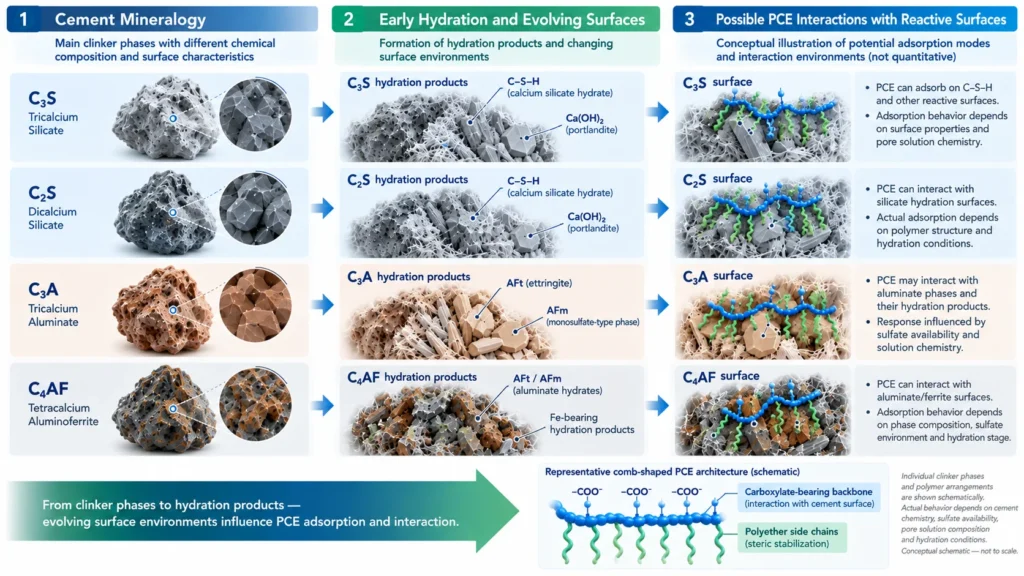
The major clinker phases in ordinary Portland cement include tricalcium silicate (C₃S), dicalcium silicate (C₂S), tricalcium aluminate (C₃A) and tetracalcium aluminoferrite (C₄AF).
These phases differ in chemical composition, hydration reactivity and surface characteristics. Consequently, their interactions with PCE are not necessarily identical.
Aluminate Phases and Polymer Uptake
C₃A is particularly relevant to early cement–admixture interactions because of its rapid hydration and sensitivity to sulfate availability.
Aluminate-containing surfaces and early hydration products may interact with PCE molecules, influencing polymer distribution within the suspension.
Under certain conditions, polymer uptake associated with reactive aluminate phases may reduce the amount of PCE available for effective dispersion elsewhere.
However, higher C₃A content does not automatically result in poorer PCE compatibility.
The response also depends on aluminate crystal structure, hydration reactivity, sulfate availability, PCE molecular characteristics and mixing conditions.
Silicate Phases and Hydration Development
Calcium silicate phases contribute to the formation of calcium silicate hydrate (C–S–H), the principal binding phase in hydrated Portland cement.
As hydration proceeds, new products form and available surface characteristics evolve.
These changes can modify the environment in which PCE molecules interact with cementitious particles.
The importance of individual phases varies with cement composition and hydration stage.
Why Mineralogy Alone Cannot Predict Compatibility
Two cements with similar nominal clinker compositions may exhibit different PCE performance because of differences in sulfate dissolution, soluble ions, particle-size distribution or hydration behavior.
Cement mineralogy is an important component of compatibility assessment, but it cannot independently predict PCE effectiveness.
Sulfate Balance and Competitive Adsorption
Sulfate chemistry plays an important role in early cement hydration and PCE performance.
Sulfate-bearing components are introduced into cement primarily to regulate aluminate reactions. However, their influence on PCE behavior depends on more than the total sulfate content reported in a cement specification.
Total Sulfate Content Versus Sulfate Availability
Sulfate may be present in different chemical forms with different dissolution characteristics.
During mixing, soluble sulfate species enter the pore solution while hydration reactions consume sulfate.
The resulting concentration depends on sulfate-bearing phases, clinker characteristics, temperature and elapsed hydration time.
Therefore, two cements with comparable total SO₃ content may develop different pore solution sulfate concentrations.
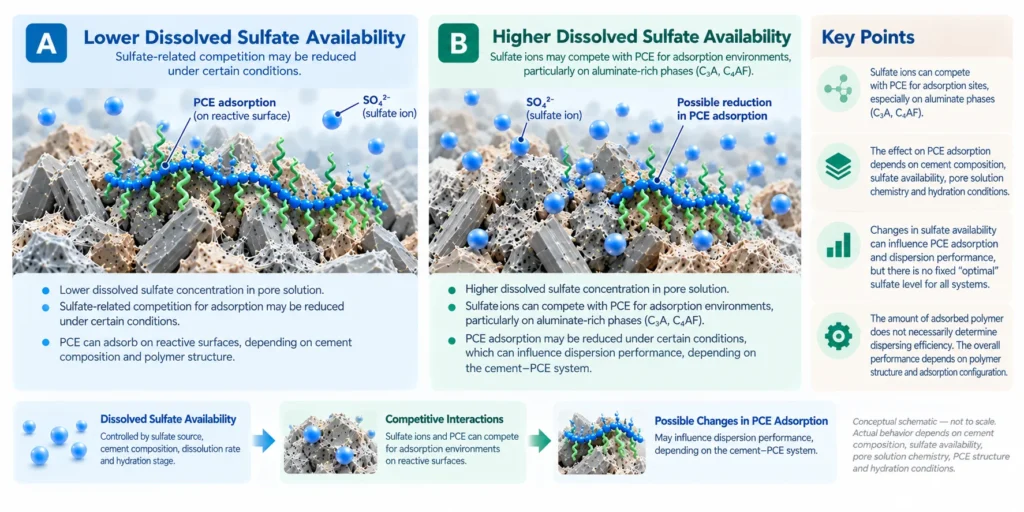
This distinction matters because dissolved sulfate influences the environment in which polymer adsorption occurs.
Competitive Interactions with PCE
Sulfate species can influence PCE adsorption through competitive interactions at suitable cementitious surfaces or through changes in surface chemistry.
Experimental studies have demonstrated that sulfate ion concentration can affect PCE adsorption and dispersing behavior under specific conditions.
However, the effect is not universal.
It depends on polymer structure, cement mineralogy, sulfate availability and hydration stage.
It would therefore be inaccurate to conclude that increasing total sulfate content always reduces PCE performance.
Why Sulfate Balance Is Dynamic
A meaningful assessment should consider:
- Sulfate sources and chemical forms.
- Dissolution behavior during mixing.
- Sulfate consumption during aluminate hydration.
- Changes in pore solution concentration over time.
These processes influence the evolving adsorption environment.
Sulfate balance should be understood as a time-dependent interaction between dissolution, hydration and solution chemistry—not simply a fixed SO₃ percentage.
Cement Fineness, Surface Area and Admixture Demand
Cement fineness influences the physical characteristics of a cementitious suspension and can affect the amount of PCE required to achieve a specified fluidity.
In general, finer cement provides greater surface area per unit mass, although the relationship depends on particle-size distribution, particle shape and the measurement method.
Why Available Surface Area Matters
At a fixed PCE dosage, cement with a greater available particle surface area may receive less polymer per unit surface area.
This can influence the development of effective surface coverage and the resulting particle dispersion.
Increased fineness may also change water demand, interparticle interactions and early hydration kinetics.
Therefore, a change in cement fineness can affect fluidity even when the polymer formulation remains identical.
However, the relationship between fineness and PCE demand is not necessarily linear.
Why Blaine Fineness Is Not a Complete Predictor
Blaine specific surface area provides useful information about cement fineness, but it does not fully characterize particle-size distribution, mineral-specific surface properties or surface reactivity.
Two cements with similar Blaine values may exhibit different PCE dosage requirements.
Separating Physical Demand from Chemical Effects
If one cement requires more PCE to achieve the same initial flow, greater particle surface area may be a contributing factor.
However, differences in mineral reactivity, sulfate availability or pore solution chemistry may produce similar observations.
A higher dosage requirement alone cannot determine the dominant cause.
Fineness data should support PCE compatibility assessment rather than replace controlled performance testing.
Pore Solution Chemistry and Ionic Interactions
The pore solution surrounding cement particles is a highly alkaline electrolyte environment.
Its composition evolves as clinker phases dissolve and hydration products form.
Dissolved calcium, sodium, potassium, hydroxide and other ionic species influence the conditions governing polymer–surface interactions.
Calcium and Polymer Adsorption
Calcium-associated sites can participate in interactions involving PCE carboxylate groups and cementitious surfaces.
Changes in calcium availability may influence polymer adsorption, while also affecting hydration and the formation of new solid phases.
However, the influence of calcium must be considered together with the overall solution chemistry and reactive surfaces.
Alkalis and Ionic Strength
Sodium and potassium compounds contribute to pore solution alkalinity and ionic strength.
Changes in ionic strength can affect electrostatic screening and the behavior of charged polymer segments.
These effects may influence adsorption and dispersion without changing the chemical composition of the PCE itself.
Nevertheless, alkali content should not be treated as an isolated predictor of admixture compatibility.
Bulk Cement Composition Versus Actual Pore Solution
Cement chemical certificates commonly report oxide compositions.
These values are useful, but they do not directly describe all dissolved ion concentrations present during mixing.
The pore solution environment depends on dissolution rates, hydration reactions, temperature and elapsed time.
Two cements with similar bulk chemistry may therefore establish different liquid-phase conditions.
PCE interacts with an evolving chemical environment, not simply with the oxide composition reported on a cement certificate.
Why Initial Flow and Flow Retention May Differ
A reliable PCE–cement compatibility assessment should compare material performance under controlled conditions and distinguish experimental observations from possible chemical explanations.
The most informative evaluation combines two complementary testing approaches.
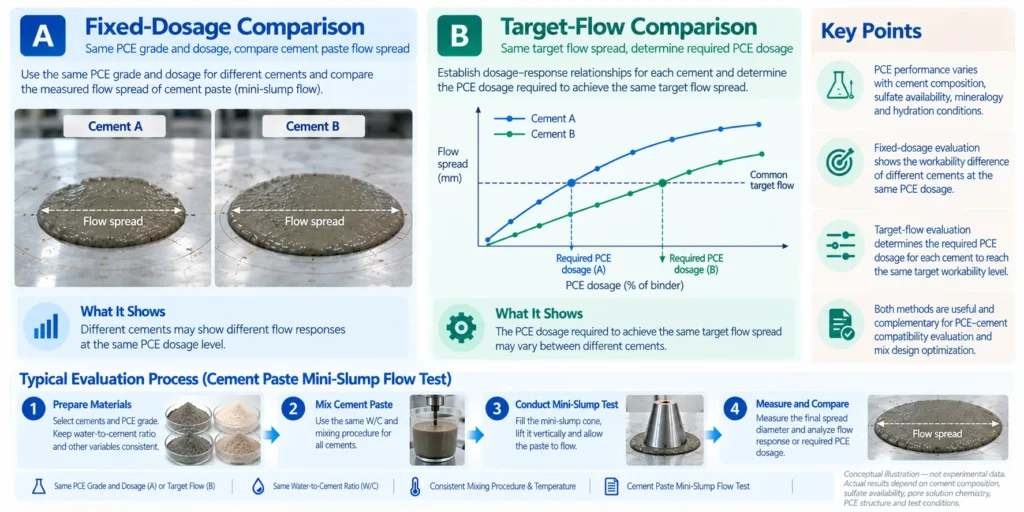
Test A — Fixed-Dosage Comparison
A fixed-dosage test evaluates how different cement sources respond to the same PCE grade and dosage under otherwise comparable conditions.
The principal objective is to determine whether the cement source affects initial flow or time-dependent fluidity.
The test should maintain consistent water-to-cement ratio, mixing conditions, temperature and measurement timing.
This approach answers:
How does the same amount of PCE perform with different cements?
A difference in measured flow demonstrates a difference in performance under the tested conditions, but it does not independently establish the cause.
Test B — Target-Flow Comparison
A target-flow test evaluates how much PCE is required for different cement sources to achieve a predefined flow spread.
Rather than comparing only one dosage, each cement should be evaluated over an appropriate dosage range.
The resulting dosage–response relationship allows comparison of admixture demand at the same target consistency.
This approach answers:
How much PCE does each cement require to achieve equivalent measured fluidity?
Dosage should be reported consistently, with the basis clearly defined—for example, percentage of cement mass or percentage of binder mass.
For liquid PCE formulations, it is also necessary to clarify whether the dosage refers to the supplied liquid product or the polymer solids.
Recommended Laboratory Controls
A meaningful comparison should maintain the following parameters consistently wherever practical.
| Parameter | Recommended Comparison Principle |
|---|---|
| PCE Grade | Use the same formulation |
| PCE Dosage | Use a clearly defined and consistent mass basis |
| Water-to-Cement Ratio | Keep constant within each comparison |
| Mixing Procedure | Maintain identical mixing sequence and duration |
| Material Temperature | Control and record |
| Measurement Timing | Use identical time intervals |
| Flow Test Procedure | Use the same equipment and method |
| Repeatability | Conduct appropriate repeat measurements |
Key Technical Conclusions
The effectiveness of a PCE superplasticizer depends on the interaction between polymer characteristics and the chemical and physical properties of the cementitious system.
The same PCE may produce different initial flow, dosage demand and workability retention when used with different cement sources.
Several interacting factors contribute to these differences.
Cement mineralogy influences reactive surface chemistry and early hydration behavior.
Sulfate availability affects aluminate reactions and may influence competitive polymer adsorption.
Cement fineness affects particle surface characteristics, water demand and potentially admixture dosage requirements.
Pore solution chemistry influences polymer–surface interactions and the electrochemical environment surrounding cement particles.
Hydration development continuously changes these conditions over time.
None of these factors should be interpreted independently.
A cement with higher C₃A content is not necessarily incompatible with PCE. Similarly, a cement with lower fineness does not automatically require less superplasticizer under every condition.
The most reliable compatibility assessment combines cement characterization with controlled performance testing.
Effective PCE–cement compatibility is demonstrated by achieving the required performance under defined material and production conditions—not inferred from a single chemical indicator.
Frequently Asked Questions
1. Why does the same PCE superplasticizer perform differently with different cement brands?
Different cements may vary in mineral composition, sulfate characteristics, fineness and soluble ion content. These differences affect PCE adsorption, particle interactions and hydration behavior. Consequently, the same PCE dosage may produce different initial flow, admixture demand or workability retention.
2. Does higher C₃A content always cause poor PCE compatibility?
No. C₃A content can influence polymer uptake and early hydration, but the actual response also depends on aluminate reactivity, sulfate availability, PCE molecular structure and other cement characteristics. C₃A content alone cannot reliably predict compatibility.
3. How does sulfate balance affect PCE performance?
Sulfate species influence early aluminate reactions and can affect the environment for PCE adsorption. Their impact depends on sulfate forms, dissolution behavior, pore solution concentration and cement chemistry. Total SO₃ content alone is not sufficient to predict PCE performance.
4. Why does finer cement sometimes require more PCE?
Finer cement may provide greater available surface area and exhibit different water demand and hydration behavior. The same PCE dosage may therefore provide different effective polymer coverage. However, mineralogy and pore solution chemistry also influence dosage requirements.
5. Can two cements with the same 52.5 strength grade show different PCE performance?
Yes. Cement strength grade specifies strength-related performance requirements, not identical chemical composition, fineness or surface characteristics. Two cements of the same strength grade can therefore respond differently to the same PCE formulation.
6. Why does cement paste show good initial flow but rapid flow loss?
Initial flow reflects the suspension shortly after mixing. Subsequent flow loss may result from hydration-related changes in reactive surfaces, pore solution chemistry, polymer distribution and particle interactions. Further testing is necessary to identify the dominant cause.
7. Can increasing PCE dosage solve cement compatibility problems?
Increasing dosage may improve initial fluidity within a certain range, but it does not necessarily resolve the underlying cause. Excessive dosage may also influence mixture stability, air content or setting behavior. An appropriate dosage should be determined through controlled testing.
8. Which tests can identify PCE–cement compatibility problems?
Controlled cement paste and mortar flow testing can provide useful preliminary evidence. Fixed-dosage and target-flow comparisons help distinguish differences in performance from differences in dosage demand. Rheological measurements, polymer adsorption analysis, calorimetry and pore solution analysis may support further investigation. Final performance should be confirmed in the intended concrete system where applicable.
Scientific References & Further Reading
1. Yamada, K., Ogawa, S., and Hanehara, S. (2001). Controlling of the Adsorption and Dispersing Force of Polycarboxylate-Type Superplasticizer by Sulfate Ion Concentration in Aqueous Phase. Cement and Concrete Research. https://doi.org/10.1016/S0008-8846(00)00503-2
2. Adsorption Properties of Polycarboxylate Ether-Based High Range Water Reducing Admixture on Cementitious Systems: A Review. Construction and Building Materials (2021). https://doi.org/10.1016/j.conbuildmat.2021.125366
3. Influence of Water to Cement Ratio on the Compatibility of Polycarboxylate Superplasticizer with Portland Cement. Construction and Building Materials (2022). https://doi.org/10.1016/j.conbuildmat.2022.127846
4. Influence of the Structures of Polycarboxylate Superplasticizer on Its Performance in Cement-Based Materials — A Review. Construction and Building Materials (2020). https://doi.org/10.1016/j.conbuildmat.2019.117257
5. Adsorption and Dispersion Capability of Polycarboxylate-Based Superplasticizers: A Review. Journal of Sustainable Cement-Based Materials (2022). https://doi.org/10.1080/21650373.2021.1983483
6. Lombois-Burger, H., Guillot, L., and Haehnel, C. (2006). Interaction between Cements and Superplasticizers. ACI Symposium Paper. https://doi.org/10.14359/18390