
How PCE Superplasticizer Works
From Molecular Structure to Cement Dispersion
Explore how PCE molecular architecture, surface adsorption and steric stabilization influence cement particle dispersion, concrete rheology and workability, supported by POLYVIA™ laboratory observations.
How PCE Superplasticizer Works: From Molecular Structure to Cement Dispersion
How Does PCE Superplasticizer Work?
Polycarboxylate ether (PCE) superplasticizers improve the flowability of cementitious materials by modifying interactions between cement particles. Their effectiveness depends on more than polymer dosage: molecular architecture, adsorption behavior, steric stabilization and the evolving chemistry of cement collectively determine how efficiently particles disperse.
Understanding how PCE works requires connecting molecular-level interactions with measurable changes in cement paste and concrete behavior. Although steric stabilization is widely recognized as a principal mechanism, polymer adsorption, electrostatic interactions and cement hydration also influence the resulting performance.
The central question is not simply how much PCE adsorbs onto cement, but how effectively its molecular interactions translate into particle dispersion and practical workability.
This article examines the relationship between PCE molecular structure, surface adsorption, interparticle forces, cement rheology and hydration-dependent behavior, supported by original POLYVIA™ laboratory observations using PCE 840.
Cement Flocculation: Why Dispersion Matters
Fresh cement paste is a concentrated suspension of reactive mineral particles in water.
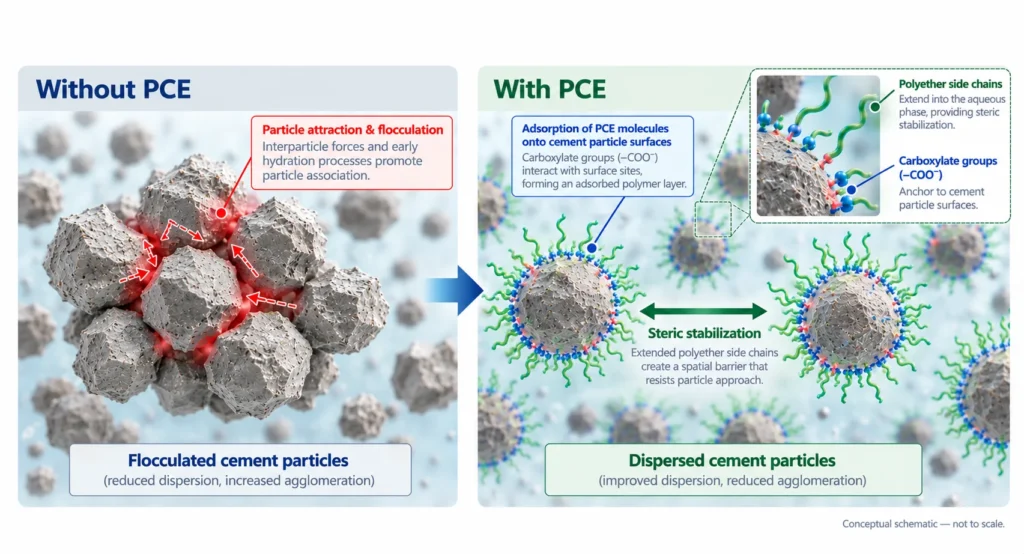
Immediately after mixing, cement particles interact through attractive forces, electrostatic effects and early hydration processes. These interactions can promote flocculation, in which individual particles form temporary clusters and interconnected structures.
Flocculated networks influence cement paste workability in two important ways.
First, interactions between associated particles contribute to the yield stress of the suspension—the stress required to initiate sustained flow within an appropriate rheological description.
Second, part of the mixing water becomes less effective in facilitating particle movement because it is held within flocculated structures.
Consequently, cement paste workability depends not only on the quantity of water present, but also on how efficiently that water supports particle mobility.
PCE superplasticizers modify the interactions responsible for flocculation, allowing cement particles to disperse more effectively.
This creates two practical possibilities:
- At constant water content: PCE can improve fluidity by reducing resistance to particle movement.
- At constant target workability: Effective dispersion can permit a reduction in mixing water while maintaining the required consistency.
The second effect is particularly important in high-performance concrete, where reducing the water-to-binder ratio is often a central part of mixture optimization.
However, water reduction is a consequence of improved dispersion, not the direct removal of water from the mixture.
PCE primarily modifies particle interactions. The resulting improvement in water-use efficiency creates the potential for greater flowability or lower water demand.
Molecular Architecture: How PCE Controls Dispersion
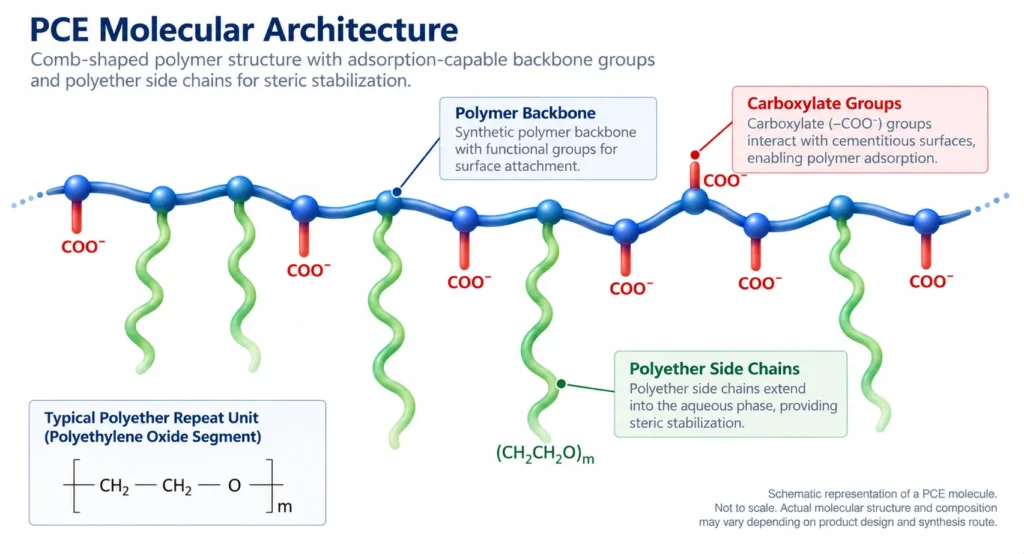
The working mechanism of PCE originates from its characteristic comb-like molecular structure.
A typical PCE polymer contains a backbone with adsorption-capable functional groups and polyether side chains extending into the surrounding aqueous environment.
These structural components perform complementary functions.
Polymer Backbone: Establishing Surface Attachment
Carboxylate functional groups along the PCE backbone interact with suitable sites on cementitious surfaces, including calcium-associated adsorption environments.
These interactions allow polymer molecules to associate with cement particles and newly formed hydration products.
The extent of adsorption depends on the density and distribution of functional groups, molecular conformation and surrounding pore solution chemistry.
A higher density of anchoring groups can increase adsorption under certain conditions, but it does not automatically guarantee greater dispersing efficiency.
Polyether Side Chains: Providing Steric Stabilization
Once PCE molecules are appropriately adsorbed, their polyether side chains extend into the aqueous phase.
When neighboring particles approach each other, interactions between their polymer-containing surface regions resist close contact.
This steric stabilization reduces the tendency of particles to form persistent flocculated structures.
The effectiveness of this process depends on side-chain length, grafting density, molecular conformation and the arrangement of the adsorbed polymer layer.
Why Molecular Balance Matters
The performance of PCE cannot be reliably predicted by maximizing a single molecular parameter.
Stronger adsorption may increase polymer coverage, but an unfavorable molecular arrangement can limit the resulting steric stabilization.
Longer side chains may create a more extended protective region, but their effectiveness depends on how the polymer is anchored and distributed across available surfaces.
Research involving structurally controlled PCE copolymers has demonstrated that molecular composition influences adsorption, dispersion and cement hydration behavior in ways that cannot be explained by one structural feature alone.
The most effective molecular architecture is therefore determined by the balance between surface attachment and the interparticle forces generated after adsorption.
Surface Adsorption: Why Polymer Uptake Is Not the Same as Dispersion
Adsorption is central to the working mechanism of PCE, but adsorption quantity and dispersing efficiency are not interchangeable.
When PCE is introduced into cement paste, polymer molecules may become associated with cement particles and hydration products, remain dissolved in the pore solution or interact with reactive phases without contributing equally to dispersion.
The resulting polymer distribution depends on both the admixture and the cementitious system.
Effective Adsorption Versus Total Adsorption
Adsorption measurements provide information about the quantity of polymer taken up by the solid phase under specified experimental conditions.
However, they do not independently reveal the configuration of adsorbed molecules or the forces acting between neighboring particles.
For the same PCE and cement system, increasing effective adsorption commonly improves particle dispersion until a limiting condition is approached.
When comparing polymers with different molecular architectures, greater measured adsorption does not necessarily produce greater fluidity.
Two polymers may exhibit similar uptake but create different adsorption-layer structures and interparticle interactions.
Accordingly, adsorption should be evaluated as one component of dispersing performance rather than as an independent measure of its effectiveness.
The Contribution of Non-Adsorbed PCE
PCE remaining in the liquid phase should not automatically be considered inactive.
In concentrated cementitious suspensions, particularly at low water-to-binder ratios, non-adsorbed polymer may influence liquid-phase behavior and particle mobility.
The magnitude and direction of these effects depend on polymer characteristics, concentration and suspension conditions.
Research examining PCE behavior in cementitious systems indicates that both surface-associated and non-adsorbed polymer can influence workability under different conditions.
A useful evaluation therefore considers three separate questions:
- How much polymer becomes associated with the solid phase?
- How effectively does the adsorbed polymer stabilize neighboring particles?
- How do the remaining polymer and pore solution influence the suspension?
The relevant objective is effective particle dispersion, not maximum polymer adsorption in isolation.
Steric Stabilization and Electrostatic Interactions
After PCE molecules associate with cementitious surfaces, they change the balance of interparticle forces.
Steric stabilization is a major mechanism of PCE dispersion, while electrostatic interactions influence adsorption and the behavior of the polymer–particle system.
Steric Stabilization
Adsorbed PCE molecules form a polymer-containing region around cementitious particles.
When two coated particles approach sufficiently closely, overlap and compression of these polymer regions become energetically unfavorable.
This creates a repulsive contribution that helps prevent persistent particle association.
Steric stabilization is especially important in cement pore solutions because their relatively high ionic strength screens many long-range electrostatic interactions.
Electrostatic Interactions
The ionic functionality of the PCE backbone influences how polymer molecules attach to cementitious surfaces.
Carboxylate groups can interact with calcium-associated surface sites, while the composition of the pore solution affects the electrochemical environment.
These interactions influence polymer adsorption and can contribute to particle stabilization.
However, greater negative surface charge does not automatically imply greater fluidity.
The overall response depends on polymer configuration, adsorption-layer characteristics and solution chemistry.
A Coupled Mechanism
Steric and electrostatic effects should not be treated as completely independent processes.
Changes in backbone functionality can alter polymer adsorption and the arrangement of side chains at the particle surface.
Likewise, changes in the ionic environment can modify polymer–surface interactions without changing the chemical structure of the PCE molecule.
Therefore, dispersing performance emerges from a coupled interfacial mechanism involving adsorption, polymer configuration and particle–particle interactions.
Surface chemistry influences whether an effective polymer layer develops; steric stabilization helps explain how that layer maintains particle separation.
From Molecular Dispersion to Cement Rheology
The microscopic action of PCE becomes observable through changes in the rheological behavior of cement paste, mortar and concrete.
However, improved dispersion should not be interpreted as an automatic improvement in every aspect of workability.
Fresh cementitious materials typically exhibit non-Newtonian flow behavior influenced by particle concentration, interparticle forces, shear conditions and structural evolution.
Two rheological parameters are particularly relevant.
Yield Stress: Resistance to Initiating Flow
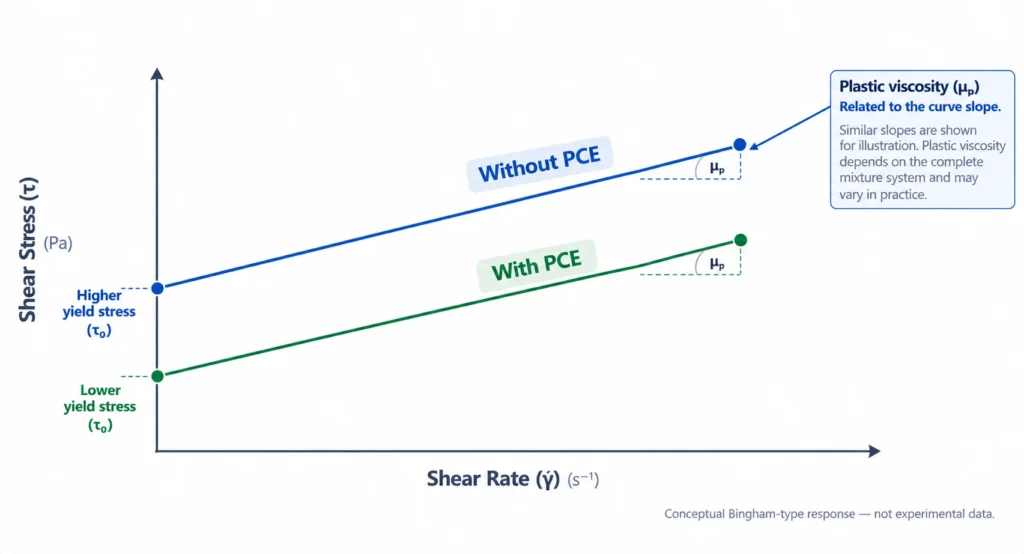
Yield stress describes the resistance that must be overcome before sustained flow occurs within the adopted rheological model.
In flocculated cement paste, the particle network contributes to this resistance.
By weakening particle associations, PCE can reduce yield stress and allow the suspension to initiate movement more readily.
This effect is closely associated with improvements in cement paste flow and concrete slump flow.
Plastic Viscosity: Resistance During Movement
Plastic viscosity describes resistance to flow after yielding within models such as the Bingham approximation.
Although PCE can influence plastic viscosity, the response depends on additional factors, including solid concentration, particle packing, water content and the rheological behavior of the complete mixture.
A substantial reduction in yield stress does not necessarily produce an equivalent reduction in plastic viscosity.
Two mixtures may therefore exhibit similar flow diameters but different flow times, pumping behavior or resistance to segregation.
Why Fluidity Alone Is Insufficient
A mixture with high flowability is not necessarily optimally proportioned.
Excessively low yield stress, inadequate cohesion or an unsuitable particle-size distribution can contribute to segregation even when the measured spread is high.
Conversely, a mixture may achieve adequate spread while retaining undesirable resistance to movement.
For this reason, PCE performance should be evaluated against the intended fresh-state requirements rather than maximum flow diameter alone.
PCE influences the dispersion component of workability, while the overall rheological response is governed by the complete cementitious mixture.
Why PCE Performance Changes During Cement Hydration
The interaction between PCE and cement is dynamic.
Once water is introduced, cement dissolution and hydration progressively change the chemical composition, available surfaces and particle network of the suspension.
These changes influence how effectively PCE maintains dispersion over time.
Formation of New Reactive Surfaces
As clinker phases hydrate, new solid phases develop and existing particle surfaces change.
The resulting surfaces may interact with PCE, altering the distribution of polymer between the liquid and solid phases.
Reactive aluminate-containing phases and their early hydration products can be particularly important in polymer uptake and admixture compatibility.
Evolution of Pore Solution Chemistry
The concentrations of dissolved calcium, sulfate and alkali species change during hydration.
These changes can affect adsorption behavior and the interfacial forces acting between particles.
Sulfate availability may influence competitive adsorption and reactions involving aluminate-containing phases.
However, sulfate imbalance should not be assumed to explain every instance of rapid workability loss.
Initial Dispersion Versus Flow Retention
Initial dispersion describes the effectiveness of PCE shortly after mixing.
Flow retention reflects how the complete suspension maintains workability as cement hydration and particle interactions evolve.
A polymer providing strong initial dispersion may not necessarily maintain the required workability over an extended period.
Conversely, PCE systems designed for prolonged workability may employ different molecular strategies to influence adsorption or polymer availability over time.
Initial fluidity and workability retention are related but distinct performance characteristics.
Understanding this distinction is essential for interpreting time-dependent concrete behavior without attributing every change solely to the superplasticizer.
How PCE Enables Water Reduction and Influences Strength
The water-reducing effect of PCE is a practical consequence of improved particle dispersion.
When a cementitious suspension achieves greater fluidity at a fixed water content, the mixture may be reformulated with less water while maintaining the required consistency.
This reduction in water demand can support a lower water-to-binder ratio.
Under appropriate production and curing conditions, a lower water-to-binder ratio may contribute to improved hardened properties.
However, the relationship is indirect.
PCE does not remove water from the mixture or automatically increase compressive strength simply by increasing flowability.
Concrete strength depends on binder composition, hydration development, aggregate characteristics, air content, compaction and curing.
Similarly, the influence of PCE on hydration should be evaluated separately from its dispersing action.
Some PCE structures and dosages can influence early hydration or setting behavior through interactions with reactive surfaces.
Improved dispersion therefore does not necessarily indicate accelerated hydration or early strength development.
The technically accurate relationship is:
Improved dispersion → Lower water demand at target workability → Potentially lower water-to-binder ratio → Potential improvement in hardened performance.
These effects must be confirmed through appropriate mixture design and hardened-material testing.
Experimental Evidence: Cement Paste Dispersion with POLYVIA™ PCE 840
The molecular mechanisms discussed above provide a scientific basis for understanding how PCE superplasticizers influence cement particle dispersion.
To connect these mechanisms with measurable performance, POLYVIA™ conducted a comparative laboratory evaluation using PCE 840, a high-water-reduction polycarboxylate superplasticizer powder.
The experiment examined the influence of PCE dosage on cement paste fluidity while maintaining constant cement and mixing-water quantities.
Experimental Materials and Conditions
The evaluation used Chinese Conch Cement with a strength grade of 52.5.
Each mixture contained 300 g of cement and 88 g of water, corresponding to a water-to-cement ratio (W/C) of approximately 0.293.
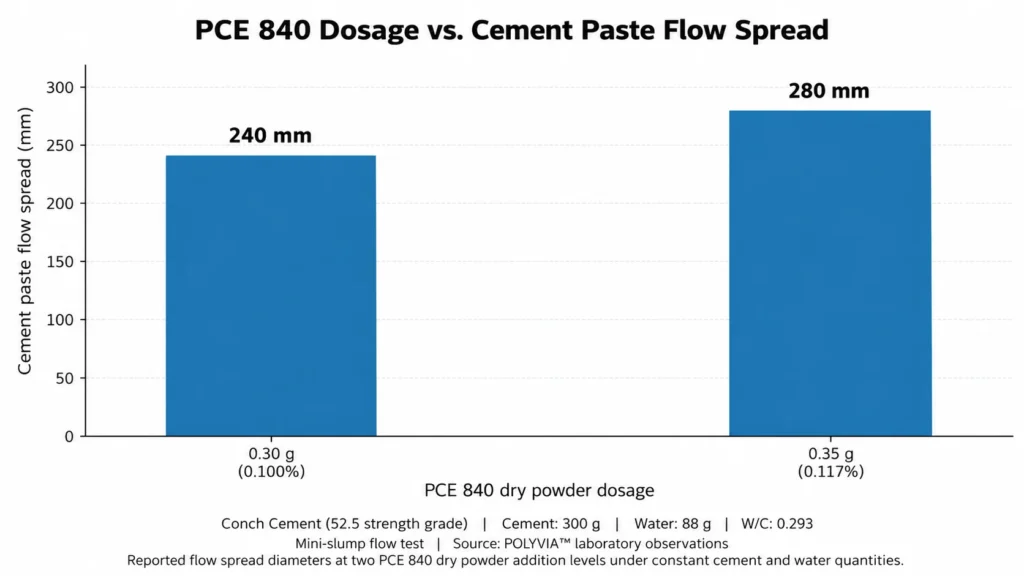
PCE 840 dry powder was added at two dosage levels: 0.30 g and 0.35 g, corresponding to 0.100% and approximately 0.117% by cement mass, respectively.
Cement paste flow spread was evaluated using a mini-slump cone method.
| Test Parameter | Experimental Condition |
|---|---|
| Superplasticizer | POLYVIA™ PCE 840 |
| Product Type | High Water Reduction PCE Powder |
| Cement | Conch Cement, China |
| Cement Strength Grade | 52.5 |
| Cement Mass | 300 g |
| Water Mass | 88 g |
| Water-to-Cement Ratio (W/C) | 0.293 |
| PCE Dosage Basis | Dry powder mass relative to cement mass |
| Test Method | Cement Paste Mini-Slump Flow Test |
Laboratory Results
| PCE 840 Dry Powder | Dosage by Cement Mass | Cement Paste Flow Spread |
|---|---|---|
| 0.30 g | 0.100% | 240 mm |
| 0.35 g | 0.117% | 280 mm |
Interpretation of the Experimental Results
Increasing the PCE 840 dry powder dosage from 0.30 g to 0.35 g increased the measured cement paste flow spread from 240 mm to 280 mm.
This represents an increase of 40 mm, equivalent to approximately 16.7% relative to the lower-dosage spread diameter.
With cement and mixing-water quantities held constant, the results indicate greater paste fluidity at the higher PCE dosage under the reported experimental conditions.
This behavior is consistent with the established dispersing action of PCE superplasticizers, where polymer-mediated changes in particle interactions reduce resistance to flow.
However, mini-slump testing measures the macroscopic flow behavior of cement paste. It does not directly quantify polymer adsorption, steric repulsion or molecular conformation.
The observations therefore provide practical evidence of a dosage-dependent difference in paste fluidity, while the molecular explanation is supported by established scientific research.
Technical Significance and Limitations
The results demonstrate that a relatively small increase in PCE 840 dosage produced a measurable increase in cement paste flow spread within the two evaluated conditions.
Nevertheless, two dosage points are insufficient to establish an optimum dosage, saturation threshold or complete dosage-response relationship.
The observed increase in spread diameter should not be interpreted as an equivalent increase in concrete water-reduction rate.
Furthermore, the results apply to the tested cement system and should not be generalized to other cement sources or concrete formulations without additional evaluation.
The experimental observation is consistent with improved dispersing performance at the higher PCE dosage, but it does not independently establish the underlying molecular mechanism.
Laboratory note: Results are based on POLYVIA™ laboratory observations. The complete cement designation, mini-slump cone dimensions, mixing procedure, testing temperature and measurement repeatability should be documented for full experimental reproducibility.
Key Technical Conclusions
The working mechanism of polycarboxylate ether superplasticizers is governed by the interaction between polymer molecular architecture, cementitious surfaces and the evolving particle suspension.
Several principles are particularly important.
1. Cement particle dispersion is the primary function. PCE modifies interparticle interactions and reduces flocculation, allowing the existing mixing water to support particle movement more effectively.
2. Molecular architecture controls interfacial behavior. Adsorption-capable backbone groups and polyether side chains contribute complementary functions, but effective performance depends on their combined configuration.
3. Adsorption quantity and dispersion efficiency are not equivalent. Polymer uptake contributes to surface stabilization, yet the resulting particle interactions determine the macroscopic dispersing response.
4. Steric stabilization is a major mechanism. Its effectiveness depends on polymer conformation, surface coverage and the surrounding electrochemical environment.
5. Concrete rheology involves more than flow diameter. Yield stress, plastic viscosity, cohesion and time-dependent behavior should be evaluated according to application requirements.
6. Laboratory measurements connect mechanisms with observable performance. POLYVIA™ PCE 840 testing demonstrated increased cement paste flow spread at the higher of two evaluated dosages, with cement mass and mixing-water quantity held constant.
Ultimately, the effectiveness of PCE should not be assessed by polymer dosage, adsorption quantity or maximum flowability in isolation.
A more reliable understanding comes from connecting molecular interactions with measurable cementitious behavior under clearly defined conditions.
PCE performance is determined by how effectively polymer chemistry is translated into particle dispersion and useful engineering performance.
Frequently Asked Questions
1. How does PCE superplasticizer disperse cement particles?
PCE molecules interact with cementitious surfaces and form polymer-containing layers that help resist close particle contact. Steric stabilization is a principal mechanism, while ionic interactions influence adsorption and the behavior of polymer-coated particles. These effects reduce flocculation and improve fluidity.
2. Why is steric hindrance important in PCE superplasticizers?
Steric hindrance helps prevent neighboring cement particles from forming persistent associations. It arises from interactions between the polymer layers formed by adsorbed PCE molecules. Its effectiveness depends on side-chain architecture, molecular conformation and surface coverage.
3. Does greater PCE adsorption always result in better dispersion?
No. For the same polymer and cement system, increasing effective adsorption commonly improves dispersion until a limiting condition is approached. However, different molecular architectures can produce different dispersing efficiencies because adsorption-layer structure and interparticle forces also matter.
4. How does PCE reduce water demand without adding water?
PCE improves particle mobility by reducing flocculation and resistance to flow. This can allow the required consistency to be achieved with less mixing water. The result depends on the complete mixture design and target workability.
5. Why does PCE performance change during cement hydration?
Hydration progressively changes cement particle surfaces, pore solution chemistry and the developing particle network. These changes affect polymer distribution and interparticle interactions, influencing how the suspension maintains flowability over time.
6. Does higher PCE dosage always produce greater cement paste flow?
Not necessarily. Flow response depends on polymer characteristics, cement chemistry, water content and the dosage range being investigated. Performance may approach a plateau, and excessive dosage can introduce undesirable effects.
In POLYVIA™'s reported PCE 840 evaluation, increasing dosage from 0.30% to 0.35% increased paste flow spread from 240 mm to 280 mm at a water-to-cement ratio of 0.293. This result applies to the tested conditions and does not establish a universal optimum dosage.
Scientific References & Further Reading
The technical mechanisms discussed in this article are supported by peer-reviewed research on PCE molecular architecture, adsorption behavior, cement dispersion and rheology.
1. Working Mechanisms and Design Principles of Comb-like PCE Superplasticizers. ACS Sustainable Chemistry & Engineering (2021). View Research
2. Adsorption and Dispersion Capability of Polycarboxylate-Based Superplasticizers. Journal of Sustainable Cement-Based Materials. View Research
3. Influence of PCE Structure on Performance in Cement-Based Materials. Construction and Building Materials (2020). View Research
4. Organic Rheology Modifiers and Cement-Based Material Performance. View Research
5. PCE Structure–Activity Relationships. Materials Today Communications (2023). View Research