
How RDP Enhances Mortar Performance
Understanding the Science Behind Polymer-Modified Mortar
Explore how redispersible polymer powder influences adhesion, flexibility, crack resistance, and moisture-related performance—and learn how testing, dosage, and polymer selection determine the results.
Introduction
Redispersible polymer powder (RDP) can improve mortar adhesion, flexibility, crack resistance, and selected water-related properties by modifying the cementitious matrix and its interfaces. However, these improvements depend on polymer chemistry, dosage, cement compatibility, and curing conditions.
This guide explains how RDP influences mortar performance, examines published experimental evidence, and provides practical guidance on formulation optimization, application-specific testing, and RDP grade selection.
Why Does Mortar Need Polymer Modification?
Conventional cementitious mortar develops strength through cement hydration, but some applications demand a combination of adhesion, deformation capacity, toughness, and environmental resistance that may be difficult to achieve using the mineral binder alone.
Redispersible polymer powder introduces an additional polymer component into dry-mix mortar. Its purpose is not to replace cement hydration but to modify selected properties of the resulting material.
1. What Are the Limitations of Conventional Cementitious Mortar?
Properly formulated cement mortar can provide reliable compressive strength and dimensional stability. However, performance varies with binder composition, aggregate grading, water demand, substrate conditions, and environmental exposure.
Several challenges become particularly important in modern construction applications.
Limited deformation tolerance
A relatively stiff or brittle cementitious matrix may crack or separate when exposed to restrained shrinkage, temperature changes, or substrate movement.
Demanding bonding conditions
Adhesion to dense ceramic tiles, concrete, or other substrates depends on surface characteristics, interfacial contact, and the internal cohesion of the mortar. Basic cement–aggregate formulations may not satisfy every bonding requirement.
Moisture-related performance limitations
Water absorption, repeated wetting and drying, and environmental conditioning may influence the mortar's mechanical properties and bonded interfaces.
Competing performance requirements
A mortar may need strong adhesion and sufficient flexibility simultaneously. Another may require low liquid-water absorption without compromising water-vapor transmission or workability.
These challenges do not mean that every cementitious mortar requires polymer modification. They explain why RDP can be valuable when the intended performance profile extends beyond the capabilities of an unmodified formulation.
2. What Does RDP Add to the Mortar System?
When a dry-mix mortar is combined with water, RDP redistributes as polymer particles within the fresh material. Under suitable conditions, polymer-rich regions and films may subsequently develop as hydration and moisture redistribution progress.
These components can influence several properties.
| Performance Requirement | Potential Contribution of RDP | Important Limitation |
|---|---|---|
| Adhesion | Modifies cohesion and interfacial stress transfer | Substrate and curing conditions remain important |
| Deformability | Changes the mechanical response of the composite | Does not guarantee S1/S2 classification |
| Toughness | May influence fracture behavior and energy dissipation | Does not eliminate all cracking |
| Water-related performance | May modify water uptake and transport | Does not automatically provide waterproofing |
| Fresh mortar behavior | Can influence consistency and rheology | Does not replace cellulose ether |
The effects are interconnected. Improving deformation capacity may, for example, change stiffness or strength.
3. Which Mortar Applications Benefit from RDP?
Tile adhesives may benefit from polymer modification where reliable initial and conditioned adhesion, application behavior, or transverse deformation are required.
ETICS base coats require suitable bonding and deformation behavior within a reinforced exterior insulation system.
Exterior renders may require improved adhesion and selected moisture-related properties while maintaining vapor transport and mechanical compatibility.
Repair mortars may require bonding and mechanical compatibility with existing concrete or masonry.
Self-leveling compounds require a controlled balance of flow, stability, surface quality, and hardened mechanical performance.
Because these applications have different priorities, one polymer profile cannot be assumed to be optimal for all of them.
4. Is RDP a Substitute for Cement or Cellulose Ether?
No. Cement, RDP, and cellulose ethers perform different functions.
Cement hydration provides the mineral binding structure. RDP modifies selected fresh and hardened properties of the cementitious composite. Cellulose ethers such as HPMC and MHEC are commonly used to control water retention and rheological behavior.
Increasing RDP dosage cannot automatically correct insufficient water retention, poor aggregate grading, unsuitable cement chemistry, or inadequate curing.
Likewise, increasing cellulose ether content cannot reproduce every mechanical effect of polymer modification.
Effective mortar formulation requires coordination among the mineral binder, polymer component, rheological additives, water demand, and processing conditions.
5. When Is Polymer Modification Technically Justified?
Polymer modification is most useful when it addresses a defined performance requirement.
If a tile adhesive meets its adhesion target but exhibits excessive slip, the next investigation may need to focus on fresh-state rheology rather than increasing RDP dosage.
If an exterior render shows excessive capillary absorption, polymer chemistry may be relevant, but pore structure, mineral grading, and curing conditions also require evaluation.
POLYVIA™ Technical Perspective
Start by identifying the application and the property that limits performance. Select polymer candidates and test methods only after those requirements are clear.
The value of RDP lies in solving a measurable formulation problem without introducing unacceptable trade-offs elsewhere.
How Does RDP Change the Cement–Polymer Microstructure?
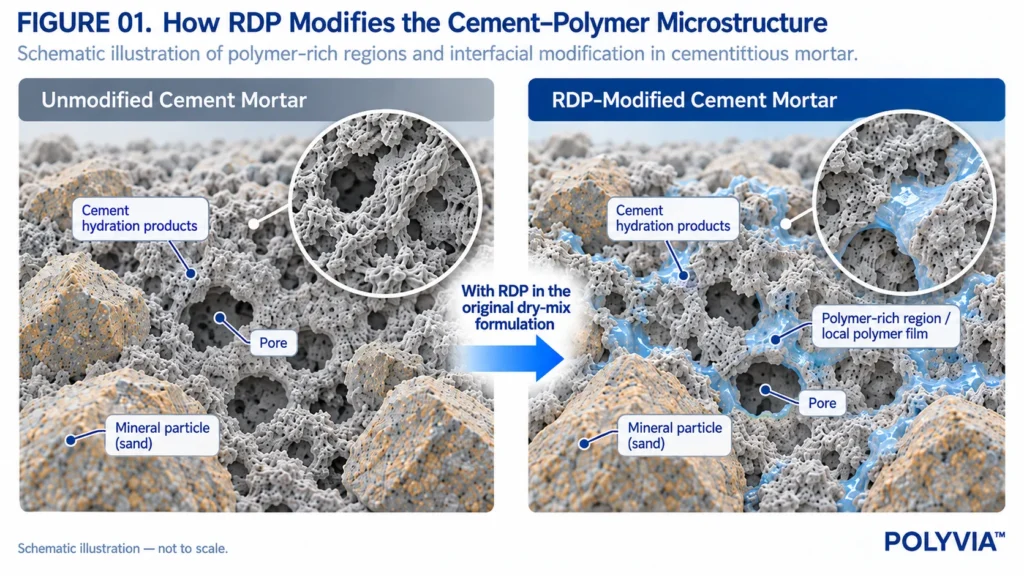
RDP modifies mortar by introducing dispersed polymer particles that may develop polymer-rich regions and films within the evolving cementitious matrix. These regions can influence interfaces, stress transfer, deformation behavior, and moisture transport.
The resulting structure depends on polymer chemistry, redispersion quality, cement hydration, water availability, temperature, and curing conditions.
1. What Happens When RDP Is Mixed with Water?
RDP is commonly manufactured by spray-drying a polymer dispersion into a free-flowing powder.
Commercial grades may contain protective colloids and other processing aids that support storage stability and redispersion.
When water is added, the powder releases polymer particles into the aqueous phase. These particles coexist with cement grains, aggregates, mineral fillers, dissolved ions, and other additives.
The quality of redispersion affects how the polymer becomes distributed within the mortar.
Incomplete dispersion or unfavorable interactions with other ingredients may influence both fresh and hardened behavior.
Redispersion and polymer film formation are related processes, but they are not the same process.
2. How Do Cement Hydration and Polymer Development Interact?
Cement hydration begins after water addition, producing mineral hydration products that contribute to the developing binding structure.
Meanwhile, polymer particles remain distributed within the changing pore solution and the spaces between solid components.
As hydration progresses and available water changes, polymer particles may become more concentrated in certain regions.
Where conditions permit, nearby particles can deform and coalesce into polymer-rich structures.
These processes can overlap rather than occurring in a fixed sequence.
Some polymer chemistries and protective colloids may also influence cement hydration kinetics, depending on dosage and cement compatibility.
Therefore, polymer modification should not be described as a process that always begins only after cement hydration has finished.
3. How Does Polymer Film Formation Occur?
A simplified description involves four overlapping stages.
| Stage | Main Process | Structural Significance |
|---|---|---|
| Redispersion | Polymer particles disperse after water addition | Polymer becomes distributed through fresh mortar |
| Redistribution | Hydration and moisture changes alter local particle concentration | Particles may approach one another |
| Coalescence | Particles deform and merge where conditions permit | Polymer-rich regions and possible films develop |
| Composite Development | Polymer and mineral structures coexist | Interfaces and mechanical behavior may change |
This framework is a conceptual representation, not four strictly separated reactions.
Not every formulation develops the same degree of film continuity. Depending on conditions, polymer-rich regions may remain discontinuous.
It is therefore inaccurate to assume that every RDP-modified mortar contains a complete, interconnected polymer network.
4. Where Does the Polymer Phase Develop?
Polymer-rich regions may occur in several locations.
Within the cementitious matrix
Polymer components may be distributed among hydration products, mineral particles, and local pore regions.
At mortar–aggregate interfaces
They may influence local cohesion and stress transfer between mineral constituents.
At mortar–substrate interfaces
Polymer modification may change the behavior of bonded surfaces, depending on the substrate and application conditions.
Near pores and microstructural discontinuities
Polymer distribution may alter local water transport or crack propagation behavior.
However, the presence of polymer-rich regions does not establish that every capillary pore is blocked or that the mortar has become impermeable.
5. How Does the Composite Structure Influence Performance?
| Structural Characteristic | Possible Performance Effect | Required Verification |
|---|---|---|
| Polymer-modified interfaces | Changes in adhesion and stress transfer | Substrate-specific adhesion testing |
| Polymer-rich regions within the matrix | Changes in deformability and toughness | Mechanical and deformation testing |
| Modified pore-related behavior | Changes in moisture transport | Water absorption and exposure testing |
| Polymer–admixture interactions | Changes in fresh-state rheology | Consistency and workability testing |
| Changes in hydration or air structure | Changes in strength or density | Mechanical and physical-property testing |
These relationships explain why RDP can influence several mortar properties without improving all of them equally.
6. Why Do Polymer Chemistry, Tg, and MFFT Matter?
Glass transition temperature (Tg) relates to changes in a polymer's mechanical behavior over a temperature region.
Minimum film-forming temperature (MFFT) relates to the formation of a coherent film under defined testing conditions.
Although related in some polymer systems, Tg and MFFT are not interchangeable.
A lower-Tg polymer may be useful when greater deformation capacity is required, but the finished mortar's behavior also depends on mineral composition, polymer dosage, moisture, and temperature.
Similarly, MFFT should not be interpreted as the guaranteed minimum application temperature of a cementitious mortar.
7. How Can Microstructure Be Investigated?
Researchers may use several analytical methods.
| Method | Potential Investigation | Main Limitation |
|---|---|---|
| Scanning Electron Microscopy (SEM) | Morphology and interface features | Polymer identification may require supporting evidence |
| FTIR Spectroscopy | Chemical features of polymer and mineral phases | Spectral overlap can complicate interpretation |
| Thermal Analysis | Selected thermal and material transformations | Results require careful attribution |
| Porosity and Water Transport Tests | Pore-related behavior and moisture movement | Do not independently prove polymer-film continuity |
| Mechanical Testing | Functional performance of the composite | Does not independently explain the microscopic mechanism |
Microscopic observations help explain why a mortar behaves differently, but they do not replace application testing.
POLYVIA™ Technical Perspective
Polymer film development provides part of the scientific explanation for RDP performance. The decisive factor, however, is how the complete polymer–mineral composite behaves under relevant application conditions.
How Does RDP Improve Adhesion Strength?
RDP can improve mortar adhesion by modifying interfacial bonding, internal cohesion, and stress transfer between the mortar and its substrate. The outcome depends on polymer chemistry, dosage, surface characteristics, curing, and the complete formulation.
For tile adhesive manufacturers, reliable adhesion after relevant environmental conditioning is more important than a high initial result alone.
1. What Determines Adhesion?
Three related characteristics are important.
Interfacial adhesion describes bonding between mortar and a substrate such as ceramic tile, concrete, or masonry.
Internal cohesion describes the resistance of the mortar layer itself to separation.
Stress transfer describes how mechanical loads pass through the bonded assembly.
A formulation may show strong bonding at one interface while failing within the mortar. Similarly, bonding to a porous ceramic tile may differ from bonding to dense porcelain.
RDP selection should therefore consider the actual substrate and application conditions.
2. What Adhesion Requirements Apply to C1 and C2 Tile Adhesives?
For normal-setting cementitious tile adhesives, EN 12004-1:2017 establishes the following performance requirements.
| Performance Indicator | C1 | C2 |
|---|---|---|
| Initial tensile adhesion | ≥0.5 MPa | ≥1.0 MPa |
| Adhesion after water immersion | ≥0.5 MPa | ≥1.0 MPa |
| Adhesion after heat ageing | ≥0.5 MPa | ≥1.0 MPa |
| Adhesion after freeze–thaw cycles | ≥0.5 MPa | ≥1.0 MPa |
| Open-time adhesion after at least 20 minutes | ≥0.5 MPa | ≥0.5 MPa |
These are finished-adhesive requirements under the stated standard, not guaranteed performance values for any individual RDP grade. Other classifications and special adhesive types have additional or different requirements.
A mortar achieving the required initial tensile adhesion value may still fail after water immersion or heat ageing.
Therefore, a complete test program is more informative than a single adhesion measurement.
3. Why Does Environmental Conditioning Matter?
Water immersion may affect moisture-sensitive ingredients and the mechanical behavior of interfaces.
Heat ageing can change the response of the polymer and mineral composite.
Freeze–thaw cycling introduces moisture and temperature stresses that challenge the integrity of the bonded assembly.
A hydrophobic RDP does not automatically guarantee superior adhesion after immersion.
Likewise, a flexible polymer does not automatically guarantee better performance after heat ageing.
Each relevant conditioning requirement must be verified in the finished formulation.
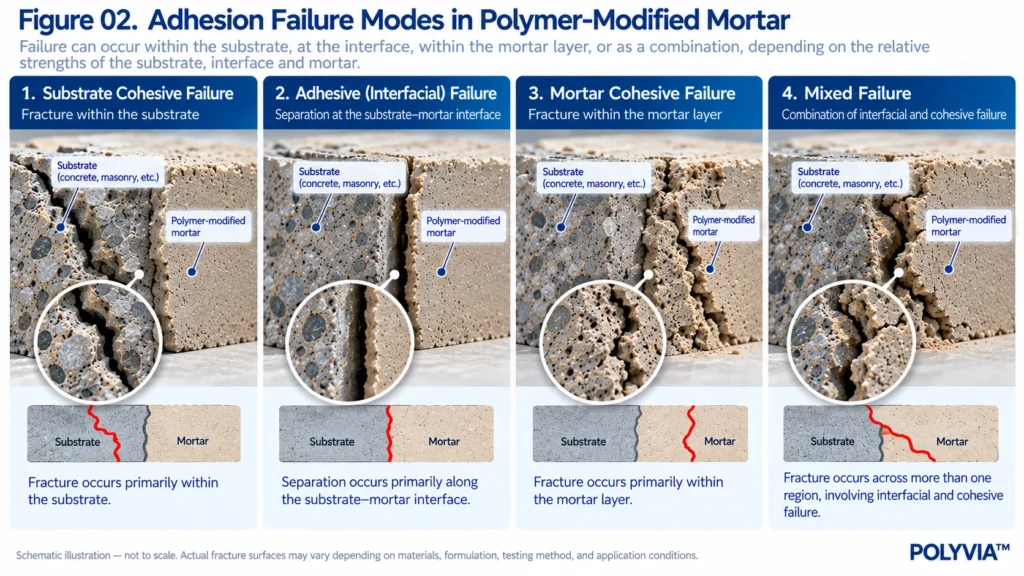
4. What Do Adhesion Failure Modes Reveal?
| Failure Location | Possible Interpretation | Investigation Priority |
|---|---|---|
| Tile–mortar interface | Bonding at the tile interface may be limiting | Wetting, substrate characteristics, compatibility |
| Mortar–substrate interface | Bonding to the substrate may be limiting | Surface preparation and porosity |
| Cohesive failure in mortar | Internal cohesion may control performance | Binder system, water demand, curing |
| Failure within substrate | Substrate strength may control the result | Substrate characteristics and test suitability |
| Mixed failure | Multiple regions contribute | Failure distribution and repeatability |
Failure modes provide diagnostic evidence, but they do not identify the root cause without further investigation.
For example, increasing RDP content may not correct a failure caused by a contaminated substrate.
5. How Should RDP Grades Be Compared for Adhesion?
A useful comparison requires a documented reference formulation, consistent substrates, controlled preparation and curing, and relevant adhesion measurements.
Manufacturers should record the dosage basis, mixing-water content, test conditions, measured values, and failure modes.
Where candidate polymers differ in water demand, fixed-water and matched-consistency trials may provide complementary information.
POLYVIA™ Technical Perspective
The objective is not the highest initial bond strength obtained in one experiment. It is reliable, application-specific adhesion after all relevant conditioning procedures.
How Does RDP Affect Flexibility and Crack Resistance?
RDP can influence the deformation capacity and fracture behavior of cementitious mortar, helping the material accommodate certain mechanical and environmental stresses. However, greater flexibility does not automatically mean lower shrinkage, fewer cracks, or improved performance under every loading condition.
1. Are Flexibility, Deformability, and Crack Resistance the Same?
No. These terms describe different material behaviors.
| Property | Meaning | Relevant Assessment |
|---|---|---|
| Flexibility | Ability to deform with relatively low resistance | Stiffness and flexural behavior |
| Deformability | Capacity to accommodate specified deformation | Deformation testing |
| Toughness | Energy absorbed during deformation or fracture | Fracture energy or load–displacement response |
| Crack Resistance | Resistance to crack initiation or propagation | Relevant cracking or fracture tests |
| Shrinkage | Dimensional contraction from drying, hydration, or other processes | Length-change testing |
A mortar may become more deformable without showing an equivalent reduction in drying shrinkage.
Crack resistance depends not only on deformability but also on stress development, restraint, curing, and fracture behavior.
2. How Does Tg Affect Flexibility?
Tg helps characterize the mechanical response of a polymer.
A lower Tg generally indicates a more compliant polymer response under comparable conditions, making it relevant to flexible mortar development.
However, mortar flexibility is influenced by the entire cement–polymer composite, including aggregate structure, cement hydration, dosage, temperature, and moisture.
Tg alone cannot establish a finished mortar's deformability classification.
3. How Can RDP Influence Crack Development?
Cracking can occur when tensile stresses exceed the mortar's resistance to crack formation or propagation.
Those stresses may arise from restrained shrinkage, substrate movement, temperature changes, or external loading.
Polymer modification may contribute through:
Deformation accommodation: Allowing greater local deformation under suitable conditions.
Fracture behavior: Changing crack paths or energy dissipation.
Interfacial response: Modifying how stresses are transferred between components.
These benefits are formulation-dependent.
A flexible mortar may still crack if restraint, movement, or curing conditions create excessive stress.
4. What Do S1 and S2 Mean?
For cementitious tile adhesives, transverse deformation provides an important standardized indicator.
| Classification | Description | Transverse Deformation |
|---|---|---|
| S1 | Deformable adhesive | ≥2.5 mm and less than 5 mm |
| S2 | Highly deformable adhesive | ≥5 mm |
S1 and S2 describe deformability, while C1 and C2 describe adhesion performance classifications.
A C2 adhesive does not automatically qualify as S1 or S2.
Likewise, using a low-Tg RDP does not independently establish either classification.
5. Why Is Crack Resistance Important in ETICS Base Coats?
ETICS base coats operate within a system containing insulation boards, reinforcement, base coat, and finishing layers.
The complete assembly determines how movement and environmental stresses are accommodated.
RDP may influence the mortar's deformation and fracture behavior, but it cannot compensate for incorrect reinforcement placement, poor system detailing, or unsuitable substrate preparation.
ETICS performance requires evaluation at the appropriate mortar and system levels.
6. How Should RDP Be Selected for Movement-Sensitive Mortars?
| Application | Main Concern | Validation Priority |
|---|---|---|
| Deformable Tile Adhesive | Bonding under movement | Adhesion and transverse deformation |
| ETICS Base Coat | Reinforcement interaction and cracking | Adhesion, cracking-related and system tests |
| Exterior Render | Shrinkage restraint and temperature variation | Dimensional stability and cracking |
| Repair Mortar | Compatibility with the existing substrate | Bond, stiffness, strength and shrinkage |
POLYVIA™ Technical Perspective
The aim is not to create the softest mortar, but to achieve the required deformation capacity while maintaining adequate adhesion, cohesion, strength, and durability.
Can RDP Improve Water Resistance and Durability?
RDP can improve selected moisture-related properties of cementitious mortar, but lower water absorption does not automatically establish waterproofing, higher adhesion after immersion, or long-term durability.
The relevant performance requirement depends on whether the mortar is exposed to rainwater, prolonged immersion, water pressure, wetting–drying cycles, or other environmental conditions.
1. Which Water-Related Properties Must Be Distinguished?
| Property | What It Describes |
|---|---|
| Water Absorption | Amount of water taken into the material |
| Capillary Water Absorption | Water uptake through capillary pathways |
| Hydrophobicity | Resistance to wetting by liquid water |
| Water Permeability | Movement of water through the material under defined conditions |
| Wet Adhesion | Bond strength after specified water conditioning |
| Water-Vapor Permeability | Transport of water vapor |
| Durability | Retention of properties under relevant exposure |
These characteristics are related but cannot be substituted for one another.
An exterior render may show low capillary water absorption yet still require assessment of vapor permeability and cracking.
A tile adhesive may meet its wet adhesion requirement without functioning as a waterproof membrane.
2. How Can RDP Modify Water Transport?
Liquid water moves through mortar along pathways influenced by pores, cracks, interfaces, and wetting characteristics.
Suitable polymer modification may alter local pore connectivity, surface wettability, or the behavior of polymer-containing regions.
Depending on the formulation, this may reduce capillary water uptake or influence other moisture-transport properties.
However, RDP does not necessarily fill all pores or form a continuous waterproof barrier.
The final behavior depends on polymer chemistry, dosage, cement hydration, air content, mineral grading, and curing.
3. Why Doesn't Lower Absorption Guarantee Better Wet Adhesion?
Water absorption measures water entering the material.
Wet adhesion measures bond strength after defined water conditioning.
A reduction in absorption may be beneficial while the mortar–substrate interface remains sensitive to immersion.
For cementitious tile adhesives, the appropriate adhesion-after-immersion requirement must therefore be tested directly.
A hydrophobic RDP is not a substitute for that measurement.
4. When Is Hydrophobic RDP Useful?
Hydrophobic polymer profiles may be relevant to exterior renders, selected façade mortars, and water-resistant mineral coatings.
Their suitability should be evaluated through capillary absorption, adhesion, vapor transport where relevant, mechanical properties, and environmental conditioning.
In façade applications, the design may require reduced liquid-water uptake without creating undesirable moisture-management behavior.
For this reason, maximum water repellency should not be treated as the only formulation objective.
5. Can RDP Improve Long-Term Durability?
Potential durability benefits depend on the exposure mechanism.
Freeze–thaw resistance is influenced by moisture saturation, pore structure, air-void characteristics, and material strength.
Wetting–drying resistance may depend on dimensional changes and interfacial behavior.
Thermal durability depends partly on the temperature-sensitive response of the polymer and cementitious composite.
Chemical resistance must be investigated separately; improved water absorption performance does not establish resistance to aggressive salts or chemicals.
Relevant exposure testing is necessary before making durability claims.
6. Which Tests Matter for Different Applications?
| Application | Main Exposure Concern | Priority Evaluation |
|---|---|---|
| Tile Adhesive | Bond loss after immersion | Conditioned tensile adhesion |
| Exterior Render | Rainwater uptake | Capillary absorption and vapor permeability |
| Waterproof Mortar | Liquid-water penetration | Relevant penetration or permeability tests |
| ETICS | Moisture and thermal exposure | Applicable system-level evaluation |
| Repair Mortar | Moisture-related deterioration | Bond and environmental conditioning |
POLYVIA™ Technical Perspective
For formulations targeting reduced liquid-water uptake, a hydrophobic profile such as POLYVIA™ RDP 50H may be worth screening. Final suitability must still be established through finished-mortar testing.
The objective is not simply low absorption, but the moisture-related performance required by the application.
How Does RDP Influence Fresh Mortar Workability?
RDP may influence fresh mortar consistency, rheology, and application behavior, but it does not automatically increase water retention, extend open time, or reduce tile slip.
Workability should be evaluated as a balance between ease of application, fresh-state stability, and finished-mortar performance.
1. What Do Common Workability Terms Mean?
| Property | Meaning | Practical Relevance |
|---|---|---|
| Workability | Ease of mixing, spreading, and finishing | Application efficiency |
| Consistency | Flow under defined conditions | Spreading behavior |
| Yield Stress | Stress associated with initiating flow under a selected model | Stability and movement resistance |
| Plastic Viscosity | Resistance to flow after yielding | Troweling behavior |
| Thixotropy | Time-dependent breakdown and rebuilding of structure | Response to mixing and resting |
| Water Retention | Resistance to water loss | Application on absorbent substrates |
| Open Time | Period during which adequate bonding can develop after spreading | Tile placement |
| Slip Resistance | Resistance to tile movement after placement | Vertical installation |
A mortar that spreads easily may still have inadequate slip resistance.
A mortar with acceptable initial consistency may also lose workability too quickly.
No single test describes every aspect of fresh-state performance.
2. How Can RDP Influence Troweling and Flow?
RDP can modify interactions among polymer particles, cement, fillers, and the aqueous phase.
Depending on grade and formulation, these changes may affect spreading resistance, consistency, and structural recovery.
However, easier spreading does not automatically mean better stability.
The target is the rheological behavior required during application and immediately afterward.
3. How Do RDP and HPMC/MHEC Work Together?
RDP mainly provides polymer modification of the mortar, while HPMC and MHEC are widely used to control water retention and rheology.
| Function | RDP | HPMC / MHEC |
|---|---|---|
| Hardened polymer modification | Major contribution | Not a direct substitute |
| Adhesion and deformability | Grade-dependent contribution | Mainly indirect formulation influence |
| Water retention | Formulation-dependent effect | Major function |
| Viscosity and consistency | Grade-dependent effect | Important control function |
| Troweling behavior | May affect application feel | Influences rheological response |
| Open-time behavior | May contribute | Often important through water retention and rheology |
The two additive systems should be evaluated together.
Changing cellulose ether selection may alter the observed performance of an otherwise unchanged RDP formulation.
4. Why Doesn't More RDP Always Improve Workability?
A higher polymer content may improve certain handling characteristics or produce undesirable changes in viscosity, flow, or stability.
Manufacturers can compare formulations using two complementary approaches.
Fixed-water trials maintain the same mixing-water content to reveal differences caused by the material change under equal water addition.
Matched-consistency trials adjust water content to achieve a defined consistency, allowing water demand and performance to be compared at a similar application state.
The two approaches answer different questions and must be documented separately.
5. Does RDP Extend Tile Adhesive Open Time?
RDP may influence open-time performance, but it is not a universal open-time extender.
Open time differs from pot life.
Open time concerns the ability of an adhesive to develop adequate bonding after it has been spread for a specified interval.
Pot life concerns the usability of the mixed material.
Open time is influenced by water retention, cellulose ethers, substrate absorption, temperature, humidity, and formulation composition.
A visibly moist adhesive does not necessarily retain adequate open-time adhesion.
6. How Can Spreading and Slip Resistance Be Balanced?
Tile adhesives require manageable resistance during troweling and sufficient stability after placement.
This balance depends on rheology, structural recovery, mineral grading, cellulose ethers, water demand, and other admixtures.
RDP may contribute, but it does not independently guarantee reduced slip.
The objective is controlled application behavior rather than maximum viscosity.
7. How Should Workability Be Evaluated?
| Stage | Measurement or Observation | Purpose |
|---|---|---|
| Mixing | Wetting, dispersion, mixing time | Mixing reliability |
| Initial State | Consistency or rheological measurement | Application behavior |
| Spreading | Controlled troweling assessment | Ease of application |
| Resting | Consistency and structural changes | Time-dependent behavior |
| Water Retention | Relevant retention test | Water-loss control |
| Open Time | Standardized adhesion test | Bonding after application delay |
| Slip Resistance | Applicable slip test | Vertical stability |
| Hardened State | Adhesion and mechanical testing | Verify final performance |
POLYVIA™ Technical Perspective
A workable formulation must remain suitable for mixing and placement while also meeting its required hardened properties.
If workability is inadequate, the correct solution may involve cellulose ether, mineral grading, water demand, or other admixtures rather than RDP dosage alone.
What Do Published RDP Test Results Actually Prove?
Published research demonstrates that RDP can significantly change mortar properties, but the best result for one indicator is not necessarily the best overall formulation. Adhesion, deformability, mechanical strength, water absorption, and rheology may respond differently to polymer chemistry and dosage.
Research data are most useful when interpreted within the original material system, dosage basis, and testing conditions.
1. Can the Highest Bond Strength Occur at a Different Dosage from the Best Overall Performance?
Yes. Dong, Fang, and Hu (2020) investigated redispersible powder in a ternary cementitious self-leveling mortar containing ordinary Portland cement, sulfoaluminate cement, and calcium sulfate.
The study examined changes in flow, bond strength, shrinkage, abrasion resistance, and mechanical strength.
| Experimental Indicator | Reported Result |
|---|---|
| Bond strength without RP | 1.5 MPa |
| Bond strength at 4.0% RP | 2.5 MPa |
| Relative bond strength increase at 4.0% RP | 66.7% |
| Bond strength increase at 3.0% RP | 46.7% |
| Shrinkage reduction at 3.0% RP | Approximately 50% |
| Abrasion loss reduction at 3.0% RP | 71.9% |
| Preferred dosage under the study's multi-criteria evaluation | 3.0% RP |
The highest reported bond strength occurred at 4.0% RP, while the study's overall performance evaluation favored 3.0%.
This illustrates the difference between maximizing one property and optimizing a formulation.
The preferred dosage was specific to the investigated ternary cementitious system and the weighting assigned to its measured properties. It should not be treated as a universal recommendation for self-leveling compounds.
Source [1]: Dong, W., Fang, C., and Hu, R. (2020), Materials, 13(24), 5703.
2. Why Can Greater Deformability Come with Mechanical Trade-Offs?
Wang, Wang, and Yao (2012) studied cement mortar modified with VA/VeoVa redispersible copolymer powder.
The researchers observed that transverse deformation increased from approximately 1.1 mm to 1.6 mm as the reported powder-to-cement mass ratio increased from 8% to 12%.
This represents an increase of approximately 45%.
However, the study also reported decreasing peak load when the powder-to-cement ratio exceeded 8%.
These results show that improving deformation capacity can coincide with less favorable behavior in another mechanical indicator.
Importantly, the 8–12% figures refer to the study's powder-to-cement mass ratio, not to the percentage of RDP in the complete dry-mix formulation.
Source [2]: Wang, R., Wang, P.-M., and Yao, L.-J. (2012), Construction and Building Materials, 27(1), 259–262.
3. Can Water Absorption Results Predict Wet Adhesion?
No. Water absorption and wet adhesion measure different properties.
Lee (2024) investigated redispersible acrylic ester polymer systems and their effects on polymer cement mortar.
The reported 48-hour water absorption value of the ordinary mortar control was 8.4%.
| Experimental Polymer System | Reported Relative Reduction in Water Absorption |
|---|---|
| AC3 | 72.6% |
| DMAC | 30.9% |
| PMAC | 40.5% |
These percentages describe improvements relative to the control, not final absolute absorption values.
The study illustrates that different polymer formulations can produce different water-related outcomes.
However, lower water absorption in this experiment does not establish tile adhesive wet adhesion performance or resistance to hydrostatic water pressure.
Source [3]: Lee, J.-B. (2024), Materials, 17(22), 5534.
4. What Can Rheology Studies Tell Us About Workability?
Feng and colleagues (2022) investigated cement pastes containing limestone powder, redispersible polymer powder, and HPMC.
The researchers reported that adding 1% redispersible polymer powder improved the measured thixotropic property of the investigated cement paste by approximately 50%.
They also found that HPMC influenced plastic viscosity and yield stress.
The results demonstrate that polymer powder and cellulose ether can change fresh-state behavior through different mechanisms.
However, cement paste is not equivalent to commercial dry-mix mortar containing sand or other aggregates.
The reported rheological response cannot be used to guarantee better tile slip resistance, open time, or troweling in a finished formulation.
Source [4]: Feng, K., et al. (2022), Materials, 15(9), 3159.
5. Why Should Results from Different Studies Not Be Compared Directly?
These studies investigated different material systems using different test methods and dosage definitions.
Their results cannot be combined into a universal ranking of RDP performance.
Four distinctions are particularly important:
Relative improvement vs. absolute performance
A 50% increase does not establish whether the final value meets a product specification.
Polymer-to-cement vs. total dry-mix dosage
The percentages use different denominators and cannot be compared directly.
Single-property vs. overall performance
A formulation with the highest bond strength may not achieve the best balance of strength, flow, shrinkage, and cost.
Research formulations vs. commercial RDP grades
Published experimental findings do not constitute POLYVIA™ product test results or performance guarantees.
POLYVIA™ Technical Perspective: Translate Evidence into Formulation Decisions
Before applying published data, manufacturers should ask:
What was tested? Identify polymer chemistry, mineral composition, dosage basis, and test conditions.
What improved, and what deteriorated? Review all relevant performance indicators rather than one favorable result.
What should be tested next? Use the evidence to select candidate grades, dosage levels, and meaningful acceptance criteria.
Research should guide formulation design, but application-specific testing must confirm performance.
Why Doesn't More RDP Always Mean Better Mortar?
Higher RDP dosage does not necessarily produce better mortar because different performance properties respond differently to polymer modification. Additional polymer may improve adhesion or deformation capacity while creating diminishing benefits, mechanical trade-offs, or unnecessary material cost.
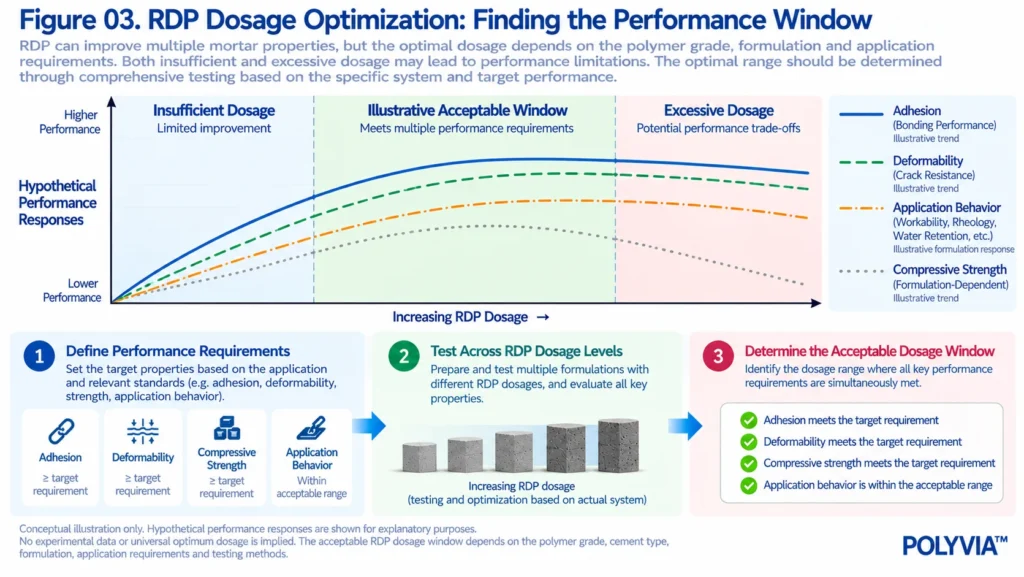
Dosage optimization should therefore focus on meeting all critical application requirements.
1. Why Is Performance Not Proportional to Dosage?
As polymer addition increases, its contribution to the cement–polymer composite changes.
Three response patterns are relevant:
Performance improvement: A property improves within the tested addition range.
Diminishing returns: Additional polymer produces progressively smaller useful improvements.
Performance trade-offs: A benefit in one property accompanies deterioration in another.
These patterns depend on polymer chemistry, mineral composition, air content, mixing water, and curing conditions.
There is no universal dosage threshold beyond which all RDP products become ineffective or harmful.
2. Why Must Dosage Comparisons Use the Same Basis?
RDP percentages are meaningful only when the calculation basis is defined.
| Expression | Calculation Basis |
|---|---|
| RDP / Total Dry Mix | Commercial RDP powder mass divided by finished dry-mix mass |
| RDP / Mineral Base | RDP powder mass divided by a specified mineral-ingredient mass |
| Polymer / Cement | Polymer mass divided by cement mass |
| RDP Powder / Cement | Commercial RDP powder mass divided by cement mass |
Commercial RDP may include protective colloids and other non-polymer constituents. Therefore, commercial powder mass and active polymer mass are not necessarily identical.
For example, a hypothetical 1,000 kg mortar containing 20 kg RDP powder and 400 kg cement has:
RDP content = 2.0% of total dry-mix mass
RDP powder-to-cement ratio = 5.0%
These describe the same formulation using different denominators.
The second value is not automatically an active polymer-to-cement ratio.
3. What Should a Controlled Dosage Trial Measure?
| Formulation Objective | Main Indicator | Supporting Indicators |
|---|---|---|
| Higher tile adhesion | Initial and conditioned adhesion | Open time, slip, workability |
| Greater deformability | Transverse deformation or relevant mechanical test | Adhesion, strength |
| Better crack tolerance | Relevant cracking or fracture test | Shrinkage, stiffness |
| Lower water uptake | Capillary absorption | Wet adhesion, vapor transport |
| Better workability | Consistency and rheology | Stability, water demand |
| Lower material cost | Cost at acceptable performance | Compliance and repeatability |
The trial should investigate whether an addition level provides meaningful improvement without compromising essential requirements.
4. How Should Manufacturers Design a Dosage Trial?
A practical screening procedure includes:
1. Define the performance target. Establish required properties and acceptance criteria.
2. Select a relevant RDP candidate. Use polymer characteristics and application information.
3. Establish several dosage levels. Keep the calculation basis consistent.
4. Control formulation variables. Document cement, fillers, aggregates, cellulose ether, mixing water, and curing.
5. Measure multiple properties. Include potential mechanical and application trade-offs.
6. Identify passing formulations. Determine which candidates satisfy all essential requirements.
7. Confirm repeatability. Retest promising formulations using representative conditions.
A failed trial should identify the next variable to investigate rather than automatically lead to higher polymer dosage.
5. How Can Diminishing Returns Be Evaluated?
One useful screening indicator is the incremental performance response:
Incremental Performance Response = Change in Measured Property / Change in RDP Dosage
For example, in a hypothetical comparison, adding another 5 kg of RDP per tonne produces a 0.10 MPa increase in adhesion.
The incremental response is 0.02 MPa per additional kg/t within that specific interval.
This calculation is illustrative and is not a POLYVIA™ experimental result.
Results should not be extrapolated beyond the tested range. Small improvements should also be assessed against test variability and the actual acceptance criteria.
6. Why Is the Lowest-Cost Formulation Not Always the Best?
The RDP material cost contribution can be estimated as:
RDP Cost per Tonne of Mortar = RDP Addition (kg/t) × RDP Price per kg
However, a lower-cost formulation that fails a critical specification cannot be considered an effective optimization.
Cost decisions should account for performance compliance, production consistency, application behavior, suitable performance margins, and supplier reliability.
7. The POLYVIA™ Performance-Window Approach
POLYVIA™ recommends identifying a performance window: the range of experimentally evaluated formulation conditions in which all essential requirements are satisfied.
This approach follows five steps:
Define → Screen → Measure → Validate → Optimize
If no dosage level produces the required balance, the next adjustment may involve polymer chemistry, the binder system, cellulose ether, mineral grading, or another formulation variable.
The optimum RDP dosage is not a universal percentage. It is a formulation choice supported by relevant, repeatable performance testing.
How Should RDP Performance Be Evaluated for Different Mortar Applications?
RDP performance should be evaluated according to the requirements of the finished mortar, not solely through polymer specifications or results from unrelated applications.
A meaningful program begins by identifying the application, selecting appropriate test methods, defining acceptance criteria, and evaluating candidate grades within a controlled formulation.
1. Why Should Testing Start with the Application?
Tg, polymer chemistry, and other material characteristics support grade screening but do not establish finished-mortar performance.
Three levels of evaluation should be distinguished.
| Evaluation Level | Main Question | Evidence |
|---|---|---|
| RDP Material | Is the polymer suitable for initial screening? | Material specifications |
| Finished Mortar | Does the mortar meet the target requirements? | Relevant performance tests |
| Construction System | Does the complete assembly perform as required? | Applicable system-level evaluation |
An RDP technical data sheet cannot independently certify the performance of the customer's tile adhesive, render, or ETICS assembly.
2. Which Tests Matter for Each Application?
| Application | Main Objective | Relevant Framework | Priority Tests |
|---|---|---|---|
| C1/C2 Tile Adhesive | Reliable bonding | EN 12004-1 and applicable test methods | Initial and conditioned adhesion, open time |
| Deformable Tile Adhesive | Bonding and movement capacity | EN 12004 classification / applicable deformation test | Adhesion and S1/S2 deformation |
| ETICS Base Coat | Performance within a reinforced façade system | Applicable ETICS EAD | Adhesion, cracking-related behavior, system performance |
| Exterior Render | Moisture management and mechanical properties | EN 998-1, where applicable | Adhesion, capillary absorption, vapor permeability |
| Concrete Repair Mortar | Repair and substrate compatibility | EN 1504-3, where applicable | Bond, strength, stiffness, shrinkage |
| Self-Leveling Compound | Flow and hardened performance | EN 13813, where applicable | Flow, stability, mechanical strength |
This matrix is an initial screening guide. The full scope and requirements of each applicable standard must be checked before conformity claims are made.
3. How Should Candidate RDP Grades Be Compared?
Begin with a representative reference formulation.
Document the binder system, mineral composition, cellulose ether, RDP dosage basis, mixing-water content, preparation, and curing conditions.
Compare technically relevant candidate grades using the same evaluation criteria.
Where grades have different water demands, fixed-water and matched-consistency testing may provide complementary information.
Measure the limiting property alongside other important performance indicators.
Repeat promising tests before selecting a commercial formulation.
4. What Should Manufacturers Do When a Test Fails?
A failed result does not automatically indicate insufficient RDP.
| Problem | Variables to Investigate | Next Evaluation |
|---|---|---|
| Low initial adhesion | Substrate, wetting, binder compatibility, polymer profile | Adhesion and failure-mode testing |
| Low adhesion after immersion | Polymer chemistry, curing, interface behavior | Conditioned adhesion testing |
| Insufficient deformation | Polymer profile, dosage, mineral skeleton | Deformation and strength |
| Excessive tile slip | Rheology, cellulose ether, water demand | Slip and fresh-state testing |
| High capillary absorption | Hydrophobic modification, pore structure, curing | Capillary absorption |
| Poor self-leveling flow | Particle grading, water demand, admixtures | Flow and stability |
| Repair mortar cracking | Shrinkage, restraint, stiffness, curing | Shrinkage, cracking and bond |
These are investigation priorities, not confirmed root causes.
The next formulation adjustment should be based on controlled evidence.
5. Why Do Test Conditions and Failure Modes Matter?
A reported performance value should be accompanied by sufficient context.
Relevant information includes the test method, formulation, dosage basis, specimen preparation, water content, curing and conditioning procedures, test age, measured units, failure mode, and result variability.
A numerical result without this information may be unsuitable for direct comparison.
6. How Can Testing Be Made More Efficient?
A staged evaluation is often appropriate.
Stage A — Material Screening: Review polymer chemistry and supplier documentation.
Stage B — Preliminary Formulation Screening: Measure initial consistency, application behavior, and the main performance indicator.
Stage C — Application-Specific Validation: Conduct the full set of relevant tests.
Stage D — Production Confirmation: Confirm repeatability using representative raw materials and manufacturing conditions.
Preliminary screening must not replace mandatory conformity testing where applicable.
POLYVIA™ Technical Perspective
A practical decision process is:
Application Requirement → Relevant Test → Observed Result → Limiting Variables → Controlled Formulation Adjustment
The most valuable test is the one that reliably informs the next engineering decision.
How Can Manufacturers Select the Right RDP Performance Profile?
RDP selection should begin with the performance limitation of the finished mortar, followed by screening and validating suitable polymer profiles. Material characteristics such as Tg, MFFT, and hydrophobicity help narrow the options but cannot independently predict finished-mortar performance.
1. Start with the Performance Problem
Before selecting a grade, identify whether the main challenge concerns:
- Initial or conditioned adhesion.
- Deformability and movement accommodation.
- Shrinkage or cracking.
- Liquid-water uptake or environmental exposure.
- Flow, troweling, open time, or slip.
- Formulation cost and production consistency.
Different problems may require different polymer characteristics or adjustments to other formulation ingredients.
2. Which POLYVIA™ RDP Grades Should Be Considered?
POLYVIA™ offers six VAE-based RDP grades with different intended performance profiles.
| Main Requirement | Candidate POLYVIA™ Grade | Screening Direction | Required Verification |
|---|---|---|---|
| Wall putty and skim coat bonding | RDP 10 | Relatively rigid, general-purpose modification | Cohesion, adhesion, workability |
| General-purpose tile adhesive or render | RDP 20 | Balanced adhesion and flexibility | Initial and conditioned adhesion |
| Flexible tile adhesive or ETICS base coat | RDP 30F | Flexible polymer profile | Adhesion, deformation, cracking-related behavior |
| Higher deformation requirements | RDP 40F | High-flexibility profile | Transverse deformation and mechanical balance |
| Exterior mortar targeting lower water uptake | RDP 50H | Hydrophobic profile | Absorption, adhesion, moisture behavior |
| Cementitious self-leveling systems | RDP 60L | Self-leveling application profile | Flow, stability, strength, surface quality |
These are preliminary formulation-screening recommendations based on POLYVIA™ product positioning. They are not guarantees of finished-mortar classifications or test results.
A more flexible grade is not universally superior.
A hydrophobic grade is not automatically better in water-conditioned adhesion.
A self-leveling-oriented grade does not guarantee the correct flow or strength without suitable formulation design.
3. How Should Tg and MFFT Influence Selection?
Tg helps describe polymer mechanical response.
MFFT describes film-forming behavior under defined conditions.
Lower Tg may be relevant when greater deformation capacity is required, but complete mortar performance depends on polymer content, mineral composition, temperature, and curing.
MFFT should not be interpreted as a guaranteed installation temperature.
These parameters are screening tools rather than finished-product performance indicators.
4. What If the Initial Candidate Does Not Solve the Problem?
Scenario A — Tile adhesive fails after immersion
Investigate conditioned bonding, curing, polymer chemistry, and moisture-sensitive interfaces. Higher dosage alone may not solve the problem.
Scenario B — ETICS base coat develops cracks
Investigate shrinkage, restraint, reinforcement, substrate movement, and mechanical compatibility. A more flexible polymer cannot correct every system-level problem.
Scenario C — Self-leveling mortar has poor flow
Investigate water demand, aggregate and filler grading, rheological additives, and polymer compatibility before assuming that the RDP grade is the main cause.
5. How Should Two Grades Be Compared Fairly?
Use a documented reference formulation and a consistent dosage basis.
Compare all relevant performance requirements, including fresh-state behavior, mechanical properties, environmental conditioning, cost, and repeatability.
When water demand varies between grades, fixed-water and matched-consistency trials should be interpreted separately.
A higher value in one test does not necessarily identify the better commercial grade.
6. What Information Should Customers Share with an RDP Supplier?
| Information | Why It Matters |
|---|---|
| Mortar application | Defines the material system |
| Target standard or classification | Establishes acceptance criteria |
| Main performance problem | Identifies the limiting property |
| Cement or binder system | Supports compatibility assessment |
| Mineral fillers and aggregates | Influences water demand and structure |
| Cellulose ether and other additives | Reveals potential interactions |
| Current RDP dosage | Establishes the baseline |
| Existing test results | Supports evidence-based troubleshooting |
| Application and curing conditions | Helps assess environmental relevance |
Customers do not necessarily need to disclose a complete confidential formulation during initial screening, but sufficient technical information improves recommendation quality.
7. POLYVIA™ Technical Perspective: Select, Compare, Validate
Select: Match the application and limiting requirement with suitable candidate profiles.
Compare: Test candidate grades in a controlled formulation.
Validate: Confirm the finished mortar's required performance, consistency, and cost balance.
The right RDP grade is the one that helps the complete mortar achieve its intended performance reliably and efficiently—not simply the most flexible or most specialized product.
For further information, explore the POLYVIA™ RDP product range or discuss your formulation requirements with the technical team.
What Should Formulators Remember About RDP Performance?
The effectiveness of RDP depends on how well its polymer chemistry, dosage, and formulation conditions match the requirements of the finished mortar.
There is no universal grade or dosage that simultaneously maximizes adhesion, deformability, water resistance, workability, mechanical strength, and cost efficiency.
1. Five Principles for Reliable RDP Formulation
1. Start with the application.
Identify the finished mortar's requirements before selecting polymer characteristics.
2. Evaluate the complete formulation.
Cement, aggregates, cellulose ethers, water demand, curing, and polymer chemistry interact.
3. Measure the limiting performance property.
Use tests that reflect the application's actual acceptance criteria.
4. Optimize within a performance window.
Additional RDP may create diminishing returns or trade-offs.
5. Confirm results before commercial adoption.
Published research and supplier reference formulations support screening, but they do not replace application-specific validation.
2. What Makes a Selection Decision Reliable?
| Stage | Main Question | Desired Outcome |
|---|---|---|
| Define | What must the mortar achieve? | Clear targets |
| Diagnose | What currently limits performance? | Identified problem |
| Screen | Which polymer profiles are relevant? | Candidate grades |
| Compare | How do candidates perform? | Comparable evidence |
| Validate | Are results repeatable? | Confirmed performance |
| Optimize | Which option provides the best balance? | Reliable, economical formulation |
3. Final Takeaway
The value of RDP lies not in maximizing polymer content, but in controlling the performance of the complete mortar system.
A technically suitable grade should help the finished formulation meet its required adhesion, deformation, application, and environmental performance while maintaining consistent quality and acceptable cost.
POLYVIA™ recommends an application-led process:
Define the Requirement → Select Candidate Grades → Test the Formulation → Validate Performance → Optimize Cost
This approach connects polymer science with practical formulation decisions and provides a more reliable basis for comparing redispersible polymer powders.
Frequently Asked Questions
1. Does RDP improve adhesion to concrete and ceramic tiles?
Yes. RDP can improve adhesion in suitable cementitious mortars by modifying interfacial bonding, internal cohesion, and stress transfer.
However, the improvement depends on substrate characteristics, polymer chemistry, dosage, and curing conditions. For cementitious tile adhesives, relevant initial and conditioned tensile adhesion tests should be used. High initial adhesion does not automatically guarantee adequate adhesion after water immersion or heat ageing.
2. Does a lower RDP glass transition temperature (Tg) always improve mortar flexibility?
No. A lower Tg may indicate a more compliant polymer response, but it does not guarantee greater deformability in the finished mortar.
Deformability depends on polymer content, cementitious binder, aggregates, temperature, and curing. Where S1 or S2 performance is required, the finished adhesive must be evaluated using the relevant transverse deformation method.
3. Can RDP prevent cracking in cement-based mortar?
RDP can improve selected deformation and fracture properties, but it cannot guarantee crack-free mortar.
Cracking may result from restrained shrinkage, thermal movement, substrate deformation, inadequate curing, or system-design problems. Polymer selection should be evaluated alongside dimensional stability and application-specific cracking performance.
4. Does hydrophobic RDP improve adhesion after water immersion?
Not necessarily. A hydrophobic RDP may help reduce liquid-water uptake, but lower absorption does not independently establish higher adhesion after immersion.
Water absorption and conditioned adhesion measure different properties. For water-exposed tile adhesives, the finished formulation must satisfy the applicable adhesion-after-immersion requirements.
5. Can excessive RDP reduce compressive strength?
Yes. Increasing RDP dosage can reduce compressive strength in some cementitious formulations, even when other properties improve.
The result depends on polymer chemistry, dosage, air content, water demand, and binder composition. There is no universal excessive-dosage threshold. Controlled testing should assess the complete mechanical performance profile.
6. Does RDP extend tile adhesive open time?
RDP may influence open-time performance, but it does not automatically extend open time.
Open time also depends on water retention, cellulose ether selection, substrate absorption, temperature, humidity, and formulation design. It must be verified through the applicable open-time adhesion test rather than appearance or consistency alone.
7. How should manufacturers compare two RDP grades?
Two RDP grades should be compared in a controlled reference formulation using documented dosage, water content, mixing, curing, and testing procedures.
Manufacturers should measure the limiting performance requirement and potential trade-offs. Fixed-water and matched-consistency comparisons may provide complementary information when candidate grades differ in water demand.
The preferred grade is the one that meets the required performance with acceptable consistency and cost.
8. Why Does the Same RDP Perform Differently in Different Mortar Formulations?
The same redispersible polymer powder (RDP) can produce different results because its performance depends on the complete mortar formulation, not the polymer alone.
Cement chemistry, aggregate grading, cellulose ether selection, water demand, dosage, and curing conditions can all influence adhesion, flexibility, workability, and durability.
For example, an RDP grade that provides good adhesion in one tile adhesive formulation may deliver different results when the cement source or cellulose ether is changed.
Manufacturers should therefore evaluate RDP using their own raw materials and controlled formulation trials rather than relying solely on supplier reference data.
References and Technical Sources
[1] Dong, W., Fang, C., and Hu, R. (2020). Influence of Redispersible Powder on Properties of Self-Leveling Mortar of Ternary Cementitious System. Materials, 13(24), 5703.
https://doi.org/10.3390/ma13245703
[2] Wang, R., Wang, P.-M., and Yao, L.-J. (2012). Effect of redispersible vinyl acetate and versatate copolymer powder on flexibility of cement mortar. Construction and Building Materials, 27(1), 259–262.
https://doi.org/10.1016/j.conbuildmat.2011.07.050
[3] Lee, J.-B. (2024). Redispersible Acrylic Ester Polymers: Effect of Polymer Property Changes Due to Polymerization Method Modification and Functional Additives on the Performance of Polymer Cement Mortar. Materials, 17(22), 5534.
https://doi.org/10.3390/ma17225534
[4] Feng, K., Xu, Z., Zhang, W., Ma, K., Shen, J., and Hu, M. (2022). Rheological Properties and Early-Age Microstructure of Cement Pastes with Limestone Powder, Redispersible Polymer Powder and Cellulose Ether. Materials, 15(9), 3159.
https://doi.org/10.3390/ma15093159
Relevant Standards and Assessment Frameworks
[5] EN 12004-1:2017. Adhesives for ceramic tiles — Part 1: Requirements, assessment and verification of constancy of performance, classification and marking.
[6] EN 12004-2:2017. Adhesives for ceramic tiles — Part 2: Test methods.
[7] EN 998-1:2016. Specification for mortar for masonry — Part 1: Rendering and plastering mortar.
[8] EN 1504-3:2005. Products and systems for the protection and repair of concrete structures — Part 3: Structural and non-structural repair.
[9] EN 13813:2002. Screed material and floor screeds — Screed material properties and requirements.
[10] EAD 040083-01-0404. External Thermal Insulation Composite Systems with Rendering.
Technical Note: The published experimental results cited in this article were obtained by independent researchers and do not represent POLYVIA™ product-specific laboratory results. Test conditions, dosage definitions, and material systems differ among studies. The listed standards apply to defined finished products or systems; applicable editions and complete requirements should be checked for the intended market. POLYVIA™ RDP grade recommendations are starting points for formulation screening, not guarantees of classification or conformity.