
What Is Redispersible Polymer Powder? A Guide for Dry-Mix Mortar Manufacturers
Understanding VAE Polymer Powder, Redispersion and Its Role in Modern Dry-Mix Mortar
Learn what redispersible polymer powder (RDP) is, how it is manufactured, how it redistributes in water and how it modifies cementitious and gypsum-based dry-mix mortar. Explore the material fundamentals and POLYVIA™ VAE RDP product range.
Introduction: What Is Redispersible Polymer Powder?
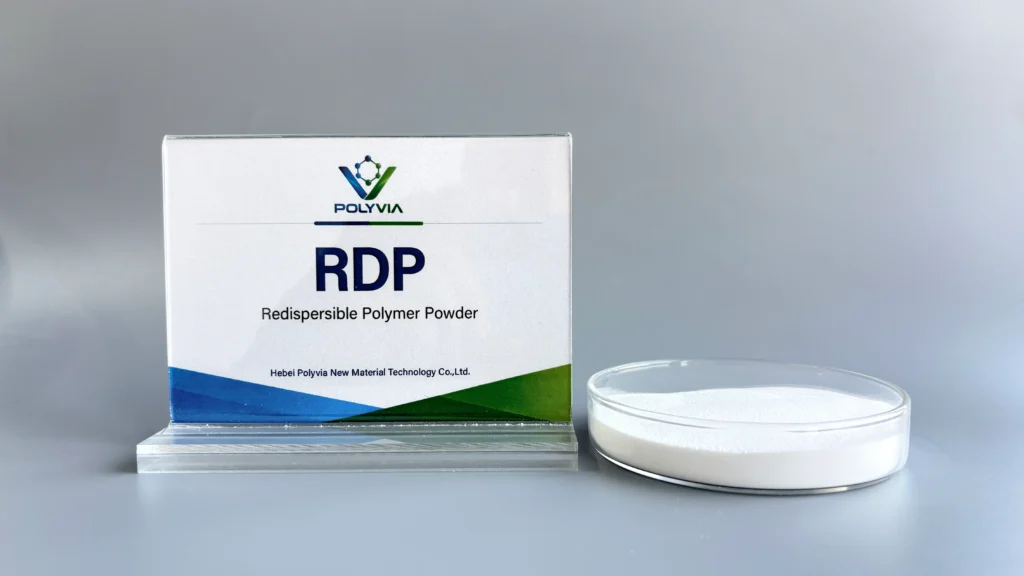
Redispersible polymer powder (RDP) is a spray-dried polymer powder designed to redisperse in water and provide polymer modification in dry-mix mortar systems.
It is widely used in cementitious and gypsum-based construction materials to modify adhesion, flexibility, cohesion and other application-related properties.
Unlike conventional liquid polymer dispersions, RDP is supplied in powder form, allowing it to be incorporated into factory-produced dry-mix formulations and packaged together with cement, fillers, aggregates and other additives.
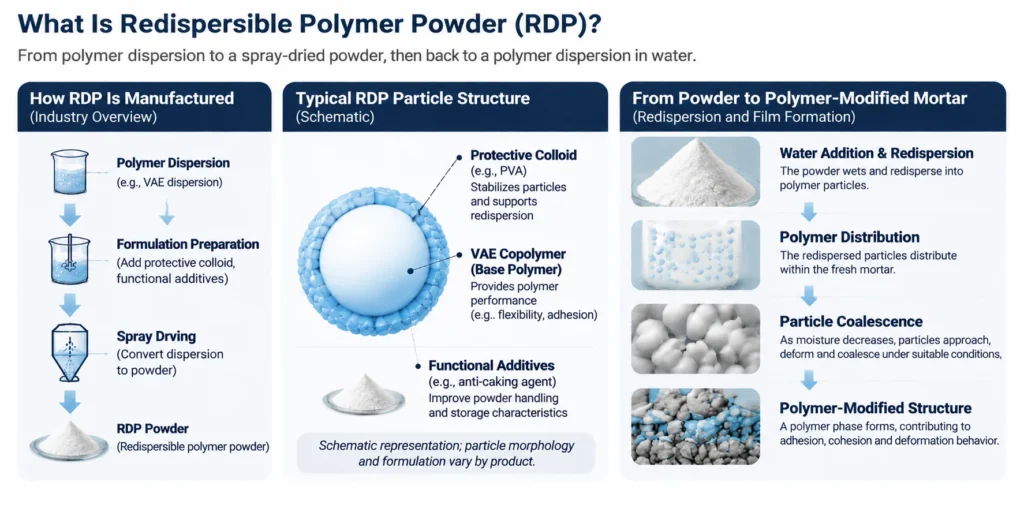
When water is added, the powder redistributes into polymer particles within the fresh mortar. During subsequent moisture loss and hardening, these particles can deform and coalesce under suitable conditions, contributing to the polymer-modified structure of the hardened material.
For dry-mix mortar manufacturers, understanding RDP requires more than knowing its basic definition. Its polymer chemistry, powder formulation, redispersion behavior and compatibility with other raw materials all influence its suitability for a particular application.
POLYVIA™ supplies six VAE-based RDP grades developed for different dry-mix mortar requirements.
What Is Redispersible Polymer Powder Made Of?
RDP is a formulated polymer powder rather than a single pure chemical substance.
Its composition generally includes a polymer component and, depending on the commercial formulation, protective colloids and other functional additives.
Main Components
| Component | General Function |
|---|---|
| Base Polymer | Determines the main polymer characteristics, including flexibility and film-forming behavior |
| Protective Colloid | Helps stabilize polymer particles during drying, storage and redispersion |
| Anti-Caking Agent | Helps reduce powder agglomeration and improve handling and storage characteristics |
| Other Functional Components | May be included depending on the product formulation |
The exact composition and proportions vary between manufacturers and commercial grades. Not every RDP contains identical additives or uses the same stabilization system.
VAE: Vinyl Acetate–Ethylene Copolymer
VAE is a commonly used polymer chemistry in redispersible polymer powder.
It is based on the copolymerization of vinyl acetate and ethylene.
The polymer composition and molecular characteristics influence properties such as glass transition temperature (Tg), film-forming behavior and flexibility.
Different VAE RDP grades can therefore exhibit different technical profiles and application suitability.
PVA: Polyvinyl Alcohol
Polyvinyl alcohol (PVA) is commonly used as a protective colloid in certain redispersible polymer powder formulations.
It helps stabilize polymer particles and supports their redispersion after the powder is mixed with water.
PVA should not be confused with the VAE base polymer.
The distinction is:
- VAE identifies the main copolymer chemistry.
- PVA may function as a protective colloid.
- RDP identifies the commercial redispersible polymer powder form.
POLYVIA™ identifies VAE copolymer as the polymer base and PVA as the protective colloid in its published product information.
How Does RDP Redisperse in Water and Form a Polymer Phase?
Redispersion and molecular dissolution are different processes.
RDP is designed to redisperse into polymer particles when water is introduced. It does not simply dissolve into individual water-soluble polymer molecules.
Understanding this distinction helps explain how RDP functions in dry-mix mortar.
Stage 1: Wetting and Redispersion
When water contacts RDP-containing dry mortar, the powder particles become wetted and begin to redisperse.
Protective colloids, where present, contribute to the stabilization of the resulting polymer particles.
The effectiveness of redispersion depends on the product formulation, mixing procedure and surrounding mortar system.
Stage 2: Polymer Distribution
The redispersed polymer particles become distributed within the aqueous mortar system.
Their distribution is influenced by mixing, water movement, substrate absorption, cement hydration and the other formulation components.
It should not be assumed that polymer particles distribute uniformly around every cement particle or aggregate.
Stage 3: Moisture Reduction and Particle Coalescence
As the mortar loses moisture, polymer particles may become more closely packed.
Under suitable conditions, particles deform and coalesce, developing polymer-rich regions and films within the hardened mortar structure.
The extent of film formation depends on polymer characteristics, temperature, MFFT, moisture conditions and the surrounding mineral matrix.
Research on powdered polymer-modified mortar has examined how polymer particles coalesce and develop films during curing [3].
Stage 4: Polymer-Modified Hardened Structure
The resulting polymer phase can contribute to adhesion, cohesion and deformation-related behavior.
However, the final structure is not determined by RDP alone.
Cement hydration, aggregate packing, water content, curing conditions and polymer characteristics all influence the resulting mortar properties.
For a more detailed explanation of how these processes influence mortar performance, see the related POLYVIA™ technical article on RDP mechanisms once its published URL has been verified.
What Does RDP Do in Dry-Mix Mortar?
RDP is primarily used to modify the performance of hardened mortar through polymer incorporation.
Its contribution depends on the polymer grade, dosage, binder system and application conditions.
Adhesion
RDP can contribute to improved bonding between mortar and compatible substrates.
This is important in tile adhesives, skim coats, rendering mortars and external thermal insulation systems.
Actual adhesion depends on substrate characteristics, formulation, water content, curing and testing conditions.
Flexibility and Deformation Behavior
Polymer modification can change the mechanical behavior of hardened mortar.
Depending on polymer characteristics and dosage, RDP may contribute to reduced brittle behavior and improved deformation accommodation.
However, flexibility does not automatically establish a particular finished-product deformation classification.
Cohesion and Crack Resistance
RDP can contribute to the cohesion and toughness of polymer-modified mortar.
These characteristics are relevant to thin-layer materials and applications exposed to shrinkage or substrate movement.
Crack resistance also depends on binder composition, aggregate grading, layer thickness, curing and construction conditions.
Water-Related Performance
Selected polymer grades can contribute to hydrophobicity and reduced water absorption in suitable formulations.
However, the following properties should be distinguished:
- Hydrophobicity.
- Capillary water absorption.
- Water permeability.
- Wet adhesion.
- Crack-bridging performance.
A hydrophobic RDP grade does not automatically make a finished mortar waterproof.
Fresh-Mortar Behavior
RDP may influence fresh-mortar consistency and application behavior.
Its effects depend on the specific grade and interaction with cellulose ethers, starch ethers, defoamers, fillers and water.
It should not be assumed that every RDP grade automatically improves water retention, open time, workability or flowability.
What Types of RDP Are Used in Dry-Mix Mortar?
RDP products can be classified according to their base-polymer chemistry.
Common polymer systems used in the construction industry include:
- VAE: Vinyl Acetate–Ethylene.
- VA/VeoVa: Vinyl Acetate–Vinyl Versatate.
- Acrylic-based polymer systems.
- Styrene-acrylic systems.
- Other copolymer and polymer systems developed for specific applications.
These polymer systems have different chemical structures and can exhibit different material characteristics.
However, polymer family alone cannot determine finished-mortar performance.
The specific commercial grade, powder formulation, dosage and complete mortar composition must also be considered.
POLYVIA™'s current RDP range is based on VAE copolymer technology.
For a detailed discussion of polymer chemistry and its influence on mortar performance, refer to the dedicated RDP polymer chemistry article in the POLYVIA™ technical knowledge cluster.
POLYVIA™ VAE Redispersible Polymer Powder Product Range
POLYVIA™ supplies six VAE-based RDP grades for different dry-mix mortar applications.
| Grade | Product Positioning | Main Application Direction |
|---|---|---|
| RDP 10 | Rigid / General Purpose | Wall Putty, Skim Coat, Gypsum Mortar |
| RDP 20 | Multi-Purpose / Semi-Flexible | Tile Adhesive, Render & Plaster |
| RDP 30F | Flexible | C2 Tile Adhesive, EIFS / ETICS Base Coat |
| RDP 40F | High-Flexibility | Flexible Tile Adhesive, EIFS / ETICS |
| RDP 50H | Hydrophobic | Waterproof Mortar, Exterior Mortar |
| RDP 60L | Self-Leveling | Cement-Based Self-Leveling Compounds |
These descriptions represent the current published POLYVIA™ product positioning. They are not exclusive application restrictions or guarantees of finished-mortar performance.
The appropriate grade should be selected according to the intended application, required performance and formulation compatibility.
For complete technical parameters and product specifications, visit:
Where Is RDP Used?
RDP is used in a wide range of factory-produced dry-mix mortar systems.
Its function and required polymer characteristics depend on the application.
| Application | Main Reason for Using RDP |
|---|---|
| Tile Adhesive | Adhesion and polymer modification |
| Wall Putty | Surface adhesion and cohesion |
| Skim Coat | Adhesion and thin-layer performance |
| Render and Plaster | Adhesion and cohesion |
| EIFS / ETICS | Adhesion, flexibility and crack resistance |
| Cementitious Waterproofing Mortar | Hydrophobicity and water-related performance |
| Self-Leveling Compound | Adhesion and cohesion |
| Gypsum-Based Mortar | Cohesion and application performance |
Tile Adhesive
RDP is an important functional additive in cement-based tile adhesive.
Its contribution to adhesion and polymer modification must be evaluated together with cellulose ether, aggregate grading, cement and water dosage.
For practical formulation examples, see:
Tile Adhesive Formula: 1,000 kg Dry-Mix Recipes for C1, C1TE, C2 and C2TE
Wall Putty and Skim Coat
RDP is used to modify adhesion and cohesion in finishing materials.
The appropriate polymer grade depends on the binder system, substrate, layer thickness and required surface performance.
EIFS / ETICS
Polymer-modified adhesive and base-coat mortars are used in external thermal insulation systems.
The required polymer characteristics depend on the insulation material, substrate, reinforcing mesh and complete system design.
Waterproofing Mortar
Selected RDP grades may be used where hydrophobicity, adhesion and water-related performance are important.
The finished waterproofing system must still meet its specified performance requirements.
Self-Leveling Compound
RDP can contribute to adhesion and cohesion in cement-based self-leveling systems.
The selected grade must be evaluated together with the complete formulation to maintain suitable flow and surface stability.
What Should Manufacturers Consider Before Using RDP?
Selecting an RDP product requires more than checking its powder appearance or a single technical parameter.
Dry-mix mortar manufacturers should consider the following factors.
1. Product Identity and Technical Documentation
Check the polymer type, product grade, TDS and relevant batch COA.
Distinguish typical values from specification limits and batch-specific results.
2. Binder Compatibility
Evaluate the selected grade in the intended cementitious or gypsum-based system.
Different binders may produce different formulation responses.
3. Additive Compatibility
Consider the interaction between RDP and other functional additives, including HPMC, MHEC, starch ether, PCE and defoamers.
These materials perform different functions and should be balanced in the complete formulation.
4. Dosage Basis
Record RDP dosage using a clearly defined mass basis.
For example, 10 kg of commercial RDP in 1,000 kg of dry mix represents 1.0% of total dry-mix mass.
This is not the same as an active-polymer-to-cement ratio.
5. Finished-Mortar Testing
Evaluate both fresh and hardened mortar properties.
The relevant tests depend on the application and required performance classification.
Powder properties alone cannot establish the final performance of the mortar.
6. Production and Storage Conditions
Check packaging, moisture protection, storage conditions and handling procedures.
The product should be stored and handled according to its current technical documentation.
Frequently Asked Questions
1. What is redispersible polymer powder used for?
RDP is used to modify cementitious and gypsum-based dry-mix mortar. Depending on the polymer grade and complete formulation, it can contribute to adhesion, flexibility, cohesion and other application-related properties.
2. What does RDP stand for in construction materials?
RDP stands for Redispersible Polymer Powder. It is a spray-dried polymer powder designed to redisperse in water and provide polymer modification in dry-mix mortar systems.
3. Is VAE the same as RDP?
No. VAE refers to vinyl acetate–ethylene copolymer chemistry, while RDP refers to the commercial redispersible powder form. VAE is one of the polymer bases used to manufacture RDP.
4. Is RDP water-soluble?
RDP should not be described simply as a water-soluble polymer. It redistributes into polymer particles when mixed with water, forming a polymer dispersion rather than dissolving completely at the molecular level.
5. What is the difference between RDP and PVA?
RDP is a commercial redispersible polymer powder. PVA, or polyvinyl alcohol, may be used as a protective colloid in certain RDP formulations. They are different materials with different functions.
6. Can RDP be used in cement-based and gypsum-based mortar?
Yes. Different RDP grades are designed for cementitious and gypsum-based applications. However, compatibility and finished-mortar performance should be verified in the intended binder system.
7. Does adding more RDP always improve mortar performance?
No. Increasing RDP dosage does not guarantee that every mortar property will improve simultaneously. The result depends on polymer characteristics, binder composition, water content, aggregate grading and other additives.
8. How do manufacturers select the right RDP grade?
Manufacturers should begin with the intended application and required performance, then evaluate suitable RDP grades using product documentation and controlled formulation testing. The final choice should be based on finished-mortar results rather than powder specifications alone.
References
[1] Caimi, S., Timmerer, E., Banfi, M., Storti, G. and Morbidelli, M. (2018). Core-Shell Morphology of Redispersible Powders in Polymer-Cement Waterproof Mortars. Polymers, 10(10), 1122.
https://doi.org/10.3390/polym10101122
[2] Spray Drying of Polymer Dispersions for Redispersible Powder Coatings: Effects of Stabilization Mechanisms and Process Conditions (2024).
https://www.sciencedirect.com/science/article/pii/S0300944024005617
Note: This study focuses on VAE dispersions and redispersible powder coatings. Its findings are used only to support general discussion of spray-drying and stabilization, not to establish performance claims for commercial cement-mortar RDP grades.
[3] Development of Polymer Films by the Coalescence of Polymer Particles in Powdered and Aqueous Polymer-Modified Mortars (2003). Cement and Concrete Research, 33(11), 1715–1721.
https://doi.org/10.1016/S0008-8846(02)01094-3
[4] Jenni, A., Holzer, L., Zurbriggen, R. and Herwegh, M. (2005). Influence of Polymers on Microstructure and Adhesive Strength of Cementitious Tile Adhesive Mortars. Cement and Concrete Research, 35(1), 35–50.
https://doi.org/10.1016/j.cemconres.2004.06.039
[5] POLYVIA™. Redispersible Polymer Powder Product Information.
https://www.polyvia-material.com/product/redispersible-polymer-powder/
Technical Note
The product descriptions and application directions in this article reflect published POLYVIA™ product information. The general manufacturing and polymer-film formation explanations are based on published technical literature. The performance of RDP in a finished mortar depends on the complete formulation, raw materials, dosage, application conditions and testing methods. Product specifications should be confirmed using the latest applicable TDS and batch documentation.
Conclusion: From Polymer Science to Practical Formulation
Redispersible polymer powder provides a practical route to polymer modification in dry-mix construction materials. Its effectiveness results from the relationship between polymer chemistry, redispersion, film formation, mineral binder reactions, and formulation design.
Understanding these interactions is more useful than evaluating RDP through an isolated technical parameter.
POLYVIA™ reference formulations also illustrate that polymer dosage varies according to the material system. The correct dosage is not simply the highest possible addition rate, but one that supports the required combination of application performance, consistency, and cost.
With six VAE-based RDP grades covering different technical requirements, POLYVIA™ provides starting points for material screening and application-specific formulation development.
Effective RDP selection begins with understanding the finished mortar—not simply choosing a polymer powder by name or specification.
Explore our Redispersible Polymer Powder products or contact the POLYVIA™ technical team to discuss the requirements of your formulation.