
PCE Dosage Optimization: Understanding the Saturation Point
Dosage–Response Behavior, Saturation Limits and Practical Superplasticizer Selection
Learn how PCE dosage affects cement dispersion and flowability, why additional superplasticizer may produce diminishing returns, and how to distinguish laboratory saturation from practical optimum dosage. Explore a systematic approach to dosage evaluation across powder, flake and liquid PCE formulations.
POLYVIA™ · MATERIAL SCIENCE & CONCRETE PERFORMANCE
Increasing the dosage of a Polycarboxylate Ether (PCE) Superplasticizer does not always produce a proportional improvement in cementitious material flowability.
At relatively low dosages, additional PCE may improve particle dispersion and reduce resistance to flow. As dosage increases, however, the incremental benefit may decline. In some systems, the measured response approaches a plateau.
Understanding this behavior is essential for identifying a suitable admixture dosage.
The objective is not to maximize the amount of PCE added, but to establish a dosage or operating range that achieves the required concrete performance under defined material and production conditions.
1. Why Insufficient Dosage Can Limit Performance
PCE molecules interact with cementitious particles through adsorption-related functional groups, while their molecular architecture contributes to dispersion and steric stabilization.
When the available PCE is insufficient for the selected cementitious system, the mixture may exhibit inadequate dispersion at the specified water content.
This can result in limited flowability or increased resistance to deformation.
However, the dosage at which a meaningful response begins depends on the polymer formulation, cement characteristics and test conditions.
2. Why Increasing Dosage Can Improve Dispersion
As PCE dosage increases, more polymer becomes available to interact with the cementitious system.
Within an effective dosage range, this can produce substantial improvement in flowability or rheological behavior.
However, the relationship is not necessarily linear.
The same dosage increment may produce a different response when the cement source, binder composition or polymer formulation changes.
3. Why Additional Dosage Eventually Provides Less Benefit
At higher dosages, further PCE additions may produce progressively smaller improvements in the selected performance measurement.
This is commonly described as a diminishing-return response.
A diminishing return does not mean that additional PCE has become completely inactive. It means that the selected measurement is becoming less responsive under the tested conditions.
Excessive addition may also increase formulation cost or introduce unwanted changes in mixture behavior.
The goal of dosage optimization is to identify a useful performance range—not to achieve the highest possible admixture concentration.
Understanding the PCE Dosage–Response Curve
A dosage–response curve shows how a selected performance measurement changes as PCE dosage increases under controlled conditions.
In preliminary cementitious material testing, the response may be evaluated using cement paste flow spread, mortar flow or rheological parameters such as yield stress.
The horizontal axis normally represents PCE dosage, expressed on a defined mass basis. The vertical axis represents the measured property.
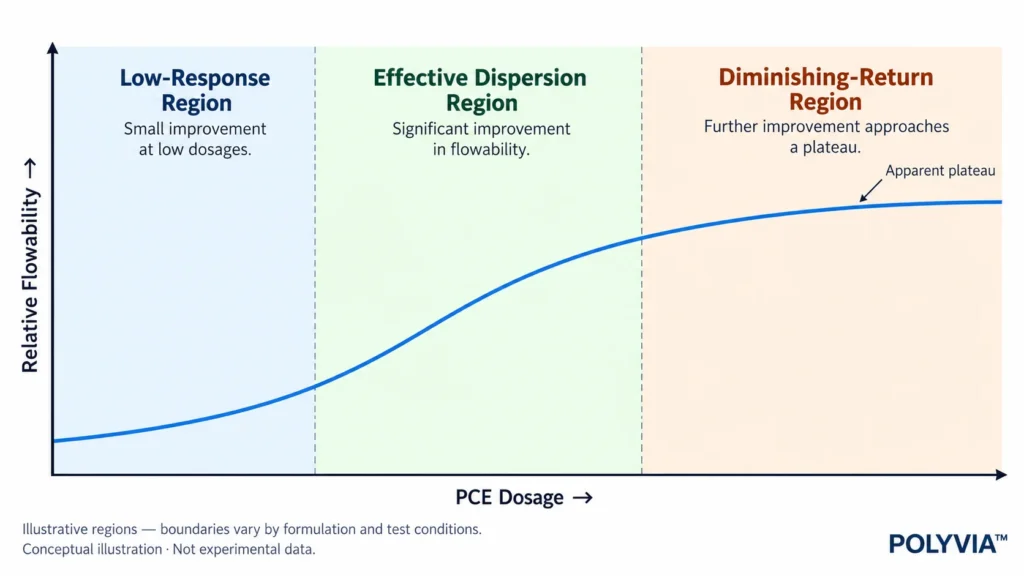
A conceptual dosage–response relationship may include three regions.
1. Low-Response Region
At relatively low PCE dosages, the measured flow or rheological response may change only slightly.
In some systems, a more pronounced effect begins after the dosage reaches a certain level.
This is sometimes discussed as a critical dosage, although the exact threshold depends on the selected measurement and testing conditions.
Not all cement–PCE combinations exhibit a clearly distinguishable low-response region.
2. Effective Dispersion Region
Within an effective dispersion region, additional PCE may produce a meaningful improvement in the measured response.
For example, cement paste flow spread may increase substantially as dosage increases.
The magnitude of the response depends on polymer characteristics, cementitious materials, water content and mixing conditions.
This region is often important for identifying suitable dosage candidates.
3. Diminishing-Return Region
At higher dosages, additional PCE may produce progressively smaller improvements.
The measured response may approach a plateau or continue changing more gradually.
This region is often associated with the concept of apparent saturation.
However, it should not automatically be interpreted as a precisely defined saturation point.
4. Is Every PCE Dosage–Response Curve S-Shaped?
No.
An S-shaped relationship has been described in research on superplasticizer dosage and cement paste rheology [1].
However, the actual curve shape depends on the polymer, cementitious materials, measurement method and testing conditions.
A curve based on cement paste flow spread may differ from one based on yield stress.
Therefore, a conceptual S-shaped diagram is useful for technical explanation but should not be regarded as a universal performance model for every PCE formulation.
5. What Can Engineers Learn from the Curve?
A dosage–response curve helps engineers answer three questions:
- At which dosage does a meaningful performance response begin?
- Over which range does additional PCE provide substantial improvement?
- At what stage do further additions become less effective?
These observations help establish candidate dosage ranges for further evaluation.
They do not independently determine the optimum dosage for concrete production.
What Is the PCE Saturation Point?
The PCE saturation point commonly refers to a dosage beyond which further superplasticizer addition produces little additional improvement in a specified laboratory measurement.
However, the term saturation should be interpreted carefully because it may refer to different physical or experimental phenomena.
1. Flow-Based Saturation
Flow-based saturation is identified from a measured dosage–response relationship.
For example, increasing PCE dosage may initially produce substantial changes in cement paste spread, followed by smaller improvements at higher dosages.
The beginning of this diminishing-return region may be described as an apparent flow saturation dosage.
Its interpretation depends on the selected dosage increments, measurement sensitivity and experimental repeatability.
Two neighboring results showing similar flow spread are not sufficient, by themselves, to establish a reliable saturation point.
2. Adsorption Saturation
Adsorption saturation concerns interactions between PCE molecules and available cementitious surfaces.
It is different from flow-based saturation.
The cementitious system continues to evolve during hydration, while pore solution chemistry and surface characteristics can affect polymer adsorption.
Consequently, a flow plateau does not prove that all available particle surfaces are fully covered by PCE.
3. Why Saturation May Be a Region Rather Than an Exact Point
Experimental measurements have inherent variability.
When several adjacent dosage levels produce similar responses, the apparent saturation behavior may be better described as a region rather than one exact percentage.
If a numerical saturation dosage is reported, the evaluation criterion should be clearly defined.
This helps prevent false precision when the experimental data do not support an exact threshold.
4. Why Saturation Depends on the Test System
An apparent saturation dosage may change when any of the following changes:
- Cement source or binder composition.
- Water-to-binder ratio.
- PCE formulation.
- Mixing procedure.
- Temperature.
- Measurement timing.
- Selected test method.
Therefore, a saturation dosage determined for one cement paste formulation cannot automatically be transferred to another concrete system.
A reported PCE saturation dosage is meaningful only when its materials, dosage basis, test method and evaluation conditions are understood.
Saturation Dosage vs. Practical Optimum Dosage
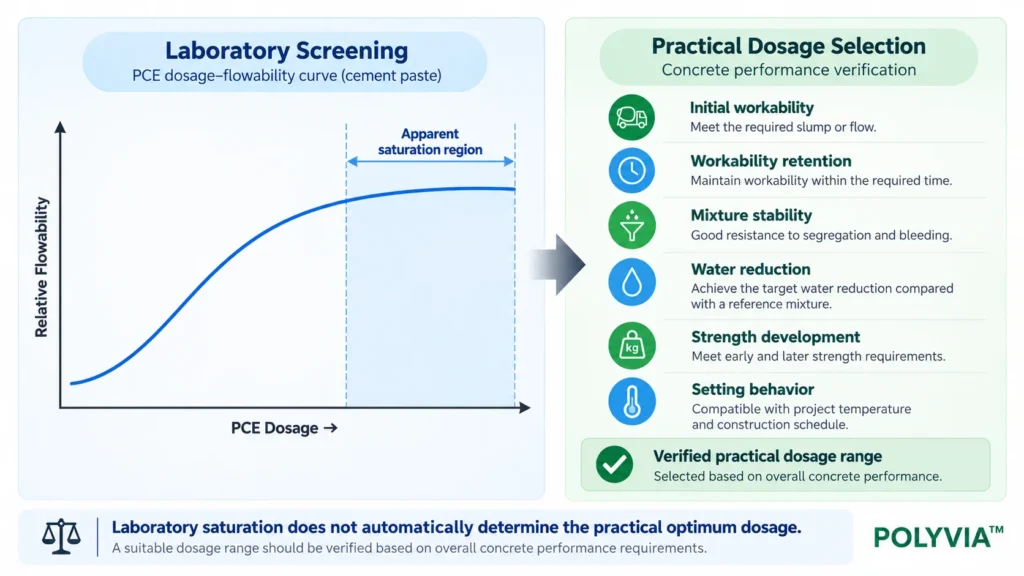
Saturation dosage and practical optimum dosage are related concepts, but they answer different technical questions.
Saturation dosage: At what dosage does a selected laboratory response begin to show diminishing improvement?
Practical optimum dosage: What dosage meets the complete performance requirements of the intended concrete formulation?
These answers are not necessarily identical.
1. A Performance Target May Be Achieved Before Saturation
A cement paste may achieve its specified initial flow before the dosage–response curve enters a diminishing-return region.
In such cases, increasing dosage toward apparent saturation may provide unnecessary additional flowability.
The lower dosage may be a suitable candidate if subsequent concrete testing confirms acceptable workability retention, mixture stability and other required properties.
2. Maximum Flow Does Not Guarantee the Best Concrete
Flowability is only one aspect of concrete performance.
An admixture dosage that produces high paste flow does not necessarily provide adequate segregation resistance or acceptable time-dependent workability.
Research on PCE dosage optimization for self-compacting concrete has highlighted the limitations of relying solely on conventional paste flow or Marsh Cone tests when evaluating stability at higher admixture dosages [2].
This illustrates why a paste-based saturation result should be used as a screening indicator rather than a complete concrete dosage recommendation.
3. What If Initial Workability Is Good but Slump Retention Is Poor?
Increasing the dosage of the existing PCE may not be the most effective solution.
The engineer should evaluate the polymer's retention characteristics, cement compatibility, temperature, mixing conditions and the complete mixture design.
A different PCE formulation or an adjusted admixture strategy may provide a more suitable performance balance.
The final decision should be supported by controlled testing.
4. Three Dosage Concepts That Must Be Distinguished
| Concept | Technical Meaning | Main Limitation |
|---|---|---|
| Reference Dosage Range | A starting range for product use or formulation trials | Not necessarily optimum |
| Apparent Saturation Dosage | A dosage or region where a selected laboratory response begins to level off | Depends on the test and evaluation criterion |
| Practical Optimum Dosage | A dosage or operating range satisfying the complete performance requirements | Requires representative concrete verification |
The practical optimum should be selected through performance evaluation, not inferred from a single laboratory flow plateau.
Why PCE Dosage Demand Changes Between Cementitious Systems
PCE dosage demand depends on interactions among polymer chemistry, cementitious materials, water content and production conditions.
This explains why one fixed dosage percentage cannot reliably represent every concrete application.
1. Cement Mineralogy and Fineness
Cement mineralogy, fineness and early hydration behavior affect the environment in which PCE interacts with cementitious particles.
Different cement sources may therefore produce different dosage–response relationships, even when the same PCE grade and nominal water-to-binder ratio are used.
Greater fineness may increase surface-related dispersant demand in some systems, but the relationship is not necessarily proportional.
2. Sulfate Balance and Pore Solution Chemistry
Sulfate availability and dissolved ionic species can influence PCE adsorption and dispersion.
These effects depend on both cement and polymer chemistry.
The relationship between PCE molecular structure and performance in cement-based materials has been extensively examined in the scientific literature [3].
3. Supplementary Cementitious Materials
Fly ash, ground granulated blast-furnace slag, silica fume and other supplementary cementitious materials may change particle packing, surface characteristics, adsorption behavior and rheology.
Their influence varies with material source and composition.
For example, certain fly ashes containing adsorptive carbon may increase admixture demand or affect air-related performance.
However, the presence of a particular supplementary cementitious material does not imply a universal increase or decrease in PCE dosage.
4. Water-to-Binder Ratio
Water-to-binder ratio influences particle concentration and the rheological behavior of cementitious mixtures.
At low water content, the balance among dispersion, viscosity and mixture stability may become particularly important.
Changing the water-to-binder ratio can therefore alter the useful PCE dosage range.
5. PCE Molecular Architecture and Formulation
Different PCE formulations may exhibit different initial dispersing efficiency, dosage sensitivity and workability-retention behavior.
Two products used at the same as-supplied dosage may not contain the same amount of active polymer.
Even when active-polymer dosages are comparable, differences in molecular architecture may produce different performance.
6. Temperature and Mixing Conditions
Temperature, mixing sequence, mixing intensity and elapsed time after water contact can affect the measured response.
For meaningful comparisons, these conditions should be controlled or documented.
7. Why Application Type Alone Cannot Define Dosage
Ready-mix concrete, precast concrete, high-performance concrete and other applications may have different performance requirements.
However, the application name alone does not determine the amount of PCE required.
The practical dosage depends on the actual materials, formulation, selected polymer and required performance.
Dosage optimization should therefore be based on a representative cementitious system rather than a universal application-specific dosage table.
How to Determine an Appropriate PCE Dosage
A reliable dosage optimization program should progress from preliminary laboratory screening to representative concrete verification.
The purpose is to establish how the selected PCE performs within the intended materials and identify a dosage range that satisfies the required performance criteria.
Step 1 — Define the Testing Objective
Determine the property the experiment is intended to evaluate.
Possible objectives include:
- Initial dispersion at fixed water content.
- Apparent saturation behavior.
- Dosage required to achieve a target consistency.
- Workability retention at specified intervals.
- Concrete water reduction under controlled comparison conditions.
These objectives should not be treated as interchangeable.
A fixed-water cement paste flow test evaluates dispersion under the selected conditions. It does not directly establish the water-reduction percentage of concrete.
Step 2 — Establish a Clear Dosage Basis
For dosage calculated using supplied-product mass:
PCE Dosage (%) = (Mass of Supplied PCE Product / Mass of Total Cementitious Materials) × 100
If a cement-only denominator or an active-polymer basis is used, it must be stated explicitly.
For liquid admixtures, the water contained in the supplied solution must be accounted for when maintaining constant effective water content.
Step 3 — Establish a Multi-Point Dosage Series
Select several dosage levels based on reliable product reference information and preliminary screening.
The range should be sufficiently broad to reveal the relevant performance response.
If the measured response begins to level off, additional points near that region may help determine whether the apparent plateau is reproducible.
No universal dosage increment is appropriate for every PCE formulation.
Step 4 — Control Materials and Testing Conditions
For a fixed-water initial dispersion series, maintain consistent experimental conditions.
| Test Parameter | Control Requirement |
|---|---|
| Cementitious materials | Same source, composition and mass |
| Effective water content | Held constant |
| PCE formulation | Identified grade and dosage basis |
| Mixing procedure | Same equipment, sequence and duration |
| Temperature | Controlled or recorded |
| Measurement timing | Same elapsed time after water contact |
| Test method | Consistent apparatus and procedure |
| Repeatability | Appropriate repeat measurements |
When liquid PCE dosage changes, account for the solution water so that differences in effective water content are not mistaken for changes in dispersing efficiency.
Step 5 — Measure and Plot the Response
Measure the selected performance property at each dosage.
For a cement paste spread test:
X-axis: PCE dosage on the defined mass basis.
Y-axis: Measured flow spread.
The plotted points should represent actual measurements.
A fitted or connecting curve should not imply greater precision than the experimental data support.
Examine how much additional improvement is produced by each successive dosage increment.
Step 6 — Identify the Diminishing-Return Region
Where additional PCE produces progressively smaller changes, the system may be approaching an apparent saturation region.
However, similar results at neighboring dosages may reflect measurement variability.
Repeatability and test sensitivity should therefore be considered before identifying a saturation region.
If an exact numerical saturation dosage is reported, the criterion used to define it should be documented.
Step 7 — Select Candidate Dosages
Identify the tested dosages that meet the required initial performance.
The lowest dosage meeting the initial target may be a useful candidate, but it is not automatically the final optimum.
Other requirements, including workability retention and mixture stability, must also be evaluated.
Step 8 — Verify Performance in Concrete
Shortlisted dosages should be evaluated using the intended concrete materials.
Depending on the application, verification may include:
- Initial slump or slump flow.
- Workability retention over the required period.
- Concrete water reduction.
- Segregation and bleeding resistance.
- Air content.
- Setting behavior.
- Strength development.
When evaluating concrete water reduction, compare an appropriate reference concrete mixture and an admixture-containing concrete mixture at a comparable target consistency, with relevant mixture and testing conditions controlled.
For a properly defined comparison:
Water Reduction (%) = [(Reference Mixing Water − Admixture Mixing Water) / Reference Mixing Water] × 100
Both water quantities must refer to equivalent concrete quantities and include the relevant mixing-water contributions, including water introduced by liquid admixtures.
A cement paste spread result alone cannot establish a concrete water-reduction percentage.
ASTM C494/C494M provides a relevant framework for evaluating chemical admixtures for concrete [4].
However, PCE performance categories, reference dosage ranges or cement paste results do not independently establish compliance with a particular ASTM admixture classification.
Step 9 — Confirm Production Suitability
The selected dosage should be verified under representative production conditions where appropriate.
Changes in cementitious material sources, aggregate moisture, temperature or batching procedures may influence performance.
The final recommendation may be expressed as a verified operating range rather than one exact dosage when that better reflects production variability.
How to Interpret Common Trial Results
| Observation | Practical Interpretation |
|---|---|
| Flow improves strongly with additional PCE | The system remains responsive to additional dosage |
| Flow improvement becomes small | Investigate a possible diminishing-return region |
| Required flow is achieved before saturation | Evaluate lower dosage candidates against complete requirements |
| Greater flow is accompanied by segregation | Review mixture stability and formulation |
| Initial flow is acceptable but retention fails | Investigate retention characteristics and cement compatibility |
| Paste testing is satisfactory but concrete performance is not | Reassess the complete concrete formulation |
The outcome of dosage optimization should be a reproducible performance decision—not simply the highest flow spread measured in the laboratory.
PCE Powder, Flake and Liquid: Understanding Dosage Basis
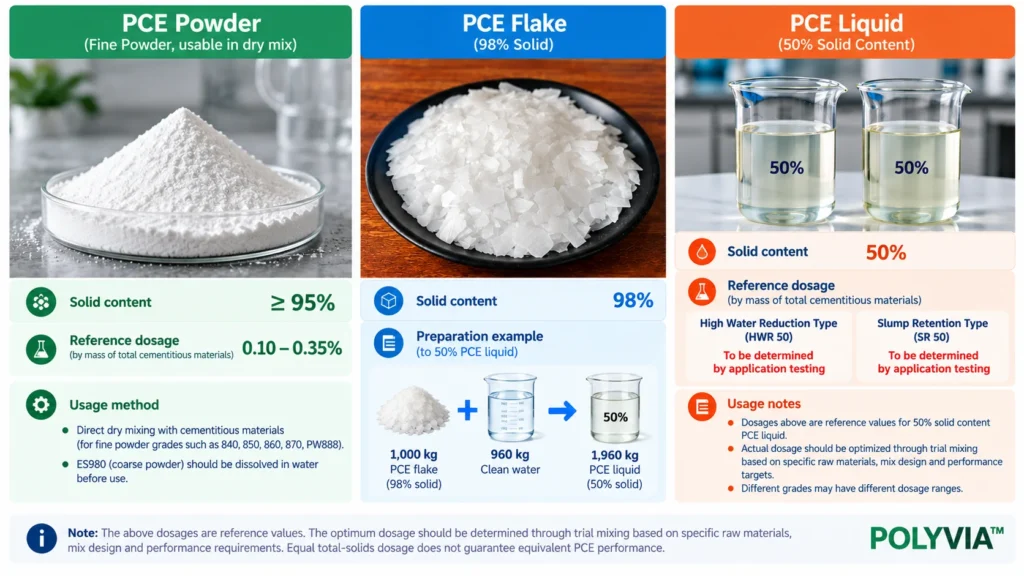
PCE superplasticizers may be supplied as powder, flake or liquid.
The supply form affects handling, solution preparation and dosage reporting, but it does not independently determine saturation behavior.
A meaningful comparison should distinguish three quantities:
- As-supplied product mass: The mass of the product in its delivered form.
- Total-solids mass: The mass of nonvolatile material contained in that product.
- Active-polymer mass: The mass of active PCE polymer, where its concentration is known.
These quantities are not necessarily interchangeable.
1. PCE Powder: POLYVIA™ Laboratory Reference
Based on POLYVIA™ laboratory evaluations, a reference dosage range of 0.10–0.35% relative to the total mass of cementitious materials has been used for relevant PCE powder formulations.
This range provides a practical reference for preliminary dosage screening.
It does not represent an experimentally established saturation range, a universal optimum or a guaranteed recommendation for every PCE powder grade.
When applying the reference range, the applicable product documentation or laboratory test record should be used to confirm whether admixture mass was calculated using the supplied powder or another defined basis.
The appropriate dosage must ultimately be established for the intended cementitious materials and concrete performance requirements.
2. PCE Flake: Preparing a Liquid Solution
PCE flake can be dissolved in water to prepare a liquid admixture solution at the required concentration.
The general preparation sequence is:
PCE Flake → Dissolution in Water → Prepared PCE Solution → Dosage Evaluation
For a solution prepared using only flake and added water, assuming no material losses:
Prepared Solution Mass = Flake Mass × Flake Total-Solids Fraction ÷ Target Solution Total-Solids Fraction
Added Water Mass = Prepared Solution Mass − Flake Mass
Both solids fractions must be expressed consistently.
The actual flake solids content should be obtained from reliable product specifications or measurements rather than assumed to be 100%.
After appropriate dissolution and concentration verification, the prepared solution can be handled and dosed as a liquid admixture, subject to its stability and application requirements.
However, a flake-derived solution should not automatically be regarded as chemically or functionally equivalent to a separately manufactured commercial liquid PCE grade, even when their nominal solids contents are identical.
3. Liquid PCE: As-Supplied Dosage and Total-Solids Dosage
Liquid PCE products contain water as part of the supplied formulation.
Consequently, the supplied-product dosage is not necessarily equal to the amount of nonvolatile material introduced into the mixture.
When both dosages use the same cementitious-material denominator:
Total-Solids Dosage (%) = As-Supplied Liquid Dosage (%) × Total-Solids Mass Fraction
Consider the following hypothetical calculation:
| Illustrative Solution | Total Solids | As-Supplied Dosage | Calculated Total-Solids Dosage |
|---|---|---|---|
| Solution A | 40% | 0.50% | 0.20% |
| Solution B | 50% | 0.40% | 0.20% |
Illustrative mass-balance calculation only. These figures are not POLYVIA™ recommended liquid dosages or experimental performance results.
Both examples provide the same calculated total-solids dosage, but they do not necessarily introduce equivalent amounts of active polymer.
Total solids may include nonpolymeric formulation components. Therefore, an equivalent total-solids dosage should not be interpreted as an equivalent active-polymer dosage or guaranteed equivalent performance.
4. Why Equal Solids Content Does Not Guarantee Equal Performance
Even when two PCE formulations contain the same total solids, their polymer structures and formulation constituents may differ.
These differences can influence:
- Initial dispersing efficiency.
- Dosage sensitivity.
- Workability retention.
- Compatibility with cementitious materials.
- Time-dependent performance.
The dosage basis must therefore be clearly defined before comparing products.
Concentration conversion can improve the consistency of material-balance calculations, but it cannot replace experimental performance evaluation.
What Happens When PCE Dosage Is Too High?
An excessive PCE dosage cannot be defined by one universal percentage.
A dosage may be excessive when additional admixture provides no necessary performance benefit or produces unacceptable performance trade-offs for the intended mixture.
1. Diminishing Improvement in Flowability
Beyond the useful response range, further PCE additions may provide only small improvements in flowability.
The additional material can increase cost without significantly improving the required performance.
However, a flow plateau alone does not prove that the mixture is chemically overdosed or unstable.
2. Bleeding and Segregation Risks
In susceptible mixtures, excessive dispersion relative to mixture stability may contribute to bleeding or segregation.
This behavior depends on aggregate grading, water content, fine-particle content, rheology and the selected admixture formulation.
Higher PCE dosage does not inevitably cause segregation, but stability should be verified rather than inferred from flowability alone.
3. Setting Behavior
PCE formulations may affect cement hydration and setting behavior under certain conditions.
The influence depends on polymer chemistry, dosage and cementitious materials.
It would be incorrect to assume that every higher PCE dosage necessarily causes significant retardation.
Setting performance should be evaluated experimentally where relevant.
4. Air Content and Fresh-Concrete Behavior
Changes in PCE dosage may affect air content and other fresh-concrete properties depending on the formulation and interactions with additional admixtures.
These properties should be evaluated together with workability when dosage is adjusted.
5. Unnecessary Material Consumption
Increasing dosage without a measurable performance benefit reduces formulation efficiency.
However, the lowest admixture dosage is not automatically the best economic choice if it causes inconsistent production or fails other performance requirements.
The objective is a technically suitable, robust formulation that meets the specified performance efficiently.
6. When Additional PCE Is Not the Right Solution
If increasing dosage produces limited improvement, the engineer should investigate other possible causes.
These may include cement compatibility, supplementary cementitious materials, water-to-binder ratio, temperature, mixing conditions and polymer formulation.
Changing the PCE grade or optimizing the overall mixture may be more effective than continuing to increase dosage.
More PCE is not always the solution to a workability problem. The underlying performance limitation must first be identified.
Key Technical Conclusions
PCE dosage optimization requires a clear distinction between reference dosage, apparent saturation and practical optimum dosage.
A dosage–response curve can reveal how a selected cementitious system responds to increasing PCE addition.
The diminishing-return region provides useful information about the efficiency of further additions, but it does not prove complete surface adsorption or establish a universal saturation dosage.
The practical optimum must be determined from the complete performance requirements of the intended concrete mixture.
Cement chemistry, supplementary cementitious materials, water-to-binder ratio, PCE formulation and testing conditions can all influence dosage demand.
Powder, flake and liquid PCE also require clearly defined dosage reporting because as-supplied product mass, total-solids mass and active-polymer mass are not necessarily equivalent.
A reliable optimization process therefore follows four principles:
- Define the required performance.
- Evaluate multiple dosages under controlled conditions.
- Identify a useful dosage response and candidate operating range.
- Verify the final selection in representative concrete trials.
Effective PCE dosage optimization is not about maximizing admixture addition or laboratory flow spread. It is about achieving the required concrete performance with a technically justified, reproducible and efficient dosage.
Frequently Asked Questions
1. What is the saturation point of PCE superplasticizer?
The PCE saturation point commonly refers to a dosage beyond which further superplasticizer addition produces little additional improvement in a specified flow or rheological measurement.
The apparent value depends on the PCE formulation, cementitious materials and testing conditions.
A flow-based saturation point does not establish complete polymer adsorption.
2. Is the saturation dosage the same as the optimum PCE dosage?
No.
Saturation dosage is associated with diminishing improvement in a selected laboratory measurement.
The optimum practical dosage must satisfy the complete concrete performance requirements, including workability retention, stability and other relevant properties.
3. How can the PCE saturation point be determined experimentally?
A common approach is to test several dosage levels under controlled conditions and plot the measured response against dosage.
The diminishing-return region can then be evaluated while considering test repeatability, dosage increments and measurement sensitivity.
4. Why does increasing PCE dosage sometimes stop improving flowability?
The measured dispersing response may approach a plateau under the selected conditions.
This does not necessarily mean that all available polymer adsorption sites are occupied.
The observed behavior depends on the cementitious system, PCE formulation and measurement method.
5. Why do different cement sources require different PCE dosages?
Cement sources may differ in mineralogy, fineness, sulfate availability and hydration behavior.
These differences can influence polymer–surface interactions and dispersion, resulting in different dosage–response relationships.
6. Can PCE powder, flake and liquid use the same dosage percentage?
Not automatically.
Dosage must be interpreted according to its mass basis and product concentration.
Flake-derived solutions and commercial liquid PCE may be handled similarly, but equal solids content does not guarantee equivalent polymer composition or performance.
7. Can excessive PCE dosage cause bleeding or segregation?
It may contribute to mixture instability in susceptible formulations.
However, the effect depends on the complete mixture, including water content, aggregate grading, fine-particle content and admixture chemistry.
Higher dosage does not inevitably cause segregation.
8. Can cement paste saturation results determine the final concrete dosage?
No.
Cement paste testing provides useful preliminary screening information, but it cannot establish the optimum dosage for the complete concrete mixture.
The final dosage should be verified using the intended materials and required concrete performance criteria.
Scientific References
[1] Rindle, O., & Gädt, T. (2023). Along the S-Curve – How Superplasticizers Affect the Yield Stress of Cement Paste. ce/papers, 6, 614–620.
https://doi.org/10.1002/cepa.2914
[2] Al-Negheimish, A. I., Fares, G., Alhozaimy, A. M., & Khan, M. I. (2018). Visual-Based Evaluation Method for Optimizing the Dosage of PCE-Based Superplasticizer for SCC Paste and Concrete Mixtures. Journal of Materials in Civil Engineering, 30(8), 04018168.
https://doi.org/10.1061/(ASCE)MT.1943-5533.0002374
[3] Sha, S., Wang, M., Shi, C., & Xiao, Y. (2020). Influence of the Structures of Polycarboxylate Superplasticizer on Its Performance in Cement-Based Materials—A Review. Construction and Building Materials, 233, 117257.
https://doi.org/10.1016/j.conbuildmat.2019.117257
[4] ASTM International. ASTM C494/C494M-24: Standard Specification for Chemical Admixtures for Concrete.