
Clay Sensitivity of PCE Superplasticizers
Understanding Clay–PCE Interactions, Dispersion Loss and Clay-Tolerant Formulation Design
Explore how clay minerals in concrete aggregates interfere with PCE dispersion and workability retention. Understand the differences between montmorillonite and kaolinite, the mechanisms behind clay sensitivity, and how clay-tolerant PCE formulations can be evaluated through controlled laboratory and concrete testing.
Why Clay Sensitivity Matters for PCE Superplasticizers
Certain clay minerals in concrete aggregates can interfere with Polycarboxylate Ether (PCE) Superplasticizers by interacting with polymer molecules and changing the rheological behavior of the cementitious system.
These interactions may reduce initial dispersion, increase PCE dosage demand and make workability retention less predictable.
The problem is particularly relevant when manufactured sand or natural aggregates contain clay-bearing fines.
However, not all fine particles are clay minerals, and not all clay minerals affect PCE in the same way.
The severity depends on mineral composition, surface characteristics, polymer architecture and the chemical environment of the mixture [1,2].
1. Clay Minerals Are Different from Ordinary Rock Fines
Manufactured sand may contain crushed-rock particles, mineral fines and clay-bearing material.
Crushed-rock fines can influence particle packing, water demand and fresh-concrete rheology without necessarily exhibiting the same polymer interactions as expandable clay minerals.
By contrast, certain clay minerals may interact strongly with PCE through surface adsorption or, in specific layered structures, interlayer incorporation.
Therefore, aggregate fines content alone cannot establish the severity of a PCE compatibility problem.
2. How Clay Sensitivity Appears in Concrete
Depending on the materials, a clay-sensitive PCE system may exhibit:
- Lower initial flowability at a fixed PCE dosage.
- Greater admixture demand to achieve a target consistency.
- Faster or less predictable workability loss.
- Increased performance variability when aggregate sources change.
These observations are not unique to clay contamination.
Changes in aggregate moisture, grading, cement chemistry or mixing conditions can produce similar symptoms.
Controlled comparison is therefore necessary before identifying clay as the principal cause.
3. The Key Technical Question
Clay sensitivity should be evaluated in relation to a defined cementitious system.
Rather than asking only whether an aggregate contains clay, the more useful question is:
How much does an identified clay mineral change PCE performance under controlled conditions?
This approach distinguishes measurable admixture performance from assumptions based on aggregate appearance or total fines content.
Montmorillonite, Kaolinite and Illite: Why Clay Mineralogy Matters
Clay sensitivity cannot be evaluated reliably from total fines content alone.
Mineralogical composition matters because different clay minerals exhibit different surface characteristics, layered structures and interactions with PCE molecules.
Among the minerals investigated in PCE compatibility research, montmorillonite is particularly important because of its expandable structure and potential for strong polymer uptake [1,2].
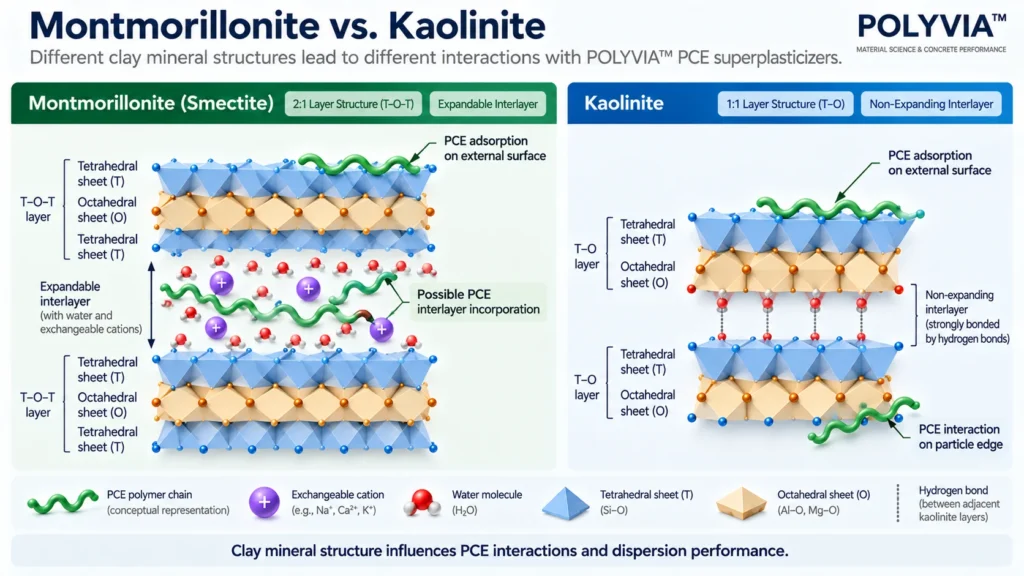
1. Montmorillonite: Expandable 2:1 Layers
Montmorillonite belongs to the smectite group and consists of a 2:1 layered structure, with an octahedral sheet positioned between two tetrahedral sheets.
The layers carry a net negative charge balanced by exchangeable interlayer cations.
Depending on the interlayer cations and chemical environment, water molecules and certain molecular species can enter the interlayer region.
This expandable structure provides additional interaction pathways for some PCE formulations.
In susceptible systems, polymer uptake by montmorillonite may reduce the amount of PCE available to support effective cement dispersion.
However, montmorillonite does not have one fixed adsorption capacity for every commercial PCE product.
Its behavior depends on mineral composition, exchangeable cations, polymer structure and solution chemistry.
2. Kaolinite: Non-Expanding 1:1 Layers
Kaolinite consists of a 1:1 layered structure containing one tetrahedral sheet and one octahedral sheet.
Hydrogen bonding between adjacent layers restricts interlayer expansion under ordinary conditions.
Compared with montmorillonite, PCE interaction with kaolinite is more commonly associated with accessible external surfaces and particle edges.
Nevertheless, kaolinite can influence polymer adsorption, particle interactions and rheological behavior.
Its presence should not be dismissed solely because it is classified as a non-expanding clay.
3. Illite: Potassium-Stabilized 2:1 Layers
Illite has a 2:1 layered structure, but interlayer potassium restricts expansion under ordinary conditions.
Its interaction with PCE therefore differs from the swelling-related behavior characteristic of expandable smectites.
However, illite-bearing particles can still influence admixture distribution and mixture rheology through accessible surface interactions.
4. Exchangeable Cations and Pore Solution Conditions
The interaction between clay minerals and PCE depends partly on the surrounding chemical environment.
Exchangeable cations may affect clay layer spacing, swelling behavior and polymer interactions.
In cementitious systems, calcium-rich alkaline pore solutions introduce additional complexity.
Observations obtained in pure water or simplified clay suspensions should therefore not automatically be transferred to cement paste or concrete.
The evaluation environment must be considered when interpreting adsorption or interlayer interaction results.
5. Comparison of Three Common Clay Minerals
| Characteristic | Montmorillonite | Kaolinite | Illite |
|---|---|---|---|
| Layer structure | 2:1 | 1:1 | 2:1 |
| Interlayer expansion | Potentially substantial | Strongly restricted | Generally restricted |
| Relevant PCE interactions | Surface uptake and possible interlayer incorporation | Accessible surface and edge interactions | Primarily accessible surface interactions |
| Important variables | Exchangeable cations, polymer architecture and pore chemistry | Surface characteristics, concentration and pore chemistry | Surface chemistry, mineral composition and mixture conditions |
| Evaluation implication | Investigate strong polymer–clay interactions | Do not assume negligible sensitivity | Verify actual response experimentally |
The table describes general mineralogical characteristics. It does not establish a universal quantitative ranking of PCE compatibility.
6. Why Equal Clay Mass Does Not Mean Equal Clay Sensitivity
Equal masses of different clay minerals may provide different accessible surface areas, adsorption characteristics and swelling behavior.
A relatively small amount of a strongly interactive clay may affect a particular PCE formulation more than a larger amount of another mineral.
Meaningful clay-sensitivity evaluation should therefore identify the mineral type and report the observed performance response rather than relying exclusively on total clay percentage.
The influence of clay on PCE performance is determined by the polymer–mineral–cement system, not by clay mass alone.
How Clay Minerals Interfere with PCE Dispersion
Clay-related PCE performance loss may result from several interacting mechanisms.
The most important are competitive polymer adsorption, possible interlayer incorporation and changes in the water-related rheological behavior of the cementitious suspension.
These mechanisms must be distinguished because they cannot all be identified from a single flow test.
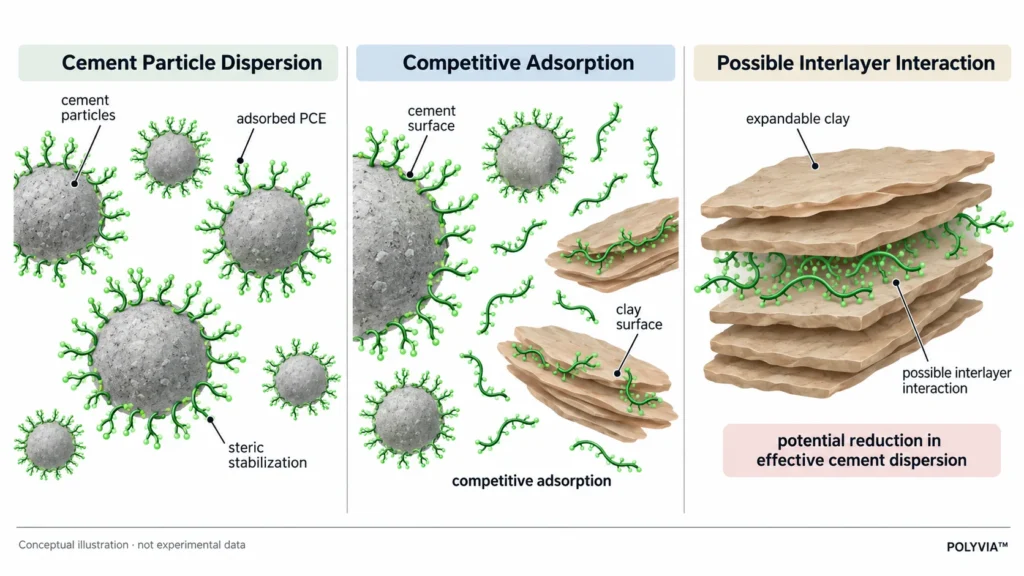
1. Competitive Adsorption and Polymer Distribution
PCE molecules interact with cementitious surfaces to support particle dispersion.
When clay-bearing particles are present, some polymer may become associated with clay surfaces.
This can alter the distribution of polymer among cementitious particles, clay particles and the surrounding solution.
In susceptible systems, the change may reduce effective cement dispersion at a fixed PCE dosage.
However, polymer uptake depends on surface chemistry, polymer characteristics and the solution environment.
A loss of flowability is consistent with reduced dispersing effectiveness, but it does not directly quantify how much PCE has been adsorbed by clay.
2. Interlayer Incorporation in Expandable Clays
Certain PCE formulations may interact with the interlayer regions of expandable clay minerals such as montmorillonite.
This process is commonly described as polymer intercalation.
Unlike adsorption limited to accessible external surfaces, interlayer incorporation involves interactions within the layered mineral structure.
Depending on polymer architecture and clay chemistry, such interactions may contribute to substantial polymer uptake that does not provide the intended cement dispersion.
However, intercalation should not be assumed to occur equally for all PCE structures.
Experimental evidence is needed when using this mechanism to explain the behavior of a specific formulation [1–3].
3. Clay-Related Changes in Water Distribution and Rheology
Clay minerals may influence cementitious suspension behavior through water interactions, swelling and particle networking.
These effects can change the apparent flow response independently of, or together with, PCE adsorption.
For example, adding a swelling clay may alter the mixture's rheological behavior while simultaneously affecting polymer availability.
Consequently, workability loss may involve several mechanisms acting together.
4. What Different Measurements Can Reveal
| Measurement | What It Can Help Establish | What It Cannot Establish Alone |
|---|---|---|
| Flow spread | Changes in fresh-state flowability | Polymer adsorption mechanism |
| Rheological testing | Changes in measured rheological properties | Complete molecular explanation |
| Polymer uptake measurement | Changes in polymer distribution or uptake | Exact location of all polymer molecules |
| X-ray diffraction, where appropriate | Changes in layered mineral structure or interlayer spacing | Concrete performance improvement |
| Concrete testing | Practical performance under selected conditions | A unique molecular cause |
Different analytical methods may be required depending on whether the objective is performance screening or mechanism identification.
5. The Practical Interpretation
For most application evaluations, the immediate objective is to determine whether clay reduces performance and whether a candidate PCE formulation provides a meaningful improvement.
Detailed molecular analysis can help explain results, but it does not replace controlled concrete testing.
A scientifically sound conclusion distinguishes observed performance loss from the proposed mechanism responsible for that loss.
How Clay Sensitivity Affects Concrete Performance
Clay sensitivity can influence both the initial response to PCE and the evolution of workability after mixing.
These effects should be evaluated separately because good initial flow does not guarantee acceptable workability retention.
1. Initial Flowability
At a fixed effective water content and PCE dosage, introducing an interactive clay mineral may reduce cement paste, mortar or concrete flowability.
The magnitude depends on the mineral, polymer and complete mixture composition.
A fixed-dosage comparison helps evaluate initial sensitivity.
2. Increased Dosage Demand
A clay-containing mixture may require additional PCE to reach the same target consistency as a reference mixture.
The dosage required to recover a common target flow is a useful performance indicator.
However, increased dosage demand does not by itself identify the dominant clay–PCE interaction mechanism.
3. Workability Retention
Clay-bearing materials may affect the evolution of workability after mixing.
A formulation can meet its initial consistency requirement yet show inadequate retained workability after a specified holding period.
Clay-tolerant performance should therefore not be judged from initial flow alone.
4. Mixture Stability
Adjustments intended to restore flowability can change the overall rheological balance of concrete.
Bleeding, segregation resistance and air content should be examined where relevant.
A mixture is not successfully optimized simply because its initial slump or spread has increased.
5. Avoiding Misdiagnosis
When comparing aggregate sources, account for differences in moisture condition, particle grading, shape and fines content.
Changing several variables simultaneously makes it difficult to isolate the influence of clay mineralogy.
The most useful evaluation compares defined systems under consistent conditions and reports both initial and retained performance.
A decrease in workability may reveal a compatibility problem, but controlled testing is required before attributing that problem specifically to clay.
How Clay-Tolerant PCE Formulations Are Designed
Clay-tolerant PCE formulations aim to maintain effective cementitious particle dispersion while limiting undesirable interactions with clay minerals.
Research has investigated different molecular architectures and supplementary formulation approaches, but no single design can be assumed to provide the best performance across all clay-bearing systems [1,3].
1. Polymer Architecture and Adsorption Selectivity
PCE performance depends partly on the relationship between polymer architecture and interactions with mineral surfaces.
Changes in backbone composition, adsorption-related groups and side-chain structure may alter polymer uptake and dispersing behavior.
A formulation intended to reduce clay sensitivity must still maintain sufficient interaction with cementitious particles to provide useful dispersion.
Reducing undesirable clay adsorption is therefore only one part of the optimization objective.
2. Side Chains: Dispersion Benefits and Clay Interactions
PCE side chains contribute to steric stabilization when the polymer interacts appropriately with cementitious surfaces.
However, certain side-chain structures may also interact with the interlayer regions of expandable clay minerals.
This creates a molecular design trade-off.
A structural change that reduces unfavorable clay interactions may also influence initial dispersion, workability retention or other formulation characteristics.
Therefore, increasing side-chain length or grafting density should not automatically be interpreted as an improvement in clay resistance.
3. Sacrificial Agents and Additional Formulation Components
Some approaches use components intended to interact preferentially with clay or reduce interference with the primary PCE.
These are commonly discussed as sacrificial agents or clay-mitigation components.
Their effect depends on the materials and mixture environment.
Potential benefits must be evaluated against additional dosage demand, compatibility and overall concrete performance.
4. Clay Resistance and Slump Retention Are Different Objectives
Clay resistance concerns the performance of a PCE formulation in the presence of defined clay-bearing materials.
Slump retention concerns maintaining the required workability over a specified period.
A formulation may be designed to address both, as reflected in the performance positioning of POLYVIA™ PCE CSR.
However, neither property can be established solely from the product's nominal solids content, pH or density.
5. What Constitutes Demonstrated Clay Tolerance?
Useful evidence may include:
- Smaller initial flow loss after defined clay addition.
- Lower additional PCE dosage demand at a common target consistency.
- Improved retained workability after matching initial flow.
- Acceptable mixture stability and concrete performance.
Each performance claim should identify the reference system, comparison basis and testing conditions.
The objective of clay-tolerant formulation is not simply to reduce polymer–clay interaction in isolation, but to maintain the required concrete performance under representative clay-containing conditions.
POLYVIA™ PCE CSR: Clay Resistance & Slump Retention
POLYVIA™ PCE CSR is a liquid polycarboxylate superplasticizer grade intended for concrete formulations involving clay-bearing aggregates and workability-retention requirements.
Relevant application contexts include manufactured-sand concrete and ready-mix production.
1. Product Identity
| Item | Product Information |
|---|---|
| Product Grade | POLYVIA™ PCE CSR |
| Performance Type | Clay Resistance & Slump Retention |
| Supply Form | Liquid |
| Nominal Solids Options | 40% / 50% |
| Application Context | Manufactured sand, clay-bearing aggregates and ready-mix concrete |
2. Declared Technical Specifications
The available POLYVIA™ product information lists the following characteristics:
| Parameter | Declared Value |
|---|---|
| Solid Content | 40 ± 1% / 50 ± 1% |
| Appearance | Colorless to light yellow liquid |
| pH at 25°C | 4.0 ± 1.0 |
| Density at 25°C | 1.10 ± 0.02 g/cm³ |
| Chloride Content | ≤0.02% |
These values reproduce the available product specifications. Grade- and concentration-specific limits should be confirmed against the applicable technical data sheet and test reports. They do not independently quantify clay-resistance or slump-retention performance.
3. How CSR Should Be Evaluated
For concrete containing clay-bearing aggregates, a CSR candidate can be evaluated alongside a suitable reference PCE formulation.
The comparison should consider both initial consistency and workability retention.
Where required, dosage demand, mixture stability, setting behavior and strength development should also be verified.
The tested clay characteristics and cementitious materials should be representative of the actual application.
4. Product Claims and Evidence Boundaries
The CSR designation identifies a formulation intended to address clay-related interference and workability retention.
It does not independently establish a numerical improvement over another PCE grade.
Without product-specific controlled comparisons, no universal reduction in polymer adsorption, increase in clay tolerance or extension in slump-retention time is claimed here.
Likewise, nominal solids content should not be used alone to predict dosage efficiency or concrete performance.
5. Product Selection Considerations
The appropriate CSR grade and solids concentration should be selected according to the actual formulation requirements and handling conditions.
Where commercial liquid PCE grades with different solids contents are compared, supplied-product dosage, total-solids dosage and active-polymer dosage should be distinguished.
Equal total-solids content does not guarantee equivalent polymer composition or concrete performance.
For available PCE formulations and technical information, refer to the POLYVIA™ PCE product portfolio.
How to Evaluate PCE Clay Sensitivity: Testing Methods and Performance Indicators
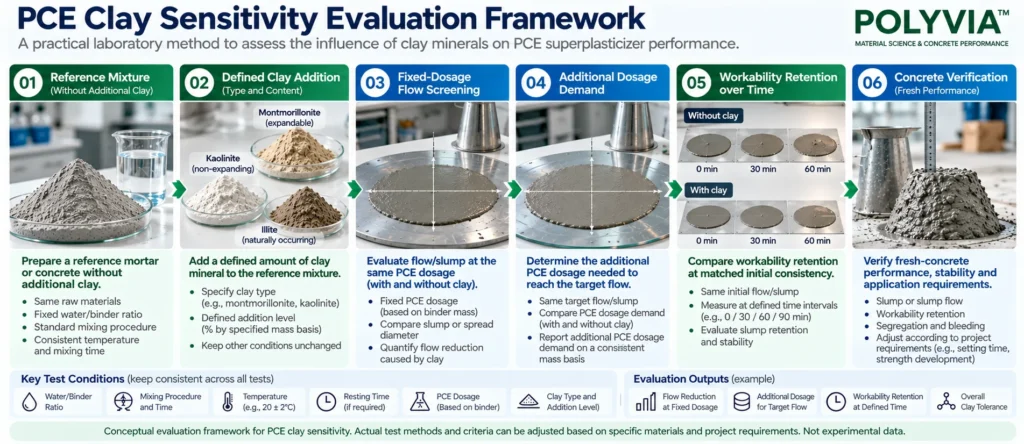
A reliable clay-sensitivity evaluation should use controlled comparisons rather than relying on isolated flow measurements or general descriptions of aggregate quality.
The testing program should distinguish three questions:
- How much does defined clay addition change initial flowability at a fixed PCE dosage?
- How much additional PCE is required to recover a common target consistency?
- How well does the selected formulation retain workability under the required conditions?
These questions provide complementary information and should not be interpreted as interchangeable measurements.
1. Establish a Controlled Reference System
Select representative cementitious materials, a clearly identified PCE formulation and defined mixing conditions.
Where appropriate, prepare a reference mixture without intentional clay addition.
Maintain consistent effective water content, temperature, mixing procedure and measurement timing.
When testing liquid PCE products, account for water introduced by the admixture solution.
2. Characterize the Clay Material
Record the clay mineral type where known, or provide available characterization information for the clay-bearing aggregate.
Define the clay addition level and its denominator.
For example, clay content expressed as a percentage of sand mass should not be compared directly with clay content expressed as a percentage of total cementitious material mass.
Where different aggregate sources are compared, consider differences in grading, particle shape and moisture condition.
3. Indicator 1 — Relative Flow Ratio at Fixed PCE Dosage
A fixed-dosage comparison examines the effect of clay addition while holding PCE dosage and effective water content constant.
For a specified flow measurement, a simple relative comparison can be defined as:
Relative Flow Ratio (%) = (Flow Spread with Clay / Reference Flow Spread) × 100
Both measurements must be obtained using the same test method, reporting basis and measurement time.
A lower ratio indicates a smaller measured spread relative to the reference under the specified conditions.
However, flow spread is not linearly proportional to dispersing efficiency.
This ratio is an operational comparison index, not a standardized clay-resistance percentage or a direct measurement of PCE adsorption.
It should not be used to compare unrelated methods or different mixture systems without appropriate justification.
4. Indicator 2 — Additional Dosage Demand at a Common Target Flow
A second experimental series determines the PCE dosage needed to achieve the same target consistency in the reference and clay-containing systems.
Define:
Additional PCE Dosage Demand = Dosage Required with Clay − Dosage Required without Clay
The dosage values must use the same mass basis.
If dosage is expressed as a percentage of total cementitious materials, the difference should be reported in percentage points.
This indicator describes the additional dosage required under defined conditions.
It does not establish the mechanism responsible for the change.
5. Indicator 3 — Workability Retention at a Defined Time
Where workability retention matters, compare selected formulations after a specified holding period.
For a fair comparison, candidate mixtures may first be adjusted to achieve a common initial target consistency.
Flow or slump can then be measured at relevant elapsed times using a consistent procedure.
The test report should include:
- Initial measured consistency.
- Elapsed time after mixing.
- Consistency at the specified later time.
- PCE dosage and dosage basis.
- Test temperature and relevant mixing conditions.
Where a percentage retention metric is used, its mathematical definition and limitations should be stated.
A ratio of later-to-initial spread should not be interpreted as a direct percentage of polymer activity remaining.
6. Recommended Test Matrix
| Test Series | Experimental Condition | Main Output |
|---|---|---|
| A | Reference mixture, fixed PCE dosage | Baseline initial flow |
| B | Defined clay addition, fixed PCE dosage | Relative flow response |
| C | Reference and clay systems at common target flow | Additional dosage demand |
| D | Candidate PCE formulations matched for initial consistency | Workability retention |
| E | Representative concrete mixture | Stability and application performance |
This is a proposed comparison framework, not a report of POLYVIA™ experimental results.
7. Interpreting Common Results
| Observation | What It May Indicate | What It Does Not Prove |
|---|---|---|
| Initial spread decreases after clay addition | Sensitivity to the tested clay-containing system | Interlayer incorporation is the sole cause |
| More PCE is needed to reach target flow | Increased dosage demand | Universal incompatibility of the PCE grade |
| Equal initial flow but different later consistency | Different retention behavior | A unique molecular mechanism |
| Equal total-solids dosage gives different performance | Different formulation response | Equal active-polymer concentration |
| Paste tests are satisfactory but concrete performance is not | Preliminary testing is insufficient | The product has no clay tolerance |
8. Comparing POLYVIA™ PCE CSR with a Reference PCE
Where controlled comparison data are available, POLYVIA™ PCE CSR can be evaluated alongside a suitable reference PCE formulation.
The comparison should clearly identify the respective product concentrations and dosage bases.
At a minimum, a useful evaluation should include the effect of defined clay addition on initial flow and retained workability.
Where practical, dosage demand at a common target consistency should also be examined.
No numerical superiority should be claimed unless supported by actual measurements.
9. Verify Results in Representative Concrete
Cement paste and mortar tests can help identify sensitivity trends, but final product selection should be confirmed in concrete.
Verification should use representative aggregates, cementitious materials and mixing conditions.
Important properties may include initial consistency, retained workability, mixture stability, air content, setting behavior and strength development, according to the application requirements.
10. Minimum Reporting Requirements
A technically useful clay-tolerance report should identify:
| Reporting Item | Required Information |
|---|---|
| PCE | Grade, supply form and solids or active-polymer basis where known |
| Clay | Mineral identity or characterization, addition level and mass basis |
| Cementitious materials | Relevant binder composition and source |
| Water | Effective water content or water-to-binder ratio |
| Test method | Procedure, apparatus and measurement definition |
| Test timing | Time after mixing and applicable retention intervals |
| Results | Actual measurements, units and repeatability information |
| Conclusion | Performance interpretation and limits of applicability |
A reliable clay-tolerance claim should be supported by repeatable performance results under documented conditions, not by a universal percentage inferred from a product description.
Key Technical Conclusions
Clay sensitivity arises from interactions among PCE molecules, clay minerals and the cementitious environment.
Montmorillonite is particularly important because its expandable layered structure can support strong polymer uptake, including possible interlayer incorporation.
Kaolinite and illite have different structural characteristics but can still influence adsorption and fresh-state behavior.
Clay-related performance loss may involve competitive adsorption, interlayer interactions and changes in water distribution or rheology.
Clay-tolerant PCE design can reduce undesirable interactions under particular conditions, but its effectiveness must be demonstrated through suitable testing.
POLYVIA™ PCE CSR is positioned for clay-bearing aggregate systems where both dispersion and workability retention matter. Its actual performance should be verified using representative materials.
A robust evaluation should distinguish fixed-dosage flow loss, additional dosage demand and workability retention, followed by concrete verification.
Reliable clay tolerance means maintaining the required concrete performance under defined clay-containing conditions—not simply labeling a superplasticizer as clay-resistant.
Frequently Asked Questions
1. Why are PCE superplasticizers sensitive to clay minerals?
Certain clay minerals interact with PCE through surface adsorption and, for expandable layered clays, possible interlayer incorporation. These interactions may reduce effective cement dispersion and alter fresh-concrete workability.
2. Why is montmorillonite often more problematic than kaolinite?
Montmorillonite has an expandable 2:1 layered structure that can support strong interactions with certain PCE formulations, including possible interlayer uptake. Kaolinite is comparatively non-expanding, although it can still affect adsorption and rheology.
3. Does high manufactured-sand fines content always mean poor PCE compatibility?
No. Fine particles may include relatively inert rock fines or different clay minerals. PCE sensitivity depends on mineralogy, particle characteristics and the complete cementitious system, not fines content alone.
4. How can clay sensitivity be measured experimentally?
A controlled evaluation can compare initial flow at fixed PCE dosage, additional dosage required for a common target consistency, and workability retention at defined intervals. The clay material, dosage basis and testing conditions must be documented.
5. Can increasing PCE dosage solve clay-related workability loss?
Sometimes, additional PCE can recover part of the initial flow response. However, it may increase material consumption and does not guarantee adequate retention or mixture stability. The formulation should be evaluated rather than increasing dosage automatically.
6. What is the difference between clay-resistant PCE and slump-retention PCE?
Clay resistance concerns performance in the presence of clay-bearing materials. Slump retention concerns maintaining workability over time. These are separate characteristics, although a PCE formulation may be designed to address both.
7. What does a lower relative flow ratio mean in a clay-sensitivity test?
Under a consistent test method and fixed dosage, a lower ratio of clay-containing to reference flow spread indicates a smaller measured spread. It does not directly measure the proportion of PCE adsorbed by clay or establish a universal clay-resistance rating.
8. What is POLYVIA™ PCE CSR designed for?
POLYVIA™ PCE CSR is a liquid superplasticizer grade positioned for concrete containing clay-bearing aggregates and requiring workability retention, including manufactured-sand and ready-mix systems. Its performance should be verified using representative materials and controlled application testing.
Scientific References
[1] Ma, Y., Shi, C., Lei, L., Sha, S., Zhou, B., Liu, Y., & Xiao, Y. (2020). Research Progress on Polycarboxylate Based Superplasticizers with Tolerance to Clays — A Review. Construction and Building Materials, 255, 119386.
https://doi.org/10.1016/j.conbuildmat.2020.119386
[2] Lei, L., Palacios, M., Plank, J., & Jeknavorian, A. A. (2022). Interaction Between Polycarboxylate Superplasticizers and Non-Calcined Clays and Calcined Clays: A Review. Cement and Concrete Research, 154, 106717.
https://doi.org/10.1016/j.cemconres.2022.106717
[3] Gao, Y., Liu, Y., Wang, G., Liu, J., Cao, Z., Yong, Q., & Zhao, H. (2025). Interaction Between Polycarboxylate Superplasticizer and Clay in Cement and Its Sensitivity Inhibition Mechanism: A Review. Materials, 18(11), 2662.