
RDP and Cellulose Ether in Dry-Mix Mortar
How Do They Work Together?
Explore how RDP and HPMC/MHEC interact to influence mortar rheology, adhesion, open time, and formulation compatibility.
Introduction
Redispersible polymer powder (RDP) and cellulose ether work together in dry-mix mortar by influencing different but interconnected aspects of fresh application and hardened performance. RDP contributes polymer modification, while cellulose ethers such as HPMC and MHEC/HEMC primarily control water retention and fresh-mortar rheology.
However, their combined performance cannot always be predicted from the properties of each additive alone.
A mortar formulation may contain a suitable RDP grade and still show inadequate open-time adhesion. Another formulation may provide excellent water retention but suffer from excessive stickiness, poor substrate contact, or inconsistent hardened strength.
These problems do not necessarily mean that either additive is defective.
They may indicate that the RDP–cellulose ether combination is not appropriately balanced within the complete cementitious system.
Published research has shown that the selection of cellulose ether and latex powder can strongly influence viscosity, setting, surface skinning, and adhesion in cementitious tile adhesives [1].
For manufacturers, the important question is therefore:
How can RDP and cellulose ether be selected and tested as a compatible formulation system rather than as two unrelated ingredients?
This guide introduces the POLYVIA™ Four-Stage Interaction Framework and a proposed 3 × 3 compatibility-screening method to help formulators understand additive interactions, identify performance trade-offs, and develop more reliable dry-mix mortar formulations.
Why Must RDP and Cellulose Ether Be Evaluated as a System?
RDP and cellulose ether perform different primary functions, but they share the same changing chemical and physical environment after mortar is mixed with water.
The cement begins dissolving and hydrating. Soluble polymers enter the aqueous phase, RDP particles redisperse, and mineral surfaces interact with dissolved compounds and dispersed particles.
These processes occur simultaneously.
The resulting mortar performance depends not only on the individual additives but also on their interactions with cement, fillers, mixing water, and other admixtures.
1. Different roles, interconnected effects
Table 01. Functional Comparison of RDP and Cellulose Ether
| Performance Aspect | RDP | HPMC / MHEC |
|---|---|---|
| Primary function | Polymer modification | Water retention and rheology control |
| Fresh mortar consistency | May influence workability, depending on grade | Often a major influence |
| Water retention | Grade- and formulation-dependent effects | A principal selection criterion |
| Open-time performance | May influence application and interface behavior | Important through water retention and surface behavior |
| Hardened adhesion | Can contribute through polymer modification | Influences conditions under which adhesion develops |
| Deformability | Relevant for suitable polymer grades | Not normally the principal deformation-modifying additive |
| Setting and hydration | May influence hydration behavior | May influence hydration behavior |
| Air content | Formulation-dependent | Formulation-dependent |
This comparison is useful for initial selection, but it does not mean that each property is controlled exclusively by one additive.
For example, a change in cellulose ether grade may influence the final adhesion result even when the RDP grade remains unchanged.
Similarly, replacing an RDP grade can alter fresh-mortar behavior as well as hardened performance.
2. What does research reveal about their interaction?
Petit and Wirquin investigated 11 cellulose ethers in cement-based ceramic tile adhesive formulations [1].
Their results showed that the selected cellulose ether and latex powder combination strongly influenced fresh and hardened properties.
One important mechanism identified was competitive adsorption, which affected the amount of cellulose ether remaining in the pore solution and was associated with changes in mortar viscosity, setting, and surface skinning.
The engineering implication is significant:
Two cellulose ether products with similar stated viscosity values may behave differently when combined with the same RDP and cement system.
Compatibility should therefore be evaluated in the actual mortar formulation.
3. Complementary functions are not the same as synergy
RDP and cellulose ether can provide complementary functions without demonstrating a scientifically synergistic interaction.
For example, an RDP may contribute to adhesion while a cellulose ether improves water retention.
Both effects can be useful, but their simultaneous presence does not prove that the interaction creates a greater-than-expected improvement.
A claim of synergy requires a defined response, appropriate controls, and experimental evidence.
For technical communication, compatible combination is usually the more appropriate description unless a specific synergistic effect has been demonstrated.
The POLYVIA™ Four-Stage Interaction Framework
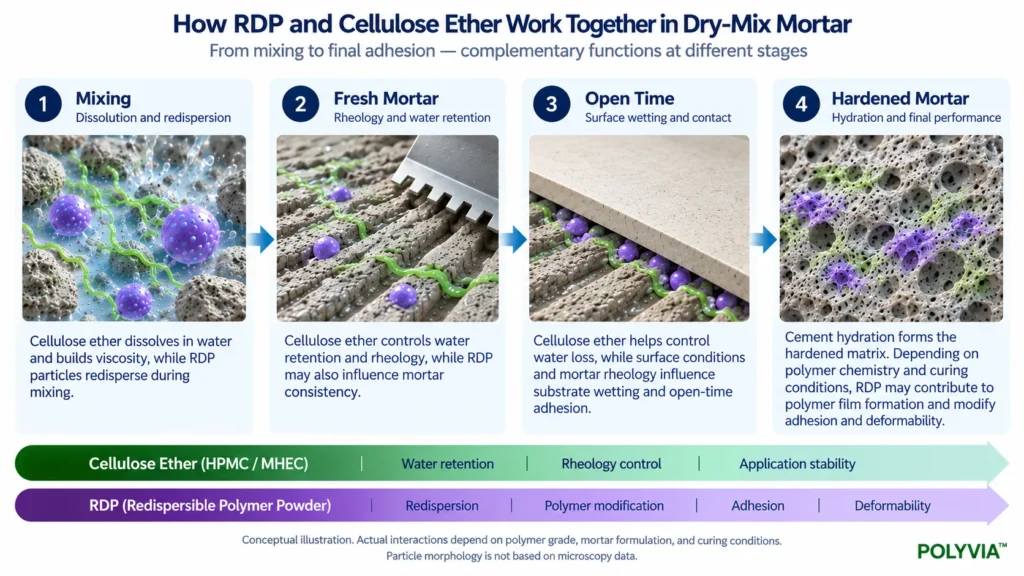
To evaluate RDP and cellulose ether systematically, POLYVIA™ proposes examining their combined effects across four stages of mortar development.
These stages are not independent chemical processes. They are practical checkpoints for identifying where a formulation may gain or lose performance.
Stage 1 — Wetting, Dissolution, and Redispersion
Water initiates the dissolution of cellulose ether and the redispersion of RDP particles.
At the same time, cement begins reacting and changes the ionic environment of the mixture.
Important variables include:
- RDP redispersion characteristics
- Cellulose ether dissolution behavior
- Mixing sequence and mixing energy
- Cement and mineral surface chemistry
- Water quantity and temperature
Engineering question: Does the mixture develop uniform and reproducible fresh-mortar characteristics under the intended preparation conditions?
Stage 2 — Rheology and Structural Development
As the mortar develops consistency, cellulose ether influences water retention and rheological behavior.
RDP may also affect consistency through its polymer composition, protective colloids, air-entrainment characteristics, and interactions with other ingredients.
A useful mortar must balance two requirements: adequate flow during application and sufficient stability after placement.
For a tile adhesive, excessive resistance to deformation can make spreading difficult. Insufficient structural stability may contribute to slip.
Engineering question: Does the mortar provide the intended balance between spreading, wetting, and application stability?
Stage 3 — Surface Exposure and Substrate Contact
After application, the exposed mortar begins losing or redistributing water.
Evaporation, substrate absorption, surface skinning, and rheological changes may influence effective contact.
This stage is especially important for tile adhesives and other thin-bed mortars.
Research has demonstrated that surface skinning before tile installation can reduce wetting and the resulting adhesive strength [3].
Engineering question: Can the mortar establish effective substrate contact after the intended exposure period?
Stage 4 — Hydration, Drying, and Hardened Performance
Cement hydration continues while water distribution and polymer morphology evolve.
Depending on polymer chemistry and curing conditions, dispersed polymer particles may coalesce and contribute to polymer-rich regions or films.
The resulting mechanical and adhesion performance depends on the complete hardened matrix and its interfaces.
Engineering question: Does the finished material satisfy the required adhesion, mechanical, and exposure-performance criteria?
1. Turning the four stages into practical verification
Table 02. POLYVIA™ Four-Stage Interaction and Verification Framework
| Stage | Main Risk | Possible Warning Sign | Suggested Evaluation |
|---|---|---|---|
| 1. Mixing and redispersion | Inconsistent material distribution | Agglomeration, inconsistent mixing response | Standardized mixing and uniformity assessment |
| 2. Rheology development | Imbalanced flow and stability | Stickiness, sagging, poor spreading | Consistency, rheology, slip where relevant |
| 3. Surface contact | Insufficient wetting after exposure | Skinning, incomplete ridge collapse | Open-time adhesion and contact observation |
| 4. Hardening | Failure to meet final requirements | Low adhesion or poor conditioned performance | Adhesion, strength, deformation, exposure testing |
These warning signs are not unique diagnoses. Several mechanisms may produce similar symptoms.
The framework helps identify which stage should be investigated first.
2. Why the limiting performance stage matters
A mortar can perform well during mixing yet fail during application or curing.
Good water retention does not automatically establish good open-time adhesion.
Likewise, strong initial adhesion does not guarantee satisfactory adhesion after water immersion.
The objective is to identify and improve the limiting performance requirement without compromising the other essential properties.
This framework is a proposed POLYVIA™ engineering approach, not a proprietary testing standard or a universally validated physical model.
How Do RDP and Cellulose Ether Influence Rheology, Water Retention, and Open Time?
Water retention, rheology, and open time are closely related, but they measure different properties.
Understanding the distinction is essential when troubleshooting polymer-modified dry-mix mortar.
1. Water retention: Controlling premature water loss
Cellulose ethers can help reduce water loss from mortar into absorbent substrates or through other moisture-transfer processes.
This is important for thin-bed applications, where the material has a high exposed surface area relative to its thickness.
Insufficient water retention may influence application behavior and the moisture conditions available for cement hydration.
However, maximum water retention is not automatically desirable.
The formulation must also maintain adequate flow, substrate wetting, and other required properties.
2. Mortar rheology: More than a viscosity number
Fresh mortar behavior includes several characteristics:
- Yield stress: resistance to the initiation of flow
- Resistance to flow under applied shear
- Structural recovery after mixing or spreading
- Resistance to sagging or slipping
- Ease of troweling and spreading
The viscosity stated on a cellulose ether technical data sheet is usually measured in a specified aqueous solution.
It is not equivalent to the rheological behavior of a complete cementitious mortar.
Differences in chemical substitution, molecular characteristics, dosage, and formulation interactions can produce different mortar responses even when two cellulose ether grades have similar solution-viscosity values.
The best cellulose ether is not necessarily the one with the highest stated viscosity.
It is the grade that helps achieve the required application behavior in the selected mortar system.
3. Why water retention does not guarantee open-time adhesion
Open time describes the exposure interval after an adhesive is spread during which tile installation can still produce the required adhesion under a defined test procedure.
It should not be confused with pot life, which concerns the usable period of the mixed material.
An adhesive may retain water internally while its exposed surface changes sufficiently to impair wetting.
Fujii-Yamagata and co-authors investigated skin formation in adhesive mortars using magnetic resonance imaging and interfacial rheology [2].
Their work showed that cellulose ether characteristics and environmental conditions influenced the development of a relatively dry surface region and the mechanical evolution of the surface layer.
Jenni and co-authors also demonstrated the importance of water migration, polymer distribution, interface development, and skinning in cementitious tile adhesive mortars [3].
These studies explain why water-retention measurements alone cannot establish open-time performance.
A mortar can remain workable in bulk while its exposed surface becomes less effective at forming a bond.
4. Surface skinning versus incomplete adhesive-ridge collapse
Two related but different mechanisms may reduce the effective tile–adhesive contact area.
Surface skinning occurs when the exposed surface develops physical characteristics that impair wetting during installation.
Incomplete ridge collapse occurs when the adhesive ridges do not deform sufficiently under tile placement to achieve the required contact.
Both mechanisms may contribute to poor open-time adhesion.
A formulation that holds combed ridges well is not necessarily capable of producing adequate tile contact after extended exposure.
Similarly, a formulation that spreads easily immediately after mixing may develop a problematic surface layer when exposed to heat or airflow.
A practical investigation should therefore assess the exposed surface, ridge deformation, substrate wetting, and resulting adhesion.
5. What should be optimized?
For tile adhesive formulations, the target should not be maximum viscosity or maximum water retention.
The target is adequate application stability, effective contact, and verified adhesion under the intended installation conditions.
This distinction is one of the most important reasons to evaluate RDP and cellulose ether as a combined system.
How Do Additive Interactions Affect Hardened Mortar Performance?
RDP and cellulose ether can influence hardened performance through different but interconnected mechanisms.
RDP contributes to polymer modification, while cellulose ether influences conditions such as water management, hydration behavior, air content, and application contact.
These effects should be evaluated at the complete-formulation level.
1. A change in adhesion does not identify a single cause
If adhesion changes after replacing an HPMC or MHEC grade, the difference does not necessarily mean that the RDP has become more or less effective in isolation.
Possible contributing factors include:
- Changes in fresh-mortar rheology
- Surface wetting or contact area
- Water transport and hydration conditions
- Entrained air
- Curing and interface development
Controlled testing and fracture observations can help identify the most plausible causes.
2. Initial and conditioned adhesion may respond differently
Initial adhesion, adhesion after water immersion, and adhesion after heat ageing represent different performance conditions.
A formulation may perform well in one condition and poorly in another.
For this reason, the effect of an RDP–cellulose ether combination should be evaluated against all relevant application requirements.
A hydrophobic RDP characteristic should not be treated as proof of waterproofing or satisfactory adhesion after water immersion.
3. Optimize the overall performance profile
The most appropriate additive combination is not necessarily the one producing the highest value in a single test.
A commercially useful formulation must provide acceptable application behavior, required hardened properties, and reproducible manufacturing performance.
POLYVIA™ Formulation Principle: Select the combination that meets the complete performance specification rather than maximizing the dosage of either additive.
Why Do the Same RDP and Cellulose Ether Grades Behave Differently in Different Mortars?
Compatibility depends on the complete mortar system.
A combination that performs well with one cement and sand source may behave differently when the mineral composition, grading, or mixing conditions change.
1. Cement chemistry and pore-solution interactions
Cement composition influences hydration and the chemical environment surrounding the additives.
Interactions involving cellulose ether, polymer powder components, dissolved ions, and cement surfaces may influence the amount of cellulose ether present in the pore solution.
This can contribute to differences in viscosity, setting, and surface behavior.
2. Aggregate grading and filler composition
Sand grading and mineral filler characteristics influence particle packing, available surface area, and water demand.
Consequently, two formulations with identical additive dosages may require different water quantities or show different workability.
3. Mixing conditions
Mixing energy, sequence, temperature, and duration affect the reproducibility of specimen preparation.
Laboratory comparisons should use clearly documented and standardized procedures.
4. Additional functional additives
Starch ethers, defoamers, accelerators, retarders, and other admixtures may introduce additional interactions.
Changing several ingredients at once can make it difficult to identify the cause of a performance difference.
Table 03. Key Variables in RDP–Cellulose Ether Compatibility Testing
| Variable | Recommended Record | Reason |
|---|---|---|
| Cement | Type, supplier, batch | Hydration and pore-solution environment |
| Aggregate | Source and grading | Packing and water demand |
| Mineral filler | Type and fineness | Particle interactions and rheology |
| RDP | Grade, dosage, batch | Polymer modification |
| Cellulose ether | Chemistry, grade, dosage | Water retention and rheology |
| Water | Dosage and temperature | Consistency and hydration |
| Mixing | Equipment, sequence, duration | Experimental reproducibility |
| Curing | Time, temperature, humidity | Hardened-performance development |
The objective of compatibility testing is not to find one impressive laboratory result.
It is to obtain consistent performance under controlled and relevant conditions.
How Can Manufacturers Diagnose an Underperforming RDP–Cellulose Ether Combination?
Formulation troubleshooting should begin with the observed symptom rather than an assumption about which ingredient is responsible.
Increasing RDP or cellulose ether without identifying the limiting mechanism may introduce new performance problems.
Table 04. POLYVIA™ Additive Compatibility Diagnostic Matrix
| Observed Problem | What It Does Not Prove | Recommended First Investigation |
|---|---|---|
| Low initial adhesion | RDP dosage must be insufficient | Substrate contact, curing, fracture mode |
| Poor open-time adhesion | More cellulose ether will solve it | Surface skinning, wetting, ridge deformation |
| Excessive stickiness | RDP is incompatible | Cellulose ether response, water content, fines |
| Tile slip | Maximum viscosity is required | Yield behavior, structural recovery |
| Low wet adhesion | Only the RDP grade is responsible | Conditioning, interface, curing, complete formulation |
| Unexpected strength reduction | Polymer dosage is the sole cause | Air content, water demand, binder behavior |
| Batch variability | A chemical incompatibility must exist | Raw-material, dosing, mixing and test variability |
These are possible diagnostic directions, not exclusive explanations.
1. A five-step troubleshooting sequence
Step 1 — Confirm the problem.
Repeat the relevant measurement using a documented procedure. Determine whether the result is reproducible.
Step 2 — Identify the stage of failure.
Distinguish mixing, fresh-mortar rheology, surface contact, hardening, and exposure-performance problems.
Step 3 — Establish a reference.
Use a controlled baseline formulation and avoid changing several variables simultaneously unless following a designed experiment.
Step 4 — Test the suspected mechanism.
Select measurements that directly investigate the possible cause.
Step 5 — Validate the correction.
Confirm that an improvement in one property does not compromise another mandatory requirement.
This problem-solving sequence can reduce unnecessary formulation adjustments and improve the interpretation of experimental results.
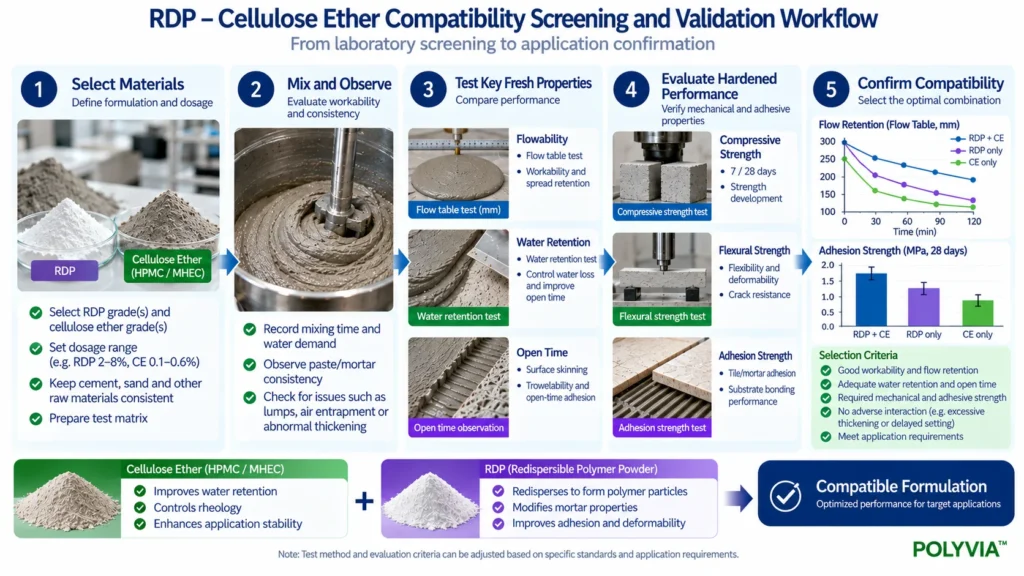
The POLYVIA™ 3 × 3 Compatibility Screening Method
A structured formulation study should determine both the individual influence of RDP and cellulose ether and whether their effects depend on one another.
The proposed POLYVIA™ 3 × 3 Compatibility Screening Method provides a practical framework for a two-factor laboratory screening study.
It is an engineering workflow, not a proprietary test standard or a record of completed POLYVIA™ experiments.
1. Define the performance question
Before selecting additive dosages, identify the intended application and critical performance requirements.
For a cementitious tile adhesive, relevant questions may include:
- Does the adhesion response to increasing RDP change at different cellulose ether levels?
- Does cellulose ether dosage influence the workability response to RDP?
- Can a combination improve open-time adhesion without compromising application stability?
- Are the observed results reproducible across independently prepared batches?
A study should begin with measurable questions, not a predetermined preferred dosage.
2. Establish the reference formulation
Choose a base mortar with defined cement, aggregate grading, mineral filler, and other additives.
Document all raw-material sources and preparation conditions.
Where practical and scientifically useful, no-RDP or no-cellulose-ether control mixtures may be included to investigate individual contributions.
Such control formulations may not be suitable for commercial use.
3. Design the experimental matrix
Table 05. Illustrative 3 × 3 RDP–Cellulose Ether Compatibility Matrix
| Cellulose Ether Dosage | RDP 1.0% | RDP 2.0% | RDP 3.0% |
|---|---|---|---|
| CE 0.20% | Trial A1 | Trial A2 | Trial A3 |
| CE 0.30% | Trial B1 | Trial B2 | Trial B3 |
| CE 0.40% | Trial C1 | Trial C2 | Trial C3 |
All percentages refer to the total dry-mix mass.
These are illustrative screening levels only. They are not experimentally validated POLYVIA™ dosages, universal recommendations, or formulations certified to meet an adhesive performance classification.
The actual ranges must be selected according to the polymer and cellulose ether grades, the mortar system, and the required performance.
4. Keep the total dry-mix mass consistent
In a 1,000 kg formulation, the illustrative RDP levels correspond to:
- 1.0% RDP = 10 kg
- 2.0% RDP = 20 kg
- 3.0% RDP = 30 kg
Likewise:
- 0.20% cellulose ether = 2 kg
- 0.30% cellulose ether = 3 kg
- 0.40% cellulose ether = 4 kg
When additive quantities change, the dry-mix composition should be adjusted to maintain the intended total mass.
One option is to compensate using a designated mineral filler while keeping cement, aggregate grading, and other functional additive quantities fixed.
However, this substitution does not eliminate every secondary effect. Changing the mineral-to-polymer ratio can also influence particle packing and water demand.
The substitution method must therefore be documented and considered when interpreting results.
5. Separate fixed-water and matched-consistency testing
Two experimental protocols can provide different information.
Protocol A — Fixed Water Content
Use the same amount of mixing water for all formulations.
This allows differences in fresh consistency to be observed under a common water condition.
However, the mixtures may not be equally suitable for practical application.
Protocol B — Matched Application Consistency
Adjust the water quantity until the formulations reach a defined consistency target.
This is useful for comparing performance at a similar application condition.
However, the different water amounts may affect hardened properties and must be reported.
Neither protocol should be interpreted as a substitute for the other.
For critical comparisons, using both can help explain how additive selection and water demand contribute to performance.
6. Distinguish replicate specimens from independent batches
Reliable testing requires attention to experimental variability.
Several test specimens prepared from one mortar batch can help assess within-batch variation.
They do not, by themselves, establish independent batch-to-batch repeatability.
Where resources permit, independently prepared batches should be included, particularly when confirming promising formulations.
Record:
- Number of independent batches
- Number of specimens per batch
- Mean results and observed variability
- Mixing and curing conditions
- Any deviations from the planned procedure
The replication plan should reflect the applicable test method and the precision required for decision-making.
7. Measure multiple relevant responses
Table 06. Suggested Measurements for Compatibility Screening
| Stage | Suggested Measurement | Purpose |
|---|---|---|
| Mixing | Uniformity and consistency | Identify preparation-related issues |
| Fresh-state development | Rheology, water retention | Evaluate flow and moisture management |
| Application | Contact behavior, slip, open-time adhesion | Assess installation requirements |
| Physical properties | Fresh density or air content | Investigate possible air-related effects |
| Hardened state | Adhesion, strength, deformation as applicable | Verify final mechanical requirements |
| Exposure | Conditioned adhesion or other specified tests | Assess required exposure performance |
Not every application requires every test.
The test program should correspond to the intended product and the relevant standards.
8. How to identify an interaction between RDP and cellulose ether
Suppose a measured adhesion response is obtained at several RDP levels.
The change in response from 1.0% to 3.0% RDP can be calculated separately at each cellulose ether level:
RDP response difference = Result at 3.0% RDP − Result at 1.0% RDP
If those differences vary with cellulose ether level, the result may indicate an additive interaction.
However, observed differences may also reflect experimental variability.
A replicated factorial design can be evaluated using an appropriate statistical model containing:
- RDP dosage
- Cellulose ether dosage
- RDP × cellulose ether interaction
- Experimental variability
A statistically significant interaction does not automatically mean that the combination is beneficial. The direction, magnitude, and practical relevance of the response must also be considered.
A claim of synergy requires stronger evidence than the observation that two additives work together.
9. Select an acceptable performance region
Do not automatically choose the formulation with the highest adhesion result or the greatest viscosity.
Define the required performance criteria before interpreting the trials.
Table 07. Performance-Based Formulation Selection
| Requirement | Acceptance Principle |
|---|---|
| Initial adhesion | Meets the relevant performance target |
| Conditioned adhesion | Meets the required exposure criteria |
| Open-time adhesion | Meets the intended open-time requirement |
| Application behavior | Falls within a defined acceptable range |
| Manufacturing consistency | Provides sufficiently reproducible results |
A formulation is acceptable only if it meets all mandatory requirements.
If several formulations satisfy these criteria, cost, raw-material tolerance, ease of processing, and production consistency can guide the final choice.
If none qualifies, the formulation or screening conditions should be reconsidered.
10. Validate before commercial production
The final development stage should confirm the selected formulation under representative production and application conditions.
A practical confirmation program includes:
- Repeat preparation of the selected candidate formulations.
- Verification of mandatory performance tests.
- Review of sensitivity to normal raw-material variation.
- Assessment of application behavior under representative conditions.
- Evaluation of production feasibility and cost.
- Documentation of formulation limits and quality-control requirements.
The goal is not to establish one universal RDP-to-cellulose ether ratio. It is to identify a reproducible combination that satisfies the needs of a specific mortar formulation.
How Should RDP and Cellulose Ether Be Selected for Different Mortar Applications?
Different dry-mix mortar applications require different combinations of polymer modification, water retention, and rheological behavior.
A formulation designed for a vertical tile adhesive cannot automatically be transferred to a self-leveling mortar, even if both use RDP and cellulose ether.
Application-Based RDP and Cellulose Ether Selection Priorities
| Application | RDP Selection Priority | Cellulose Ether Selection Priority | Key Validation |
|---|---|---|---|
| Cementitious tile adhesive | Adhesion and required deformation performance | Water retention, open-time and application behavior | Initial and conditioned adhesion, open time, slip where relevant |
| ETICS adhesive and base coat | Bonding, flexibility, system compatibility | Water retention and application stability | Interface adhesion and system requirements |
| Wall putty and skim coat | Surface cohesion and specified adhesion | Trowelability, retention, surface quality | Workability and hardened surface performance |
| Cementitious repair mortar | Bonding and mechanical compatibility | Placement stability and moisture management | Repair interface and dimensional stability |
| Self-leveling mortar | Suitability for required flow and hardened properties | Rheology compatible with leveling | Flow, segregation, air release, strength |
1. Tile adhesive: Balance contact and adhesion
Cementitious tile adhesive illustrates the importance of additive interaction because performance depends on both fresh-state behavior and the development of a suitable interface.
The selected RDP should reflect the required hardened properties, while cellulose ether selection should consider water retention, workability, and open-time behavior.
C1 and C2 adhesive classifications cannot be guaranteed through the selection of additive grades or dosages alone.
Similarly, additional properties such as slip resistance, extended open time, and deformability require their own applicable evaluation.
2. ETICS mortars: Evaluate the complete system
External thermal insulation composite systems involve different interfaces, reinforcing materials, and environmental exposures.
RDP selection should consider the required bonding and mechanical characteristics of the system.
Cellulose ether selection must support suitable application and water management.
The complete system should be tested rather than relying on isolated mortar properties.
3. Wall putty and skim coat: Application quality matters
Surface finishing materials place strong emphasis on workability, smoothness, surface cohesion, and the quality of the hardened finish.
The optimal additive balance may differ from that required for tile adhesive.
Higher polymer content or viscosity does not automatically provide a better surface finish.
4. Self-leveling mortar: Avoid incompatible rheology
Self-leveling compounds require flow, leveling ability, stability, and appropriate air-release behavior.
A cellulose ether grade suitable for high-build vertical mortar may not be suitable for a highly flowable formulation.
The RDP should also be selected with the complete self-leveling system in mind.
5. Why this guide does not provide one universal recipe
The purpose of this Knowledge article is to explain the interaction and validation of RDP and cellulose ether.
Application-specific formulations require additional decisions involving cement, aggregate grading, fillers, water demand, and product performance classification.
These details are better addressed in separate C1 Tile Adhesive Formula, C2 Tile Adhesive Formula, and other dedicated Application guides.
This separation keeps material science, formulation recipes, and troubleshooting guidance focused on their respective technical questions.
Engineering Conclusions: Select the Combination, Not Just the Individual Grades
RDP and cellulose ether are widely used together because they influence different but interconnected aspects of mortar performance.
RDP contributes polymer modification, while HPMC and MHEC/HEMC help control water retention and fresh-state rheology.
Their combined behavior can also influence adsorption, setting, surface skinning, substrate contact, and the performance of the hardened mortar.
Four principles are particularly important.
1. Evaluate the complete mortar system
Technical data sheets provide useful information for selecting candidate products.
However, they cannot fully predict interactions with every cement, mineral filler, aggregate, and auxiliary additive.
2. Separate fresh behavior from hardened performance
Good consistency and high water retention are useful only when they contribute to the requirements of the finished product.
Neither property guarantees acceptable adhesion or durability.
3. Test interaction rather than assuming synergy
Controlled formulation studies can identify how one additive influences the response to another.
Claims of beneficial interaction should be supported by appropriate comparative data.
4. Prioritize robust compliance over a single maximum result
A successful formulation meets its required properties consistently under realistic raw-material, production, and application conditions.
The highest measured result in one laboratory test may not represent the best commercial formulation.
The POLYVIA™ approach is to move from individual additive selection toward evidence-based formulation compatibility: define the requirements, screen appropriate grades, measure interactions, and validate the complete mortar system.
Frequently Asked Questions
1. Do RDP and HPMC work together in tile adhesive?
Yes. RDP and HPMC are commonly used together because they provide complementary functions. RDP contributes polymer modification, while HPMC helps control water retention and rheology. Their combined effect depends on the complete tile adhesive formulation.
2. Does cellulose ether improve RDP film formation?
Cellulose ether may influence the moisture and rheological conditions under which redispersed polymer particles develop during curing. However, it does not automatically create a more continuous polymer film or guarantee improved adhesion.
3. What is the best RDP-to-HPMC ratio in dry-mix mortar?
There is no universal ratio. The optimum combination depends on the selected additive grades, cement and aggregate composition, water demand, application conditions, and required performance tests.
4. Can too much HPMC reduce tile adhesive performance?
An unsuitable cellulose ether grade or dosage can contribute to excessive resistance to spreading, altered setting behavior, air-content changes, or unfavorable surface characteristics. The limiting mechanism should be verified before adjusting the formulation.
5. Why can tile adhesive lose adhesion even when water retention is good?
Water retention does not directly measure effective tile contact or open-time adhesion. Surface skinning, inadequate ridge collapse, environmental exposure, and other interface conditions may reduce the resulting bond.
6. Can HPMC and MHEC grades be substituted based on viscosity alone?
No. Solution-viscosity specifications are measured under defined conditions. Differences in chemistry and interactions with the cementitious system may produce different water-retention, rheological, and application results.
7. How can RDP and cellulose ether compatibility be tested?
Manufacturers can use a controlled factorial screening study with multiple RDP and cellulose ether levels. The experiment should standardize raw materials, mixing, water-addition strategy, curing, and relevant performance tests.
8. Are RDP and cellulose ether always synergistic?
No. Complementary performance contributions do not automatically demonstrate synergy. A synergistic claim requires controlled experimental evidence and a clearly defined performance response.
9. Does changing a cellulose ether grade require retesting the mortar?
Retesting is appropriate when the substitution may influence important performance requirements. Relevant fresh-state behavior, application characteristics, and mandatory hardened properties should be confirmed before approving the replacement.
10. Should a manufacturer select RDP or cellulose ether first?
There is no universally correct selection order. A practical approach is to define the mortar's end-use requirements, select appropriate candidate grades from both additive families, and evaluate their combined performance.
References
References
[1] Petit, J.-Y., & Wirquin, E. (2013). Evaluation of various cellulose ethers performance in ceramic tile adhesive mortars. International Journal of Adhesion and Adhesives, 40, 202–209.
DOI: https://doi.org/10.1016/j.ijadhadh.2012.09.007
[2] Fujii-Yamagata, A. L., Cardoso, F. A., Sarou-Kanian, V., Daubresse, A., Prat, E., & Chaouche, M. (2019). Skin formation in adhesive mortars evaluated by MRI and interfacial rheology. Cement and Concrete Composites, 99, 251–261.
DOI: https://doi.org/10.1016/j.cemconcomp.2019.02.002
[3] Jenni, A., Holzer, L., Zurbriggen, R., & Herwegh, M. (2005). Influence of polymers on microstructure and adhesive strength of cementitious tile adhesive mortars. Cement and Concrete Research, 35(1), 35–50.
DOI: https://doi.org/10.1016/j.cemconres.2004.06.039
Technical Disclosure: The POLYVIA™ Four-Stage Interaction Framework and 3 × 3 Compatibility Screening Method are proposed engineering tools for organizing formulation development and testing. The illustrative dosage levels and trial matrix do not represent completed POLYVIA™ experiments, certified mortar formulations, or universal performance guarantees.