
How Does RDP Polymer Chemistry Affect Mortar Performance?
VAE, VA/VeoVa & Acrylic-Based Polymer Systems
Explore how VAE, VA/VeoVa, and acrylic-based RDP chemistries influence polymer flexibility, film formation, adhesion, and mortar performance. Discover published research findings, key formulation trade-offs, and practical strategies for selecting and validating RDP grades across different dry-mix mortar applications.
Introduction
RDP polymer chemistry affects mortar performance by influencing polymer flexibility, film-forming behavior, moisture-related characteristics and interactions with the cementitious matrix. VAE, VA/VeoVa, acrylic-based and styrene-acrylic redispersible polymer powders may produce different results, but polymer family alone cannot predict finished-mortar adhesion, strength, deformation or durability. The decisive factors are the specific grade, powder composition, dosage, formulation and curing conditions.
This distinction matters when selecting redispersible polymer powder for tile adhesives, ETICS mortars, wall putties, repair mortars and other dry-mix construction materials.
For example, a polymer with a low glass transition temperature may be relatively flexible, but this does not automatically qualify a tile adhesive for a particular deformation class. Similarly, a powder described as hydrophobic does not automatically guarantee adhesion after water immersion.
The engineering objective is not to identify a universally superior polymer family. It is to select an RDP grade that enables the complete mortar formulation to meet defined performance requirements.
This POLYVIA™ guide examines the major polymer chemistries, interprets published experimental data and introduces a five-layer selection framework supported by practical testing and supplier-comparison methods.
What Does Polymer Chemistry Tell Us About RDP?
Redispersible polymer powder (RDP) is generally produced by drying a stabilized polymer dispersion into a powder that can redisperse when mixed with water.
Its base-polymer chemistry depends on the monomers used, their proportions and the resulting polymer structure.
These characteristics influence polymer chain mobility, thermal properties and aspects of polymer–water interaction.
However, a commercial RDP is not simply a pure polymer.
Protective colloids, anti-caking agents and other powder constituents can influence redispersion and behavior in fresh mortar.
Three different concepts must therefore be distinguished:
| Term | Meaning | What It Does Not Prove |
|---|---|---|
| Polymer family | General chemical identity, such as VAE | Specific mortar performance |
| Commercial RDP grade | A defined powder product with its own composition and characteristics | Universal suitability for all formulations |
| Qualified mortar formulation | A complete mixture tested against application requirements | Equivalent performance after changing raw materials |
For instance, VAE-based RDP does not define one universal Tg, MFFT, flexibility level or adhesion value.
Those characteristics depend on the specific product and test conditions.
POLYVIA™ Engineering Principle 01
Polymer family identifies the chemistry. Commercial grade identifies the material. Mortar testing establishes suitability.
How Do VAE, VA/VeoVa and Acrylic Polymer Chemistries Differ?
The differences between polymer families originate in their chemical building blocks.
Understanding those differences can help narrow the selection of candidate products, but cannot replace grade-specific performance evaluation.
1. VAE: Vinyl Acetate–Ethylene
VAE contains vinyl acetate and ethylene-derived units.
Changes in copolymer composition can modify molecular mobility, flexibility and other characteristics of the polymer phase.
Consequently, VAE powders can be developed for different dry-mix mortar applications rather than one fixed performance category.
VAE redispersible polymer powder is commonly considered in:
- Cementitious tile adhesives
- ETICS adhesives and base coats
- Wall putties and skim coats
- Polymer-modified rendering mortars
- Other dry-mix construction materials
The important selection question is not whether all VAE products are flexible.
It is whether the specified VAE grade provides appropriate characteristics for the intended formulation and curing environment.
2. VA/VeoVa: Vinyl Acetate–Vinyl Versatate
VA/VeoVa contains vinyl acetate and vinyl versatate units.
The branched hydrocarbon groups associated with vinyl versatate can affect polymer hydrophobic characteristics.
Published research has shown changes in the water-related and mechanical behavior of cement mortars modified with particular VA/VeoVa powders.
However, the performance of one experimental powder cannot be generalized to the entire VA/VeoVa family.
VA/VeoVa chemistry should not be treated as an automatic guarantee of waterproofing performance, higher strength or improved wet adhesion.
Each property requires its own relevant test.
3. Acrylic-Based RDP
Acrylic-based polymers may contain different acrylate or methacrylate-derived units.
Their formulation flexibility allows different polymer characteristics, but the category acrylic is chemically broad.
In particular, a pure acrylic product should not automatically be treated as equivalent to a styrene-acrylic copolymer.
It is also important to distinguish redispersible acrylic powders from liquid acrylic dispersions. Results from one product form do not establish equivalent behavior in the other.
4. Styrene-Acrylic RDP
Styrene-acrylic polymers include both styrene and acrylic-derived units.
Such systems have been investigated in polymer-modified mortars, including long-term exposure research.
Their actual performance depends on the specific polymer and powder formulation, dosage and application conditions.
RDP Polymer Families: Chemical Differences and Selection Criteria
| Polymer System | Chemical Distinction | Relevant Selection Considerations | Essential Verification |
|---|---|---|---|
| VAE | Vinyl acetate–ethylene copolymer | Grade-dependent flexibility and thermal properties | Tg, adhesion, deformation, curing |
| VA/VeoVa | Vinyl acetate–vinyl versatate copolymer | Polymer structure and potential moisture-related effects | Water uptake, conditioned adhesion, mechanical properties |
| Acrylic-based | Acrylate/methacrylate-containing polymer | Actual composition and grade characteristics | Redispersion, compatibility, finished-mortar tests |
| Styrene-acrylic | Styrene and acrylic-derived copolymer | Grade-dependent mechanical and film behavior | Adhesion, strength, exposure testing |
Interpretation: This table identifies relevant technical differences. It does not rank the polymer families by quality or suitability.
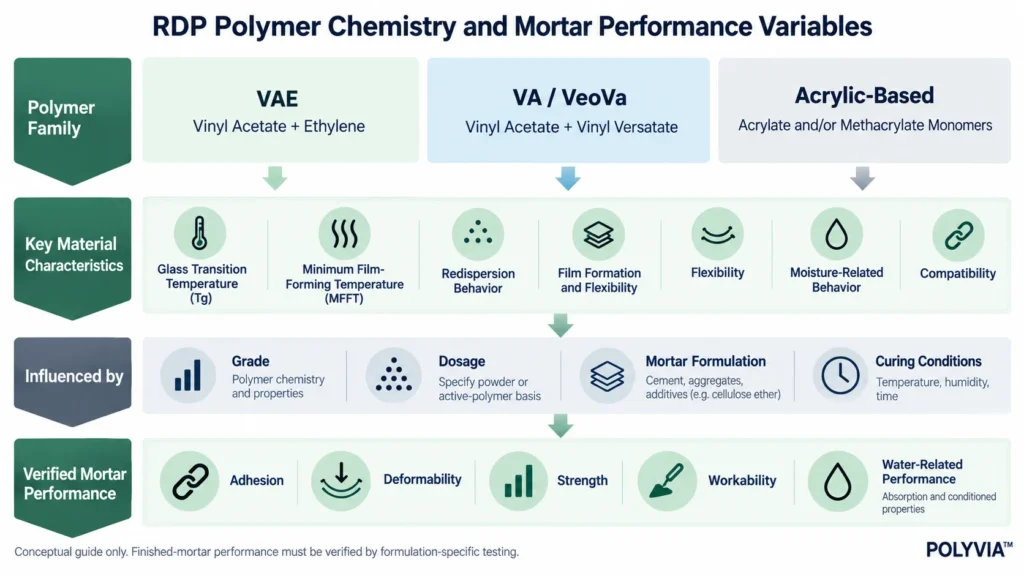
How Do Tg and MFFT Affect RDP Film Formation?
Two commonly discussed polymer characteristics are glass transition temperature (Tg) and minimum film-forming temperature (MFFT).
Although related to polymer behavior, they describe different properties.
Glass Transition Temperature
Tg describes the temperature region associated with changes in molecular mobility within an amorphous polymer phase.
A lower Tg is often associated with a softer polymer phase at a given temperature, provided the materials and conditions being compared are otherwise relevant.
However, finished-mortar deformability depends on more than the polymer phase.
Aggregate grading, cement hydration products, polymer distribution, air content and curing conditions also affect mechanical response.
Therefore, a lower Tg does not automatically guarantee higher tensile adhesion or a specific mortar deformation class.
Minimum Film-Forming Temperature
MFFT describes the minimum temperature at which a polymer dispersion forms a coherent film under defined test conditions.
MFFT is not interchangeable with Tg.
The relationship between these parameters depends on the polymer system and associated formulation components.
For example, the VA/VeoVa powder investigated by Wang and colleagues in their cement mortar research had a reported MFFT of 6°C.
This was a grade-specific material characteristic, not a universal value for VA/VeoVa products.
Film Development Inside Mortar
When water is added to dry-mix mortar, RDP particles may redisperse while cement hydration and other fresh-state processes begin.
During curing, polymer particles can undergo redistribution and coalescence as moisture conditions change.
Depending on the chemistry and environment, polymer-rich regions or films may develop.
It is not appropriate to assume that every redispersible polymer powder forms a continuous film throughout the hardened mortar.
Low-Temperature Application
Low-temperature installation may affect hydration, moisture movement and polymer film development.
For products intended for cold conditions, laboratory screening should include the relevant curing temperature and required finished-mortar properties.
A Tg or MFFT value alone does not constitute low-temperature application approval.
POLYVIA™ Engineering Principle 02
Tg and MFFT help screen materials. Application testing determines whether their characteristics deliver the required mortar performance.
What Does Published Research Show About Polymer Chemistry and Mortar Performance?
The relationship between polymer chemistry and mortar properties becomes clearer when measured results are interpreted together with their test conditions.
Three published studies provide useful evidence.
1. VA/VeoVa: Measured Changes in Transverse Deformation
Wang, Wang and Yao (2012) investigated redispersible VA/VeoVa powder-modified cement mortar.
The reported materials included:
- Portland cement: P·II 52.5R
- Quartz sand: 301–600 μm
- Specific VA/VeoVa powder: average particle size 80 μm
- Powder minimum film-forming temperature: 6°C
- Investigated powder-to-cement mass ratios including 0%, 1%, 3%, 5%, 8%, 10% and 12%
The study examined transverse deformation, fracture energy and strength-related properties.
One particularly useful result was the change in transverse deformation as the powder-to-cement ratio increased.
Published VA/VeoVa Transverse Deformation Results
| RDP Powder-to-Cement Ratio | Transverse Deformation | Interpretation |
|---|---|---|
| 8% | 1.1 mm | Measured response for the investigated mortar |
| 12% | 1.6 mm | Higher transverse deformation under the investigated conditions |
Source: Wang et al. (2012), Construction and Building Materials, 27(1), 259–262.
The increase from 1.1 mm to 1.6 mm corresponds to approximately 45% higher transverse deformation between these two reported conditions.
This calculation describes the measured difference between two experimental mixtures. It does not represent an expected performance improvement for other RDP grades or mortar formulations.
The research also reported that transverse peak load decreased when the powder-to-cement mass ratio exceeded 8%.
This is an important distinction.
More deformation was not equivalent to better performance in every mechanical property.
The study illustrates why product qualification should evaluate the required combination of deformation, strength and adhesion rather than one isolated value.
Important Dosage Definition
The reported 8% and 12% are VA/VeoVa commercial powder-to-cement mass ratios, not percentages of the complete dry-mix mortar.
They should also not automatically be described as active-polymer-to-cement ratios.
For example, a formulation containing 20 kg of commercial RDP powder and 250 kg of cement has:
RDP powder-to-cement ratio = 20 ÷ 250 × 100% = 8%
If the total dry mix is 1,000 kg, the same 20 kg powder corresponds to:
RDP powder dosage = 2% of total dry-mix mass
These expressions describe different concentration bases.
Neither calculation is a recommended formula for commercial tile adhesive.
2. VA/VeoVa: Water Demand, Air Content and Strength
Wang and Wang (2011) also studied VA/VeoVa-modified cement mortar.
They reported changes in water-related behavior, fresh-mortar air content, bulk density, compressive strength and flexibility-related indicators.
The reported air-entrainment effect was associated with reduced bulk density.
The study also reported improvements in hydrophobicity and resistance to water penetration for the investigated system.
These observations demonstrate that polymer modification can influence fresh and hardened properties simultaneously.
However, they cannot establish the behavior of every commercial VA/VeoVa grade.
3. Ten-Year Exposure: Why Polymer Comparisons Need Controlled Conditions
Schulze and Killermann (2001) investigated the long-term behavior of mortars modified using three redispersible polymer powders.
The reported materials included:
| Investigated Polymer | Reported Tg |
|---|---|
| VAE powder | −7°C |
| Ethylene–vinyl chloride–vinyl laurate terpolymer | 1°C |
| Styrene-acrylic powder | 20°C |
The study used a constant resin-to-cement ratio of 0.15, and air content was adjusted toward comparable levels using a defoamer.
The researchers investigated indoor and outdoor exposure over 10 years.
The study reported stable adhesion, flexural strength and compressive strength for the investigated polymer-modified mortar systems. It also reported hydrophobic performance over five years for the tested terpolymer-modified stucco formulation.
The engineering significance is not that one polymer family can be declared universally superior.
It is that meaningful comparison requires control of formulation variables, and that long-term performance must be evaluated under defined exposure conditions.
These results do not establish a ten-year service-life guarantee for commercial RDP products.
What Can We Conclude from These Studies?
The evidence supports three practical conclusions:
- Polymer dosage can produce performance trade-offs rather than uniform improvements.
- Different polymer chemistries can be evaluated under controlled test conditions, but findings remain specific to the investigated materials.
- Long-term mortar performance must be established through testing rather than inferred from polymer-family identity.
POLYVIA™ Engineering Principle 03
Never separate a numerical performance claim from its material, dosage basis and test conditions.
Why Does RDP Selection Require Balancing Different Mortar Properties?
A polymer grade may contribute to useful performance characteristics while creating changes elsewhere in the formulation.
The relevant balance depends on the product being manufactured.
Adhesion and Surface Contact
RDP may contribute to adhesion through polymer modification of the hardened mortar and relevant interfaces.
However, adhesion is also affected by substrate conditions, surface wetting, cement hydration and curing.
A powder with favorable polymer characteristics does not automatically produce adequate tile adhesive bonding after water immersion or heat exposure.
Flexibility and Mechanical Strength
A relatively flexible polymer phase may contribute to deformation-related behavior.
Nevertheless, higher deformation does not necessarily coincide with higher peak load or compressive strength.
The published VA/VeoVa data illustrate this trade-off.
Water Uptake and Conditioned Adhesion
These are separate measurements.
Water absorption relates to the amount of water absorbed under a defined protocol.
Water penetration concerns transport through a material under specified conditions.
Conditioned adhesion measures bonding performance following particular exposure conditions.
A product described as hydrophobic cannot be assumed to pass every water-related mortar requirement.
Workability and Air Content
Commercial RDP powders may influence fresh-mortar consistency, water demand and air content.
A change in air content may affect hardened density and mechanical properties.
This is why a grade selected for adhesion must also be checked for fresh-state compatibility.
RDP Performance Trade-Off Matrix
| Required Outcome | What May Affect It | Recommended Verification |
|---|---|---|
| Adhesion | Polymer grade, contact conditions, cement, curing | Relevant initial and conditioned adhesion tests |
| Deformability | Polymer phase, dosage, matrix structure | Applicable deformation testing |
| Compressive strength | Water demand, air content, matrix porosity | Specified strength testing |
| Water-related performance | Polymer characteristics, pore system, curing | Relevant absorption, penetration or conditioning tests |
| Workability | RDP, cellulose ether, water and mixing | Fresh-mortar evaluation |
| Low-temperature suitability | Hydration and film development | Testing under representative temperature conditions |
This matrix highlights the evidence required for selection; it does not provide universal performance rankings.
Why Can Two Commercial RDP Grades Perform Differently Even Within the Same Polymer Family?
Two products described as VAE-based may not be technically interchangeable.
Differences can arise from both polymer composition and the complete powder formulation.
Base-Polymer Composition
Different monomer proportions can produce different polymer characteristics.
Thus, the polymer-family name does not determine one fixed Tg or flexibility level.
Protective Colloids and Powder Constituents
Protective colloids and auxiliary materials can influence redispersion and interactions in the mortar.
Two commercial powders may also differ in active-polymer fraction.
Equal powder mass is therefore not necessarily equal active-polymer mass.
Cement and Mineral Components
Cement composition, sand grading and filler characteristics can affect water demand, hydration and mortar structure.
A suitable RDP grade may need renewed testing when a manufacturer changes major raw materials.
Cellulose Ether Interactions
HPMC and MHEC influence water retention, rheology and application behavior.
Their combined response with RDP should be assessed in the actual formulation.
For detailed guidance, see the POLYVIA™ article RDP and Cellulose Ether in Dry-Mix Mortar: How Do They Work Together?
Curing and Exposure Conditions
Temperature, moisture availability and substrate properties affect finished-mortar performance.
Consequently, substitution decisions should use conditions relevant to the intended application.
How Can Manufacturers Select RDP Using the POLYVIA™ Five-Layer Framework?
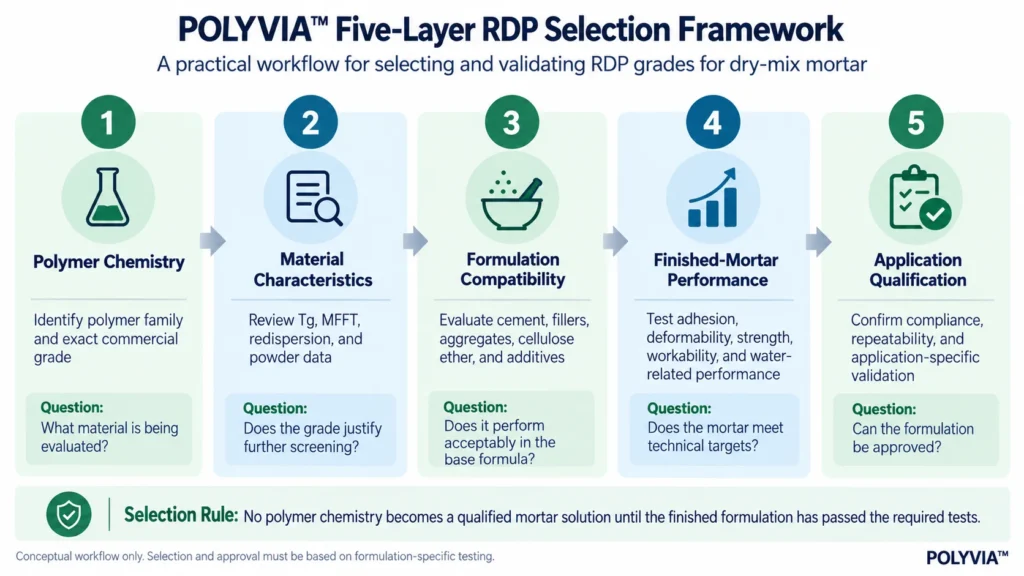
The POLYVIA™ Five-Layer Polymer Selection Framework converts material information into a practical qualification sequence.
It organizes established engineering principles into a systematic method; it is not a claim of newly discovered polymer science.
Layer 1 — Identify Polymer Chemistry
Confirm the polymer family and the exact commercial grade.
Decision question: What material is being evaluated?
Layer 2 — Review Material Characteristics
Assess relevant supplier information and, where necessary, material testing.
Parameters may include Tg, MFFT and redispersion characteristics.
Decision question: Does the grade justify further screening for the target application?
Layer 3 — Evaluate Formulation Compatibility
Test the candidate in the actual cement, filler, aggregate and additive system.
Decision question: Does it produce acceptable fresh-mortar behavior?
Layer 4 — Measure Finished-Mortar Performance
Test the properties required by the final product.
Decision question: Does the complete formulation achieve its technical targets?
Layer 5 — Confirm Application Qualification
Verify the relevant standards, test conditions and reproducibility.
Decision question: Can this formulation be approved for the intended application?
POLYVIA™ Five-Layer RDP Selection Framework
| Layer | Evaluation Focus | Evidence |
|---|---|---|
| 1. Chemistry | Polymer family and grade identity | Supplier documentation |
| 2. Characteristics | Relevant material properties | Grade-specific data |
| 3. Compatibility | Performance in the actual base formulation | Controlled screening trials |
| 4. Mortar Performance | Required fresh and hardened properties | Measured test results |
| 5. Qualification | Compliance and reproducibility | Application-specific validation |
POLYVIA™ Selection Rule
No polymer chemistry becomes a qualified mortar solution until the finished formulation has passed the required tests.
Practical Selection Example: Can Grade B Replace Grade A in Tile Adhesive?
The following example shows how a manufacturer can apply the five-layer method without assuming which RDP grade will win.
This is a hypothetical testing scenario, not POLYVIA™ laboratory data.
The Purchasing Situation
A tile adhesive manufacturer currently uses Grade A, a VAE-based commercial redispersible polymer powder.
A supplier proposes Grade B, another VAE-based powder, as an alternative.
Both are marketed for cementitious tile adhesives.
The buyer wants to determine whether Grade B can replace Grade A without reducing finished-product performance.
Step 1 — Define the Qualification Target
The manufacturer first records the exact adhesive classification and applicable test standard.
Required results might include:
- Initial tensile adhesion
- Adhesion after specified water conditioning
- Heat-conditioned adhesion where required
- Open time
- Slip resistance if the claimed class requires it
- Transverse deformation where a deformation classification is targeted
The acceptance criteria must come from the applicable standard and product specification.
Step 2 — Establish a Controlled Reference
Use the same cement, sand grading, mineral fillers, cellulose ether and other additives.
Maintain a documented dry-mix mass balance.
If the two RDP powders have different compositions, determine which comparison is feasible:
- Equal commercial powder mass
- Equal active-polymer mass, if reliable composition information is available
- Application-specific dosage optimization as a separate trial
These comparisons answer different questions.
Step 3 — Define Water-Control Methods
Use a fixed-water comparison to observe differences in consistency under equal water addition.
Where relevant, run a separate matched-consistency comparison to determine how much water each mixture requires to achieve the target application behavior.
Do not combine the two protocols without documenting the resulting differences.
Step 4 — Compare Results Against Acceptance Criteria
Hypothetical Grade A vs. Grade B Qualification Matrix
| Evaluation | Grade A | Grade B | Acceptance Rule |
|---|---|---|---|
| Polymer family | VAE | VAE | Identity documented |
| Material characteristics | Record actual data | Record actual data | Relevant properties reviewed |
| Initial adhesion | Test required | Test required | Meets specified criterion |
| Conditioned adhesion | Test required | Test required | Meets specified criterion |
| Application behavior | Test required | Test required | Meets agreed requirements |
| Deformation, if applicable | Test required | Test required | Meets required classification |
| Repeatability | Repeat batches | Repeat batches | Acceptable variability |
| Commercial assessment | Compare | Compare | Consider only after technical qualification |
No performance results are assigned to either grade in this example.
If both meet the required criteria, the manufacturer can evaluate cost, supply stability and production compatibility.
If Grade B fails a mandatory property, a lower purchase price does not justify approving the substitution without further formulation work.
What Makes This Comparison Meaningful?
The key is not that both products are VAE.
It is that each is evaluated against the same defined application requirements, with differences in composition and experimental conditions properly controlled.
POLYVIA™ Engineering Principle 04
A one-to-one RDP replacement is a testable proposal, not proof of material equivalence.
Which RDP Polymer Chemistry Should Be Considered for Different Applications?
Application requirements determine which material characteristics are relevant.
No single polymer family can be recommended universally for all dry-mix products.
RDP for Cementitious Tile Adhesive
For tile adhesives, selection priorities may include initial and conditioned adhesion, open time and deformation where applicable.
A polymer described as flexible does not automatically produce an S1 or S2 adhesive.
Similarly, no polymer family independently guarantees C1 or C2 classification.
Qualification belongs to the finished adhesive.
RDP for ETICS Mortar
ETICS adhesives and base coats require attention to system adhesion, mechanical behavior, substrate compatibility and exposure conditions.
The polymer grade should be evaluated as part of the complete insulation system.
RDP for Wall Putty and Skim Coat
Wall finishing materials may prioritize application feel, adhesion, sanding behavior and surface quality.
Selecting the lowest-Tg or highest-cost polymer is not automatically the correct approach.
RDP for Cementitious Repair Mortar
Important considerations may include bond, strength, dimensional stability and resistance to the intended exposure environment.
These properties must be evaluated together.
RDP for Self-Leveling Compounds
Flow, segregation control, air release, setting behavior and hardened properties are relevant.
Polymer selection should be coordinated with the complete rheology and binder system.
Application-Specific RDP Selection Priorities
| Application | Primary Questions |
|---|---|
| Tile adhesive | Are adhesion, open time and required deformation achieved? |
| ETICS mortar | Does the complete system meet adhesion and exposure requirements? |
| Wall putty | Are application, surface quality and adhesion acceptable? |
| Repair mortar | Are bond, mechanical and dimensional properties suitable? |
| Self-leveling compound | Are flow, stability and hardened properties balanced? |
What Should Buyers Ask an RDP Supplier Before Approving a Grade?
Technical purchasing should begin with verified product information and defined performance requirements.
Before approving a new redispersible polymer powder, buyers should request available information about:
- Polymer family and commercial grade identity
- Relevant material characteristics and product specifications
- Recommended applications and clearly stated dosage basis
- Supporting evidence for specific performance claims
- Quality consistency and batch documentation
- Sample availability for laboratory qualification
- Storage, handling and supply conditions
When suppliers describe a powder as high-flexibility, water-resistant or high-adhesion, the buyer should ask which property was measured, by which method and in what formulation.
A useful technical claim connects material identity, test conditions and measured performance.
Need Help Selecting an RDP Grade?
POLYVIA™ supplies construction chemical additives for dry-mix mortar applications, including tile adhesives, wall putties and other cementitious systems.
Contact POLYVIA™ to discuss your application requirements, available RDP options and sample evaluation needs.
A formulation-specific comparison provides a more reliable basis for grade selection than polymer-family labels alone.
Conclusion: What Ultimately Determines RDP Mortar Performance?
RDP polymer chemistry influences the characteristics of the polymer phase and may affect flexibility, film development, moisture-related behavior and the performance of polymer-modified mortar.
However, the polymer family does not independently determine finished-product adhesion, strength or durability.
Published research demonstrates that higher polymer modification can increase deformation while reducing other mechanical indicators under specific conditions.
The most reliable selection process therefore combines polymer identification, material screening, controlled formulation testing and application qualification.
POLYVIA™ Technical Conclusion
Polymer chemistry defines the possibilities. Formulation determines the response. Testing establishes suitability.
Frequently Asked Questions
1. Is VAE or VA/VeoVa RDP better for tile adhesive?
Neither is universally better. The appropriate grade depends on the required adhesion, workability, deformation and exposure performance of the finished adhesive.
2. What is the main difference between VAE and VA/VeoVa RDP?
VAE contains vinyl acetate and ethylene-derived units, while VA/VeoVa contains vinyl acetate and vinyl versatate units. These chemical differences may influence material characteristics, but actual mortar performance requires grade-specific testing.
3. Is acrylic RDP more durable than VAE?
A universal ranking is not supported. Durability depends on polymer composition, powder formulation, mortar design, exposure conditions and the property being measured.
4. Does lower Tg mean higher mortar adhesion?
No. Tg describes polymer thermal behavior, not finished-mortar adhesion. Surface contact, curing, binder composition and polymer modification also affect bonding.
5. Can VA/VeoVa RDP reduce mortar water absorption?
Some VA/VeoVa-modified mortars have demonstrated improved water-related behavior in published research. This does not guarantee the same result for every commercial grade or formulation.
6. Why can higher RDP dosage increase flexibility but reduce peak load?
Increasing polymer modification can change the mechanical response of a cementitious matrix. Published VA/VeoVa research observed greater transverse deformation alongside a decrease in peak load above a particular experimental dosage level.
7. Does 8% RDP-to-cement mean 8% of total dry-mix mortar?
No. An RDP powder-to-cement mass ratio of 8% means 8 kg of commercial powder per 100 kg of cement. It is not the same as 8% of the entire dry mixture.
8. Can one VAE RDP grade directly replace another?
Only after validation. Different VAE powders may vary in composition, protective colloids, active-polymer fraction and mortar performance.
9. What should be tested when selecting RDP for low-temperature curing?
Relevant material characteristics and finished-mortar performance should be assessed under the intended curing temperature. Tg or MFFT alone cannot establish suitability.
10. Which RDP is suitable for C2 tile adhesive?
No polymer family automatically creates C2 performance. The complete adhesive must meet the required classification criteria through applicable testing.
11. How should a manufacturer compare RDP samples from two suppliers?
Use a documented base formula, consistent dosage definitions, appropriate water-control protocols, relevant fresh and hardened testing, and independent repeat batches.
12. What matters more: RDP chemistry or the complete mortar formulation?
Both matter, but at different stages. Polymer chemistry identifies potential material characteristics; the complete formulation and its measured performance determine application suitability.
References
- Wang, R., Wang, P.-M., & Yao, L.-J. (2012). Effect of redispersible vinyl acetate and versatate copolymer powder on flexibility of cement mortar. Construction and Building Materials, 27(1), 259–262. https://doi.org/10.1016/j.conbuildmat.2011.07.050
- Wang, R., & Wang, P.-M. (2011). Action of redispersible vinyl acetate and versatate copolymer powder in cement mortar. Construction and Building Materials, 25(11), 4210–4214. https://doi.org/10.1016/j.conbuildmat.2011.04.060
- Schulze, J., & Killermann, O. (2001). Long-term performance of redispersible powders in mortars. Cement and Concrete Research, 31(3), 357–362. https://doi.org/10.1016/S0008-8846(00)00498-1
Research and Technical Disclosure
Published experimental values refer only to the materials, dosage definitions and test conditions reported in the cited studies. The reported findings should not be treated as commercial RDP dosage recommendations, guaranteed product properties or POLYVIA™ laboratory measurements.
The hypothetical Grade A/Grade B selection example contains no measured results. It is provided solely to illustrate a controlled qualification procedure.
The POLYVIA™ Five-Layer Polymer Selection Framework is an original practical organization of established material-selection principles, not a claim of newly discovered polymer science.