
C1 Tile Adhesive Formula: 1,000 kg Recipes
Practical C1 & C1TE Formulations for Dry-Mix Manufacturers
Explore two practical 1,000 kg C1 and C1TE tile adhesive formulations developed from proven dry-mix mortar experience. Discover precise cement, VAE RDP, HPMC and HPS dosages, understand their effects on adhesion, workability, slip resistance and open time, and learn how to optimize material costs, conduct laboratory trials and verify performance under EN 12004.
Introduction
A practical C1 tile adhesive formula must balance adhesion performance, workability, and raw-material cost. The POLYVIA™ C1 reference formulation uses 12 kg of VAE redispersible polymer powder (RDP) per 1,000 kg of dry mix, while the C1TE design uses 16 kg, together with adjusted HPMC and starch ether dosages.
This technical guide provides two complete C1/C1TE reference recipes, precise laboratory batch quantities, additive-selection criteria, and a cost-performance optimization method. It also explains how to investigate adhesion, open-time, and slip failures before commercial production.
The formulas are derived from recipes with a reported history of practical use in China's dry-mix mortar market. The simplified published versions require qualification using the intended raw materials and applicable test methods.
C1 and C1TE Tile Adhesive Formulas: 1,000 kg Recipes
C1 and C1TE are classifications for cementitious tile adhesives. Both must meet the applicable C1 adhesion requirements, while C1TE additionally requires reduced slip (T) and extended open time (E).
The POLYVIA™ reference designs provide mass-balanced starting points for developing these two product grades.
1. Complete C1 and C1TE Reference Formulations
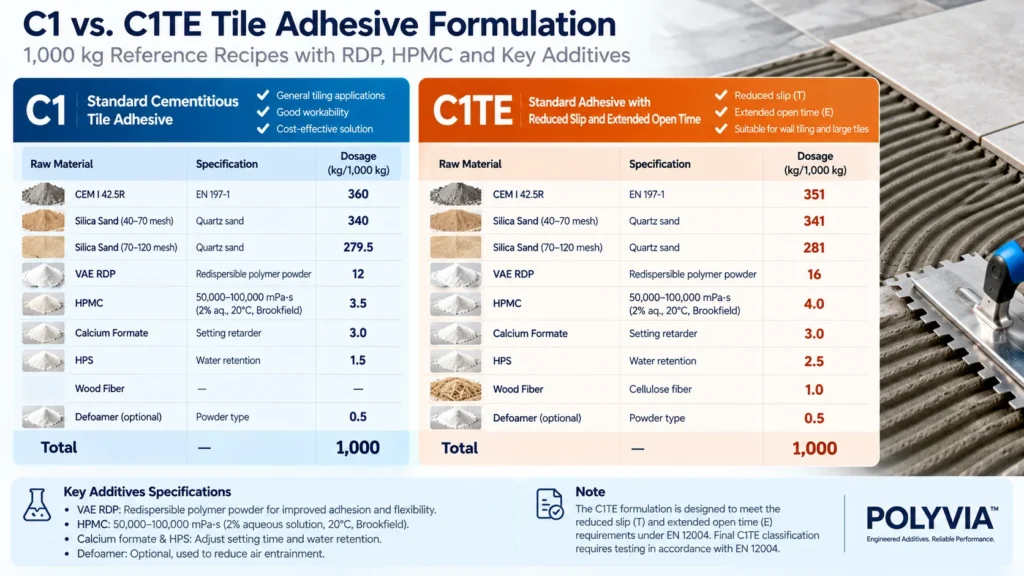
POLYVIA™ C1 and C1TE Tile Adhesive Formulas — kg per 1,000 kg Dry Mix
| Raw Material | C1 | C1TE |
|---|---|---|
| CEM I 42.5R Cement | 360 | 351 |
| Silica Sand, 40–70 mesh | 340 | 341 |
| Silica Sand, 70–120 mesh | 279.5 | 281 |
| VAE Redispersible Polymer Powder (RDP) | 12 | 16 |
| Hydroxypropyl Methylcellulose (HPMC) | 3.5 | 4.0 |
| Calcium Formate | 3.0 | 3.0 |
| Hydroxypropyl Starch Ether (HPS) | 1.5 | 2.5 |
| Wood Fiber (Optional) | — | 1.0 |
| Defoamer (Optional) | 0.5 | 0.5 |
| Total Dry Mix | 1,000 | 1,000 |
HPMC specification: 50,000–100,000 mPa·s, measured using a Brookfield viscometer with a 2% aqueous solution at 20°C. Instrument configuration and rotational speed should also be confirmed when comparing supplier data.
The listed sand fractions are nominal grading ranges. Actual particle-size distribution, fines content, and moisture should be evaluated before adopting the formulation.
Mixing water is added separately and is not included in the dry-mix totals.
2. What Changes Between the Two Formulas?
Compared with C1, the C1TE reference formulation contains:
- 4 kg/MT more VAE RDP.
- 0.5 kg/MT more HPMC.
- 1.0 kg/MT more HPS.
- 1.0 kg/MT optional wood fiber.
The cement and aggregate quantities also differ to maintain the exact batch total.
These changes reflect different formulation objectives. They do not independently establish compliance with the additional T or E requirements.
3. How to Adjust the Formula Without Optional Additives
Wood fiber and defoamer are optional formulation components.
If they are omitted, their mass can be replaced with 70–120 mesh silica sand to preserve the total dry-mix quantity.
Fine Sand Adjustment When Optional Ingredients Are Removed
| Formulation Variant | Original Fine Sand | Adjusted Fine Sand |
|---|---|---|
| C1 without 0.5 kg defoamer | 279.5 kg | 280.0 kg |
| C1TE without 1.0 kg wood fiber and 0.5 kg defoamer | 281.0 kg | 282.5 kg |
These substitutions maintain the 1,000 kg total but may affect fresh-mortar properties. Modified variants require separate evaluation.
Formulation Note: The quantities are practical reference inputs, not compulsory ingredient dosages prescribed by EN 12004 or ISO 13007.
C1 vs. C1TE: Performance Requirements and Design Priorities
The key difference between C1 and C1TE is not a higher basic adhesion class.
Both target normal cementitious adhesive performance. C1TE additionally requires controlled tile slip and a longer verified open-time interval.
1. What Performance Must C1 and C1TE Achieve?
Selected EN 12004-1:2017 Performance Requirements
| Performance Property | C1 | C1TE |
|---|---|---|
| Initial tensile adhesion strength | ≥0.5 MPa | ≥0.5 MPa |
| Adhesion after water immersion | ≥0.5 MPa | ≥0.5 MPa |
| Adhesion after heat ageing | ≥0.5 MPa | ≥0.5 MPa |
| Adhesion after freeze–thaw cycles | ≥0.5 MPa | ≥0.5 MPa |
| Basic open time, at least 20 minutes | ≥0.5 MPa | ≥0.5 MPa |
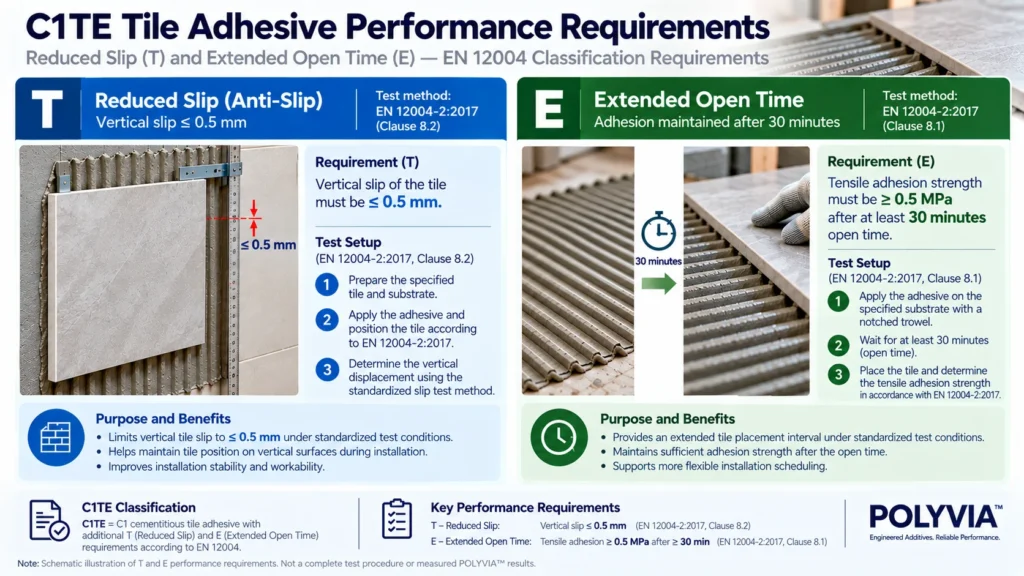
| Extended open time (E), at least 30 minutes | Not required | ≥0.5 MPa |
| Reduced slip (T) | Not required | ≤0.5 mm |
These are selected requirements for normal-setting cementitious adhesives. Complete qualification must follow the applicable standard and prescribed methods.
Reduced Slip (T) measures tile movement under standardized conditions. The T designation requires slip not exceeding 0.5 mm.
Extended Open Time (E) requires the adhesive to achieve the specified tensile adhesion after the longer open-time interval.
Extended open time is not equivalent to pot life, setting time, or tile adjustment time.
2. Why Does C1TE Need a Different Rheological Balance?
A suitable tile adhesive must spread effectively when trowelled, maintain appropriate adhesive ridges, and permit sufficient tile contact after placement.
Insufficient rheological resistance may result in unstable ridges or excessive tile movement.
Excessive resistance may improve apparent ridge stability but make spreading difficult and prevent the ridges from deforming adequately beneath the tile.
For C1TE development, the formulation must balance:
Water retention → Trowelability → Ridge stability → Tile contact → Verified adhesion
RDP, HPMC, HPS, aggregate grading, and mixing water all contribute to this balance.
The additional T and E properties must be demonstrated by testing rather than inferred from ingredient quantities.
RDP Dosage, Grade Selection and Cost-Performance Optimization
VAE redispersible polymer powder is a functional component of cementitious tile adhesive and an important factor in formulation economics.
The objective is to select an appropriate commercial RDP grade and dosage that support consistent performance at a practical total product cost.
1. How Much RDP Do C1 and C1TE Require?
The POLYVIA™ reference quantities are shown below.
RDP Dosage Comparison
| Parameter | C1 | C1TE |
|---|---|---|
| Cement Content | 360 kg/MT | 351 kg/MT |
| Commercial VAE RDP | 12 kg/MT | 16 kg/MT |
| RDP / Total Dry Mix | 1.20% | 1.60% |
| RDP / Cement | 3.33% | 4.56% |
The RDP-to-cement percentages are based on the mass of commercial powder, not an exact active-polymer-to-cement ratio.
C1TE uses 4 kg more RDP per metric ton, representing a 33.3% increase over the C1 dosage.
However, different RDP quantities should not be interpreted as a direct prediction of adhesion strength. Performance also depends on polymer chemistry, cement compatibility, conditioning, and the complete mortar formulation.
2. What RDP Specifications Should Manufacturers Compare?
Commercial VAE RDP grades may differ in polymer composition, thermal characteristics, redispersion behavior, and formulation compatibility.
Important VAE RDP Selection Parameters
| Parameter | Technical Significance | Evaluation Priority |
|---|---|---|
| Polymer chemistry | Influences polymer modification and adhesion-related properties | Confirm grade and intended application |
| Glass transition temperature (Tg) | Describes an aspect of polymer thermal behavior | Interpret alongside polymer chemistry and application needs |
| Ash content | Indicates inorganic residue under a specified test method | Compare data measured using equivalent methods |
| Redispersion behavior | Relevant to polymer distribution after water addition | Review powder behavior and finished-mortar performance |
| Protective colloid and additives | May influence redispersion and compatibility | Examine available technical specifications |
| Cement compatibility | Affects fresh and hardened properties | Test with the intended cement |
| Conditioned adhesion | Relevant to C1 qualification | Verify water-, heat-, and freeze–thaw-conditioned adhesion |
| Batch consistency | Influences repeatable manufacturing quality | Evaluate representative supplier batches |
Tg and ash content are not standalone quality rankings.
A lower Tg does not automatically mean better tile adhesion, and a lower ash value does not necessarily indicate a superior RDP.
The correct grade should be selected from its demonstrated performance in the actual adhesive formulation.
3.How to Compare Two RDP Grades Fairly
Begin with a controlled grade comparison.
For C1, test candidate RDP products at the same initial addition rate of 12 kg/MT.
For C1TE, use 16 kg/MT as the initial reference quantity.
Keep the cement source, sand grading, other additive dosages, and preparation method consistent wherever practical.
Evaluate fresh-mortar behavior and the required adhesion properties.
Once a suitable grade has been identified, a separate dosage optimization study can determine whether a different quantity offers a better cost-performance balance.
Any dosage adjustment should be compensated by the designated aggregate fraction to preserve the total dry-mix mass.
4. How to Calculate RDP Cost per Metric Ton
The direct RDP cost contribution is:
RDP Cost per MT = RDP Dosage (kg/MT) × Purchase Price (USD/kg)
For example, using a hypothetical RDP price of USD 2.00/kg:
Illustrative RDP Cost Comparison
| Parameter | C1 | C1TE |
|---|---|---|
| RDP Dosage | 12 kg | 16 kg |
| Assumed RDP Price | USD 2.00/kg | USD 2.00/kg |
| RDP Cost Contribution | USD 24/MT | USD 32/MT |
The RDP cost difference is USD 8 per metric ton at the assumed price.
USD 2.00/kg is a mathematical example, not a verified market price or POLYVIA™ quotation.
Total raw-material cost must also include cement, sand, HPMC, HPS, calcium formate, and the optional additives actually used.
Commercial manufacturing cost may additionally include labor, energy, packaging, quality control, handling, and production losses.
5. Why the Lowest-Priced RDP May Not Be the Most Economical
A lower-priced RDP grade may require formulation changes to achieve the intended performance.
Conversely, a more expensive grade is not automatically better if it provides no necessary verified benefit.
The most useful economic comparison is therefore the total cost of a formulation that reliably satisfies its specified requirements.
Cost optimization should follow technical qualification, with appropriate verification after material or dosage changes.
HPMC and HPS Selection: Balancing Workability, Slip and Open Time
HPMC and HPS are used to influence the behavior of fresh cementitious mortar.
For C1 and C1TE products, they should be selected as a coordinated rheology-control system rather than evaluated only by individual viscosity or thickening characteristics.
1. Reference HPMC and HPS Dosages
HPMC and HPS Formulation Comparison
| Parameter | C1 | C1TE |
|---|---|---|
| HPMC Dosage | 3.5 kg/MT | 4.0 kg/MT |
| HPS Dosage | 1.5 kg/MT | 2.5 kg/MT |
| Combined HPMC + HPS | 5.0 kg/MT | 6.5 kg/MT |
| HPMC Viscosity | 50,000–100,000 mPa·s | 50,000–100,000 mPa·s |
The specified HPMC viscosity is measured using a 2% aqueous solution at 20°C with a Brookfield viscometer.
2. Is Higher HPMC Viscosity Always Better?
No.
The viscosity of an HPMC solution is a useful specification, but it does not completely describe performance in cementitious mortar.
Commercial HPMC grades may differ in substitution chemistry, modification, dissolution behavior, and interaction with other ingredients.
Two grades reporting similar viscosity values may therefore produce different application results.
For meaningful comparisons, manufacturers should confirm that viscosity measurements use compatible testing conditions, including the relevant instrument configuration and rotational speed.
The preferred HPMC grade is the one that supports the required mortar performance, not necessarily the highest viscosity within the available range.
3. Why HPMC and HPS Must Be Evaluated Together
HPMC can support water retention and modify workability. HPS can influence rheology and adhesive-ridge stability, depending on grade and dosage.
Their combined response is important because improved resistance to slip can create an unwanted increase in spreading resistance.
Similarly, increased water retention does not automatically establish extended open-time performance.
The appropriate combination should support both practical tile application and the relevant standardized requirements.
4. Critical Formulation Risks for C1 and C1TE
Some ingredients deserve closer attention during formulation qualification because their effects depend strongly on material compatibility.
Formulation-Specific Risk Assessment
| Variable | Reference Quantity | Potential Risk | Priority Evaluation |
|---|---|---|---|
| VAE RDP | C1: 12 kg; C1TE: 16 kg | Inadequate conditioned adhesion with an unsuitable grade | Initial and conditioned adhesion |
| HPMC | C1: 3.5 kg; C1TE: 4.0 kg | Poor water retention or excessive spreading resistance | Water demand, trowelability, open-time adhesion |
| HPS | C1: 1.5 kg; C1TE: 2.5 kg | Insufficient slip control or overly resistant mortar | Slip, ridge stability, tile contact |
| Calcium Formate | Both: 3.0 kg | Cement-dependent changes in hydration and setting behavior | Setting response and open-time adhesion |
| Silica Sand | Two grading fractions | Variable water demand and mortar consistency | Particle-size distribution and moisture |
These are technical risks to investigate, not measured failures of the reference formulas.
Calcium Formate and C1TE Open Time
Calcium formate may influence cement hydration and setting characteristics. Its actual effect depends on cement chemistry and the complete additive system.
The C1TE reference contains 3.0 kg/MT calcium formate. When evaluating extended open time, manufacturers should determine whether the selected cement–calcium formate combination contributes to premature setting or reduced adhesive transfer.
Removing or increasing calcium formate without testing is not a reliable correction.
HPS and Tile Contact
The C1TE formula contains 2.5 kg/MT HPS. Depending on grade, this may influence structural stability and trowelability.
An adhesive that maintains stable ridges but does not allow sufficient ridge deformation may provide inadequate tile contact.
For this reason, slip resistance should be assessed alongside spreading behavior and adhesive transfer.
5. A Practical HPMC–HPS Optimization Method
Begin with the approved reference formulation and document the selected HPMC and HPS grades.
Compare candidate HPMC grades at the same dosage, then evaluate HPS grade or dosage differences where justified by the results.
Avoid changing several unrelated variables simultaneously during initial screening.
Record mixing water, spreading characteristics, ridge stability, tile transfer, and the applicable standardized performance results.
The final grade combination should be selected from the performance of the complete adhesive, not individual additive specifications alone.
Laboratory Batch Scaling and Water-Demand Control
A 1,000 kg tile adhesive recipe can be scaled to smaller laboratory batches before full production.
Accurate preparation is particularly important when low-dosage additives are involved.
1. Exact 5 kg and 25 kg Laboratory Recipes
The scaling calculation is:
Ingredient Mass = Reference Dosage × Laboratory Batch Size ÷ 1,000
C1 and C1TE Laboratory Batch Quantities
| Raw Material | C1 — 5 kg | C1 — 25 kg | C1TE — 5 kg | C1TE — 25 kg |
|---|---|---|---|---|
| CEM I 42.5R Cement | 1,800 g | 9,000 g | 1,755 g | 8,775 g |
| Silica Sand 40–70 mesh | 1,700 g | 8,500 g | 1,705 g | 8,525 g |
| Silica Sand 70–120 mesh | 1,397.5 g | 6,987.5 g | 1,405 g | 7,025 g |
| VAE RDP | 60 g | 300 g | 80 g | 400 g |
| HPMC | 17.5 g | 87.5 g | 20 g | 100 g |
| Calcium Formate | 15 g | 75 g | 15 g | 75 g |
| HPS | 7.5 g | 37.5 g | 12.5 g | 62.5 g |
| Wood Fiber (Optional) | — | — | 5 g | 25 g |
| Defoamer (Optional) | 2.5 g | 12.5 g | 2.5 g | 12.5 g |
| Total Dry Mix | 5,000 g | 25,000 g | 5,000 g | 25,000 g |
These quantities include the listed optional additives. Mixing water is excluded.
For small batches, use weighing equipment with suitable resolution and repeatability. A 5 kg C1 batch contains only 7.5 g of HPS, making accurate measurement important.
2. How Much Mixing Water Should Be Added?
The correct water dosage must be established using the actual raw materials and required application consistency.
C1 and C1TE should be evaluated independently because their additive systems differ.
Illustrative Mixing-Water Calculations
| Water / Dry Mix | Water for 5 kg Powder | Water for 25 kg Powder |
|---|---|---|
| 21% | 1.05 kg | 5.25 kg |
| 22% | 1.10 kg | 5.50 kg |
| 23% | 1.15 kg | 5.75 kg |
| 24% | 1.20 kg | 6.00 kg |
These values are calculation examples, not measured or recommended POLYVIA™ water requirements. The actual screening range must be selected from material behavior and test needs.
At a hypothetical 23% water addition, a 25 kg dry-mix bag requires 5.75 kg of water.
However, a mixture that appears easy to spread may not satisfy the required adhesion or slip performance.
Water adjustments should therefore be evaluated using both application observations and the relevant performance tests.
3. Mixing and Dispersion Control
Low-dosage functional additives must be distributed uniformly throughout the dry powder.
Important variables include:
- Weighing accuracy.
- Raw-material identification.
- Ingredient addition sequence.
- Mixer loading and operating conditions.
- Mixing duration.
- Powder-flow and segregation behavior.
- Representative sampling.
The appropriate mixing procedure depends on the equipment and ingredient characteristics.
A visually uniform mixture does not necessarily demonstrate sufficient additive homogeneity.
Small-scale laboratory results should therefore be confirmed through suitable production-scale evaluation.
C1/C1TE Performance Troubleshooting and Formula Adjustment
A formulation may appear satisfactory during spreading but fail one or more standardized requirements.
An effective troubleshooting process begins with the specific failed test, rather than an automatic increase in RDP, HPMC, or HPS.
Before modifying the recipe, verify specimen preparation, test materials, mixing water, conditioning, equipment, and recorded results.
1. C1/C1TE Formulation Optimization Decision Matrix
Practical Troubleshooting and Adjustment Priorities
| Observed Problem | First Investigation | Possible Adjustment | Required Verification |
|---|---|---|---|
| Cost is high, but all tests pass | Ingredient costs and performance margin | Compare qualified RDP grades or controlled dosage variants | Complete classification performance |
| Initial adhesion is low | Test preparation, tile contact, water dosage | Improve contact or assess RDP compatibility | Initial and conditioned adhesion |
| Initial adhesion passes but immersion fails | Conditioning validity, failure mode, polymer–cement compatibility | Compare RDP grades or polymer-system variants | Water-conditioned and other required adhesion |
| Heat-aged adhesion fails | Conditioning procedure, material compatibility | Review polymer–cement system | Heat-aged adhesion and full classification |
| Freeze–thaw adhesion fails | Conditioning validity, mortar moisture response | Investigate material compatibility and mortar structure | Freeze–thaw adhesion and full classification |
| Open-time adhesion is inadequate | Surface drying, skin formation, tile wetting | Evaluate HPMC grade, water demand, and additive compatibility | Standardized open-time adhesion |
| Slip exceeds 0.5 mm | Water quantity, mortar rheology, grading | Evaluate HPMC–HPS response | Standardized slip and application behavior |
| Slip passes but spreading is difficult | Excessive rheological resistance | Review modifier grades, dosages, and water demand | Trowelability, tile contact, slip and adhesion |
| Pilot-production batches are inconsistent | Dosing, sand moisture, mixing conditions | Correct manufacturing variables before changing the recipe | Batch consistency and relevant performance tests |
The possible adjustments are investigation options rather than guaranteed solutions.
6.2 Why Initial Adhesion and Conditioned Adhesion May Differ
Initial adhesion and adhesion after water, heat, or freeze–thaw conditioning assess different aspects of the finished system.
A mixture that passes initial adhesion may fail after water immersion because of the selected polymer system, mortar structure, or conditioning-related factors.
Similarly, heat and freeze–thaw failures require separate investigation rather than a single generalized durability correction.
Failure location can provide useful evidence, but it should be interpreted together with the test procedure and formulation records.
6.3 How to Correct a Failed C1TE Open-Time or Slip Test
For open-time failure, inspect surface drying, skin formation, water retention, tile wetting, and cement/additive interactions.
For slip failure, examine water demand, structural resistance, HPMC/HPS selection, and aggregate grading.
The two properties can respond differently to formulation changes.
For example, additional thickening may reduce tile movement while making spreading or adhesive transfer more difficult.
A successful correction must improve the intended property without compromising the other required characteristics.
6.4 The Correct Formulation Adjustment Sequence
Step 01 — Identify the failure. Record the measured result, relevant standard, and acceptance requirement.
Step 02 — Validate the test. Confirm specimen preparation, conditioning, and equipment.
Step 03 — Isolate a likely variable. Use failure observations and material records to select a focused investigation.
Step 04 — Prepare controlled trials. Change a defined variable, rebalance the formulation to 1,000 kg, and document the new composition.
Step 05 — Retest the targeted property. Confirm that the intended correction has a measurable effect.
Step 06 — Reconfirm complete performance. Verify that the final composition meets all applicable C1 or C1TE requirements.
Engineering Principle: Identify the problem, isolate the variable, make a controlled adjustment, and verify the complete result.
From Reference Formula to Commercial Production
A laboratory formulation becomes commercially useful only when its required performance can be reproduced through a controlled manufacturing process.
The final production formula should be supported by approved raw materials, validated processing conditions, and appropriate quality records.
1. Commercial Qualification Checklist
Table 12. C1/C1TE Production Readiness
| Qualification Area | Required Control |
|---|---|
| Final formulation | Exact ingredient quantities and revision record |
| Raw materials | Approved grades and specifications |
| Mixing water | Validated quantity and instructions |
| Laboratory performance | All applicable classification requirements |
| Pilot production | Uniformity and process repeatability |
| Production quality control | Defined checks and acceptance criteria |
| Raw-material substitutions | Controlled assessment and requalification where needed |
| Product documentation | Technical data, test reports, and applicable conformity records |
2. Why Production Scale-Up Requires Verification
Laboratory mixers and industrial production equipment may differ in geometry, filling level, operating conditions, and powder-distribution behavior.
Sand moisture, low-dosage additive accuracy, conveying, and packaging may also influence consistency.
A formula that performs acceptably in a 5 kg or 25 kg trial should therefore be evaluated using representative production equipment and materials before routine release.
3. Managing Material Changes
Replacing a cement source, RDP grade, HPMC product, HPS grade, or sand fraction can affect finished-mortar properties even if the nominal recipe remains unchanged.
Similar material names or comparable data-sheet values do not establish equivalence.
Changes should be recorded, assessed for technical risk, and supported by suitable verification before approval.
4. Technical Support for C1 and C1TE Development
POLYVIA™ supplies VAE redispersible polymer powder and cellulose ether products for cementitious dry-mix mortar applications.
Manufacturers seeking suitable additive grades can provide the following information:
- Target classification: C1 or C1TE.
- Cement type and available sand grading.
- Existing RDP, HPMC, and HPS products.
- Current mixing-water quantity and preparation method.
- Specific adhesion, slip, open-time, or cost issue.
These details help define a focused supplier comparison and formulation trial program.
Conclusion
The POLYVIA™ C1 and C1TE reference formulas provide two defined starting points for developing cost-conscious cementitious tile adhesives.
The C1 formulation contains 12 kg/MT VAE RDP, while C1TE contains 16 kg/MT, together with different HPMC, HPS, and aggregate quantities.
Both are designed to support systematic laboratory evaluation rather than replace standardized performance testing.
For manufacturers, the most effective approach is to qualify a compatible raw-material system, optimize ingredient costs through controlled comparisons, and confirm that the finished adhesive performs consistently at production scale.
A cost-effective C1 or C1TE adhesive is not simply the formula with the lowest additive dosage. It is the formulation that reliably meets its specified performance requirements at a commercially practical total cost.
Develop Your Tile Adhesive Formula with POLYVIA™
Contact POLYVIA™ to discuss VAE RDP and HPMC grade selection, sample evaluation, and additive compatibility for your C1 or C1TE dry-mix mortar development.
Frequently Asked Questions
1. What is a practical C1 tile adhesive formula for 1,000 kg?
The POLYVIA™ reference contains 360 kg CEM I 42.5R cement, 340 kg silica sand (40–70 mesh), 279.5 kg silica sand (70–120 mesh), 12 kg VAE RDP, 3.5 kg HPMC, 3 kg calcium formate, 1.5 kg HPS, and 0.5 kg optional defoamer.
The total is exactly 1,000 kg of dry mix, excluding water. It is a reference formula requiring qualification before C1 classification is claimed.
2. How much RDP is used in C1 and C1TE tile adhesive?
The POLYVIA™ C1 reference uses 12 kg/MT (1.2%) of commercial VAE RDP powder. C1TE uses 16 kg/MT (1.6%).
These are formulation-specific quantities, not mandatory minimum dosages under EN 12004 or ISO 13007.
3. What is the difference between C1 and C1TE tile adhesive?
Both must meet the applicable C1 adhesion requirements.
C1TE additionally requires reduced slip of no more than 0.5 mm and tensile adhesion of at least 0.5 MPa after an extended open time of at least 30 minutes, under the prescribed test conditions.
4. What HPMC viscosity and dosage should be used?
The POLYVIA™ reference formulas specify HPMC at 50,000–100,000 mPa·s, measured by Brookfield viscometer in a 2% aqueous solution at 20°C.
C1 uses 3.5 kg/MT HPMC and C1TE uses 4.0 kg/MT. The actual grade must be evaluated in the complete mortar system.
5. How much water is needed for a 25 kg bag of C1 tile adhesive?
Water demand must be established using the selected raw materials.
At a hypothetical 23% water-to-dry-mix ratio, 25 kg dry powder requires 5.75 kg of water.
This is a calculation example, not a validated mixing-water recommendation for the reference formulas.
6. Can C1TE tile adhesive be made without wood fiber and defoamer?
Yes, as a modified reference variant.
If the listed 1.0 kg wood fiber and 0.5 kg defoamer are omitted, increase the 70–120 mesh silica sand from 281 kg to 282.5 kg per 1,000 kg dry mix.
The modified formulation requires evaluation because application behavior may change.
7. Why can a C1 adhesive pass initial adhesion but fail after water immersion?
Possible causes include the polymer–cement system, hardened mortar characteristics, preparation conditions, or test-conditioning errors.
Verify the test procedure and failure observations, then compare controlled material or formulation variants before assuming that the RDP dosage should be increased.
8. Can a C1 reference formula be used directly for commercial production?
Not without appropriate qualification.
The finished product should meet the applicable adhesion and open-time requirements and demonstrate consistent production performance.
C1TE additionally requires verification of reduced slip and extended open time.
References
[1] EN 12004-1:2017. Adhesives for ceramic tiles — Part 1: Requirements, assessment and verification of constancy of performance, classification and marking.
https://www.nen.nl/en/nen-en-12004-1-2017-en-230833
[2] EN 12004-2:2017. Adhesives for ceramic tiles — Part 2: Test methods.
https://www.nen.nl/en/nen-en-12004-2-2017-en-230792
[3] ISO 13007-1:2014. Ceramic tiles — Grouts and adhesives — Part 1: Terms, definitions and specifications for adhesives.
https://www.iso.org/standard/60880.html
[4] ISO 13007-2:2013. Ceramic tiles — Grouts and adhesives — Part 2: Test methods for adhesives.
https://www.iso.org/standard/60881.html
Formulation Experience and Data Disclosure
The POLYVIA™ C1 and C1TE reference formulations are derived from recipes reported to have a history of practical use in China's dry-mix mortar market.
The published quantities have been simplified and mass-balanced for technical presentation. The adjusted versions have not been independently verified for compliance with EN 12004 or ISO 13007 in this article.
All ingredient quantities are reference formulation inputs. The illustrated cost and mixing-water values are calculations, not measured product performance. No unpublished adhesion results or third-party certification are claimed.