
C2 Tile Adhesive Formula: 1,000 kg Recipes
C2 & C2TE Formulation, Polymer Selection and Performance Verification
Explore POLYVIA™ C2 and C2TE reference formulations built on years of practical dry-mix mortar experience in China. Compare complete 1,000 kg recipes with 25 kg and 35 kg VAE RDP dosages, examine polymer–cement compatibility and additive interactions, and learn how to evaluate improved adhesion under water, heat and freeze–thaw conditioning.
Introduction
A reliable C2 tile adhesive formula must achieve at least 1.0 MPa tensile adhesion under the specified initial, water-immersion, heat-ageing, and freeze–thaw test conditions. Meeting these requirements involves more than increasing polymer powder dosage: the cement, VAE Redispersible Polymer Powder (RDP), rheology modifiers, and auxiliary additives must function as a compatible system.
The POLYVIA™ reference formulations use 25 kg of VAE RDP per 1,000 kg dry mix for C2 and 35 kg for C2TE, with defined cement, silica sand, HPMC, HPS, calcium formate, and defoamer quantities.
This guide presents two complete formulations, explains the critical factors influencing improved adhesion, and provides practical methods for RDP grade selection, conditioned-adhesion troubleshooting, laboratory testing, and commercial production qualification.
The formulations are derived from recipes with a reported history of practical use in China's dry-mix mortar market. Their simplified published versions require testing with the intended raw materials before C2 or C2TE compliance is claimed.
C2 and C2TE Tile Adhesive Formulas: 1,000 kg Reference Recipes
C2 is the classification for an improved cementitious tile adhesive. C2TE combines the same improved adhesion requirements with reduced slip (T) and extended open time (E).
The POLYVIA™ formulations below provide two mass-balanced starting points for manufacturers developing these product grades.
1. Complete C2 and C2TE Reference Formulations
POLYVIA™ C2 and C2TE Tile Adhesive Formulas — kg per 1,000 kg Dry Mix
| Raw Material | C2 | C2TE |
|---|---|---|
| CEM I 42.5R Cement | 376 | 369 |
| Silica Sand, 40–70 mesh | 317 | 319 |
| Silica Sand, 70–120 mesh | 267 | 258 |
| VAE Redispersible Polymer Powder (RDP) | 25 | 35 |
| Hydroxypropyl Methylcellulose (HPMC) | 4.0 | 4.5 |
| Calcium Formate | 7.0 | 7.0 |
| Hydroxypropyl Starch Ether (HPS) | 2.0 | 3.5 |
| Wood Fiber (Optional) | — | 2.0 |
| Defoamer (Optional) | 2.0 | 2.0 |
| Total Dry Mix | 1,000 | 1,000 |
Reference material specifications
- Cement: CEM I 42.5R.
- Silica sand: Two nominal grading fractions, 40–70 mesh and 70–120 mesh.
- VAE RDP: 25 kg/MT for C2 and 35 kg/MT for C2TE, expressed as commercial powder mass.
- HPMC: 50,000–100,000 mPa·s, measured using a Brookfield viscometer with a 2% aqueous solution at 20°C. The instrument configuration, spindle, and rotational speed should also be confirmed when comparing supplier specifications.
- HPS: 2.0 kg/MT for C2 and 3.5 kg/MT for C2TE, with grade suitability requiring evaluation.
- Calcium formate: 7.0 kg/MT in both reference formulations.
- Optional ingredients: Wood fiber and defoamer are included in the stated batch totals wherever quantities are shown.
- Mixing water: Added separately and determined through formulation testing.
The specified sand fractions are nominal sieve-size descriptions. Their actual particle-size distributions, fines contents, and moisture conditions should be verified before production.
These ingredient quantities are formulation references, not dosages prescribed by EN 12004 or ISO 13007.
2. What Changes Between C2 and C2TE?
The main formulation differences are:
Key Ingredient Differences per 1,000 kg Dry Mix
| Ingredient | C2 | C2TE | Difference |
|---|---|---|---|
| Cement | 376 kg | 369 kg | −7 kg |
| Total Silica Sand | 584 kg | 577 kg | −7 kg |
| VAE RDP | 25 kg | 35 kg | +10 kg |
| HPMC | 4.0 kg | 4.5 kg | +0.5 kg |
| HPS | 2.0 kg | 3.5 kg | +1.5 kg |
| Calcium Formate | 7.0 kg | 7.0 kg | No change |
| Wood Fiber (Optional) | — | 2.0 kg | +2.0 kg |
| Defoamer (Optional) | 2.0 kg | 2.0 kg | No change |
C2TE contains 10 kg/MT more commercial RDP than C2, representing a 40% increase in RDP quantity.
However, the complete formulations also differ in cement, aggregate, and rheology-modifier content. Any actual performance difference must therefore be assessed for the finished adhesive rather than attributed solely to the higher RDP dosage.
3. Can Optional Ingredients Be Removed?
Wood fiber and defoamer are optional components of these reference designs.
If an optional ingredient is omitted, its mass can be replaced with the 70–120 mesh silica sand fraction to maintain the total dry-mix quantity.
Fine Sand Adjustment Without Optional Additives
| Formula | Original Fine Sand | Adjusted Fine Sand |
|---|---|---|
| C2 without 2 kg defoamer | 267 kg | 269 kg |
| C2TE without 2 kg wood fiber and 2 kg defoamer | 258 kg | 262 kg |
These modified formulations still total 1,000 kg, but their application and adhesion properties must be evaluated separately.
C2 Adhesion Requirements: Why Conditioned Performance Matters
The defining technical requirement of a C2 adhesive is improved tensile adhesion performance under the specified test conditions.
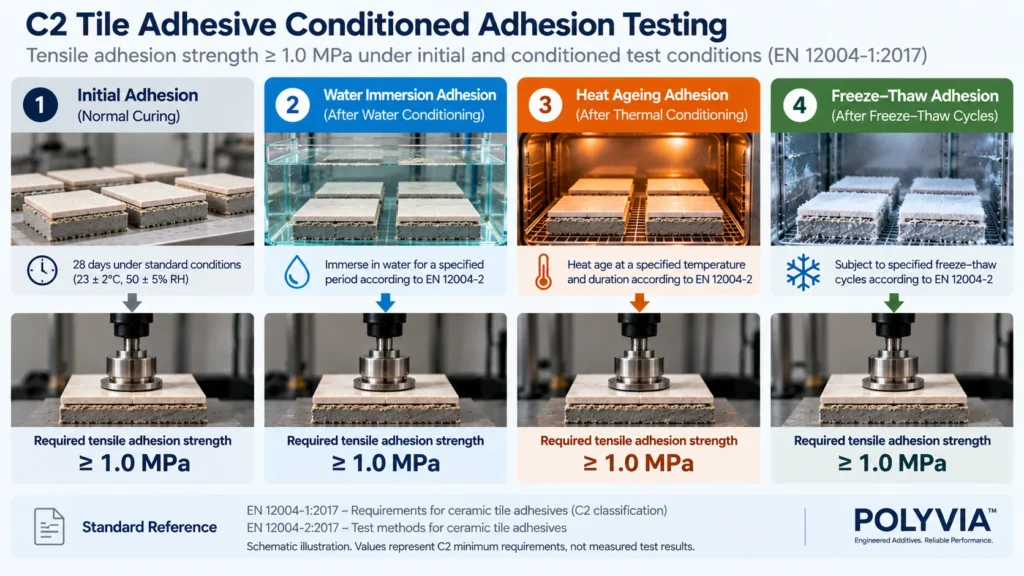
Under EN 12004-1:2017, normal-setting C2 cementitious adhesives must achieve at least 1.0 MPa tensile adhesion after initial curing and the relevant conditioning procedures.
For manufacturers, the challenge is not simply achieving high initial adhesion. The formulation must satisfy the required performance after water immersion, heat ageing, and freeze–thaw cycling.
1. C2 and C2TE Performance Requirements
Selected EN 12004-1:2017 Requirements
| Performance Property | C2 | C2TE |
|---|---|---|
| Initial tensile adhesion | ≥1.0 MPa | ≥1.0 MPa |
| Adhesion after water immersion | ≥1.0 MPa | ≥1.0 MPa |
| Adhesion after heat ageing | ≥1.0 MPa | ≥1.0 MPa |
| Adhesion after freeze–thaw cycles | ≥1.0 MPa | ≥1.0 MPa |
| Basic open time, at least 20 minutes | ≥0.5 MPa | ≥0.5 MPa |
| Extended open time, at least 30 minutes | Not required | ≥0.5 MPa |
| Reduced slip | Not required | ≤0.5 mm |
The table summarizes selected requirements for normal-setting cementitious adhesives. Complete performance classification must follow the applicable standard and prescribed testing methods.
The 1.0 MPa threshold applies to the four specified initial and conditioned tensile adhesion properties. It should not be applied incorrectly to every other C2 test.
2. Water-Conditioned Adhesion
Water immersion evaluates tensile adhesion after a defined moisture-conditioning procedure.
Performance may depend on polymer–cement compatibility, mortar structure, specimen preparation, and the selected raw materials.
A formulation that passes initial adhesion but fails after water immersion requires a different investigation from one that fails both conditions.
Manufacturers should examine the test procedure, failure mode, and selected RDP grade before deciding whether polymer dosage needs adjustment.
3. Heat-Aged Adhesion
Heat ageing evaluates the adhesive after prescribed elevated-temperature conditioning.
Polymer characteristics, cementitious matrix properties, and specimen preparation may influence the measured result.
The glass transition temperature (Tg) of an RDP grade provides useful information about polymer thermal behavior, but it cannot independently predict heat-aged tensile adhesion.
The actual conditioned performance must be measured.
4. Freeze–Thaw-Conditioned Adhesion
Freeze–thaw testing evaluates adhesion after specified conditioning cycles.
The response may depend on hardened mortar structure, moisture behavior, cement–polymer compatibility, and preparation conditions.
Passing this test supports the required C2 classification but does not independently guarantee suitability for every exterior environment or installation system.
5. C2TE, S1, and S2: Different Performance Characteristics
C2TE combines improved adhesion, reduced slip, and extended open time.
It does not automatically establish deformability.
The additional classifications are:
- S1: Transverse deformation of at least 2.5 mm but less than 5 mm.
- S2: Transverse deformation of at least 5 mm.
Deformability must be established through the applicable testing procedure.
Similarly, C2 or C2TE classification alone does not guarantee suitability for every large-format tile, heated substrate, movement-sensitive structure, or exterior installation.
The adhesive must be selected according to the complete tile installation system and project requirements.
VAE RDP Selection for Improved C2 Adhesion
RDP selection is one of the most important technical decisions in C2 formulation development.
The POLYVIA™ C2 reference contains 25 kg/MT commercial VAE RDP, equivalent to 2.5% of the dry mix.
The C2TE reference contains 35 kg/MT, equivalent to 3.5%.
These quantities provide practical starting points, but the suitable polymer grade must be evaluated through finished-mortar performance.
1. RDP Dosage Relative to Cement
Commercial RDP Dosage in C2 and C2TE
| Parameter | C2 | C2TE |
|---|---|---|
| Cement Content | 376 kg/MT | 369 kg/MT |
| VAE RDP | 25 kg/MT | 35 kg/MT |
| RDP / Total Dry Mix | 2.50% | 3.50% |
| RDP / Cement | 6.65% | 9.49% |
The RDP-to-cement values use commercial powder mass rather than measured active-polymer content.
A higher commercial powder dosage does not automatically establish higher initial or conditioned tensile adhesion.
2. Which RDP Properties Matter Most?
Commercial VAE RDP grades may differ in polymer composition, thermal characteristics, redispersion behavior, and compatibility with cement.
Technical Parameters for RDP Grade Selection
| Parameter | Technical Significance | Evaluation Priority |
|---|---|---|
| Polymer composition | Influences polymer-phase characteristics and compatibility | Confirm commercial grade and intended application |
| Glass transition temperature (Tg) | Describes an aspect of polymer thermal behavior | Interpret with polymer chemistry and intended conditions |
| Ash content | Indicates inorganic residue using the specified method | Compare equivalent test methods |
| Redispersion characteristics | Relevant to polymer distribution after water addition | Review powder behavior and mortar performance |
| Protective colloid system | May influence redispersion and additive interactions | Examine available technical specifications |
| Cement compatibility | Affects fresh and hardened adhesive properties | Test with the intended cement source |
| Conditioned adhesion | Directly relevant to C2 qualification | Evaluate water-, heat-, and freeze–thaw-conditioned adhesion |
| Batch consistency | Supports repeatable production | Compare representative supplier batches |
Tg and ash content are useful technical parameters, but neither provides a standalone ranking of RDP quality.
A lower Tg does not automatically guarantee better adhesion, and a lower ash content does not necessarily mean superior performance.
The preferred RDP grade is the one that demonstrates suitable finished-adhesive performance in the selected cementitious formulation.
3. How to Compare RDP Grades for C2
Start with the approved C2 reference composition containing 25 kg/MT commercial VAE RDP.
Compare alternative RDP grades at the same initial powder dosage.
Keep cement, aggregate, HPMC, HPS, calcium formate, and other ingredient quantities consistent wherever practical.
Record the mixing-water selection procedure and fresh-mortar characteristics.
Then evaluate the relevant standardized adhesion properties.
For C2TE, begin with the corresponding 35 kg/MT reference and include T/E requirements in the final qualification program.
4. RDP Cost-Performance Evaluation
At a hypothetical RDP price of USD 2.00/kg:
- C2 RDP contribution: 25 kg × USD 2.00 = USD 50/MT.
- C2TE RDP contribution: 35 kg × USD 2.00 = USD 70/MT.
- Difference attributable to RDP: USD 20/MT.
These figures are illustrative calculations, not verified market prices or POLYVIA™ quotations.
The complete formulation-cost difference also depends on cement, sand, HPMC, HPS, and other ingredient quantities.
For C2 development, polymer compatibility and conditioned adhesion qualification should precede cost optimization.
Calcium Formate, Defoamer, and Additive Compatibility
The POLYVIA™ C2 and C2TE reference formulations contain two auxiliary ingredient quantities that require particular attention:
Calcium Formate: 7 kg/MT
Defoamer: 2 kg/MT (Optional)
These amounts are established reference-formula quantities, not universal dosage recommendations for every commercial grade.
1. Calcium Formate and Cement Compatibility
Calcium formate represents 0.70% of the total dry mix.
Relative to cement content, this corresponds to approximately:
- 1.86% for C2.
- 1.90% for C2TE.
Calcium formate may influence hydration, setting behavior, and early-age development, depending on cement chemistry and the complete formulation.
Its effect should therefore be assessed using the intended cement source.
For C2TE, special attention should be given to extended open time.
A cement–additive combination that changes setting or surface behavior may influence adhesive transfer and the required 30-minute open-time adhesion result.
The appropriate response is a controlled compatibility investigation rather than automatic calcium formate removal.
2. Defoamer Selection and Air-Related Behavior
The listed 2 kg/MT defoamer represents 0.20% of dry-mix mass.
Different commercial defoamer grades can produce different results at the same dosage.
Possible effects include changes in air-related behavior, fresh density, mortar consistency, and hardened performance.
Manufacturers should evaluate the selected grade using appropriate observations or measurements rather than assuming that lower air content always produces a better adhesive.
3. HPMC and HPS Interaction
The C2 reference contains:
- HPMC: 4.0 kg/MT.
- HPS: 2.0 kg/MT.
The C2TE reference contains:
- HPMC: 4.5 kg/MT.
- HPS: 3.5 kg/MT.
HPMC can influence water retention and consistency, while HPS may modify rheology and adhesive-ridge stability.
For C2TE, an appropriate combination should support reduced slip without producing excessive resistance to spreading or inadequate tile contact.
Increasing viscosity or thickening strength alone is not a reliable formulation strategy.
4. Critical Compatibility Risks
Table 07. C2/C2TE Formulation Risk Matrix
| Variable | Potential Technical Risk | Priority Evaluation |
|---|---|---|
| RDP–cement system | Insufficient adhesion after conditioning | Initial and conditioned tensile adhesion |
| Calcium formate, 7 kg/MT | Unsuitable hydration or setting response | Cement compatibility, open-time adhesion |
| Defoamer, 2 kg/MT | Unfavorable air-related behavior | Fresh density, air-related measurements, adhesion |
| HPMC/HPS combination | Excessive spreading resistance or insufficient slip control | Trowelability, slip, tile contact |
| Silica sand grading | Variable water demand or mortar consistency | Particle-size distribution and water demand |
The listed risks are engineering considerations, not measured defects in the POLYVIA™ reference formulations.
The selected corrective action should follow a demonstrated performance limitation.
Water Demand, Tile Contact, and Application Performance
A C2 adhesive must provide both practical fresh-mortar behavior and the required finished-product adhesion.
Poor adhesive transfer or unsuitable tile contact can affect performance even when the formulation has sufficient cement and polymer content.
1. Determine Water Demand Separately
The C2 and C2TE reference formulations differ in RDP, HPMC, HPS, and aggregate quantities.
Consequently, their water requirements should be established independently through controlled trials.
The manufacturer should record actual water dosage, mixing procedure, consistency, trowelability, and tile-transfer observations.
No fixed mixing-water requirement has been established for these published reference versions.
2. Adhesive Ridge Stability vs. Tile Contact
Fresh mortar must maintain suitable ridges after notched application while allowing them to deform adequately when the tile is installed.
Three conditions are useful during development:
Insufficient Rheological Resistance
Ridges may collapse excessively or provide inadequate resistance to tile movement.
Balanced Rheology
The mortar can spread effectively, maintain suitable ridges, and allow appropriate adhesive contact.
Excessive Rheological Resistance
Ridges may resist compression and prevent adequate contact beneath the tile.
The desired response depends on the complete formulation and installation conditions.
3. Why C2TE Requires Additional Application Control
C2TE must satisfy the improved C2 adhesion requirements while also achieving reduced slip and extended open time.
These objectives may involve competing rheological requirements.
An adjustment that improves slip resistance but reduces adhesive transfer or open-time adhesion is not a successful optimization.
Manufacturers should evaluate trowelability, ridge stability, tile contact, and the prescribed T/E performance together.
4. How to Evaluate Tile Transfer
During development, use a consistent tile, substrate, trowel geometry, placement procedure, and exposure interval.
Where appropriate, lift representative tiles in exploratory trials to observe adhesive transfer and ridge deformation.
These observations can help identify application problems.
However, visual tile-contact checks do not replace standardized tensile adhesion testing.
The final selected preparation conditions must be validated using the intended commercial materials and applicable methods.
C2 Adhesion Failure Analysis and Controlled Trial Program
A C2 formulation may pass initial adhesion but fail after water immersion, heat ageing, or freeze–thaw cycling.
The appropriate investigation depends on the failed condition and supporting observations.
Increasing RDP without identifying the cause may increase cost without resolving the problem.
1. How to Prioritize the Investigation
Initial Adhesion Failure
Verify specimen preparation, mixing water, tile contact, curing, and polymer–cement compatibility.
Water-Conditioned Adhesion Failure
Check the immersion procedure, failure mode, and selected RDP grade. Compare compatible grades at equal commercial powder dosage before automatically increasing polymer quantity.
Heat-Aged Adhesion Failure
Examine thermal conditioning and polymer–cement behavior. Tg may support background evaluation but cannot replace the measured heat-aged adhesion result.
Freeze–Thaw Adhesion Failure
Verify the conditioning procedure and investigate mortar structure, moisture response, and material compatibility.
Multiple Adhesion Failures
Review general preparation conditions, mixing water, tile contact, and raw-material compatibility before isolating a single conditioning-specific mechanism.
A failed test suggests an investigation direction; it does not independently establish the root cause.
2. Failure-Oriented Troubleshooting Matrix
C2/C2TE Performance Troubleshooting
| Observed Failure | First Investigation | Controlled Evaluation |
|---|---|---|
| Initial adhesion below 1.0 MPa | Test procedure, tile contact, water dosage | Review RDP–cement compatibility and application conditions |
| Water-conditioned adhesion below 1.0 MPa | Immersion procedure, failure mode, polymer grade | Compare suitable RDP grades |
| Heat-aged adhesion below 1.0 MPa | Thermal conditioning, polymer characteristics | Evaluate controlled material variants |
| Freeze–thaw adhesion below 1.0 MPa | Conditioning procedure, moisture response | Investigate mortar structure and compatibility |
| C2TE extended open-time failure | Surface drying, tile wetting, setting behavior | Evaluate HPMC and calcium formate compatibility |
| C2TE slip above 0.5 mm | Water dosage, rheology, sand grading | Evaluate HPMC/HPS response |
| Slip passes but spreading is difficult | Excessive rheological resistance | Review modifier grades and adhesive transfer |
These are investigation priorities, not confirmed failure causes.
3. A Controlled Laboratory Trial Program
The POLYVIA™ C2 formulation containing 25 kg/MT VAE RDP provides a baseline for investigating polymer compatibility and auxiliary additive behavior.
Table 09. C2 Formulation Optimization Trial Matrix
| Trial | Formulation Variable | Objective | Main Evaluation |
|---|---|---|---|
| A — Baseline | Original C2 reference formula | Establish reference performance | Initial and conditioned tensile adhesion |
| B — RDP Grade | Alternative VAE RDP at 25 kg/MT | Investigate polymer–cement compatibility | Water-, heat-, and freeze–thaw-conditioned adhesion |
| C — Calcium Formate | Controlled variants from the 7 kg/MT baseline | Evaluate hydration and setting response | Setting-related behavior, open time, adhesion |
| D — Defoamer Grade | Alternative commercial grade at 2 kg/MT | Evaluate air-related behavior and compatibility | Fresh density, air-related properties, adhesion |
The trial matrix describes proposed experiments, not existing POLYVIA™ laboratory results.
Each trial series should use a consistently prepared baseline. RDP grade, calcium formate, and defoamer investigations should initially be conducted separately to avoid confounding multiple changes.
4. How to Conduct the Trials
Step 01 — Establish the Reference
Prepare the complete C2 formula with the selected commercial materials.
Record mixing water, preparation conditions, raw-material batches, and specimen identification.
Step 02 — Change One Defined Variable
For an RDP comparison, maintain the 25 kg/MT dosage.
For calcium formate or defoamer studies, investigate separately documented variants.
Step 03 — Preserve the 1,000 kg Batch Total
Any dosage change must be compensated by a corresponding change in the designated fine sand fraction.
For example, reducing calcium formate from 7 to 5 kg/MT requires increasing 70–120 mesh silica sand from 267 to 269 kg/MT.
This is an experimental variant, not a modification of the approved reference design.
Step 04 — Control Water-Comparison Conditions
Record the results at consistent water dosage and, where appropriate, under a defined target consistency.
Distinguish changes caused by water adjustment from those caused by raw-material chemistry.
Step 05 — Verify the Relevant Performance
Measure the targeted property and assess other applicable requirements.
Step 06 — Confirm Repeatability
Repeat promising trials using representative raw materials and suitable preparation procedures.
The final candidate must be evaluated against the complete intended classification requirements before commercial approval.
Laboratory Recipes and Production Qualification
The POLYVIA™ C2 and C2TE reference formulas can be scaled proportionally to smaller laboratory batches without changing their ingredient ratios.
Accurate weighing and reproducible preparation are particularly important for low-dosage functional additives.
1. Exact 5 kg and 25 kg Laboratory Formulations
C2/C2TE Laboratory Batch Quantities
| Raw Material | C2 — 5 kg | C2 — 25 kg | C2TE — 5 kg | C2TE — 25 kg |
|---|---|---|---|---|
| CEM I 42.5R Cement | 1,880 g | 9,400 g | 1,845 g | 9,225 g |
| Silica Sand, 40–70 mesh | 1,585 g | 7,925 g | 1,595 g | 7,975 g |
| Silica Sand, 70–120 mesh | 1,335 g | 6,675 g | 1,290 g | 6,450 g |
| VAE RDP | 125 g | 625 g | 175 g | 875 g |
| HPMC | 20 g | 100 g | 22.5 g | 112.5 g |
| Calcium Formate | 35 g | 175 g | 35 g | 175 g |
| HPS | 10 g | 50 g | 17.5 g | 87.5 g |
| Wood Fiber (Optional) | — | — | 10 g | 50 g |
| Defoamer (Optional) | 10 g | 50 g | 10 g | 50 g |
| Total Dry Mix | 5,000 g | 25,000 g | 5,000 g | 25,000 g |
The values are calculated directly from the 1,000 kg reference compositions and include the optional ingredients where listed.
Mixing water is not included.
2. What Must Be Verified Before Scale-Up?
Before pilot production, confirm:
- Raw-material identity and specifications.
- Accurate weighing and powder blending.
- Suitable mixing-water instructions.
- Representative fresh-mortar behavior.
- Applicable C2 tensile adhesion requirements.
- Additional T/E characteristics where C2TE is claimed.
- Repeatability using the intended production equipment.
A successful laboratory formulation does not automatically guarantee equivalent production-scale performance.
Mixer geometry, equipment loading, sand moisture, additive distribution, conveying, and packaging may influence finished-product consistency.
3. Managing Raw-Material Changes
Replacing cement, RDP, HPMC, HPS, or other components may alter mortar behavior even if the nominal formulation remains unchanged.
Supplier specifications can support initial material screening, but similar data-sheet values do not guarantee identical performance.
Changes should be documented, evaluated for technical risk, and supported by appropriate verification.
4. When Is a Formula Ready for Commercial Production?
A C2 or C2TE formulation should advance to commercial production only after its intended performance has been established and the manufacturing process has demonstrated suitable consistency.
The producer should maintain an approved formulation, raw-material specifications, production records, performance test reports, validated water instructions, and appropriate product documentation.
Any additional classification or market-specific claim must be supported by relevant evidence.
The POLYVIA™ reference formulas provide starting compositions for this qualification process. They are not presented as independently certified finished adhesive products.
5. Technical Support from POLYVIA™
POLYVIA™ supplies VAE redispersible polymer powder and cellulose ether products for cementitious dry-mix mortar applications.
Manufacturers evaluating C2 or C2TE reference formulas can share their target classification, cement source, sand grading, current additive system, and specific performance limitations.
This information supports more focused RDP and HPMC grade selection, controlled laboratory comparisons, and technical discussions.
Contact POLYVIA™ to discuss suitable additive grades, technical compatibility, and sample evaluation for C2/C2TE tile adhesive development.
Conclusion
Developing a reliable C2 tile adhesive requires more than adding a higher quantity of polymer powder.
The POLYVIA™ reference formulas use 25 kg/MT commercial VAE RDP for C2 and 35 kg/MT for C2TE, together with defined cement, silica sand, HPMC, HPS, calcium formate, and auxiliary additive quantities.
The critical objective is to establish improved tensile adhesion under the specified initial and conditioned testing procedures.
Compatible polymer–cement systems, controlled water demand, suitable tile contact, and careful evaluation of calcium formate and defoamer behavior are essential considerations during formulation development.
For C2TE, reduced slip and extended open time must be achieved without compromising the underlying C2 adhesion requirements.
A successful C2 or C2TE adhesive is defined by verified finished-product performance, reproducible manufacturing, and commercially practical total cost—not simply polymer dosage or a reference recipe.
Frequently Asked Questions
1. What is a practical C2 tile adhesive formula for 1,000 kg?
The POLYVIA™ C2 reference formula contains 376 kg CEM I 42.5R cement, 317 kg silica sand (40–70 mesh), 267 kg silica sand (70–120 mesh), 25 kg VAE RDP, 4 kg HPMC, 7 kg calcium formate, 2 kg HPS, and 2 kg optional defoamer.
The total is exactly 1,000 kg dry mix, excluding mixing water. Performance qualification is required before C2 compliance is claimed.
2. How much RDP is used in C2 and C2TE tile adhesive?
The POLYVIA™ C2 reference uses 25 kg/MT VAE RDP (2.5%), while C2TE uses 35 kg/MT (3.5%).
These quantities refer to commercial polymer powder and are not universal minimum dosages prescribed by EN 12004 or ISO 13007.
The appropriate grade and quantity must be evaluated through finished-adhesive performance.
3. What tensile adhesion strength must a C2 adhesive achieve?
For the specified initial, water-immersion, heat-ageing, and freeze–thaw test conditions, normal-setting C2 cementitious adhesives must achieve tensile adhesion of at least 1.0 MPa.
A satisfactory initial result does not compensate for failure under another required conditioning regime.
4. Why can C2 tile adhesive fail after water immersion?
Potential contributing factors include RDP–cement compatibility, hardened mortar structure, mixing-water dosage, specimen preparation, and conditioning conditions.
The appropriate response is to verify the test procedure and compare controlled formulation variants rather than assume additional RDP will solve the problem.
5. What HPMC viscosity and dosage are used for C2 tile adhesive?
The POLYVIA™ C2 reference contains 4.0 kg/MT HPMC, while C2TE contains 4.5 kg/MT.
Both specify a viscosity range of 50,000–100,000 mPa·s, measured using a Brookfield viscometer with a 2% aqueous solution at 20°C.
Actual performance depends on the commercial HPMC grade and complete mortar formulation.
6. Why do C2 and C2TE contain 7 kg calcium formate?
Both reference designs contain 7 kg/MT calcium formate (0.70% of dry mix).
Calcium formate may influence cement hydration and setting behavior, depending on the cementitious system.
For C2TE, manufacturers should pay particular attention to its compatibility with the extended-open-time requirement.
The stated quantity is a reference-formula input, not a universal recommendation.
7. Is C2TE automatically suitable for large-format tiles or S1 applications?
No.
C2TE identifies improved adhesion, reduced slip, and extended open time. S1 and S2 deformability are separate characteristics requiring additional testing.
Suitability for large-format tiles, heated substrates, and exterior installations depends on the complete tile, adhesive, substrate, and installation system.
8. Can these C2 and C2TE formulas be used directly for commercial production?
The formulas provide defined starting points for laboratory development.
Before commercial release, manufacturers must verify the applicable standardized adhesion requirements, establish mixing-water instructions, confirm production consistency, and support any additional classifications claimed for the finished adhesive.
References
[1] EN 12004-1:2017. Adhesives for ceramic tiles — Part 1: Requirements, assessment and verification of constancy of performance, classification and marking.
Official standard information: https://www.nen.nl/en/nen-en-12004-1-2017-en-230833
[2] EN 12004-2:2017. Adhesives for ceramic tiles — Part 2: Test methods.
Official standard information: https://www.nen.nl/en/nen-en-12004-2-2017-en-230792
[3] ISO 13007-1:2014. Ceramic tiles — Grouts and adhesives — Part 1: Terms, definitions and specifications for adhesives.
Official ISO publication: https://www.iso.org/standard/60880.html
[4] ISO 13007-2:2013. Ceramic tiles — Grouts and adhesives — Part 2: Test methods for adhesives.
Official ISO publication: https://www.iso.org/standard/60881.html
Formulation Experience & Technical Validation
The POLYVIA™ C2 and C2TE reference formulations are based on established dry-mix mortar formulations that we have supplied to customers in China for many years. These formulations have been widely applied in the Chinese market and have received consistently positive feedback for their practical performance and reliability.
Drawing on this extensive application experience, the published recipes have been refined and mass-balanced to provide clear, practical references for tile adhesive manufacturers worldwide.
As cement characteristics, raw materials, and production conditions vary between markets, manufacturers should conduct appropriate laboratory trials and verify the required performance in accordance with EN 12004 or ISO 13007 before commercial adoption or making classification claims.