
What Is GRC (GFRC)?
Understanding Glass Fiber Reinforced Concrete
Glass fiber reinforced concrete is a cement-based composite used in architectural cladding, decorative elements and precast components. Explore its materials, reinforcement mechanism, manufacturing methods and key considerations for GRC production.
What Is GRC (GFRC)?
Glass Fiber Reinforced Concrete (GFRC), also known as Glassfibre Reinforced Concrete (GRC), is a cement-based composite material reinforced with glass fibers designed for use in alkaline cementitious environments. It is widely used in architectural cladding, decorative facade elements, molded building components and other precast products where design flexibility, controlled component weight and fiber-reinforced performance are important.
Unlike conventional reinforced concrete, which commonly relies on steel reinforcement bars, GRC incorporates glass fibers into a cementitious matrix to influence its tensile and flexural behavior. When properly designed and manufactured, the composite can offer advantages for thin-section architectural components, complex shapes and specialized precast products.
However, GRC is not a single standardized mix design or manufacturing process. Its performance depends on the fiber system, matrix composition, production method, curing conditions, component geometry and quality control.
This guide explains what GRC is, how it works, which materials it contains, how it is manufactured, where it is used and what manufacturers should consider when selecting raw materials.
What Does GRC (GFRC) Mean?
GRC stands for Glassfibre Reinforced Concrete, a spelling commonly used in British and international industry contexts. GFRC stands for Glass Fiber Reinforced Concrete, using the American spelling of “fiber.”
Both terms generally refer to the same class of glass-fiber-reinforced cementitious composite. The difference is primarily terminology rather than a fundamental difference in material composition.
GRC is commonly used to manufacture architectural and precast products such as facade panels, decorative profiles, molded elements and selected building components. Its suitability depends on the ability to combine a cementitious matrix with an appropriate fiber reinforcement system and a manufacturing process suited to the intended product.
GRC should not automatically be considered interchangeable with conventional steel-reinforced concrete in structural applications. The structural function, loading conditions, connection design, applicable requirements and verification procedures must be evaluated for each intended use.
What Is GRC Made Of?
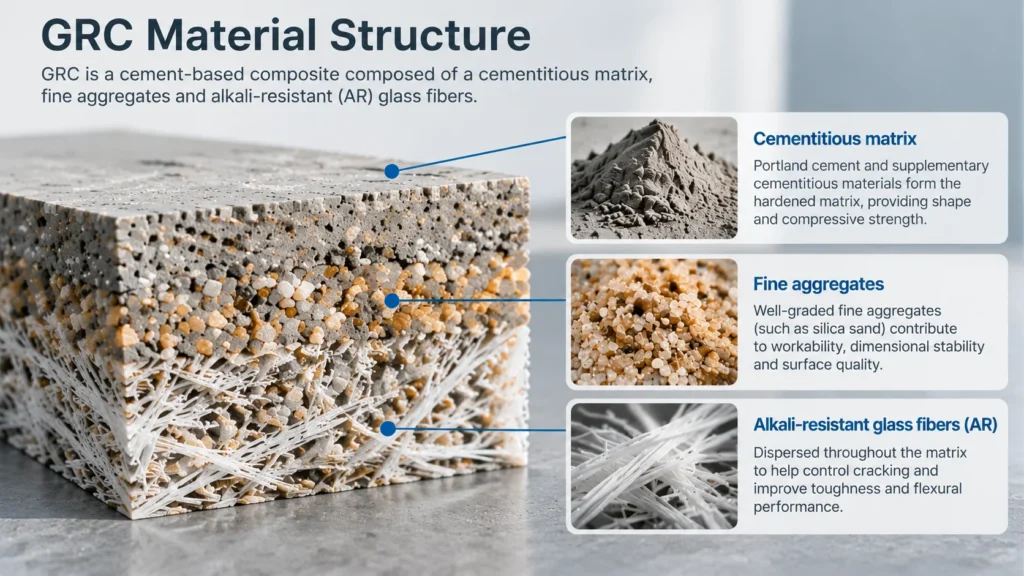
GRC is a composite system rather than a single raw material. The characteristics and compatibility of its constituents influence fresh-state processing, hardened performance and long-term durability.
1. Cementitious Binder
Cement is the primary hydraulic binder in conventional GRC formulations. Through hydration, it forms the hardened matrix that provides the component's shape and contributes to its mechanical properties.
Cement chemistry and consistency can influence setting behavior, early-age performance, water demand and admixture compatibility. Changes in cement source may therefore require renewed formulation evaluation.
2. Fine Aggregate
Fine aggregate contributes to the granular structure of the matrix and influences workability, dimensional stability and surface quality.
Particle-size distribution, particle shape, cleanliness and moisture condition can affect slurry rheology, mold filling and fiber distribution.
Conventional GRC formulations typically use fine aggregate rather than the coarse aggregate commonly found in structural concrete. The appropriate grading depends on the manufacturing method, component thickness and required surface finish.
3. Water
Water supports cement hydration and provides the workability required for mixing, spraying or casting.
Excessive water can increase capillary porosity and adversely affect hardened properties. Insufficient water or unsuitable rheology can make processing difficult, impair mold filling and complicate fiber incorporation.
The objective is to achieve the required fresh-mix behavior without adding unnecessary water. The appropriate water-to-binder ratio must be established for the actual formulation and production process.
4. Alkali-Resistant Glass Fiber
Alkali-resistant (AR) glass fiber is a key reinforcement material in conventional GRC.
Cementitious materials create a highly alkaline environment in which unsuitable glass fibers may deteriorate. AR glass fibers are specifically formulated to improve resistance to alkaline exposure and are widely used in conventional GRC systems.
Fiber selection should consider more than the product name. Relevant factors include fiber form, length, strand characteristics, dosage, dispersion behavior, compatibility with the matrix and suitability for the intended manufacturing process.
The contribution of glass fibers depends on how effectively stress is transferred between the matrix and the fibers. Fiber properties, matrix composition, interface behavior and processing conditions all influence the resulting composite performance.
Selecting an appropriate AR glass fiber is therefore fundamental to GRC formulation and production control. Fiber specifications and relevant performance requirements should be verified through technical documentation and appropriate testing.
5. Chemical Admixtures and Other Modifiers
Depending on the formulation, GRC may incorporate plasticizers, superplasticizers, polymer modifiers or other compatible additives.
A superplasticizer may help adjust fresh-mix flow and water demand. However, its effect depends on the cementitious system, fiber characteristics, dosage and processing conditions. PCE superplasticizer designed for conventional concrete should not automatically be assumed suitable for every GRC formulation.
Polymer modifiers and other functional additives may be used in selected systems where their contribution is technically justified. They are not mandatory ingredients in every GRC formulation.
The complete mixture must be evaluated to establish compatibility, processing behavior and final performance.
How Does GRC Work?
GRC combines a cementitious matrix with glass-fiber reinforcement. The matrix provides the continuous material phase, while the fibers influence how tensile stress is transferred and how cracks develop.
When a cementitious matrix is subjected to tensile or flexural loading, cracks may initiate once local tensile stresses exceed the matrix's resistance. Fibers crossing a developing crack can transfer stress across the crack faces and influence crack opening and post-cracking behavior.
The effectiveness of this mechanism depends on several interacting factors.
Fiber characteristics: Fiber length, geometry, strand integrity and reinforcement content influence the interaction between fibers and developing cracks.
Fiber distribution: Uneven distribution or agglomeration can create areas with inconsistent reinforcement.
Fiber–matrix interaction: Stress transfer depends on the interaction between the fibers and the surrounding cementitious matrix.
Matrix properties: Binder composition, water-to-binder ratio, porosity and curing conditions influence the material surrounding the fibers.
Manufacturing process: Fiber orientation, incorporation method and processing conditions affect the resulting composite.
Properly designed GRC can provide improved flexural behavior and post-cracking performance compared with an otherwise comparable unreinforced matrix. The extent of improvement must be established through relevant testing rather than assumed from fiber addition alone.
GRC is not crack-proof. Its performance depends on the complete material system, component design, loading conditions, curing and service environment.
What Are the Main Benefits of GRC?
Lightweight Component Design
GRC can be used to manufacture relatively thin architectural components, potentially reducing component weight compared with some conventional concrete alternatives of similar function. Actual weight savings depend on component geometry, thickness, reinforcement design and the reference product.
Complex Shapes and Surface Finishes
GRC can be molded into curved panels, decorative profiles, reliefs and other customized forms. This makes it useful for architectural applications where design flexibility and surface appearance are important.
Fiber-Reinforced Mechanical Performance
Appropriate fiber reinforcement can improve flexural behavior and influence post-cracking response. These benefits depend on fiber characteristics, matrix composition, production consistency and component design.
Manufacturing Flexibility
Different GRC production processes support different component geometries, production volumes and finishing requirements. Manufacturers can select the process and material system to suit the intended product.
Potential for Controlled Factory Production
Precast GRC manufacturing can support repeatable molding, curing and inspection procedures. Consistent results still require suitable equipment, trained operators, effective process control and a documented quality-management system.
These benefits are not automatic guarantees. Each product must be designed and verified against its intended performance requirements.
How Is GRC Manufactured?
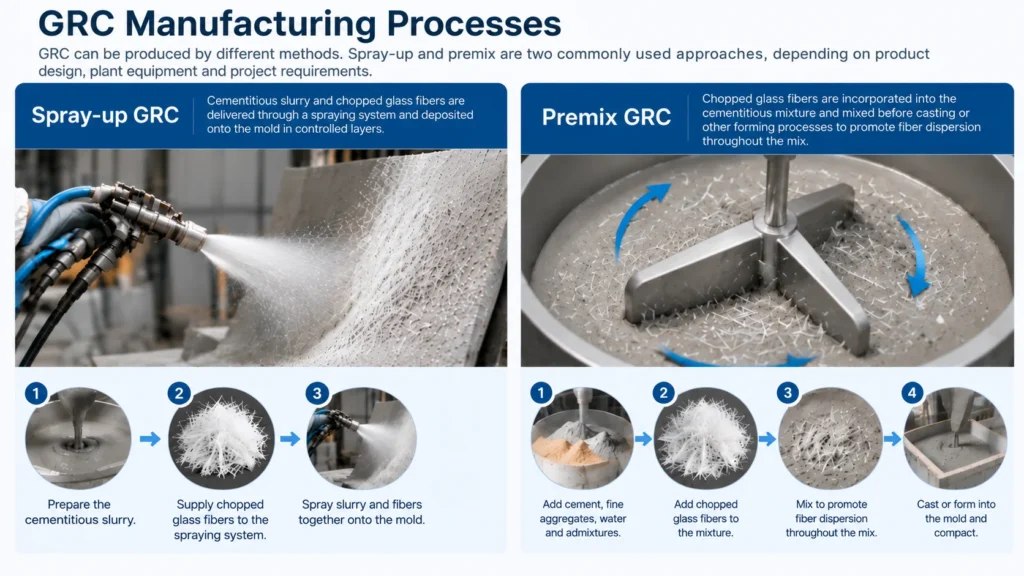
GRC can be produced through several manufacturing processes. The appropriate method depends on the reinforcement system, component geometry, required properties, production volume and available equipment.
Two widely recognized approaches are spray-up and premix. Premix itself includes multiple process variations, so it should not be treated as one single manufacturing method.
1. Spray-Up GRC
In a conventional spray-up process, cementitious slurry and chopped glass fibers are delivered to a mold through specialized spraying equipment. Material is deposited in layers to achieve the specified thickness, with compaction and other process controls applied as required.
Important process variables include:
- Slurry consistency and spray characteristics
- Fiber feed and deposition uniformity
- Layer thickness and compaction
- Mold preparation and component geometry
- Curing conditions and production quality control
Spray-up systems require suitable equipment and controlled fiber delivery. Their suitability depends on the product specification, production requirements and manufacturer's capabilities.
2. Premix GRC
In premix GRC, chopped glass fibers are incorporated into the cementitious mixture before casting or another placement process. The fresh mixture must remain workable enough to distribute the fibers and fill the mold while maintaining appropriate stability.
Premix production can include cast, spray-premix, press-molded, extruded and other specialized processes, depending on the product and equipment.
Important considerations include:
- Fiber length, content and strand integrity
- Addition sequence and mixing conditions
- Slurry rheology and mold-filling behavior
- Fiber dispersion and the risk of agglomeration
- Air content, compaction and curing
The maximum fiber content that can be incorporated effectively depends on the fiber system, mixture composition and mixing equipment. Increasing fiber content or mixing intensity without evaluating the complete system does not necessarily improve performance.
3. Choosing Between Spray-Up and Premix
Spray-up and premix are useful reference categories, but neither is universally superior.
Spray-up may suit components requiring specialized fiber deposition and layered placement. Premix may suit products manufactured by casting or other processes in which fibers are incorporated before placement.
The appropriate process depends on component design, required properties, production economics, equipment and quality-control capabilities.
For a detailed comparison of equipment, process control and material behavior, see the dedicated article on Spray-Up GRC vs. Premix GRC: Key Differences.
What Are the Main Applications of GRC?
Architectural Facade Panels
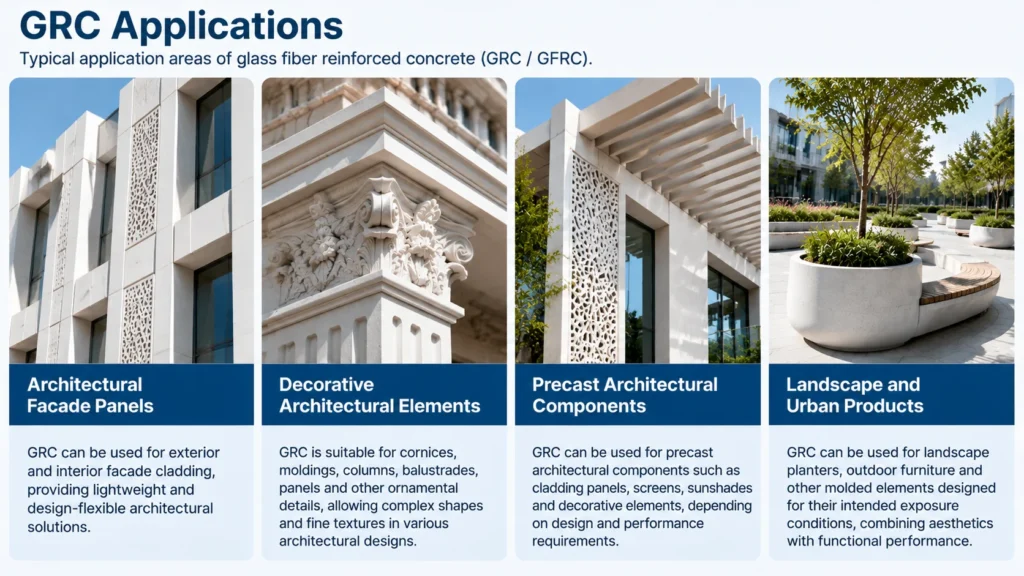
GRC is used in selected facade cladding and decorative panel systems where component geometry, surface appearance and weight are important design considerations.
The final panel design must account for fixing systems, loads, environmental exposure and relevant project requirements.
Decorative Architectural Elements
Applications include cornices, moldings, reliefs, decorative profiles and customized architectural details. GRC's molding flexibility can support complex shapes that would be difficult to produce economically using some conventional materials.
Landscape and Urban Products
Selected GRC formulations are used for planters, landscape features, street furniture and other molded products.
The formulation and design should be suitable for the expected moisture exposure, handling, loading and service environment.
Interior and Specialty Components
GRC may also be used in decorative interior panels and specialized prefabricated components where the material system meets the relevant performance requirements.
Across all applications, product suitability should be verified for the intended service environment and applicable building or project specifications.
How to Select Raw Materials for GRC Manufacturing
Material selection should begin with the intended product, required performance and manufacturing process. Selecting an individual additive without considering the complete formulation can lead to inconsistent results.
Select an Appropriate AR Glass Fiber
Confirm that the fiber is intended for cementitious reinforcement and that its technical documentation supports the intended application.
Evaluate fiber form, length, strand characteristics, compatibility with the manufacturing process and relevant performance evidence. Product consistency and documented specifications are important when comparing suppliers.
Evaluate Cement and Aggregate Compatibility
Cement chemistry, aggregate grading, moisture conditions and raw-material variation can affect workability, setting behavior and hardened performance.
Changes in raw-material sources should be evaluated rather than assumed to have no effect.
Optimize Fresh-Mix Workability
The mix must be workable enough for the selected process without relying on unnecessary additional water.
In premix GRC, slurry rheology must support fiber distribution and mold filling while maintaining appropriate stability. A compatible superplasticizer may help adjust flow and water demand, but its suitability must be demonstrated in the actual cement–fiber system.
Verify the Complete Composite
Individual raw-material specifications cannot establish the performance of the finished GRC component.
Depending on the intended product, evaluation may include fresh-mix behavior, flexural performance, dimensional stability, curing and relevant durability assessments.
A formulation that performs well with one cement source, fiber grade or mixing system may not behave identically when those inputs change.
How Is GRC Quality Controlled?
Quality control should cover raw materials, fresh-mix processing, curing and finished components. The specific acceptance criteria depend on the product, applicable requirements and intended service conditions.
Raw-Material Control
Verify incoming material identification, relevant technical specifications and batch consistency. Particular attention should be given to fiber characteristics, cement consistency, aggregate grading and the suitability of any admixtures.
Fresh-Mix and Production Control
Monitor the parameters relevant to the selected process, such as mixture consistency, fiber incorporation, deposition or casting behavior, component thickness and compaction.
For premix systems, fiber dispersion and mold-filling behavior are important considerations. For spray-up systems, fiber feed, layer deposition and process consistency require appropriate control.
Curing and Finished-Product Evaluation
Curing conditions can influence the development of matrix properties and the interaction between fibers and the cementitious material.
Finished-product evaluation should use methods appropriate to the intended application. Depending on the product, this may include flexural testing, dimensional checks, visual inspection, connection or fixing-system verification, and relevant durability assessments.
No single test result establishes every aspect of GRC performance. Manufacturers should define appropriate acceptance criteria and maintain records that support consistent production.
Common GRC Production Challenges
Poor Fiber Dispersion
Uneven distribution or fiber agglomeration may result from unsuitable fiber characteristics, addition sequence, mixing conditions or slurry rheology.
Troubleshooting should consider the complete production system rather than changing only one parameter.
Inadequate Workability
Insufficient or unsuitable flow may make mixing, spraying or mold filling difficult. Causes can include raw-material properties, mixture proportions, water content and admixture compatibility.
Excessive Water Demand
High water demand can complicate formulation control. Adding water without evaluating the consequences may adversely affect hardened properties.
Manufacturers should investigate the causes of poor workability and establish suitable mixture proportions through controlled trials.
Surface Defects
Surface defects may be associated with mold preparation, entrapped air, slurry consistency, compaction, placement or finishing procedures. The appropriate corrective action depends on the observed defect and the production process.
Inconsistent Mechanical Performance
Variations in raw materials, fiber distribution, curing or manufacturing conditions may contribute to inconsistent results.
Systematic process control and application-relevant testing are more reliable than assuming that a single additive or material change will resolve the problem.
For more focused troubleshooting, dedicated technical articles should address workability, fiber dispersion and surface defects separately.
Frequently Asked Questions
1. Is GRC the Same as GFRC?
Yes. GRC and GFRC generally refer to Glassfibre Reinforced Concrete and Glass Fiber Reinforced Concrete, respectively. The difference is primarily regional spelling.
2. Why Does GRC Use Alkali-Resistant Glass Fiber?
Cementitious materials create a highly alkaline environment that can degrade unsuitable glass fibers. AR glass fiber is formulated to improve resistance to alkaline exposure and is widely used for conventional GRC reinforcement. Fiber suitability should be verified against its technical specifications and intended application.
3. Is GRC Stronger Than Conventional Concrete?
There is no universal answer. GRC can provide useful flexural and post-cracking performance, but the results depend on the material system, fiber reinforcement, component geometry, curing and test conditions. Comparisons should be based on relevant performance data.
4. Can PCE Superplasticizers Be Used in GRC?
Selected PCE superplasticizers may be suitable for specific GRC formulations, particularly premix systems where flow and water demand require control. Compatibility depends on the cementitious materials, fiber system, dosage and manufacturing process. Laboratory trials are recommended before production use.
5. Can Polypropylene Fiber Replace AR Glass Fiber in Conventional GRC?
Polypropylene fiber is not a direct, like-for-like replacement for AR glass fiber in conventional GRC. The materials have different properties and reinforcement behavior. Any alternative reinforcement system requires its own formulation, design and performance verification.
6. What Is the Difference Between Spray-Up and Premix GRC?
In conventional spray-up production, slurry and chopped fibers are delivered to the mold through spraying equipment. In premix production, fibers are incorporated into the mixture before placement. Premix includes several manufacturing variations, and the appropriate process depends on the product and production requirements.
7. Is GRC Waterproof?
GRC should not automatically be considered waterproof. Moisture resistance depends on matrix composition, porosity, curing, cracks, joints, surface treatments and the complete component design. Where water resistance is required, it must be evaluated for the intended exposure conditions.
8. How Is GRC Quality Evaluated?
GRC quality evaluation depends on the intended product and applicable requirements. It may include raw-material checks, fresh-mix controls, dimensional and visual inspection, flexural testing, curing verification and relevant durability assessments. Manufacturers should establish appropriate test methods and acceptance criteria for their products.
Conclusion
GRC is a versatile glass-fiber-reinforced cementitious composite used in architectural cladding, decorative elements and a range of precast products. Its performance depends on the interaction between the matrix, glass-fiber reinforcement, manufacturing process, curing and quality control.
Reliable GRC production begins with selecting suitable raw materials and matching them to the intended process. Understanding fiber reinforcement, evaluating AR glass fiber specifications, controlling fresh-mix behavior and verifying finished-product performance are essential steps toward consistent quality.
For manufacturers evaluating reinforcement materials, POLYVIA™ offers an AR Glass Fiber product range for technical assessment. The appropriate grade should be selected according to the production method, material requirements and performance verification needs.
Technical References and Further Reading
- American Concrete Institute (ACI). ACI PRC-549.3-22: Glass Fiber-Reinforced Concrete Premix—Report. Technical information on premix materials, mixture proportions, manufacturing methods, engineering properties and applications.
- American Concrete Institute (ACI). ACI PRC-549.5-16: Report on Spray-up and Continuous Strand Glass Fiber-Reinforced Concrete (GFRC). Technical information on spray-up processes, continuous-strand systems, material properties and applications.
- International Glassfibre Reinforced Concrete Association (GRCA). Official Website and Technical Resources. Industry guidance and technical publications relating to GRC materials, production and performance.
These resources provide technical background for understanding GRC systems. Applicable requirements should be selected according to the intended product, manufacturing method and project specifications.