
Centrifugal Forming of PHC Spun Piles: Concrete Rheology, Cohesion and PCE Selection
Understanding Yield Stress, Plastic Viscosity, Mixture Stability and Material Redistribution During Centrifugal Forming
Why can two PHC concrete mixtures with similar slump values behave differently during centrifugal forming? Explore how yield stress, plastic viscosity, cohesion and time-dependent workability influence mold placement and material redistribution. Learn how to evaluate PCE superplasticizer compatibility through laboratory testing and representative PHC production trials.
1. Why Rheology Matters in PHC Spun Pile Production
Prestressed high-strength concrete (PHC) spun piles are manufactured using a specialized process in which concrete is placed into a longitudinal steel mold and subsequently formed through centrifugal rotation.
In a typical production arrangement, the reinforcement cage is positioned inside an open steel mold. Concrete is fed and distributed along the mold before closure and centrifugal forming. The specific production sequence depends on the plant's equipment and approved procedure.
Unlike conventional concrete placement, PHC manufacturing requires fresh concrete to perform under both placement-related forces and the subsequent centrifugal field.
This creates an important engineering challenge: a concrete mixture that appears workable in a conventional consistency test may not necessarily be suitable for centrifugal forming.
1.1 Flowability Is Only One Part of Workability
Fresh-concrete workability includes several interrelated characteristics:
- Ease of feeding and distribution along the mold.
- Movement around reinforcement.
- Resistance to unacceptable paste, water or aggregate separation.
- Consistency during the required handling interval.
- Response to centrifugal forming.
These characteristics cannot be fully represented by a single slump or flow measurement.
A high-flow mixture may have inadequate stability for a particular process. Conversely, a relatively stiff mixture may perform satisfactorily when the production equipment and procedure are designed for it.
1.2 Why Rheological Behavior Matters
Concrete rheology describes how fresh concrete resists deformation and flows under applied stress.
For PHC manufacturers, understanding rheology helps explain why concrete mixtures with similar conventional consistency values may behave differently during feeding, distribution and forming.
Yield stress, plastic viscosity and time-dependent behavior provide useful analytical concepts. Cohesion and segregation resistance add practical information about mixture stability.
1.3 The Role of PCE Superplasticizers
Polycarboxylate ether (PCE) superplasticizers can modify cementitious particle interactions and influence fresh-concrete flow behavior.
Their performance depends on the polymer formulation, cementitious materials, aggregate system, dosage and mixing conditions.
For PHC production, selecting PCE solely because it produces high flow or high nominal water reduction is insufficient.
The engineering objective is a balanced fresh-concrete response that supports the intended placement and centrifugal-forming process.
2. Understanding Yield Stress, Plastic Viscosity and Cohesion
Fresh concrete is a concentrated multiphase suspension. Its rheological behavior is influenced by cementitious paste, aggregate particles, water, chemical admixtures and their interactions.
Rheological models are useful for interpreting this behavior, although no single idealized model describes every concrete formulation under all conditions.
2.1 Yield Stress
Yield stress is the stress associated with the onset of sustained flow in a selected rheological representation.
In practical terms, it helps characterize the resistance that must be overcome before fresh concrete begins moving.
For PHC production, yield behavior can influence:
- Concrete feeding.
- Distribution along the mold.
- Movement around reinforcement.
- Response after temporary periods of rest.
A relatively high yield stress may make placement difficult under a particular feeding process.
A relatively low yield stress may improve mobility, but mixture stability must still be evaluated.
The appropriate value depends on the full production system.
2.2 Plastic Viscosity
Plastic viscosity is a rheological parameter describing flow resistance after yielding in a Bingham-type model.
For an ideal Bingham material:
[
tau = tau_0 + mu_pdot{gamma}
]
Where:
- (tau) = shear stress
- (tau_0) = yield stress
- (mu_p) = plastic viscosity
- (dot{gamma}) = shear rate
Real concrete may deviate from ideal Bingham behavior because of nonlinear response, thixotropy, shear history, wall slip, particle migration or segregation.
Consequently, reported rheological parameters should be interpreted with the measurement method and fitting model in mind.
For a deeper explanation of polymer adsorption and cement particle dispersion, see our guide on how PCE superplasticizers work.
2.3 Cohesion Is Not Equivalent to Plastic Viscosity
Cohesion is commonly used in concrete technology to describe the mixture's ability to maintain sufficient integrity during handling and placement.
It is influenced by aggregate grading, paste composition, particle interactions, water content and admixture formulation.
Although rheological properties can influence cohesive behavior, plastic viscosity alone is not a universal measure of cohesion.
Increasing viscosity does not automatically guarantee improved segregation resistance.
Similarly, a low-viscosity mixture does not necessarily segregate if its overall formulation provides adequate stability.
2.4 Segregation Resistance
Segregation resistance describes the ability of the mixture to avoid unacceptable separation of its constituents.
Potential manifestations include:
- Coarse-aggregate separation.
- Excessive paste migration.
- Bleeding or visible water separation.
- Nonuniform distribution during handling.
For PHC concrete, fresh-state segregation resistance is important but does not by itself predict the material distribution produced by centrifugal forming.
2.5 Thixotropy and Time-Dependent Behavior
Some cementitious mixtures rebuild internal structure while resting and become more fluid when subjected to shear.
This behavior is often described as thixotropy.
The practical significance depends on the interval between mixing, mold feeding and spinning.
A mixture may perform adequately immediately after mixing but become more difficult to distribute after a production delay.
Testing should therefore reflect the handling interval relevant to the factory.
2.6 Comparison of Key Properties
| Property | Technical Meaning | PHC Production Relevance |
|---|---|---|
| Yield stress | Resistance associated with initiating sustained flow | Mold feeding and distribution |
| Plastic viscosity | Flow resistance after yielding in a rheological model | Movement under continued shear |
| Thixotropy | Time-dependent structural breakdown and rebuilding | Delays between mixing and forming |
| Cohesion | Practical integrity of fresh concrete | Handling and placement stability |
| Segregation resistance | Resistance to unacceptable constituent separation | Placement and forming quality |
These properties interact, but they should not be treated as interchangeable.
A useful PHC rheological evaluation considers flow resistance, time dependence and mixture stability together.
3. Why Similar Slump Values Can Produce Different Forming Behavior
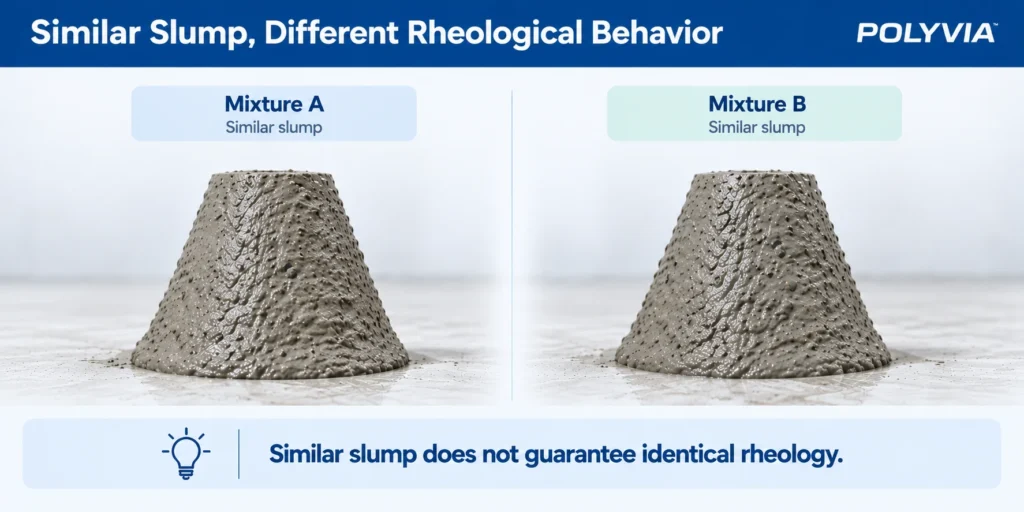
A common challenge in concrete production is that two mixtures may exhibit similar slump values but behave differently during actual manufacturing.
For PHC spun piles, this difference can affect feeding, distribution and centrifugal forming.
3.1 Slump Does Not Fully Describe Rheology
Slump is a practical consistency test, but it does not uniquely determine yield stress, plastic viscosity, thixotropy or segregation resistance.
Mixtures with similar slump may have different aggregate structures, paste characteristics and responses to continued shear.
As a result, a single slump value cannot reliably predict every aspect of PHC forming behavior.
3.2 Aggregate Grading Changes the Mixture Response
Aggregate grading affects particle packing, paste demand and interactions among particles.
Two mixtures with different aggregate size distributions may achieve comparable initial consistency but exhibit different resistance to movement or different stability during handling.
An unsuitable aggregate system cannot necessarily be corrected by increasing PCE dosage.
3.3 Paste Volume and Fine-Particle Content
Paste volume influences the interaction and lubrication of aggregate particles.
The amount and characteristics of fine particles also influence fresh-concrete behavior.
A mixture with insufficient paste for its aggregate system may be difficult to distribute even when its initial consistency appears acceptable.
Conversely, changes that increase mobility may also change the mixture's stability.
These properties should be evaluated together.
3.4 Mixing and Shear History
Concrete behavior can depend on the mixing process and the sequence of applied shear.
A mixture evaluated immediately after intensive mixing may behave differently after a period of rest.
Therefore, comparisons should use consistent preparation and testing procedures.
Where practical, record the time between mixing and measurement.
Because cement chemistry can affect admixture response, the relationship between rheological behavior and cement–PCE compatibility should also be considered during formulation evaluation.
3.5 The Importance of the Production Time Window
Consider two candidate mixtures that produce similar initial consistency readings.
One may retain suitable placement behavior throughout the planned feeding interval.
The other may develop additional resistance to movement during the same period.
If both are evaluated only immediately after mixing, this difference could be overlooked.
A representative time-series evaluation can therefore be more informative than a single initial measurement.
3.6 A Practical Comparison Example
For two candidate PCE formulations, a controlled assessment can include:
| Evaluation | Mixture A | Mixture B | Purpose |
|---|---|---|---|
| Initial consistency | Measure | Measure | Establish comparable starting conditions |
| Consistency after the required handling interval | Measure | Measure | Evaluate time dependence |
| Rheological response, where available | Measure | Measure | Examine differences beyond slump |
| Segregation and bleeding | Observe/test | Observe/test | Assess fresh-mixture stability |
| Mold placement | Observe | Observe | Compare actual feeding and distribution |
| Centrifugal forming | Verify | Verify | Establish production compatibility |
This is a proposed test comparison, not experimental data.
To isolate a particular influence, the comparison must control the relevant mixture variables.
For example, testing the effect of PCE formulation at fixed water content is a different experimental question from comparing water reduction at equal target consistency.
Both approaches can be useful, but their results should not be interpreted as equivalent.
3.7 Engineering Implication
A PHC producer should avoid selecting PCE solely on the basis of achieving the highest slump or flow spread.
Instead, the formulation must provide appropriate consistency and stability within the intended placement and forming process.
Similar slump values do not guarantee similar rheological behavior or centrifugal-forming performance.
4. Concrete Placement and Stability Before Spinning
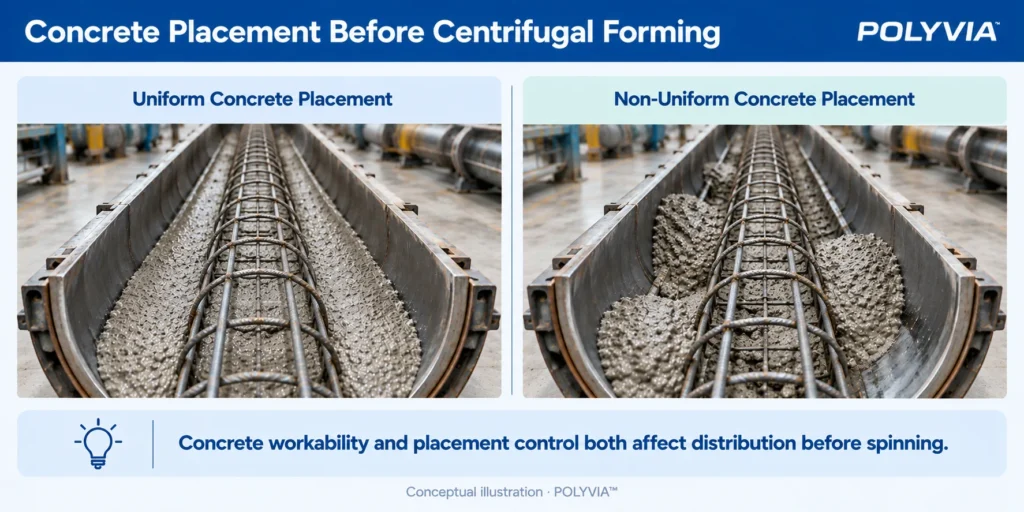
Before centrifugal forming, concrete must be fed into the mold and distributed according to the manufacturing procedure.
For a longitudinal mold arrangement, the reinforcement cage is positioned in the open steel mold before concrete placement.
After the intended distribution is achieved, the mold is closed and prepared for the subsequent forming operation.
4.1 Controlled Distribution Along the Mold
Because PHC molds can be relatively long, consistent concrete distribution along the mold is an important production consideration.
Inadequate distribution may create local variations in material quantity before spinning.
The feeding equipment, mixing conditions and concrete rheology all contribute to the placement process.
4.2 Workability Around Reinforcement
Reinforcement geometry can influence the movement of fresh concrete.
The mixture should exhibit adequate mobility for the intended feeding system without unacceptable separation.
A suitable laboratory consistency result does not automatically establish that concrete will distribute correctly around the actual reinforcement arrangement.
4.3 Excessive Fluidity and Inadequate Stability
Excessive fluidity is not inherently a defect.
However, a highly mobile mixture with insufficient stability may exhibit undesirable constituent separation.
Such behavior should prompt investigation of the complete formulation, including:
- Water content.
- Aggregate grading.
- Paste volume.
- Cementitious fines.
- PCE type and dosage.
- Other admixture components.
The cause should not automatically be attributed to PCE alone.
4.4 Excessive Resistance to Movement
A mixture may also be unsuitable because it is difficult to feed or distribute.
Potential contributing factors include insufficient paste lubrication, aggregate interactions, rheological structure development or unsuitable admixture compatibility.
The correct adjustment depends on identifying the controlling variable.
4.5 Practical Placement Observations
During representative production trials, record:
- Ease of concrete feeding.
- Longitudinal distribution along the mold.
- Movement around reinforcement.
- Visible bleeding or segregation.
- Local material accumulation.
- Time between mixing and placement.
These observations help connect laboratory test results with actual manufacturing performance.
Suitable PHC workability means controlled placement and adequate stability—not simply maximum concrete fluidity.
5. Centrifugal Forming and Radial Material Redistribution
Centrifugal forming subjects fresh concrete to rotational acceleration inside a closed mold.
This process promotes the formation and compaction of the hollow cylindrical wall, while potentially redistributing constituents within the fresh concrete.
The response depends on the concrete composition and the forming procedure.
5.1 Centrifugal Acceleration
The magnitude of the acceleration associated with rotation can be expressed as:
[
a = omega^2r
]
Where:
- (a) = centrifugal acceleration magnitude
- (omega) = angular velocity
- (r) = radial distance from the axis of rotation
At a constant angular velocity, acceleration magnitude increases with radial distance.
However, this expression describes rotational acceleration, not the detailed movement of concrete constituents.
It cannot independently predict material segregation, the resulting pore structure or the mechanical performance of the finished pile.
5.2 Why Constituents Can Redistribute
Fresh concrete contains particles and phases with different sizes, densities and mobilities.
Under centrifugal forming, the mixture is subjected to a complex mechanical environment.
Constituents may redistribute depending on:
- Aggregate density and grading.
- Paste characteristics.
- Water content.
- Rheological behavior.
- Mold geometry.
- Concrete quantity.
- Rotational speed history.
- Duration of forming stages.
Different combinations of these factors can produce different internal material distributions.
5.3 Radial Microstructural Differences
Research on PHC pipe pile concrete has identified radial variation in microstructural characteristics following centrifugal forming and curing [1,2].
The investigated properties include pore distribution, hydration-related microstructure and other material characteristics.
These findings demonstrate that a centrifugally formed pipe pile should not automatically be assumed to have identical properties throughout the wall thickness.
5.4 Radial Variation Is Not Necessarily a Defect
Material redistribution does not automatically imply unacceptable product quality.
The relevant question is whether the resulting concrete satisfies the applicable strength, dimensional, durability and other product requirements.
A measured radial difference must be interpreted against an appropriate acceptance framework.
It should not be labelled a defect solely because the material is not perfectly homogeneous.
For a complementary discussion of effective water demand and low water–binder ratio design, see our technical guide on PCE water reduction in PHC spun pile concrete.
5.5 How Rheology Influences Forming Behavior
Rheological properties can influence the movement and redistribution of fresh concrete under applied forces.
However, no universal relationship establishes that increasing plastic viscosity, lowering slump or increasing PCE dosage will improve centrifugal-forming performance.
The actual response must be established using representative materials and the intended spinning procedure.
5.6 Why Conventional Laboratory Results Are Not Enough
Conventional slump, flow and rheometer tests apply specific measurement conditions.
They do not reproduce every aspect of centrifugal forming, including rotational acceleration, aggregate redistribution and complex shear history.
Laboratory testing is therefore valuable for screening and diagnosis, but final suitability requires representative production verification.
5.7 What Should Be Verified?
Depending on the applicable specification and the plant's quality-control procedures, evaluation may include:
- Mold-filling and forming observations.
- Inner surface condition.
- Wall thickness and dimensional quality.
- Visible defects or abnormal separation.
- Relevant hardened-concrete properties.
- Repeatability between production batches.
Additional investigation of radial composition or microstructure may be appropriate when diagnosing a particular quality problem.
Such specialized testing is not automatically required for every routine batch.
The objective is not to eliminate every radial difference, but to produce PHC piles that consistently satisfy their specified quality requirements.
6. How to Select PCE for Rheological Balance
PCE superplasticizers influence cementitious particle dispersion and can modify the fresh-concrete rheological response.
Their suitability for PHC production should be evaluated according to the primary manufacturing requirement.
6.1 When Placement Mobility Is Inadequate
If concrete is difficult to feed or distribute, evaluate whether the mixture provides suitable dispersion and mobility.
A PCE adjustment may be one option.
However, aggregate grading, paste volume, effective water content and the feeding process should also be investigated.
Increasing PCE dosage is not necessarily the correct solution.
6.2 When Cohesion or Stability Is Inadequate
If a mixture exhibits bleeding, paste separation or other stability problems, evaluate the complete formulation.
The response may require changes to aggregate grading, binder fines, water content or admixture formulation.
A different PCE may improve compatibility, but PCE selection alone may not resolve a mixture-design problem.
6.3 When Workability Changes Before Forming
If the mixture becomes difficult to handle after a production delay, evaluate its time-dependent consistency and cement–PCE compatibility.
The comparison should reflect the actual interval between mixing and spinning.
A formulation that performs well immediately after mixing may not provide sufficient operational stability during the entire production window.
6.4 When High Water Reduction Is Required
High water-reduction PCE grades may be evaluated when the mixture needs to achieve the specified consistency at reduced effective water content.
POLYVIA™ offers suitable high water-reduction product families in powder, liquid and flake forms.
However, the product's physical form does not independently determine its rheological suitability.
The final result depends on the grade, dosage, preparation method and complete concrete formulation.
6.5 When Early Strength Is Also Required
Some PHC production systems must meet early-age strength requirements in addition to fresh-concrete forming requirements.
Early-strength-oriented PCE grades may then be included in the evaluation.
For example:
POLYVIA™ PCE ES980 is an early-strength-oriented coarse powder that must first be dissolved in water.
POLYVIA™ PCE PW888 is an early-strength-oriented fine powder suitable for direct dry blending.
Their selection should follow the intended preparation method and representative concrete testing.
Early-age strength and curing compatibility require separate verification; favorable rheology alone does not establish release-strength performance.
Explore the POLYVIA™ PCE product range to compare available supply forms and performance priorities before selecting grades for representative PHC concrete trials.
6.6 Selection Matrix
| Primary Production Problem | Evaluation Priority | Additional Variables to Check |
|---|---|---|
| Difficult mold feeding | Dispersion and placement mobility | Aggregate grading, paste volume, equipment |
| Excessive bleeding or separation | Cohesion and mixture stability | Water content, fines, grading, admixture system |
| Workability loss before spinning | Time-dependent consistency | Cement compatibility, temperature, handling interval |
| Inconsistent forming | Rheology–process compatibility | Spinning program, concrete distribution, mold conditions |
| Required early strength | Early-strength-oriented formulation | Binder chemistry, curing and strength testing |
| Excessive water demand | High water-reduction performance | Comparable-consistency mixture evaluation |
6.7 Why Product Ranking Should Be Avoided
A PCE grade should not be ranked as universally superior for PHC centrifugal forming based solely on laboratory spread, nominal water reduction or generic performance scores.
A product that achieves excellent initial dispersion may not provide the best balance of stability and production compatibility.
Grade selection must be based on the identified manufacturing constraint and supported by controlled laboratory and production trials.
7. Laboratory-to-Production Evaluation Framework
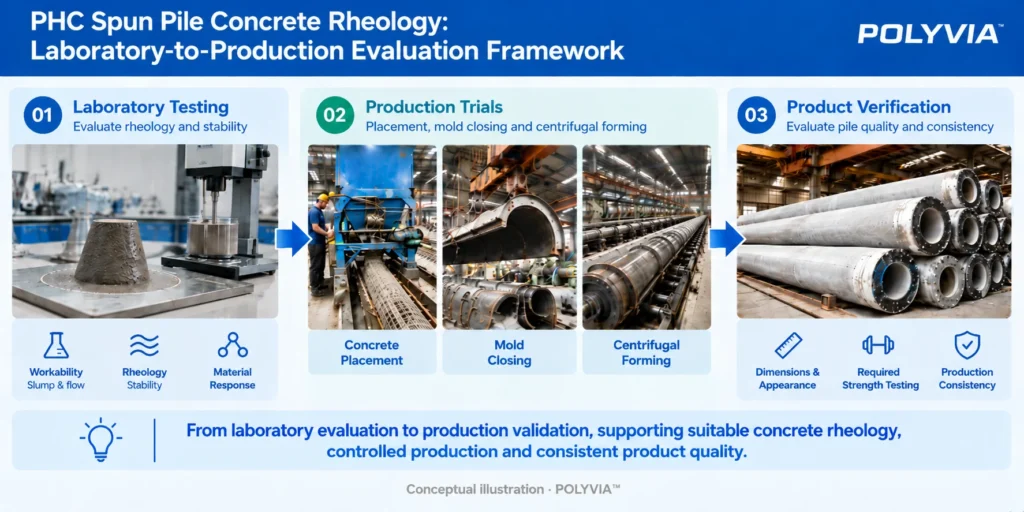
A technically useful PHC evaluation program should connect laboratory measurements with actual manufacturing observations.
The aim is to understand not only whether a mixture passes an individual test, but whether it performs reliably throughout the intended production process.
Step 1 — Define the Problem
Identify the primary performance issue:
- Difficult mold feeding.
- Uneven concrete distribution.
- Rapid loss of workability.
- Bleeding or segregation.
- Inconsistent centrifugal forming.
- Unsatisfactory finished-product quality.
The test plan should target the actual problem rather than attempt to optimize every property simultaneously.
Step 2 — Record the Reference Conditions
Document the existing mixture and production procedure.
Relevant information includes:
- Binder composition.
- Aggregate grading and moisture.
- Effective mixing water.
- PCE grade and dosage basis.
- Mixing procedure.
- Time from mixing to forming.
- Mold-feeding arrangement.
- Approved centrifugal-forming procedure.
Step 3 — Design a Controlled Comparison
Determine which variable is being studied.
For water-reduction evaluation: compare effective water demand at a defined target consistency.
For rheological evaluation: control the relevant mixture variables and compare the chosen rheological measurements.
For stability evaluation: combine suitable fresh-state tests with representative handling observations.
Changing several variables simultaneously can prevent meaningful interpretation.
Step 4 — Perform Laboratory Screening
Depending on the application and available equipment, measurements may include:
- Slump or slump-flow tests where appropriate.
- Rheological measurements.
- Time-dependent consistency.
- Bleeding or segregation tests.
- Fresh-concrete temperature.
If a concrete rheometer is used, record the measurement procedure, shear history and the selected model.
Different instruments and test procedures may produce values that are not directly interchangeable.
Step 5 — Conduct Representative Mold-Placement Trials
Observe the actual feeding and distribution process.
Document whether the mixture can be placed consistently along the mold and around the reinforcement.
Record visible bleeding, separation, local accumulation or handling difficulty.
Step 6 — Evaluate Centrifugal Forming
Use the plant's approved spinning procedure.
Record relevant forming observations and inspect the resulting product according to the applicable requirements.
Do not introduce unapproved changes to rotational speed or cycle duration during routine production.
Step 7 — Verify Finished-Product Quality
Confirm the applicable dimensions, visual condition and required material properties.
Laboratory consistency alone is not sufficient evidence that the finished pile meets its specification.
Where a particular defect is being investigated, additional testing may be required.
Step 8 — Confirm Repeatability
A favorable result from one trial does not establish long-term reliability.
Repeat the relevant evaluation under representative conditions and record variation across batches.
The required number of trials should follow the approved technical and quality-control procedure.
PHC Rheology–Forming Compatibility Matrix
| Laboratory Evaluation | Production Observation | Main Engineering Question |
|---|---|---|
| Initial consistency | Feeding and longitudinal distribution | Can the mixture be placed as required? |
| Rheological response | Movement during handling | Is flow resistance compatible with the process? |
| Bleeding and segregation resistance | Water or paste separation | Does the mixture maintain suitable stability? |
| Time-dependent consistency | Performance after production delays | Is the handling interval adequate? |
| Fresh-mixture stability | Response during centrifugal forming | Does the mixture form acceptably under the approved procedure? |
| Hardened-product testing | Wall quality and other product properties | Does the finished pile meet applicable requirements? |
| Repeated trials | Batch-to-batch behavior | Is the formulation sufficiently repeatable? |
This matrix is a recommended evaluation framework and does not represent POLYVIA™ experimental data.
Decision Guidance
Continue evaluation when laboratory results are favorable but production compatibility has not yet been demonstrated.
Investigate or adjust when a candidate mixture meets the initial consistency target but exhibits unacceptable placement, stability or forming behavior.
Approve for routine use only after the applicable production and product acceptance requirements have been satisfied.
Laboratory testing is a screening and diagnostic tool. Final PCE suitability for PHC centrifugal forming must be established through representative production verification.
Key Technical Conclusions
PHC spun pile manufacturing requires fresh concrete with suitable rheological behavior during placement and centrifugal forming.
Slump and flow measurements are useful but do not fully describe yield behavior, plastic viscosity, cohesion, thixotropy or segregation resistance.
Two mixtures with similar slump values may therefore behave differently during actual production.
Centrifugal forming can redistribute constituents and create radial differences in the developing concrete wall. These differences must be evaluated against applicable finished-product requirements rather than automatically classified as defects.
PCE superplasticizers can influence dispersion and fresh-concrete behavior, but the appropriate formulation depends on cement chemistry, aggregate grading, water content and production conditions.
High water reduction, initial workability, mixture stability and early-strength performance are related but distinct evaluation priorities.
For PHC producers, the most reliable selection strategy combines controlled laboratory testing with representative placement, centrifugal-forming and finished-product verification.
The optimum PCE formulation is not necessarily the one that produces the highest laboratory flow. It is the one that provides the required rheological balance and reliable performance under the intended PHC manufacturing conditions.
Frequently Asked Questions
1. Why is concrete rheology important for PHC spun piles?
Rheology influences fresh-concrete movement, flow resistance and handling behavior. PHC production requires suitable workability and stability during mold placement and centrifugal forming.
2. Can two PHC concrete mixtures with the same slump behave differently?
Yes. Similar slump values do not guarantee equivalent plastic viscosity, thixotropy, cohesion or segregation resistance. Mixtures may therefore behave differently during actual production.
3. What is the difference between yield stress and plastic viscosity?
Yield stress is associated with the onset of sustained flow in a selected rheological model. Plastic viscosity describes resistance during continued flow in a Bingham-type representation.
4. Does higher viscosity always improve concrete stability?
No. Stability depends on aggregate grading, paste characteristics, water content, admixtures and other mixture properties. Higher viscosity alone does not guarantee better segregation resistance.
5. How does PCE affect PHC concrete rheology?
PCE can improve cementitious particle dispersion and change fresh-concrete flow behavior. The actual response depends on polymer formulation, cement compatibility, dosage and the complete concrete mixture.
6. Does centrifugal forming create uniform concrete throughout the pile wall?
Not necessarily. Research has identified radial differences in the microstructure of centrifuged PHC concrete. Their significance depends on the finished product's applicable performance requirements.
7. Which PCE is most suitable for PHC centrifugal forming?
There is no universally suitable grade. Selection depends on the required placement mobility, time-dependent workability, mixture stability, water-reduction performance and any additional strength requirements.
8. How should PHC manufacturers evaluate PCE suitability?
Use controlled laboratory tests, followed by representative mold-placement and centrifugal-forming trials. Confirm finished-product quality and repeatability against the applicable acceptance criteria.
Scientific References
[1] Han, X., Wei, D., Wang, P., Wang, M., Du, Z., & Ling, Z. (2024). Microstructure characteristics and evolution of pipe pile concrete under centrifugation and steam curing. Construction and Building Materials, 450, 138554.
https://doi.org/10.1016/j.conbuildmat.2024.138554
[2] Han, X., Du, Z., Wang, P., Zhang, R., Gao, J., Ling, Z., & Wei, D. (2023). Multi-scale microstructure quantitative characterization and anti-erosion performance of PHC pipe pile. Construction and Building Materials, 406, 133464.
https://doi.org/10.1016/j.conbuildmat.2023.133464
[3] Zhang, Q., Chen, J., Zhu, J., Yang, Y., Zhou, D., Wang, T., Shu, X., & Qiao, M. (2022). Advances in Organic Rheology-Modifiers (Chemical Admixtures) and Their Effects on the Rheological Properties of Cement-Based Materials. Materials, 15(24), 8730.
https://doi.org/10.3390/ma15248730
[4] Lei, L., & Plank, J. (2023). 40 Years of PCE Superplasticizers — Current State of the Art and Future Perspectives. ce/papers, 6(6), 594–599.
https://doi.org/10.1002/cepa.2804
[5] Fares, G., Al-Negheimish, A., Alhozaimy, A. M., & Khan, M. I. (2022). Polycarboxylate superplasticizer and viscosity modifying agent: Mode of addition and its effect on cement paste rheology using image analysis. Journal of Building Engineering, 48, 103946.
https://doi.org/10.1016/j.jobe.2021.103946
Reference Scope: References [1] and [2] support the discussion of PHC centrifugal forming and radial microstructural variation. References [3]–[5] provide scientific background on cementitious rheology and PCE-related admixture behavior. These publications do not constitute PHC-specific performance validation of POLYVIA™ commercial grades.