
Early-Strength PCE for PHC Spun Piles: Strength Development, Curing Compatibility and Release Criteria
Understanding Early-Age Strength, Steam-Curing Compatibility and Production Release Requirements
Explore how early-strength polycarboxylate ether (PCE) superplasticizers influence strength development in PHC spun pile concrete. Understand the relationships between cement hydration, steam curing and release-strength requirements, discover how to evaluate early-strength PCE formulations, and examine a real POLYVIA™ PW888 application at a spun pile factory in Thailand.
Why Early Strength Matters in PHC Spun Pile Production
Prestressed high-strength concrete (PHC) spun piles are manufactured through a controlled sequence involving reinforcement preparation, concrete feeding, mold closure, centrifugal forming and curing.
For a PHC manufacturer, achieving the required early-age concrete strength is an important production objective. It influences when a pile can be demolded, when prestress can be transferred and when subsequent handling or production operations may proceed.
However, early strength is not determined by the superplasticizer alone. It depends on the combined effects of cementitious materials, effective water content, concrete forming, admixture compatibility and curing conditions.
Early-strength polycarboxylate ether (PCE) superplasticizers are formulated for applications where water reduction and early-age performance are important. Their suitability must be evaluated against the actual manufacturing requirements.
1. Early-Age Strength vs. Release Strength
Early-age compressive strength refers to concrete strength measured at a specified time after mixing or casting.
Release strength is the strength required before a particular production operation is permitted.
For PHC manufacturing, several criteria may be relevant:
| Strength Requirement | Technical Meaning | Production Relevance |
|---|---|---|
| Early-age compressive strength | Measured compressive strength at a defined age | Evaluates the strength-development profile |
| Demolding strength | Required strength before removing the mold | Determines whether demolding may proceed |
| Prestress-transfer strength | Required strength before transferring prestressing force to the concrete | Supports safe and controlled prestress transfer |
| Specified later-age strength | Required strength at a specified later age | Confirms compliance with the applicable product specification |
These requirements are related but not interchangeable.
The applicable release criterion must be established by the relevant product standard, approved manufacturing procedure or engineering specification.
A high compressive-strength result does not automatically establish every aspect of production readiness.
2. Why Early Strength Affects Mold Turnover
PHC production schedules depend partly on how long molds remain occupied before the next production operation.
If the concrete does not reach the required release strength within the planned period, demolding or other operations may need to be delayed.
A suitable early-strength PCE formulation may contribute to a production system designed to meet these requirements.
However, a shorter production cycle can only be claimed when the complete concrete mixture, forming process and curing procedure achieve the specified acceptance criteria.
3. The Correct Optimization Objective
The goal is not simply to maximize compressive strength as early as possible.
The concrete must also exhibit suitable fresh-state behavior, acceptable centrifugal-forming quality and adequate later-age performance.
Effective early-strength optimization means achieving the required release strength consistently under the intended PHC production and curing conditions.
How Early-Strength PCE Influences Concrete Strength Development
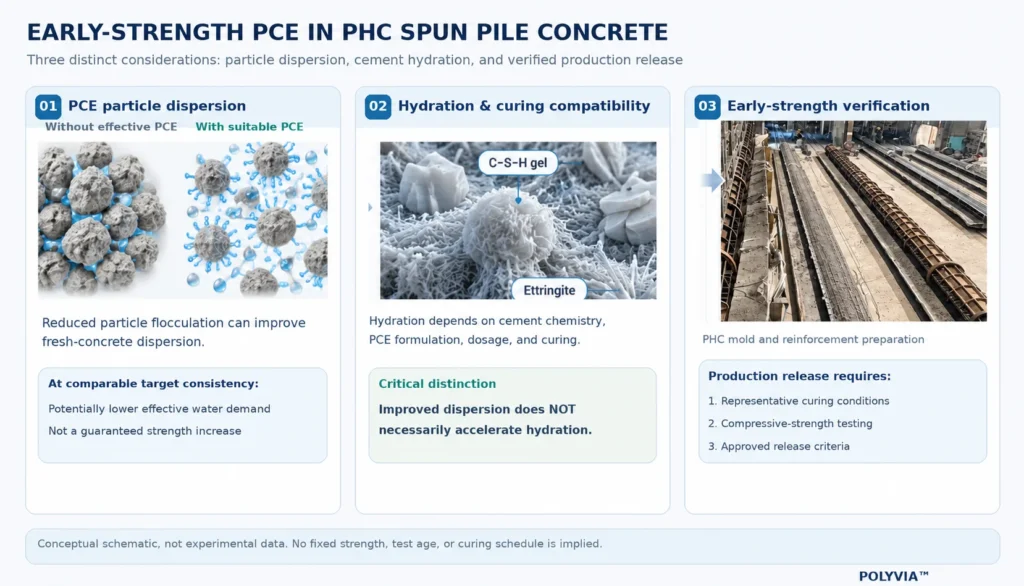
PCE superplasticizers can improve cementitious particle dispersion by modifying interactions among particles.
This can help a concrete mixture achieve its required consistency with less effective mixing water.
However, improved dispersion and accelerated cement hydration are different phenomena. Their effects on early-age strength must be evaluated separately.
1. Dispersion and Water Reduction
PCE molecules can adsorb onto cementitious particle surfaces, contributing to steric stabilization and reducing particle flocculation.
With a suitable PCE formulation, the mixture may achieve its target consistency at a lower effective water content.
When the concrete is appropriately proportioned, compacted and cured, a lower water–binder ratio can support the development of a denser hardened matrix.
This is one pathway through which PCE may contribute to strength development.
It does not prove that a specific PCE directly accelerates cement hydration.
2. PCE Can Influence Cement Hydration
PCE formulations differ in molecular architecture, adsorption behavior and interactions with cementitious materials.
Certain PCE polymers can influence early cement dissolution, ion concentrations, hydrate formation and setting behavior.
Research by Zhu and colleagues found that the specific PCE investigated increased the initial dissolution rate of cement while subsequently retarding early hydration under the study conditions [1].
This distinction is important.
A superplasticizer can improve fresh-concrete dispersion without necessarily accelerating the formation of hydration products.
The hydration response must be evaluated for the specific polymer and cementitious system.
3. Early-Strength-Oriented PCE Is Not Automatically a Hydration Accelerator
The term early-strength PCE identifies an intended performance objective.
It does not establish that every early-strength PCE formulation accelerates cement hydration through the same molecular mechanism.
Early-age strength may benefit from an optimized combination of water reduction, particle dispersion, binder composition, hydration behavior and curing.
Depending on the formulation, supplementary components may also influence setting or strength development.
Unless the polymer structure and formulation have been independently characterized, a specific mechanism should not be assigned to a commercial grade solely from its product designation.
4. Why Cement Chemistry Matters
Cement composition, sulfate availability, fineness and supplementary cementitious materials can affect PCE adsorption and hydration behavior.
Consequently, the same PCE formulation may produce different consistency, setting or strength-development results when used with different cements.
This is particularly important for production facilities that receive cement from multiple suppliers.
When early strength changes after a raw-material substitution, the complete binder–PCE system should be re-evaluated.
5. The Technical Distinction
| Performance Aspect | Main Question | How It Should Be Evaluated |
|---|---|---|
| Dispersion efficiency | Does the PCE provide suitable fresh consistency? | Controlled paste, mortar or concrete testing |
| Water reduction | Does the admixture reduce effective water demand at comparable consistency? | Comparable reference and admixture concrete mixtures |
| Hydration behavior | Does the formulation alter hydration kinetics? | Suitable hydration or setting investigations |
| Early-age strength | Does concrete achieve the required strength at the specified age? | Compressive-strength testing |
| Release readiness | Can the specified production operation proceed? | Verified strength and applicable acceptance criteria |
Good dispersion is beneficial, but only measured concrete performance can establish whether a formulation meets the required early-strength objective.
Cement Hydration, Setting and Early-Age Strength
Understanding the distinction between setting and strength development helps producers diagnose early-strength problems more accurately.
Setting is related to the formation of a developing cementitious structure, while compressive strength reflects the load-bearing capacity of the hardened material at a specified age.
The two are connected but are not interchangeable measurements.
1. Initial Setting and Strength Development
Concrete that has reached initial or final setting has not necessarily achieved the strength required for demolding or prestress transfer.
Similarly, a shorter setting time does not automatically establish a higher compressive strength at the production release age.
A formulation must therefore be evaluated using the property required by the manufacturing procedure.
Where compressive strength governs release, setting results should be treated as supporting information rather than a substitute for strength testing.
2. Early Hydration and Temperature Sensitivity
Cement hydration is temperature-sensitive.
Under suitable conditions, an increase in concrete temperature can accelerate hydration and early strength development.
However, the response depends on cement chemistry, mixture proportions, temperature history and the duration of curing.
Different combinations of cement and PCE may not respond identically to an accelerated curing schedule.
3. Supplementary Cementitious Materials
Fly ash, slag, silica fume and other supplementary cementitious materials can influence fresh-concrete properties, hydration and strength development.
Their effect depends on material characteristics, replacement level and curing conditions.
A change in supplementary cementitious materials may alter the PCE dosage requirement and early-age strength response.
Any adjustment should be evaluated within the complete mixture rather than attributed to one ingredient.
4. Why Early-Strength Testing Requires Controlled Comparisons
If several variables are changed simultaneously, it becomes difficult to determine which factor caused a measured difference in strength.
For example, changing the cement source, water content, PCE grade and curing schedule in one trial does not isolate the effect of the admixture.
A controlled experimental design should distinguish:
- The influence of water content.
- The influence of PCE formulation and dosage.
- The influence of cementitious binder composition.
- The influence of curing temperature and duration.
- The influence of specimen preparation and testing procedures.
5. Interpreting the Results
| Observation | What It May Indicate | What It Does Not Prove |
|---|---|---|
| Improved initial consistency | More effective dispersion | Faster hydration |
| Lower effective water content | Reduced water demand at the evaluated consistency | Guaranteed early strength |
| Shorter setting time | Earlier development of setting characteristics | Achievement of release strength |
| Higher early-age compressive strength | Improved strength under the tested conditions | Universal performance across all PHC mixes |
| Earlier achievement of release strength | Potential compatibility with the specified production schedule | Guaranteed cycle-time reduction in every plant |
A technically valid conclusion must match the property that was actually measured.
Steam-Curing Compatibility in PHC Spun Pile Production
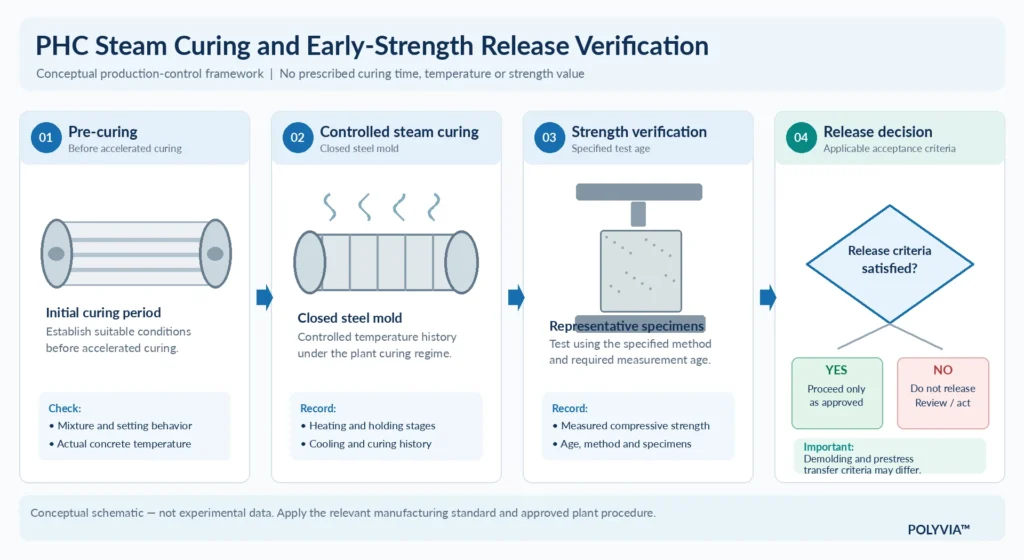
PHC manufacturing often uses controlled curing procedures to achieve the required concrete performance within a defined production cycle.
However, the exact curing regime varies with the product specification, binder composition, plant equipment and manufacturing procedure.
Pre-curing, atmospheric steam curing and autoclaving are distinct processes and should not be presented as one universal production sequence.
1. Pre-Curing Before Accelerated Curing
Following concrete placement and centrifugal forming, a production procedure may include an initial period before accelerated curing begins.
This period allows the concrete to develop an appropriate initial structure for the subsequent temperature increase.
The suitable duration depends on the mixture, concrete temperature, setting characteristics and intended curing schedule.
Insufficient pre-curing or an unsuitable heating profile may adversely affect concrete performance.
2. Steam Curing and Early Strength
Atmospheric steam curing changes the temperature history of concrete and can accelerate strength development.
Its effectiveness depends on the complete curing process, including:
- Initial concrete temperature.
- Pre-curing duration.
- Heating rate.
- Maximum temperature.
- Holding period.
- Cooling procedure.
- Binder composition.
- Admixture compatibility.
A suitable curing schedule should be established for the actual PHC concrete formulation.
There is no universally optimal steam-curing temperature or duration that applies to every production facility.
3. Autoclave Curing Is a Separate Process
Autoclaving involves elevated temperature and pressure.
It differs from atmospheric steam curing in its operating conditions and potential effects on cementitious reaction products and concrete microstructure.
Research on PHC pipe piles has investigated the differences between steam curing and autoclave curing, including their effects on pore structure, microcracking and durability [2].
The findings reinforce the importance of evaluating curing conditions rather than assuming that all accelerated curing methods produce equivalent results.
4. Why PCE Compatibility Must Be Tested Under Actual Curing Conditions
A formulation that performs well under ambient laboratory conditions may exhibit different setting or strength-development behavior during accelerated curing.
Therefore, early-strength PCE evaluation should reproduce the intended curing procedure as closely as practical.
The evaluation should consider both the required early-age strength and the applicable later-age performance requirements.
5. Avoiding Over-Acceleration
Achieving release strength quickly is valuable only when the finished product continues to satisfy its specified performance requirements.
An aggressive curing schedule should not be adopted solely because it produces a favorable early-age strength result.
Later-age strength, dimensional stability and relevant durability properties must also be considered.
A successful PHC curing strategy achieves the specified production strength without compromising the quality requirements of the finished pile.
Selecting Early-Strength PCE Grades for PHC Production
POLYVIA™ offers PCE grades designed around different performance priorities and supply forms.
For PHC production, the selection process should begin with the required strength-development profile, concrete consistency, production method and curing conditions.
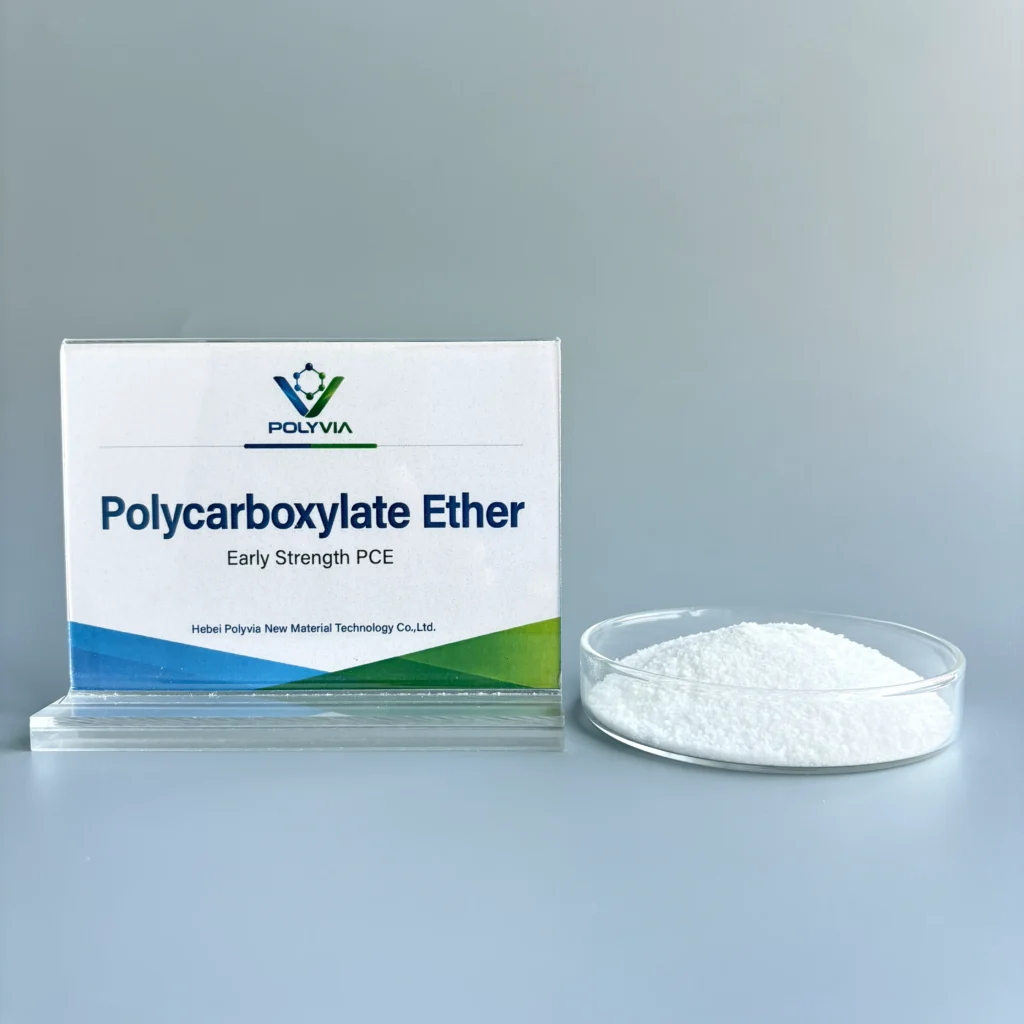
1. POLYVIA™ PCE ES980 — Early-Strength Coarse Powder
POLYVIA™ PCE ES980 is an early-strength-oriented polycarboxylate ether superplasticizer supplied in coarse powder form.
The available ES980 technical data sheet declares the following specifications:
| Parameter | Declared Specification |
|---|---|
| Product grade | PCE ES980 |
| Performance focus | Early strength and high water reduction |
| Appearance | White coarse powder |
| Solid content | ≥98.0% |
| Moisture content | ≤2.0% |
| Water-reduction rate | ≥27% |
These are manufacturer-declared product specifications.
The declared water-reduction rate is not a PHC-specific strength result and should not be interpreted as a guarantee for every concrete formulation.
ES980 must first be dissolved in water before use, following the appropriate preparation procedure.
2. POLYVIA™ PCE PW888 — Early-Strength Fine Powder
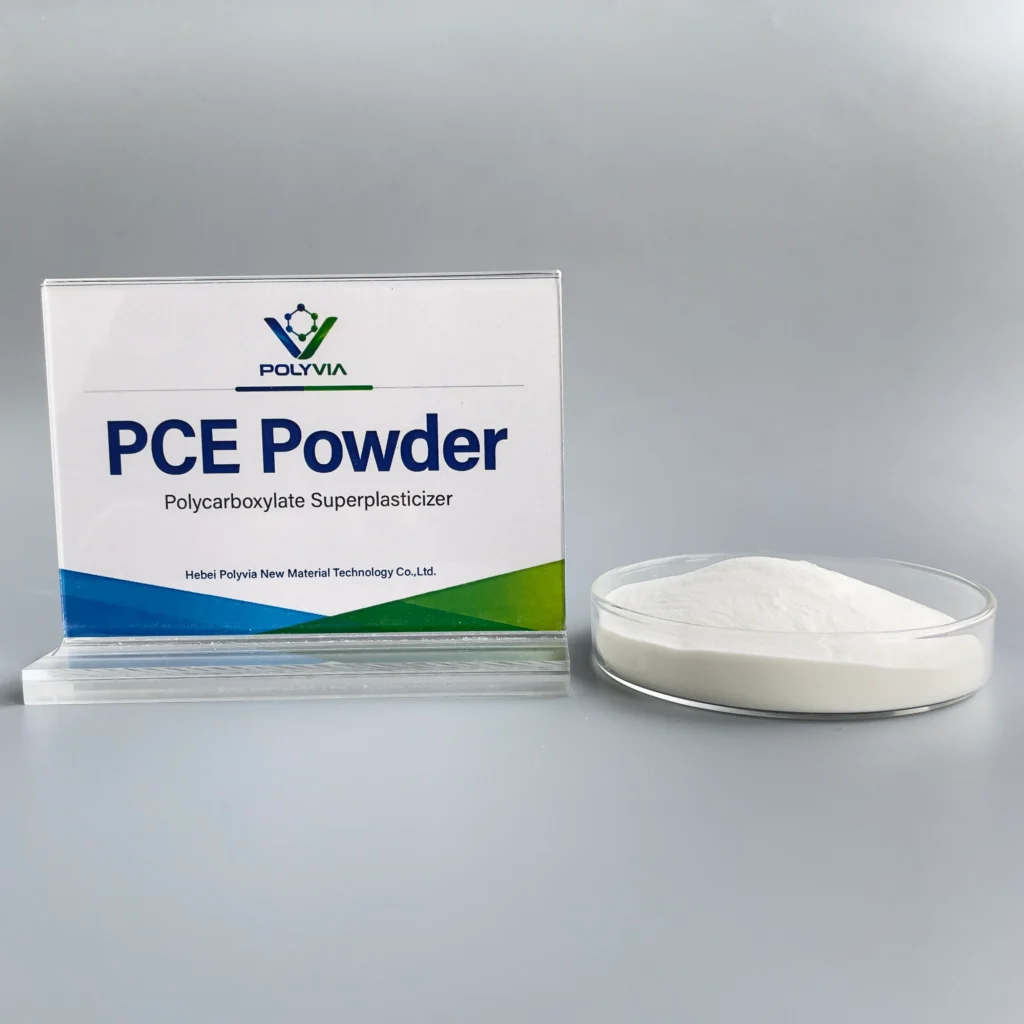
POLYVIA™ PCE PW888 is a fine powder early-strength grade designed for dry-blending applications.
Unlike ES980, PW888 is intended to be mixed directly with suitable dry formulation ingredients before water is added.
This difference is relevant to admixture preparation, storage and batching procedures.
Its suitability for a specific PHC mixture depends on compatibility with the cementitious materials, mixing process and curing regime.
3. High Water-Reduction Grades vs. Early-Strength Grades
High water-reduction PCE formulations and early-strength-oriented formulations have different primary selection objectives.
| Grade Category | Primary Performance Focus | Important Evaluation |
|---|---|---|
| High water-reduction PCE | Reducing effective water demand | Target consistency and water reduction |
| Early-strength-oriented PCE | Meeting required early-age strength development | Strength at specified ages |
| Slump-retention PCE | Maintaining workability over time | Workability retention under relevant conditions |
These categories are not mutually exclusive, and some formulations may provide a combination of performance characteristics.
However, the actual response must be confirmed through representative testing.
4. Dosage Basis and Product Form
Comparisons among powder and liquid PCE products should distinguish:
- As-supplied product dosage.
- Total-solids dosage.
- Active-polymer dosage, where reliably known.
- Water introduced through liquid admixtures.
- Effective water–binder ratio.
Equal product mass or equal solids content does not necessarily represent equivalent active-polymer content or concrete performance.
5. Recommended Selection Framework
| PHC Production Requirement | Initial Selection Consideration | Required Verification |
|---|---|---|
| High water-reduction efficiency | Suitable HWR formulation | Comparable-consistency concrete trials |
| Required early-age release strength | Early-strength-oriented formulation | Strength at the specified release age |
| Liquid admixture preparation from coarse powder | Appropriate dissolution procedure | Preparation consistency |
| Dry-blended admixture production | Suitable fine powder grade | Homogeneous blending and application performance |
| Accelerated curing | Cement–PCE–curing compatibility | Strength and quality under intended curing conditions |
| Variable raw materials | Robust compatibility across material variations | Repeatability testing |
The appropriate grade should be selected based on the complete technical evaluation rather than product designation alone.
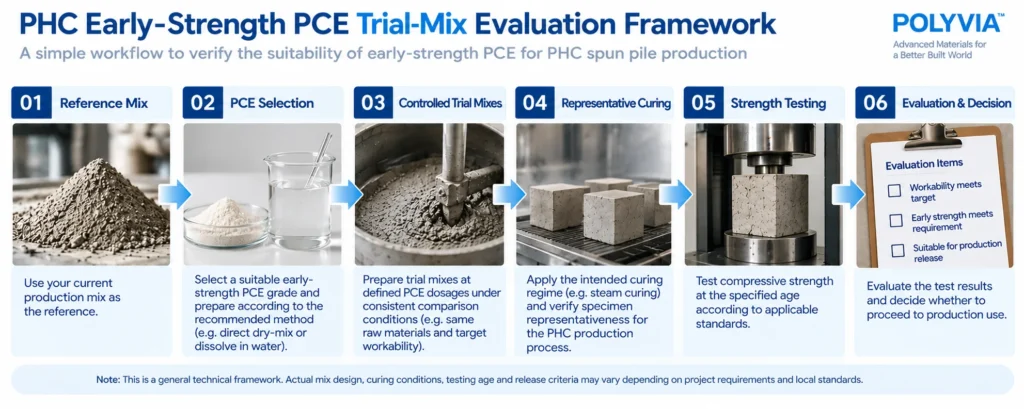
How to Evaluate Early-Strength PCE in PHC Trial Mixes
A controlled trial-mix program is necessary to determine whether a candidate PCE formulation is suitable for a specific PHC manufacturing process.
The evaluation should distinguish initial workability, water reduction, strength development, curing compatibility and release readiness.
Step 1 — Define Production Requirements
Before testing, document the required fresh-concrete consistency, effective water–binder ratio, strength-development target and curing procedure.
Identify the specific manufacturing operation for which release strength is required.
The applicable acceptance criterion must be obtained from the relevant standard or approved production specification.
Step 2 — Establish a Reference Mixture
Prepare a reference mixture using representative production materials.
Record the binder composition, aggregate grading, water content, PCE grade, dosage basis and mixing procedure.
The reference should reproduce the intended manufacturing conditions as closely as practical.
Step 3 — Compare Candidate PCE Formulations
Evaluate each candidate formulation under controlled conditions.
If the purpose is to assess water reduction, compare mixtures at equivalent target consistency.
If the purpose is to assess early-strength development, control the relevant mixture variables and measure strength at defined ages.
When more than one variable changes, document the changes clearly so that the results can be interpreted correctly.
Step 4 — Apply the Intended Curing Regime
Use the relevant production curing procedure, including pre-curing and accelerated curing where applicable.
Record the actual temperature history rather than relying solely on nominal equipment settings.
A laboratory curing procedure that differs substantially from production conditions cannot automatically establish performance in a PHC factory.
Step 5 — Measure Strength at Defined Ages
Test compressive strength using the applicable method and representative specimens.
Document:
- Actual elapsed time from mixing or casting.
- Specimen type and dimensions.
- Specimen preparation procedure.
- Curing conditions.
- Test method.
- Measured strength.
- Applicable release-strength criterion.
The suitability of a formulation should be evaluated against the specified production requirements.
Step 6 — Verify Centrifugal-Forming Quality
Fresh-concrete consistency and compressive-strength results alone do not fully describe the quality of centrifugally formed concrete.
The actual forming process and finished pile should be evaluated against the relevant product requirements.
Research on centrifuged PHC concrete has shown that centrifugal forming can affect mechanical properties and that conventional vibrated specimens may not fully represent the behavior of centrifugally formed concrete [3].
Step 7 — Confirm Repeatability
A single favorable laboratory result is not sufficient to establish production robustness.
Repeat the relevant tests using representative materials and production conditions.
The number of trial batches and acceptance limits should follow the applicable quality-control procedure.
Early-Strength Evaluation Matrix
| Evaluation Stage | Primary Variable | Required Evidence |
|---|---|---|
| Reference mixture | Binder and effective water content | Verified mix-design record |
| PCE evaluation | Grade and dosage basis | Controlled trial-mix data |
| Fresh concrete | Target consistency | Relevant fresh-state test results |
| Curing compatibility | Temperature and time history | Recorded curing conditions |
| Early-age strength | Specified test age | Compressive-strength results |
| Production release | Applicable release criteria | Approved quality-control decision |
| Repeatability | Batch-to-batch consistency | Repeated trial results |
This table presents a recommended evaluation framework. It is not a report of POLYVIA™ experimental data.
Minimum Requirements for a Technical Test Report
A useful PHC early-strength evaluation report should include the actual materials, mixture proportions, admixture dosage, curing history and test results.
It should distinguish between measured strength, the specified release-strength threshold and the manufacturer's decision to proceed with a production operation.
The most reliable early-strength assessment is one that can be traced to documented materials, curing conditions and applicable acceptance criteria.
Troubleshooting Delayed Early Strength in PHC Production
Delayed early-strength development may arise from several interacting factors.
A structured troubleshooting procedure helps identify the controlling variable without making unnecessary changes to PCE dosage.
1. Early Strength Is Below the Required Level
Review cement composition, binder characteristics, effective water–binder ratio, admixture dosage, curing history and test conditions.
Check whether raw materials or manufacturing conditions changed before the problem appeared.
2. Workability Is Acceptable but Strength Development Is Slow
Initial consistency does not establish the subsequent strength-development rate.
Investigate setting behavior, cement chemistry, concrete temperature and curing conditions.
Where appropriate, compare candidate PCE formulations through controlled testing.
3. Strength Changes After a Cement Source Change
Different cements may interact differently with the same PCE formulation.
Repeat compatibility and strength-development testing with the new cement before assuming that the existing dosage remains suitable.
4. Steam Curing Does Not Produce the Expected Strength
Review the actual temperature history, including pre-curing, heating, holding and cooling stages.
Confirm that the tested specimens experienced representative curing conditions.
Do not evaluate the process solely from the nominal maximum curing temperature.
5. Strength Results Vary Between Batches
Check aggregate moisture corrections, actual admixture dosage, raw-material consistency, mixing conditions, curing uniformity and specimen preparation.
Batch variability should be investigated as a production-control issue rather than attributed automatically to PCE.
6. Demolding Is Delayed
Confirm the required release-strength criterion and the actual strength measured at the planned release time.
Review the concrete formulation, curing process and admixture compatibility.
The appropriate response may involve curing control, mixture redesign or a different admixture formulation.
Increasing PCE dosage alone is not a universal solution.
7. Troubleshooting Matrix
| Observed Problem | Variables to Investigate | Recommended Verification |
|---|---|---|
| Low early-age strength | Binder, water content, curing | Controlled strength-development trials |
| Delayed setting | Cement–PCE compatibility, dosage, temperature | Setting and hydration evaluation |
| Variable release strength | Batch control, curing uniformity | Repeated production testing |
| Laboratory and production results differ | Specimen representativeness, forming and curing | Plant-scale verification |
| Poor fresh consistency | PCE dosage, cement compatibility, mixing | Fresh-concrete comparisons |
| Delayed demolding | Release criteria, actual measured strength | Review of approved release procedure |
Effective troubleshooting begins by identifying the cause of the strength-development problem rather than assuming that every issue is caused by the superplasticizer.
Key Technical Conclusions
Early-strength PCE can support PHC spun pile production by improving cementitious particle dispersion and helping control effective water demand.
However, early-age strength is determined by the complete concrete system, including binder chemistry, water content, curing conditions and the quality of the manufacturing process.
Improved water reduction does not necessarily mean faster hydration. Similarly, an early-strength product designation does not guarantee a particular strength level or demolding time.
POLYVIA™ PCE ES980 and PW888 are early-strength-oriented powder grades with different preparation methods. Their suitability for specific PHC applications must be verified through representative trials.
The most effective evaluation combines PCE selection, controlled curing, measured early-age strength and the applicable production release criteria.
For PHC manufacturers, the primary objective is to achieve the required strength consistently without compromising fresh-concrete performance, centrifugal-forming quality or later-age product requirements.
Reliable early-strength performance is demonstrated through verified concrete strength under the intended production conditions—not through the superplasticizer designation alone.
Frequently Asked Questions
1. What is early-strength PCE for PHC spun piles?
Early-strength PCE is a polycarboxylate ether superplasticizer formulation intended for concrete applications requiring suitable water reduction and early-age strength development. Its performance must be verified using the intended cementitious materials, mixture proportions and curing conditions.
2. Does early-strength PCE directly accelerate cement hydration?
Not necessarily. PCE can improve dispersion and influence cement hydration, but the response depends on the polymer formulation, cement chemistry, dosage and curing conditions. Improved dispersion does not automatically mean faster hydration.
3. What is the difference between early-age strength and demolding strength?
Early-age strength is the measured compressive strength of concrete at a specified time. Demolding strength is the required strength criterion for a particular demolding operation. The relevant release requirement must be defined by the applicable manufacturing specification.
4. Can early-strength PCE help shorten PHC production cycles?
It may contribute to a formulation that achieves the required release strength within the planned curing schedule. However, any reduction in production time must be verified under the actual manufacturing conditions and acceptance criteria.
5. Why is steam-curing compatibility important for early-strength PCE?
Steam curing changes the temperature history of cement hydration and strength development. The PCE formulation should therefore be evaluated under the intended curing procedure rather than relying only on ambient-temperature laboratory tests.
6. What is the difference between POLYVIA™ PCE ES980 and PW888?
Both are early-strength-oriented PCE powders, but their supply forms and preparation methods differ. ES980 is a coarse powder that must first be dissolved in water, while PW888 is a fine powder intended for dry blending. Their performance should be evaluated separately.
7. How should early-strength PCE be tested for PHC production?
Use representative materials and controlled trial mixes. Record fresh consistency, effective water content, PCE dosage, curing conditions and compressive strength at the required ages. Compare results with the applicable release-strength criteria.
8. Does higher early-age compressive strength always mean earlier demolding?
No. Demolding readiness depends on the applicable release criteria and the complete production procedure. Compressive strength may be an important requirement, but it should not be assumed to be the only acceptance condition for every PHC manufacturing system.
Scientific References
[1] Zhu, W., Feng, Q., Luo, Q., Bai, X., Chen, K., & Lin, X. (2022). Effect of a specific PCE superplasticizer on the initial dissolution and early hydration of Portland cement. Journal of Building Engineering.
https://doi.org/10.1016/j.jobe.2021.103786
[2] Liu, Z., Bu, L., Wang, Z., & Hu, G. (2019). Durability and microstructure of steam cured and autoclaved PHC pipe piles. Construction and Building Materials, 209, 679–689.
https://doi.org/10.1016/j.conbuildmat.2019.03.166
[3] Chen, Y., Li, X., Xu, W., Miao, H., & Zuo, X. (2025). Experimental investigation and statistical evaluation of mechanical properties of centrifuged PHC pipe pile concrete. Structures, 82, 110821.
https://doi.org/10.1016/j.istruc.2025.110821
[4] POLYVIA™ PCE ES980 Technical Data Sheet. Manufacturer-declared product specifications. Refer to the current approved revision for applicable technical limits.