
How PCE Water Reduction Affects PHC Spun Pile Concrete at Low Water–Binder Ratios
Balancing Water Reduction, Workability, Centrifugal Forming and Strength Development
Learn how polycarboxylate ether (PCE) superplasticizers help control water demand in high-strength PHC spun pile concrete. Explore the relationship between low water–binder ratios, fresh-concrete rheology, centrifugal forming and strength development, and discover how to evaluate PCE performance using representative materials and production-specific trial mixes.
Why Water Reduction Matters in PHC Spun Pile Concrete
Prestressed high-strength concrete (PHC) spun piles are manufactured using high-strength concrete, prestressing steel and centrifugal forming. Their production requires a controlled balance between fresh-concrete workability, forming stability, early-age strength and the specified curing process.
The water–binder ratio is a fundamental mix-design parameter. It is defined as the mass of effective mixing water divided by the mass of total cementitious materials.
Reducing this ratio can contribute to higher strength and lower capillary porosity when the mixture is appropriately proportioned, adequately compacted and properly cured. However, reducing water content also makes fresh concrete more sensitive to particle interactions, admixture compatibility and mixing conditions.
Polycarboxylate ether (PCE) superplasticizers help address this challenge by improving cementitious particle dispersion. A suitable PCE can enable a mixture to achieve its required consistency with less water under appropriate conditions.
1. The Challenge of Low Water–Binder Ratios
At a low water–binder ratio, the amount of water available to support particle movement and flow is limited.
Without effective dispersion, cementitious particles can form flocculated structures that increase resistance to deformation. This may make concrete more difficult to mix, distribute inside the pile mold and compact uniformly during centrifugal forming.
Adding more water may improve workability, but it also changes the designed water–binder ratio and can affect strength and other performance characteristics.
The objective is therefore to achieve the required fresh-concrete behavior without unnecessarily increasing effective mixing water.
2. Why PHC Production Requires More Than High Compressive Strength
PHC spun pile concrete must satisfy several requirements simultaneously:
- Suitable workability for batching, mold filling and centrifugal forming.
- Adequate cohesion and resistance to unacceptable segregation during spinning.
- Required early-age strength before prestress transfer or demolding, according to the production process.
- Appropriate strength development under the specified curing regime.
- Compliance with the applicable dimensional, mechanical and durability requirements.
A mixture that reaches high compressive strength but cannot be formed consistently is not a successful production formulation.
Likewise, a mixture that flows easily but develops unacceptable segregation during centrifugal forming may fail to achieve the required product quality.
3. The Role of PCE in the Mix-Design Balance
PCE superplasticizers can improve dispersion and reduce the water needed to reach a target consistency.
However, the magnitude of this effect depends on cement chemistry, supplementary cementitious materials, polymer formulation, dosage and mixing conditions.
PCE does not independently determine the final strength of PHC concrete. Its contribution must be evaluated together with binder composition, aggregate grading, effective water content, forming conditions and curing.
The objective is not to minimize water–binder ratio at any cost, but to establish a workable, stable and adequately strong mixture for the intended PHC production process.
How PCE Water Reduction Works at Low Water–Binder Ratios
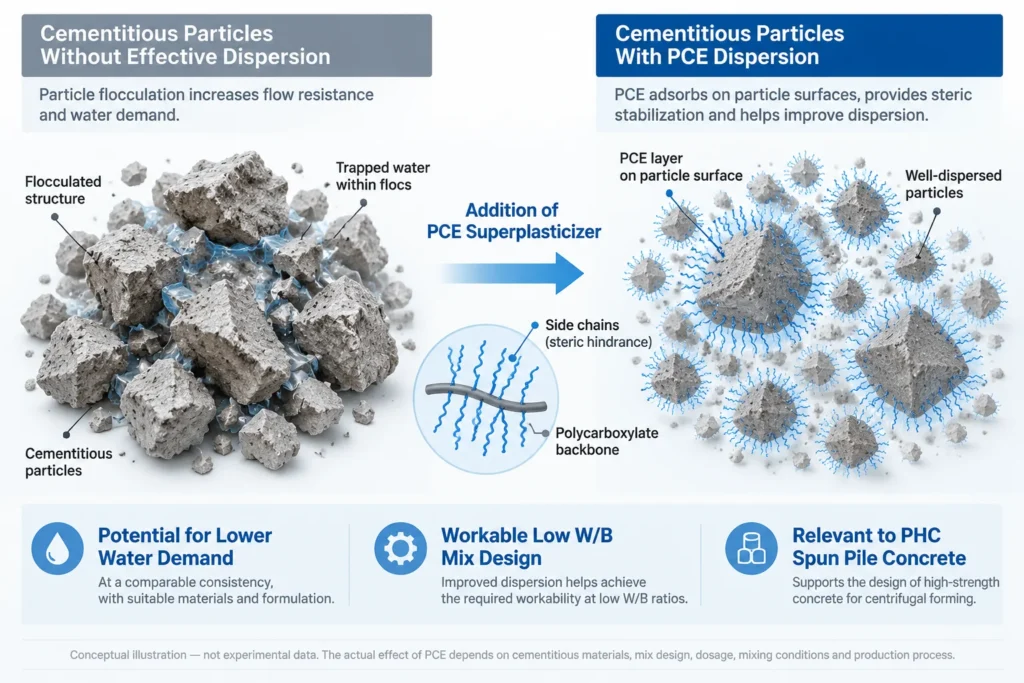
PCE superplasticizers contain a polymer backbone with side chains that contribute to their interaction with cementitious particles.
When appropriately formulated, the polymer adsorbs onto available particle surfaces and helps reduce particle flocculation. This improves dispersion and can reduce the resistance to flow at a given water content.
1. From Particle Flocculation to Dispersion
Cementitious particles can form agglomerated structures through surface interactions.
These structures may trap water within the flocculated network and increase the apparent resistance of the mixture to flow.
PCE adsorption can modify these interactions. The polymer's side chains provide steric stabilization that helps particles remain more effectively dispersed.
Improved dispersion can make the available water more effective in supporting the required fresh-concrete behavior.
The result depends on the polymer structure, cementitious surfaces and chemical environment. Not all PCE formulations produce the same dispersing response.
For a broader explanation of polymer adsorption and steric stabilization, see our technical guide on How PCE Superplasticizer Works.
2. Water Reduction at a Comparable Consistency
The water-reduction effect of a PCE should be evaluated by comparing appropriate reference and admixture-containing mixtures at a comparable target consistency.
For a valid comparison, the mixtures should use clearly defined material quantities and consistent testing conditions.
The calculation is:
Water Reduction (%) = [(Reference Mixing Water − Admixture Mixing Water) / Reference Mixing Water] × 100
The water quantities must refer to equivalent quantities of concrete and include relevant water contributions.
For liquid PCE, water introduced by the admixture solution must be accounted for when determining effective mixing water.
If the reference and admixture mixtures differ in binder composition, aggregate grading or target consistency, the comparison may not isolate the effect of PCE.
A cement paste flow test can help evaluate dispersion, but it does not independently establish the water-reduction percentage achievable in PHC concrete.
3. Why PCE Efficiency Matters at Low Water Content
At a low water–binder ratio, changes in particle dispersion can produce meaningful differences in fresh-concrete behavior.
A suitable PCE formulation may help achieve the required consistency without increasing effective water content.
However, PCE grades differ in initial dispersing efficiency, workability retention and compatibility with a given binder system.
A formulation selected for PHC production must therefore be evaluated using the actual materials and production requirements.
4. Water Reduction Does Not Guarantee Suitable Centrifugal Forming
Improved dispersion can support mold filling and forming, but centrifugal forming introduces additional requirements.
Concrete must redistribute and compact under rotation without unacceptable separation of its constituent materials.
A high slump or flow value alone does not establish suitable centrifugal behavior.
The selected formulation must balance dispersion, cohesion and the rheological properties required by the specific forming process.
Why the Lowest Water–Binder Ratio Is Not Always the Best Choice
Water–binder ratio is an important strength-related variable, but it cannot be optimized independently of workability and forming requirements.
Reducing water content may improve the potential for strength development, yet an excessively low ratio can make the mixture difficult to mix, distribute or compact.
1. Insufficient Workability Can Compromise Uniformity
When a mixture is too stiff for its intended process, it may not distribute uniformly inside the mold.
Poor mold filling or inadequate compaction can create local differences in density and material distribution.
In centrifugal forming, these effects can influence the uniformity and quality of the finished pile.
Therefore, a lower water–binder ratio is beneficial only when the mixture retains suitable processing characteristics.
2. Why More Water Is Not the Only Adjustment
If workability is insufficient, automatically adding water may undermine the designed water–binder ratio.
Before changing effective water content, evaluate:
- PCE grade and compatibility with the cementitious materials.
- Admixture dosage and its calculation basis.
- Aggregate grading and moisture condition.
- Binder composition and total binder content.
- Mixing sequence and mixing duration.
- Time elapsed between mixing and forming.
These variables can influence workability and should be investigated systematically.
When PCE performance changes with the binder source, cement chemistry and material compatibility should be evaluated systematically. See our guide to Why PCE Performance Varies with Cement Chemistry.
3. What PHC Research Tells Us
Research on PHC pipe pile concrete has investigated the combined effects of water–binder ratio, centrifugal forming and curing on strength and microstructure [1–3].
Studies of centrifugally formed PHC concrete have also reported differences in water–binder ratio and material distribution across the pile wall, highlighting the importance of the manufacturing process itself [1].
These findings do not establish a universal optimum water–binder ratio for all PHC products.
Instead, they support a broader engineering principle: water content, fresh-concrete behavior, centrifugal compaction and curing must be evaluated as a coupled system.
3.4 Establish a Suitable Operating Range
Rather than choosing the lowest possible ratio, evaluate a practical range using the intended materials.
Each candidate mixture should be assessed for:
- Fresh consistency and its repeatability.
- Mold filling and centrifugal-forming behavior.
- Cohesion and resistance to unacceptable separation.
- Required early-age strength.
- Final strength and applicable durability requirements.
The selected ratio should satisfy the production specification while allowing for realistic variations in raw materials and manufacturing conditions.
A lower water–binder ratio is a mix-design choice, not a guarantee of better PHC pile performance.
How PCE Influences Concrete Rheology During Centrifugal Forming
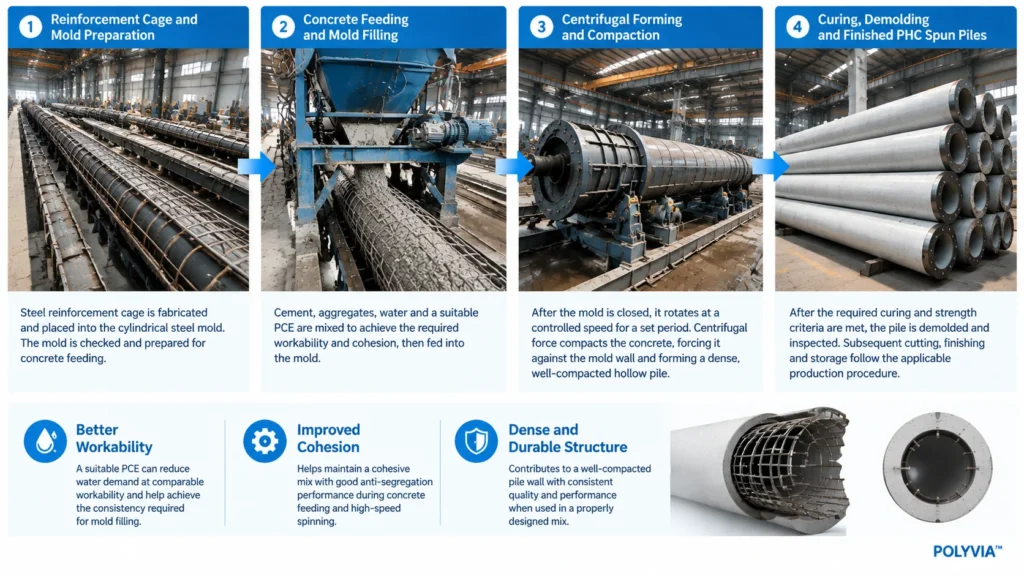
PHC spun pile concrete is distributed and compacted through a controlled centrifugal process rather than conventional vibration alone.
This makes the fresh mixture's rheological behavior particularly important.
1. Flowability and Mold Filling
Adequate workability helps concrete move through the production process and fill the mold.
However, flowability measured by slump or another consistency test is only one part of the evaluation.
The response of the mixture under actual forming conditions may differ from its response during a static laboratory test.
2. Cohesion and Segregation Resistance
The mixture must maintain an appropriate balance between mobility and cohesion.
If the mixture is insufficiently cohesive for the selected forming conditions, centrifugal action may contribute to nonuniform distribution of water, paste and aggregates.
If the mixture is too stiff, it may be difficult to distribute and compact consistently.
The correct balance depends on the formulation and production process.
3. Centrifugal Forming Can Change Local Material Distribution
During centrifugal forming, the distribution of particles and water may change across the pile wall.
Research has investigated how centrifugal forming and subsequent curing affect the microstructure of PHC pipe pile concrete [1,2].
These effects reinforce why the properties of conventionally vibrated specimens may not fully represent centrifugally formed concrete.
For a broader overview of PCE selection across reinforced, prestressed and high-strength precast pile applications, see PCE Superplasticizer for Precast Concrete Piles.
4. Why One Fresh-Concrete Test Is Insufficient
A single slump or flow measurement cannot establish every property required for PHC production.
A suitable evaluation should combine fresh-state testing with observations of mold filling, centrifugal-forming quality and hardened performance.
Where the production process requires particular consistency limits or forming procedures, these should be established by the applicable plant specification and validated trial mixes.
PCE selection for PHC concrete must account for the actual forming process rather than relying solely on a nominal flowability target.
How PCE Selection Affects Early Strength and Curing Compatibility
PHC production often involves controlled curing intended to achieve the required strength within a specified production cycle.
PCE selection can influence this process because different formulations may affect cement hydration and setting behavior differently.
1. Dispersion and Strength Development
By improving dispersion and enabling lower mixing water at a comparable consistency, PCE can support the design of high-strength concrete.
However, final strength depends on the combined effects of binder composition, water–binder ratio, compaction, curing temperature, curing duration and testing age.
It is not technically correct to attribute a specific strength increase to PCE alone without controlled comparison data.
2. High Water Reduction Is Not the Same as Early Strength
A high water-reduction PCE and an early-strength-oriented formulation may serve different priorities.
A high water-reduction grade focuses on dispersion and reducing the water needed to achieve a target consistency.
An early-strength-oriented formulation is selected to meet required strength-development and production-cycle objectives.
These performance characteristics may overlap, but they are not interchangeable.
3. Curing Conditions Must Be Considered
PHC manufacturing may use different steam-curing or autoclaving regimes, depending on the production system and applicable requirements.
Research has shown that curing regime and water–binder ratio can influence PHC concrete microstructure and durability [2,3].
Consequently, a PCE formulation should be evaluated under the intended curing process rather than selected solely from room-temperature fresh-concrete results.
4. A Practical Selection Principle
The appropriate PCE should be selected based on the required combination of:
- Water reduction at the target consistency.
- Fresh-concrete workability and retention.
- Compatibility with the binder system.
- Setting and early-strength requirements.
- Stability during centrifugal forming.
- Performance under the actual curing regime.
The final decision should be supported by representative trial-mix results.
Selecting PCE Grades for PHC Spun Pile Concrete
POLYVIA™ offers PCE grades designed for different performance priorities.
For PHC production, selection should begin with the required fresh-concrete behavior and strength-development schedule, rather than choosing a product solely because it has a high nominal solids content or a particular supply form.
1. High Water Reduction PCE
A high water-reduction grade may be considered when the formulation requires effective dispersion and lower water demand at a comparable target consistency.
Relevant POLYVIA™ options include:
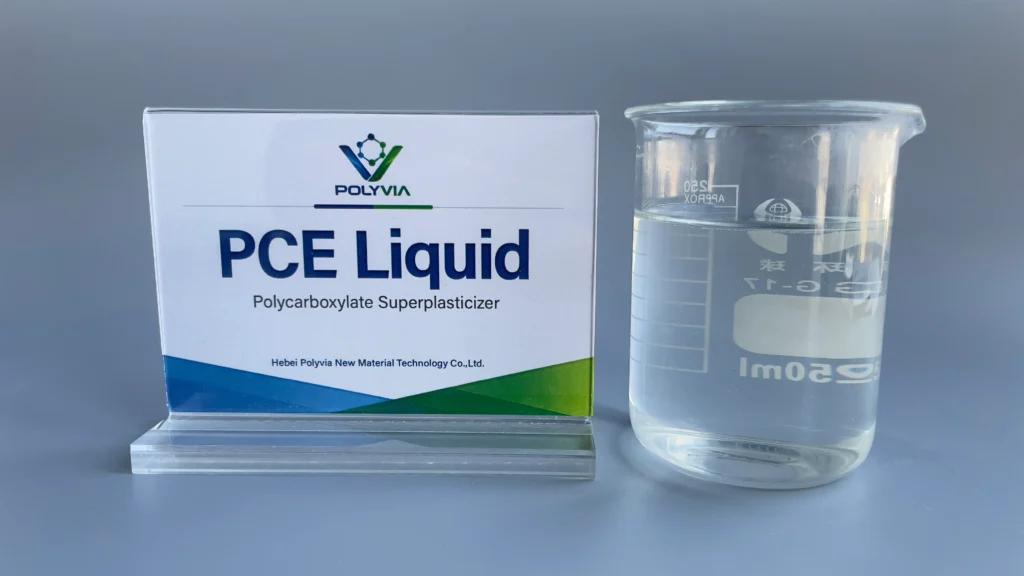
- PCE Liquid HWR40 / HWR50: High water-reduction grades at their respective nominal solids contents.
- PCE Powder 840: High water-reduction powder grade.
- PCE Flake F980: High water-reduction flake grade for preparing a liquid solution.
The appropriate grade depends on the intended production system, product handling and compatibility with the actual materials.
Explore POLYVIA™ PCE Liquid Superplasticizer for available liquid grades, solids-content options and product specifications.
2. Early-Strength-Oriented PCE
Where early strength and production-cycle requirements are important, an early-strength-oriented PCE formulation may be evaluated alongside the high water-reduction option.
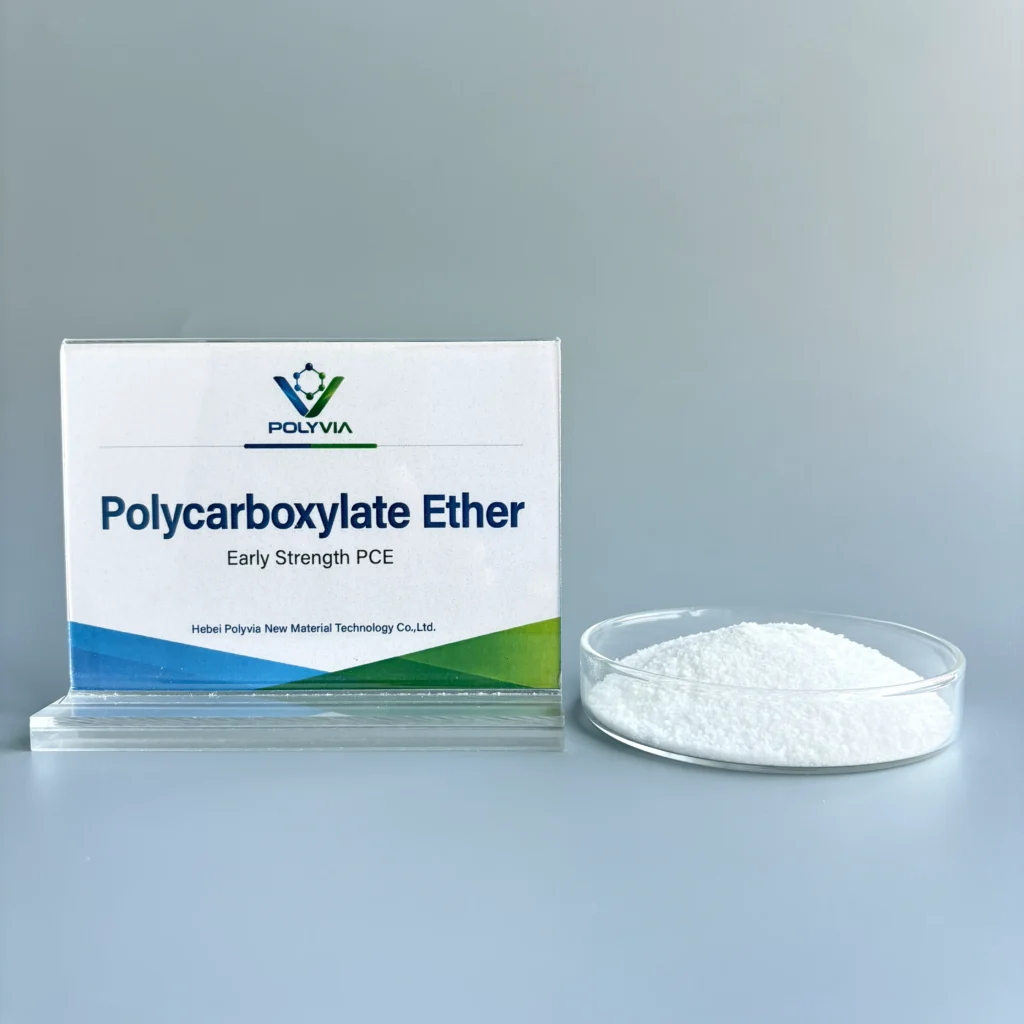
For powder products, POLYVIA™ ES980 is a coarse powder that must first be dissolved in water, while PW888 is a fine powder intended for dry blending.
These differences affect preparation and handling. They do not independently prove that one grade will produce a particular early strength in PHC concrete.
Actual selection should be supported by trial-mix and curing results.
3. Powder, Flake and Liquid Are Supply Forms, Not Performance Rankings
Different supply forms can offer different handling, transport and production advantages.
However, equal solids content does not guarantee equivalent active-polymer content or performance.
When comparing products, distinguish:
- As-supplied product dosage.
- Total-solids dosage.
- Active-polymer dosage, where reliably known.
Liquid-admixture water must also be considered when controlling effective water content.
4. PCE Selection Framework
| Production Requirement | Initial Selection Consideration | Required Verification |
|---|---|---|
| High water reduction | Evaluate a suitable HWR grade | Target consistency and water-reduction performance |
| Workability retention | Evaluate retention behavior at the required time and temperature | Time-based consistency measurements |
| Early-strength requirement | Evaluate an early-strength-oriented grade | Strength development under the intended curing regime |
| Powder admixture preparation | Confirm grade-specific dissolution or dry-blending requirements | Preparation consistency and trial-mix performance |
| Variable cement or aggregate sources | Evaluate compatibility across representative materials | Repeatability and production robustness |
No single PCE grade should be designated as universally optimal for all PHC production lines.
How to Evaluate PCE Water Reduction in PHC Trial Mixes
A useful PHC trial-mix program should separate water-reduction performance from the effects of changes in consistency, binder composition or curing.
The objective is to determine whether the selected PCE achieves the required fresh and hardened performance under defined conditions.
1. Establish the Reference Mixture
Record the reference binder composition, aggregate grading, effective water content and production requirements.
Define the target consistency and applicable testing procedure.
Where practical, maintain consistent materials and processing conditions when comparing candidate PCE formulations.
2. Define the PCE Dosage Basis
State whether dosage is calculated using the supplied product mass, total-solids mass or active-polymer mass.
For liquid PCE, account for water introduced by the admixture solution.
Do not compare products at an apparently identical dosage if their dosage bases differ.
3. Conduct Controlled Water-Reduction Comparisons
Compare an appropriate reference mixture with an admixture-containing mixture at a comparable target consistency.
Record the effective mixing water required by each mixture and calculate water reduction using the same reference basis.
If binder composition or aggregate grading changes, the comparison should be designed to account for those changes.
4. Evaluate Fresh-Concrete Performance
Measure the relevant fresh properties under consistent conditions.
Depending on the production specification, these may include slump, flow, workability retention and indicators of mixture stability.
Fresh-state measurements should be supplemented by actual observations of mold filling and centrifugal-forming behavior.
5. Verify Strength Under the Intended Curing Regime
Prepare representative specimens using the relevant production and curing procedures.
Measure the strength required by the project or product specification at the specified ages.
Do not infer demolding or prestress-transfer suitability from water reduction alone.
6. Evaluate the Complete Production Result
A suitable PHC formulation must satisfy the combined requirements for:
- Fresh-concrete handling.
- Centrifugal-forming quality.
- Required early-age strength.
- Final strength and applicable durability criteria.
- Consistent performance across production batches.
The final selection should be based on the complete evidence rather than one isolated test result.
Key Technical Conclusions
PCE water reduction is an important tool for designing PHC spun pile concrete at low water–binder ratios.
By improving particle dispersion, a suitable PCE can help achieve the required consistency with less water under appropriate conditions.
However, lower water content does not automatically guarantee better concrete.
The mixture must remain workable and sufficiently cohesive for mold filling and centrifugal forming. Strength development also depends on binder composition, admixture compatibility, curing regime and production conditions.
High water reduction and early-strength performance are related but distinct selection priorities. The appropriate grade must be confirmed through representative trial mixes.
The goal of PCE optimization for PHC spun piles is to balance water reduction, fresh-concrete behavior, centrifugal forming and strength development within the actual production process.
Frequently Asked Questions
1. Why is PCE used in PHC spun pile concrete?
PCE can improve cementitious particle dispersion and help reduce the water required to achieve a target consistency. In PHC concrete, this can support the design of low water–binder ratio mixtures, provided that workability and centrifugal-forming requirements are also satisfied.
2. Does a lower water–binder ratio always increase PHC concrete strength?
No. A lower ratio can support strength development when the mixture is properly designed, compacted and cured. If water content becomes too low for adequate mixing and forming, poor uniformity or compaction can offset the expected benefit.
3. How does PCE water reduction differ from early-strength performance?
Water reduction concerns the amount of water needed to achieve a target consistency. Early-strength performance concerns strength development at specified ages and under defined curing conditions. These properties must be evaluated separately.
4. Can high flowability guarantee good centrifugal forming?
No. Flowability is only one aspect of fresh-concrete behavior. PHC concrete must also maintain suitable cohesion and uniformity during centrifugal forming.
5. Why should liquid PCE dosage account for solids content?
The supplied liquid contains water as well as nonvolatile material. Dosage comparisons should identify the mass basis and account for admixture water when controlling the effective water–binder ratio.
6. Is a high water-reduction PCE always the best choice for PHC piles?
Not necessarily. The best choice depends on the required consistency, early-strength schedule, cement compatibility, forming process and curing regime. Trial-mix results should guide selection.
7. How should PCE performance be verified for PHC production?
Use representative materials and controlled trial mixes. Evaluate target consistency, water demand, workability retention where relevant, centrifugal-forming quality and strength under the intended curing regime.
8. Can laboratory paste results predict final PHC pile performance?
Paste tests are useful for preliminary dispersion screening, but they cannot establish the complete behavior of centrifugally formed PHC concrete. Representative concrete trials and production verification remain necessary.
Scientific References
[1] Microstructure characteristics and evolution of pipe pile concrete under centrifugation and steam curing. Construction and Building Materials, 450 (2024), 138554.
https://doi.org/10.1016/j.conbuildmat.2024.138554
[2] Performance evaluation of steam cured HPC pipe piles produced with metakaolin based mineral additives. Construction and Building Materials, 189 (2018), 719–727.
https://doi.org/10.1016/j.conbuildmat.2018.09.044
[3] Liu, Z., Bu, L., Wang, Z., & Hu, G. (2019). Durability and microstructure of steam cured and autoclaved PHC pipe piles. Construction and Building Materials, 209, 679–689.