
Polycarboxylate Ether Structure
Molecular Design, Mechanism and Concrete Performance
Explore how PCE backbone chemistry, carboxylate groups, polyether side chains and molecular architecture influence cement adsorption, dispersion, rheology and hydration. This research-based technical guide explains the structure–property relationships behind polycarboxylate ether superplasticizers and their implications for concrete performance.
Introduction
Why can two polycarboxylate ether (PCE) superplasticizers with similar solid contents exhibit different water-reduction efficiency, adsorption behavior and cement paste rheology?
One important reason is their molecular structure.
Most conventional PCE superplasticizers have a comb-shaped copolymer architecture consisting of a functional backbone and hydrophilic polyether side chains. However, the chemical composition, side-chain configuration grafting density and molecular weight distribution can differ substantially between polymers.
These structural characteristics influence how PCE molecules interact with cementitious surfaces and modify particle behavior.
Yet molecular structure alone cannot predict the complete performance of a concrete admixture. Cement mineralogy, pore-solution chemistry, binder concentration and hydration processes also affect the result.
Understanding polycarboxylate ether structure therefore requires a distinction between three levels:
Molecular architecture: How the polymer is chemically constructed.
Interfacial behavior: How the polymer adsorbs and stabilizes cementitious particles.
Material performance: How these interactions influence rheology, water demand and hydration.
This article focuses on the relationships between these levels, using published experimental research to explain which conclusions are supported by evidence and which depend on specific cementitious conditions.
The Comb-Shaped Molecular Structure of Polycarboxylate Ether
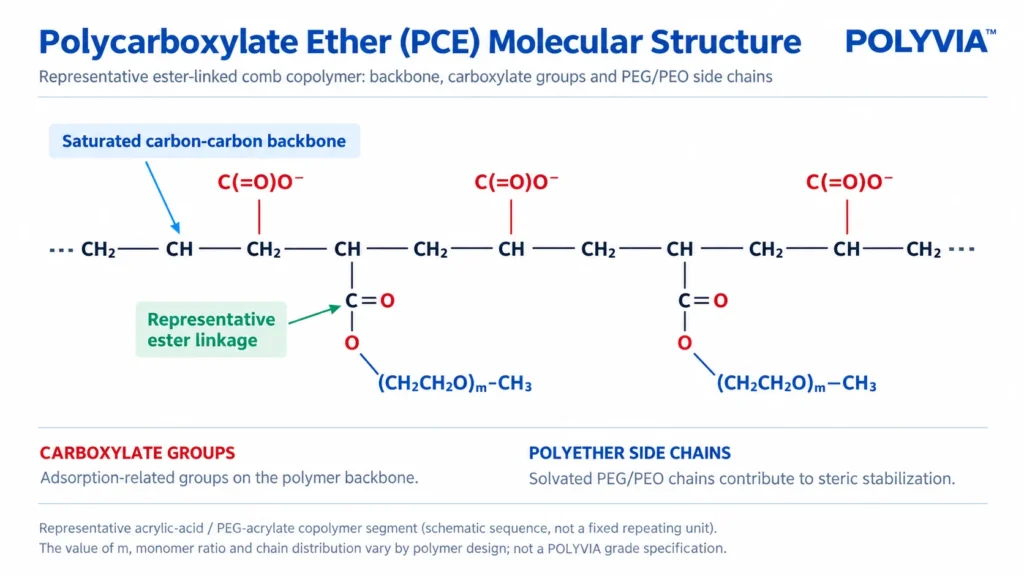
Conventional polycarboxylate ether superplasticizers are commonly based on comb-shaped copolymers containing an adsorption-functional backbone and hydrophilic polyether side chains.
The two structural components perform complementary functions.
1. Polymer Backbone and Carboxylate Groups
The backbone provides the molecular framework and carries functional groups involved in interactions with cementitious surfaces.
Many conventional PCEs are synthesized from unsaturated carboxylic acid monomers, such as acrylic acid or methacrylic acid, together with polyether macromonomers.
Under the highly alkaline conditions of cement pore solution, accessible carboxylic acid groups are predominantly present as carboxylates:
–COOH ⇌ –COO⁻ + H⁺
These anionic groups contribute to interactions with suitable cementitious surface sites, including calcium-associated sites.
However, adsorption depends on more than the number of carboxylate groups. The spacing, accessibility and molecular conformation of the backbone also influence how the polymer interacts with the surface.
A higher concentration of carboxylate groups may promote adsorption in a given polymer series without necessarily providing better particle dispersion.
2. Polyether Side Chains and Steric Stabilization
Most conventional PCE side chains contain hydrophilic poly(ethylene oxide) segments, often described as polyethylene glycol (PEG)-based chains.
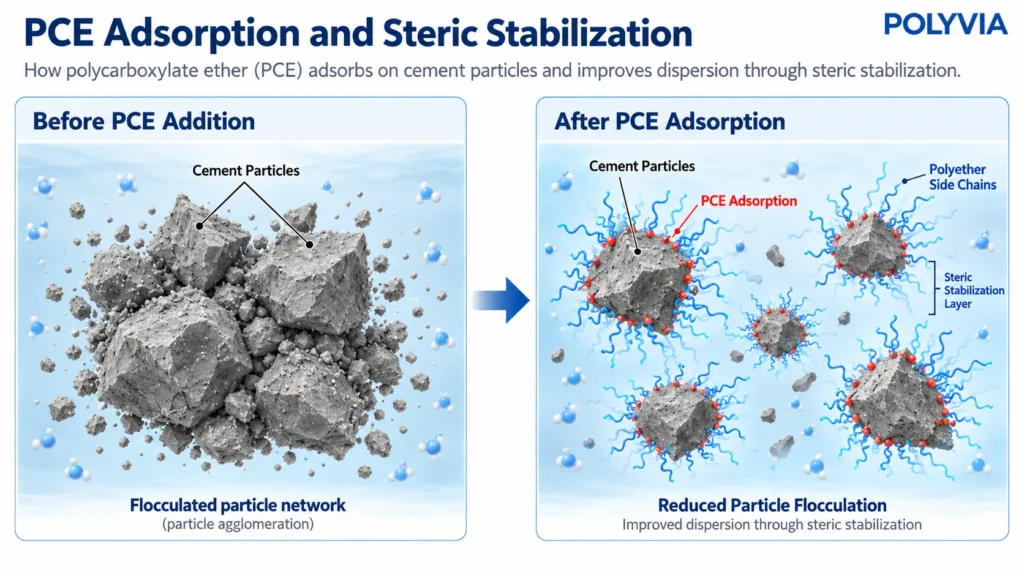
After adsorption, these solvated lateral chains can extend into the surrounding aqueous phase.
When two polymer-covered particles approach each other, overlap and compression of their solvated polymer layers become energetically unfavorable.
The resulting steric repulsion helps reduce particle flocculation.
The effectiveness of this stabilization depends on side-chain length, grafting density, polymer conformation and surface coverage.
Consequently, longer side chains do not automatically produce better dispersion. Their benefit depends on whether the polymer can establish an effective adsorbed layer.
3. PCE Is a Polymer Family, Not One Fixed Molecular Formula
Different PCE structures can be synthesized using different monomers, molecular compositions and polymerization methods.
Commercial synthesis routes may employ polyether macromonomers such as HPEG, TPEG, IPEG and EPEG families.
These starting materials can influence the molecular architecture, but the macromonomer name alone does not determine the performance of the finished superplasticizer.
The final polymer also depends on monomer ratios, conversion, chain growth, functional-group distribution and molecular weight characteristics.
Technical distinction: The polymer's chemical architecture, commercial supply form and performance grade are three separate classifications.
A PCE powder, liquid or flake does not represent a unique molecular structure merely because of its physical form.
For a broader introduction to PCE technology and commercial supply forms, see Polycarboxylate Ether (PCE) Superplasticizer.
Key Molecular Design Parameters
The structure–property relationship of PCE is governed by several interacting parameters.
| Parameter | Molecular significance | Potential performance influence |
|---|---|---|
| Backbone chemistry | Functional-group composition and arrangement | Adsorption and chemical interactions |
| Carboxylate content | Concentration of potential anchoring groups | Surface affinity and adsorption kinetics |
| Side-chain length | Dimensions of the solvated polyether chains | Steric stabilization |
| Grafting density | Frequency of side-chain attachment | Polymer conformation and surface coverage |
| Molecular weight distribution | Distribution of polymer molecular sizes | Adsorption, solution behavior and consistency |
| Monomer sequence and topology | Arrangement of structural units | Functional-group accessibility and interfacial behavior |
These variables are frequently coupled.
For example, changing the proportion of polyether macromonomer relative to carboxylic acid monomer may alter carboxylate content, grafting density and molecular weight simultaneously.
A performance difference between two such polymers cannot automatically be attributed to one structural variable.
This limitation is central to the interpretation of molecular-design research.
1. Carboxylate Density and Adsorption
Carboxylate groups contribute to polymer association with cementitious surfaces.
Increasing their concentration may improve adsorption under certain conditions. However, an adsorbed polymer must also establish a sufficiently effective steric layer to reduce interparticle attraction.
A 2023 study by Fang and colleagues investigated PCE polymers with varying carboxyl-related composition parameters and degrees of backbone polymerization.
Within the investigated series, an intermediate carboxyl-related parameter produced the greatest slurry fluidity and adsorption. The response was not monotonically improved by increasing the parameter.
The study therefore supports the importance of structural balance rather than maximum ionic functionality.
The reported optimum applies to the researchers' specific polymer series and test conditions, not to PCE formulations generally. [1]
2. Side-Chain Length and Effective Steric Stabilization
Longer polyether side chains can provide greater potential spatial extension when adsorbed and solvated.
However, side-chain length can also influence polymer molecular mass, adsorption efficiency and the number of polymer molecules present at a given mass dosage.
Shorter chains may provide stronger adsorption or more favorable surface coverage in certain systems.
A controlled-polymer study by Ezzat and colleagues examined PCE structure–property relationships using RAFT polymerization.
The research demonstrated that differences in polymer side-chain architecture can influence adsorption and rheological behavior, including the reduction of cement paste yield stress.
The findings support the need to evaluate the complete polymer architecture rather than assume that increasing side-chain length is universally beneficial. [2]
3. Grafting Density and Anchoring-Group Balance
Grafting density describes how frequently polyether side chains are attached along the backbone.
Changing grafting density alters the arrangement of hydrophilic chains and can also affect the relative amount of adsorption-related functionality.
Higher grafting density may modify steric-chain packing and polymer conformation, but can reduce the effective proportion of carboxylate groups depending on the polymer composition.
Lower grafting density may increase the concentration of anchoring functionality, while providing a different steric-chain arrangement.
Neither extreme is universally optimal.
The key design objective is a suitable balance between polymer adsorption and steric stabilization.
4. Molecular Weight and Polymer Distribution
PCE is typically a distribution of molecules rather than a collection of chemically identical chains.
Important descriptors include number-average molecular weight (Mn), weight-average molecular weight (Mw) and dispersity (Đ = Mw/Mn).
Molecular weight influences polymer dimensions and the number of molecules present at a given mass dosage.
Nevertheless, two polymers with similar molecular weights may differ in side-chain architecture and adsorption-related functionality.
For this reason, molecular weight alone is not a reliable predictor of water-reduction efficiency.
Quantitative Research: Molecular Architecture and Water Reduction
A study published in ACS Sustainable Chemistry & Engineering examined nine well-defined comb-shaped PCE copolymers and their interactions with an ordinary Portland cement system.
The research varied structural characteristics including side-chain grafting density and PEG side-chain length.
Importantly, the study connected molecular design with adsorption, hydration and cement paste dispersion measurements. [3]
1. Experimental Approach
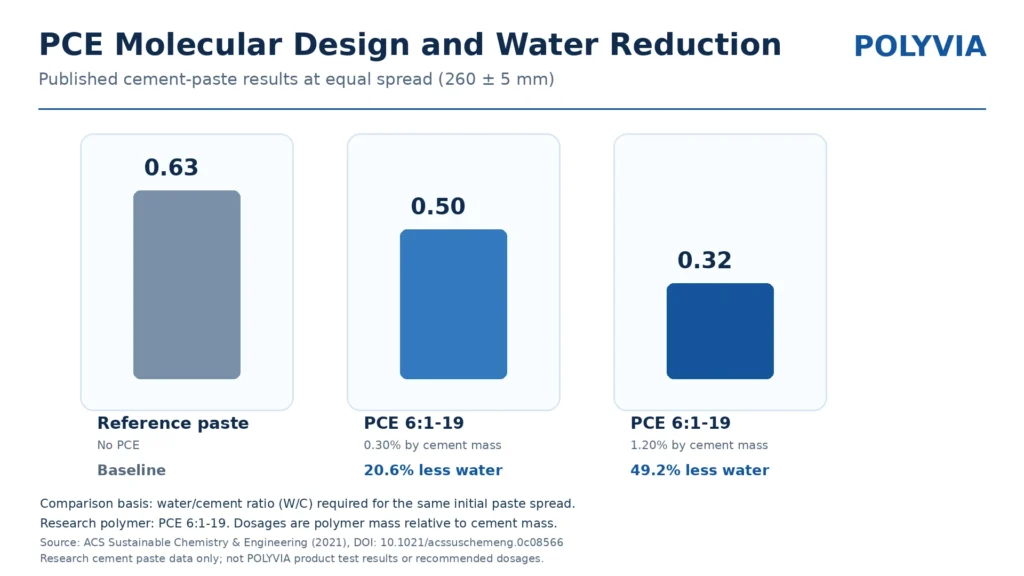
The researchers compared the amount of water needed to obtain a defined cement paste spread.
A reference paste without PCE required a water–cement ratio of 0.63 to achieve approximately 26 ± 0.5 cm spread.
Different PCE structures were evaluated by determining the water–cement ratio required to achieve the same target spread.
This approach is particularly informative because the comparison is made at equivalent measured consistency.
2. Verified Water-Reduction Results
Within the investigated polymer series, PCE 6:1-19 provided particularly effective dispersion.
| Test condition | Water–cement ratio | Calculated water reduction |
|---|---|---|
| Reference paste without PCE | 0.63 | — |
| PCE 6:1-19 at 0.30% by cement mass | 0.50 | 20.6% |
| PCE 6:1-19 at 1.20% by cement mass | 0.32 | 49.2% |
The values are calculated relative to the reference water–cement ratio:
Water reduction (%) = [(Reference W/C − Test W/C) / Reference W/C] × 100
The research dosages were based on the investigated polymer mass relative to cement mass.
They should not be interpreted as recommended dosages for commercial PCE liquid, powder or flake products.
The high experimental dosage was used to investigate the performance range of the research polymer.
The results describe cement paste under a specific spread-test procedure, not standardized concrete water-reduction performance.
3. Why the Molecular Design Matters
The research demonstrated that changes in molecular architecture influenced adsorption and cement paste dispersion.
A polymer with stronger surface adsorption did not necessarily provide the highest dispersion efficiency.
The best performance within the investigated series reflected a balance between the adsorption-related functionality of the backbone and the steric contribution of the polyether side chains.
This is an important distinction because greater adsorption and more effective dispersion are connected but separate properties.
Research-supported conclusion: The molecular architecture must provide sufficient surface association and an effective stabilization layer. Maximizing a single structural parameter does not guarantee maximum dispersing efficiency.
4. What These Results Cannot Establish
The findings are specific to the synthesized copolymers and cement system used in the study.
They do not identify a universally optimal side-chain length, grafting density or molecular weight.
They also do not establish that commercial PCE products with superficially similar chemical characteristics will reproduce the reported water-reduction values.
The study provides a scientific explanation of structure–performance relationships, not a universal product specification.
How PCE Molecular Structure Controls Cement Adsorption
Adsorption is the primary connection between PCE molecular structure and cementitious particle behavior.
However, cement is a chemically heterogeneous material whose surface characteristics evolve during hydration.
1. Cement Surface Chemistry
Ordinary Portland cement contains multiple mineral phases, including calcium silicates and aluminates.
After contact with water, dissolution and precipitation processes begin and new hydration products form.
Polymer adsorption is influenced by:
Cement mineral composition.Calcium-associated surface sites.
Sulfate availability.
Pore-solution alkalinity and ionic strength.
Polymer functional-group distribution.
Time-dependent hydration reactions.
These factors help explain why a given PCE structure may interact differently with different cement systems.
2. Adsorption Quantity Versus Dispersion Efficiency
Adsorption measurements quantify polymer uptake under defined conditions.
They do not directly measure the effectiveness of the adsorbed polymer layer in reducing particle interactions.
For example, two polymers may exhibit different adsorption amounts but produce similar flowability.
Alternatively, a polymer with relatively strong adsorption may produce less dispersion because of unfavorable surface organization.
The key relationship is:
Molecular structure → Adsorption and conformation → Particle interactions → Rheological response
Each stage requires appropriate measurements.
3. Time-Dependent Adsorption
Cement hydration changes the surfaces available for polymer adsorption.
Pore-solution composition also evolves with time.
Consequently, adsorption measured shortly after mixing cannot fully describe polymer behavior throughout an extended workability period.
Time-resolved measurements are more informative when investigating the relationship between PCE structure and workability evolution.
Molecular Structure and Cement Paste Rheology
PCE affects fresh cementitious materials primarily by changing particle interactions.
However, flow behavior cannot be described by a single parameter.
1. Yield Stress
Yield stress represents the resistance that must be overcome to initiate flow under a specified rheological model.
Cement particle flocculation contributes to this resistance.
Effective PCE adsorption and stabilization can weaken the flocculated particle network and reduce yield stress.
This often improves initial flowability.
2. Plastic Viscosity
Plastic viscosity describes resistance during continued flow under an appropriate model.
It depends on particle concentration, packing, interparticle interactions and the composition of the suspension.
A reduction in yield stress does not necessarily produce an equivalent reduction in plastic viscosity.
Therefore, two PCE formulations that achieve similar paste spread may still exhibit different rheological behavior.
3. Implications for Low Water–Binder-Ratio Systems
At a low water–binder ratio, the cementitious suspension becomes more concentrated.
Particle spacing, packing and interparticle interactions become increasingly important.
PCE can help maintain workable flow by reducing flocculation, but performance depends on more than polymer structure.
Binder fineness, supplementary cementitious materials, aggregate characteristics, temperature and mixing conditions also influence the response.
Laboratory paste measurements are useful for screening molecular dispersion behavior, but they cannot independently predict the complete behavior of a high-performance concrete mixture.
For a production-specific example, see How PCE Water Reduction Affects PHC Spun Pile Concrete at Low Water–Binder Ratios.
Molecular Structure, Workability Retention and Cement Hydration
Initial dispersion and workability retention are related but distinct performance characteristics.
A PCE that produces excellent initial fluidity may not maintain the same response throughout transportation and placement.
1. Workability Evolution
During hydration, new cementitious surfaces form and dissolved-ion concentrations change.
PCE molecules can redistribute between the liquid phase and available solid surfaces.
The particle network also evolves with time.
These processes contribute to changes in workability.
Certain modified PCE structures are designed to influence adsorption behavior over time, but not all retention-oriented superplasticizers use the same molecular mechanism.
Consequently, workability retention cannot be predicted from side-chain length or charge density alone.
2. Hydration Interactions
PCE molecules can influence cement hydration through adsorption and interactions with developing hydration products.
Depending on polymer chemistry and cement composition, the resulting effects may include changes in hydration kinetics and heat evolution.
However, a measured delay in hydration does not necessarily establish the final effect on concrete strength.
Strength development also depends on water–binder ratio, curing conditions, binder reactivity and testing age.
For early-strength-sensitive applications, molecular structure can guide technical investigation but cannot replace direct testing.
What Molecular Structure Means for Practical Concrete Performance
Molecular research helps explain why different PCE polymers may behave differently, but an engineering decision requires evaluation of the complete cementitious system.
| Engineering observation | Possible molecular explanation | Required verification |
|---|---|---|
| Different initial fluidity at similar reported solids | Different active-polymer composition, adsorption and steric configuration | Controlled paste or concrete comparison |
| Strong adsorption but limited flow improvement | Ineffective surface conformation or stabilization | Adsorption and rheometry |
| Different sensitivity to binder composition | Differences in polymer affinity and ionic interactions | Representative cement testing |
| Similar spread but different flow resistance | Different yield stress and viscosity contributions | Rheological testing |
| Different workability evolution | Time-dependent adsorption and hydration interactions | Time-based consistency and hydration testing |
| Different low-W/B performance | Surface coverage and particle interactions in a concentrated suspension | Representative mix trials |
1. Similar Solid Content Does Not Mean Similar Molecular Performance
Commercial PCE solutions can have comparable reported solid contents while containing polymers with different molecular architectures.
Even at equal dry-polymer mass, their molecular concentrations, functional-group contents and adsorption characteristics may differ.
Solid content is therefore a material specification, not a complete measure of molecular performance.
2. The Most Effective Molecular Design Is Application-Dependent
A molecular architecture that provides effective initial dispersion in one cementitious system may not produce the same response in another.
The appropriate structure depends on the intended binder environment and performance requirements.
For commercial admixture selection, molecular understanding should support controlled laboratory screening and practical concrete verification rather than replace them.
How to Characterize PCE Structure and Verify Its Effects
Understanding PCE molecular architecture requires analytical methods that describe different aspects of polymer chemistry.
| Analytical method | Primary information | Important limitation |
|---|---|---|
| FTIR | Functional-group identification | Cannot establish complete molecular architecture |
| NMR | Chemical environment and compositional characteristics | Interpretation depends on polymer and method |
| SEC/GPC | Molecular size and molecular weight distribution | Results depend on separation and calibration methods |
| Functional-group analysis | Ionic-group content and composition | Does not independently establish dispersion efficiency |
| Adsorption measurement | Polymer uptake by cementitious solids | Does not directly quantify effective stabilization |
| Rheometry | Yield stress and flow resistance | Depends on binder and measurement conditions |
| Isothermal calorimetry | Hydration heat evolution | Does not directly measure concrete strength |
1. Adsorption Measurement
A simplified apparent adsorption calculation can be expressed as:
Γ = (C₀ − Cₑ) × V / m
Where:
- Γ = Apparent adsorbed polymer mass per unit cement mass.
- C₀ = Initial dissolved polymer concentration.
- Cₑ = Residual dissolved polymer concentration.
- V = Defined liquid-phase volume.
- m = Cement mass.
This mass-balance expression assumes an appropriate definition of liquid volume and polymer concentration.
Analytical blank corrections, other dissolved organic compounds, material losses and changes in the liquid phase must be considered when interpreting actual test results.
2. Recommended Evaluation Sequence
A defensible structure–performance investigation should follow four stages:
Stage 1 — Polymer characterization
Determine functional groups, composition, molecular weight distribution and available molecular architecture information.
Stage 2 — Adsorption evaluation
Measure polymer uptake and investigate the influence of the intended cementitious environment.
Stage 3 — Rheological assessment
Measure initial dispersion, yield stress, viscosity and time-dependent behavior where relevant.
Stage 4 — Concrete verification
Confirm the required water reduction, workability, stability, setting and strength characteristics under representative conditions.
The purpose is to distinguish the polymer's molecular potential from its demonstrated performance in a complete material system.
Conclusion
The polycarboxylate ether structure is a major factor controlling how PCE superplasticizers interact with cementitious materials.
The polymer backbone provides adsorption-related functionality, while hydrophilic polyether side chains contribute to steric stabilization.
However, side-chain length, grafting density, carboxylate content and molecular weight do not act independently.
Published research demonstrates that effective dispersion depends on the balance between polymer adsorption and the stabilizing action of the adsorbed molecular layer.
A structure that performs well in one cement system may behave differently in another because adsorption, pore-solution chemistry and hydration conditions also influence the result.
For formulation engineers and concrete manufacturers, understanding molecular architecture provides a stronger technical basis for interpreting performance differences and planning controlled evaluations.
Effective PCE molecular design is not about maximizing one structural parameter. It is about achieving a suitable balance between polymer–surface interactions, steric stabilization and the requirements of the intended cementitious system.
Frequently Asked Questions
1. What is the molecular structure of polycarboxylate ether?
Conventional PCE superplasticizers commonly have a comb-shaped copolymer structure with an adsorption-functional backbone and hydrophilic polyether side chains. The backbone contributes to surface interactions, while the side chains help stabilize dispersed cementitious particles.
2. What are the main components of a PCE molecule?
The main structural components are the polymer backbone, adsorption-related functional groups and polyether side chains. Their chemical composition, arrangement and molecular distribution affect polymer behavior.
3. How does polyether side-chain length affect PCE performance?
Side-chain length influences steric stabilization and molecular conformation. Longer chains may improve the steric effect under suitable conditions, but shorter or intermediate chains can produce better overall dispersion in some polymer–cement systems.
4. What is PCE grafting density?
Grafting density describes how frequently side chains are attached along the polymer backbone. It influences polymer conformation, the arrangement of steric chains and the balance between side-chain and anchoring functionality.
5. Why does higher PCE adsorption not always improve cement dispersion?
Adsorption measures polymer association with solid surfaces, while dispersion depends on how effectively the adsorbed polymer layer reduces interparticle interactions. A strongly adsorbing polymer may not provide the most favorable steric stabilization.
6. Does PCE molecular weight determine water-reduction performance?
No. Molecular weight influences polymer dimensions and distribution, but water reduction also depends on backbone chemistry, side-chain architecture, adsorption behavior and the cementitious environment.
7. Can molecular structure influence slump retention and cement hydration?
Yes. Molecular architecture can influence adsorption kinetics, workability evolution and hydration interactions. The resulting effects depend on the polymer and binder system and must be verified experimentally.
8. How is polycarboxylate ether molecular structure analyzed?
FTIR, NMR and SEC/GPC provide complementary information about functional groups, composition and molecular weight distribution. Adsorption tests, rheological measurements and calorimetry help connect these characteristics to cementitious behavior.
Scientific References
[1] Fang, Y., Lin, Z., Yan, D., Zhang, X., Ma, X., Lai, J., Liu, Y., Chen, Z., and Wang, Z. (2023). Study on the Effect of Polycarboxylate Ether Molecular Structure on Slurry Dispersion, Adsorption, and Microstructure. Polymers, 15(11), 2496.
DOI: https://doi.org/10.3390/polym15112496
[2] Ezzat, M., Xu, X., El Cheikh, K., Lesage, K., Hoogenboom, R., and De Schutter, G. (2019). Structure-property relationships for polycarboxylate ether superplasticizers by means of RAFT polymerization. Journal of Colloid and Interface Science, 553, 788–797.
DOI: https://doi.org/10.1016/j.jcis.2019.06.088
[3] Working Mechanisms and Design Principles of Comb-like Polycarboxylate Ether Superplasticizers in Cement Hydration: Quantitative Insights for a Series of Well-Defined Copolymers. (2021). ACS Sustainable Chemistry & Engineering.
DOI: https://doi.org/10.1021/acssuschemeng.0c08566
Research Data Notice
The experimental findings cited in this article refer to the published polymer structures, cementitious systems, dosage bases and testing procedures described in their respective studies. They are provided to explain PCE structure–property relationships and do not represent product-specific laboratory results or performance guarantees for POLYVIA™ commercial grades.