
What Is Powder Defoamer? A Technical Guide for Dry-Mix Mortars
Understanding Powder Form, Foam Control and Mortar Performance
Learn what powder defoamer contains, how it works after water addition, and why foam control matters in dry-mix mortar. Explore common applications and the difference between visible foam, residual air and finished-mortar performance.
What Is Powder Defoamer?
Powder defoamer is a dry-form additive used to suppress unwanted foam and help control air in mortar after water is added. Grades designed for factory-made dry mixes can be incorporated with the other powder ingredients, making foam-control chemistry available during wet mixing.
The term describes a product form and intended function, not one chemical substance. Different grades can have different active components, carriers and application suitability.
For a mortar manufacturer, the useful question is whether the additive helps the finished formulation meet its requirements. Less visible foam is one observation; acceptable flow, application behavior and hardened performance still need to be established.
What Is It Made Of?
Many commercial powders combine defoaming components with a solid carrier. A liquid active phase can be held on an absorbent carrier, allowing it to be handled as a powder and incorporated into dry formulations. Carrier silica is one documented approach; it is not the composition of every product. [1]
Polyether-based products on inorganic carriers are commercially available, as are explicitly silicone-free grades for mineral-bound building materials. Therefore, “powder defoamer” should not automatically be interpreted as “silicone defoamer.” [2,3]
When reviewing a sample, distinguish:
- Chemical basis: the type of foam-control components.
- Commercial powder: the complete supplied material, including any carrier and auxiliary ingredients.
- Application performance: the response of that material in the actual mortar.
These distinctions prevent an important purchasing error: equal masses of two powders do not necessarily contain equal quantities of active components. Even a reliable active-content figure cannot independently establish which grade will perform better.
Why Does Air Remain in Fresh Mortar?
Air can enter during wet mixing. Whether it persists depends on both the formulation and the process: how readily bubbles form, how stable their interfaces become, and how easily they can move through the fresh material.
Cellulose ethers illustrate why air control belongs within formulation development. In a published cement-mortar study, changing cellulose ether dosage affected air content, density and fresh-state behavior. Those results apply to the tested materials and conditions; they do not establish a fixed response for every cellulose ether grade. [4]
A mortar containing Hydroxypropyl methylcellulose (HPMC) should therefore be evaluated as a complete system rather than treated as a simple water-and-powder mixture.
For troubleshooting, record when the problem appears: in the mixing vessel, after a holding period, during spreading, or only after hardening. This observation helps define what should be investigated before changing the additive.
How Does Powder Defoamer Work After Water Addition?
The basic process connects dry distribution, wet incorporation and foam-film disruption:
- Distribution in the dry blend. A grade intended for dry addition is mixed with the other powder ingredients so that it is distributed throughout the batch.
- Availability during wet mixing. Water and mixing bring the foam-control components into contact with the fresh mortar. In carrier-based designs, the active material can leave its carrier; the entire powder need not dissolve. [1]
- Destabilization of foam films. Suitable active components interact with the thin liquid films around bubbles. Depending on the chemistry, processes such as entry, spreading or bridging can promote film rupture. These are possible mechanisms, not a single pathway shared by every powder grade. [5]
- Air release from the fresh material. Film rupture may collapse surface foam or allow neighboring bubbles to merge. Gas within the mortar still needs a route out; its movement depends on the fresh material and placement conditions.
Foam-film disruption and air release are therefore related but distinct. BYK makes this distinction in its general treatment of foam control in coatings; the practical mortar implication is to check residual air as well as surface appearance. [6]
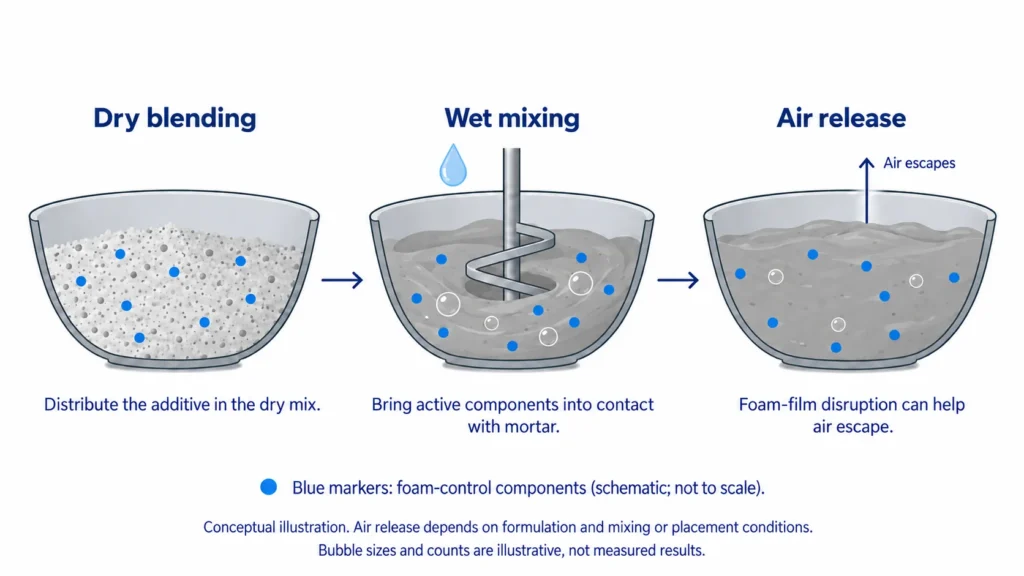
Use the following distinctions when describing a problem:
|
Observation |
What it indicates |
What it does not establish |
|---|---|---|
| Visible foam on fresh mortar | Bubbles are present at the observed surface | Total air content throughout the batch |
| Air measured in fresh mortar | Air present under the selected test conditions | Final hardened pore structure by itself |
| Pinholes in the finished surface | Local surface discontinuities | A confirmed cause or a universal need for more defoamer |
| Voids observed inside hardened material | Internal discontinuities in the examined specimen | Their origin solely from the photograph |
Where Is Powder Form Useful?
Powder form is particularly relevant where additives must be metered and distributed within a factory-produced dry blend. Its practical value is compatibility with that manufacturing route; powder form alone does not establish superior defoaming performance.
Powder grades are available for self-leveling mortars, screeds, cementitious grouts, repair mortars, skim coats and selected waterproofing materials. Some are also intended for gypsum-based dry mixes. [2] The following application checks provide a starting point for deciding what an air-control trial should address:
|
Application |
Air-control concern to investigate |
Performance to retain or verify |
|---|---|---|
| Cement-based self-leveling compounds | Persistent bubbles during spreading and air-related surface pinholes | Flow retention, stability, surface quality and required strength |
| Cementitious grouts | Air introduced during mixing versus voids caused by incomplete filling | Filling behavior, bleeding, specified volume change and strength |
| Repair mortars | Air-related defects in the applied material | Application behavior, substrate bond and specified mechanical properties |
| Cementitious waterproofing mortars | Pinholes or discontinuities in the applied layer | Layer continuity, adhesion and required water-resistance performance |
| Putty, skim coat, plaster and tile adhesive | Whether air is excessive relative to the formulation's intended behavior | Trowelling, water retention and relevant bond properties |
| Gypsum-based materials | Foam and residual air in the particular gypsum formulation | Working time, setting behavior and application-specific performance |
These checks are application priorities, not proof that a particular grade is suitable. For grouts, evaluate the filling method separately from the additive: reducing mixing air cannot by itself correct incomplete placement. For trowel-applied products, the target is an appropriate air level with acceptable workability, not automatically the lowest reading. Cement- and gypsum-based systems require separate validation.
How Does It Fit Alongside Other Mortar Additives?
A defoamer has a different primary role from a dispersant, water-retention additive or polymer modifier. It should be assessed alongside those ingredients without being treated as their replacement.
Polycarboxylate ether (PCE) powder is used for particle dispersion and water-demand control. Its presence does not remove the need to assess air behavior in the complete mixture.
Redispersible polymer powder (RDP) is selected for polymer modification. Changing its commercial grade can also change fresh-mortar behavior, so an existing defoamer arrangement should not be assumed to remain suitable.
For more on those formulation relationships, see RDP and Cellulose Ether in Dry-Mix Mortar: How Do They Work Together?
A useful development rule is to document the complete additive package. If several ingredients change together, the result belongs to that combined change until separate comparisons establish individual contributions.
What Should Manufacturers Expect—and Verify?
The expected benefit is better control of unwanted foam and associated air defects while preserving the properties required by the finished mortar. Surface appearance, fresh-mortar behavior and hardened performance should be assessed together.
As a practical acceptance framework, separate three questions:
- Was the intended air-related problem reduced? Record the original symptom and use a relevant measurement where possible.
- Was fresh-mortar performance retained? Check the properties needed for mixing, placement or trowelling.
- Did the finished material meet its requirements? Verify the relevant hardened properties rather than inferring them from appearance.
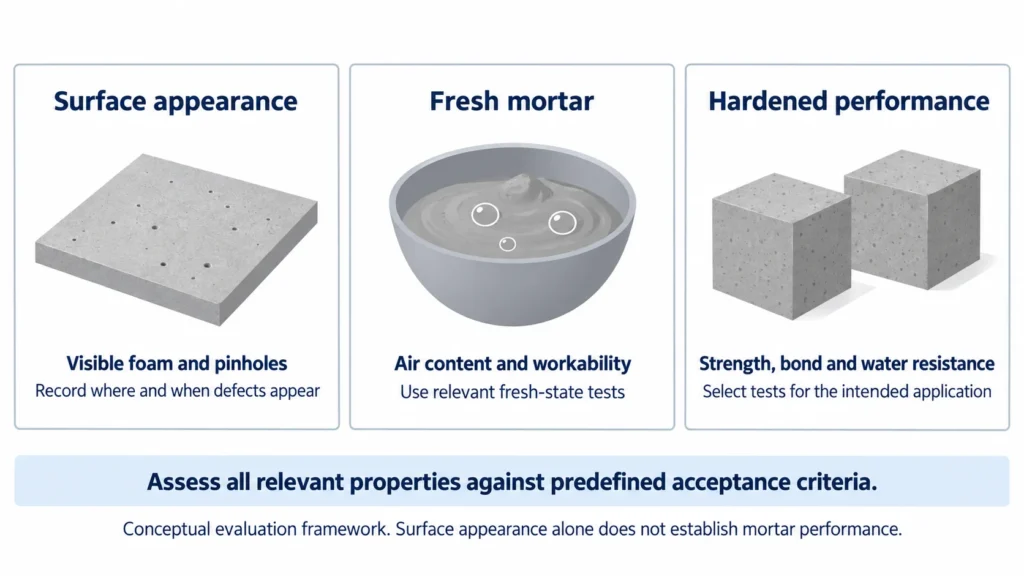
Define acceptance criteria before comparing samples. A smoother surface is useful evidence of a surface change, but strength, adhesion or water resistance must be established by the relevant tests. Where air is intentionally part of the formulation, retain the specified air characteristics.
What Should You Confirm Before a Product Trial?
Prepare a concise brief covering the binder system, application, additive package, water addition, mixing procedure and the timing of the observed problem. Include any measurements already available and the properties the formulation must retain.
Request the current technical data sheet (TDS), safety data sheet (SDS), incorporation guidance and dosage basis for the proposed grade. Confirm whether the suggested percentage refers to total dry mix or binder mass, and whether it describes the supplied product or active components.
Use the POLYVIA™ Powder Defoamer product page for available product information, or contact POLYVIA™ to discuss sample evaluation.
Frequently Asked Questions
1. Is powder defoamer simply a liquid defoamer that has been dried?
Not necessarily. One common approach places liquid components on an absorbent carrier. Other product designs may differ. Check the specific composition and incorporation guidance instead of assuming a shared manufacturing process. [1]
2. Does a powder defoamer have to dissolve completely in water?
Complete dissolution is not a universal requirement. Carrier-based products may contain insoluble mineral material. Evaluate incorporation and performance according to the grade’s instructions; a clear water solution is not a general acceptance criterion. [1,2]
3. Does a higher active content mean better mortar performance?
It is not sufficient evidence. Check how active content is defined, then compare the complete products under documented conditions. Chemical compatibility and the required finished-mortar properties still determine suitability.
4. Can I replace one supplier’s powder with another at the same dosage?
Treat that as a trial proposal. Equal commercial powder dosage is not necessarily equal active dosage or equivalent performance. Confirm the dosage denominator and evaluate the replacement before production approval.
5. Can I use the same grade in cement-based and gypsum-based mortar?
Some commercial grades are intended for both. That designation supports screening, but each binder formulation still needs its own evaluation. Do not transfer a dosage or performance claim solely because both materials are dry mixes. [2]
6. Should powder defoamer be dry-blended or added after water?
Use the incorporation route specified for the grade. Products intended for factory-made dry mixes are normally distributed in the dry blend before water addition. Do not assume the same product is suitable for post-addition to wet mortar; confirm the supplier’s instructions and the available mixing procedure.
7. Can I judge effectiveness using a foam test in water alone?
Use such a test only for the question it actually measures. A water-based screening result does not establish finished-mortar suitability. Include the actual binder, solids, additives and representative mixing conditions in the qualification work.
8. If the mortar surface looks smooth, can I skip further testing?
No. Surface appearance does not establish internal air content, adhesion, strength or water-related performance. Select the additional tests according to the intended product and its acceptance criteria.
References
- Evonik. Silica for Powder Defoamers. Official technical webpage; publication year not stated. Explains carrier-based conversion of liquid components into powder form. Source.
- Evonik. SITREN AirVoid® 370. Official product webpage; publication year not stated. Documents a polyether-based powder on an inorganic carrier and its listed application areas. Source.
- BYK. BYK-1692 SD. Official product webpage; publication year not stated. Documents a silicone-free powder grade for mineral-bound formulations. Source.
- Spychał, E.; Stępień, P. (2022). Effect of Cellulose Ether and Starch Ether on Hydration of Cement Processes and Fresh-State Properties of Cement Mortars. Materials, 15(24), 8764. DOI: 10.3390/ma15248764.
- Evonik. Technical Background: Defoamers. Official technical publication; publication year not confirmed. Discusses foam-film destabilization mechanisms in model and coating systems. Used here for general interfacial principles, not mortar performance claims. Source.
- BYK. Mechanism of Action of Defoamers and Air Release Agents. Official technical webpage; publication year not stated. Explains the distinction between defoaming and air release in coatings. Source.
Manufacturer examples illustrate product-category diversity. Their specifications and results are not specifications or performance guarantees for POLYVIA products.