
What Is PCE Liquid? A Technical Guide to Liquid Polycarboxylate Superplasticizer
Understanding Its Performance Grades, Solid Content, Dosage Calculations and Applications in Concrete Production.
PCE Liquid is an aqueous polycarboxylate ether superplasticizer used to improve cement particle dispersion, reduce mixing-water demand and control concrete workability. Understanding its six performance grades, solid-content specifications and dosing requirements helps manufacturers select and apply the appropriate admixture for different concrete production systems.
What Is PCE Liquid?
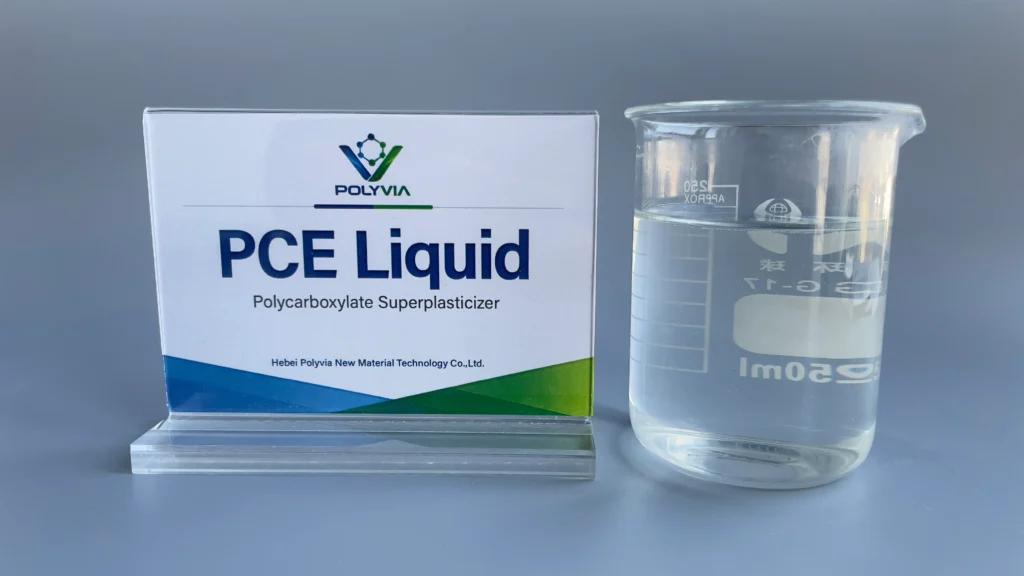
PCE Liquid is an aqueous polycarboxylate ether (PCE) superplasticizer used in concrete admixture formulations to improve cement dispersion, reduce mixing-water demand and support the required workability and strength-development profile.
It is supplied as a liquid admixture rather than a dry powder or solid flake. This allows it to be incorporated into concrete production through liquid dosing systems or used in the preparation of compatible admixture formulations.
Different Liquid PCE grades are developed to prioritize different performance objectives, including:
- High water reduction.
- Slump retention.
- Early strength.
- Balanced general-purpose performance.
- Setting-time control.
- Clay resistance and slump retention.
Liquid PCE is used in ready-mixed, pumped, high-performance, precast, prestressed and self-compacting concrete.
Its performance depends on polymer characteristics, product grade, solid content, dosage, cement compatibility, aggregate properties and production conditions.
An important distinction is that Liquid PCE performance cannot be determined by solid content alone. Two products with identical solid content may behave differently because their polymer structures and formulations can differ.
How Does Liquid PCE Work in Concrete?
Liquid PCE works through interactions between polycarboxylate polymer molecules and cementitious particles in the aqueous phase of concrete.
Its primary mechanisms involve polymer adsorption and steric hindrance.
1. Polymer Adsorption
PCE molecules typically contain an anionic polymer backbone with functional groups that can interact with cement particles and early hydration products.
After Liquid PCE is introduced into the concrete mixture, its polymer molecules become available in the aqueous phase and can adsorb onto suitable particle surfaces.
The adsorption behavior depends on polymer architecture, cement composition and pore-solution chemistry.
2. Steric Hindrance and Cement Particle Dispersion
Many PCE superplasticizers have a comb-like molecular architecture consisting of a polymer backbone and polyether side chains.
After adsorption, hydrated side chains extend into the surrounding aqueous phase.
These chains create steric hindrance, helping reduce particle flocculation and improve cement particle dispersion.
Electrostatic interactions may also contribute, depending on the polymer structure and cement system.
3. Water Reduction and Workability
Improved cement particle dispersion releases water that would otherwise remain physically trapped within particle flocs.
This allows a concrete mixture to achieve a specified slump or flow target with potentially less mixing water.
The resulting benefits may include:
- Reduced mixing-water demand.
- Improved initial workability.
- Opportunities to reduce the water-to-binder ratio.
- Better control of fresh concrete rheology.
- Improved formulation flexibility.
However, water reduction, slump retention, setting time and early strength are different performance characteristics.
A higher initial slump does not automatically mean better retention or faster strength development. Each property must be evaluated according to the intended application.
What Are the Six Main Types of Liquid PCE?
POLYVIA™ Liquid PCE covers six performance-oriented product series.
| Product Series | Performance Positioning | Main Evaluation Objective |
|---|---|---|
| PCE HWR | High Water Reduction | Water demand and initial workability |
| PCE SR | High Slump Retention | Workability retention over time |
| PCE ES | Early Strength | Early-age strength development |
| PCE GP | General Purpose | General formulation performance |
| PCE RET | Set Retarding | Setting-time control |
| PCE CSR | Clay Resistance & Slump Retention | Clay tolerance and workability retention |
1. PCE HWR — High Water Reduction
PCE HWR is designed for concrete formulations where reducing mixing-water demand while achieving the required workability is the main objective.
Its selection should consider target initial slump or flow, required water-to-binder ratio, cement characteristics, aggregate properties and dosage.
High-water-reduction positioning does not guarantee a specific water-reduction percentage in every concrete formulation.
2. PCE SR — High Slump Retention
PCE SR is designed for concrete applications where maintaining workability over time is an important requirement.
Slump retention becomes particularly relevant when concrete must remain workable during transportation, waiting and placement.
Its performance should be evaluated through time-dependent slump or slump-flow measurements.
Important evaluation conditions include initial slump, elapsed time, ambient and concrete temperature, cement source, admixture dosage and mixing procedures.
Initial slump and slump retention should be reported separately.
3. PCE ES — Early Strength
PCE ES is an early-strength-oriented Liquid PCE series.
It is designed for applications where early-age strength development is an important consideration.
Its suitability should be assessed together with cement characteristics, water-to-binder ratio, admixture dosage, setting behavior, concrete temperature and curing conditions.
Early-strength positioning does not independently guarantee a specific compressive strength or demolding time.
Actual performance must be verified through strength testing at defined ages.
4. PCE GP — General Purpose
PCE GP is positioned for general-purpose concrete admixture formulations.
It is intended for applications requiring a suitable overall performance profile rather than prioritizing only one specialized property.
Its suitability should be determined by the concrete formulation, cement characteristics, workability requirements and production conditions.
General-purpose positioning does not mean universal compatibility with all cement sources.
5. PCE RET — Set Retarding
PCE RET is designed for applications where setting-time control is an important requirement.
Set retardation and slump retention are related but different properties.
Setting time describes the development of cementitious material from a plastic state toward hardening.
Slump retention describes the ability of fresh concrete to maintain its workability over a defined period.
A mixture may exhibit different responses in these two properties. Therefore, setting behavior and workability retention should be measured independently.
PCE RET should be evaluated according to the required setting profile, concrete temperature, cement characteristics and placement conditions.
6. PCE CSR — Clay Resistance & Slump Retention
PCE CSR is positioned for concrete systems where clay tolerance and slump retention are important considerations.
Clay contamination in aggregates can interfere with PCE performance. Certain clay minerals may interact with polycarboxylate polymers and increase admixture demand or reduce effective dispersing performance.
The effect depends on clay mineralogy, clay content, specific surface area, aggregate characteristics, cement composition and PCE polymer characteristics.
CSR should be evaluated using the actual aggregate source and relevant clay characteristics.
Clay-resistance positioning should not be interpreted as guaranteed immunity to all clay types or contamination levels.
What Are the Technical Specifications of POLYVIA™ Liquid PCE?
The following table summarizes the six product series according to the official POLYVIA™ PCE Liquid Technical Data Sheet.
| Parameter | HWR | SR | ES | GP | RET | CSR |
|---|---|---|---|---|---|---|
| Grade | High Water Reduction | Slump Retention | Early Strength | General Purpose | Set Retarding | Clay Resistance & Slump Retention |
| Solid Content, % | 40±1 / 50±1 | 40±1 / 50±1 | 40±1 / 50±1 | 40±1 / 50±1 | 40±1 / 50±1 | 40±1 / 50±1 |
| Appearance | Colorless to light yellow | Amber to brown | Colorless to light yellow | Colorless to light yellow | Amber to brown | Colorless to light yellow |
| pH Value, 20°C | 6.0±1.0 | 6.0±1.0 | 4.0±1.0 | 6.0±1.0 | 4.0±1.0 | 4.0±1.0 |
| Density, 25°C, g/cm³ | 1.10±0.02 | 1.10±0.02 | 1.10±0.02 | 1.10±0.02 | 1.10±0.02 | 1.10±0.02 |
| Chloride Content, % | ≤0.02 | ≤0.02 | ≤0.02 | ≤0.02 | ≤0.02 | ≤0.02 |
Understanding the Specifications
Solid Content
All six Liquid PCE series have two standard solid-content specifications:
- 40% ± 1%.
- 50% ± 1%.
These are two defined product specifications, not a continuous 40–50% range.
Solid content is important when calculating commercial dosage, comparing product concentrations and correcting mixing water.
It should not automatically be interpreted as active-polymer content unless the analytical definition confirms that equivalence.
Appearance
The supplied TDS identifies two appearance groups:
- Colorless to light yellow liquid: HWR, ES, GP and CSR.
- Amber to brown liquid: SR and RET.
Appearance is a product-identification characteristic. It should not independently be used to determine product performance or quality.
pH Value
The specified pH values are measured at 20°C:
- HWR: 6.0 ± 1.0.
- SR: 6.0 ± 1.0.
- ES: 4.0 ± 1.0.
- GP: 6.0 ± 1.0.
- RET: 4.0 ± 1.0.
- CSR: 4.0 ± 1.0.
The measurement temperature must be stated correctly when comparing pH results.
Density
All six series have a specified density of 1.10 ± 0.02 g/cm³ at 25°C.
Density is useful for product identification and volumetric dosing calculations. Where dosing is based on volume, actual product density should be considered.
Chloride Content
The TDS specifies chloride content at no more than 0.02% for all six product series.
This is a product specification value, not a substitute for checking the chloride contribution and applicable requirements of the complete concrete formulation.
Performance Data Availability
The current supplied Liquid PCE TDS does not specify numerical water-reduction rates, slump-retention periods or 1-day and 3-day strength ratios.
These performance indicators must therefore be established through relevant test reports and application-specific evaluations rather than inferred from product names.
What Is the Recommended Dosage of Liquid PCE?
Liquid PCE dosage depends on the product grade, solid content, cement characteristics, binder composition, water-to-binder ratio and required concrete workability.
The previously established POLYVIA™ dosage references for 40% solid-content products are:
| Product | Solid Content | Historical Dosage Reference | Dosage Basis |
|---|---|---|---|
| HWR40 | 40% ± 1% | 0.80–1.20% | Original reference denominator not recorded |
| SR40 | 40% ± 1% | 0.10–0.30% | Total cementitious material mass |
These values are reference ranges from previous POLYVIA™ product discussions. They are not universal dosage guarantees.
Important dosage limitations:
- HWR40: The 0.80–1.20% reference is retained, but its original dosage denominator has not been confirmed. It must not be represented as a verified percentage of binder mass.
- SR40: The 0.10–0.30% reference is based on total cementitious material mass.
- HWR50 and SR50: Do not automatically transfer the 40% product dosage references to the 50% products.
- ES40, ES50, GP, RET and CSR: No universal numerical dosage has been confirmed in the available product documentation.
The appropriate dosage must be established through laboratory trials using the actual concrete formulation and production conditions.
1. SR40 Dosage Example per Tonne of Cementitious Materials
For a concrete formulation containing 1,000 kg of total cementitious materials:
At 0.10% commercial product dosage:
1,000 × 0.10% = 1.0 kg SR40.
At 0.30% commercial product dosage:
1,000 × 0.30% = 3.0 kg SR40.
Therefore, the historical SR40 reference corresponds to:
1.0–3.0 kg of commercial SR40 per 1,000 kg of total cementitious materials.
This example uses the previously confirmed commercial product dosage basis and the specified 40% solid-content grade.
2. Converting Liquid PCE Dosage into Solids Dosage
The calculation formula is:
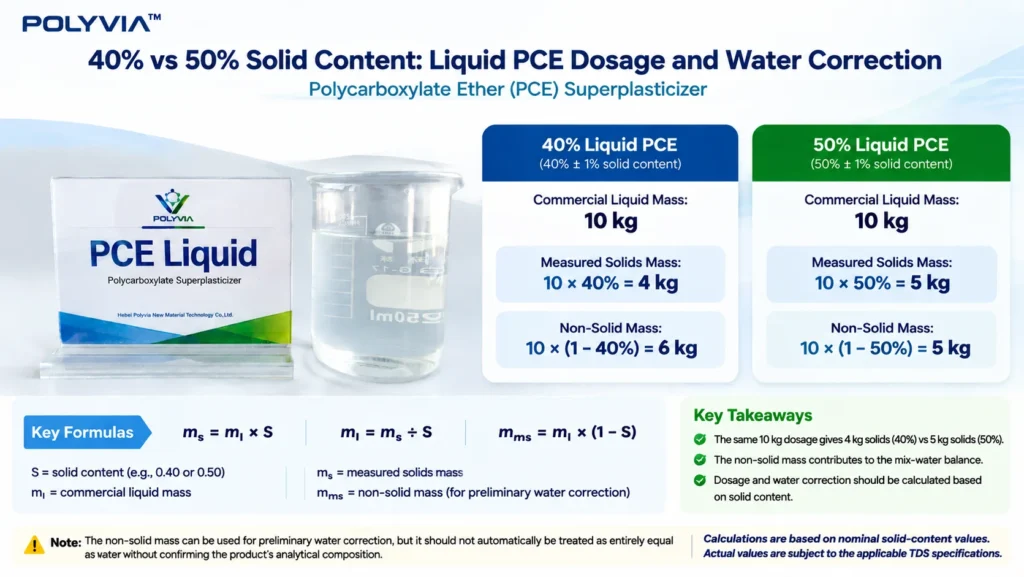
PCE Solids Mass = Commercial Liquid Mass × Solid Content.
For example, 10 kg of a 40% solid-content Liquid PCE contains:
10 × 0.40 = 4 kg of measured solids.
The same commercial mass of a 50% solid-content product contains:
10 × 0.50 = 5 kg of measured solids.
This distinction is essential when comparing commercial product dosages.
Equal solids dosage does not guarantee equivalent performance between different PCE grades because polymer characteristics and formulations may differ.
3. How to Convert a Required Solids Mass into Commercial Liquid Dosage
Use:
Commercial Liquid Dosage = Required Solids Mass ÷ Solid Content.
Example:
Assume a calculation requires 5 kg of measured PCE solids.
For a 40% product:
5 ÷ 0.40 = 12.5 kg of commercial Liquid PCE.
For a 50% product:
5 ÷ 0.50 = 10 kg of commercial Liquid PCE.
Both provide 5 kg of theoretical measured solids.
This is a concentration conversion, not a recommendation to replace one grade with another without compatibility and performance testing.
4. How to Account for the Liquid Product's Water Contribution
For preliminary mass-balance calculations:
Non-Solid Mass = Commercial Liquid Mass × (1 − Solid Content).
Example:
For 10 kg of a 50% solid-content Liquid PCE:
10 × (1 − 0.50) = 5 kg of non-solid mass.
For 10 kg of a 40% solid-content Liquid PCE:
10 × (1 − 0.40) = 6 kg of non-solid mass.
Because Liquid PCE is an aqueous product, this non-solid fraction is relevant to the mixing-water balance. However, non-solid mass should not automatically be treated as exactly equal to water without confirming the product's analytical composition.
The final water correction must follow the applicable analytical definition and approved mix-design procedure.
The dosage reference, solids calculation and water correction must always be treated as separate but related calculations.
How Is Liquid PCE Added During Concrete Production?
Liquid PCE is commonly introduced into concrete production through liquid admixture dosing systems.
The addition procedure should be compatible with the concrete plant, mix design and product instructions.
1. Product Identification and Dosage Preparation
Before dosing:
- Verify the correct PCE product series.
- Confirm the 40% ± 1% or 50% ± 1% solid-content specification.
- Check product appearance and batch identification.
- Calculate the required commercial dosage.
- Account for the product's water contribution.
- Confirm dosing equipment calibration.
Accurate product identification is particularly important because HWR, SR, ES, GP, RET and CSR have different performance positioning.
2. Liquid Dosing
A general production sequence involves:
- Preparing the concrete raw materials.
- Measuring the required mixing water.
- Dosing Liquid PCE according to the approved production procedure.
- Mixing according to the validated sequence and duration.
- Evaluating fresh concrete performance.
- Recording the actual dosage and test results.
The precise addition sequence may vary between production systems.
Do not assume that all concrete plants require an identical dosing sequence.
3. Dilution Before Dosing
In some production systems, Liquid PCE may be diluted with water before dosing.
Dilution may be required by specific equipment or production procedures, but it does not increase the original PCE solids mass.
For example, adding water to 10 kg of 50% Liquid PCE increases the final solution mass but does not change the original 5 kg of measured solids.
All dilution water must be included in the total mix-water calculation.
Dilution ratios should follow verified product instructions and factory trials rather than an assumed universal value.
4. Production Control
Important production control points include:
- Correct product grade.
- Accurate dosage measurement.
- Dosing equipment calibration.
- Addition sequence.
- Mixing time.
- Total water calculation.
- Concrete temperature.
- Slump or slump-flow testing.
- Batch-to-batch consistency.
The objective is to ensure consistent admixture introduction and predictable concrete performance under defined production conditions.
Where Is Liquid PCE Used?
According to the POLYVIA™ PCE Liquid TDS, its listed application areas include ready-mix, pumped, high-performance, precast, prestressed and self-compacting concrete.
1. Ready-Mixed Concrete
Ready-mixed concrete often requires a balance between initial workability, retention, pumpability and stability.
HWR and SR are relevant performance categories for different workability objectives.
Selection should consider transportation time, ambient temperature, cement source, aggregate characteristics and placement requirements.
2. Pumped Concrete
Pumped concrete requires suitable rheology, cohesion and workability throughout the pumping process.
Liquid PCE selection should consider water demand, slump retention, aggregate grading, binder composition and the pumping system.
High initial slump alone does not establish suitable pumpability.
3. High-Performance Concrete
High-performance concrete often requires controlled water-to-binder ratios and consistent fresh-state properties.
PCE selection should consider the complete binder system, cement compatibility, aggregate characteristics and target workability.
The final performance must be verified through relevant fresh and hardened concrete testing.
4. Precast Concrete
Precast production requires appropriate workability, filling behavior, production consistency and strength development.
Liquid PCE selection should consider the casting process, demolding requirements and curing conditions.
Where early strength is important, ES may be evaluated alongside the complete concrete formulation and production process.
Learn more about PCE selection and production considerations in precast concrete pile applications.
5. Prestressed Concrete
Prestressed concrete requires controlled fresh-state performance and strength development to meet production and demolding requirements.
PCE selection should consider:
- Water-to-binder ratio.
- Concrete rheology.
- Casting and compaction.
- Early-age strength.
- Curing regime.
- Required demolding conditions.
A specific early-strength result cannot be attributed to PCE alone without appropriate supporting evidence.
For more information on water reduction and fresh-concrete performance in PHC production, see our guide to PCE water reduction in PHC spun pile concrete.
6. Self-Compacting Concrete
Self-compacting concrete requires a balance between filling ability, passing ability and segregation resistance.
Liquid PCE may be used to support the required flowability and particle dispersion.
However, high slump-flow values alone do not establish satisfactory self-compacting concrete performance.
Testing should consider flowability, passing ability and stability using the applicable evaluation methods.
Explore our broader range of concrete applications to understand how different material technologies address specific production and performance requirements.
How Should Manufacturers Select the Right Liquid PCE Grade?
Product selection should begin with the primary performance requirement.
| Main Requirement | POLYVIA™ Series | Key Evaluation |
|---|---|---|
| High water reduction | HWR | Water demand and initial workability |
| High slump retention | SR | Workability over time |
| Early strength | ES | Early-age strength and curing |
| General-purpose performance | GP | Overall formulation performance |
| Set-time control | RET | Setting behavior and workability |
| Clay resistance and slump retention | CSR | Aggregate compatibility and retention |
Before choosing a product, manufacturers should evaluate seven factors.
1. Cement Compatibility
Different cement sources may interact differently with PCE polymers.
2. Aggregate Characteristics
Clay contamination, mineralogy and aggregate quality can affect admixture demand and workability.
3. Required Workability
Define the initial slump, slump retention, pumping or placement requirements.
4. Solid Content
Select the 40% ± 1% or 50% ± 1% specification according to the production and dosing requirements.
5. Setting and Strength Requirements
Determine whether the project prioritizes early strength, normal setting or controlled retardation.
6. Production Conditions
Consider transportation time, temperature, batching sequence and mixing procedure.
7. Formulation Compatibility
Test the selected Liquid PCE with the actual cementitious materials and other admixtures.
The final product and dosage should be determined through laboratory trials and, where necessary, production validation.
What Factors Can Affect Liquid PCE Performance?
Even when the same Liquid PCE grade is used, concrete performance may vary between production systems.
Important influencing factors include:
- Cement mineral composition.
- Cement fineness.
- Sulfate balance.
- Alkali content.
- Supplementary cementitious materials.
- Aggregate characteristics.
- Clay contamination.
- Water-to-binder ratio.
- Ambient and concrete temperature.
- Mixing sequence.
- Mixing duration.
- Admixture dosage.
- Other chemical admixtures.
- Time between mixing and testing.
For example, an HWR grade that achieves the required initial slump may not provide the necessary retention in a different cement system.
Similarly, a concrete mixture that maintains its slump may still require separate evaluation of setting time, segregation resistance and hardened performance.
When troubleshooting performance changes, investigate material variation, dosing accuracy and production conditions before changing the admixture dosage.
For further guidance on diagnosing concrete performance problems and evaluating corrective measures, explore our concrete performance solutions.
A controlled trial using consistent materials and test conditions is more reliable than changing several formulation variables simultaneously.
How Should Liquid PCE Be Stored, Handled and Transported?
Liquid PCE should be handled according to its product-specific storage and transportation requirements.
The supplied POLYVIA™ PCE Liquid TDS identifies the following commercial packaging options:
- 1,000 kg IBC Tank.
- 20 MT per 20-foot FCL.
- 23 MT per Flexitank.
Actual loading quantities should be confirmed against the applicable packaging, transport and shipment arrangements.
Recommended general handling practices include:
- Keep containers properly closed.
- Protect the product from contamination.
- Avoid unintended dilution with water.
- Follow the manufacturer's storage-temperature recommendations.
- Use suitable transfer and dosing equipment.
- Check product appearance and condition before use.
- Maintain batch and storage records.
Storage duration, temperature limits, freezing sensitivity and any agitation requirements should follow the latest approved product-specific TDS or manufacturer instructions.
Do not assume that all six Liquid PCE series have identical storage stability or handling requirements.
FAQ
1. What Is Liquid PCE Used For?
Liquid PCE is used as a high-performance water-reducing admixture in concrete and compatible cementitious materials. Its main functions include improving cement particle dispersion, reducing mixing-water demand and controlling workability. Common applications include ready-mixed, pumped, high-performance, precast, prestressed and self-compacting concrete.
2. What Is the Recommended Dosage of Liquid PCE?
The previously established POLYVIA™ reference dosages for 40% solid-content products are 0.80–1.20% for HWR40 and 0.10–0.30% of total cementitious material mass for SR40. The original dosage denominator for HWR40 has not been confirmed. These references should not automatically be transferred to HWR50, SR50 or other Liquid PCE grades. Final dosage should be verified through application-specific concrete trials.
3. What Is the Difference Between 40% and 50% Solid Content Liquid PCE?
A 50% solid-content product provides more measured solids per kilogram than a 40% product. For the same required solids mass, a 40% product requires a greater commercial dosage. The non-solid contribution must also be considered when calculating the concrete mix-water balance. Equal solids dosage does not guarantee equivalent performance between different PCE grades.
4. How Do You Add Liquid PCE to Concrete?
Liquid PCE is generally introduced through a calibrated liquid dosing system according to the approved concrete mixing procedure. The correct product grade and dosage should be verified before batching. If dilution is required by the production process, the additional water must be included in the total mix-water calculation. The addition sequence and mixing time should be established through plant trials.
5. How Do You Calculate Liquid PCE Dosage for Concrete?
Liquid PCE dosage can be calculated using either commercial product mass or measured solids mass. The basic formula is: PCE Solids Mass = Commercial Liquid Mass × Solid Content. Commercial dosage is calculated by dividing the required solids mass by the solid-content fraction. The calculation must also consider the product's non-solid contribution and use a clearly defined binder-mass reference.
6. What Is the Difference Between PCE HWR and PCE SR?
PCE HWR is designed primarily for high water reduction, while PCE SR is positioned for high slump retention. HWR selection focuses on water demand and initial workability, whereas SR evaluation focuses on maintaining workability over time. The appropriate grade depends on the cement system, required slump, retention period, temperature and production conditions.
7. Why Does Concrete Lose Slump After Adding Liquid PCE?
Rapid slump loss may be associated with cement compatibility, sulfate balance, temperature, admixture dosage, aggregate characteristics or interactions with other admixtures. Initial slump and slump retention should be measured separately. Controlled trials using the actual cement and aggregate sources help identify the contributing factors.
8. Is Liquid PCE Compatible with All Types of Cement?
No. PCE performance can vary with cement composition, fineness, sulfate balance, alkali content and pore-solution chemistry. A Liquid PCE grade that performs well with one cement source may behave differently with another. Compatibility should be evaluated through laboratory testing using the intended cement and concrete formulation before large-scale production.
CONCLUSION
Liquid PCE is an aqueous polycarboxylate ether superplasticizer designed to improve cement particle dispersion, reduce mixing-water demand and support the required workability and strength-development profile of concrete.
Its performance depends on polymer characteristics, solid content, product grade, dosage, cement compatibility, aggregate properties and production conditions.
POLYVIA™ offers six Liquid PCE series—HWR, SR, ES, GP, RET and CSR—to address different concrete admixture requirements, including high water reduction, slump retention, early strength, general-purpose performance, setting-time control and clay resistance with slump retention.
Understanding the differences between these grades, together with correct solids calculations, water correction and production control, helps concrete manufacturers select and apply Liquid PCE more effectively.
POLYVIA™ — Advanced PCE Solutions for Concrete and Cementitious Materials.
REFERENCES
- Yoon, J., Choi, B. I., & Kim, J. H. (2022). Adsorption properties of polycarboxylate ether-based superplasticizer on cement particles and their resultant dispersion. Frontiers of Structural and Civil Engineering, 16(4), 506–514. https://doi.org/10.1007/s11709-022-0813-5
- Adsorption properties of polycarboxylate ether-based high range water reducing admixture on cementitious systems: A review. (2021). Construction and Building Materials, 312, 125366. https://doi.org/10.1016/j.conbuildmat.2021.125366
- Ding, B., Ng, S., & Ou, Z. (2023). Effect of sulfate on the compatibility between polycarboxylate superplasticizer and cement-based materials with or without silica fume. Construction and Building Materials, 405, 133256. https://doi.org/10.1016/j.conbuildmat.2023.133256
- Zhang, K., Mezhov, A., & Schmidt, W. (2023). Effect of Polycarboxylate Superplasticizer in Ordinary Portland Cement and Sulfate Resistant Cement. Journal of Materials in Civil Engineering, 35(6). https://doi.org/10.1061/JMCEE7.MTENG-15033
- Pang, J. et al. (2024). Effect of the structure of macromonomer in polycarboxylate superplasticizer on slump-retention of concrete. Journal of Dispersion Science and Technology, 45(8), 1553–1561. https://doi.org/10.1080/01932691.2023.2222799