
PCE-Based Cement Grinding Aids: Can PCE Grinding Aid Powder Improve Cement Mill Output?
Understanding Polycarboxylate Ether Technology, Grinding Efficiency and Industrial Applications
Polycarboxylate Ether (PCE) is widely used as a high-performance concrete superplasticizer. Beyond water reduction and cement dispersion, scientific research has also investigated specially designed PCE polymers as cement grinding aids.
Can PCE grinding aid powder improve clinker grinding efficiency, reduce particle agglomeration and increase cement mill productivity?
This technical guide examines published research, PCE molecular architecture, powder and liquid delivery forms, dosage considerations and industrial validation methods. It also explains why conventional PCE superplasticizers should not automatically be considered qualified cement grinding aids.
Can PCE Grinding Aid Powder Improve Cement Mill Output?
Yes. Specially designed PCE-based grinding aids have demonstrated improved cement grinding efficiency in laboratory studies. However, laboratory grinding-energy savings do not automatically translate into higher industrial cement mill output.
Cement grinding is an energy-intensive stage of cement manufacturing. During clinker grinding, newly generated fine particles can agglomerate or adhere to grinding media and mill internals. These interactions reduce the effective energy available for particle breakage and may limit grinding efficiency.
Traditional cement grinding aids commonly include alkanolamines, glycols and other organic compounds. PCE-based grinding aids introduce another approach: modifying particle-surface interactions through specifically designed polymer structures.
Published research between 2016 and 2026 has demonstrated that PCE-based grinding-aid formulations can:
- Improve grinding efficiency under controlled laboratory conditions.
- Reduce the energy required to achieve a target cement fineness.
- Modify cement particle-size distribution (PSD).
- Influence fine-particle agglomeration and powder flowability.
- Affect the fresh and hardened properties of the resulting cement.
However, these findings concern specifically developed PCE grinding-aid formulations. They do not establish that ordinary commercial PCE superplasticizer powder will achieve the same results.
The distinction between PCE chemistry, commercial product form and actual grinding performance is essential when evaluating this technology.
What Is a PCE-Based Cement Grinding Aid?
A PCE-based cement grinding aid is a polycarboxylate ether polymer formulation developed to improve clinker or cement grinding performance.
PCE polymers generally have a comb-shaped molecular architecture consisting of:
- An anionic polymer backbone containing carboxylate groups.
- Polyether side chains, commonly based on polyethylene glycol structures.
- Molecular characteristics that can be adjusted through polymer design.
In concrete production, PCE superplasticizers are primarily designed to disperse cement particles in an aqueous environment, reduce water demand and improve concrete workability.
In cement grinding, the performance objective is different.
A PCE-based grinding aid is evaluated for its ability to influence surface interactions during mechanical grinding, limit fine-particle agglomeration and improve the processing behavior of the resulting cement powder.
The principal evaluation objectives include:
Grinding efficiency: Reducing the energy required to achieve a specified cement fineness.
Particle-size distribution: Controlling the distribution of fine and coarse particles.
Powder flowability: Improving the handling and flow characteristics of ground cement.
Cement performance: Maintaining acceptable setting behavior, water demand and strength development.
A formulation that reduces grinding energy but negatively affects cement hydration or final strength may not be suitable for industrial use.
Is PCE Grinding Aid Powder the Same as Conventional PCE Superplasticizer Powder?
No. Both materials belong to the broader polycarboxylate ether polymer family, but their formulation objectives and performance requirements are different.
This distinction is particularly important because the term PCE grinding aid powder can refer to a specially developed solid grinding-aid formulation rather than an ordinary powdered concrete superplasticizer.
1. Conventional PCE Superplasticizer Powder
Conventional PCE powder is primarily developed for cementitious formulations requiring:
- Water reduction.
- Cement particle dispersion in aqueous systems.
- Initial flowability.
- Workability retention, depending on grade.
- Application-specific concrete or mortar performance.
Its suitability is normally evaluated through concrete or mortar testing.
2. PCE-Based Grinding Aid
A dedicated PCE grinding aid is developed for mechanical grinding applications.
Its performance is evaluated through:
- Grinding energy consumption.
- Cement fineness.
- Particle-size distribution.
- Powder flowability.
- Clinker-surface interactions.
- Cement hydration and mechanical properties.
The molecular architecture, formulation chemistry and addition method may therefore differ from those of conventional concrete superplasticizers.
3. Why This Distinction Matters
Several published studies synthesized PCE-based grinding aids specifically for their experiments.
Their reported results cannot be used as direct performance guarantees for unrelated commercial PCE powders.
For manufacturers and cement plants, a conventional PCE product should only be considered for grinding applications after formulation-specific laboratory and production validation.
How Does PCE Work as a Cement Grinding Aid?
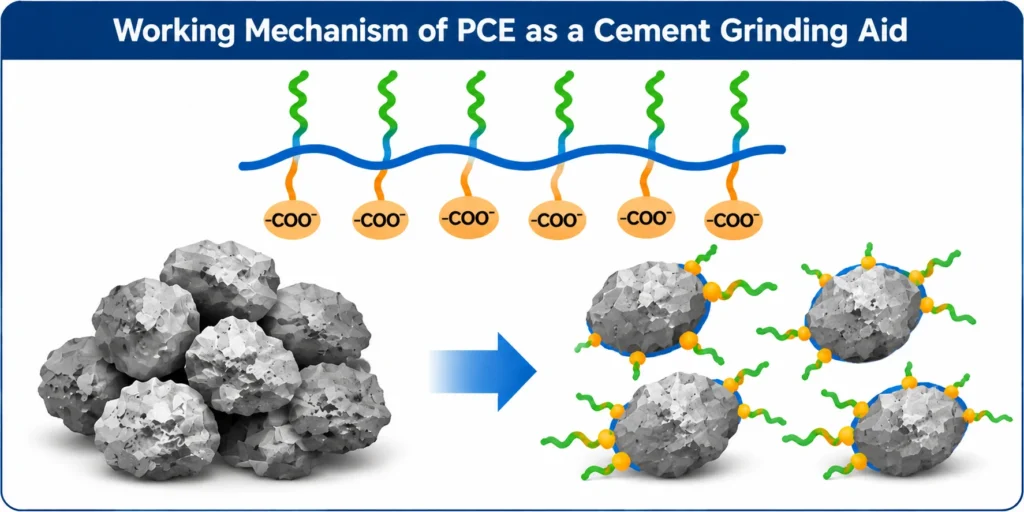
The proposed PCE grinding-aid mechanism is associated with polymer adsorption, surface interactions and changes in particle agglomeration.
Importantly, dry cement powder and fresh cement paste are different physical systems. The familiar steric dispersion mechanism of PCE in aqueous cement suspensions should not be transferred directly to dry grinding without considering the different environment.
1. Adsorption on Newly Generated Clinker Surfaces
During mechanical grinding, clinker particles fracture and expose new mineral surfaces.
PCE molecules can interact with suitable surface sites through their functional groups, particularly carboxylate-containing polymer structures.
Adsorption may modify surface properties and influence attractive interactions between newly generated particles.
Potential effects include:
- Reduced agglomeration of fine particles.
- Less particle adhesion to grinding media.
- Reduced coating of mill internals.
- Improved separation of newly generated particles.
The extent of adsorption depends on clinker mineral composition, surface chemistry, polymer architecture and the milling environment.
2. Electrostatic Surface Interactions
Grinding can generate charged surfaces and electrostatic interactions between mineral particles.
PCE adsorption may alter these surface interactions and influence the tendency of particles to approach or agglomerate.
Some research on PCE-based grinding aids has investigated surface-charge behavior, including zeta-potential measurements in non-aqueous media to better represent quasi-dry powder conditions.
However, zeta-potential results must be interpreted according to the measurement medium and test procedure. They do not independently establish the complete mechanism operating inside an industrial mill.
3. Steric Effects and Particle Re-Agglomeration
PCE polyether side chains are well known for their role in steric stabilization in aqueous cement systems.
In grinding-aid formulations, polymer adsorption and side-chain characteristics may also influence particle-surface interactions and help limit re-agglomeration.
The relative contributions of electrostatic and steric effects depend on polymer architecture and the physical environment.
Technical conclusion: PCE grinding-aid performance should be understood as a coupled process involving polymer structure, mineral-surface interactions, particle-size evolution and powder handling—not simply as the same dispersion mechanism used in concrete admixtures.
What Does Scientific Research Say About PCE Grinding Aids?
Peer-reviewed research provides experimental evidence that specially designed PCE-based grinding aids can improve cement grinding performance.
The following studies illustrate the development of this technology.
1. Early Research on Polycarboxylate-Based Grinding Aids – 2016
Sun et al. (2016) investigated the preparation of a polycarboxylate-based grinding aid through free-radical polymerization and evaluated its influence on cement properties under laboratory conditions.
The study reported that the synthesized PC-GA achieved grinding efficiency close to that of triethanolamine (TEA).
It also reported:
- Optimization of cement particle-size distribution.
- Improved uniformity of particle-size distribution.
- Increased cement-paste fluidity.
- No obvious adverse effect on the other cement properties investigated.
The authors used scanning electron microscopy (SEM) to investigate the possible mechanism and discussed the role of PC-GA in reducing the accumulation of fine particles on cement surfaces.
Engineering significance: This study established early laboratory evidence that polycarboxylate-based polymers could be investigated as cement grinding aids rather than exclusively as concrete superplasticizers.
Reference: Sun et al. (2016), Construction and Building Materials.
2. PCE Dosage and Cement Performance – 2021
He et al. (2021) investigated a molecularly modified PCE-type grinding aid.
The researchers evaluated grinding duration, cement fineness, particle-size distribution, setting time, flowability, hydration heat, mechanical properties and microstructure.
The study reported that adding 0.03% PCE-type grinding aid to cement clinker produced the highest Blaine surface area at each investigated 10-minute grinding interval and the highest volume percentage of particles in the 0–32 μm range.
The researchers also found that excessive PCE dosage could impair grinding efficiency.
Engineering significance: PCE dosage must be optimized. Increasing the amount of polymer does not necessarily produce continuously improving grinding performance.
Reference: He et al. (2021), Journal of Wuhan University of Technology – Materials Science Edition.
3. The Influence of pH on PCE Grinding Performance – 2025
Kaya et al. (2025) investigated PCE-based grinding aids synthesized under three pH conditions: 4, 7 and 9.
The researchers evaluated dosage levels of 0.025%, 0.05% and 0.10% by the combined mass of clinker and gypsum.
The investigation included:
- Grinding performance.
- Final cement properties.
- Thermal stability through thermogravimetric analysis.
- Molecular-dynamics simulations of adsorption energies on clinker phases.
The study reported that the low-pH PCE formulation achieved up to 17% improvement in grinding efficiency compared with the control under the investigated conditions.
This result suggests that pH-related formulation differences can influence PCE grinding-aid performance.
However, it does not establish that simply lowering the pH of an existing commercial PCE superplasticizer will produce the same result.
Engineering significance: pH should be treated as a formulation-development variable, not a universal adjustment rule for existing PCE products.
Reference: Kaya et al. (2025), Journal of Sustainable Cement-Based Materials.
4. PCE Molecular Architecture and Grinding Efficiency – 2026
Kaya et al. (2026) systematically investigated seven synthesized PCE-based grinding aids with different molecular architectures.
The research examined:
- Main-chain length.
- Polyether side-chain characteristics.
- Main-chain-to-side-chain ratio.
- Grinding efficiency.
- Particle-size distribution.
- Cement powder flowability.
The laboratory investigation used a ball mill with a 5 kg grinding capacity and a target Blaine fineness of 3,900 ± 100 cm²/g.
The cement system contained 96% clinker and 4% gypsum.
Two PCE grinding-aid dosages were investigated: 0.05% and 0.10% by mass of the clinker–gypsum mixture.
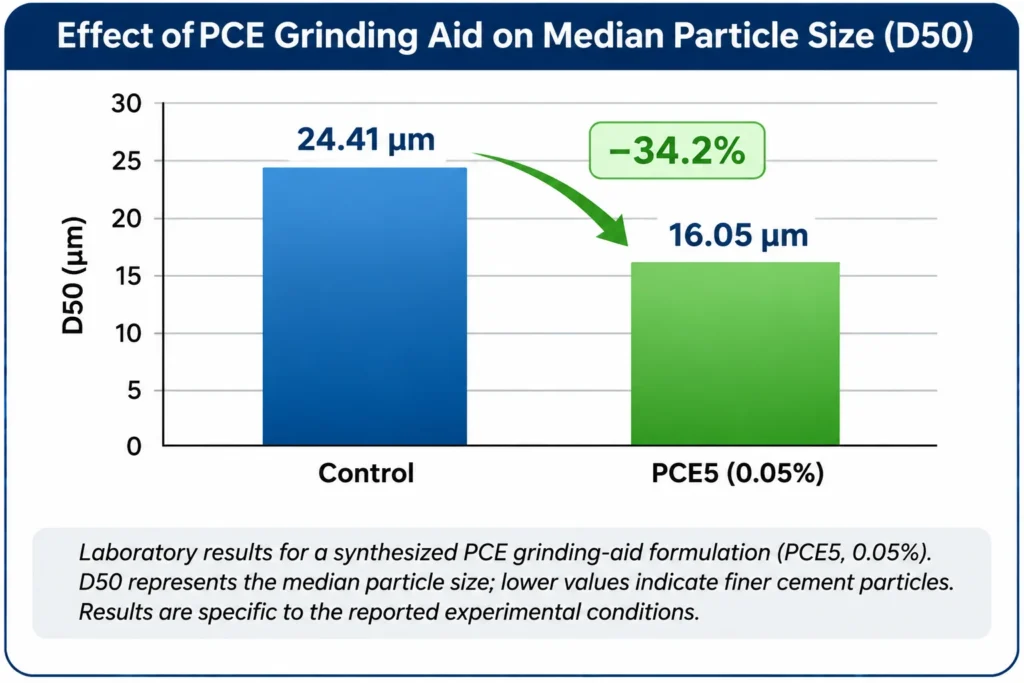
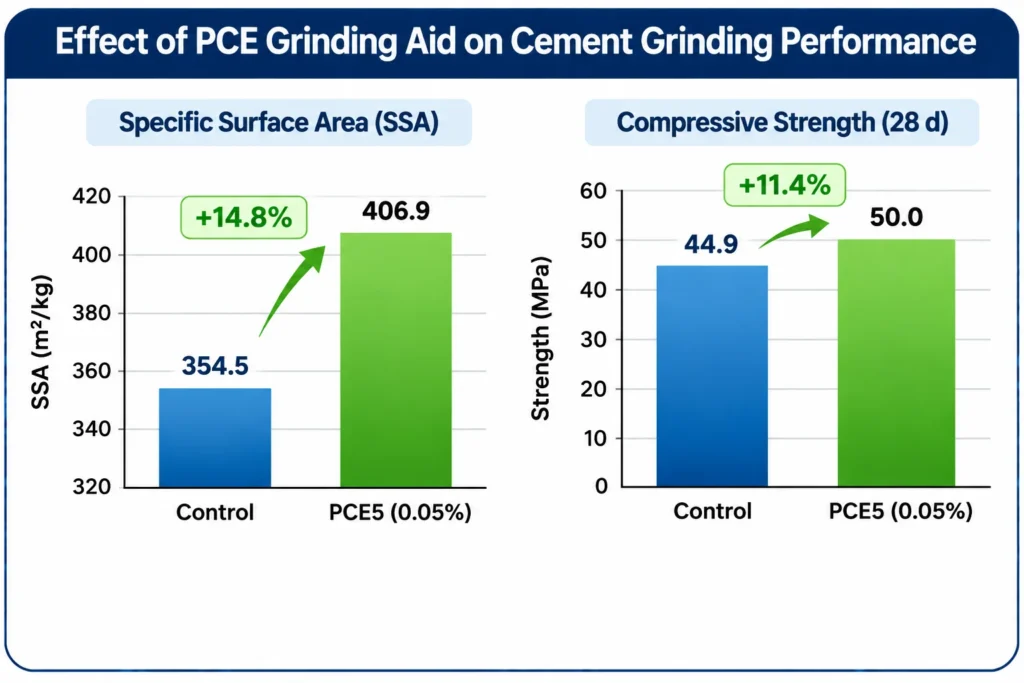
One formulation, PCE5, achieved the following results at 0.05% dosage:
| Evaluation | Control | PCE5 |
|---|---|---|
| Blaine fineness | 3,910 cm²/g | 3,982 cm²/g |
| Grinding time | 125.0 min | 110.3 min |
| Energy expended | 52.48 kWh | 46.30 kWh |
| Relative energy efficiency | Reference | 11.77% |
| Median particle size (D50) | 24.41 μm | 16.05 μm |
Both Blaine values were within the study's target range of 3,900 ± 100 cm²/g, although they were not identical.
The reported 11.77% is the relative energy-efficiency improvement calculated in the study. The energy values are reported as laboratory grinding energy in kWh; they should not be converted into industrial specific energy consumption in kWh/t without the appropriate mass-normalized data.
The results demonstrate that PCE molecular architecture can significantly influence grinding performance.
The study also showed that the best-performing formulation was not simply the one with the longest side chains. A suitable balance between main-chain and side-chain characteristics was important.
An important limitation is that the study used specially synthesized PCE grinding-aid formulations, not ordinary commercial PCE superplasticizer powders.
Engineering significance: A PCE developed for concrete water reduction cannot automatically be expected to deliver equivalent cement grinding performance. Polymer design must be matched to the intended application.
Reference: Kaya et al. (2026), Polymers.
5. PCE-Based Hybrid Grinding Aids – 2026
Kaya et al. (2026) investigated hybrid grinding aids combining PCE with conventional grinding-aid components, including:
- Triisopropanolamine (TIPA).
- Diethanolisopropanolamine (DEIPA).
- Diethylene glycol (DEG).
The formulations were evaluated through laboratory-scale ball milling of CEM I 42.5R cement at dosages of 0.05% and 0.10%.
The PCE–DEIPA hybrid formulation achieved up to 14.4% energy savings compared with the control under the reported experimental conditions.
The study attributed the improvement to complementary effects:
- PCE contributed to controlling particle agglomeration.
- Alkanolamines contributed to other grinding and particle-formation effects.
- The hybrid system improved the balance between grinding efficiency and powder characteristics.
The PCE–DEIPA system also achieved approximately 76.4% of particles in the 0–32 μm range in the reported particle-size analysis.
Importantly, the 14.4% energy-saving result belongs to a hybrid PCE–DEIPA formulation. It must not be presented as the performance of pure PCE or ordinary PCE powder.
The same study also reported that synthesized PCE used alone reduced laboratory grinding energy by approximately 8.80–11.77% in its experimental program.
Engineering significance: Hybrid PCE grinding-aid systems are a potential formulation-development direction, but the contribution of each component and the resulting cement properties must be evaluated separately.
Reference: Kaya et al. (2026), Scientific Reports.
6. Comparison of Published Research
| Year | Research Focus | Main Finding |
|---|---|---|
| 2016 | Polycarboxylate-based grinding aid | Laboratory grinding efficiency comparable to TEA |
| 2021 | PCE dosage | 0.03% produced favorable results in the investigated system |
| 2025 | Formulation pH | Up to 17% grinding-efficiency improvement |
| 2026 | Molecular architecture | PCE5 achieved 11.77% relative energy-efficiency improvement |
| 2026 | PCE hybrid formulation | PCE–DEIPA achieved up to 14.4% energy savings |
These results come from different formulations, materials, equipment and experimental designs. Their percentages should not be directly ranked or interpreted as expected industrial production gains.
Together, they establish the technical potential of PCE-based grinding aids, not the universal performance of every commercial PCE product.
PCE Grinding Aid Powder vs. Liquid PCE: Which Form Is More Suitable?
PCE grinding-aid chemistry and physical delivery form are separate considerations.
A PCE grinding aid may be developed in different physical forms depending on its polymer formulation, manufacturing route and intended dosing system.
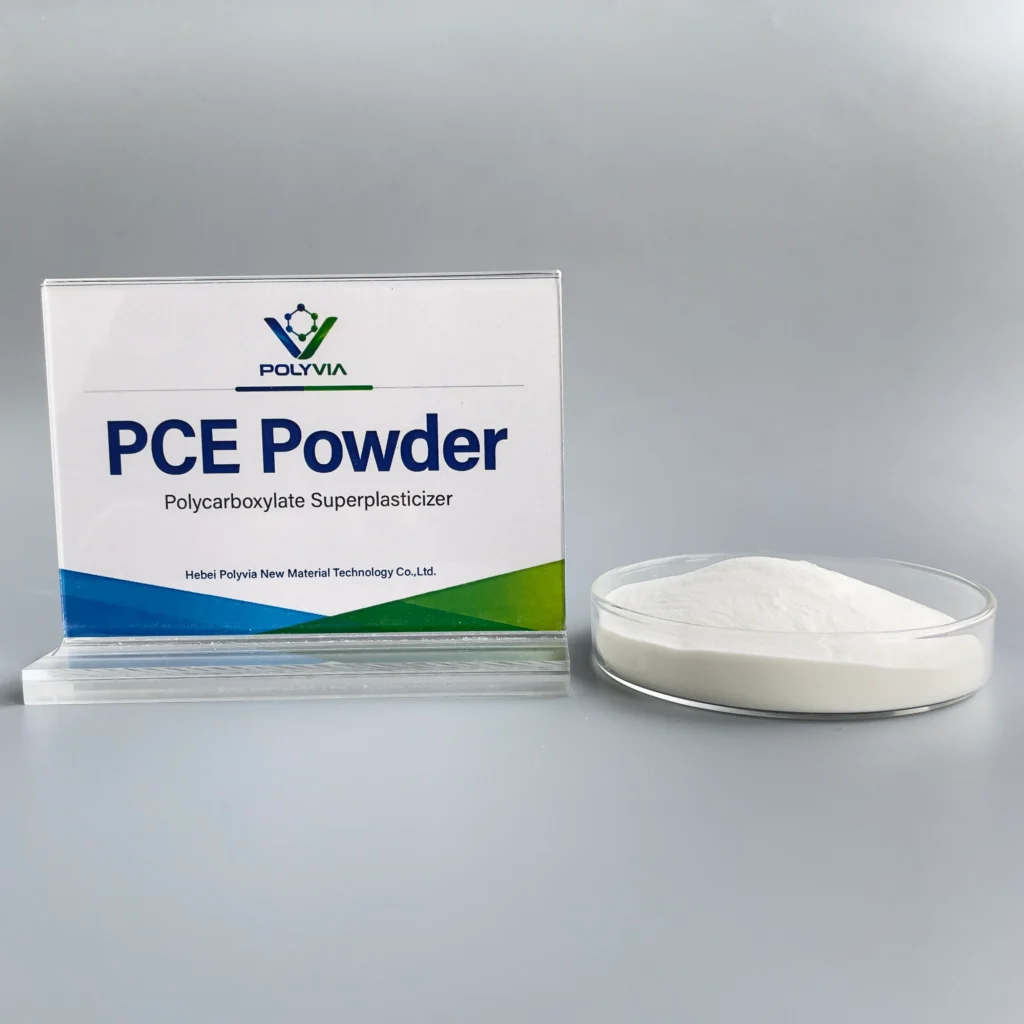
1. Powder PCE
Powder-form PCE may be considered where concentrated solid materials, dry handling or customized solid formulations are preferred.
Potential advantages include:
- Lower transportation volume compared with dilute liquid products.
- Convenient storage when adequate moisture protection is provided.
- Compatibility with suitable powder-feeding systems.
- Flexibility in preparing customized formulations.
However, powder feeding requires accurate metering and uniform distribution.
Poor dispersion may result in inconsistent local concentrations and unreliable grinding performance.
Pre-dissolution may also be considered when the specific polymer and dosing process permit it. Dissolution behavior and compatibility must be verified.
2. Liquid PCE
Liquid PCE is often more straightforward to integrate into conventional liquid dosing systems.
Potential advantages include:
- Metering through dosing pumps.
- Adjustable addition rates.
- Compatibility with suitable spraying or injection equipment.
- Convenient control of additive delivery.
Limitations include transportation of the liquid carrier, storage requirements and compatibility with existing dosing infrastructure.
3. Powder vs. Liquid Comparison
| Evaluation Factor | Powder PCE | Liquid PCE |
|---|---|---|
| Physical form | Solid powder | Liquid formulation |
| Dosing equipment | Powder feeder | Metering pump |
| Distribution | Controlled solid feeding | Suitable injection or spraying |
| Transportation | Potential solid-content advantage | Includes liquid carrier |
| Storage | Moisture protection | Suitable liquid storage |
| Process integration | Depends on powder-handling system | Depends on liquid dosing system |
| Main consideration | Uniform feeding and dispersion | Pumpability and injection distribution |
Which form should a cement plant choose?
Liquid PCE is generally a practical starting point for plants already equipped with liquid additive dosing systems. Powder PCE may be attractive where solid feeding, storage or transportation considerations are important.
However, published research does not establish that dry PCE powder is inherently more effective than liquid PCE.
The polymer's molecular architecture, dosage, compatibility and actual addition method remain the decisive evaluation factors.
For information about POLYVIA's conventional concrete-admixture supply forms, see PCE Powder vs. PCE Liquid.
What Factors Determine PCE Grinding-Aid Performance?
1. Molecular Architecture
The main-chain structure and polyether side chains influence adsorption and interparticle interactions.
Important characteristics include:
- Molecular weight.
- Main-chain length.
- Carboxylate group distribution.
- Side-chain length.
- Side-chain grafting density.
- Main-chain-to-side-chain ratio.
The 2026 molecular-architecture study demonstrated that these characteristics must be considered together.
A longer side chain does not automatically produce better grinding efficiency.
2. pH and Formulation Chemistry
pH can influence polymer characteristics, functional-group ionization and interactions with mineral surfaces.
Research has demonstrated that PCE grinding aids synthesized under different pH conditions can produce different grinding results.
The optimal pH is formulation-dependent and must be established through laboratory evaluation.
3. Dosage
Published studies have investigated PCE grinding-aid dosages around 0.025–0.10% by mass of clinker and gypsum.
These values provide research context, not universal commercial dosage recommendations.
The actual dosage must be optimized according to:
- Active polymer content.
- Commercial formulation.
- Clinker composition.
- Gypsum content.
- Milling conditions.
- Target cement performance.
Commercial product dosage and active PCE polymer dosage must be distinguished when comparing formulations.
4. Clinker and Cement Composition
Different clinker sources may respond differently to the same grinding aid.
Relevant factors include:
- C₃S, C₂S, C₃A and C₄AF proportions.
- Mineralogical composition.
- Surface characteristics.
- Gypsum content.
- Other cement constituents.
- Feed moisture and material conditions.
A formulation that performs well with one clinker may not produce equivalent results with another.
5. Grinding Equipment and Operating Conditions
Grinding performance also depends on equipment and process configuration.
Important factors include:
- Ball mill or vertical roller mill.
- Grinding media size and distribution.
- Mill rotational speed.
- Mill filling ratio.
- Feed rate.
- Separator efficiency.
- Mill temperature.
- Target cement fineness.
Laboratory ball-mill results should not be treated as direct predictions of industrial vertical roller mill or closed-circuit ball-mill performance.
How to Evaluate PCE Grinding-Aid Performance?
A reliable evaluation should determine whether the additive improves the overall grinding process while maintaining the required cement quality.
Three main performance dimensions should be assessed together.
1. Grinding Efficiency
The first objective is to determine how much energy is required to achieve the target fineness.
Useful indicators include:
- Blaine specific surface area.
- Grinding energy (kWh under a defined laboratory test).
- Specific grinding energy (kWh/t) for mass-normalized industrial or laboratory comparisons.
- Grinding duration under controlled conditions.
- Particle-size distribution.
- Sieve residue.
Relevant testing standards include:
- ASTM C204 – Standard Test Methods for Fineness of Hydraulic Cement by Air-Permeability Apparatus.
- EN 196-6:2018 – Methods of Testing Cement: Determination of Fineness.
Blaine fineness should not be used as the only indicator because two cement samples with similar Blaine values can have different particle-size distributions.
2. Cement Mill Productivity
Mill output must be evaluated separately from laboratory grinding efficiency.
The most useful industrial indicator is:
Cement mill throughput (tonnes per hour, t/h).
A controlled industrial comparison should evaluate throughput at comparable:
- Cement composition.
- Target Blaine fineness.
- Particle-size distribution.
- Cement quality requirements.
- Operating stability.
A higher Blaine value at the same production rate does not necessarily demonstrate higher mill output.
Likewise, a reduction in laboratory grinding energy does not automatically establish an increase in industrial tonnes per hour.
3. Final Cement Quality
Grinding-aid performance must also be evaluated against final cement properties.
Relevant tests include:
- Standard consistency.
- Water demand.
- Setting time.
- Mortar flowability.
- Early compressive strength.
- Later-age compressive strength.
- Powder flowability.
The additive must not compromise required cement performance in pursuit of higher grinding efficiency.
4. Recommended Laboratory-to-Plant Trial Procedure
Stage 1 – Establish the control
Prepare cement without grinding aid using a consistent clinker–gypsum composition and controlled grinding conditions.
Stage 2 – Screen PCE formulations
Evaluate several candidate formulations and dosage levels. Record the active-polymer basis and commercial-product basis separately.
Stage 3 – Compare grinding performance
Use two complementary approaches:
- Constant fineness: compare the energy required to reach the same target Blaine value.
- Constant energy: compare the fineness and particle-size distribution achieved at the same energy input.
Stage 4 – Evaluate cement properties
Check setting behavior, water demand, flowability and compressive strength.
Stage 5 – Conduct industrial mill trials
Only after laboratory compatibility is established should the selected formulation be evaluated in an industrial grinding circuit.
Monitor throughput, specific energy consumption, cement fineness, separator performance and final product quality.
This process provides a more reliable basis for determining whether a PCE grinding aid offers a meaningful industrial benefit.
Why Does PCE Not Always Improve Cement Mill Output?
PCE-based grinding aids have potential, but their performance is formulation-dependent.
Several factors may limit their effectiveness.
Unsuitable polymer architecture: A PCE developed for concrete water reduction may not have the molecular structure required for cement grinding.
Excessive dosage: Higher dosage does not necessarily improve grinding efficiency and may adversely influence cement properties.
Poor addition distribution: Inconsistent powder feeding or liquid injection can produce uneven additive concentrations.
Cement incompatibility: Different clinker compositions and mineral phases can alter adsorption and grinding performance.
Hydration effects: Some PCE formulations may influence cement hydration, setting time and strength development.
Equipment differences: Laboratory results cannot be directly transferred to every industrial grinding circuit.
A successful grinding aid must improve the overall manufacturing process, not just one isolated laboratory indicator.
Are Conventional PCE Superplasticizers Suitable for Cement Grinding?
Not automatically.
PCE concrete superplasticizers and PCE grinding aids belong to the same broad polymer family, but they have different primary performance objectives.
| Evaluation | Concrete PCE Superplasticizer | PCE Cement Grinding Aid |
|---|---|---|
| Primary application | Concrete production | Clinker and cement grinding |
| Main objective | Water reduction and workability | Grinding efficiency and powder behavior |
| Main evaluation | Water reduction, flow retention and concrete properties | Energy consumption, PSD and cement properties |
| Design focus | Cement dispersion in aqueous systems | Mineral-surface interactions during grinding |
| Validation | Concrete laboratory and production trials | Grinding laboratory and industrial mill trials |
POLYVIA™ currently offers conventional PCE powder and liquid superplasticizers for concrete and cementitious applications.
The PCE powder portfolio includes:
- PCE 840 – High Water Reduction.
- PCE 850 – Slump Retention.
- PCE 860 – Balanced / Hybrid Performance.
- PCE 870 – Low Viscosity.
- PCE ES980 – Early Strength.
The liquid portfolio includes high-water-reduction, slump-retention and balanced-performance formulations, with standard solid-content specifications of 40% ± 1% and 50% ± 1%.
These are existing concrete-admixture products. Their suitability as cement grinding aids has not been established through POLYVIA-specific cement mill trials.
For current product information, visit:
A dedicated PCE grinding-aid formulation would require separate molecular design, dosage optimization, cement compatibility testing and industrial validation.
Conclusion: Is PCE Grinding Aid Powder Worth Investigating?
Research published between 2016 and 2026 demonstrates that specially designed PCE-based grinding aids can improve cement grinding efficiency under suitable laboratory conditions.
The main findings are:
- PCE molecular architecture influences grinding efficiency, particle-size distribution and powder flowability.
- Formulation pH can significantly influence grinding performance.
- Dosage must be optimized because excessive addition may impair efficiency.
- PCE-based hybrid grinding aids may provide additional benefits, but their results cannot be attributed to pure PCE alone.
- Powder and liquid delivery forms require different dosing and process considerations.
- Industrial cement mill output must be validated independently from laboratory grinding efficiency.
For cement manufacturers, the most reliable approach is to evaluate PCE-based grinding aids using controlled laboratory comparisons before proceeding to industrial trials.
The real objective is not simply to produce finer cement. It is to achieve the required cement quality with lower grinding energy, stable powder handling and reliable production throughput.
For POLYVIA™, this field represents a potential direction for future PCE technology development, rather than an already validated application of the existing concrete superplasticizer portfolio.
Frequently Asked Questions
1. What is PCE cement grinding aid?
PCE cement grinding aid is a polycarboxylate ether-based formulation developed to improve clinker or cement grinding efficiency. It can modify particle-surface interactions, reduce agglomeration and influence cement powder flowability. Its performance depends on polymer architecture, dosage and grinding conditions.
2. Does PCE grinding aid powder increase cement mill output?
It may contribute to improved grinding efficiency and potentially higher mill throughput. However, higher industrial output must be demonstrated at comparable cement fineness, composition and quality. Laboratory energy savings alone do not prove increased tonnes per hour.
3. Is PCE powder or liquid better for cement grinding?
Liquid PCE is generally easier to integrate into conventional liquid dosing systems. Powder PCE may be suitable for systems equipped with appropriate solid-feeding and dispersion equipment. Published studies do not establish that one physical form is universally superior.
4. What is the typical dosage of PCE-based grinding aid?
Published research has investigated approximately 0.025–0.10% by mass of clinker and gypsum. These are experimental ranges, not universal commercial recommendations. The optimum dosage depends on polymer formulation, active content, clinker characteristics and grinding conditions.
5. Does PCE molecular structure affect cement grinding?
Yes. Main-chain length, carboxylate group distribution, side-chain characteristics and molecular architecture can influence surface interactions, particle-size distribution and grinding efficiency. Research published in 2026 demonstrated significant performance differences among seven synthesized PCE formulations.
6. Does pH influence PCE grinding-aid performance?
Yes. A 2025 study investigated PCE grinding aids synthesized at pH 4, 7 and 9 and reported up to 17% improvement with a low-pH formulation under its experimental conditions. This does not establish a universal optimum pH for commercial PCE products.
7. How is PCE grinding-aid efficiency measured?
Grinding-aid performance should be evaluated using grinding energy, specific energy consumption, Blaine fineness, particle-size distribution, sieve residue, powder flowability and final cement properties. Industrial trials should additionally measure mill throughput in tonnes per hour.
8. Can ordinary PCE superplasticizer be used as a cement grinding aid?
Not without validation. Conventional PCE superplasticizers are designed primarily for concrete water reduction and workability control. Their suitability for cement grinding depends on polymer structure, formulation, dosage, addition method and compatibility with the actual clinker and milling system.
Technical Support and Industrial Cooperation
POLYVIA™ develops and supplies polycarboxylate ether superplasticizer solutions for concrete and cementitious applications.
For cement manufacturers and industrial additive developers interested in PCE-based grinding-aid technology, technical evaluation should begin with the clinker composition, grinding equipment, target fineness and production requirements.
Contact Hebei Polyvia New Material Technology Co., Ltd. to discuss PCE technology, product specifications and potential technical cooperation.
References
- Sun, Z., Yang, H., Shui, L., Liu, Y., Yang, X., Ji, Y., Hu, K., & Luo, Q. (2016). Preparation of polycarboxylate-based grinding aid and its influence on cement properties under laboratory condition. Construction and Building Materials, 127, 363–368. https://doi.org/10.1016/j.conbuildmat.2016.10.007
- He, Y., Zhang, X., Wu, G., & Shi, P. (2021). Effects of Polycarboxylate-based Grinding Aid on the Performance of Grinded Cement. Journal of Wuhan University of Technology – Materials Science Edition, 36(5), 682–688. https://doi.org/10.1007/s11595-021-2460-4
- Kaya, Y., Kobya, V., Samadpour, N., Altun, O., Ozcan, A., Kaya, Y., & Mardani, A. (2025). Evaluation of polycarboxylate ether-based grinding aids on clinker grinding performance: the influence of pH. Journal of Sustainable Cement-Based Materials, 14(11), 2460–2478. https://doi.org/10.1080/21650373.2025.2536518
- Kaya, Y., Kobya, V., Kaya, Y., Mardani, A., & Ramyar, K. (2026). Influence of Molecular Architecture of Polycarboxylate Ether Grinding Aids on Cement Grinding Efficiency and Powder Flowability. Polymers, 18(3), 326. https://doi.org/10.3390/polym18030326
- Kaya, Y., Kobya, V., Mardani, A., & Ramyar, K. (2026). The Effect of Modifying Grinding Aids with PCE on Grinding Efficiency and Powder Flowability. Scientific Reports, 16, 20711. https://doi.org/10.1038/s41598-026-46801-6
- ASTM C204. Standard Test Methods for Fineness of Hydraulic Cement by Air-Permeability Apparatus.
- EN 196-6:2018. Methods of Testing Cement – Determination of Fineness.