Polycarboxylate Ether (PCE) for CLC Foam Concrete Blocks
PCE SUPERPLASTICIZER · CLC APPLICATION
Polycarboxylate Ether (PCE) for CLC Foam Concrete Blocks
Improve Water Efficiency, Slurry Flowability and Strength Performance in CLC Production
PCE improves cement particle dispersion and helps control water demand while maintaining the slurry flowability required for efficient mixing, foam incorporation and casting. By optimizing slurry rheology, it supports a more stable balance between target density, cellular structure and compressive strength in CLC block production.
Flowability, Water Demand and Foam Stability Must Work Together
CLC combines a cementitious matrix with a controlled cellular structure. Its performance depends not only on cement and water, but also on foam quality, pore distribution, density, curing and the interaction between all formulation components.
During production, the cementitious slurry must remain sufficiently workable for:
Efficient mixing
Uniform foam incorporation
Pumping or transfer
Mold filling
Stable production
Increasing water can improve flowability, but excessive water may increase the effective water-to-cementitious ratio and reduce the efficiency of the hardened matrix.
The formulation challenge is therefore:
Required Flowability × Controlled Water Demand × Stable Foam Structure
PCE Superplasticizer helps address this balance through improved cement particle dispersion rather than simply increasing mixing water.
How PCE Works in CLC Foam Concrete
Better Particle Dispersion for More Efficient Slurry Performance
When cement contacts water, particles tend to flocculate. Part of the mixing water can become trapped within these flocculated structures instead of contributing effectively to slurry flow.
PCE molecules adsorb onto cement particles and promote dispersion, helping release trapped water and improve slurry efficiency.
01 — Cement Particle Dispersion
PCE reduces particle flocculation and promotes more uniform dispersion throughout the cementitious slurry.
02 — Water-Demand Control
Improved dispersion can achieve the required flowability with less unnecessary mixing water.
03 — Slurry Rheology Optimization
The slurry can be adjusted toward the workability required for mixing, foam incorporation, transfer and casting.
04 — Matrix Efficiency
At the target CLC density, controlled water demand can support a more efficient cementitious matrix and contribute to strength development.
The objective is not maximum water reduction.
It is to achieve the required slurry behavior and target density while maintaining stable foam structure and hardened performance.
PCE Is Not the Foaming Agent
Two Materials. Two Different Functions.
A clear distinction between PCE and the foaming agent is essential in CLC formulation.
Foaming Agent
Creates the cellular structure
The foaming agent generates and stabilizes the air cells responsible for the lightweight structure of CLC.
PCE Superplasticizer
Controls the cementitious slurry
PCE primarily improves cement particle dispersion, water efficiency and slurry rheology.
The two systems must therefore work together.
A PCE should not be selected only because it provides high water reduction.
The more important question is:
Can the PCE provide the required slurry flowability and water reduction without negatively affecting foam stability, pore structure or target density?
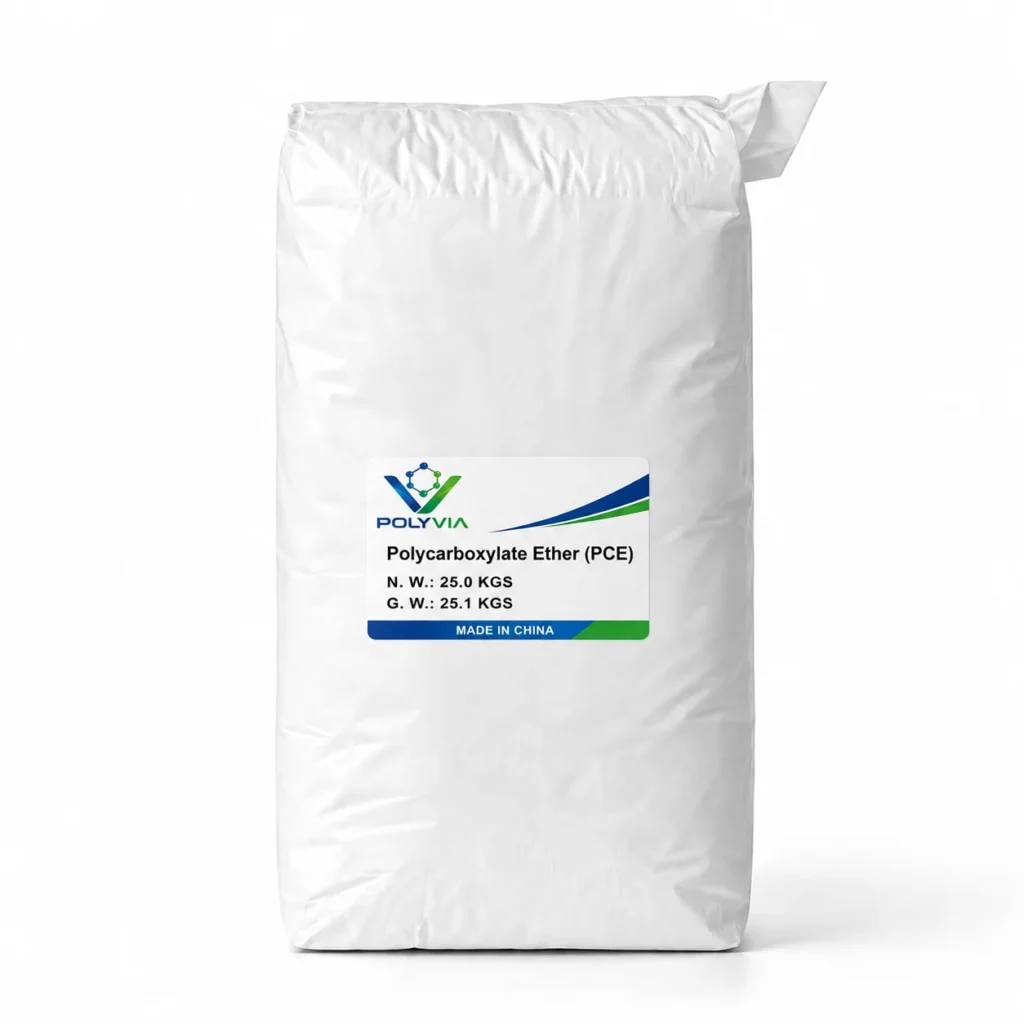
High-performance PCE Powder for dry-mix mortar, concrete and cementitious formulations.
PCE–Foaming Agent Compatibility
Compatibility Is Critical to Stable CLC Production
CLC performance depends strongly on the formation and preservation of a controlled cellular structure.
Changes in PCE chemistry or dosage can alter slurry rheology and may influence how the foam behaves during incorporation, casting and early setting.
For this reason, the actual PCE + foaming agent + cementitious system should always be evaluated together.
Fresh-State Evaluation
Monitor:
Slurry flowability
Fresh density
Foam density
Foam stability
Foam incorporation
Bubble distribution
Segregation or bleeding
Hardened Evaluation
Measure:
Dry density
7-day compressive strength
28-day compressive strength
Water absorption
Drying shrinkage
Dimensional stability
The objective is to identify a stable formulation window, not simply the dosage that produces the highest fluidity.
Finding the Optimum PCE Window for CLC
More PCE Does Not Necessarily Mean Better Performance
PCE dosage should be optimized around the complete CLC system.
Too Little PCE
Insufficient Dispersion
Possible results include:
Higher water demand
Insufficient slurry flowability
Poorer mixing efficiency
Difficult foam incorporation
Reduced formulation flexibility
Optimum PCE Window
Balanced Slurry Performance
The desired window provides:
Effective cement dispersion
Controlled water demand
Suitable slurry flowability
Stable foam incorporation
Consistent fresh density
Target dry density
Required hardened strength
Excessive or Incompatible PCE
Potential System Instability
Depending on the formulation, excessive or incompatible PCE may contribute to:
Excessive fluidity
Unstable slurry rheology
Segregation tendency
Changes in foam behavior
Density variation
Inconsistent block performance
The optimum dosage is therefore the dosage that produces the best overall performance balance, not the highest individual test value.
Practical PCE Dosage Evaluation
Establish the Dosage Through Controlled Trials
For CLC and foamed concrete, PCE dosage should be determined according to the water-to-binder ratio, slurry rheology, foam stability and target density.
A practical starting evaluation range is:
0.20–0.60% by weight of total cementitious materials
PCE Dosage
Primary Evaluation
0.20%
Water demand and slurry flow
0.30%
Flowability and foam incorporation
0.40%
Foam stability and fresh density
0.50%
Density control and strength
0.60%
Higher-range performance evaluation
*Dosage is based on total cementitious materials. Actual requirements depend on PCE chemistry and solid content, cement composition, mineral additions, foaming agent and water-to-binder ratio.
The optimum dosage is not necessarily the dosage that produces the highest flow. It should provide sufficient water reduction and slurry workability while maintaining stable foam distribution and the required density.
Once the suitable range is identified, fine-tune the dosage in approximately 0.05% increments and verify:
Slurry Flow → Foam Stability → Fresh Density → Hardened Density → Compressive Strength
Density, Pore Structure and Strength
CLC Strength Cannot Be Evaluated Independently of Density
CLC differs fundamentally from conventional dense concrete because a significant part of its volume consists of intentionally introduced air cells.
Its mechanical performance is therefore strongly related to:
Dry Density × Pore Structure × Solid Matrix Performance
PCE primarily acts on the solid cementitious matrix.
By improving particle dispersion and controlling unnecessary water demand, PCE can help make that matrix more efficient. However, final compressive strength still depends on the complete cellular system.
Important variables include:
Dry density
Foam volume
Bubble size and distribution
Pore connectivity
Water-to-cementitious ratio
Cementitious composition
Curing
Matrix quality
For this reason, a PCE trial should never compare compressive strength without also comparing dry density and pore structure.
Better Evaluation Principle
Instead of asking:
“Which PCE gives the highest strength?”
Evaluate:
“Which PCE provides the required strength at the target CLC density while maintaining stable production and pore structure?”
This is a more meaningful basis for industrial CLC formulation.
Typical CLC Production Process with PCE
Integrating PCE into the Complete Production System
POLYVIA develops PCE solutions for cement-based systems where particle dispersion, water demand and rheological behavior need to be carefully controlled.
For CLC production, product evaluation can be based on the manufacturer's actual formulation:
Cement
Mineral Additions
Water
Foaming Agent
Target Dry Density
Required Strength
Production Process
This approach allows PCE selection to focus on the complete performance window rather than a single water-reduction value.
Technical Support for CLC Formulation
Need to Optimize PCE for Your CLC Production?
For a more meaningful PCE evaluation, provide:
Cement type
Mineral additions
Current water-to-cementitious ratio
Foaming agent type
Current PCE or admixture
Target fresh / dry density
Required compressive strength
Current production issue
POLYVIA can support PCE selection, dosage-window evaluation and formulation trials based on your actual production system.
PCE improves cement particle dispersion, helping reduce unnecessary water demand while maintaining the slurry flowability required for CLC production. Its role is primarily to optimize the cementitious slurry rather than create the cellular structure.
2. Is PCE the foaming agent in CLC?
No. The foaming agent creates the cellular structure. PCE modifies cement particle dispersion, water demand and slurry rheology. The two materials perform different functions and must be compatible within the complete formulation.
3. Can PCE be used with CLC foaming agents?
Yes, but compatibility should be tested with the actual cement, foaming agent and production conditions. Slurry flowability, foam stability, density and pore structure should all be monitored.
4. What is the recommended PCE dosage for CLC blocks?
A practical starting range is typically 0.20–0.60% by weight of total cementitious materials. The optimum dosage depends on PCE chemistry and solid content, cement composition, water-to-binder ratio, mineral additions, foaming agent and target density. Final dosage should be confirmed through formulation trials based on slurry flow, foam stability, density and compressive strength.
5. Can PCE improve CLC block strength?
PCE can contribute to strength optimization when improved dispersion allows lower unnecessary water demand and a more efficient cementitious matrix. However, CLC strength also depends strongly on dry density, pore structure, cementitious composition and curing.
6. Does PCE affect foam stability?
It can. The effect depends on PCE chemistry, dosage, slurry rheology and the specific foaming system. Foam stability and cellular structure should therefore be evaluated during PCE compatibility trials.
7. How should different PCE products be compared for CLC?
Compare them at controlled target density using slurry flowability, foam stability, fresh and dry density, pore structure, compressive strength and production consistency. Water-reduction percentage alone is not sufficient.
8. Can PP Fiber be used together with PCE in CLC blocks?
Yes. They perform different functions. PCE primarily controls dispersion, water demand and slurry rheology, while PP Fiber can be evaluated for microcrack and shrinkage-crack control within suitable CLC formulations.