
Polycarboxylate Ether (PCE) Superplasticizer for Spun Pile
High Early Strength PCE for Steam-Cured PHC Pile Concrete and Faster Demolding
POLYVIA™ early-strength PCE technology supports low water-to-binder ratios, stable centrifugal processing and rapid strength development for efficient spun pile production and faster demolding.
Early Strength · High Water Reduction · Steam-Curing Compatibility · Stable Processing
Why Early Strength Matters in Spun Pile Production
The Real Target Is Reaching Release Strength at the Right Time
Spun pile and PHC pile production is an accelerated manufacturing process. Concrete moves through batching, mold charging, prestressing, centrifugal spinning, curing, strength verification, prestress release and demolding within a controlled production schedule.
Early strength therefore has a direct production function.
If the required release strength is reached on schedule, the pile can proceed to release and demolding and the mold can return to production. If strength development is slower than expected, demolding may be delayed and mold turnover can be affected.
A typical production sequence is:
Concrete Batching → PCE Addition & Mixing → Mold Charging → Prestressing → Centrifugal Spinning → Steam Curing → Strength Verification → Prestress Release & Demolding → Mold Reuse
For a spun pile factory, the practical question is not simply:
“How high is the concrete strength?”
It is:
“Can the concrete consistently reach the required release strength within the planned production cycle?”
This is one of the key performance targets when selecting a polycarboxylate superplasticizer for spun pile concrete.
Common Problems in PHC Spun Pile Production
Early Strength Must Be Balanced with Processing Performance
High-strength spun pile concrete operates within a demanding performance window. Low water content, workable fresh concrete, centrifugal stability and rapid early-strength development must be achieved together.
Insufficient Strength After Steam Curing
Concrete may show acceptable workability during production but still fail to reach the required release strength after the planned curing cycle.
Cement chemistry, supplementary cementitious materials, water-to-binder ratio, PCE chemistry, dosage, concrete temperature and curing conditions can all influence early-strength development.
The problem should therefore be evaluated as a cement–PCE–water–curing system, rather than attributed to one variable alone.
Low W/B Ratio vs. Required Workability
High-strength PHC pile concrete typically requires tight control of the water-to-binder ratio.
Adding uncontrolled extra water to improve workability may compromise strength potential and change concrete behavior during centrifugal processing.
An effective PCE superplasticizer for PHC pile concrete should provide sufficient cement dispersion to achieve the required processing performance at controlled water content.
Unstable Concrete During Centrifugal Spinning
Spun pile production differs from conventional cast concrete because the mix undergoes high-speed centrifugal compaction.
Fresh concrete therefore requires appropriate cohesion and rheological stability during mold charging and spinning.
PCE should not be selected on water reduction alone. Aggregate grading, water content, concrete rheology and admixture dosage must work together.
Delayed Demolding and Slow Mold Turnover
When concrete does not reach the required strength at the planned release time:
Slow Early Strength → Delayed Release → Delayed Demolding → Slower Mold Turnover
For continuous spun pile production, repeated delays can reduce production efficiency even when later-age strength is satisfactory.
Where PCE Works in the Spun Pile Production Cycle
From Cement Dispersion to Release Strength
PCE enters the concrete during batching, but its influence extends throughout the critical stages of spun pile production.
Mixing & Water Reduction
Polycarboxylate ether disperses cement particles and helps achieve the required fresh-concrete performance with reduced mixing water.
Mold Charging
The concrete must maintain sufficient consistency and cohesion for efficient placement into the pile mold.
Centrifugal Spinning
The complete formulation must remain suitable for centrifugal compaction without relying on excessive water for workability.
Accelerated Curing
Cement chemistry, PCE chemistry, water-to-binder ratio and curing conditions together influence early-strength development.
Strength Verification & Demolding
Prestress release and demolding should proceed only after the required release strength has been verified according to the applicable production requirements.
Mixing → Spinning → Steam Curing → Strength Verification → Release & Demolding
The Performance Window for Spun Pile Concrete
High Water Reduction Alone Is Not Enough
A high nominal water-reduction rate does not automatically make a PCE suitable for spun pile production.
The complete performance window is:
Water Reduction → Workability → Centrifugal Stability → Curing Response → Early Strength → Release Strength
These properties interact.
A PCE may provide excellent initial workability but produce an unsuitable early-age response with a particular cement. Another formulation may develop strength rapidly but provide inadequate processing stability.
The objective is therefore not to maximize one isolated parameter.
The best PCE for spun pile concrete is the one that provides the required balance of water reduction, processing stability and early-strength development with the factory's actual cement, mix design and curing cycle.
For this reason, polycarboxylate superplasticizer for PHC pile production should be selected through formulation and plant trials rather than product specifications alone.
How Early-Strength PCE Works in Spun Pile Concrete
From Cement Dispersion to Early Strength Development
Cement Dispersion
PCE molecules adsorb onto cement particles and provide dispersing effects that reduce particle agglomeration.
This allows cementitious materials to be more effectively dispersed in the available mixing water.
Controlled Water Demand
Efficient dispersion helps achieve the required concrete consistency at a controlled water content, supporting the low W/B conditions required for high-strength spun pile concrete.
Stable Processing
The optimized concrete must remain suitable for mixing, mold charging and centrifugal spinning.
PCE dosage should therefore be evaluated together with water content, aggregate grading and concrete rheology.
Early-Strength Development
Not every PCE produces the same early-age response.
PCE molecular structure, dosage and cement chemistry can influence setting and early hydration. Where rapid strength development is required, an early-strength PCE designed for accelerated precast production should be evaluated.
Release Strength
The final objective is not simply faster strength development.
It is to achieve the required release strength at the required production time while maintaining stable concrete processing.
PCE and Steam Curing in Spun Pile Production
Cement, PCE and the Curing Cycle Must Work Together
Steam curing is widely used in accelerated precast production to promote early-strength development and shorten the time required before subsequent production operations.
However, curing performance cannot be separated from the concrete formulation.
Early-age performance is influenced by:
Cement Chemistry · SCMs · W/B Ratio · PCE Chemistry · PCE Dosage · Concrete Temperature · Curing Regime
A PCE that performs well under normal curing conditions may not provide the same performance window under an accelerated steam-curing process.
Similarly, increasing curing temperature or extending curing duration should not automatically be used to compensate for an unsuitable concrete formulation.
For PHC spun pile production, the preferred approach is to optimize:
Cement + PCE + Water + Curing
as one production system.
Can PCE Help Achieve Same-Day Demolding?
Yes — When the Required Release Strength Is Reached
An appropriately selected early-strength PCE superplasticizer can support same-day demolding by helping concrete develop the required early strength within the validated production and curing cycle.
However, PCE alone does not determine demolding time.
Same-day demolding depends on the combined influence of:
Cement Type · SCM Content · W/B Ratio · PCE Chemistry · Dosage · Concrete Temperature · Steam-Curing Cycle · Required Release Strength
The correct production target is therefore not:
“Add more PCE to demold faster.”
It is:
“Optimize the concrete system so that the required release strength is reached reliably within the target production cycle.”
This distinction is especially important for prestressed spun pile and PHC pile production.
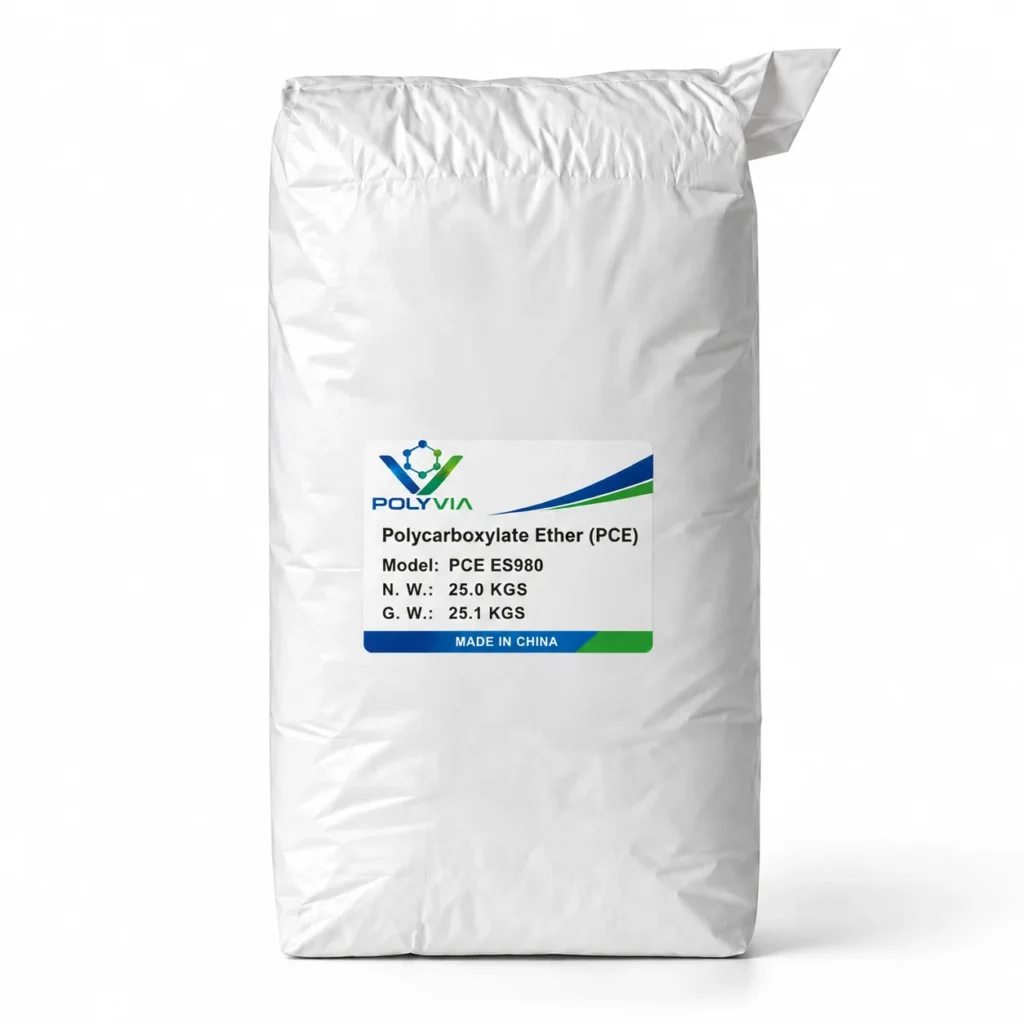
POLYVIA™ ES980 Early-Strength PCE Powder
For Accelerated Precast, Prestressed and Spun Pile Production
POLYVIA™ ES980 is an early-strength polycarboxylate ether (PCE) powder developed for concrete systems where high water reduction and rapid early-strength development are required together.
Typical applications include:
PHC Spun Pile · Prestressed Concrete · Precast Concrete · High-Performance Concrete
| Typical Property | ES980 |
|---|---|
| Solid Content | ≥98% |
| Moisture | ≤2.0% |
| Alkali Content | ≤0.3% |
| 1-Day Compressive Strength Ratio | ≥180% |
| 3-Day Compressive Strength Ratio | >160% |
| Typical Dosage | 0.15–0.35% |
Dosage: 0.15–0.35% by mass of total cementitious materials.
The optimum dosage should be established using the actual cement, mix design, curing regime and required early strength.
Where additional early-strength adjustment is required, ES980 can be evaluated as part of a compatible admixture system. Compatibility should be verified before production use.
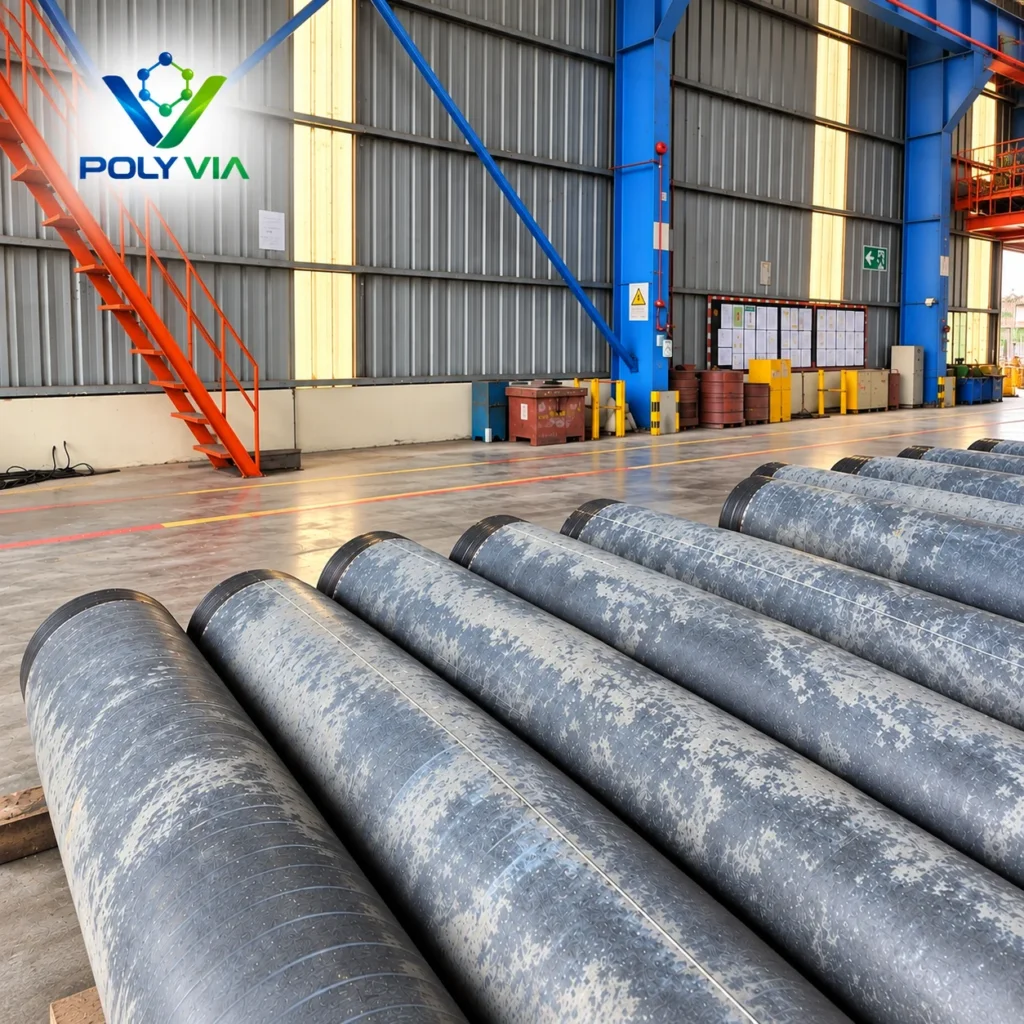
Field Case — Spun Pile Factory, Indonesia
60+ MPa Same-Day Compressive Strength Under Actual Plant Conditions
Application: Prestressed Spun Pile Concrete
Market: Indonesia
Product: POLYVIA™ ES980 Early-Strength PCE Powder
Process: Centrifugal Forming + Accelerated Steam Curing
Target: Rapid Early Strength + Same-Day Demolding
An Indonesian spun pile manufacturer required faster early-strength development within its actual production cycle.
The target was clear:
Reach the required early strength after the established curing process to support same-day demolding.
ES980 was evaluated using the customer's actual cementitious materials, concrete formulation, production equipment and curing conditions.
Following centrifugal production and the factory's established steam-curing cycle, the concrete achieved:
60+ MPa
Same-Day Compressive Strength
The achieved strength supported the factory's same-day demolding requirement under the validated production conditions.
The production result can be summarized as:
Early-Strength PCE → Controlled W/B + Stable Processing → Accelerated Early-Strength Development → 60+ MPa Same-Day Strength → Same-Day Demolding → Faster Mold Turnover
This field case demonstrates why an early-strength PCE should be evaluated against the factory's actual production target rather than water-reduction rate alone.
Project Performance Note
The 60+ MPa same-day strength represents an actual result obtained under this customer's specific materials, concrete formulation, production equipment and curing conditions.
It should not be interpreted as a universal performance guarantee. Performance must be validated under each factory's own production conditions.
How to Evaluate PCE for Spun Pile Concrete
Test Against the Actual Production Cycle
A reliable PCE for spun pile concrete should be evaluated against the factory's real production requirements rather than only standard laboratory ages.
1. Define the Production Target
Establish:
Required Release Strength · Target Demolding Time · Curing Cycle · Required Processing Performance
This creates a measurable target before formulation adjustment begins.
2. Establish the Reference Mix
Record the existing:
Cement · SCMs · W/B Ratio · Aggregate Grading · PCE Type · PCE Dosage · Concrete Temperature
Use the existing production mix as the reference.
3. Establish the ES980 Dosage Window
The typical dosage of ES980 is:
0.15–0.35% by mass of total cementitious materials.
Evaluate controlled dosage levels while keeping other major variables as consistent as practical.
4. Evaluate Fresh-Concrete Performance
Observe:
Workability · Cohesion · Bleeding · Mold Charging · Centrifugal Processing
Early strength should not be optimized at the expense of production stability.
5. Reproduce the Actual Curing Cycle
Use the factory's actual curing procedure during final evaluation.
This shows how the formulation performs under real production conditions.
6. Measure Strength at Production-Critical Ages
Conventional 1-day, 3-day and 28-day strength results remain useful, but they may not answer the factory's immediate production question.
When same-day demolding is required, strength should also be measured at the actual production-critical age.
Trial checkpoints may include:
4 h · 6 h · 8 h · 10 h · Same Day
These are evaluation examples rather than universal testing ages. The actual schedule should follow the plant's production cycle and applicable requirements.
7. Verify Before Mass Production
Repeat the selected formulation under representative plant conditions.
A single successful batch should not be treated as proof of long-term production stability.
What Data Should Be Recorded During a Spun Pile Trial?
Better Trial Data Leads to Better PCE Selection
A structured plant trial makes it easier to identify why concrete performance changes.
Concrete System
Cement source and type · SCM type and dosage · W/B ratio · Aggregate grading
Admixture System
PCE grade · PCE dosage · Other functional admixtures
Fresh Concrete
Mixing time · Concrete temperature · Workability · Cohesion · Bleeding
Production
Mold charging behavior · Spinning conditions · Processing stability
Curing
Pre-curing period · Curing temperature profile · Curing duration
Strength
Release-age strength · Same-day strength · 1-day strength where required
Production Result
Release time · Demolding time · Surface condition · Abnormal observations
This information helps distinguish the actual PCE response from changes caused by cement, water, temperature or production conditions.
It also creates a reproducible technical record for future formulation optimization.
Typical ES980 Dosage for Spun Pile Concrete
0.15–0.35% of Total Cementitious Materials
For spun pile and PHC pile concrete, the typical ES980 dosage is:
0.15–0.35%
by mass of total cementitious materials.
The optimum dosage depends on:
Cement Chemistry · SCM Content · W/B Ratio · Concrete Temperature · Required Workability · Curing Regime · Target Early Strength
Importantly:
Higher PCE dosage does not necessarily produce higher early strength.
Excessive dosage can affect setting behavior and early-age performance depending on the cement–PCE system.
The optimum dosage is the level that provides the required:
Water Reduction + Processing Stability + Early Strength
together.
Final dosage should be confirmed through laboratory testing and actual spun pile production trials.
Troubleshooting PCE in Spun Pile Production
Good Workability but Low Early Strength
Check PCE chemistry and dosage together with cement compatibility, W/B ratio, SCM content and curing conditions.
Good initial workability does not necessarily mean the admixture system is optimized for accelerated strength development.
High Early Strength but Poor Spinning Stability
Review concrete rheology, aggregate grading, water content and PCE dosage.
Early-strength optimization should not compromise the stability required during centrifugal processing.
Steam-Curing Cycle Is Still Too Long
Evaluate the complete cement–PCE–W/B–curing system before simply increasing curing temperature or adding another accelerator.
The limitation may originate from formulation compatibility rather than curing capacity.
Performance Changes After Changing Cement
Repeat compatibility testing.
Changes in cement chemistry, fineness, sulfate balance or supplementary cementitious materials can alter PCE response and early-strength development.
Extra Water Is Needed to Maintain Workability
Do not immediately increase mixing water.
First evaluate PCE compatibility, dosage, concrete temperature, aggregate moisture and required working time.
For high-strength spun pile concrete, uncontrolled additional water can work against the original strength and production objectives.
How to Select PCE for PHC Spun Pile Production
Start with the Production Problem
Different production problems require different formulation priorities.
Insufficient Early Strength
Evaluate early-strength PCE chemistry together with W/B ratio and curing conditions.
High Water Demand
Evaluate PCE dispersion efficiency and cement compatibility.
Poor Centrifugal Stability
Review concrete rheology, water content, aggregate grading and PCE dosage together.
Delayed Demolding
Measure strength at the actual release age and determine whether the limitation originates from PCE chemistry, cement system, W/B ratio or curing conditions.
Cement Source Changes
Revalidate the admixture system rather than assuming the previous PCE dosage remains optimum.
PCE selection should follow the production requirement — not the other way around.
FAQ
What is the best PCE for spun pile concrete?
The best PCE for spun pile concrete is one that provides the required balance of water reduction, processing stability and early-strength development with the factory's actual cement, mix design and curing cycle. For accelerated PHC pile production, an early-strength PCE may be more appropriate than selecting a product based only on maximum water reduction.
Can PCE help achieve same-day spun pile demolding?
Yes. An appropriately selected early-strength PCE can support same-day demolding when the concrete reaches the required release strength within the validated production and curing cycle. PCE alone does not determine demolding time.
What is the typical ES980 dosage for PHC spun pile concrete?
The typical dosage of POLYVIA™ ES980 is 0.15–0.35% by mass of total cementitious materials. The optimum dosage should be confirmed using the actual cement, W/B ratio, curing cycle and required early strength.
Why is early strength important in PHC pile production?
Early strength affects when prestress release and demolding can proceed according to the applicable production requirements. Consistent early-strength development supports predictable demolding and efficient mold turnover.
Can ES980 be used in steam-cured concrete?
Yes. ES980 is designed for accelerated precast and prestressed concrete applications and can be evaluated in steam-cured spun pile systems. Performance should be verified using the actual cement, concrete formulation and curing cycle.
Does increasing PCE dosage always increase early strength?
No. Higher PCE dosage does not automatically produce higher early strength. PCE dosage can influence water demand, workability, setting and early hydration differently depending on cement chemistry and PCE structure.
Can ES980 be used with other early-strength additives?
ES980 can be evaluated with compatible early-strength components where additional formulation adjustment is required. The complete admixture system should be compatibility-tested before production use.
How should a spun pile factory evaluate ES980 before mass production?
Establish the existing concrete as a reference, evaluate controlled ES980 dosage levels, check fresh-concrete and centrifugal processing performance, reproduce the actual curing cycle, measure strength at the required release age and repeat the selected formulation under representative plant conditions before mass production.
Optimize Early Strength for Your Spun Pile Production
Build a More Predictable Production Cycle
Spun pile production should not be optimized around a single admixture parameter.
The real objective is to create a concrete system that moves reliably through:
Mixing → Centrifugal Spinning → Curing → Strength Verification → Release → Demolding
within the required production cycle.
If your factory is experiencing insufficient early strength, extended curing, delayed demolding or inefficient mold turnover, share your current production data with POLYVIA.
For an initial technical evaluation, provide:
Cement Type · Mix Design · W/B Ratio · Current PCE & Dosage · Curing Cycle · Current Release-Age Strength · Required Release Strength
POLYVIA can help evaluate whether ES980 is suitable for your spun pile production system and establish an appropriate plant-trial dosage.