
PCE Powder Market: Applications, Demand and Supply Trends
Global Market Growth, Industrial Applications and Asia-Pacific Supply Opportunities
PCE powder is a concentrated solid polycarboxylate superplasticizer used in compatible dry-mix formulations and industrial admixture preparation. Its market is supported by demand for factory-produced construction materials, specialized cementitious products and high-performance concrete systems.
This report examines global PCE powder market estimates, production and supply structure, major industrial applications, Asia-Pacific manufacturing and consumption markets, and the factors influencing international purchasing decisions.
What Is the Global PCE Powder Market Size and What Is Driving Its Growth?
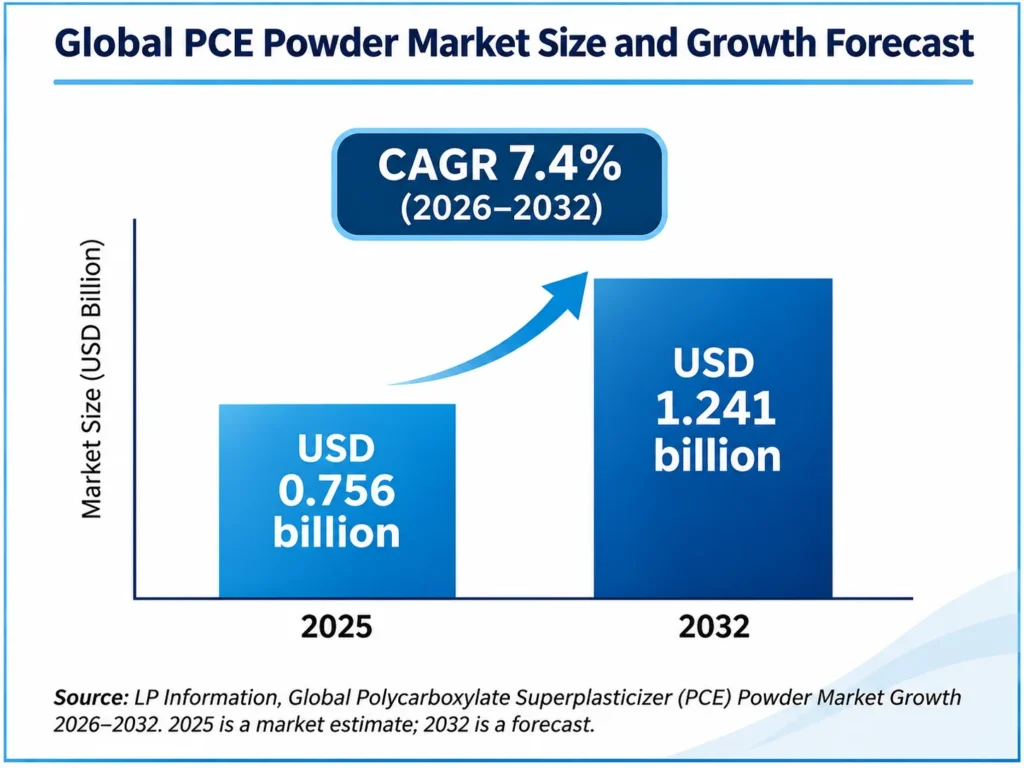
The global PCE powder market was estimated at USD 756 million in 2025 and is forecast to reach USD 1.241 billion by 2032, representing a projected CAGR of 7.4% between 2026 and 2032, according to LP Information. Market development is supported by demand for dry-mix mortar, self-leveling compounds, grouts, repair materials, UHPC and prefabricated construction.
Global PCE Powder Market Size and Forecast
| Indicator | Market Estimate |
|---|---|
| 2025 Market Size | USD 756 million |
| 2032 Forecast | USD 1.241 billion |
| 2026–2032 CAGR | 7.4% |
| Research Publisher | LP Information |
| Publication Date | October 7, 2026 |
Source: LP Information, Global Polycarboxylate Superplasticizer (PCE) Powder Market Growth 2026–2032.
These figures are research estimates and forecasts, not audited global sales records.
What Is Driving PCE Powder Market Growth?
Four developments are particularly relevant.
Expansion of factory-produced dry-mix materials
Dry-mix mortar, grouts, self-leveling compounds and repair materials require functional additives that can be incorporated into factory-preblended formulations. Suitable PCE powder grades provide water-reducing and dispersion functions in these systems.
Growth of specialized cementitious applications
UHPC, high-performance concrete, specialized grouts and precast materials require carefully controlled flowability, water demand and strength development.
Demand for concentrated solid admixtures
Powder PCE can be transported without the additional water contained in liquid admixtures. This can offer logistical advantages for international shipments and manufacturers with suitable dry-blending or dissolution facilities.
Increasing formulation requirements
Changes in cement composition, supplementary cementitious materials and alternative binder systems create demand for PCE formulations with more specific compatibility and performance characteristics.
The actual contribution of each factor to global sales growth has not been quantified in the cited market report.
How Much PCE Powder Is Produced and Sold Globally?
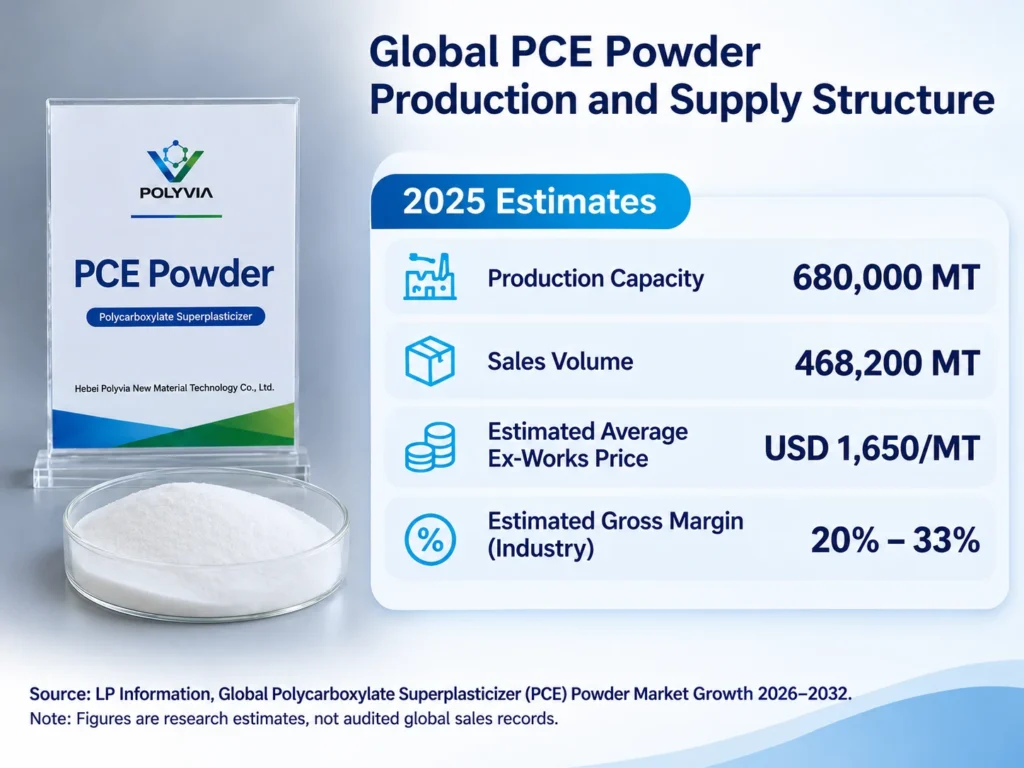
LP Information estimates that global effective PCE powder production capacity reached approximately 680,000 metric tons in 2025, while estimated sales volume was approximately 468,200 metric tons.
According to LP Information, the estimated average ex-works price of global PCE powder was approximately USD 1,650 per metric ton in 2025. This figure represents a research-based industry average rather than a universal transaction price. Actual prices vary according to product grade, solid content, performance requirements, order volume and delivery terms.
Global PCE Powder Production and Supply Estimates
| Supply Indicator | 2025 Estimate |
|---|---|
| Effective Production Capacity | 680,000 MT |
| Sales Volume | 468,200 MT |
| Average Ex-Works Price | USD 1,650/MT |
| Estimated Gross Margin | 20%–33% |
Source: LP Information, 2026 PCE Powder Industry Forecast.
How Have PCE Powder Prices Changed in 2026?
The 2025 average ex-works price provides a historical reference, but market conditions have changed in 2026. Geopolitical tensions in the Middle East and disruptions to energy and petrochemical supply chains have increased cost pressures across the chemical manufacturing industry. Based on POLYVIA's market observations, finished PCE powder prices in 2026 have increased by approximately 30% compared with the 2025 annual average. This is an observed market trend rather than a verified global price index. Actual price changes vary by product grade, raw-material sourcing, supplier and purchasing conditions. Therefore, the 2025 price estimate should not be treated as a current purchasing benchmark.
What Does the Production Capacity Data Indicate?
Based on the reported production capacity and sales volume, the sales-to-capacity ratio is approximately 68.9%.
Calculation:
468,200 ÷ 680,000 × 100 = 68.9%
This is an indicative ratio calculated from two research estimates. It is not a verified operating-capacity utilization rate because sales volume and actual production volume are not necessarily identical.
What Does the Average PCE Powder Price Mean for Buyers?
The reported average ex-works price of USD 1,650/MT provides a broad industry reference, not a universal purchasing price.
Actual prices depend on:
- Polymer formulation and performance grade.
- Solid content and moisture specifications.
- Raw-material costs.
- Manufacturing process.
- Packaging requirements.
- Order quantity.
- Supplier location and delivery terms.
Data interpretation note: Multiplying the reported sales volume of 468,200 MT by the average price of USD 1,650/MT produces approximately USD 772.53 million, which does not exactly reconcile with the separately reported market value of USD 756 million. The report does not provide enough detail in its public summary to reconcile these figures. They should therefore remain separate research estimates rather than being presented as a single internally reconciled financial statement.
What Does This Mean for PCE Powder Suppliers?
The estimated production capacity indicates that the industry has an established manufacturing base.
Competition is therefore not determined by production volume alone.
Manufacturers also need to differentiate through:
- Consistent product quality.
- Application-specific polymer design.
- Reliable raw-material supply.
- Technical support.
- Customer formulation development.
- International delivery capability.
Suppliers capable of addressing specialized formulation requirements may compete on more than price.
What Are the Main Applications of PCE Powder?
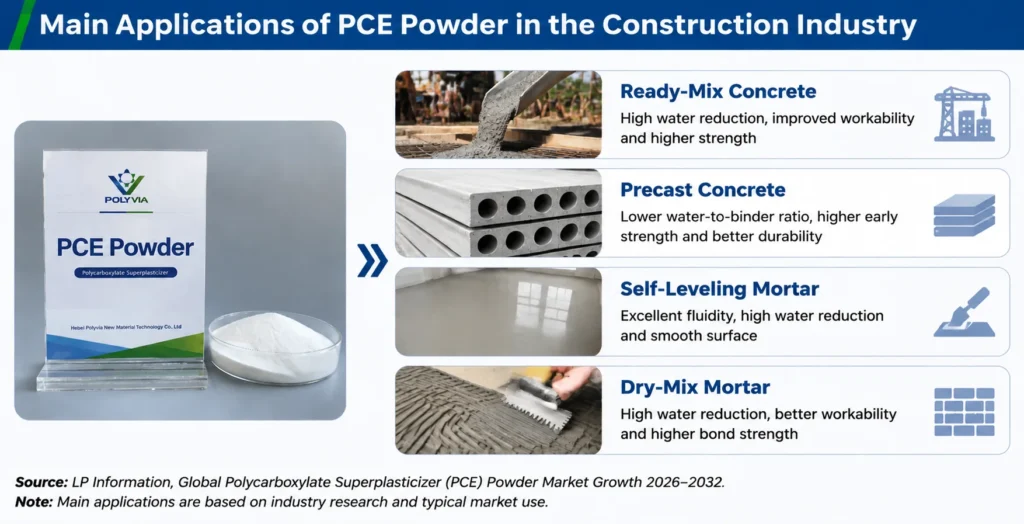
PCE powder is used in compatible dry-mix formulations and selected concrete systems where cementitious particle dispersion, water reduction and flow control are required.
Its main industrial applications include dry-mix mortar, self-leveling compounds, cementitious grouts, repair materials, UHPC and selected precast concrete systems.
Dry-Mix Mortar
Dry-mix mortar manufacturers combine cementitious binders, mineral fillers, aggregates and functional additives through controlled factory blending.
Suitable fine-powder PCE grades can be incorporated directly into compatible dry formulations.
After water is added, the polymer dissolves and contributes to particle dispersion and flow control.
Relevant applications include:
- Specialized construction mortars.
- High-flow cementitious mortars.
- Grouting materials.
- Repair mortars.
- Selected dry-mix shotcrete formulations.
Performance depends on blending uniformity, dissolution, binder compatibility and the complete formulation.
Self-Leveling Compounds
Self-leveling compounds require high flowability, controlled viscosity and suitable surface-finishing characteristics.
PCE powder can help reduce water demand while maintaining the required flow in compatible cement-based formulations.
The formulation must also account for cellulose ethers, defoamers, retarders, fillers and other additives.
Gypsum-based self-leveling materials require particular attention to binder compatibility.
A 2023 study published in Construction and Building Materials found that PCE increased gypsum-mortar flowability but also delayed setting and affected mechanical properties. The study demonstrates why flowability, setting behavior and strength must be evaluated together rather than treating higher flow as an unconditional improvement.
Cementitious Grouts and Repair Materials
Cementitious grouts require appropriate flowability to fill gaps, anchor equipment and achieve effective contact with surrounding substrates.
PCE powder can support cement dispersion and water-demand control in compatible formulations.
Applications include:
- Non-shrink grouts.
- Equipment foundation grouts.
- Anchor and bolt grouting.
- Structural repair mortars.
- Cementitious filling materials.
- Specialized reinforcement and connection grouts.
The appropriate PCE grade depends on flow requirements, binder composition, filling geometry, setting behavior and strength development.
UHPC and High-Performance Concrete
Ultra-High Performance Concrete (UHPC) requires carefully controlled water-to-binder ratios, particle packing and rheological behavior.
Suitable PCE formulations can improve binder dispersion and help maintain flow at low water-to-binder ratios.
Other relevant applications include:
- High-Performance Concrete (HPC).
- Self-Compacting Concrete (SCC).
- Precast concrete.
- Prestressed concrete.
- Specialized concrete production.
PCE performance must be evaluated using the actual cement, supplementary cementitious materials, aggregates and mixing conditions.
Other Specialty Applications
PCE-type dispersants are also investigated in selected refractory, ceramic and gypsum-based systems.
However, these applications involve different binder chemistry and processing conditions.
A conventional concrete PCE powder cannot automatically be considered suitable for refractory or ceramic formulations without application-specific testing.
Major PCE Powder Applications
| Application | Main Performance Requirements |
|---|---|
| Dry-Mix Mortar | Dispersion, flowability and formulation compatibility |
| Self-Leveling Compounds | High flowability and rheology control |
| Cementitious Grouts | Filling ability and reduced water demand |
| Repair Mortars | Workability and additive compatibility |
| UHPC | Efficient dispersion and low water-to-binder ratio |
| Precast Concrete | Controlled workability and early-strength development |
| SCC | Flowability, passing ability and viscosity control |
| Refractory Castables | Binder-specific dispersion and stability |
These are technical application categories, not a ranking of global PCE powder sales.
Related application resources:
How Does PCE Powder Perform in Different Binder Systems?
PCE powder performance depends on binder chemistry, polymer structure, dosage and the complete formulation. A grade that performs well in Portland cement may respond differently in gypsum, low-water-to-binder or refractory systems.
Portland Cement Systems
In Portland cement systems, PCE molecules adsorb onto cement particle surfaces through their functional groups.
Polyether side chains contribute to steric repulsion, reducing particle flocculation and improving dispersion.
This can release water previously trapped within cement particle agglomerates and reduce the water demand required to achieve a target flow.
However, PCE performance is influenced by:
- Cement mineral composition.
- Sulfate balance.
- Aluminate phases.
- Cement fineness.
- Clay-bearing aggregates.
- Supplementary cementitious materials.
- Temperature and dosage.
Therefore, cement compatibility testing is necessary before finalizing a formulation.
Gypsum-Based Systems
Gypsum-based systems have different hydration and setting characteristics from Portland cement.
PCE may improve flowability and reduce water demand, but it can also influence hydration, setting time and hardened mechanical properties.
Research on gypsum-based self-leveling mortar has demonstrated that the optimum PCE dosage depends on the gypsum composition and the complete mixture design.
Buyers should evaluate flowability, setting time, water demand and strength together.
Low-Water-to-Binder Systems
UHPC and other low-water-to-binder systems require effective dispersion at relatively low water contents.
PCE selection must consider:
- Polymer compatibility.
- Binder composition.
- Particle packing.
- Mixing energy.
- Required flow and viscosity.
- Strength development.
A suitable grade should maintain the required fresh-concrete performance without causing undesirable viscosity changes or segregation.
Refractory Castables
Refractory castables use specialized mineral and cementitious binder systems designed for high-temperature applications.
PCE-type dispersants may be used in selected formulations, but their suitability depends on calcium aluminate cement (CAC), aggregate chemistry, particle distribution, setting requirements and high-temperature performance.
POLYVIA's refractory application guidance discusses PCE 840 and PCE 860 selection in low-cement and ultra-low-cement refractory castables. These recommendations should be evaluated against the actual refractory formulation and testing requirements.
Technical principle: PCE powder should be selected according to the binder system and performance target, not simply by its advertised water-reduction category.
Why Do Industrial Buyers Choose PCE Powder Instead of Liquid PCE?
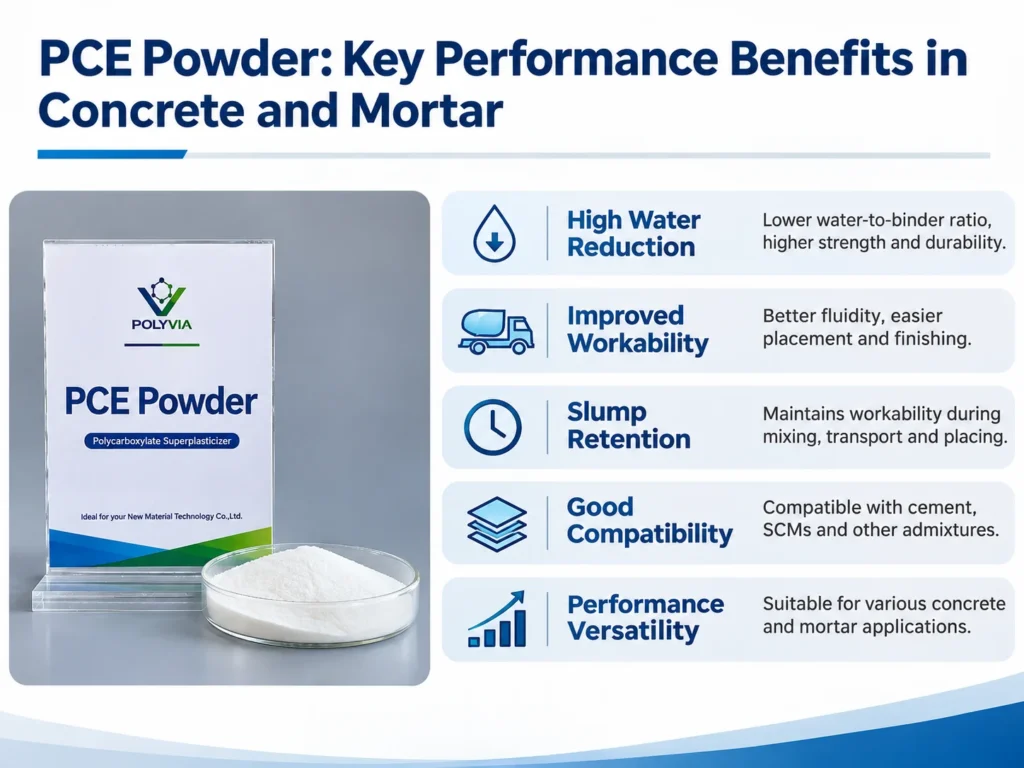
Industrial buyers choose PCE powder when dry-form incorporation, concentrated solid transportation or flexible solution preparation provides advantages for their manufacturing process.
Liquid PCE remains suitable for ready-mix concrete plants with established liquid dosing systems.
The two forms serve different production requirements.
Direct Incorporation into Dry Formulations
Suitable fine-powder PCE grades can be incorporated into factory-preblended dry-mix systems.
Manufacturers can combine them with cement, fillers, aggregates and other powdered additives before packaging.
Water is then added during application.
This provides a practical route for dry-mix manufacturers that prefer to formulate and package complete dry products.
Concentrated Solid Transportation
Liquid PCE contains water, which contributes to total shipment weight.
Powder PCE is transported as a concentrated solid material without the additional water contained in ready-made liquid admixtures.
This may be advantageous for:
- Long-distance international shipments.
- Landlocked markets.
- Buyers without reliable local liquid PCE supply.
- Dry-mix mortar manufacturers.
- Industrial admixture producers.
Actual economic benefits depend on product concentration, packaging, freight rates, shipment volume and the final preparation process.
Flexible Industrial Formulation
Suitable PCE powder grades can be used through different incorporation methods.
Direct dry blending
Appropriate fine-powder grades can be blended with compatible dry ingredients before water addition.
Pre-dissolved addition
Suitable grades can be dissolved in water before being introduced into a concrete or mortar system.
The dissolution water must be included in the total mixing-water calculation.
Not every PCE powder grade has identical dissolution requirements. Product-specific addition instructions should be followed.
PCE Powder vs Liquid PCE
| Comparison | PCE Powder | Liquid PCE |
|---|---|---|
| Physical Form | Solid powder | Liquid |
| Dry-Mix Incorporation | Suitable for validated formulations | Requires an appropriate incorporation process |
| Direct Liquid Dosing | Requires solution preparation | Yes |
| Transportation | Concentrated solid | Includes water |
| Storage | Moisture protection required | Appropriate liquid storage required |
| Main Advantage | Dry-form flexibility and concentrated transport | Convenient liquid handling and dosing |
Neither form is universally better.
The appropriate choice depends on the manufacturing process, product formulation, transportation conditions and total delivered cost.
For a more detailed comparison, see PCE Powder vs PCE Liquid.
Which Countries Are Important to the PCE Powder Market?
China, India and Southeast Asia are important regions to evaluate for PCE powder manufacturing, consumption and purchasing opportunities. However, manufacturing capacity, domestic consumption and import demand must be assessed separately.
Asia-Pacific accounted for an estimated 45.25% of the broader global PCE market in 2025, according to Mordor Intelligence. This is not a PCE powder-specific regional market share.
China: Manufacturing and International Supply
China is an important manufacturing base for construction chemicals and PCE products.
Its supply chain includes polyether macromonomers, polymer production, powder processing and downstream construction admixture manufacturing.
Relevant downstream applications include:
- Dry-mix mortar.
- Cementitious grouts.
- Self-leveling compounds.
- Precast concrete.
- Specialized concrete admixtures.
For international buyers, Chinese suppliers provide access to a range of PCE powder grades and manufacturing options.
Supplier evaluation should consider product consistency, polymer performance, technical documentation and export experience rather than relying solely on price.
India: Construction and Industrial Formulation Demand
India is an important construction-material market with developing concrete and dry-mix manufacturing sectors.
Relevant PCE powder applications include:
- Dry-mix construction materials.
- Cementitious grouts.
- Precast concrete.
- High-performance concrete.
- Industrial flooring materials.
The balance between domestic production and imported powder products varies by grade, manufacturer capability and customer requirements.
Actual import opportunities should be assessed through local buyer demand and competitive supply information.
Southeast Asia: Diverse Manufacturing and Construction Markets
Indonesia, Vietnam, Thailand, Malaysia and the Philippines have different construction industries and construction chemical supply structures.
Relevant demand areas include factory-produced dry-mix mortar, ready-mix and precast concrete, cementitious grouting materials and infrastructure construction.
The demand for PCE powder depends on whether local manufacturers operate dry-mix production facilities, have access to domestic admixture suppliers or prefer importing concentrated solid materials.
General construction growth should not be treated as direct evidence of PCE powder import growth.
Europe, the Middle East and the Americas
Europe has established specialty mortar and construction chemical industries, with demand for PCE powder in selected dry-mix and cementitious applications.
The Middle East presents opportunities in grouts, repair materials, infrastructure and industrial construction. Transportation conditions and local liquid admixture availability may influence product selection.
North America and Latin America have established or developing concrete admixture and construction-material markets. Buyers may evaluate imported PCE powder according to technical compatibility, logistics and local production economics.
Regional PCE Powder Market Considerations
| Region | Market Characteristics | Potential Applications |
|---|---|---|
| China | Established manufacturing and export supply | Dry-mix, grout, precast |
| India | Construction and dry-mix development | Grout, mortar, concrete |
| Southeast Asia | Diverse construction and manufacturing markets | Dry-mix, precast, infrastructure |
| Europe | Specialty mortar and chemical supply chains | Self-leveling, repair mortar, grout |
| Middle East | Infrastructure and industrial construction | Grout, repair mortar, dry-mix |
| Americas | Concrete and construction-material industries | Mortar, grout, specialized concrete |
This is a qualitative market assessment, not a ranking of regional PCE powder sales or import volumes.
How Do POLYVIA PCE Powder Grades Differ?
POLYVIA™ offers five PCE powder grades with different performance focuses: high water reduction, slump retention, balanced performance, low viscosity and early strength.
The appropriate grade depends on the concrete or mortar application, binder chemistry, required workability and addition method.
POLYVIA PCE Powder Grade Selection
| Grade | Performance Focus | Physical Form | Addition Method |
|---|---|---|---|
| PCE 840 | High Water Reduction | Fine Powder | Direct Dry-Mix |
| PCE 850 | Slump Retention | Fine Powder | Direct Dry-Mix |
| PCE 860 | Balanced / Hybrid Performance | Fine Powder | Direct Dry-Mix |
| PCE 870 | Low Viscosity | Fine Powder | Direct Dry-Mix |
| PCE ES980 | Early Strength | Coarse Powder | Pre-Dissolution |
PCE 840 — High Water Reduction
PCE 840 is designed for formulations requiring effective cement dispersion and reduced water demand.
It can be evaluated in self-leveling compounds, high-flow mortars and high-performance concrete systems.
Its suitability depends on binder composition, water-to-binder ratio, target flow and formulation compatibility.
PCE 850 — Slump Retention
PCE 850 is designed for concrete systems where maintaining workability during transportation, waiting, pumping and placement is important.
It can be evaluated in ready-mix concrete and other applications requiring controlled workability retention.
PCE 860 — Balanced / Hybrid Performance
PCE 860 provides balanced performance for suitable dry-mix mortar, grout, general concrete and shotcrete formulations.
It is intended for applications where water reduction and workability need to be balanced rather than maximizing a single performance characteristic.
PCE 870 — Low Viscosity
PCE 870 is designed for systems where viscosity control and flow characteristics are important.
Relevant applications include UHPC, HPC, precast, prestressed concrete and PHC systems.
Final selection should be confirmed through application-specific testing.
PCE ES980 — Early Strength
PCE ES980 is a coarse-powder early-strength grade recommended for pre-dissolution.
It is intended for precast and prestressed concrete applications where early-age strength development and production-cycle efficiency are important.
It should not be treated as a standard fine powder for direct dry blending.
Recommended Dosage and Addition
POLYVIA™ publishes a typical PCE powder dosage range of 0.10–0.35% based on total cementitious materials.
This is a starting range, not a universal dosage for every application.
Final dosage should be established through laboratory trials using the actual cement, supplementary cementitious materials, aggregates and other additives.
For direct dry blending, suitable fine-powder grades should be uniformly distributed with compatible dry ingredients before water addition.
For ES980, pre-dissolution is recommended before incorporation into the mixture.
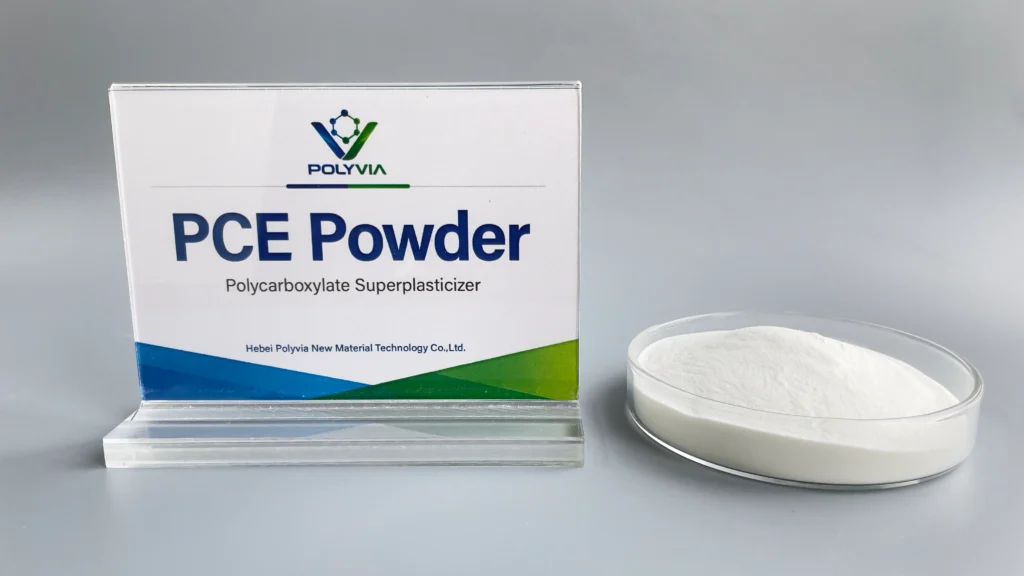
Explore POLYVIA PCE Powder for product information and grade selection.
What Should International Buyers Consider When Purchasing PCE Powder?
International buyers should evaluate PCE powder according to performance requirements, technical specifications, formulation compatibility, logistics and supplier reliability rather than comparing purchase prices alone.
Performance Requirements
Identify the primary performance target before selecting a grade.
Important requirements include:
- Water reduction.
- Initial flowability.
- Workability retention.
- Viscosity control.
- Early strength.
- Compatibility with the complete formulation.
A high-water-reduction grade is not automatically the best choice for a system requiring extended flow retention or controlled viscosity.
Solid Content and Technical Specifications
Solid content, moisture, chloride content, pH and performance parameters should be evaluated against the intended application.
Buyers should request current technical documentation and batch-specific COA rather than relying only on general product descriptions.
Formulation Compatibility
PCE powder should be evaluated within the complete cementitious formulation.
Cement chemistry, supplementary cementitious materials, gypsum, fillers, HPMC, RDP, defoamers, retarders and accelerators can influence final performance.
A product that performs well in one formulation may respond differently in another.
See How PCE Superplasticizer Works for a technical explanation of PCE dispersion mechanisms.
Packaging and Storage
Moisture protection is important for powdered construction chemicals.
Buyers should evaluate packaging integrity, moisture protection, palletization, container loading, storage conditions and shelf-life documentation.
Packaging specifications should be confirmed with the supplier for the intended shipment.
Manufacturing Capability and Technical Support
A reliable supplier should provide consistent product quality, clear technical specifications and appropriate application support.
International buyers should evaluate:
- Manufacturing capability.
- Batch-to-batch consistency.
- Product availability.
- COA and TDS documentation.
- Sample testing.
- Export arrangements.
- Technical communication.
A supplier's ability to recommend a suitable grade for the actual formulation is often more valuable than simply offering the lowest quotation.
What Is the Outlook for the Global PCE Powder Market?
The PCE powder market is expected to develop alongside the expansion of factory-produced construction materials and specialized cementitious formulations.
Five trends deserve attention.
Expansion of factory-produced dry-mix materials
Dry-mix mortar, self-leveling compounds, grouts and repair materials provide important downstream markets for powdered functional additives.
Demand for application-specific grades
Different binder systems and concrete applications require more precise performance control.
High water reduction, slump retention, low viscosity and early strength are important areas of product differentiation.
Greater attention to binder compatibility
Different cements, supplementary materials and alternative binders can influence PCE adsorption and dispersion.
Suppliers will need to validate products across different cementitious systems rather than relying on a single standard formulation.
Transportation and supply-chain optimization
Powder PCE offers advantages where dry-form incorporation, concentrated transportation and local formulation capabilities are important.
However, the final purchasing decision should consider total delivered cost and application performance.
Competition beyond price
As conventional powder grades become more widely available, price competition may intensify.
Technical differentiation, formulation support, consistent quality and customer-specific application development will remain important competitive factors.
The long-term competitiveness of PCE powder suppliers will therefore depend not only on manufacturing scale, but also on their ability to solve specific formulation challenges.
Frequently Asked Questions
1. What is the global PCE powder market size?
LP Information estimates the global PCE powder market at USD 756 million in 2025 and forecasts it to reach USD 1.241 billion by 2032, with a projected CAGR of 7.4% between 2026 and 2032. These figures are research estimates, not audited global sales records.
2. What is PCE powder used for?
PCE powder is used in dry-mix mortar, self-leveling compounds, cementitious grouts, repair mortars, UHPC, precast concrete and other compatible cementitious formulations. Its application depends on the grade and complete formulation.
3. Why do buyers choose PCE powder instead of liquid PCE?
PCE powder can be incorporated directly into compatible dry formulations and transported as a concentrated solid material without the additional water contained in liquid products. It is particularly useful for dry-mix manufacturing and certain international supply chains.
4. Is PCE powder suitable for dry-mix mortar?
Yes. Suitable PCE powder grades can be dry-blended with cement, fillers and other powdered ingredients. Proper distribution, dissolution after water addition and compatibility testing are important for consistent performance.
5. Can PCE powder be dissolved in water?
Yes. Suitable PCE powder grades can be dissolved in water to prepare liquid admixture solutions. Dissolution procedures and final solution properties depend on the grade and formulation. POLYVIA ES980 is specifically recommended for pre-dissolution.
6. What is the difference between PCE powder and PCE flake?
Both are concentrated solid forms, but they serve different commercial and formulation purposes. Suitable PCE powder grades can be used in direct dry blending or solution preparation, while PCE flake is primarily supplied for local preparation of liquid PCE solutions. Their specifications and addition methods should be evaluated separately.
7. What is the typical dosage of PCE powder?
POLYVIA™ publishes a typical starting dosage range of 0.10–0.35% based on total cementitious materials. The optimum dosage depends on grade, cement chemistry, binder composition and application requirements. Laboratory testing is recommended.
8. How should buyers select a PCE powder supplier?
Buyers should evaluate product specifications, grade consistency, COA and TDS documentation, formulation compatibility, manufacturing capability, packaging, export arrangements and technical support. Sample testing with actual raw materials is recommended before commercial purchasing.
Research Sources and Data Limitations
This article uses published market research, technical literature and manufacturer product information.
Market Research
- LP Information — Global Polycarboxylate Superplasticizer (PCE) Powder Market Growth 2026–2032.
- Mordor Intelligence — Polycarboxylate Ether Market.
Technical References
- Silva et al. — Producing a Gypsum-Based Self-Leveling Mortar Modified by Polycarboxylate Admixture, Construction and Building Materials, 2023.
- MDPI — Effect of Chemical Admixtures on the Working Performance and Mechanical Properties of Cement-Based Self-Leveling Mortar, 2023.
- POLYVIA™ — PCE Powder for Low Cement and Ultra-Low Cement Refractory Castables.
POLYVIA™ Product and Technical Information
- POLYVIA™ PCE Powder.
- PCE Powder vs PCE Liquid.
- How PCE Superplasticizer Works.
- PCE Superplasticizer for Precast Concrete Piles.
Data Interpretation and Limitations
The global PCE powder market figures are estimates and forecasts published by LP Information. They should not be treated as audited transaction records.
Production capacity, sales volume, average ex-works price and gross margin are also research estimates. The calculated sales-to-capacity ratio is an indicative comparison, not a verified operating-capacity utilization rate.
Market estimates from different research organizations may vary because of differences in product definitions, geographical coverage, market scope and forecasting methodologies.
Regional construction demand is not equivalent to regional PCE powder sales. Country-level purchasing opportunities require separate verification using relevant trade statistics, local manufacturing information and customer purchasing records.
The product specifications and dosage recommendations in this article refer to published POLYVIA™ product information and should be checked against the latest technical documentation and actual application requirements.
| Column 1 | Column 2 | Column 3 |
|---|
| Column 1 | Column 2 | Column 3 |
|---|
| Column 1 | Column 2 | Column 3 |
|---|
| Column 1 | Column 2 | Column 3 |
|---|