
C80+ PHC Spun Pile Production with Same-Day Demoulding
Achieving over 60 MPa early compressive strength after steam curing, enabling same-day demoulding and improved production efficiency with POLYVIA™ PCE technology.
Project Overview
A PHC (Prestressed High-Strength Concrete) spun pile manufacturer in Thailand sought to improve production efficiency by achieving sufficient early strength for same-day demoulding.
The project required suitable concrete workability during production, reliable early strength development and compatibility with the manufacturer's existing batching and curing processes.
POLYVIA™ supported the customer's evaluation with two polycarboxylate ether (PCE) technologies: ES980 Early-Strength PCE Powder and F980 High-Water-Reduction PCE Flake.
The customer reported successful production of C60+ PHC spun piles with same-day demoulding, enabling improved mould turnaround and manufacturing efficiency.
Project Highlights
|
Parameter |
Project Result |
|---|---|
| Country | Thailand |
| Application | PHC Spun Pile Production |
| Concrete Grade | C80+ |
| Curing Method | Steam Curing |
| Same-Day Compressive Strength | 60+ MPa |
| Demoulding | Same Day |
| PCE Technologies Evaluated | ES980 Powder / F980 Flake |
| Production Benefit | Improved Mould Turnaround & Production Efficiency |
Production Challenge
Accelerating Mould Turnaround Without Compromising Concrete Performance
For PHC spun pile manufacturers, production efficiency depends partly on how quickly concrete develops sufficient strength for safe demoulding and subsequent handling.
The Thai manufacturer aimed to shorten mould occupancy while maintaining the workability needed for concrete distribution, centrifugal compaction and consistent product quality.
Three requirements shaped the admixture evaluation:
Early Strength Development
Achieve sufficient compressive strength for the customer's targeted same-day demoulding process.
Fresh Concrete Performance
Maintain suitable workability and mixture stability throughout production.
Admixture Compatibility
Select a PCE system compatible with local cementitious materials, existing production practices and the customer's early-strength requirements.
The objective was to improve manufacturing efficiency through a practical, application-specific admixture strategy.
Two PCE Formulation Approaches
Different Performance Functions, Flexible Preparation Options
POLYVIA™ provided two PCE technologies with different functional characteristics, allowing the manufacturer to evaluate alternative admixture strategies.
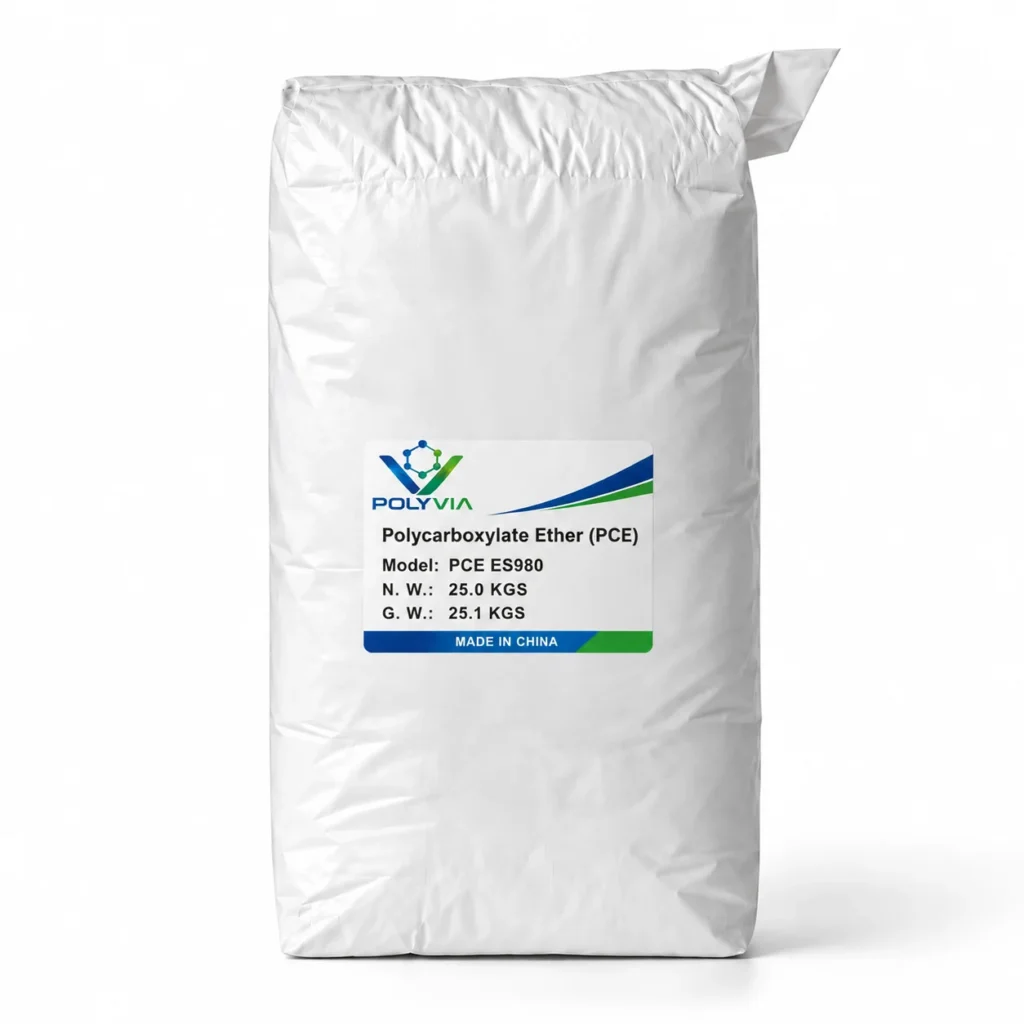
ES980 — Integrated Early-Strength PCE Approach
POLYVIA™ ES980 is an early-strength PCE superplasticizer supplied in powder form.
It can be incorporated through direct dry blending or pre-dissolved in water to prepare liquid PCE solutions at the required solid content.
In the customer's evaluated formulation, ES980 supported the early-strength requirement without an additional accelerating admixture.
Its principal advantages included:
- Early-strength functionality combined with water reduction.
- Direct powder dosing or on-site liquid preparation.
- No separate early-strength additive required in the evaluated formulation.
- Simplified admixture handling and formulation management.
F980 — High-Water-Reduction PCE with Separate Early-Strength Additive
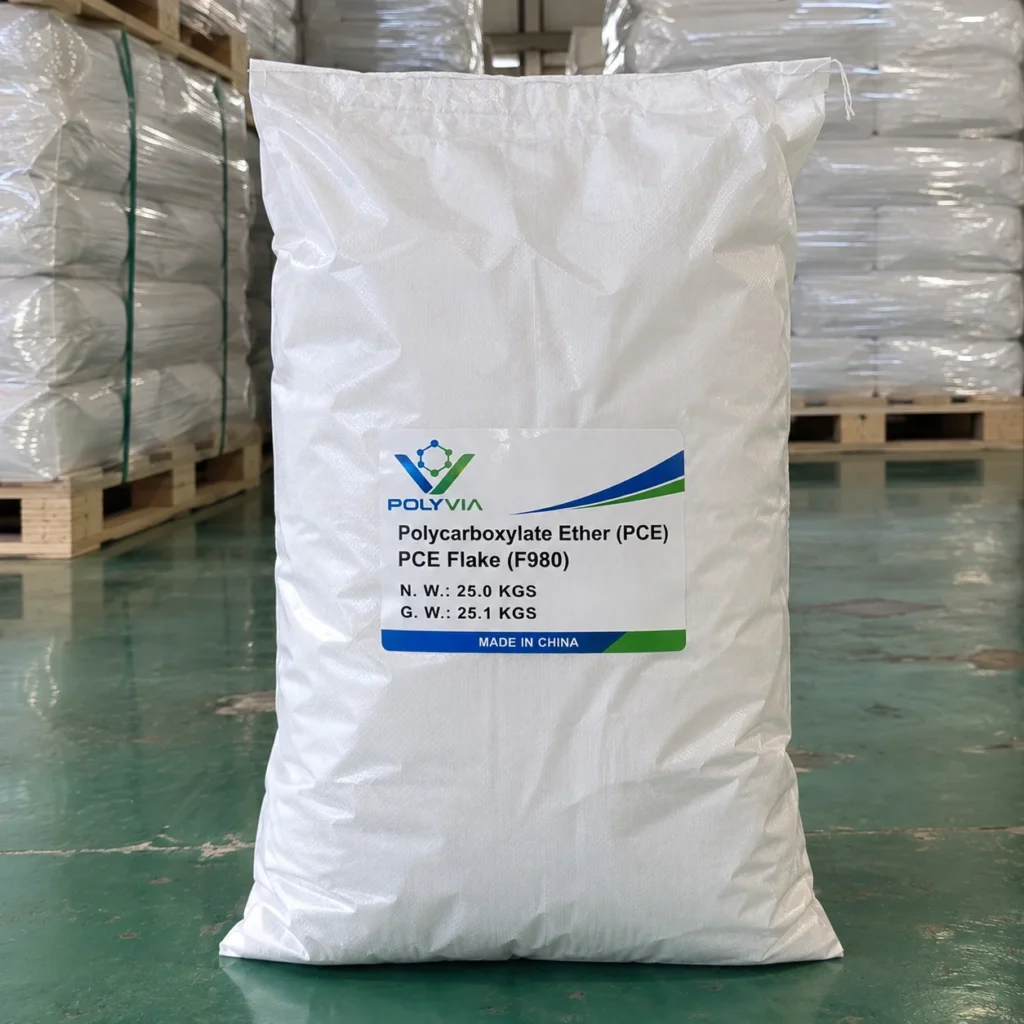
POLYVIA™ F980 is a high-water-reduction PCE supplied in flake form.
The product can be dissolved on-site to prepare liquid PCE solutions at concentrations suited to the manufacturer's dosing and formulation requirements.
Because F980 is not a dedicated early-strength PCE, the customer evaluated it in combination with its existing early-strength additive.
This approach offered:
- High-water-reduction capability.
- Flexible preparation of liquid PCE at selected solid contents.
- Independent adjustment of water-reduction and early-strength components.
- Integration with the customer's established accelerating admixture system.
Selecting the Appropriate Approach
| Parameter | ES980 | F980 |
|---|---|---|
| PCE Type | Early Strength | High Water Reduction |
| Supply Form | Powder | Flake |
| Direct Powder Dosing | Available | Not used in this case |
| Liquid Preparation | Available | Available |
| Separate Accelerator | Not required in the evaluated formulation | Used in the evaluated formulation |
| Main Advantage | Integrated early-strength functionality | Flexible combination of PCE and accelerator |
Both products support local preparation of liquid PCE solutions. The essential difference is their functional design and the role of the separate early-strength additive.
Actual Production Results
C80+ PHC Spun Pile Concrete: 60+ MPa Early Strength After Steam Curing
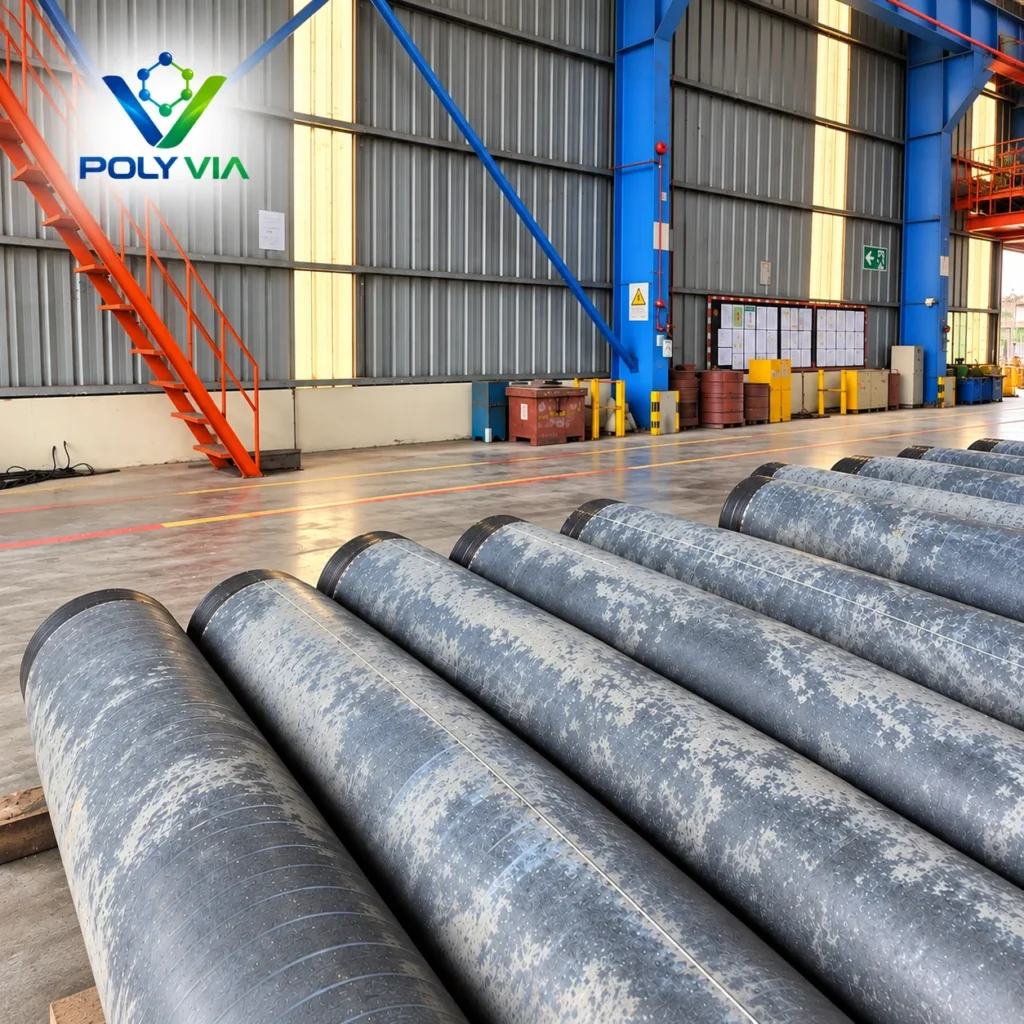
The Thai manufacturer produced PHC spun piles using C80+ high-strength concrete. With the evaluated POLYVIA™ PCE admixture system and the customer's steam-curing process, the concrete achieved a reported early-age compressive strength exceeding 60 MPa within the same production day.
This strength development met the manufacturer's demoulding requirements, enabling same-day demoulding and improving production efficiency.
Key Production Results
C80+ — High-Strength Concrete Grade
The PHC spun piles were manufactured using C80+ concrete, with the admixture system supporting the workability and early-strength requirements of high-strength precast production.
60+ MPa — Same-Day Compressive Strength
Following steam curing, the concrete achieved a reported compressive strength exceeding 60 MPa within the same production day, meeting the customer's early-age strength requirements for demoulding.
Same-Day Demoulding — Improved Production Efficiency
Achieving the required early strength allowed the manufacturer to demould the PHC spun piles on the production day, supporting faster mould turnaround and more efficient production scheduling.
Technical Significance
The results demonstrate the practical value of matching PCE technology with high-strength concrete mix design and controlled steam-curing conditions.
Early-age strength development depends on the combined effects of cementitious materials, water-to-binder ratio, admixture formulation and curing conditions.
For this project, the reported production results highlight how a suitable PCE-based admixture system can support the early-strength requirements of C80+ PHC spun pile manufacturing while contributing to more efficient production cycles.
Technical and Operational Advantages
Supporting Production Performance and Admixture Supply Flexibility
The project illustrates four practical advantages of selecting a PCE system according to the manufacturer's production conditions.
1. Early-Strength Optimization
ES980 provides a dedicated early-strength PCE option, while the F980 approach allows manufacturers to combine high water reduction with a separately controlled accelerating admixture.
2. Flexible Dosing and Liquid Preparation
ES980 can be used as a powder or prepared as a liquid solution. F980 can also be converted into liquid PCE on-site, allowing manufacturers to adjust solution solid content to their production requirements.
3. Potential Logistics Savings
Concentrated powder and flake products reduce the need to transport water contained in pre-diluted liquid PCE. Actual savings depend on product concentration, freight rates, preparation costs and storage requirements.
4. Adaptation to Existing Production Systems
The availability of different PCE technologies allows manufacturers to evaluate solutions without necessarily replacing their entire admixture preparation system.
Successful implementation still requires verification of cement compatibility, admixture dosage, concrete workability, curing conditions and early-age strength.
Project Takeaways
Application-Specific PCE Selection for Efficient PHC Production
The Thailand case highlights the value of matching PCE technology to the manufacturer's strength requirements, admixture formulation and production process.
POLYVIA™ provided two different technical options:
- ES980: An early-strength PCE powder supporting flexible dosing and simplified accelerator requirements in the customer's evaluated formulation.
- F980: A high-water-reduction PCE flake supporting on-site liquid preparation and combination with the customer's existing early-strength additive.
The customer's reported achievement of C60+ PHC spun pile production with same-day demoulding demonstrates the operational value of a suitably designed and controlled concrete system.
For manufacturers seeking to improve precast production efficiency, PCE selection should be based on verified concrete performance and compatibility with actual manufacturing conditions.
Related Technical Resources
- PCE Superplasticizer for Spun Pile Concrete
- PHC Spun Pile Concrete Production Solutions
- Early-Strength PCE Superplasticizer
- PCE Powder and PCE Flake Technologies
Optimize Your PHC Spun Pile Production
POLYVIA™ supports precast concrete manufacturers with PCE grade selection, admixture preparation guidance and application-specific formulation evaluation.
Contact our technical team to discuss early-strength targets, PCE compatibility and manufacturing requirements.
Frequently Asked Questions
1. Why does C80+ PHC spun pile concrete sometimes fail to reach the required demoulding strength on the same day?
Insufficient early strength may result from unsuitable water-to-binder ratio, cement characteristics, admixture incompatibility or inadequate steam-curing conditions.
For C80+ PHC spun pile production, achieving the required demoulding strength depends on the complete concrete system rather than the PCE superplasticizer alone.
Manufacturers should evaluate cement compatibility, admixture dosage, concrete compaction and steam-curing parameters before adjusting the formulation.
2. How can PHC spun pile manufacturers achieve over 60 MPa compressive strength after same-day steam curing?
Achieving more than 60 MPa within the same production day requires coordinated control of concrete mix design, water reduction, cementitious materials and steam-curing conditions.
An appropriate PCE system can support lower water-to-binder ratios while maintaining the workability required for spinning and compaction.
In the Thailand project, the customer reported achieving over 60 MPa early compressive strength after steam curing, enabling same-day demoulding of C80+ PHC spun piles.
The result should be verified under each manufacturer's actual production and curing conditions.
3. Should PHC spun pile manufacturers choose ES980 early-strength PCE or F980 high-water-reduction PCE?
The selection depends primarily on the manufacturer's existing admixture system and early-strength requirements.
PCE ES980 provides an integrated early-strength PCE approach. In the Thai customer's evaluated formulation, no separate accelerating admixture was required.
PCE F980 primarily provides high water reduction. For this application, it was evaluated together with the customer's existing early-strength additive.
Both approaches require compatibility and early-strength testing before full-scale production.
4. Can ES980 powder and F980 flake be prepared as liquid PCE at different solid contents?
Yes. Both ES980 powder and F980 flake can be dissolved in water to prepare liquid PCE solutions at selected solid contents according to the manufacturer's dosing and formulation requirements.
ES980 also supports direct dry blending when suitable mixing and dispersion conditions are provided.
For liquid preparation, the water ratio should be calculated using the supplied product's actual solid content. Complete dissolution, uniformity and storage stability should be verified before use.
The appropriate solution concentration depends on dosing equipment and formulation requirements.
5. How can PCE technology improve PHC spun pile production efficiency without compromising concrete quality?
PCE technology can help improve production efficiency by supporting effective water reduction, suitable workability and early strength development.
For PHC spun pile manufacturers, the practical objective is to reach the required demoulding strength while maintaining reliable spinning, compaction and curing performance.
In the Thailand case, the customer achieved same-day demoulding following steam curing, supporting faster mould turnaround.
However, earlier demoulding should only be implemented after verifying the required compressive strength, concrete quality and safe handling conditions.
The optimal PCE formulation should be determined through representative production trials.