
Slump-Retention PCE Solutions for Ready-Mix Concrete in Malaysia
Flexible Supply. Consistent Workability. Cost-Efficient Options.
Comparing 40–50% SR-Type PCE liquid and 97% F970 flake to support consistent slump retention, flexible on-site preparation and more efficient admixture supply.
Project Overview
Maintaining suitable concrete workability during transportation and placement is a key challenge for ready-mix concrete producers operating under Malaysia's tropical conditions.
A Malaysian customer originally used slump-retention-type polycarboxylate ether (PCE) liquid admixtures with solid contents of 40% and 50%.
To provide greater flexibility in material supply and formulation management, POLYVIA™ recommended PCE F970, a 97% solid-content slump-retention PCE flake, as an additional option.
Rather than replacing the existing liquid admixture, the two products provide different supply and preparation approaches for meeting the customer's concrete production requirements.
The liquid products offer convenient direct dosing, while F970 provides concentrated supply and the ability to prepare liquid PCE locally at selected solid contents.
The customer's decision can therefore consider both concrete performance and the total cost of purchasing, transporting, preparing and using the admixture.
Project at a Glance
| Parameter | Project Details |
|---|---|
| Market | Malaysia |
| Application | Ready-Mix Concrete |
| Primary Requirement | Slump Retention |
| Existing Product | PCE Liquid — SR Type |
| Liquid Solid Content | 40% / 50% |
| Additional Option | PCE F970 — SR Type Flake |
| F970 Solid Content | 97% |
| Preparation Options | Direct Liquid Dosing / On-Site Dissolution |
| Performance Reference | PCE-SR-50% Product Test Data |
| Main Objective | Workability Control & Supply Optimization |
Customer Requirements
Reliable Slump Retention with Flexible Admixture Supply
For ready-mix concrete manufacturers, achieving the specified initial slump is only the first step.
Concrete must also maintain suitable consistency throughout transportation, waiting and discharge while remaining stable and meeting the required hardened performance.
Elevated concrete temperatures and variable delivery conditions can increase the difficulty of maintaining workability.
For the Malaysian customer, the existing 40% and 50% SR-Type PCE liquids offered a familiar and convenient admixture supply format.
However, transporting pre-diluted liquid PCE also means transporting the water contained in the product.
The customer therefore needed to balance three priorities:
Consistent Workability Retention
Maintaining the required concrete consistency throughout the relevant delivery period.
Practical Admixture Handling
Ensuring that the selected product works with the plant's batching, dosing and quality-control arrangements.
Supply and Cost Flexibility
Evaluating the balance between transportation cost, liquid preparation requirements and actual admixture performance.
The objective was not simply to identify a more concentrated product, but to provide a supply option that could meet the same application requirements under the customer's operating conditions.
Two PCE Supply Options
Slump-Retention Liquid and Concentrated F970 Flake
POLYVIA™ offers two slump-retention-oriented PCE supply approaches for the customer's consideration.
Both are designed for applications requiring workability retention, but their physical forms and preparation requirements differ.
Option A — PCE Liquid SR Type (40% / 50%)
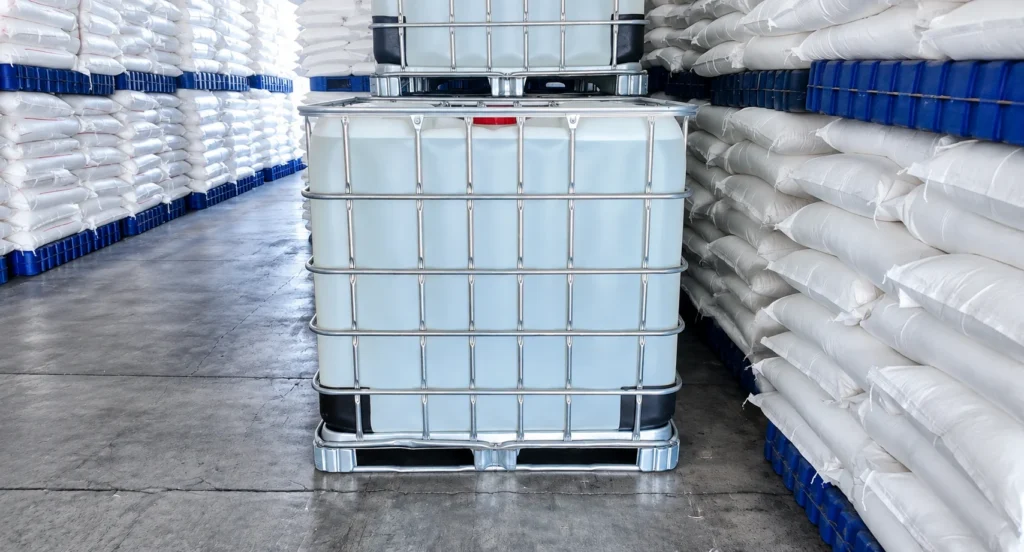
The customer's existing admixture supply includes SR-Type PCE Liquid at 40% and 50% solid contents.
These liquid products can be dosed directly through suitable liquid admixture equipment without separate on-site dissolution.
The principal advantages are convenient handling, simplified preparation and established liquid batching procedures.
For the PCE-SR-50% grade, the specified solid content is 50 ± 1.5%.
The product guidance also recommends an initial blending ratio of:
WR-PCE : SR-PCE = 8:2 to 6:4 by weight
This allows high-water-reduction and slump-retention components to be adjusted according to formulation requirements.
The recommended ratio is a starting range, not a fixed requirement for every concrete mix. The final proportion must account for product concentrations, cement compatibility, setting behavior and the required initial and retained workability.
Option B — PCE F970 Slump-Retention Flake (97%)
POLYVIA™ PCE F970 is a concentrated slump-retention-type polycarboxylate superplasticizer with 97% solid content.
F970 can be dissolved on-site to prepare liquid PCE solutions at selected solid contents, including 40% or 50%, subject to suitable dissolution and solution stability.
This gives the manufacturer flexibility to match its liquid preparation to existing batching and dosing requirements.
Compared with pre-diluted liquid supply, the concentrated flake form offers the potential to reduce transported water and improve logistics efficiency.
However, on-site preparation introduces additional requirements for equipment, water quality, dissolution procedures, concentration control and solution stability.
Although F970 and the original liquid products share a slump-retention performance focus, their actual performance must be compared through concrete testing rather than assumed to be identical.
Supply Option Comparison
| Parameter | SR PCE Liquid | PCE F970 Flake |
|---|---|---|
| Performance Type | Slump Retention | Slump Retention |
| Supply Form | Liquid | Flake |
| Solid Content | 40% / 50% | 97% |
| Direct Liquid Dosing | Yes | After Dissolution |
| On-Site Preparation | Generally Not Required | Required |
| Concentration Flexibility | Supplied Concentration | Locally Adjustable |
| Transported Water | Higher | Lower |
| Preparation Complexity | Lower | Higher |
| Main Advantage | Operational Convenience | Logistics & Formulation Flexibility |
The more suitable choice depends on the customer's production system, verified admixture performance and total operating cost.
Slump-Retention Performance
PCE-SR-50% Performance Reference
The supplied PCE-SR-50% test data provide a technical reference for understanding the performance characteristics of a slump-retention-oriented liquid admixture.
The results include cement paste fluidity measurements and C30 concrete slump retention over time.
These are product performance data; they are not presented as verified Malaysian customer site results or as F970 test results.
Cement Paste Fluidity
Reported dosage: 0.32% b.o.c.
| Test Time | Paste Flow Diameter |
|---|---|
| Initial | 220 mm |
| 60 Minutes | 280 mm |
| 120 Minutes | 280 mm |
| 180 Minutes | 260 mm |
The measured paste flow diameter increased from 220 mm initially to 280 mm after 60 minutes, remained at 280 mm after 120 minutes and decreased to 260 mm after 180 minutes.
This pattern is consistent with the delayed or sustained dispersion characteristics that may be observed in slump-retention-oriented PCE systems.
However, the measurements alone do not establish the specific polymer mechanism responsible for the behavior.
The dosage basis and testing conditions should be confirmed when interpreting or reproducing the results.
C30 Concrete Slump Retention
The supplied concrete performance data show the following slump measurements:
| Test Time | Reported Slump |
|---|---|
| Initial | 210–220 mm |
| 60 Minutes | 190–200 mm |
| 120 Minutes | 165–180 mm |
Under the reported test conditions, the concrete maintained considerable workability over the two-hour observation period.
Based on the reported ranges, the possible slump reduction was approximately 10–30 mm after 60 minutes and 30–55 mm after 120 minutes.
These values represent interval estimates from the supplied data ranges, rather than paired measurements from individual batches.
What the Results Mean for Ready-Mix Production
The results illustrate the performance objective of a slump-retention PCE system: maintaining suitable concrete workability as time passes after mixing.
However, cement paste flow and concrete slump are different test measurements and should not be directly compared.
Concrete temperature, cement composition, admixture dosage, aggregate characteristics and testing procedures must also be considered.
For the Malaysian customer, the SR-50% results provide a useful formulation reference.
Any comparison with F970 should be carried out using representative concrete mixtures and consistent testing conditions, with both products assessed against the same required discharge performance.
Logistics and Total Cost Evaluation
Reducing Transported Water Through Concentrated PCE Supply
One potential benefit of F970 is its high solid content.
Compared with 40% or 50% liquid PCE, transporting 97% solid-content F970 reduces the quantity of water shipped with the admixture.
For an equal total-solids quantity of 970 kg:
| Product | Required Supply Mass |
|---|---|
| 40% PCE Liquid | 2,425 kg |
| 50% PCE Liquid | 1,940 kg |
| 97% F970 Flake | 1,000 kg |
On this theoretical basis, F970 reduces shipped product mass by approximately:
58.8% compared with 40% solid-content liquid
48.5% compared with 50% solid-content liquid
These figures are based on equal total-solids mass. They do not represent verified freight-cost savings or equivalent concrete performance.
Flexible On-Site Liquid Preparation
One metric ton of F970 containing 97% solids can theoretically be used to prepare:
- Approximately 2.425 tons of 40% solid-content PCE liquid.
- Approximately 1.940 tons of 50% solid-content PCE liquid.
The corresponding water additions are approximately 1.425 tons and 0.940 tons, respectively.
Actual preparation must account for the supplied product specification, water quality, complete dissolution, solution viscosity and storage stability.
A prepared F970 solution should not be regarded as chemically identical to the customer's original liquid PCE solely because both have the same solid content.
Evaluating the Complete Supply Cost
For ready-mix concrete manufacturers, the commercial comparison should include more than the initial purchase price or freight weight.
SR PCE Liquid
- Purchase and transportation costs.
- Storage and liquid dosing requirements.
- Routine incoming quality control.
- Minimal additional preparation.
F970 PCE Flake
- Concentrated product purchase and transportation costs.
- Local dissolution equipment and labour.
- Preparation water and utilities.
- Solution quality control and storage.
- Any differences in effective admixture dosage.
The preferred option is the one delivering the required concrete performance at a suitable total cost per cubic metre of concrete.
Application Insights and Customer Value
Matching PCE Supply with Real Production Requirements
For Malaysian ready-mix concrete producers, the effectiveness of a slump-retention admixture depends on its interaction with the complete concrete formulation.
Cement chemistry, supplementary cementitious materials, concrete temperature, admixture dosage and delivery time can all affect consistency retention.
A practical evaluation should consider:
Cement Compatibility
The selected PCE should be tested with the actual cementitious materials used in production.
Initial and Retained Workability
The admixture must provide the required consistency at mixing and at the specified discharge time.
Formulation Balance
Where WR-PCE and SR-PCE are blended, the ratio should be optimized according to water reduction, slump retention, setting behavior and concrete stability.
Liquid Preparation Quality
F970-based solutions require verification of concentration, complete dissolution and storage stability.
Total Cost of Use
The choice between liquid and flake should reflect both the technical performance and the complete supply and preparation costs.
Key Takeaways
The Malaysia application illustrates the advantages of maintaining two slump-retention PCE supply options.
PCE-SR Liquid (40% / 50%) provides convenient direct dosing and simpler on-site handling.
PCE F970 Flake (97%) provides concentrated supply, flexible local liquid preparation and potential transportation advantages.
The available PCE-SR-50% test data demonstrate the intended workability-retention characteristics of the liquid product. They also provide a reference for further comparative evaluation of F970.
Rather than treating one supply form as universally superior, POLYVIA™ supports manufacturers in selecting the most suitable solution based on verified concrete performance, preparation capabilities and supply economics.
Frequently Asked Questions
1. Can F970 flake replace 40% or 50% slump-retention PCE liquid?
F970 can be dissolved to prepare liquid solutions at comparable solid contents, but this does not guarantee identical admixture performance.
The F970-based solution and original SR liquid should be evaluated using the same cementitious materials and representative concrete conditions. Dosage, initial slump, retained slump, setting behavior and mixture stability should be compared.
2. Why does PCE-SR-50% show higher cement paste fluidity after 60 minutes?
Some slump-retention-oriented PCE formulations exhibit delayed or sustained dispersion behavior.
The supplied PCE-SR-50% data show paste flow increasing from 220 mm initially to 280 mm after 60 minutes.
This behavior is consistent with the product's intended retention function, but the specific molecular mechanism cannot be established from these measurements alone.
3. What is the recommended blending ratio of WR-PCE and SR-PCE?
The supplied PCE-SR-50% guidance recommends a starting weight ratio of WR-PCE : SR-PCE from 8:2 to 6:4.
The appropriate ratio depends on the products' solid contents, cement compatibility, target workability and required retention period.
The formulation should be verified through laboratory and plant trials before commercial production.
4. How much liquid PCE can be prepared from one ton of F970?
Based on 97% total solids, one metric ton of F970 can theoretically produce approximately 2.425 tons of 40% liquid or 1.940 tons of 50% liquid.
Actual preparation requires accurate water calculation and verification of solution uniformity, viscosity and stability.
5. Which option is more economical: SR PCE Liquid or F970 Flake?
SR PCE Liquid offers operational simplicity because it can be dosed directly without separate dissolution.
F970 reduces transported water and provides flexibility in local liquid preparation, but requires additional equipment, labour and quality control.
The economic choice should be based on verified admixture performance and total cost per cubic metre of compliant concrete.
Conclusion
Flexible Supply Solutions for Reliable Slump Retention
The Malaysian ready-mix concrete application demonstrates how two different supply forms can support the same overall workability-retention objective.
By offering 40–50% SR-Type PCE Liquid alongside 97% F970 Slump-Retention Flake, POLYVIA™ provides manufacturers with flexibility to balance operational convenience, local formulation capability and material transportation efficiency.
The final product choice should always be supported by representative concrete testing and a realistic assessment of total operating cost.
Discuss Your Ready-Mix Concrete Requirements
POLYVIA™ offers liquid and concentrated flake PCE technologies, together with technical support for admixture selection, cement compatibility and formulation evaluation.
Contact our technical team to discuss slump-retention targets, liquid preparation and admixture supply optimization.
POLYVIA™ — Advanced Materials for Better Concrete Performance.
| Column 1 | Column 2 | Column 3 |
|---|
| Column 1 | Column 2 | Column 3 |
|---|
| Column 1 | Column 2 | Column 3 |
|---|
| Column 1 | Column 2 | Column 3 |
|---|