
Anti-Crack Mortar Optimization in Vietnam
A Customer Trial with PP Fiber & RDP
Discover how POLYVIA™ adjusted a real exterior rendering mortar formulation, with customer-reported satisfaction in crack resistance, workability, overall performance, and cost.
Project Overview
POLYVIA™ supported a customer in Vietnam with the optimization of an exterior cement-based anti-crack rendering mortar formulation.
The project focused on rebalancing the mineral composition and adjusting the dosages of cellulose ether, POLYVIA™ RDP 20, and 6 mm polypropylene (PP) fiber.
The adjusted formulation increased cement, sand, and RDP 20 content while eliminating two mineral powder components and reducing cellulose ether and PP fiber consumption.
After trialing the revised formulation, the Vietnamese customer confirmed satisfaction with four key aspects: crack resistance, workability, overall performance, and cost.
This case study presents the original and adjusted formulations, explains the technical considerations behind the changes, and discusses practical lessons for manufacturers developing exterior cement-based rendering mortars.
The reported outcome reflects customer feedback under the trial conditions, not independently verified comparative laboratory results.
Original Customer Formulation
The customer initially provided the following dry-mix mortar formulation.
| Raw Material | Dosage (kg/batch) |
|---|---|
| P.O 42.5 Cement | 375.0 |
| Sand | 375.0 |
| Ground Calcium Carbonate | 175.0 |
| Gray Calcium Powder | 78.0 |
| Cellulose Ether | 5.0 |
| Redispersible Polymer Powder (RDP) | 3.0 |
| 6 mm Polypropylene Fiber | 2.0 |
| Starch Ether | 0.7 |
| Total | 1,013.7 |
Basis: Original recorded dry-batch quantities, excluding mixing water.
The original formulation combined cement and sand with two mineral powder components, cellulose ether, RDP, PP fiber, and starch ether.
These ingredients serve different functions within the mortar system. Cement provides hydraulic binding, sand forms the aggregate skeleton, cellulose ether contributes to water retention and rheology, RDP modifies the cementitious matrix, and PP fiber provides distributed reinforcement.
The original formulation serves as the reference point for evaluating the subsequent adjustment.
POLYVIA™ Optimized Formulation
The revised formulation changed the mineral composition and redistributed the functional additive dosages.
| Raw Material | Dosage (kg/batch) |
|---|---|
| P.O 42.5 Cement | 400.0 |
| Sand | 600.0 |
| Ground Calcium Carbonate | 0 |
| Gray Calcium Powder | 0 |
| Cellulose Ether | 2.5 |
| POLYVIA™ RDP 20 | 5.0 |
| 6 mm Polypropylene Fiber | 0.5 |
| Starch Ether | 0.7 |
| Total | 1,008.7 |
Basis: Adjusted recorded dry-batch quantities, excluding mixing water.
The revised formula eliminated ground calcium carbonate and gray calcium powder, increased cement and sand, and raised the RDP dosage from 3.0 kg to 5.0 kg per batch.
The cellulose ether dosage was reduced by 50%, while 6 mm PP fiber consumption decreased by 75%. Starch ether remained unchanged at 0.7 kg per batch.
The two batch totals are retained exactly as recorded. Neither formulation is represented as an original 1,000 kg batch.
Key Formulation Changes
| Component | Original (kg) | Optimized (kg) | Change |
|---|---|---|---|
| Cement | 375 | 400 | +6.67% |
| Sand | 375 | 600 | +60.00% |
| Ground Calcium Carbonate | 175 | 0 | Removed |
| Gray Calcium Powder | 78 | 0 | Removed |
| Cellulose Ether | 5 | 2.5 | −50.00% |
| RDP / RDP 20 | 3 | 5 | +66.67% |
| 6 mm PP Fiber | 2 | 0.5 | −75.00% |
| Starch Ether | 0.7 | 0.7 | Unchanged |
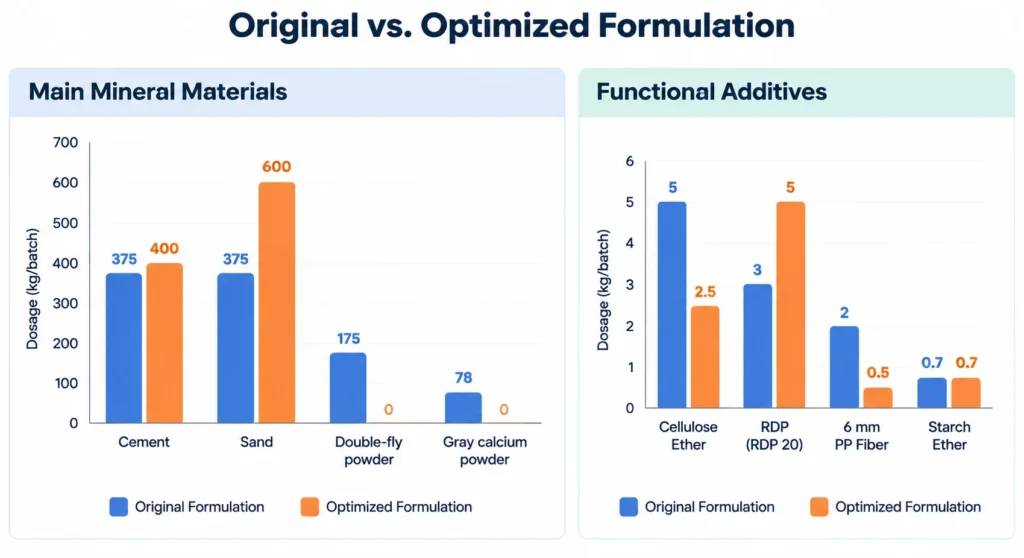
Changes are calculated from the original batch quantities. They do not represent measured changes in mortar performance.
1. Rebalancing the Mineral Composition
The cement-to-sand mass ratio changed from 1:1 to 1:1.5. At the same time, both mineral powder components were removed.
This altered the balance between hydraulic binder, aggregate, and fine mineral particles. The resulting effects on water demand, cohesion, and workability depend on sand grading, particle characteristics, cement properties, and the overall formulation.
The change should therefore be understood as a complete mineral-composition adjustment rather than simply an increase in sand content.
2. Adjusting the RDP 20 Dosage
RDP 20 was used in the adjusted formulation at 5.0 kg per batch, compared with 3.0 kg of RDP in the original formulation.
RDP is used to modify cement-based dry-mix mortar systems. Depending on polymer chemistry, grade, dosage, and curing conditions, it may influence adhesion, cohesion, and deformation behavior.
Increasing the dosage can change the polymer-to-binder balance, but it does not guarantee a proportional improvement in any individual performance property.
The positive customer feedback relates to the complete revised formulation. Because several ingredients changed simultaneously, the isolated contribution of RDP 20 cannot be quantified from the available trial information.
3. Reducing Cellulose Ether
Cellulose ether decreased from 5.0 kg to 2.5 kg per batch.
Cellulose ether contributes to water retention and fresh-mortar rheology. Its appropriate dosage depends on the grade, cement characteristics, aggregate grading, and required application behavior.
Reducing the dosage can alter consistency and water retention. The actual result must be evaluated within the complete mortar system.
In this project, the customer reported satisfactory workability after trialing the adjusted formulation.
4. Optimizing 6 mm PP Fiber Consumption
The PP fiber dosage decreased from 2.0 kg to 0.5 kg per batch.
Polypropylene microfibers can contribute to controlling certain early-age cracking mechanisms, particularly plastic shrinkage cracking, when appropriately selected and dispersed.
However, more fiber does not automatically produce better overall mortar performance. Fiber geometry, dosage, dispersion, mixing conditions, and matrix properties all influence its contribution.
The customer reported satisfactory crack resistance with the adjusted formulation. This is a positive observation about the complete formulation, not proof that reducing fiber dosage alone improved crack resistance.
Customer Trial Results in Vietnam
Following the trial, the Vietnamese customer confirmed satisfaction in four areas.
| Evaluation Area | Customer-Reported Feedback |
|---|---|
| Crack Resistance | Satisfactory |
| Workability | Satisfactory |
| Overall Performance | Satisfactory |
| Cost Efficiency | Satisfactory |
These results represent actual customer-reported application experience.
The positive feedback is relevant because the revised formula involved multiple changes to the mineral composition, RDP 20 dosage, cellulose ether, and PP fiber.
The available information does not establish quantified improvements in crack width, shrinkage, adhesion strength, or long-term durability. No independent comparative laboratory results have been provided for publication.
The customer's satisfaction with cost is also recorded as feedback. A specific cost-saving percentage should only be stated after confirming the applicable purchasing prices and calculation basis.
Practical Lessons for Mortar Manufacturers
This project highlights three important considerations for exterior rendering mortar development.
First, optimize the complete formulation. Cement, sand, mineral fillers, polymer modifiers, rheology modifiers, and fibers interact. A change to one component can affect several fresh and hardened properties.
Second, select RDP and PP fiber according to their different functions. RDP modifies the cementitious matrix, while PP fiber provides distributed reinforcement. They are complementary materials, not direct substitutes.
Third, validate the revised formula under the intended application conditions. Cement characteristics, sand grading, additive specifications, water addition, substrate preparation, rendering thickness, and curing conditions can all influence performance.
The exact raw-material grades, mixing-water quantity, production parameters, and curing conditions of the Vietnamese customer trial have not been fully documented here. The formulation should therefore be treated as a customer-specific example rather than a universally validated production specification.
POLYVIA™ Materials for Exterior Rendering Mortar POLYVIA™ RDP 20
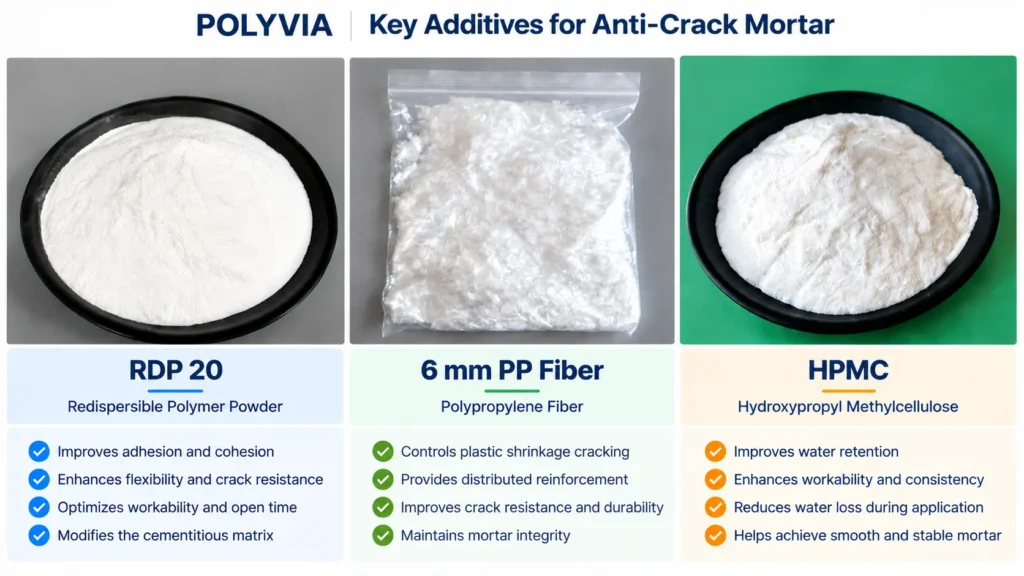
RDP 20 was the identified RDP grade used in the adjusted formulation described in this case study.
Redispersible polymer powders are used in suitable dry-mix mortar systems to modify the cementitious matrix. Product selection should consider the intended application, binder compatibility, and the performance requirements of the final mortar.
Product reference: POLYVIA™ Redispersible Polymer Powder
POLYVIA™ PP Fiber
POLYVIA™ PP Fiber is available in different lengths, including 6 mm, for suitable cement-based applications.
Fiber selection should consider the intended reinforcement function, dispersion, workability, and application conditions.
Product reference: POLYVIA™ PP Fiber
Cellulose Ether
Cellulose ether helps regulate water retention and fresh-mortar rheology. The suitable grade and dosage depend on the complete formulation and intended application.
The specific cellulose ether grade used in the Vietnamese customer trial has not been identified in the available records.
Frequently Asked Questions
1. What type of mortar was optimized for the Vietnamese customer?
The project involved ordinary exterior cement-based anti-crack rendering mortar, not a specialized ETICS base coat.
2. What was the main change in the optimized formulation?
The adjusted formula increased cement, sand, and RDP 20, eliminated two mineral powder components, and reduced cellulose ether and 6 mm PP fiber.
3. Why was RDP 20 increased?
RDP dosage was increased as part of the overall formulation adjustment. The available information does not establish the isolated effect of this change or a quantified improvement attributable solely to RDP 20.
4. Why was PP fiber reduced?
The fiber reduction was one component of the multi-variable formulation adjustment. The customer reported satisfactory results with the revised formulation, but the reason for the isolated fiber reduction has not been independently established.
5. Did the customer report better crack resistance and workability?
The customer confirmed satisfaction with both crack resistance and workability during the trial. Quantified comparative test results have not been provided.
6. Did the adjusted formulation reduce costs?
The customer reported satisfaction with cost. A verified percentage saving is not claimed without confirmed purchasing prices and a consistent cost-comparison basis.
7. Can another manufacturer use this formulation directly?
The formulation provides a practical reference, subject to authorization for disclosure. Other manufacturers should verify their raw materials, water addition, production conditions, and performance requirements before commercial adoption.
8. Can POLYVIA™ support similar formulation projects?
POLYVIA™ can discuss additive selection, material compatibility, sample evaluation, and formulation optimization for suitable cement-based mortar applications.
Conclusion
The Vietnamese customer project demonstrates a practical example of exterior anti-crack mortar formulation optimization.
The revised formulation increased cement, sand, and POLYVIA™ RDP 20, removed two mineral powder components, and reduced cellulose ether and 6 mm PP fiber consumption.
Following the trial, the customer confirmed satisfaction with crack resistance, workability, overall performance, and cost.
The central lesson is that successful mortar optimization depends on balancing the complete binder–aggregate–additive system, rather than maximizing individual additive dosages.
The outcome is specific to the customer's trial conditions and should be verified before transferring the formulation to other manufacturing or application environments.
Formulation Support from POLYVIA™
POLYVIA™ supplies construction chemical additives and reinforcement fibers for cement-based mortar applications, including RDP and PP Fiber.
For manufacturers developing or optimizing exterior rendering mortars, POLYVIA™ can discuss material selection, compatibility evaluation, sample testing, and application-specific formulation requirements.
Contact POLYVIA™ to discuss your mortar formulation needs.
Technical Disclosure
This case study is based on actual customer-provided and adjusted formulation records and customer-reported trial feedback from Vietnam.
The reported outcomes are not independently verified comparative laboratory measurements and do not constitute a universal performance guarantee. The original batch quantities are preserved as recorded.
The customer's actual water addition, complete raw-material specifications, production parameters, and curing conditions have not been fully documented for publication.
Public disclosure of customer-specific formulation details and trial feedback is subject to appropriate authorization.
| Column 1 | Column 2 | Column 3 |
|---|
| Column 1 | Column 2 | Column 3 |
|---|
| Column 1 | Column 2 | Column 3 |
|---|
| Column 1 | Column 2 | Column 3 |
|---|