
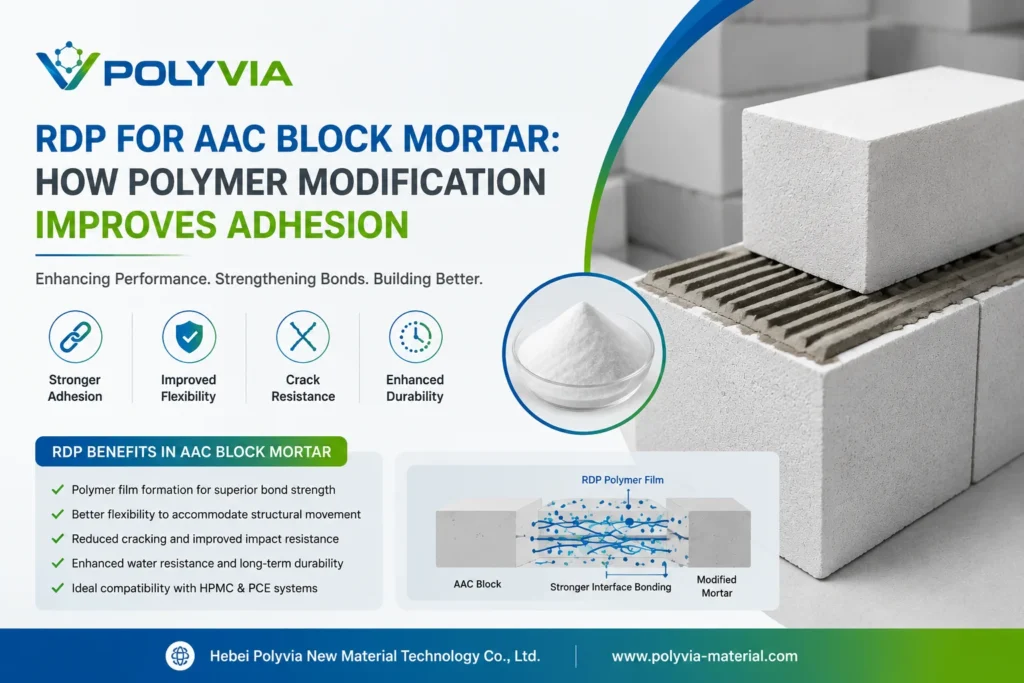
1. Why AAC Block Mortar Needs Polymer Modification
AAC (Autoclaved Aerated Concrete) blocks are widely used in lightweight construction because of:
- Low density
- Thermal insulation
- Fast installation
- Large block size
However, AAC blocks create a special challenge for mortar systems.
The substrate has:
- High porosity
- High water absorption
- Low surface strength
- Different deformation behavior compared with traditional concrete
A cement-based mortar alone may provide basic bonding, but it often lacks:
- Long-term flexibility
- Interface durability
- Crack resistance
This is where polymer modification becomes important.
RDP (Redispersible Polymer Powder) improves the cementitious mortar matrix by introducing polymer properties into the inorganic system.
The result is a mortar with:
- Higher adhesion
- Better flexibility
- Improved durability
2. The Difference Between HPMC and RDP in AAC Mortar
This section creates differentiation from previous article.
Many manufacturers confuse the roles of HPMC and RDP.
They are not interchangeable.
| Additive | Main Function | Performance Stage |
|---|---|---|
| HPMC | Water retention & rheology control | Fresh mortar |
| RDP | Adhesion & flexibility improvement | Hardened mortar |
| PCE Powder | Water reduction & efficiency | Mixing and strength development |
A high-performance AAC adhesive mortar requires all three systems working together.
3. Why AAC Blocks Require Polymer-Modified Mortar
3.1 Different Material Properties
AAC block:
- Lightweight
- Low elastic modulus
- Porous structure
Cement mortar:
- Higher rigidity
- Different shrinkage behavior
After curing:
Stress develops at the interface.
Without polymer modification:
Possible problems:
- Interface cracks
- Reduced adhesion
- Wall defects
3.2 Thin-Bed Mortar Requires Strong Adhesion
AAC adhesive mortar is normally applied:
2–5 mm
At such a thin thickness:
Mechanical bonding alone is insufficient.
The mortar needs:
- Chemical bonding
- Polymer film formation
- Flexible interface
RDP helps create this polymer-enhanced bonding structure.
4. How RDP Works in AAC Block Mortar
Polymer Film Formation Mechanism
During mixing:
RDP particles redisperse in water.
During curing:
Water evaporates
↓
Polymer particles form continuous film
↓
Polymer phase integrates with cement hydration products
This improves:
- Adhesion
- Flexibility
- Crack resistance
5. Benefits of RDP in AAC Adhesive Mortar
5.1 Improved Tensile Adhesion Strength
AAC blocks require strong interface bonding.
RDP improves:
- Mortar-substrate adhesion
- Internal cohesion
5.2 Enhanced Flexibility
Compared with pure cement mortar:
Polymer-modified mortar can better accommodate:
- Thermal movement
- Drying shrinkage
- Substrate deformation
5.3 Reduced Cracking Risk
RDP improves:
- Crack resistance
- Stress distribution
Especially useful for:
- External walls
- Large AAC panels
- Climate-changing regions
5.4 Better Durability
Polymer modification improves resistance against:
- Moisture variation
- Interface failure
6. RDP Dosage Guide for AAC Block Mortar
Typical Industrial Range
For AAC adhesive mortar:
RDP: 1.0–3.0%based on total dry mortar weight.
Example Formula
Premium AAC Adhesive Mortar (1000 kg)
| Material | Dosage |
|---|---|
| Cement | 320 kg |
| Quartz Sand | 520 kg |
| Mineral Powder | 100 kg |
| Limestone Powder | 40 kg |
| RDP | 15 kg |
| HPMC | 1.5 kg |
| PCE Powder | 1.5 kg |
| Defoamer | 0.5 kg |
RDP dosage: 1.5%
This level is commonly used for improved adhesion and flexibility.
7. How RDP Dosage Affects Performance
Low RDP Dosage
Example: 0.5–1.0%
Possible results:
- Limited polymer modification
- Lower flexibility
- Moderate adhesion
Suitable for: Economic grade products.
Medium RDP Dosage
Example: 1.0–2.0%
Balance:
- Adhesion
- Flexibility
- Cost
Common for: AAC block adhesive mortar.
High RDP Dosage
Example: 2.0–3.0%+
Benefits:
- Higher flexibility
- Better durability
Applications: Premium systems.
8. RDP Compatibility with HPMC and PCE Powder
RDP + HPMC
HPMC: Controls fresh mortar
RDP: Controls cured mortar
Together:
Provide:
- Better workability
- Stronger bonding
- Improved durability
RDP + PCE Powder
PCE: Reduces water demand
RDP: Improves polymer modification
Balanced use provides:
- Higher density
- Better strength
- Improved application
9. Real Application Optimization Example
Problem:
AAC adhesive mortar showed:
- Good workability
- Low bonding strength after curing
Original Formula:
HPMC: 0.10%
RDP: 0.8%
Analysis:
Water retention was acceptable.
Main problem: Insufficient polymer modification.
Optimization:
RDP: 0.8% → 1.5%
Result:
- Improved adhesion
- Better flexibility
- Reduced interface failure
Key conclusion:
Increasing HPMC cannot replace RDP.
Because they solve different problems.
10. How to Select RDP for AAC Mortar
Important factors:
Polymer Type
Common: VAE-based RDP
Glass Transition Temperature (Tg)
Lower Tg: Higher flexibility
Higher Tg: Higher hardness
Selection depends on:
- Climate
- Application requirement
Compatibility
Evaluate with:
- Cement
- HPMC
- PCE Powder
11. Polyvia RDP Solutions for AAC Block Mortar
Polyvia provides RDP solutions for:
- AAC Block Adhesive Mortar
- Tile Adhesive
- Repair Mortar
- Self-Leveling Mortar
Benefits:
- Improved adhesion
- Better flexibility
- Enhanced durability
Technical support:
- Grade selection
- Formula optimization
- Application testing
Conclusion
RDP is not simply an additive that increases strength.
Its main value is creating polymer modification inside cement-based mortar systems.
For AAC block adhesive mortar:
- HPMC controls fresh mortar behavior
- RDP improves hardened mortar performance
- PCE Powder optimizes water efficiency
A properly balanced system provides:
- Strong adhesion
- Better flexibility
- Reduced cracking
- Long-term durability
FAQ
1. What does RDP do in AAC block mortar?
RDP improves adhesion, flexibility and crack resistance by modifying the cementitious matrix with polymer properties.
2. How much RDP is used in AAC adhesive mortar?
Typical dosage is around 1–3% depending on performance requirements.
3. Can RDP replace HPMC in AAC mortar?
No. HPMC controls water retention and workability, while RDP improves cured mortar performance.
4. What type of RDP is suitable for AAC mortar?
VAE-based RDP is commonly used due to good compatibility with cementitious systems.
5. Does more RDP always improve mortar performance?
No. Excessive RDP increases cost and requires optimization with other components.