
High Water Reduction vs. Slump Retention PCE
Understanding Performance Differences, Molecular Design and Grade Selection
Explore how high water reduction, slump retention and balanced PCE technologies differ in performance, and how to select suitable PCE grades for concrete production, workability control and formulation optimization.
ARTICLE BODY
Polycarboxylate ether (PCE) superplasticizers are developed to meet different concrete performance requirements. Some formulations emphasize initial dispersion and water reduction, while others focus on maintaining workability during transportation, pumping and placement.
These properties are closely related, but they are not interchangeable. A high-water-reduction PCE may also provide useful slump retention, while a slump-retention PCE may achieve substantial water reduction.
The key question is not which PCE type is universally better, but which formulation meets the required initial consistency, water-reduction target and working period under actual concrete conditions.
Understanding these distinctions helps engineers and admixture formulators select appropriate PCE technologies without confusing molecular design, product concentration, supply form or performance classification.
This guide examines high-water-reduction, slump-retention and balanced PCE from the perspectives of polymer chemistry, concrete behavior and practical performance evaluation.
nderstanding High Water Reduction, Slump Retention and Balanced PCE
High water reduction and slump retention describe different performance priorities within PCE superplasticizer technology.
Although both depend partly on cement particle dispersion, they address different requirements in concrete production.
High Water Reduction PCE
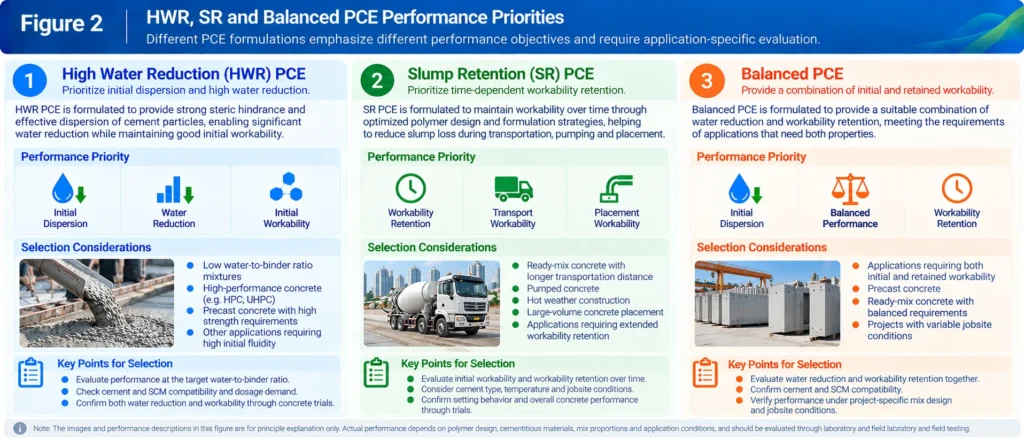
High Water Reduction (HWR) PCE is formulated with particular emphasis on dispersing efficiency and reducing the amount of mixing water required to achieve a specified consistency.
Under controlled conditions, an effective HWR formulation may produce greater initial fluidity at the same water content.
Alternatively, a mixture may be designed with less water while maintaining the specified consistency.
These outcomes are related but must be evaluated using appropriate methods.
The use of a lower water-to-binder ratio may support strength and durability objectives, provided that the complete concrete mixture, consolidation and curing are properly controlled.
However, HWR PCE is not inherently limited to short-term dispersion. Some formulations also deliver useful workability retention.
Slump Retention PCE
Slump Retention (SR) PCE is designed with particular attention to maintaining acceptable workability over a defined period.
This performance is important when fresh concrete must remain suitable for transportation, pumping, handling or placement.
A retention-oriented formulation can also provide significant initial dispersion and water-reducing capability.
Therefore, slump-retention PCE should not be interpreted as a superplasticizer with inherently low water-reducing performance.
Balanced PCE
Balanced PCE aims to provide a suitable combination of initial fluidity and retained workability.
Its objective is not necessarily to maximize either property individually, but to satisfy a defined set of performance requirements.
A balanced formulation may be appropriate where both initial consistency and a specified working period are important.
Nevertheless, suitability must be confirmed through testing rather than inferred from the product designation.
Performance Categories and Standards Classification
HWR, SR and Balanced are useful commercial descriptions of intended performance.
They should not automatically be treated as formal classifications under a particular admixture standard.
For example, ASTM C494/C494M distinguishes Type F high-range water-reducing admixtures from Type G high-range water-reducing and retarding admixtures.
Slump retention is not the same as setting retardation.
A product designed for workability retention is not necessarily a retarding admixture. Formal compliance requires testing against the applicable standard. [3]
How PCE Molecular Design Influences Performance
PCE superplasticizers commonly have comb-shaped polymer structures consisting of a backbone containing adsorption-related functional groups and side chains that contribute to steric stabilization.
Important molecular characteristics include anchoring-group chemistry, charge density, backbone structure, side-chain length, grafting density and molecular conformation.
These properties influence polymer adsorption and dispersing behavior, but their effects depend on the cementitious environment.
Anchoring Groups and Cement Surface Interaction
Carboxylate and other adsorption-related functional groups can influence how PCE molecules interact with reactive cementitious surfaces.
Their type, density and distribution affect adsorption behavior and the availability of polymer at particle surfaces.
However, greater adsorption does not necessarily produce proportionally greater dispersion.
The configuration of adsorbed molecules and their ability to provide effective steric stabilization are also important.
Polyether Side Chains and Steric Stabilization
Polyether side chains influence the spatial configuration of adsorbed PCE molecules.
By contributing to steric stabilization, these side chains help reduce particle association and support dispersion.
Side-chain length and grafting density can affect flowability and rheological behavior, but their optimum combination varies with polymer architecture and cement chemistry.
A structural change that improves performance in one system may not deliver the same benefit in another.
Molecular Strategies for Workability Retention
As cement hydrates, reactive surfaces, pore solution composition and polymer–particle interactions evolve.
Some PCE technologies use molecular designs or formulation strategies intended to sustain an effective dispersing response over time.
However, different slump-retention products may rely on different mechanisms.
It would be inaccurate to assume that every SR formulation has a particular molecular structure or follows a universal delayed-adsorption mechanism.
Structure–Performance Relationships Are System-Dependent
Scientific reviews have examined how PCE architecture, anchoring groups, main chains and side chains influence adsorption and cementitious material performance. [1, 2]
Nevertheless, polymer design alone cannot predict concrete behavior independently of cement mineralogy, sulfate availability, supplementary cementitious materials and mixing conditions.
The performance of a PCE formulation must be evaluated in the cementitious system where it will be used.
For more detail on the influence of cement chemistry, see our separate Technical Knowledge article on why PCE performance varies with cement chemistry.
Initial Dispersion, Water Reduction and Workability Retention
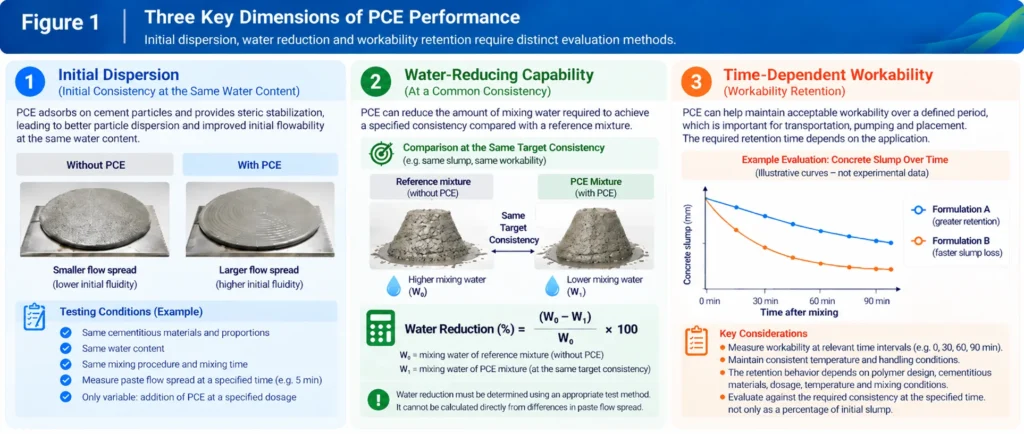
Three measurements are particularly important when comparing HWR and SR PCE: initial flowability, water-reducing capability and time-dependent workability.
Although related, they answer different technical questions.
Initial Flowability
Initial flowability describes the consistency or flow response of a fresh mixture at a defined measurement time.
At constant water content, differences in cement paste spread or concrete consistency may indicate different initial dispersing responses.
However, a greater flow spread does not directly establish a higher standardized water-reduction rate.
Water-Reducing Capability
Water reduction is evaluated by comparing the mixing-water requirement of an admixture-containing concrete mixture with an appropriate reference mixture at a specified consistency.
The simplified calculation is:
Water Reduction (%) = [(Reference Water − Test Water) / Reference Water] × 100
This expression must be applied within an appropriate testing procedure.
It cannot be used to convert differences in cement paste flow diameter into concrete water-reduction percentages.
Workability Retention
Workability retention describes the change in fresh-concrete consistency over a specified period.
Measurements may be made initially and at intervals relevant to the application.
For example, 30-, 60- and 90-minute measurements may be useful for some ready-mix concrete evaluations. They are not universal requirements for every mixture.
Temperature, storage conditions, remixing procedures and any subsequent water or admixture addition must be clearly controlled or recorded.
Why Initial Flow and Retained Workability Must Be Evaluated Separately
Two formulations may achieve the same initial slump but show substantially different consistencies after transportation.
Likewise, a formulation may retain a large percentage of its initial slump while still failing to meet the minimum consistency required for placement.
Therefore, retention performance should be evaluated against the required consistency at the specified operating time, not solely as a percentage of the initial measurement.
A suitable PCE must meet both the initial consistency requirement and the required working window.
HWR vs. SR vs. Balanced PCE: Key Performance Differences
The main distinction between HWR, SR and Balanced PCE is their formulation priority rather than an absolute difference in capability.
Performance Comparison
| Evaluation Factor | HWR Type | SR Type | Balanced Type |
|---|---|---|---|
| Primary design objective | Initial dispersion and water reduction | Retained workability | Combined initial and retained performance |
| Initial fluidity | Important target | Formulation-dependent | Important target |
| Water reduction | Principal optimization target | May also be substantial | Formulation-dependent |
| Workability retention | Requires verification | Principal optimization target | Important target |
| Cement compatibility | Must be tested | Must be tested | Must be tested |
| Dosage efficiency | Test-dependent | Test-dependent | Test-dependent |
| Overall suitability | Application-dependent | Application-dependent | Application-dependent |
These descriptions represent general performance objectives, not measured rankings or guaranteed properties of individual commercial grades.
Common Misconceptions
Misconception 1: HWR PCE cannot retain slump.
HWR formulations may also provide effective workability retention. The result depends on polymer chemistry, formulation and operating conditions.
Misconception 2: SR PCE provides little water reduction.
Retention-oriented PCE may also provide substantial water reduction. Its designation describes a performance priority rather than a limitation of dispersing capability.
Misconception 3: Balanced PCE is always the best compromise.
A Balanced formulation is appropriate only when its tested behavior meets the complete concrete specification. In some systems, a specialized grade may be more suitable.
Why There Is No Universally Superior Type
A formulation providing very high initial fluidity may not satisfy a long transportation window.
A formulation with extended retention may not be the most efficient choice where rapid production requires a short handling period.
A balanced formulation may satisfy both requirements, but this must be demonstrated through controlled testing.
The most useful comparison therefore focuses on the complete performance requirement rather than the product category alone.
Why High Water Reduction and Slump Retention PCE Are Sometimes Blended
In some concrete admixture formulations, different PCE grades may be combined to meet both initial and time-dependent workability requirements.
Blending is one possible formulation strategy, not a universal requirement.
When Blending May Be Considered
A formulation may provide satisfactory initial dispersion but insufficient workability retention for the intended transportation or placement period.
Conversely, another formulation may maintain consistency effectively but require additional optimization to reach the initial workability target at an acceptable dosage.
In such cases, blending compatible formulations may be evaluated.
However, a suitable single-grade or balanced PCE may already satisfy the complete performance specification.
Why Blending Results Are Not Always Predictable
Polymer mixtures do not necessarily produce a linear combination of their individual properties.
The final response may depend on differences in polymer architecture, adsorption behavior, competition for reactive surfaces and interactions with other formulation components.
An increase in one performance characteristic may also affect another.
Therefore, a particular HWR/SR blending ratio should not be assumed to provide an optimal result without experimental verification.
Dosage and Concentration Considerations
When blending liquid PCE formulations, proportions should use a consistent and clearly stated dosage basis.
Equal masses of solutions with different solids concentrations do not contribute equal masses of total nonvolatile solids.
Furthermore, total solids content does not necessarily equal the amount of active PCE polymer.
Where the relevant information is available, formulation records should distinguish supplied-product dosage, total solids and active polymer content.
Verification of Blended Systems
Blended formulations should be evaluated for initial flow, retained workability, mixture stability, air content, setting behavior and relevant hardened-concrete properties.
The appropriate blend is the one that meets the defined performance requirements without introducing unacceptable trade-offs.
PCE blending is a controlled optimization process, not a guaranteed solution to slump loss.
Selecting PCE by Performance Type and Product Form
PCE performance category and physical supply form are two separate selection dimensions.
HWR, SR and Balanced describe the intended performance characteristics of a formulation.
Powder, Flake and Liquid describe the form in which the product is supplied and handled.
A particular performance direction may be available in multiple forms, depending on the manufacturer's product portfolio.
Understanding the Two Classification Dimensions
| Performance Priority | Powder | Flake | Liquid |
|---|---|---|---|
| High Water Reduction | Possible | Possible | Possible |
| Slump Retention | Possible | Possible | Possible |
| Balanced Performance | Formulation-dependent | Formulation-dependent | Formulation-dependent |
This table illustrates the relationship between performance type and supply form. It does not imply that every manufacturer offers every combination.
PCE Powder
PCE powder is suitable for formulations and production systems where a dry admixture is preferred.
It may be used in appropriate dry-mix products or prepared for use in other cementitious systems according to the formulation and handling requirements.
Its water-reducing and retention performance depends on polymer chemistry and product design rather than powder form alone.
PCE Flake
PCE flake is a concentrated solid supply form that can be considered for transportation and on-site preparation of liquid PCE solutions.
Performance depends on the selected polymer grade and the resulting formulation.
Dissolution procedures, solution concentration, storage stability and preparation conditions must be controlled.
A high-solids flake product is not automatically more effective than another PCE form on an equal active-polymer dosage basis.
PCE Liquid
Liquid PCE is widely used in concrete production systems requiring liquid storage, pumping, metering or admixture blending.
Liquid formulations may be developed for high water reduction, slump retention or balanced performance.
Their stated solids contents describe the concentration of nonvolatile material in the supplied product, not their guaranteed effectiveness.
Does Higher Solids Content Mean Better PCE Performance?
Not necessarily.
A liquid PCE with 50% nominal solids contains more total nonvolatile material per unit supplied mass than a comparable product with 40% nominal solids.
However, the products may also differ in polymer structure, active polymer concentration or formulation additives.
Equal supplied-product mass, equal total-solids mass and equal active-polymer mass are not necessarily equivalent comparison conditions.
A meaningful performance comparison requires a defined dosage basis and controlled testing with the same cementitious materials.
Application-Based PCE Selection
| Concrete Production Requirement | Initial Performance Direction to Evaluate | Critical Verification |
|---|---|---|
| High initial fluidity at low W/B | HWR | Viscosity, mixture stability and retained workability |
| Extended transportation or placement time | SR | Initial consistency, setting and retention |
| Combined initial and retained workability | Balanced or validated blending approach | Both performance targets under actual conditions |
| Rapid precast production | HWR or application-specific early-strength technology | Setting, early-age strength and production cycle |
| Hot-weather ready-mix delivery | SR or Balanced | Retention at representative concrete temperature |
| Pumped concrete | Performance type determined by mixture needs | Cohesion, pumpability, air content and retained workability |
These recommendations are preliminary screening directions, not fixed application assignments.
The same concrete application may require a different formulation when cement source, mixture proportions or temperature changes.
Practical Selection Principle
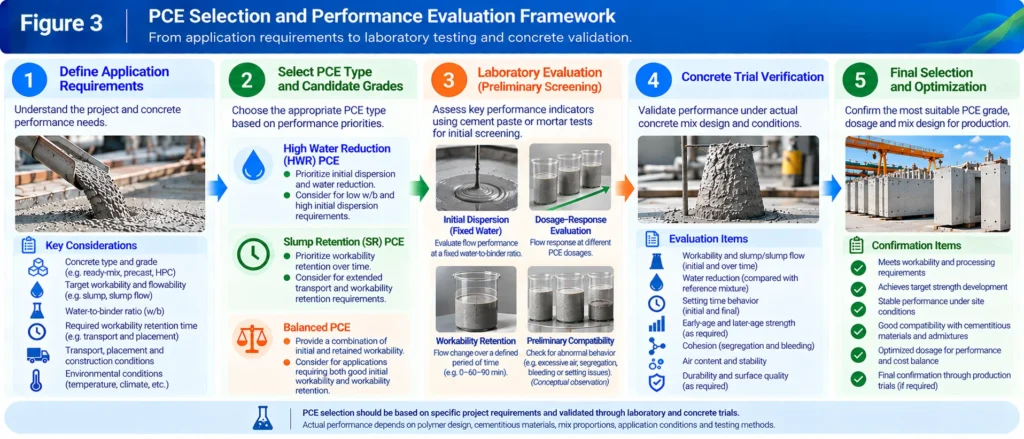
Begin by defining the performance requirements rather than selecting a supply form or commercial grade first.
Determine the required initial consistency, water-reduction objective, handling period and additional concrete properties.
Then identify candidate PCE performance types and select the supply form appropriate to the production system.
Final selection should be confirmed through controlled concrete trials.
Related PCE Products and Technical Support
POLYVIA™ supplies PCE superplasticizer formulations in selected powder, flake and liquid grades for different concrete performance requirements.
For available grades, product specifications and application support, explore the Polycarboxylate Ether (PCE) Product Portfolio.
How to Evaluate HWR and SR PCE in Laboratory and Concrete Trials
A reliable PCE comparison requires a clearly defined test objective and consistent operating conditions.
Initial dispersion, water reduction and retained workability should be evaluated separately before considering overall concrete suitability.
Step 1 — Define the Required Performance
Before testing, establish:
- Target initial slump or slump flow.
- Minimum acceptable workability at the required placement time.
- Water-to-binder ratio or water-reduction target.
- Expected concrete temperature.
- Mixing, storage and transportation conditions.
- Air content, stability, setting and strength requirements.
These criteria establish what constitutes an acceptable result.
Step 2 — Evaluate Initial Dispersion
Use consistent cementitious materials, water content and mixing procedures to compare the initial flow responses of candidate admixtures.
A dosage–response evaluation can be more informative than testing one arbitrary dosage.
Paste or mortar screening may help identify suitable candidates, but the results should not be treated as direct measurements of concrete water reduction.
Step 3 — Determine Water Reduction at a Common Consistency
Use an appropriate reference mixture and evaluate the mixing-water requirement needed to achieve the specified consistency.
Apply the relevant test procedure and calculate the water reduction on the prescribed basis.
A difference in cement paste flow spread should not be used as a substitute for a standardized water-reduction measurement.
Step 4 — Measure Time-Dependent Workability
Measure concrete consistency at intervals matching the intended working period.
Apply the same timing, temperature and handling procedure to the candidate formulations.
Record actual consistency values as well as any relevant retention indicators.
A favorable retention percentage is insufficient if the mixture no longer meets the minimum placement requirement.
Step 5 — Verify the Complete Concrete Performance
Final selection should be based on the actual concrete system.
Depending on the application, verification may include mixture stability, air content, setting time, strength development, pumpability and relevant durability requirements.
Interpreting Common Trial Results
| Trial Observation | Technical Interpretation | Recommended Next Evaluation |
|---|---|---|
| Initial flow meets target but later flow is insufficient | Retention does not meet the required working period | Evaluate retention-oriented formulations and compatibility |
| Retention appears satisfactory but initial flow is inadequate | Initial dispersing performance needs improvement | Assess dosage response or alternative grades |
| Initial and retained consistency both meet targets | Candidate may be suitable | Verify setting, stability, air content and strength |
| Increased flow causes segregation or bleeding | Flow improvement has introduced a stability problem | Reassess mixture balance and admixture selection |
| Different cements give different responses | Cement–PCE compatibility may influence behavior | Conduct controlled cement-source comparisons |
| Additional dosage provides little improvement | Diminishing response may be occurring | Review dosage–response behavior and other mix variables |
Why Actual Materials Matter
Cement mineralogy, fineness, sulfate availability, supplementary cementitious materials and aggregate characteristics can affect admixture performance.
Consequently, a result obtained with one concrete mixture should not automatically be applied to another.
Where possible, validation should use the materials, proportions and production conditions intended for the actual project.
Standards and Test Reporting
ASTM C494/C494M provides requirements and test methods for specified chemical admixture classifications, including high-range water-reducing admixtures. [3]
Commercial performance descriptions such as HWR, SR and Balanced do not independently establish compliance.
A meaningful comparison report should document the exact admixture identity, dosage basis, cement source, mixture proportions, temperature, measurement timing and test method.
Key Technical Conclusions
High water reduction and slump retention represent different but overlapping objectives in PCE superplasticizer technology.
High Water Reduction PCE prioritizes initial dispersion and water-reducing capability.
Slump Retention PCE emphasizes maintaining suitable workability over a defined period.
Balanced PCE aims to satisfy a combination of initial and time-dependent performance requirements.
These categories do not establish universal performance rankings, specific molecular structures or standards compliance.
Physical supply form and nominal solids content should be considered separately from performance type.
The most reliable selection process begins with measurable concrete requirements and uses controlled trials to verify the response of the complete mixture.
The preferred PCE formulation is not necessarily the one with the highest initial flow or longest retention time, but the one that satisfies all essential concrete performance requirements under the intended production conditions.
Frequently Asked Questions
1. What is the difference between high water reduction and slump retention PCE?
High-water-reduction PCE emphasizes initial dispersion and water-reducing capability, while slump-retention PCE emphasizes maintaining suitable workability over time. These are different formulation priorities rather than mutually exclusive properties.
2. Can high water reduction PCE also provide slump retention?
Yes. An HWR formulation can also provide useful workability retention. The actual result depends on polymer design, dosage, cementitious materials, temperature and mixing conditions.
3. Does slump retention PCE also reduce mixing water?
Yes. A retention-oriented PCE may also provide substantial water-reducing capability. Water reduction must be determined using an appropriate reference mixture and testing procedure.
4. When should balanced-type PCE be selected?
Balanced PCE may be considered when both initial consistency and workability retention are important. Its suitability should be confirmed through controlled tests that reflect the actual production conditions.
5. Can high water reduction and slump retention PCE be blended?
Yes. Compatible formulations may be blended to optimize initial and retained workability. However, the resulting behavior is not necessarily additive, and performance must be verified experimentally.
6. Are HWR and SR PCE available in powder, flake and liquid forms?
Yes. High-water-reduction and slump-retention formulations may be supplied in different physical forms. Availability depends on the manufacturer. The supply form affects handling and formulation requirements but does not independently define performance.
7. Does 50% solids PCE liquid perform better than 40% solids PCE?
Not necessarily. Solids content describes the concentration of nonvolatile material in the supplied liquid, not a guaranteed level of water reduction or slump retention. Comparisons should use a clear dosage basis and controlled testing conditions.
8. How should HWR, SR and Balanced PCE be compared in concrete trials?
Define the initial consistency, required working period and overall concrete performance targets. Evaluate initial dispersion, water reduction and retained workability separately, then verify stability, setting and relevant hardened-concrete properties using the intended materials.
Scientific References & Further Reading
[1] Sha, S., Wang, M., Shi, C., & Xiao, Y. (2020). Influence of the structures of polycarboxylate superplasticizer on its performance in cement-based materials—A review. Construction and Building Materials, 233, 117257. DOI: 10.1016/j.conbuildmat.2019.117257.
[2] Progress in the polycarboxylate superplasticizer and their structure-activity relationship—A review. (2023). Materials Today Communications, 35, 105838. DOI: 10.1016/j.mtcomm.2023.105838.
[3] ASTM International. (2024). ASTM C494/C494M-24: Standard Specification for Chemical Admixtures for Concrete. DOI: 10.1520/C0494_C0494M-24.