
How to Troubleshoot Uneven Concrete Distribution During PHC Spun Pile Centrifugal Forming
A Practical Guide to Diagnosing Concrete Placement Problems, Mixture Instability and Centrifugal-Forming Defects
Uneven concrete distribution in PHC spun piles may originate during mold preparation, concrete feeding or centrifugal forming. This technical guide explains how to identify the observed defect, investigate material and process variables, conduct controlled troubleshooting trials and verify corrective actions against finished-pile quality requirements.
Identify the Defect Before Changing the Mix
Uneven concrete distribution during prestressed high-strength concrete (PHC) spun pile production is an observation, not a diagnosis.
An irregularity may originate during concrete feeding, develop during centrifugal forming or become visible only after demolding. Different defects can appear similar while requiring different investigations.
Changing the PCE dosage before identifying the problem may obscure the original cause and introduce new variables.
The investigation should begin with three questions:
- What condition has actually been observed?
- Where and when did it first become apparent?
- Which production records or measurements can distinguish the possible causes?
1. Distinguish the Different Conditions
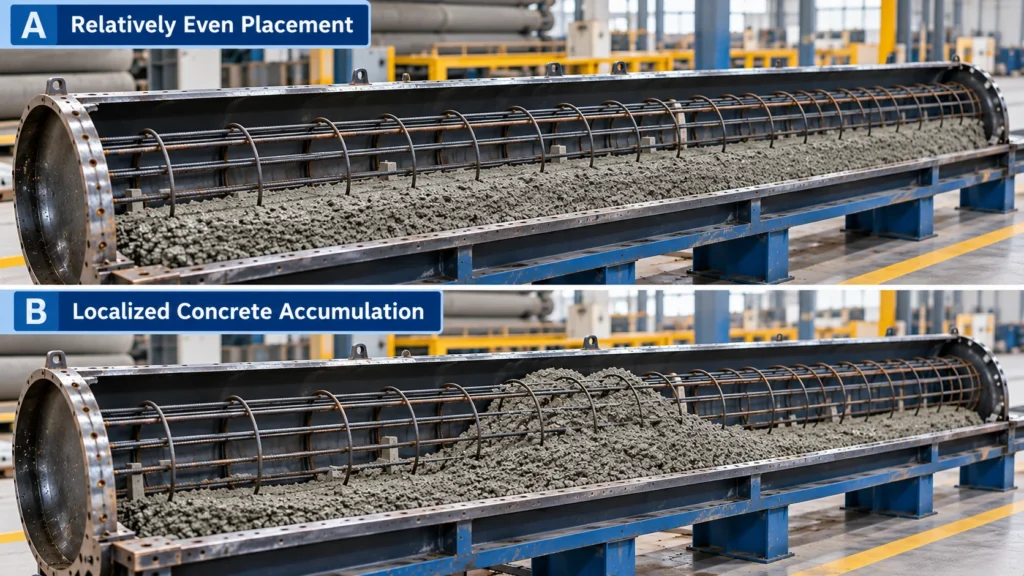
Uneven placement before spinning
Concrete is not distributed as intended along the open longitudinal steel mold. This is a placement observation and does not, by itself, establish segregation.
Visible defects after demolding
Honeycombing, exposed aggregate, local surface irregularities or other visible defects require inspection of the affected area and the associated production records.
Dimensional deviations
Wall-thickness variations, straightness deviations or other dimensional irregularities must be assessed using the applicable measurement methods and acceptance requirements.
Radial material variation
Centrifugally formed PHC concrete may exhibit variations in material composition and microstructure across the pile wall. These variations should not automatically be classified as defects. Their significance depends on the properties of the finished product and the applicable specification [1].
2. Identify the Earliest Observable Stage
Separate the investigation into three stages.
Before centrifugal forming: Examine mold preparation, reinforcement position, concrete quantity and longitudinal placement.
During forming: Review the approved spinning procedure, equipment operation and available process records.
After demolding: Inspect the finished pile, record the location of the defect and compare the measurements with relevant acceptance criteria.
A defect observed after demolding does not prove that it originated during centrifugal forming.
3. Establish a Reference Condition
Document the affected batch and compare it with satisfactory production records where available.
Record the mold identification, raw-material sources, mix design, actual batching quantities, fresh-concrete results, mixing-to-forming interval and relevant equipment settings.
The objective is to identify meaningful differences between the affected and reference conditions.
Where changes in effective water content or PCE performance are suspected, the relationship between water reduction and low water–binder-ratio concrete is discussed in our technical guide to PCE water reduction in PHC spun piles.
POLYVIA™ principle: establish the observation and the reference condition before assigning a cause.
Check Mold Preparation and Concrete Feeding
When uneven distribution is visible before spinning, begin with the mold and feeding process.
In a typical longitudinal production arrangement, the reinforcement cage is positioned inside an open steel mold. Concrete is distributed along the mold before closure and centrifugal forming.
The exact procedure depends on the plant's equipment and approved manufacturing instructions.
1. Inspect the Mold and Reinforcement Arrangement
Check the mold and relevant components against the approved setup.
The inspection should cover:
- Mold condition, cleanliness and assembly.
- Geometry and any visible damage.
- Reinforcement-cage positioning.
- Specified spacers and support arrangements.
- Potential obstructions to concrete placement.
- Closure conditions where relevant.
A defect that repeatedly appears in the same location on one mold warrants closer equipment inspection.
However, recurrence at a particular location is evidence for investigation—not proof of a specific cause.
2. Observe the Concrete Feeding Operation
Examine how concrete is delivered and distributed along the open mold.
Record whether the intended quantity reaches the relevant positions and whether the material can be placed around the reinforcement arrangement.
Look for local accumulation, incomplete distribution, inconsistent feeding or a change in workability during placement.
Where practical, compare affected and satisfactory feeding operations using the same observation and recording procedure.
3. Separate Placement Irregularity from Segregation
Uneven placement and segregation are not synonymous.
Uneven placement concerns the initial distribution of concrete within the mold.
Segregation concerns undesirable separation or redistribution of the concrete's constituents.
Concrete may be placed unevenly without showing visible segregation. Equally, a uniformly filled mold does not guarantee that its constituents will remain uniformly distributed during centrifugal forming.
Recognizing the distinction prevents inappropriate formulation changes.
4. Use the Defect Pattern to Set Priorities
| Observation | Initial Priority | Evidence to Collect |
|---|---|---|
| Distribution is uneven before spinning | Feeding and mold preparation | Placement observations and feed records |
| Similar defect follows one mold | Mold condition and assembly | Mold inspection and dimensional measurements |
| Several molds are affected by one batch | Batching and fresh-concrete behavior | Batch records and concrete tests |
| Defect becomes apparent only after forming | Forming process and product condition | Spinning records and finished-pile inspection |
The table identifies where to investigate first. It does not establish a cause without additional evidence.
If the initial concrete distribution is already abnormal, verify feeding and mold conditions before attempting to correct the problem through PCE dosage.
Evaluate Fresh-Concrete Workability and Stability
If mold preparation and feeding appear satisfactory, investigate whether the fresh concrete is suitable for the intended production process.
The goal is not maximum fluidity. It is consistent handling and adequate mixture stability throughout the relevant production interval.
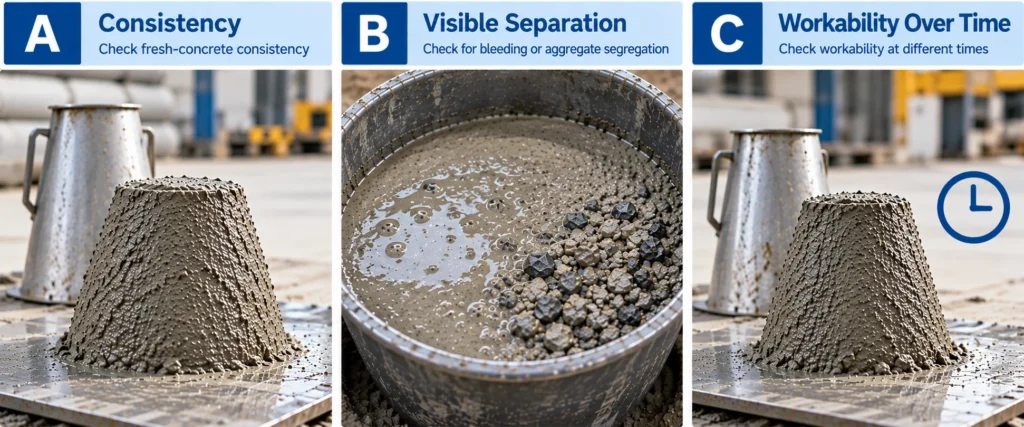
1. Compare Consistency with the Reference
Measure slump, slump flow or another specified consistency property using the plant's approved test method.
Record fresh-concrete temperature, time since mixing and relevant handling conditions.
Compare the results with the approved production range and satisfactory historical batches.
A change in consistency identifies a difference that requires investigation. It does not establish what caused it.
2. Check for Bleeding or Separation
Record observable water separation, paste accumulation, coarse-aggregate separation or other signs of instability.
Identify where and when these conditions occur.
A stationary mixture and the same mixture undergoing centrifugal forming experience different mechanical conditions. Observations from one stage cannot automatically predict behavior at another.
Visible separation may justify further investigation of water content, grading, paste characteristics or admixture compatibility.
It does not independently prove excessive PCE dosage.
3. Evaluate the Handling Interval
If workability becomes unsuitable after a production delay, measure fresh-concrete behavior at representative elapsed times.
Keep the testing method consistent.
Review whether cementitious materials, temperature, mixing conditions or admixture preparation changed during the affected period.
Where liquid PCE admixtures are used, differences in water-reduction and slump-retention performance may also warrant investigation. The selection of appropriate PCE liquid grades should be based on compatibility testing and the actual production requirements.
This helps distinguish initial consistency problems from time-dependent workability changes.
4. Decide Whether Additional Testing Is Needed
Where conventional consistency and stability checks do not explain the observed production behavior, further rheological testing may help identify differences in mixture response.
Such testing should address a defined diagnostic question and use documented measurement conditions.
Its findings should be evaluated alongside mold-placement observations and actual centrifugal-forming results.
Additional testing is valuable when it helps distinguish competing explanations—not simply because more data can be collected.
Review the Centrifugal-Forming Procedure
When concrete placement is acceptable but irregularities become apparent after forming, examine the approved centrifugal-forming process.
During this operation, the closed steel mold rotates according to a defined production program. Concrete movement and compaction are affected by the imposed rotational conditions and the fresh mixture's properties.
A manufacturing problem should not be corrected by arbitrarily increasing rotational speed or spinning duration.
1. Verify Process Compliance
Review the actual production records.
Relevant checks may include:
- Rotational speed history.
- Duration of each forming stage.
- Mold identification and condition.
- Initial concrete quantity and distribution.
- Equipment interruptions or unusual operating behavior.
- Deviations from the approved procedure.
Determine whether the process remained within the plant's accepted operating limits.
2. Compare Affected and Satisfactory Production
Investigate whether the defect is linked to a particular mold, material batch, time interval or process condition.
If the same defect repeatedly follows one mold, examine the associated equipment and preparation.
If different molds show similar defects when processing the same concrete batch, investigate the mixture and batching records.
If the problem began after a recorded process deviation, review that deviation before changing the concrete formulation.
These comparisons can narrow the investigation, although correlation alone does not establish causation.
3. Interpret Radial Material Variation Carefully
Centrifugal forming can influence the distribution of paste, aggregate, water and pore structure across the concrete wall.
Published research has documented radial microstructural differences in actual PHC pipe pile material [1].
Such results demonstrate that centrifugally formed concrete should not automatically be assumed to be homogeneous throughout its wall thickness.
However, the existence of radial differences does not establish that a pile is defective.
Their significance depends on the extent of the variation and the applicable dimensional, mechanical and durability requirements.
4. Inspect the Characteristic Associated with the Defect
Select the inspection based on the actual observed condition.
Relevant measurements may include wall thickness, straightness, inner or outer surface irregularities, visible material separation and other specified product properties.
Where an internal defect is suspected, additional examination may be appropriate.
Do not use one generic inspection method to diagnose every forming problem.
5. Determine Whether the Process or Mixture Requires Further Investigation
If the approved forming procedure was not followed, investigate the deviation through the plant's technical review process.
If forming conditions were controlled but a particular concrete mixture repeatedly produces abnormal results, investigate its fresh properties, raw materials and mix design.
Both process and mixture variables may contribute.
Use production evidence to identify the next investigation. Do not treat changes in spinning speed or admixture dosage as universal remedies.
Investigate Mix Design and Material Changes
If the initial checks do not reveal the cause, examine whether the concrete materials or batching conditions have changed.
Even when the nominal mix design remains unchanged, variations in aggregate moisture, grading, binder properties or admixture preparation can alter fresh-concrete behavior.
1. Aggregate Grading and Moisture
Compare current aggregate test records with the reference production condition.
Changes in particle-size distribution, fines content, aggregate source or moisture may affect workability and mixture stability.
Verify whether the moisture corrections used during batching were appropriate.
2. Effective Water Content
Review actual batching water, aggregate moisture corrections and water contributed by liquid admixtures according to the plant's approved calculation procedure.
Do not confuse nominal added water with effective mixing water.
A change in effective water content may influence consistency and stability, but the effect must be evaluated alongside the other mixture variables.
Avoid adding water solely to make placement easier without assessing the implications for the approved mix design.
3. Binder Characteristics and Cement–PCE Compatibility
If the problem began after a cement change or a change in supplementary cementitious materials, review the relevant material properties.
Cement fineness, sulfate balance and binder composition can influence PCE response and time-dependent workability.
Where appropriate, conduct controlled compatibility comparisons using representative materials.
Do not attribute changed concrete behavior to the admixture alone when the binder system has also changed.
4. PCE Identity, Dosage and Preparation
Verify the actual admixture grade, batching records, dosage basis and preparation procedure. The available forms and technical characteristics of PCE superplasticizers should be considered when selecting a product for controlled evaluation.
For POLYVIA™ PCE powders, two relevant preparation distinctions are:
PCE ES980: A coarse powder that must first be dissolved in water before use.
PCE PW888: A fine powder suitable for direct dry blending before water addition.
The two preparation methods should not be treated as interchangeable.
If a PCE-related issue is suspected, compare formulations under controlled conditions using representative cementitious materials and concrete mixtures.
A change in PCE grade should be evaluated for placement, stability, forming behavior and finished-product quality—not solely for initial flow.
5. Other Admixtures and Mixing Conditions
Where other chemical admixtures are used, review their dosage, compatibility and addition sequence.
Check batching accuracy, mixing procedure and the elapsed time between mixing and forming.
When several variables have changed simultaneously, reconstruct the sequence of changes before selecting a corrective trial.
6. Evidence-Based Investigation Matrix
| Suspected Variable | Evidence | Next Step |
|---|---|---|
| Aggregate grading | Current and reference test results | Verify grading suitability |
| Aggregate moisture | Moisture measurements and corrections | Recalculate effective water |
| PCE dosage | Batching records and calibration | Confirm actual dosage |
| PCE preparation | Mixing and preparation records | Verify grade-specific procedure |
| Binder change | Material records and compatibility results | Controlled comparison |
| Production delay | Consistency at defined time intervals | Evaluate handling-window behavior |
| Multiple simultaneous changes | Production chronology | Isolate relevant variables |
Each entry identifies an investigation priority, not a proven cause.
Make a formulation change only when the available evidence justifies testing that change.
Conduct Controlled Troubleshooting Trials
When routine inspection does not establish the cause, controlled trials are needed to distinguish between competing explanations.
The purpose is to test a defined hypothesis and determine whether a proposed correction addresses the observed problem without creating unacceptable effects elsewhere.
1. Establish the Reference
Select a representative mixture and production procedure that meet the applicable requirements.
Document the binder, aggregate system, effective water content, PCE formulation, dosage basis, relevant fresh-concrete properties and approved forming procedure.
The reference provides the comparison condition for the trial.
2. Define the Observed Problem and Acceptance Criteria
Specify exactly what is being evaluated.
An uneven placement problem requires evidence about concrete distribution before forming.
Visible bleeding requires an appropriate assessment of fresh-mixture stability.
A defect appearing after spinning requires examination of the forming process and finished pile.
A problem beginning after a material change requires a controlled comparison involving that material.
The trial should be designed around the observed problem, not around whichever test is easiest to perform.
3. Control the Variables
Where practical, change one principal variable at a time.
If multiple variables must change, document them and adopt an experimental design that allows their effects to be interpreted.
Examples include:
- Evaluating PCE dosage while controlling other relevant mixture variables.
- Comparing aggregate grading under defined formulation conditions.
- Measuring consistency at specified elapsed times.
- Reviewing forming-related effects under an approved technical trial procedure.
Do not simultaneously change water content, admixture dosage and centrifugal-forming settings without an appropriate controlled plan.
4. Use the Correct Comparison Basis
The appropriate comparison depends on the question.
Water-reduction assessment: Compare effective water demand at a defined target consistency.
Rheological assessment: Compare selected fresh-concrete properties while controlling the relevant mixture variables.
Stability assessment: Use suitable fresh-state testing and representative handling observations.
Forming assessment: Evaluate production behavior and inspect the resulting pile under the applicable acceptance criteria.
These assessments answer different questions.
A result from one comparison cannot automatically substitute for the others.
5. Document Trial Conditions
Each trial should have traceable records covering:
- Mix identification and batch information.
- Actual material quantities and effective water.
- PCE grade, dosage and preparation.
- Fresh-concrete test conditions and results.
- Mixing-to-placement interval.
- Mold-feeding observations.
- Relevant forming records.
- Finished-pile inspection and test results.
Without comparable records, an apparent improvement may be difficult to reproduce or attribute to the proposed correction.
6. Confirm Repeatability
A single favorable trial does not establish routine production suitability.
Repeat the relevant evaluation using representative materials and operating conditions.
The required number of trials and the acceptance limits should follow the plant's approved technical and quality-control procedures.
7. Corrective-Action Decision Matrix
| Finding | Investigation or Correction Direction | Verification |
|---|---|---|
| Placement irregularity exists before spinning | Review feeding and mold preparation | Controlled placement observation |
| Bleeding or separation is observed | Examine water, grading and mixture stability | Fresh-concrete tests |
| Problem follows a material change | Investigate changed material and compatibility | Controlled trial mixes |
| Problem follows a process deviation | Review equipment and approved forming procedure | Production records and approved process trial |
| PCE change improves fresh behavior | Assess forming and finished-product quality | Representative production verification |
| Cause remains unresolved | Expand targeted investigation | Additional testing or specialist review |
This is a proposed engineering troubleshooting framework. It is not a record of POLYVIA™ experimental results.
8. Interpreting the Results
A corrective trial may improve one production characteristic while adversely affecting another.
For example, improved mold-feeding consistency does not establish that centrifugal-forming stability or finished-pile strength has also improved.
A proposed correction should therefore be evaluated against the original problem and all relevant product acceptance requirements.
Where the evidence remains inconclusive, the appropriate decision is to continue the investigation—not to declare the problem resolved.
A useful correction must solve the identified problem without compromising the required finished-product performance.
Verify Finished-Pile Quality
A corrective action should not be considered successful solely because the finished pile looks more uniform.
The product must satisfy the relevant acceptance requirements for dimensions, material performance and other specified properties.
1. Inspect the Original Defect
Select the appropriate inspection method for the condition initially observed.
Depending on the specification, this may include wall-thickness measurements, straightness, inner and outer surface condition or other specified dimensions.
Use the applicable measurement procedures and acceptance criteria.
2. Complete Required Strength Testing
Where the problem or proposed correction may influence hardened-concrete properties, perform the required strength testing.
The specimen type, test method, curing conditions and acceptance criteria should correspond to the property being evaluated.
Research comparing centrifuged and conventionally vibrated concrete specimens has identified meaningful differences in mechanical response under the investigated conditions [2].
Consequently, results from conventional specimens should not automatically be assumed to characterize every aspect of actual centrifuged PHC concrete.
3. Investigate Suspected Internal Defects
If external observations suggest an internal defect, select an examination method appropriate to the suspected condition and its potential significance.
Specialist investigation may be appropriate where product integrity is uncertain.
Do not infer the precise internal material structure from surface appearance alone.
4. Reassess the Corrective Change
Compare the corrective trial with the reference condition and original defect records.
Verify both that the identified problem has improved and that the change has not introduced other unacceptable conditions.
5. Establish Ongoing Production Checks
Once the correction has been approved, continue monitoring the relevant production indicators.
The applicable product specification and the plant's quality-control system should determine sampling, monitoring and acceptance requirements.
A visible improvement is not the same as verified compliance.
POLYVIA™ Practical Troubleshooting Framework
For PHC spun pile production, the most useful troubleshooting process begins with observable evidence and ends with a verified production decision.
POLYVIA™ organizes this approach into six steps:
Observe → Localize → Investigate → Verify → Correct → Recheck
This is a practical diagnostic framework for organizing engineering decisions. It is not an industry standard or a separately validated proprietary test method.
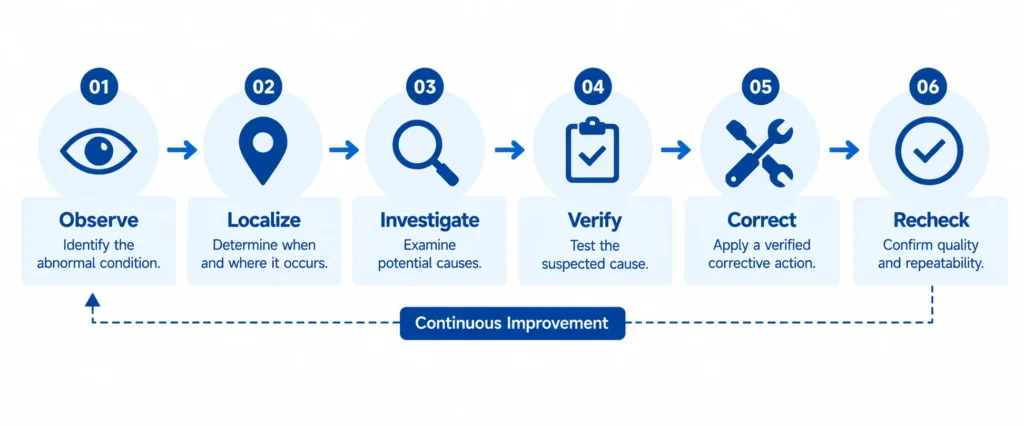
1. Observe
Document the abnormal condition precisely.
Record its location, appearance, frequency and the stage at which it first becomes apparent.
Avoid describing every visible irregularity simply as segregation.
2. Localize
Identify the most relevant manufacturing stage.
Determine whether the observation points first toward mold preparation, concrete feeding, centrifugal forming or finished-product inspection.
Use batch and equipment records to identify recurring patterns.
3. Investigate
Review the possible causes indicated by the evidence.
These may include feeding procedure, mold condition, material changes, fresh-concrete properties, PCE preparation or forming-process deviations.
Prioritize the most plausible explanations without prematurely excluding other contributors.
4. Verify
Test the proposed cause using appropriate measurements, observations or controlled comparisons.
Distinguish a correlation from evidence that supports a specific causal explanation.
Where the evidence is insufficient, collect further information before selecting a correction.
5. Correct
Apply the targeted change through the approved technical and quality-control process.
Do not introduce unverified changes to effective water content, admixture dosage or spinning parameters.
Document the modification and the expected measurable outcome.
6. Recheck
Verify that the original problem has been addressed.
Confirm that the resulting PHC piles meet the applicable product requirements and that the improvement is repeatable under representative production conditions.
7. When Should PCE Be Adjusted?
Consider a PCE adjustment when evidence indicates that admixture formulation, dosage, compatibility or time-dependent fresh-concrete behavior may be contributing to the problem.
Before the trial, confirm product identity, preparation method, dosage basis and the consistency of other relevant materials.
A higher PCE dosage is not a universal remedy for uneven distribution.
The final decision should be based on controlled comparisons and the requirements of the actual production line.
8. When Should the Production Process Be Investigated First?
Give priority to the production process when:
- Uneven placement is visible before spinning.
- A similar defect repeatedly follows a particular mold.
- Production records show a forming-program deviation.
- The problem persists across different admixture formulations.
- The observed issue is primarily dimensional or equipment-related.
These findings guide the investigation; they do not independently establish the cause.
9. POLYVIA™ Practical Troubleshooting Principles
The objective is not simply to obtain a higher slump, a smoother surface or a more uniform-looking pile.
It is to identify the controlling cause, verify the proposed correction and maintain the specified quality of the finished product.
For related challenges involving water demand, slump retention, mixture stability and other concrete performance requirements, explore POLYVIA™ concrete performance solutions.
Evidence before adjustment. Controlled comparison before adoption. Product verification before routine use.
Frequently Asked Questions
1. What causes uneven concrete distribution during PHC spun pile centrifugal forming?
Possible causes include inconsistent concrete feeding, mold-preparation issues, unsuitable fresh-concrete behavior, material variations and deviations from the approved forming procedure. The actual cause requires inspection and appropriate verification.
2. Can PCE superplasticizer contribute to uneven concrete distribution?
Yes, PCE formulation, dosage and compatibility can influence fresh-concrete behavior. However, an observed distribution problem cannot automatically be attributed to the admixture. Feeding equipment, materials and forming conditions must also be considered.
3. Will increasing PCE dosage solve uneven concrete distribution?
Not necessarily. A dosage change may improve dispersion or mobility under certain conditions, but it does not automatically correct feeding errors, aggregate grading problems or process deviations. Controlled trials are necessary.
4. Does higher slump mean better PHC centrifugal-forming performance?
No. Slump is a useful consistency indicator but does not fully characterize mixture stability or behavior under centrifugal forming. Suitability depends on the complete mix and the actual manufacturing procedure.
5. Why should mold preparation and concrete feeding be checked first?
These operations establish the initial placement of concrete before spinning. When distribution is already uneven at that stage, feeding and mold conditions are important initial investigation priorities.
6. Are radial material differences always defects in PHC concrete?
No. Centrifugal forming can produce radial differences in concrete composition and microstructure. Their significance depends on the applicable product requirements and measured material performance.
7. How can a manufacturer verify that a corrective action works?
Establish a reference condition, define acceptance criteria, conduct controlled trials and inspect the resulting piles. Confirm repeatability before adopting the change for routine production.
8. Which tests are needed after correcting uneven distribution?
The required tests depend on the observed defect and relevant product specification. They may include dimensional measurements, visual inspection, required strength testing and additional examination where an internal defect is suspected.
Scientific References
[1] Han, X., Du, Z., Wang, P., Zhang, R., Gao, J., Ling, Z., & Wei, D. (2023). Multi-scale microstructure quantitative characterization and anti-erosion performance of PHC pipe pile. Construction and Building Materials, 406, 133464.
https://doi.org/10.1016/j.conbuildmat.2023.133464
[2] Chen, Y., Li, X., Xu, W., Miao, H., & Zuo, X. (2025). Experimental investigation and statistical evaluation of mechanical properties of centrifuged PHC pipe pile concrete. Structures, 82, 110821.
https://doi.org/10.1016/j.istruc.2025.110821
Technical Reference Note
Reference [1] supports the discussion of PHC concrete microstructure and radial material differences. Reference [2] supports the discussion of differences in mechanical response between centrifuged and conventionally molded concrete under investigated conditions.
Neither publication establishes a universal cause of uneven concrete placement, a recommended PCE corrective dosage or a standard centrifugal-forming program.
The troubleshooting matrices and six-step framework in this article are proposed engineering guidance, not experimental findings from these papers.
POLYVIA™ Technical Guidance
The recommendations in this article should be adapted to the actual concrete materials, equipment, production procedures and applicable product specifications. Changes affecting production safety, structural performance or product acceptance should be reviewed and approved through the manufacturer's established engineering and quality-control processes.