
Why Does Tile Adhesive Fail After Water Immersion?
Failure Analysis, RDP Compatibility and Corrective Actions
Understand the causes of water-conditioned adhesion failure, identify where bonding breaks down, and follow a controlled troubleshooting process to improve cementitious tile adhesive performance.
Introduction
Tile adhesive can fail after water immersion because of unsuitable polymer–cement compatibility, inadequate bonding at the tile or substrate interface, unfavorable mortar structure, or problems with specimen preparation and conditioning.
However, a failed laboratory water-immersion test does not automatically mean that the adhesive contains insufficient redispersible polymer powder (RDP). Likewise, tiles detaching in a wet installation do not necessarily indicate that the adhesive itself lacks water resistance.
For normal-setting cementitious tile adhesives, EN 12004-1:2017 specifies minimum tensile adhesion strengths after water immersion of 0.5 MPa for C1 and 1.0 MPa for C2. These requirements form part of the broader C1 vs. C2 tile adhesive classification system.
When an adhesive fails the applicable requirement, the most effective approach is to verify the test, identify the failure location, investigate relevant formulation variables, and confirm corrective actions through controlled testing.
This guide explains how tile adhesive manufacturers can diagnose water-conditioned adhesion problems, evaluate RDP and cement compatibility, and prevent repeat failures without unnecessary formulation changes.
Understanding Water-Immersion Adhesion Failure
Water-immersion tensile adhesion testing evaluates the bonding performance of a cementitious tile adhesive after specimens undergo a specified conditioning procedure.
The European standard framework separates performance requirements from testing methods:
- EN 12004-1:2017 establishes classification and performance requirements.
- EN 12004-2:2017, Clause 8.3 specifies tensile adhesion testing for cementitious adhesives, including the applicable specimen preparation, conditioning, and evaluation procedures.
1. C1 and C2 Requirements After Water Immersion
Cementitious Tile Adhesive Tensile Adhesion Requirements
| Test Condition | C1 | C2 |
|---|---|---|
| Initial tensile adhesion | ≥0.5 MPa | ≥1.0 MPa |
| After water immersion | ≥0.5 MPa | ≥1.0 MPa |
| After heat ageing | ≥0.5 MPa | ≥1.0 MPa |
| After freeze–thaw cycles | ≥0.5 MPa | ≥1.0 MPa |
Requirements summarized from EN 12004-1:2017 for normal-setting cementitious adhesives. Full classification also requires the applicable open-time and other specified characteristics.
A formulation may satisfy initial tensile adhesion yet fail after water immersion.
For example, consider a hypothetical C2 development sample with:
- Initial tensile adhesion: 1.25 MPa
- Tensile adhesion after water immersion: 0.82 MPa
Although the initial result exceeds the C2 minimum, the water-conditioned result does not.
The example identifies a performance deficiency, not its root cause.
These values are illustrative and do not represent POLYVIA™ test results.
2. What Does the Water-Immersion Test Measure?
Under the standardized procedure, prepared specimens undergo the required initial conditioning and water immersion before tensile adhesion is determined.
The detailed procedure covers test materials, specimen preparation, conditioning, pull-head preparation, tensile loading, and result evaluation.
The test measures bond performance after specified water exposure. It does not directly determine:
- Waterproofing capability.
- Water permeability.
- Long-term submerged-service durability.
- Resistance to every form of moisture-related deterioration.
An adhesive that meets the water-conditioned C2 requirement is not automatically a waterproofing membrane or suitable for every continuously submerged installation.
Such applications must be evaluated as complete tiling systems.
3. Laboratory Failure vs. Field Debonding
Two different situations are often described as tile adhesive failure after water exposure.
Laboratory water-conditioned adhesion failure means that specimens tested under the applicable standardized procedure do not achieve the required tensile adhesion performance.
Field tile debonding means that installed tiles detach or lose adhesion after exposure to actual service conditions.
The laboratory investigation focuses on test validity, adhesive performance, specimen preparation, and fracture characteristics.
The field investigation must also consider substrate condition, adhesive coverage, construction movement, installation procedures, and moisture-management details.
These problems can be related, but they must not be treated as identical.
Seven Possible Causes of Water-Conditioned Adhesion Failure
Water-conditioned adhesion performance depends on the complete cementitious adhesive system.
The following seven factors provide a practical framework for investigating insufficient adhesion.
1. Unsuitable RDP Grade or Polymer–Cement Compatibility
Different RDP grades can produce different performance in the same cementitious formulation.
Polymer composition, protective colloid characteristics, redispersion behavior, and compatibility with the cement system may influence fresh-mortar behavior and hardened adhesion.
An RDP grade that produces satisfactory initial tensile adhesion may not provide the same performance margin after water immersion.
Investigation: Compare technically suitable polymer grades at equivalent nominal dosage, accounting for differences in supplied polymer content and application characteristics.
2. Insufficient or Poorly Optimized RDP Dosage
RDP dosage may affect adhesion, but the response is formulation-dependent.
Increasing polymer content does not guarantee a proportional increase in water-conditioned tensile adhesion.
Investigation: Conduct a controlled dosage series using the same polymer grade and a documented, mass-balanced formulation.
3. Inadequate Adhesive Contact
Incomplete contact between the tile, adhesive, and substrate may reduce effective bonding.
Potential contributing factors include specimen preparation, surface characteristics, application consistency, and placement procedures.
Investigation: Examine fracture surfaces, adhesive transfer, and preparation records before adjusting the formula.
4. Excessive Mixing Water or Unfavorable Mortar Structure
Mixing-water quantity influences mortar consistency and the development of the hardened cementitious matrix.
Excessive water may contribute to unfavorable hardened properties, while insufficient water can impair workability and adhesive contact.
Investigation: Evaluate water demand and adhesion in controlled trials. Do not assume that the lowest possible water addition is optimal.
5. Cement, Aggregate, or Additive Incompatibility
Changes in cement source, aggregate grading, cellulose ether, or auxiliary additives can influence mortar behavior.
Even nominally similar raw materials may produce different results in the same reference formulation.
Investigation: Review batch records and perform controlled substitution trials using representative raw materials.
6. Incorrect Specimen Preparation or Conditioning
Inconsistent specimen preparation, curing, immersion, or tensile testing may produce unreliable results.
Investigation: Audit the test procedure against EN 12004-2:2017 before interpreting an unexpected result as a formulation defect.
7. Substrate or Installation Problems
In actual installations, tile detachment may involve weak substrates, poor surface preparation, inadequate adhesive coverage, movement, or moisture-related system damage.
Investigation: Inspect the installation and identify the fracture location. A field failure should not automatically be attributed to RDP content.
8. Diagnostic Overview
Symptoms, Possible Causes, and First Investigations
| Observed Problem | Possible Cause | Recommended First Check |
|---|---|---|
| Initial adhesion passes, water-conditioned adhesion fails | Polymer–cement compatibility or conditioned-performance limitation | Verify the test and compare relevant material variables |
| Both initial and water-conditioned adhesion fail | General bonding or preparation limitation | Review contact, mortar composition, and test records |
| Large differences between specimens | Preparation or testing variability | Examine individual results and specimen records |
| Adhesion changes after a raw-material substitution | Material compatibility or batch variation | Compare retained and replacement materials |
| Failure occurs mainly at the tile interface | Interfacial bonding limitation | Review tile condition and adhesive contact |
| Installed tiles detach while laboratory results are satisfactory | Installation or system-level problem | Inspect substrate, coverage, movement, and moisture details |
These relationships are diagnostic hypotheses. No listed symptom independently establishes a definitive root cause.
How to Identify the Failure Location
The tensile adhesion value indicates the measured performance. The fracture surface helps identify where separation occurred.
These forms of evidence should be interpreted together.
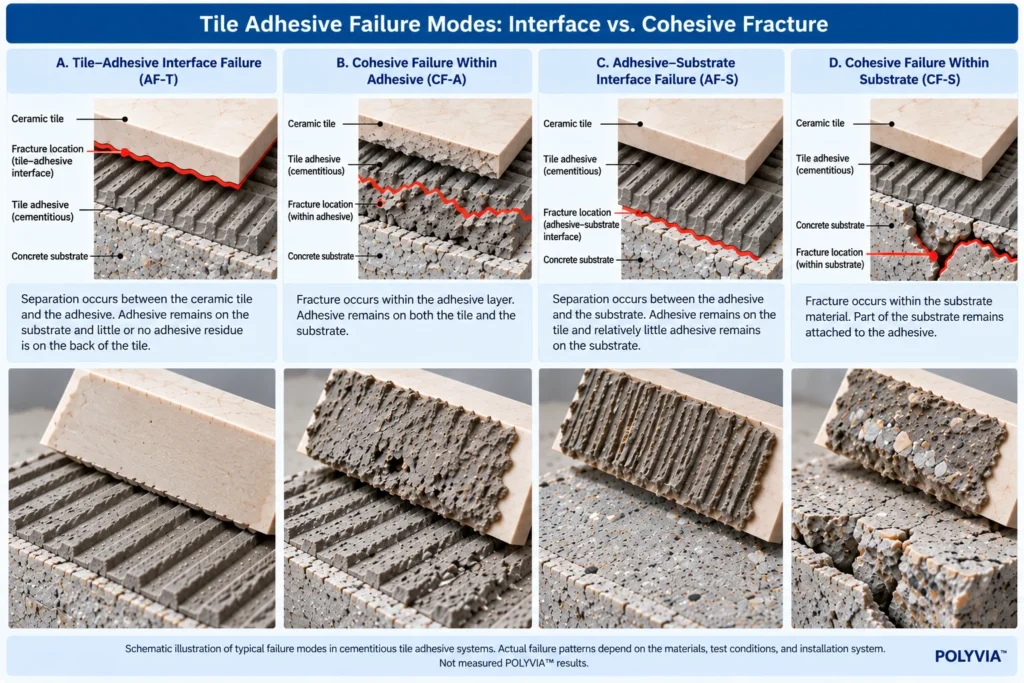
EN 12004-2:2017 includes a normative annex describing failure patterns. For cementitious tile adhesive testing, relevant designations include adhesive failure at the substrate or tile interface and cohesive failure within the adhesive, substrate, or tile.
1. Tile–Adhesive Interface Failure (AF-T)
Separation occurs predominantly between the ceramic tile and the adhesive.
The mortar may remain attached to the substrate, while the tile surface shows limited adhesive residue.
Potential influences include inadequate contact, tile surface characteristics, preparation conditions, or interfacial bonding limitations.
What it indicates: The dominant fracture location is the tile–adhesive interface.
What it does not prove: That RDP dosage is insufficient.
2. Cohesive Failure Within the Adhesive (CF-A)
The fracture develops within the hardened adhesive layer.
Mortar may remain attached to both the tile and substrate.
Possible influences include mortar composition, hardened matrix development, water demand, and conditioning effects.
What it indicates: Separation occurred within the adhesive material.
What it does not prove: That the adhesive formulation is defective. The measured tensile adhesion result and applicable evaluation rules must also be considered.
3. Adhesive–Substrate Interface Failure (AF-S)
Separation occurs predominantly between the adhesive and substrate.
The adhesive may remain attached to the tile while relatively little mortar remains on the substrate surface.
Potential influences include substrate characteristics, preparation conditions, and interfacial contact.
What it indicates: The fracture is located at the adhesive–substrate interface.
What it does not prove: That the adhesive formulation alone caused the failure.
4. Cohesive Failure Within the Substrate (CF-S)
The fracture occurs inside the substrate material.
Part of the substrate may remain attached to the adhesive after separation.
This pattern requires evaluation of the substrate condition and the applicable standardized test-result rules.
A substrate cohesive failure does not automatically establish adhesive compliance.
5. Mixed Failure Patterns and Pull-Head Bonding Failure
Some specimens exhibit more than one fracture location.
For example, a sample may show interfacial separation over part of its surface and cohesive fracture elsewhere.
The laboratory should document the observed failure characteristics according to the applicable test method.
Photographs, individual adhesion values, and repeat specimens can help determine whether a pattern is reproducible.
An additional distinction is bonding failure between the pull-head plate and the ceramic tile (BT).
Under EN 12004-2:2017, Annex B, BT identifies failure in the bonding layer connecting the pull-head plate to the tile rather than separation within the tile adhesive system being evaluated.
In this situation, the adhesive bond strength being investigated is greater than the recorded test value, and repeating the test is preferable.
A BT result should not automatically be interpreted as failure of the cementitious tile adhesive. Its evaluation and reporting must follow the applicable provisions of the standard.
The standard also identifies cohesive failure within the tile as CF-T. As with other failure patterns, the location must be considered together with the measured result and the applicable evaluation rules.
The key principle is simple: fracture location identifies where the bond system separated, not necessarily why.
Investigating RDP and Cement Compatibility
Once the test procedure has been verified, controlled material comparisons can help determine whether the adhesive has a formulation-related performance limitation.
For polymer-modified cementitious systems, RDP selection should be evaluated together with cement, aggregates, cellulose ether, mixing water, and other additives.
1. Why RDP Grade Matters
VAE redispersible polymer powder (RDP) is used in many cementitious tile adhesive formulations to modify bonding and other performance characteristics.
However, different RDP grades are not automatically interchangeable.
Their performance depends on the complete formulation and the specified test conditions.
Before changing the polymer system, manufacturers should compare:
- Initial tensile adhesion.
- Water-conditioned tensile adhesion.
- Failure patterns.
- Fresh-mortar consistency and water demand.
- Open-time behavior where relevant.
- Repeatability of the results.
The objective is to select a compatible polymer system, not simply the grade with the highest claimed performance.
2. Compare Polymer Grades at a Controlled Dosage
A useful first screening experiment compares different RDP grades while keeping other relevant formulation variables consistent.
Suggested RDP–Cement Compatibility Trial Matrix
| Trial | Cement Source | RDP Grade | RDP Dosage | Main Variable |
|---|---|---|---|---|
| R0 | Cement A | Grade A | Constant | Reference |
| R1 | Cement A | Grade B | Constant | RDP grade |
| R2 | Cement B | Grade A | Constant | Cement source |
| R3 | Cement B | Grade B | Constant | Cement–RDP interaction |
Proposed experimental design only. Trial codes and materials are illustrative; no performance results are implied.
This 2 × 2 screening design helps identify whether the selected RDP and cement source interact.
All trials should follow a consistent dry-mixing procedure, specimen preparation method, and appropriate standardized testing protocol.
Where polymer grades have different supplied-polymer contents or fresh-mortar behavior, those differences should be recorded and considered in the interpretation.
3. Optimize RDP Dosage Separately
If grade screening suggests that the chosen polymer is suitable, a separate dosage study may be justified.
For a manufacturer developing a C2 tile adhesive formula, a mass-balanced trial series could compare 20, 25, and 30 kg of RDP per 1,000 kg of dry mortar, with 25 kg/MT as the illustrative reference.
These values are experimental examples, not universal dosage recommendations or measured POLYVIA™ performance results.
Each formulation must total 1,000 kg.
A designated balancing ingredient may be adjusted to maintain total mass, but that adjustment can also change the relative proportions and packing characteristics of the mortar.
Therefore, the resulting data should be interpreted as a comparison of complete formulations rather than a perfectly isolated measurement of polymer action.
The selected dosage should satisfy the intended performance requirements while remaining practical for manufacturing and application.
4. When Should HPMC or Mixing Water Be Investigated?
Hydroxypropyl methylcellulose (HPMC) can influence water retention, consistency, and application behavior.
However, changing HPMC and RDP simultaneously makes it more difficult to identify the variable responsible for an improvement.
A practical investigation sequence is:
- Confirm the reference formulation and test validity.
- Compare suitable RDP grades if polymer selection is suspected.
- Evaluate RDP dosage separately if appropriate.
- Investigate mixing-water demand or HPMC characteristics when the evidence indicates a rheological or application limitation.
- Verify the final formulation under the required test conditions.
This staged approach reduces unnecessary formulation changes.
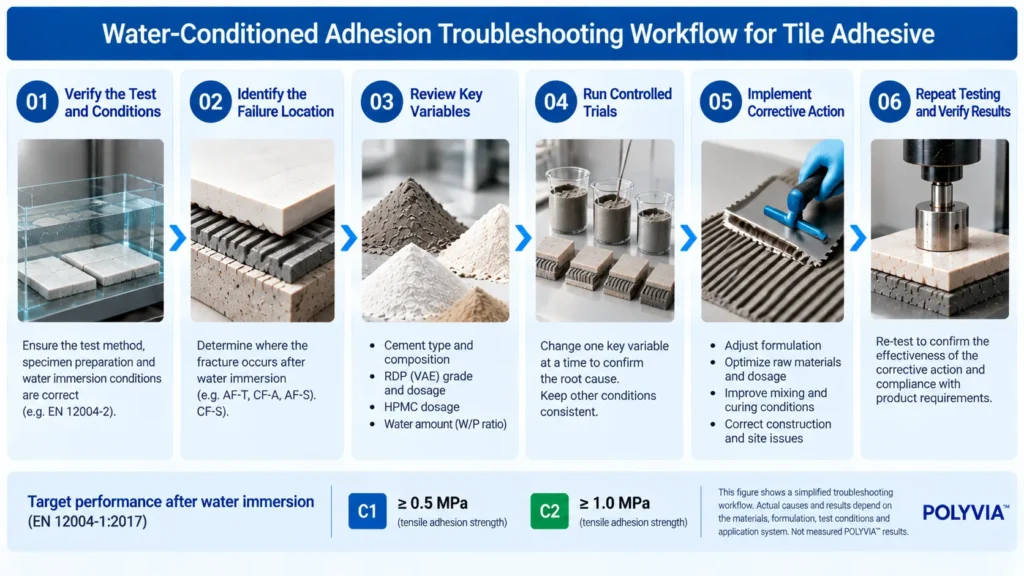
A Controlled Laboratory Troubleshooting Plan
A useful laboratory troubleshooting program should produce repeatable evidence and identify which corrective action is technically justified.
Step 01 — Establish the Reference
Record the complete formulation, ingredient specifications, raw-material batch numbers, dry-mixing procedure, mixing-water quantity, and specimen preparation method.
Include individual adhesion measurements, failure modes, and conditioning records.
If the original results are unreliable or incomplete, repeat the reference testing before changing the formulation.
Step 02 — Classify the Problem
Determine whether the main issue is:
- Insufficient water-conditioned adhesion.
- Insufficient adhesion across several conditioning conditions.
- Unusually variable laboratory results.
- Field debonding despite apparently satisfactory laboratory performance.
The investigation priority should follow the observed problem.
Step 03 — Choose the First Variable
Investigate the most plausible variable supported by the available evidence.
For example:
- RDP grade when comparable polymer systems show different conditioned performance.
- RDP dosage when a controlled series demonstrates a dosage response.
- Cement source when performance changes after cement substitution.
- Mixing-water demand when consistency or contact behavior is abnormal.
- Laboratory procedure when specimens produce unexplained variation.
Avoid making several unrelated adjustments at once.
Step 04 — Prepare Controlled Trial Batches
Use a clearly defined mass basis, such as kg per 1,000 kg of dry mortar.
Document the balancing adjustment whenever an ingredient quantity changes.
Maintain appropriate consistency in mixing equipment, test substrates, ceramic tiles, conditioning, and test execution.
For EN 12004 classification testing, the amount of mixing water and/or liquid admixtures used to prepare a given cementitious adhesive formulation must remain the same across the applicable tests.
This means manufacturers should not use one water addition for initial adhesion testing and a different addition for water-conditioned adhesion testing simply to improve the reported performance of the same formulation.
Any water-demand optimization should be completed before the final standardized verification program. Where different water levels are evaluated during development, they should be treated as separately documented trial conditions or formulations, rather than interchangeable results for one declared product.
A screening trial may be used to decide which formulation deserves further evaluation, but an informal screening method must not be presented as an EN 12004 classification test.
Step 05 — Record Results and Failure Modes
Suggested Laboratory Evaluation Record
| Trial | Main Change | Initial Adhesion | After Water Immersion | Failure Mode | Decision |
|---|---|---|---|---|---|
| REF | Reference formulation | To be tested | To be tested | To be recorded | Baseline |
| R1 | Alternative RDP grade | To be tested | To be tested | To be recorded | Compare |
| D1 | RDP dosage adjustment | To be tested | To be tested | To be recorded | Compare |
| C1 | Cement source adjustment | To be tested | To be tested | To be recorded | Compare |
| V1 | Selected final formulation | To be tested | To be tested | To be recorded | Verify |
Blank experimental recording template; no completed POLYVIA™ test results are represented. Trial identifiers are internal laboratory codes and do not denote adhesive classifications.
Record individual measurements and apply the relevant failure-mode evaluation and reporting requirements.
Step 06 — Verify Repeatability
A single improved result does not establish that the problem has been solved.
Repeat promising trials using independently prepared batches or specimens and review variability.
The final formulation should satisfy the required performance profile, not merely improve one water-conditioned result.
For example, a C2TE adhesive must meet the applicable C2 tensile adhesion requirements as well as the specified reduced-slip and extended-open-time requirements.
A successful troubleshooting trial must produce a reproducible improvement without creating an unacceptable deficiency elsewhere.
Corrective Actions Based on Verified Causes
The appropriate corrective action should follow the investigation findings.
Not every adhesion problem requires a formulation change.
1. Change the RDP Grade When Compatibility Is the Limiting Factor
An RDP substitution may be justified if controlled tests demonstrate that an alternative grade provides consistently better water-conditioned adhesion.
Verify the improvement against initial and conditioned tensile adhesion and any affected application characteristics.
2. Optimize RDP Dosage When the Response Is Demonstrated
Additional RDP may be useful when a controlled dosage series shows a reproducible improvement.
However, increasing polymer content without evidence can raise cost without resolving the cause.
The final selection should balance adhesion performance, workability, repeatability, and formulation economics.
3. Adjust Water Demand or HPMC When Relevant
If experiments show that excessive water demand, poor consistency, or inadequate adhesive contact contributes to the problem, water-demand or cellulose ether optimization may be appropriate.
Any change must be followed by suitable fresh-mortar and adhesion testing.
4. Correct Laboratory or Installation Problems Without Reformulating
If the failure originates from incorrect conditioning, inconsistent specimen preparation, unsuitable substrates, or installation defects, the appropriate action may be procedural rather than chemical.
Changing RDP dosage does not correct an invalid test method or a defective substrate.
5. Match Corrective Actions to Evidence
Table 05. Corrective Actions and Verification
| Verified Finding | Corrective Direction | Required Follow-Up |
|---|---|---|
| Alternative RDP grade performs consistently better | Evaluate grade substitution | Repeat relevant adhesion and application tests |
| Controlled dosage response demonstrates improvement | Optimize RDP content | Verify complete performance and cost |
| Excessive water demand contributes to poor performance | Adjust water-demand system | Recheck consistency, contact, and adhesion |
| Cement substitution causes repeatable variation | Review cement–RDP compatibility | Test representative raw-material batches |
| Testing procedure is invalid | Correct laboratory practice | Repeat testing before changing the formula |
| Field debonding results from substrate or installation defects | Correct the affected system | Verify substrate and installation suitability |
A C1 tile adhesive formula and a C2 formulation may require different development priorities, but neither classification can be guaranteed solely by specifying an RDP dosage.
6. Verify the Final Product Classification
After selecting the corrected formulation, complete the applicable standardized verification program.
For normal-setting C1 and C2 cementitious adhesives, initial adhesion and adhesion after water immersion, heat ageing, and freeze–thaw cycles must satisfy the relevant class thresholds.
The applicable open-time requirement must also be met.
Additional T, E, or deformability classifications require their respective tests.
A formulation that passes water-conditioned adhesion alone must not be declared C1, C2, C1TE, or C2TE without satisfying the other applicable requirements.
Preventing Repeat Failures in Production and Installation
Corrective action is complete only when the identified cause has been addressed and the improvement can be maintained.
1. Control Raw Materials and Formulation Changes
Establish specifications and traceability for cement, aggregates, RDP, cellulose ether, and auxiliary additives.
Before replacing a critical ingredient, evaluate its impact on the approved tile adhesive formulation guide or production specification.
Nominally similar raw materials should not be assumed interchangeable without verification.
2. Maintain Consistent Manufacturing Procedures
Control ingredient weighing, dry-mixing sequence, mixer loading, blending conditions, and moisture protection during storage and packaging.
These procedures should be validated for the actual equipment and formulation.
Unexpected changes in mixing-water demand or fresh-mortar consistency should trigger investigation rather than automatic water addition.
3. Use Risk-Based Quality Control
Establish incoming-material checks, in-process controls, fresh-mortar observations, and appropriate periodic performance verification.
Retain testing records, individual adhesion measurements, raw-material identities, and relevant failure-mode observations.
Testing frequency should reflect the applicable conformity requirements, production risks, and manufacturer quality system.
4. Address Field Installation Conditions
For wet-area installations, consider:
- Substrate condition and surface preparation.
- Appropriate adhesive application and contact.
- Tile placement within the suitable working window.
- Correct waterproofing and moisture-management details.
- Movement accommodation and relevant construction joints.
- Compatibility of the complete installation system.
Laboratory adhesion classification does not replace the project-specific assessment of these factors.
5. Verify Corrective-Action Effectiveness
When a nonconformity is identified:
- Contain the affected material or installation where appropriate.
- Collect test, production, and site evidence.
- Determine the supported failure mechanism.
- Implement the relevant corrective action.
- Repeat appropriate testing or inspection.
- Update specifications and operating procedures where necessary.
The purpose is not merely to produce another passing sample. It is to reduce the likelihood of the same failure recurring.
Conclusion
Tile adhesive failure after water immersion is a performance problem that requires a structured diagnosis.
Possible causes include RDP–cement incompatibility, inadequate polymer optimization, poor adhesive contact, unfavorable water demand, raw-material variation, and testing or installation deficiencies.
For normal-setting C1 and C2 cementitious adhesives, the minimum tensile adhesion strengths after standardized water immersion are 0.5 MPa and 1.0 MPa, respectively. However, a result below the relevant threshold does not independently establish its cause.
Effective troubleshooting follows five principles: verify the test, identify the failure location, isolate the relevant variables, implement a justified corrective action, and confirm repeatable performance.
For dry-mix mortar manufacturers, this evidence-based approach supports more efficient RDP selection, reliable formulation development, and consistent production quality.
Frequently Asked Questions
1. Why does tile adhesive lose bond strength after water immersion?
Possible causes include RDP–cement incompatibility, an unsuitable polymer dosage, inadequate adhesive contact, unfavorable mortar structure, or inconsistent preparation and conditioning. The root cause must be established through appropriate testing and evidence.
2. What is the minimum water-conditioned tensile adhesion for C1 and C2?
Under EN 12004-1:2017, normal-setting C1 cementitious adhesives require at least 0.5 MPa and C2 adhesives require at least 1.0 MPa after the specified water-immersion conditioning.
3. Will increasing RDP dosage improve water-immersion adhesion?
It may improve performance in some formulations, but the response depends on RDP grade, cement compatibility, water demand, and other ingredients. A controlled dosage series is necessary to establish whether increasing RDP is beneficial.
4. Can a tile adhesive pass initial adhesion but fail after water immersion?
Yes. Initial and water-conditioned adhesion are evaluated under different conditioning procedures. Passing the initial threshold does not compensate for failing the applicable water-conditioned requirement.
5. How can manufacturers identify whether the problem is caused by RDP?
First verify the test method and fracture location. Then compare suitable RDP grades at controlled dosage and conduct a separate dosage study where appropriate. Repeatable results are required before attributing the problem to polymer selection or content.
6. Does passing EN 12004 water-immersion testing mean the adhesive is waterproof?
No. The test measures tensile adhesion after specified conditioning. It does not directly establish waterproofing capability or suitability for all continuously submerged installations.
7. Why can installed tiles detach even when the adhesive passes laboratory testing?
Field failures may involve inadequate coverage, unsuitable substrates, movement, surface contamination, moisture-management defects, or installation conditions. The full tiling system must be investigated.
8. Which standard covers tensile adhesion after water immersion?
EN 12004-1:2017 defines the relevant classification requirements. EN 12004-2:2017, Clause 8.3, specifies the tensile adhesion test method for cementitious adhesives, while its normative Annex B addresses failure patterns.
References
[1] EN 12004-1:2017. Adhesives for ceramic tiles — Part 1: Requirements, assessment and verification of constancy of performance, classification and marking.
https://www.nen.nl/en/nen-en-12004-1-2017-en-230833
[2] EN 12004-2:2017. Adhesives for ceramic tiles — Part 2: Test methods.
https://www.nen.nl/en/nen-en-12004-2-2017-en-230792
[3] ISO 13007-1:2014. Ceramic tiles — Grouts and adhesives — Part 1: Terms, definitions and specifications for adhesives.
https://www.iso.org/standard/60880.html
[4] ISO 13007-2:2013. Ceramic tiles — Grouts and adhesives — Part 2: Test methods for adhesives.
https://www.iso.org/standard/60881.html
Technical Note
This article provides guidance for evaluating water-conditioned adhesion problems in cementitious tile adhesives. Suggested trial programs are illustrative and are not a substitute for the complete applicable standards.
Hypothetical test values and experimental examples are not measured POLYVIA™ product results. Manufacturers should verify the relevant standard editions, national requirements, laboratory methods, and full product performance before making classification or compliance claims.