
CONCRETE WORKABILITY SOLUTION
Improve Flowability Through Smarter Mix Design and PCE Selection
Optimize concrete workability without extra water through effective PCE dispersion, aggregate grading and verified mix-design adjustments.
Introduction
Concrete workability can be improved without adding water by optimizing cementitious particle dispersion, selecting a compatible polycarboxylate superplasticizer (PCE), improving aggregate grading, and adjusting paste proportions and mixing conditions. The most effective approach depends on whether the concrete has insufficient initial flow, excessive stickiness, poor pumpability, rapid slump loss, or inadequate mixture stability.
Adding water may temporarily increase slump, but uncontrolled water addition can change the intended water-to-binder ratio and compromise strength, durability, or mixture stability.
A high-range water reducer can improve cementitious particle dispersion and increase flowability at constant mixing water content. However, admixture dosage alone cannot correct every workability problem. Aggregate characteristics, paste availability, cement compatibility, and production conditions must also be considered.
The objective is not simply to achieve a higher slump. It is to obtain the required flowability, cohesion, consistency retention, and placement performance without increasing the specified mixing water.
This guide explains how to diagnose poor concrete workability, select practical corrective measures, evaluate suitable PCE grades, and verify improvements through controlled trials.
Why Is Concrete Difficult to Place?
Poor concrete workability is not always caused by insufficient mixing water. The underlying limitation may involve particle dispersion, aggregate structure, paste availability, mixture rheology, or changing production conditions.
Identifying the dominant symptom is the first step toward selecting an effective correction.
1. Low Initial Slump
Low slump indicates limited deformation during the slump test but does not identify the underlying cause.
Potential contributing factors include insufficient cementitious particle dispersion, unfavorable aggregate grading, excessive fine-particle water demand, and unsuitable cement–admixture interactions.
Before changing the formulation, verify the actual water balance, admixture dosage, and mixing procedure.
1. Sticky Concrete
Concrete may meet its slump target but remain difficult to discharge, spread, finish, or pump.
This behavior can be associated with unfavorable powder characteristics, excessive fines, insufficient aggregate lubrication, or viscosity-related resistance.
Stickiness is a field observation and should not automatically be treated as a measured value of plastic viscosity.
1. Poor Pumpability
Pumpability depends on aggregate grading, mortar availability, mixture rheology, stability, and pumping conditions.
A mixture with adequate slump may still generate excessive pumping resistance or become unstable during transportation through a pipeline.
Increasing slump alone does not guarantee improved pumpability.
1. High Flow with Segregation or Bleeding
A highly fluid mixture may exhibit aggregate separation, bleeding, or insufficient cohesion.
These symptoms indicate that mobility and stability are not adequately balanced.
Further increases in PCE dosage may worsen the problem if excessive dispersion is already contributing to instability.
1. Rapid Slump Loss
Concrete may achieve the required initial slump but lose consistency during transportation or placement.
Possible contributors include cement–PCE interactions, hydration behavior, temperature, and elapsed time.
This problem should be distinguished from insufficient initial dispersion because it may require a different admixture strategy.
Low slump, stickiness, poor pumpability, segregation, and rapid slump loss are different workability problems. Each requires targeted evaluation rather than automatic water addition.
What Controls Concrete Workability?
Concrete workability results from interactions among water, cementitious materials, aggregates, admixtures, and production conditions.
Four factors are particularly important.
1. Water-to-Binder Ratio
The water-to-binder ratio (w/b) is the mass of mixing water divided by the mass of cementitious binder.
It influences paste solids concentration and the potential to achieve specified strength and durability requirements.
However, two mixtures with the same w/b ratio may exhibit different workability because of differences in dispersion, particle packing, and material characteristics.
Improving workability at constant water content therefore requires more than simply controlling the w/b ratio.
2. Cementitious Particle Dispersion
Cementitious particles can form flocculated structures that contribute to resistance against flow.
A compatible PCE superplasticizer promotes dispersion, primarily through steric effects associated with its polymer side chains.
This can improve initial flowability without increasing mixing water.
The response depends on cement composition, supplementary cementitious materials, PCE chemistry, dosage, and mixing conditions.
2.3 Aggregate Grading and Paste Volume
Aggregate grading, shape, and surface texture influence particle packing and internal friction.
Paste and mortar provide lubrication between aggregates during mixing, transportation, and placement.
Insufficient paste availability may produce harsh concrete, while excessive fines or unsuitable powder combinations may increase water demand and stickiness.
Optimizing aggregate grading and paste proportions can improve workability, but changes to binder content or mixture proportions must also be evaluated for hardened concrete performance.
3. Yield Stress and Plastic Viscosity
Yield stress and plastic viscosity are commonly used to describe fresh concrete rheology.
Yield stress represents resistance to the initiation of flow within an idealized rheological model.
Plastic viscosity describes resistance to continued flow after yielding.
These parameters help explain why mixtures with similar slump values can behave differently during pumping, placement, or finishing.
Slump is useful for evaluating consistency in applicable mixtures, but it is not a complete measurement of concrete rheology.
Workability optimization should consider particle dispersion, aggregate structure, paste availability, and rheological behavior together.
How Does PCE Improve Concrete Workability Without Extra Water?
Polycarboxylate ether superplasticizers improve workability primarily by dispersing cementitious particles.
PCE molecules typically contain a polymer backbone with functional groups that interact with cementitious surfaces and side chains that extend into the surrounding solution.
After adsorption onto suitable particle surfaces, these side chains provide steric effects that help limit particle flocculation.
The resulting dispersion can reduce resistance to initial flow and improve the efficiency of the available mixing water.
1. Why PCE Performance Depends on Cement Compatibility
PCE performance varies with cement mineral composition, sulfate balance, fineness, pore solution chemistry, and supplementary cementitious materials.
Certain clay minerals in aggregates can also interfere with PCE performance.
Consequently, the same admixture grade may provide different results in different concrete mixtures.
Compatibility should be evaluated using representative materials and consistent mixing and testing conditions.
2. Why Higher PCE Dosage Is Not Always Better
Increasing PCE dosage may improve flow when insufficient dispersion is the controlling limitation.
However, the dosage–response relationship is not necessarily linear.
Additional admixture may provide diminishing benefits and, depending on the formulation, contribute to instability, changes in air content, or undesirable setting behavior.
A dosage–response trial is therefore more reliable than selecting the highest possible dosage.
3. Initial Flow, Retention, and Stability Are Different Objectives
Initial flowability describes the mixture's behavior shortly after mixing.
Workability retention describes changes in consistency during the required working period.
Mixture stability concerns resistance to undesirable separation and bleeding.
A suitable PCE grade must satisfy the relevant combination of these objectives.
PCE is most effective when insufficient particle dispersion is the controlling problem. Its selection must be based on actual mixture performance rather than nominal product classification alone.
Five Practical Ways to Improve Concrete Workability Without Adding Water
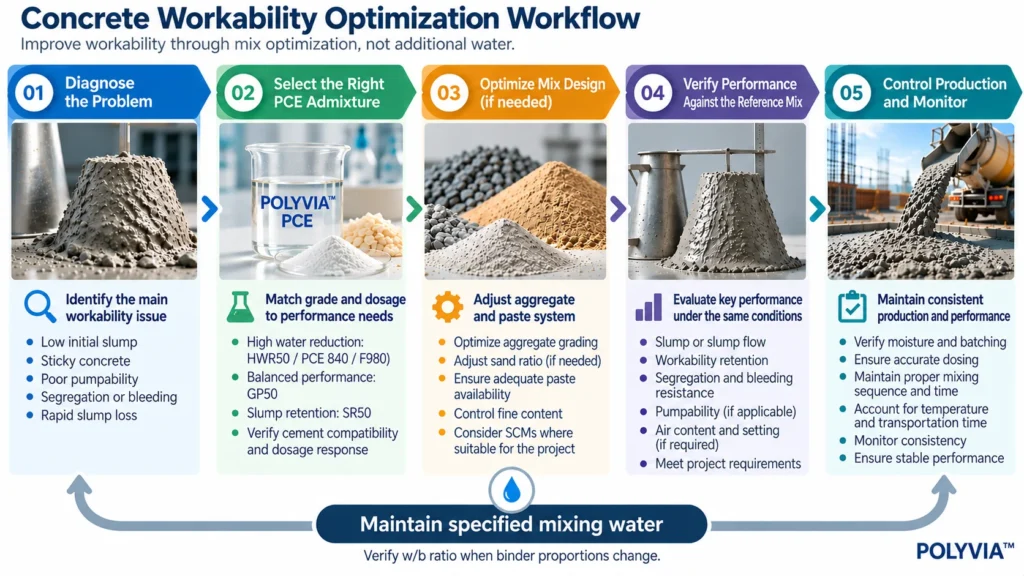
The following methods provide a structured approach to improving concrete flowability and placement performance while maintaining the specified mixing water.
1. Optimize PCE Selection and Dosage
Best Suited For: Low initial flow associated with insufficient particle dispersion.
Start with a reference mixture and verify the actual water balance.
Evaluate a compatible PCE grade at several justified dosage levels while maintaining consistent materials and mixing conditions.
Record initial consistency, workability retention, and mixture stability.
Verify: Slump or other applicable consistency measurements, segregation, bleeding, air content, and setting behavior.
Limitation: Increasing dosage cannot automatically correct poor aggregate grading or inadequate paste availability.
2. Improve Aggregate Grading
Best Suited For: Harsh concrete, excessive aggregate interference, and certain pumpability problems.
Review the grading of individual aggregate fractions and their combined particle-size distribution.
Adjust aggregate proportions where necessary, while maintaining the specified aggregate size and relevant design requirements.
Compare trial mixtures using consistent water content and appropriate performance measurements.
Verify: Flowability, cohesion, placement behavior, and segregation resistance.
Limitation: Maximum packing density does not automatically produce optimum workability.
3. Balance Paste Volume and Fines
Best Suited For: Insufficient aggregate lubrication or excessive stickiness associated with the powder system.
Evaluate paste availability, fine-particle content, and the overall cementitious material composition.
Where appropriate, adjust aggregate proportions or the powder system to improve lubrication and cohesion.
Verify: Workability, finishing behavior, stability, and applicable hardened properties.
Limitation: Changing binder content at constant water changes the w/b ratio and may influence strength, shrinkage, durability, and cost.
4. Control Mixing and Production Conditions
Best Suited For: Inconsistent workability between batches.
Verify aggregate moisture corrections, admixture dosing, mixing sequence, mixing time, and concrete temperature.
Follow the admixture manufacturer's handling and addition recommendations.
Where alternative mixing sequences are considered, confirm their effectiveness through controlled trials.
Verify: Batch-to-batch consistency and workability at defined measurement times.
Limitation: No single PCE addition sequence is optimal for every material and production system.
5. Optimize Flowability and Stability Together
Best Suited For: Concrete that meets its consistency target but remains difficult to place or exhibits inadequate stability.
Define the required placement method, working time, and performance criteria.
Determine whether the limiting factor is initial flow, viscosity-related resistance, cohesion, or time-dependent workability loss.
Adjust the controlling variable and evaluate the complete performance profile.
Verify: Placement behavior, consistency, segregation, bleeding, and application-specific requirements.
Limitation: Improving one workability characteristic may adversely affect another.
Workability Optimization Summary
| Main Problem | Priority Adjustment | Key Verification |
|---|---|---|
| Low initial slump | PCE compatibility and dosage | Initial consistency and stability |
| Harsh concrete | Aggregate grading and paste availability | Flowability and cohesion |
| Sticky concrete | Fines and powder-system optimization | Placement behavior |
| Inconsistent batches | Moisture and mixing control | Repeatability |
| Poor pumpability | Aggregate, mortar, and rheology optimization | Pumping behavior and stability |
| High flow with segregation | Balance dispersion and cohesion | Segregation and bleeding |
How to Select the Right PCE Grade
Selecting the appropriate PCE grade requires matching the admixture's intended function with the concrete's workability requirements and production conditions.
The first decision should be whether the mixture primarily needs stronger initial dispersion, a balance of initial flow and retention, or improved consistency retention over time.
1. POLYVIA™ PCE Grade Selection Guide
| Product Form | Grade | Performance Focus | Selection Objective |
|---|---|---|---|
| Liquid | HWR50 | High Water Reduction | Improve initial flowability |
| Liquid | HWR40 | High Water Reduction | Improve initial flowability |
| Liquid | GP50 | Balanced Performance | Balance initial flow and retention |
| Powder | PCE 840 | High Water Reduction | Dispersion in compatible dry-mix or prepared systems |
| Flake | F980 | High Water Reduction | Concentrated admixture preparation |
| Liquid | SR50 | Slump Retention | Maintain workability over time |
| Liquid | SR40 | Slump Retention | Maintain workability over time |
These grades are candidate products for evaluation, not guaranteed solutions for every concrete formulation.
2. Liquid PCE for Concrete Production
POLYVIA™ HWR50 is a high-water-reduction liquid PCE grade with a nominal solids concentration of 50%. A 40% solids version, HWR40, may be available upon request.
GP50 is a balanced-performance liquid grade with 50% nominal solids.
Liquid PCE is suitable for production systems equipped for controlled liquid admixture dosing.
When comparing grades, account for product concentration, verified water contribution, and actual dosage response.
3. Powder PCE for Dry-Mix Integration
POLYVIA™ PCE 840 is a fine-powder, high-water-reduction grade.
It may be incorporated into compatible dry-mix formulations or prepared using a suitable mixing procedure.
Concrete trials should confirm adequate distribution, dissolution, and performance.
4. PCE Flake for Concentrated Admixture Preparation
POLYVIA™ F980 is a high-water-reduction flake grade.
The concentrated format may support transportation efficiency and controlled preparation of liquid admixture solutions.
The product should be prepared according to its technical instructions.
Flake form alone does not guarantee superior concrete performance compared with liquid or powder PCE.
5. When Slump Retention Is the Priority
When concrete achieves sufficient initial flow but loses workability during transportation or placement, a retention-oriented grade may be more appropriate.
POLYVIA™ SR50 is a liquid slump-retention grade with a nominal solids concentration of 50%. A 40% solids version, SR40, may be available upon request.
Its suitability should be verified through time-dependent workability testing, cement compatibility assessment, and relevant setting and stability checks.
Select the PCE grade that meets the required workability profile under actual production conditions, not simply the product with the highest solids concentration or initial slump response.
Troubleshooting Poor Concrete Workability
When a concrete mixture remains difficult to place, systematic diagnosis helps distinguish admixture-related problems from aggregate, paste, or production limitations.
The following matrix provides a practical starting point.
| Observed Symptom | Priority Diagnostic Check | Corrective Direction | Verification |
|---|---|---|---|
| Low slump despite PCE addition | Water balance and constant-water dosage response | Review compatibility, dosage, and fines | Improved consistency without instability |
| Sticky concrete at acceptable slump | Aggregate grading, fines, and paste characteristics | Optimize powder and aggregate proportions | Better placement behavior |
| Performance changes after cement replacement | Comparative cement–PCE trials | Reassess grade and dosage | Initial flow, retention, and setting |
| Segregation after increasing flow | Admixture dosage and mixture stability | Rebalance dispersion and cohesion | Acceptable flow and stability |
| Inconsistent batch workability | Moisture, dosing, and mixing records | Improve production control | Repeatability across batches |
1. Recommended Troubleshooting Procedure
Step 1 — Verify the Water Balance
Check aggregate moisture, batch-water additions, and water contributed by liquid admixtures.
Step 2 — Confirm the Dominant Symptom
Distinguish insufficient initial flow, excessive stickiness, poor stability, and rapid workability loss.
Step 3 — Isolate the Likely Cause
Use controlled comparisons to investigate PCE response, cement compatibility, aggregate grading, or production conditions.
Step 4 — Apply a Targeted Correction
Change the main suspected variable first, then investigate combined adjustments if necessary.
Step 5 — Confirm the Result
Evaluate workability, stability, and relevant hardened concrete requirements under representative conditions.
2. When a Cement Change Affects PCE Performance
If the same PCE dosage produces a different result after changing cement, compare the available cement characteristics and repeat compatibility trials.
Differences in fineness, sulfate availability, mineral composition, and early hydration behavior may influence admixture performance.
Do not assume that a dosage optimized for one cement source will remain suitable for another.
3. When a Higher Slump Creates Instability
If increasing PCE dosage improves flow but produces bleeding or segregation, review the dosage response and the mixture's aggregate and paste structure.
The objective is to restore the required balance between mobility and cohesion, not simply reduce or increase the admixture dosage without diagnosis.
Effective troubleshooting identifies the controlling cause before making formulation changes.
How to Verify Concrete Workability Improvement
Workability improvement should be demonstrated through controlled comparative trials using representative materials and clearly defined acceptance criteria.
A higher slump alone is insufficient evidence of successful optimization.
1. Establish a Reference Mixture
Document the cementitious materials, aggregates, admixtures, water-to-binder ratio, mixing procedure, and test conditions.
For an admixture-only comparison, keep the principal mixture proportions and actual total mixing water constant while evaluating PCE grade or dosage.
For aggregate or paste optimization, record all proportion changes and verify the resulting mix design.
2. Correct for Water Introduced by Liquid Admixtures
Liquid PCE products can introduce different quantities of water into the mixture.
When the verified water mass fraction is known:
Admixture Water Contribution = Liquid Admixture Mass × Verified Water Mass Fraction
For a simplified product consisting only of non-water solids and water, the water fraction can be calculated as one minus the solids fraction.
However, commercial admixtures may contain additional components. Therefore, the reported solids content should not automatically be treated as a complete determination of water content without confirming the product specification or formulation basis.
Illustrative Calculation — Not POLYVIA™ Laboratory Data
| Parameter | Example A | Example B |
|---|---|---|
| Assumed non-water fraction | 40% | 50% |
| Liquid admixture mass | 2.00 kg/m³ | 1.60 kg/m³ |
| Non-water material supplied | 0.80 kg/m³ | 0.80 kg/m³ |
| Calculated admixture water | 1.20 kg/m³ | 0.80 kg/m³ |
These calculations assume that the remainder of each product is water.
The example demonstrates water-balance correction only. It does not establish equivalent polymer chemistry, dispersing efficiency, or recommended PCE dosage.
3. Measure Workability at Relevant Times
Select tests appropriate to the concrete type and application.
For conventional concrete, slump testing is commonly used to evaluate consistency.
For self-consolidating concrete, slump-flow and additional performance assessments may be more appropriate.
Record initial consistency and measurements at elapsed times relevant to the intended transportation and placement period.
Maintain comparable temperature, mixing, and handling conditions.
4. Evaluate Stability and Hardened Performance
Depending on the project, evaluate segregation, bleeding, air content, setting behavior, placement performance, and relevant hardened properties.
Changes to admixture selection or mixture proportions should not compromise specified strength or durability requirements.
5. Recommended Trial Record
| Parameter | Reference Mix | Trial A | Trial B |
|---|---|---|---|
| Cement and SCM composition | Record | Record | Record |
| Aggregate proportions | Record | Record | Record |
| Total mixing water (kg/m³) | Record | Record | Record |
| Water-to-binder ratio | Record | Record | Record |
| PCE grade and dosage basis | Record | Record | Record |
| Initial slump or slump flow (mm) | Measure | Measure | Measure |
| Consistency at specified times (mm) | Measure | Measure | Measure |
| Concrete temperature (°C) | Measure | Measure | Measure |
| Segregation and bleeding | Evaluate | Evaluate | Evaluate |
| Air content and setting | Test if applicable | Test if applicable | Test if applicable |
| Compressive strength (MPa) | Test | Test | Test |
| Overall acceptance | Assess | Assess | Assess |
For important comparisons, repeat trials or replicate batches may be required to distinguish genuine improvements from normal variability.
A successful workability adjustment must be measurable, repeatable, and compatible with the project's complete performance requirements.
Practical Limitations and Common Mistakes
Improving concrete workability requires avoiding adjustments that increase apparent flow while introducing new performance risks.
1. Uncontrolled Water Addition
Adding water without verifying the approved mix design can increase the actual water-to-binder ratio and compromise specified concrete properties.
Any permitted water adjustment must follow applicable specifications and production procedures.
2. Excessive PCE Dosage
Additional PCE does not always provide proportional improvements in flowability.
Depending on the admixture and mixture composition, excessive dosage may contribute to instability or undesirable setting behavior.
Select dosage through controlled testing rather than maximizing slump.
3. Relying Only on Slump
Slump does not fully describe viscosity-related behavior, cohesion, pumpability, or finishing performance.
Use application-appropriate measurements and observations.
4. Unverified Material or Production Changes
Changes in cement, aggregate moisture, admixture formulation, or mixing conditions can alter workability.
Significant changes should trigger appropriate verification rather than automatic reuse of previous dosage settings.
5. Assuming Laboratory Results Will Transfer Directly to Production
Laboratory and full-scale concrete production may differ in mixing energy, material variability, temperature, and handling conditions.
Confirm successful laboratory formulations through representative production trials before routine adoption.
The objective is not maximum slump. It is reliable placement performance without compromising the specified water content, mixture stability, strength, or durability.
Frequently Asked Questions
1. How can I increase concrete slump without adding water?
Use a compatible PCE superplasticizer to improve cementitious particle dispersion, or optimize aggregate grading and paste proportions when those factors control workability.
Verify the actual water balance and conduct controlled trials before changing the mixture.
2. Can PCE improve concrete workability at a constant water-to-binder ratio?
Yes. A compatible PCE can improve particle dispersion and increase flowability without changing the water-to-binder ratio.
Actual performance depends on the cementitious system, PCE chemistry, dosage, and mixing conditions.
3. Why is concrete still sticky after adding superplasticizer?
Stickiness may result from excessive fines, unfavorable aggregate grading, paste characteristics, or viscosity-related resistance rather than insufficient PCE.
Evaluate the aggregate and powder system before increasing admixture dosage.
4. Does higher PCE dosage always improve concrete flowability?
No. The dosage response may show diminishing benefits, and excessive admixture can affect stability or setting behavior.
Use controlled dosage–response trials to identify a practical operating range.
5. What is the difference between high-water-reduction and slump-retention PCE?
High-water-reduction PCE is primarily selected to improve initial dispersion and flowability.
Slump-retention PCE is primarily selected to maintain workability over a required period.
The final choice depends on actual cement compatibility and performance testing.
6. Can aggregate grading improve concrete workability without extra water?
Yes. Suitable aggregate grading can improve particle packing and reduce unfavorable internal friction.
However, aggregate shape, paste availability, and mixture stability must also be considered.
7. How should I compare 40% and 50% liquid PCE?
Compare the products using a defined dosage basis, verified water contribution, and measured concrete performance.
Different solids concentrations do not guarantee equivalent dispersing efficiency or performance at equal nominal solids dosage.
8. How can I verify improved workability in production?
Compare reference and optimized mixtures using consistent materials, water balance, testing procedures, and measurement times.
Confirm repeatability, stability, placement behavior, and relevant hardened concrete properties before routine production.
Need Help Improving Concrete Workability?
Struggling with low slump, sticky concrete, or inconsistent PCE performance?
POLYVIA™ can help you evaluate suitable PCE grades and develop a practical comparative testing approach based on your cementitious materials, concrete formulation, and placement requirements.
Share your cement type, water-to-binder ratio, target workability, and current admixture performance to discuss potential optimization options.
References & Technical Sources
- ASTM international. ASTM C143/C143M-26b: Standard Test Method for Slump of Concrete. https://doi.org/10.1520/C0143_C0143M-26B
- ASTM International. ASTM C494/C494M-24: Standard Specification for Chemical Admixtures for Concrete. https://doi.org/10.1520/C0494_C0494M-24
- ASTM International. ASTM C1611/C1611M-21: Standard Test Method for Slump Flow of Self-Consolidating Concrete. https://doi.org/10.1520/C1611_C1611M-21
- American Concrete Institute. ACI PRC-212.3-16: Report on Chemical Admixtures for Concrete. ACI Committee 212, 2016. https://www.concrete.org/store/productdetail?ItemID=212316
- Interaction Between Polycarboxylate Superplasticizer and Clay in Cement and Its Sensitivity Inhibition Mechanism: A Review. Materials, 2025, 18(11), 2662. https://www.mdpi.com/1996-1944/18/11/2662