
How to Troubleshoot Low Early Strength in PHC Spun Pile Production
A Systematic Guide to Strength Development, PCE Compatibility and Steam-Curing Optimization
Low early strength can disrupt PHC spun pile production, delay prestress transfer and reduce manufacturing efficiency. The cause may involve cement characteristics, effective water content, PCE compatibility, centrifugal forming or steam-curing conditions. This guide explains how to identify the controlling factors, investigate production deviations and validate corrective actions without compromising later-age concrete performance.
Identify the Actual Early-Strength Deficiency
Low early strength in PHC spun pile production is not necessarily caused by insufficient cement content or an unsuitable PCE superplasticizer.
A concrete mixture may meet its initial fresh-concrete requirements but fail to achieve the specified compressive strength at the intended production stage.
Before changing the formulation, manufacturers must identify which strength requirement has not been satisfied.
1. Distinguish Three Different Strength Requirements
Several strength requirements are relevant to PHC manufacturing. They must be evaluated separately.
Early-Age Compressive Strength
The compressive strength measured at a defined concrete age or production stage. It provides information about strength development under specified testing and curing conditions.
Prestress-Transfer Strength
The minimum concrete strength required before transferring prestressing force from the prestressing steel to the concrete member.
The acceptance requirement must follow the applicable structural design, product specification and approved manufacturing procedure.
Demolding and Handling Requirements
Demolding and subsequent handling involve separate manufacturing and safety considerations. The required concrete strength and release conditions must follow the manufacturer's approved procedure.
The relationship and sequence between prestress transfer, mold release and handling must be established for the actual production system.
A mixture may achieve satisfactory 28-day strength but still fail to meet the required strength at prestress transfer.
Conversely, achieving the required release strength does not automatically establish compliance with later-age strength or durability requirements.
2. Verify the Strength Measurement
Before investigating the concrete formulation, verify the reliability of the measured result.
Review:
- Specimen type, dimensions and preparation.
- Sampling location and sampling procedure.
- Actual testing age.
- Specimen curing history.
- Testing equipment and calibration.
- Applicable test method and acceptance criteria.
Particular attention should be paid to whether the test specimens represent the actual centrifugally formed concrete.
3. Quantify the Production Shortfall
Establish three basic values:
- Required compressive strength at the relevant production stage.
- Measured compressive strength under the specified testing conditions.
- Actual time at which the strength requirement is assessed.
Compare the results with qualified production batches rather than relying only on nominal mix-design values.
4. Determine Whether Production Can Proceed
| Production finding | Required action |
|---|---|
| Required prestress-transfer strength has not been achieved | Do not authorize prestress transfer |
| Prestress-transfer strength is achieved, but separate release requirements are not | Follow the applicable demolding and handling criteria |
| Test results are inconsistent with production observations | Verify sampling, specimen curing and testing |
| Early strength is satisfactory, but later-age strength is deficient | Investigate the binder system, curing and subsequent performance |
The first objective is not to increase strength. It is to establish exactly which production requirement has failed and why.
5. Match Observed Symptoms with Priority Investigations
Different early-strength problems may produce similar test results. The first investigation should focus on when the deviation occurs and which production variables have changed.
| Observed symptom | Priority investigation | Recommended verification |
|---|---|---|
| Early strength decreases across multiple production batches | Cement characteristics, effective water content and curing history | Compare affected batches with qualified production records |
| Strength decreases after a cement-source change | Cement hydration characteristics and cement–PCE compatibility | Conduct controlled cement-source comparisons |
| Strength decreases after changing PCE grade or dosage | PCE dosage basis, setting behavior and admixture compatibility | Compare fresh properties and strength development under identical curing conditions |
| Different strength results occur between production locations or molds | Concrete distribution, centrifugal-forming consistency and curing-temperature distribution | Review location-specific production and curing records |
| Early strength is satisfactory but later-age strength declines | Binder composition, curing regime and subsequent hydration | Evaluate later-age strength and relevant durability properties |
| Fresh-concrete properties are already inconsistent before forming | Batching accuracy, aggregate moisture, effective water and admixture preparation | Verify actual batch quantities and fresh-concrete test results |
These observations identify priority investigation areas rather than definitive causes. More than one factor may contribute to the same strength deficiency.
The most effective troubleshooting approach is to identify when the deviation first appears, compare it with a qualified production reference and verify the suspected cause through controlled testing.
For a deeper explanation of water reduction and fresh-concrete behavior in PHC applications, see our guide to PCE water reduction in PHC spun pile concrete at low water–binder ratios.
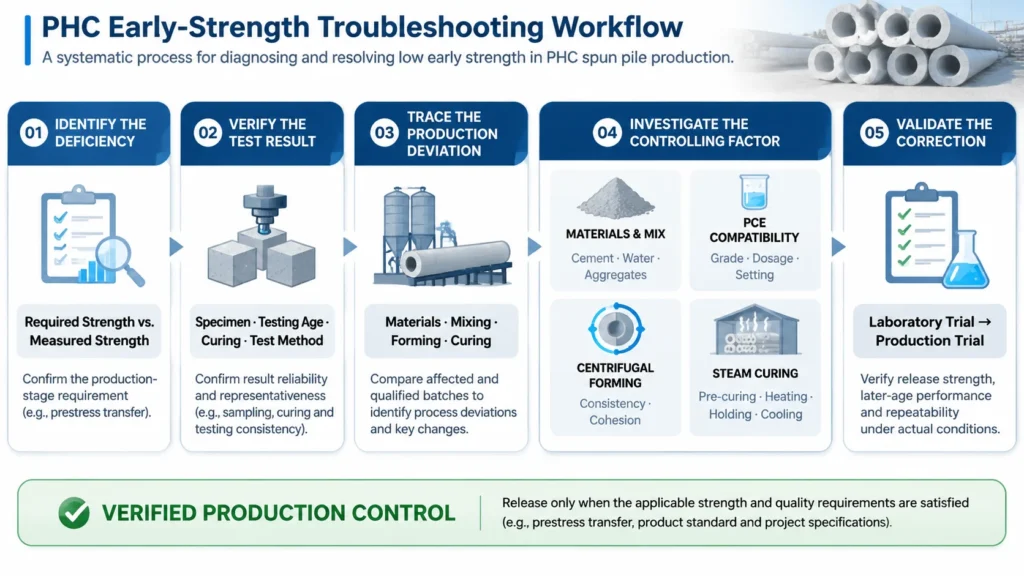
Trace the Problem Through the PHC Production Cycle
Early strength is influenced by the complete manufacturing history, not simply the age of the concrete.
PHC production combines material preparation, batching, mixing, mold feeding, centrifugal forming and accelerated curing.
A deviation at any stage may influence the final strength result.
1. Reconstruct the Production History
For an affected batch, collect the following information.
| Production stage | Information to investigate |
|---|---|
| Material preparation | Cement, aggregates and supplementary cementitious materials |
| Batching and mixing | Actual quantities, effective water and PCE dosage |
| Mold feeding | Placement time and fresh-concrete condition |
| Centrifugal forming | Rotational sequence and approved operating records |
| Pre-curing | Waiting period and temperature conditions |
| Steam curing | Temperature history, heating, holding and cooling |
| Strength assessment | Specimen preparation, curing and test results |
| Release | Prestress-transfer and demolding authorization |
The objective is to identify when the affected batch first deviated from satisfactory production.
2. Compare Affected and Qualified Batches
Select a reference batch that achieved the required early strength under comparable production conditions.
Compare:
- Cement and aggregate sources.
- Actual mix proportions.
- Effective water–binder ratio.
- PCE grade and dosage.
- Initial fresh-concrete properties.
- Mixing and mold-feeding procedures.
- Centrifugal-forming records.
- Steam-curing history.
- Strength results at defined ages.
If initial fresh-concrete properties are comparable but strength development differs, investigate material response and curing conditions.
If the differences are already present immediately after mixing, examine batching, water corrections and admixture preparation.
3. Investigate the Time Before Accelerated Curing
The interval between mixing, mold feeding, centrifugal forming and the beginning of accelerated curing can influence subsequent hydration and strength development.
Record the actual waiting period and relevant concrete or environmental temperatures where available.
Do not assume that extending pre-curing time will always improve performance. Its effect depends on the binder system, concrete temperature and subsequent curing procedure.
4. Establish a Qualified Production Reference
A useful production reference should contain:
- Actual mix proportions.
- Cement and aggregate sources.
- PCE grade and dosage basis.
- Fresh-concrete test results.
- Forming records.
- Complete curing history.
- Early-age and later-age strength results.
A qualified production reference is more valuable than a nominal formulation sheet when investigating an actual manufacturing deviation.
For a more detailed discussion of concrete cohesion, rheology and admixture selection during spinning, see our technical guide to centrifugal forming of PHC spun piles.
Investigate the Concrete Mix and Raw Materials
Once the production history has been reconstructed, investigate whether changes in the concrete material system are responsible for the strength deficiency.
1. Cement Characteristics and Hydration
Cement characteristics influence hydration and early-age strength development.
Important factors include:
- Cement type and strength class.
- Cement source and delivery consistency.
- Fineness and particle-size characteristics.
- Chemical composition.
- Sulfate balance and hydration behavior.
- Compatibility with the selected PCE formulation.
A cement-source change can affect both fresh-concrete behavior and early strength.
Two cements with the same nominal strength class should not automatically be expected to produce identical results.
When a problem appears after a cement change, compare the affected cement with the previous qualified reference using available material data and controlled concrete trials.
2. Effective Water–Binder Ratio
Effective water content is particularly important in high-strength PHC concrete.
Investigate:
- Actual batch water.
- Aggregate moisture corrections.
- Water introduced through liquid admixtures.
- Changes in aggregate absorption or moisture conditions.
- Errors in batching and water measurement.
An unintended increase in effective water–binder ratio may reduce the strength potential of the concrete.
However, reducing water without considering workability, cohesion and centrifugal-forming stability can create additional production problems.
The objective is to maintain the qualified effective water–binder ratio while achieving suitable fresh-concrete behavior.
3. Supplementary Cementitious Materials
Fly ash, ground granulated blast-furnace slag, silica fume and other supplementary cementitious materials may influence early strength differently.
Their effects depend on:
- Material characteristics.
- Replacement percentage.
- Cement composition.
- Particle-size distribution.
- Water–binder ratio.
- Curing conditions.
Some supplementary materials may support later-age performance while requiring additional consideration during early-strength optimization.
Their contribution must be assessed within the complete binder system rather than classified as universally beneficial or detrimental.
4. Aggregate Characteristics
Aggregate grading, moisture, fines content and material consistency influence water demand, packing and concrete behavior.
For PHC mixtures using manufactured sand, changes in fines content, particle shape and grading may alter the water demand and admixture response.
If the problem follows an aggregate-source change, verify whether the actual aggregate characteristics remain consistent with the approved formulation.
5. Evaluate the Complete Formulation
A suitable PHC mixture must balance:
- Controlled effective water–binder ratio.
- Appropriate initial consistency.
- Adequate cohesion during centrifugal forming.
- Suitable hydration and strength development.
- Required release strength.
- Specified later-age performance.
Increasing cement content or reducing water may appear to be simple corrective measures, but both changes can affect workability, hydration, production stability and manufacturing cost.
A formulation adjustment should improve the identified strength deficiency without creating unacceptable fresh-state or finished-product problems.
Investigate the Complete Steam-Curing Cycle
Steam curing is used in many PHC production systems to accelerate hydration and support efficient mold turnover.
However, curing effectiveness depends on the complete temperature–time history rather than the maximum steam temperature alone.
1. Pre-Curing: Establish Appropriate Initial Conditions
Before accelerated heating begins, concrete may require an appropriate initial period for early structural development.
If heating begins too early for the specific mixture and production conditions, subsequent strength development may differ from the qualified reference process.
Record:
- Actual pre-curing duration.
- Ambient temperature.
- Concrete temperature, where available.
- Time between forming and steam exposure.
There is no universal pre-curing duration suitable for every PHC formulation.
Research Evidence
Chen et al. (2025) investigated the effects of pre-curing time and steam-curing conditions on centrifuged PHC concrete.
Under the specific experimental conditions, extending pre-curing time from 2 hours to 4 hours improved strength development but inhibited the growth of fracture energy.
This finding demonstrates that early-strength improvement should not be evaluated independently of other mechanical properties.
The reported 4-hour pre-curing and 9-hour holding condition represented the best overall performance within that study's experimental program. It should not be interpreted as a universal PHC production recommendation [3].
2. Heating: Control the Temperature Increase
The heating stage determines how quickly the concrete is exposed to elevated temperatures.
Review the actual heating profile and compare it with the approved curing procedure.
Excessively rapid heating may produce temperature gradients and associated volumetric stresses.
ACI guidance also identifies excessive heating and cooling rates as conditions that should be avoided during steam curing [1].
3. Holding: Maintain the Qualified Curing Condition
The holding stage maintains the selected curing temperature for a defined period.
Its effectiveness depends on the concrete mixture, temperature distribution, curing equipment and production requirements.
Increasing holding temperature or duration without controlled evaluation may improve a particular early-age result while affecting later-age mechanical properties or durability.
4. Cooling: Control Temperature Reduction
Cooling is part of the complete curing process.
Significant temperature differences between the concrete and its surroundings may introduce thermal stresses.
Review the cooling profile and follow the approved release procedure before prestress transfer, demolding and handling.
5. Compare the Actual Curing Records
| Curing parameter | Diagnostic question |
|---|---|
| Pre-curing duration | Did the affected batch receive a different initial waiting period? |
| Heating profile | Was the temperature increase consistent with the qualified process? |
| Temperature distribution | Were meaningful differences observed between monitored locations? |
| Holding conditions | Was the approved temperature–time condition achieved? |
| Cooling profile | Did cooling differ from the established procedure? |
| Specimen curing | Did test specimens experience representative curing conditions? |
Where temperature distribution is suspected, examine sensor positions and calibration.
A single chamber reading may not represent the curing conditions throughout the entire production system.
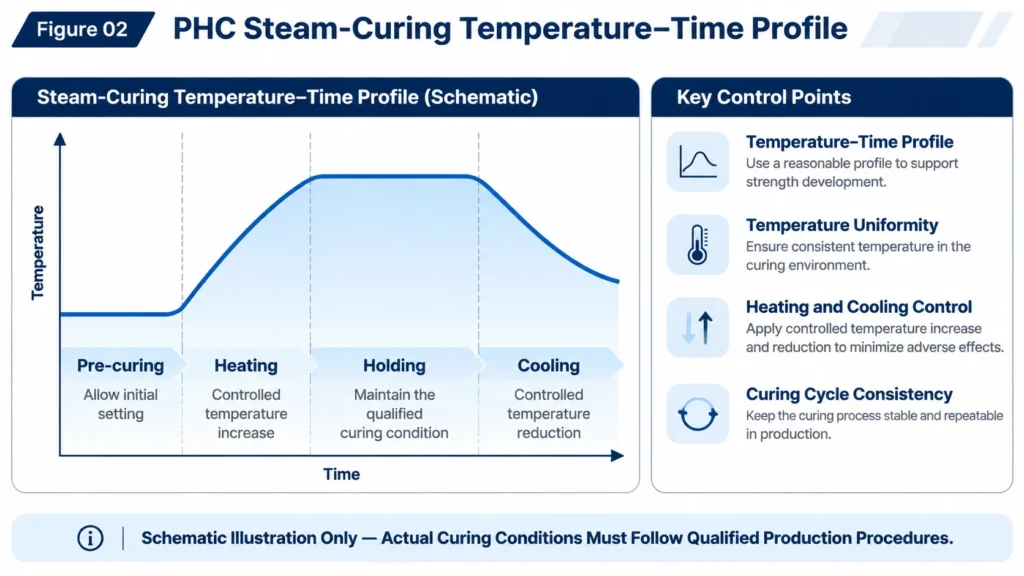
6. Distinguish Atmospheric Steam Curing from Autoclave Curing
Atmospheric steam curing and high-pressure autoclave curing are different processes.
They involve different operating conditions and can produce different hydration products, pore structures and performance characteristics.
Research on PHC pipe piles has compared steam-cured and autoclaved concrete and investigated differences in microstructure and durability [2].
These findings demonstrate why curing recommendations must be specific to the actual manufacturing route.
Optimize the complete curing regime rather than changing one isolated temperature or duration.
Determine Whether PCE Performance Contributes to Low Early Strength
PCE superplasticizers influence water demand, particle dispersion and fresh-concrete behavior in PHC production.
Their contribution to early-strength development must be evaluated within the complete concrete and curing system.
A high water-reduction result does not automatically guarantee the required strength at the planned release stage.
1. Distinguish Water Reduction from Early-Strength Development
A high water-reduction PCE can help reduce effective mixing water while maintaining the required concrete consistency.
This may support the production of high-strength concrete.
However, water reduction and early-strength development are different performance characteristics.
The actual result depends on:
- Cement characteristics.
- PCE molecular structure and formulation.
- Admixture dosage.
- Effective water–binder ratio.
- Setting and hydration behavior.
- Curing conditions.
A PCE that delivers strong initial water reduction does not automatically provide the required strength at a specific production age.
2. Evaluate Early-Strength-Oriented PCE Products
POLYVIA™ offers different PCE powder forms for technical evaluation in PHC production.
ES980 — Coarse Powder
ES980 is an early-strength-oriented PCE powder supplied in coarse form.
It must first be dissolved in water before use. It should not be treated as a direct dry-blending alternative to fine PCE powders.
PW888 — Fine Powder
PW888 is an early-strength-oriented fine PCE powder suitable for dry blending.
Its suitability should be evaluated against the actual binder system, production process and strength-development requirements.
Liquid Early-Strength PCE
Liquid early-strength PCE grades may also be evaluated where the production system uses liquid admixture dosing.
Product specifications, solids content, compatibility and dosage recommendations must be verified against the current technical documentation before selection.
PCE performance can vary significantly with cement composition and material compatibility. Explore our PCE superplasticizer technology and grade-selection guidance for further technical information.
3. Compare Products on an Equivalent Dosage Basis
Powder and liquid describe the supplied physical form, not an independent guarantee of performance.
When comparing products, establish:
- PCE solids dosage relative to binder content.
- Supplied solids concentration.
- Water contribution from liquid products.
- Actual admixture dosage.
- Fresh-concrete response.
- Strength development under the intended curing conditions.
Equal as-supplied mass does not necessarily represent equal PCE solids dosage.
4. Investigate Cement–PCE Compatibility
If early strength changes after switching cement sources or PCE grades, compare the affected materials with the qualified reference.
Review initial consistency, setting behavior where relevant, and strength development under the intended curing regime.
Compatibility should not be diagnosed from a single compressive-strength result.
5. Avoid Increasing PCE Dosage Without Evidence
Increasing PCE dosage may change dispersion and fresh-concrete behavior, but it does not guarantee faster strength development.
An unsuitable dosage adjustment may also affect setting characteristics, mixture stability and production performance.
Any proposed change must be supported by controlled trials.
Select PCE according to the actual strength-development requirement, not simply its product designation or initial water-reduction performance.
Design Controlled Trials to Identify the Limiting Factor
When production records do not establish the cause, controlled trials are necessary to separate formulation effects from curing effects.
The investigation should progress from laboratory screening to representative production validation.
1. Establish a Laboratory Reference
Select a representative mixture and document:
- Binder and aggregate quantities.
- Effective water content.
- PCE grade and dosage basis.
- Initial fresh-concrete properties.
- Mixing procedure.
- Defined curing conditions.
- Strength results at specified ages.
Use the qualified production mixture as the reference wherever possible.
2. Separate the Main Variables
Where practical, investigate one principal variable at a time.
| Trial objective | Variable to investigate | Variables to maintain |
|---|---|---|
| Compare PCE candidates | PCE grade or dosage | Reference mixture and curing procedure |
| Evaluate curing conditions | Curing profile | Qualified mixture and admixture system |
| Investigate cement variation | Cement source | Other principal formulation variables |
| Check water sensitivity | Effective water content | Binder system and other controlled conditions |
If multiple variables must change, use an appropriate trial design and document their individual contributions where possible.
3. Conduct a Representative Production Trial
Laboratory screening cannot fully reproduce PHC manufacturing conditions.
Evaluate promising adjustments under representative production conditions, considering:
- Actual batching equipment.
- Reinforcement arrangement.
- Mold preparation.
- Concrete feeding.
- Centrifugal-forming procedure.
- Steam-curing equipment.
- Production timing.
Record any deviations from the qualified manufacturing reference.
For a broader overview of PCE selection and mix-design considerations across PHC spun piles, precast square piles and concrete sheet piles, see our application guide to PCE superplasticizers for precast concrete piles.
4. Establish a Representative Strength-Testing Basis
Identify the strength result that determines production acceptance.
Specimen preparation, curing and testing methods must follow the applicable specification.
Research on centrifuged PHC concrete has demonstrated that conventional vibrated specimens may not fully represent the mechanical response of centrifugally formed concrete [3].
Where actual pile performance is being evaluated, establish an appropriate relationship between laboratory specimens and production-representative testing.
5. Verify Release Strength and Repeatability
Verify the required concrete strength before authorizing prestress transfer.
Evaluate subsequent demolding and handling according to the approved procedure.
Repeat the relevant trials using representative materials and manufacturing conditions. The number of trials and acceptance criteria should follow the plant's approved quality-control procedures.
Recommended validation sequence:
Laboratory Screening → Representative Production Trial → Release-Strength Verification → Later-Age Performance Confirmation → Repeatability Assessment.
Select Corrective Actions According to the Verified Cause
Once the investigation identifies the main contributing factor, the correction should target that factor rather than unnecessarily changing the entire formulation.
1. Correct Batching and Material Variations
If the problem results from incorrect water correction, inconsistent admixture dosing or changes in raw materials, correct the production deviation first.
A new PCE grade cannot provide a reliable solution while actual batching conditions remain uncontrolled.
2. Adjust the Binder System When Justified
Where controlled trials indicate that binder characteristics are limiting early strength, evaluate suitable formulation changes.
Consider fresh-state properties, centrifugal-forming stability, early and later-age strength, durability requirements and manufacturing cost.
3. Evaluate an Appropriate Early-Strength PCE
If evidence indicates that the existing admixture system is unsuitable, compare appropriate early-strength-oriented PCE candidates.
Evaluate their actual effects under the intended curing regime rather than relying solely on product descriptions or initial consistency results.
4. Review the Steam-Curing Procedure
If the temperature history or curing sequence differs from the qualified reference, investigate whether a controlled adjustment is justified.
Do not simply increase steam temperature or holding duration without evaluating potential effects on later-age performance and microstructure.
5. Maintain Release-Control Requirements
Prestress transfer must not be authorized solely because the scheduled curing period has elapsed.
The required concrete strength must be demonstrated according to the applicable product specification, structural design and approved quality-control procedure.
Demolding and subsequent handling must also follow their respective release requirements.
6. Corrective-Action Decision Matrix
| Verified finding | Corrective direction | Verification |
|---|---|---|
| Incorrect effective water content | Correct batching and moisture calculations | Fresh and hardened concrete results |
| Cement-source variation | Review binder characteristics and compatibility | Controlled material comparison |
| Unsuitable PCE response | Evaluate appropriate PCE grades and dosage | Strength development under actual curing |
| Inconsistent admixture dosing | Correct dosing and calibration | Repeatable batch performance |
| Deviating steam-curing history | Review pre-curing, heating, holding and cooling | Controlled curing trial |
| Unrepresentative strength results | Review sampling, specimens and testing | Valid comparative testing |
| Early strength improves but later performance deteriorates | Reassess formulation and curing balance | Later-age and relevant durability evaluation |
The matrix identifies investigation priorities rather than universal corrective prescriptions.
A successful correction must satisfy the required release strength while maintaining the overall performance of the finished PHC pile.
Establish Reliable Early-Strength Control in PHC Production
Long-term manufacturing efficiency depends on predictable strength development rather than one favorable early-age test result.
1. Establish Qualified Production References
Maintain documented reference mixtures and qualified production records, including:
- Cement and aggregate sources.
- Effective water–binder ratio.
- PCE grade and dosage.
- Fresh-concrete properties.
- Centrifugal-forming parameters.
- Steam-curing history.
- Release-strength and later-age results.
2. Control Material and Production Variations
Maintain consistent raw-material quality, aggregate moisture corrections, effective water content and admixture dosing.
Investigate material-source changes and production deviations before introducing formulation adjustments.
3. Monitor the Complete Curing Process
Maintain traceable records of pre-curing duration, temperature history, heating, holding and cooling.
Compare actual curing conditions with the qualified production reference.
4. Verify Early and Later Performance
A mixture that meets the required early strength must still satisfy applicable later-age strength and durability requirements.
Evaluate changes to the formulation or curing procedure against the complete product-performance requirements.
5. POLYVIA™ Practical Engineering Principle
Early-strength optimization in PHC production is not simply a matter of increasing cement content, reducing water or selecting an early-strength admixture.
It requires coordination of:
Material Compatibility → Effective Water Control → PCE Performance → Centrifugal Forming → Steam Curing → Verified Release Strength
The most reliable solution is one that achieves the required production strength under controlled conditions while maintaining the quality of the finished pile.
Identify the strength shortfall. Find the controlling variable. Validate the correction. Release only against verified requirements.
FAQ
1. Why does PHC pile concrete fail to reach the required early strength after steam curing?
Possible causes include cement characteristics, effective water content, PCE compatibility, batching variation, pre-curing conditions and the actual steam-curing history.
The investigation should compare the affected batch with a qualified production reference and verify that specimen preparation and curing conditions are representative.
2. What is the difference between demolding strength and prestress-transfer strength?
Prestress-transfer strength is the concrete strength required before prestressing force is transferred to the concrete member.
Demolding concerns mold release and subsequent handling. The required strength and sequence of these operations must follow the applicable design and manufacturing procedure.
3. Can early-strength PCE improve PHC pile production efficiency?
An appropriate early-strength PCE may support the required strength-development target and help optimize production cycles.
Its effectiveness depends on cement characteristics, mixture proportions, dosage, water content and curing conditions. Actual release strength must be verified before production adoption.
4. Can excessive PCE dosage delay early strength development?
It can, depending on the PCE formulation, dosage and cementitious system. An unsuitable dosage may influence setting behavior and hydration development.
However, dosage alone cannot establish the cause. Controlled comparison of admixture dosage, setting behavior and compressive-strength development is necessary.
5. How should steam curing be adjusted when PHC early strength is insufficient?
First review pre-curing duration, heating rate, holding conditions and cooling history against the qualified production process.
Adjustments should be evaluated through controlled trials because increasing temperature or curing duration does not automatically produce better overall concrete performance.
6. Can changing the cement source affect PHC prestress-transfer strength?
Yes. Changes in cement characteristics may influence hydration, setting behavior and PCE compatibility.
When early strength declines after a cement-source change, compare the new cement with the previous reference and conduct controlled trials under representative curing conditions.
7. Can conventional cube strength represent centrifuged PHC pile concrete?
Not automatically. Conventional vibrated specimens may not reproduce the compaction and material distribution associated with centrifugal forming.
A suitable relationship between laboratory testing and production-representative concrete must be established before using laboratory results to infer finished-pile performance.
8. Can PHC spun piles be released solely according to a fixed steam-curing time?
No. Curing time alone does not establish that the required concrete strength has been achieved.
Prestress transfer, demolding and handling must follow their respective strength criteria and approved factory quality-control procedures.
Scientific and Technical References
[1] American Concrete Institute (ACI). When Is Steam Curing Used? ACI Technical Questions and Answers.
https://www.concrete.org/frequentlyaskedquestions/faqid/801.aspx
[2] Liu, Z., Bu, L., Wang, Z., & Hu, G. (2019). Durability and microstructure of steam cured and autoclaved PHC pipe piles. Construction and Building Materials, 209, 679–689.
https://doi.org/10.1016/j.conbuildmat.2019.03.166
[3] Chen, Y., Li, X., Xu, W., Miao, H., & Zuo, X. (2025). Experimental investigation and statistical evaluation of mechanical properties of centrifuged PHC pipe pile concrete. Structures, 82, 110821.
https://doi.org/10.1016/j.istruc.2025.110821
[4] Jiang, Y. (2012). Concrete admixtures in the PHC pile production. Applied Mechanics and Materials, 174–177, 1410–1414.
https://doi.org/10.4028/www.scientific.net/AMM.174-177.1410
Reference Scope
Reference [1] supports general steam-curing principles and cautions regarding heating and cooling rates.
Reference [2] investigates the microstructure and durability of steam-cured and autoclaved PHC pipe piles.
Reference [3] examines the mechanical properties of centrifuged PHC concrete and the limitations of conventional vibrated specimens.
Reference [4] provides background on supplementary cementitious materials and mix-design considerations in PHC production.
These publications do not establish universal prestress-transfer strength, demolding-strength thresholds, curing schedules or POLYVIA™ product dosage recommendations.
Actual requirements must follow applicable standards, structural design, product specifications and validated factory procedures.
Technical Application Note
This article provides engineering troubleshooting guidance rather than guaranteed product performance or results from a specific POLYVIA™ production line.
Actual recommendations depend on the cementitious materials, mix design, centrifugal-forming process, curing system, testing methods and applicable product requirements.
Changes affecting concrete formulation, curing procedures, prestress transfer or demolding must undergo the manufacturer's established technical and quality-control approval.
POLYVIA™ · MATERIAL SCIENCE & CONCRETE PERFORMANCE