
PCE Flake vs Liquid PCE
Technical Differences, Dissolution, Transportation and Cost Comparison
PCE Flake and Liquid PCE offer different supply and production options for concrete admixture manufacturers. Compare solid content, dissolution requirements, transportation, storage and formulation costs to determine whether local liquid preparation or ready-to-use liquid supply better fits your production system.
INTRODUCTION
Choosing Between Concentrated Solid Supply and Ready-to-Use Liquid PCE
For concrete admixture manufacturers, importers and regional distributors, selecting between PCE Flake and Liquid PCE is an important supply-chain and production decision.
The choice affects more than the purchase price. It determines how much material must be transported, whether local dissolution facilities are required, how prepared solutions are stored and how the final admixture is incorporated into production.
PCE Flake is a concentrated solid form of polycarboxylate ether superplasticizer that can be dissolved in water to prepare a liquid solution. Liquid PCE is supplied as an aqueous product with a specified solid content, reducing the need for a separate dissolution operation before downstream use.
The fundamental difference is the supply and production route: PCE Flake requires local solution preparation, whereas Liquid PCE is supplied in an already prepared aqueous form.
PCE Flake may offer logistical and formulation advantages to manufacturers with suitable local processing facilities. Liquid PCE may be more practical for customers who prioritize ready-to-use supply and established liquid dosing systems.
Neither form is universally more economical or technically superior. The appropriate choice depends on transportation costs, production capacity, dissolution facilities, product specifications, cement compatibility and the cost of achieving the required performance.
This guide examines these factors to help manufacturers make an informed purchasing and production decision.
Explore the POLYVIA™ PCE superplasticizer portfolio to compare available supply forms and performance options.
WHAT ARE PCE FLAKE AND LIQUID PCE?
Understanding the Two Supply Forms
PCE Flake and Liquid PCE are two supply forms of polycarboxylate ether superplasticizer technology.
Both are used in concrete admixture systems, but their physical characteristics create different requirements for transportation, preparation, storage and dosing.
1. PCE Flake
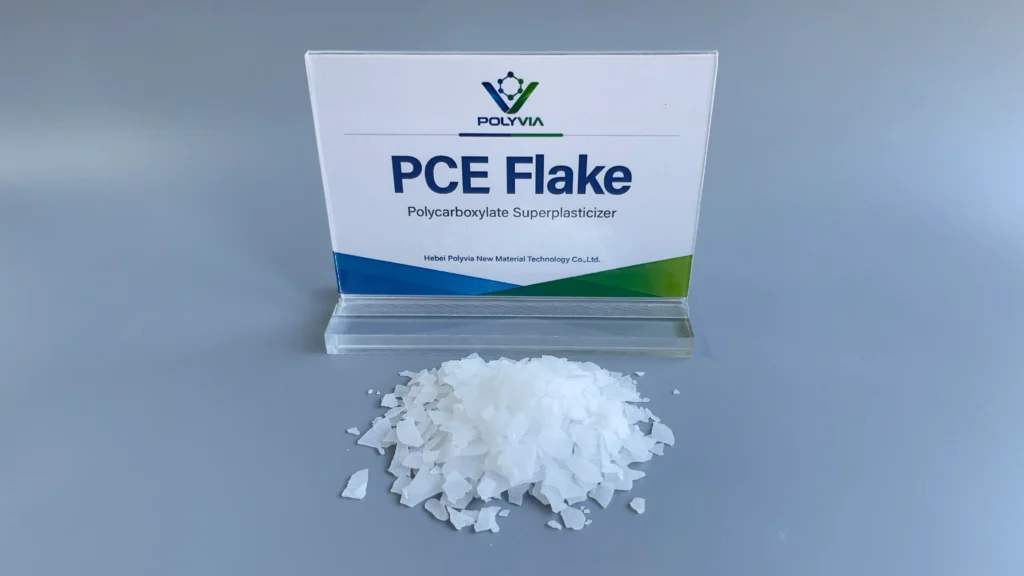
PCE Flake is a solid form of polycarboxylate ether superplasticizer supplied as concentrated flakes.
It typically has a high product-solids content and is intended for dissolution before use in liquid admixture applications.
POLYVIA™ offers two PCE Flake grades:
- F970: ≥97% solid content, designed for slump-retention applications.
- F980: ≥98% solid content, designed for high-water-reduction applications.
Key characteristics include:
- High product-solids concentration.
- Relatively low water content during transportation.
- Suitability for local liquid solution preparation.
- Flexibility in preparing different target solid concentrations.
- Reduced transportation of water compared with conventional liquid products.
PCE Flake is particularly relevant to manufacturers that have their own admixture preparation facilities or want to establish regional liquid PCE production.
Typical downstream applications include:
- Ready-mix concrete admixture manufacturing.
- Precast concrete admixture production.
- High-performance concrete admixtures.
- PHC and prestressed concrete admixture preparation.
- Regional construction chemical distribution.
PCE Flake should generally be treated as a concentrated raw material or intermediate for downstream processing rather than as a conventional ready-to-dose liquid admixture.
2. Liquid PCE
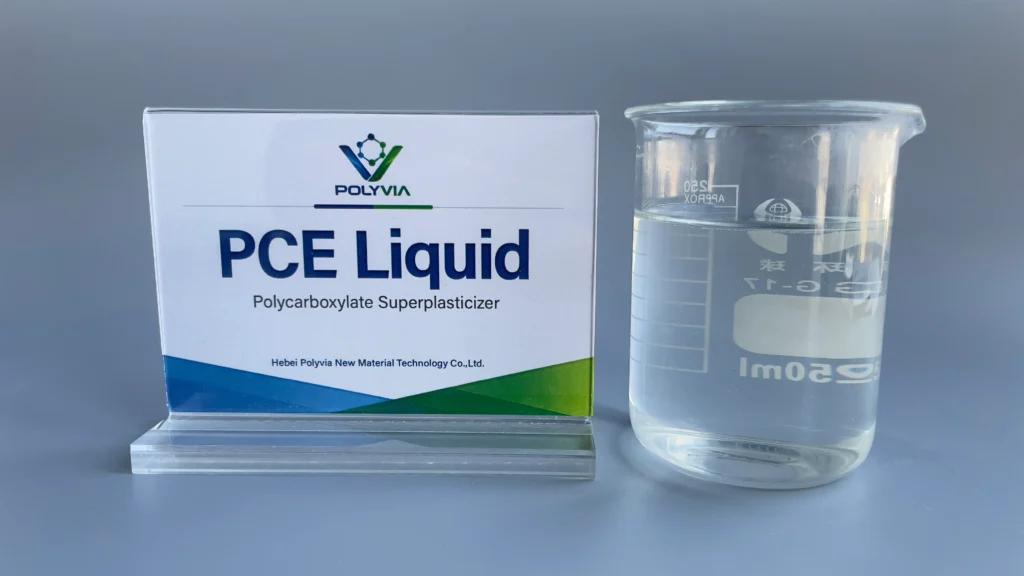
Liquid PCE is an aqueous solution of polycarboxylate ether superplasticizer supplied in a prepared liquid form.
POLYVIA™ Liquid PCE has two standard solid-content specifications:
- 40% ± 1%.
- 50% ± 1%.
The available solid-content specification depends on the selected product grade and supply requirements.
Different liquid PCE grades are designed for specific performance requirements, including:
- High water reduction.
- Slump retention.
- Early strength.
- Balanced performance.
- Set retardation.
- Clay resistance and slump retention.
Key characteristics include:
- Ready-to-use liquid supply form.
- No separate flake dissolution process.
- Compatibility with liquid storage tanks and metering systems.
- Convenient integration into admixture blending and concrete batching operations.
- Reduced preparation requirements for customers with existing liquid production facilities.
Typical applications include ready-mix concrete, precast concrete, prestressed concrete, self-compacting concrete and high-performance concrete.
The actual performance depends on the selected polymer formulation, product grade, dosage and compatibility with the intended cementitious materials.
KEY ADVANTAGES OF PCE FLAKE
Why Do Manufacturers Choose PCE Flake?
PCE Flake offers several advantages for customers that have the ability to prepare and formulate liquid admixtures locally.
1. High Product-Solids Concentration
PCE Flake contains a high proportion of product solids and relatively little water.
This allows more product solids to be transported per unit of shipment weight compared with conventional 40% or 50% liquid PCE products.
For international shipments, this can improve freight efficiency when products are compared on an equivalent product-solids basis.
2. Flexible Local Liquid Preparation
PCE Flake can be dissolved in water to prepare liquid PCE solutions.
Manufacturers can calculate the required water addition according to the actual solid content of the flakes and the target solution concentration.
This provides flexibility for customers who want to prepare liquid intermediates locally rather than import ready-made aqueous products.
3. Reduced Transportation of Water
When customers import PCE Flake instead of equivalent product-solids quantities of Liquid PCE, less total shipment weight is required.
Water can be added near the point of use rather than being transported over long international distances.
This may reduce freight expenditure, although actual savings depend on packaging, container utilization and shipping conditions.
4. Local Formulation Flexibility
After appropriate dissolution, the prepared solution can be used as a raw material in downstream liquid admixture formulation.
This enables manufacturers to manage local preparation and formulate products according to their technical and commercial requirements.
For example, customers can prepare a liquid solution from F970 or F980 and subsequently evaluate it in their own admixture formulations.
However, the performance characteristics of the prepared solution should be verified before it is incorporated into commercial products.
Limitations of PCE Flake
PCE Flake also introduces additional operational requirements:
- A suitable dissolution tank is required.
- Water quality and preparation conditions must be controlled.
- Dissolution time must be incorporated into the production schedule.
- Solution concentration and homogeneity require quality control.
- Additional labor and equipment operating costs may be involved.
- The prepared solution requires appropriate storage management.
Therefore, PCE Flake is most attractive when the customer has sufficient local preparation capacity and a clear economic reason to convert the concentrated solid material into liquid PCE.
KEY ADVANTAGES OF LIQUID PCE
Why Do Manufacturers Choose Ready-to-Use Liquid PCE?
Liquid PCE offers operational convenience for customers that already operate liquid admixture production or concrete batching systems.
1. No Separate Flake Dissolution Process
Liquid PCE is supplied as an aqueous solution.
Customers do not need to conduct an additional flake dissolution operation before using the product in their downstream formulation or dosing process.
2. Convenient Liquid Handling
Liquid PCE can be transferred through suitable storage tanks, pipelines and metering pumps.
This makes it convenient for automated production systems and facilities with established liquid handling infrastructure.
3. Simplified Production Scheduling
Customers can use the supplied liquid product according to their production requirements without scheduling a separate soaking and dissolution operation.
This can be particularly valuable for facilities with frequent production changes or limited solution preparation capacity.
4. Reduced Local Preparation Requirements
Direct liquid supply reduces the need for customers to invest in separate flake dissolution facilities, preparation tanks and additional quality-control procedures associated with local conversion.
Limitations of Liquid PCE
Liquid PCE also has commercial and operational considerations:
- Transportation includes the water contained in the product.
- More shipment weight is required for equivalent product-solids quantities.
- Larger storage volume may be needed.
- Liquid storage facilities require suitable temperature and contamination control.
- Long-distance logistics may increase total landed costs.
For customers importing large quantities of liquid PCE over long distances, transportation of water can become an important part of the total procurement cost.
TECHNICAL COMPARISON: PCE FLAKE VS LIQUID PCE
Key Differences Between the Two Supply Forms
| Comparison | PCE Flake | Liquid PCE |
|---|---|---|
| Physical form | Solid flakes | Aqueous solution |
| POLYVIA product examples | F970 / F980 | HWR / SR / ES / GP and other grades |
| Solid content | F970 ≥97%; F980 ≥98% | 40% ± 1% / 50% ± 1% |
| Water content | Low | Relatively high |
| Transportation | High efficiency on a product-solids basis | Shipment weight includes water |
| Storage before use | Dry, moisture-protected storage | Suitable liquid storage |
| Dissolution | Required for liquid preparation | Already supplied in liquid form |
| Local formulation | Requires dissolution first | Can be used as a liquid raw material |
| Equipment | Dissolution tank and mixing equipment | Liquid storage and handling equipment |
| Preparation time | Additional preparation required | No separate flake dissolution |
| Production flexibility | Flexible local solution preparation | Convenient direct liquid handling |
| Logistics | Potentially advantageous for concentrated transport | Depends on freight distance and supply arrangements |
Does PCE Flake Have Better Water-Reduction Performance Than Liquid PCE?
Not necessarily.
The physical supply form does not independently determine water-reduction performance.
PCE performance is influenced by:
- Polymer molecular structure.
- Molecular weight and distribution.
- Carboxylate group characteristics.
- Polyether side-chain design.
- Product formulation.
- Dosage.
- Cement chemistry and compatibility.
PCE Flake and Liquid PCE products may have different polymer formulations or performance designs.
For example, POLYVIA™ F970 is positioned for slump retention, while F980 is positioned for high water reduction.
A commercially supplied Liquid PCE may have a different polymer formulation or additional formulation components.
Therefore, dissolving PCE Flake to a similar solid concentration does not automatically produce a solution with identical performance to a commercial Liquid PCE grade.
The correct comparison must consider both product composition and performance under the intended cementitious application conditions.
HOW TO DISSOLVE PCE FLAKE
General Preparation Principles for PCE Flake Solutions
Dissolution is one of the most important operational differences between PCE Flake and Liquid PCE.
A suitable preparation procedure is essential to achieve a homogeneous solution with the required solid concentration.
Although individual PCE Flake grades may have different dissolution characteristics, the general preparation process involves water preparation, gradual material addition, sufficient contact time, appropriate agitation and solution quality verification.
1. Water Preparation and Temperature
Use suitable clean water for dissolution.
Water quality and temperature can influence preparation behavior and the consistency of the resulting solution.
For POLYVIA's current preparation reference, normal-temperature water at approximately 25°C is used.
The actual water temperature should be monitored during preparation, especially when preparing large batches.
Avoid assuming that every PCE Flake product has identical dissolution behavior.
2. Flake Addition and Soaking
Calculate the required flake quantity and water addition based on the measured product solid content and target solution concentration.
Add the flakes into the prepared water under an appropriate handling procedure.
Gradual addition can help reduce localized accumulation and improve contact between the flakes and water.
For POLYVIA's factory preparation practice, the recommended process is to allow the flakes to soak overnight and mix the following day.
This approach allows the material to remain in contact with water before the main mixing operation and provides a practical preparation schedule for factory production.
3. Agitation and Dissolution
After sufficient soaking, mix the prepared material using a suitable agitation system.
The mixing conditions should be selected according to:
- Batch size.
- Dissolution tank geometry.
- Water-to-flake ratio.
- Agitator design.
- Product characteristics.
- Required solution concentration.
The objective is to obtain a homogeneous solution without persistent undissolved flakes.
Do not assume that a fixed laboratory mixing time can be directly transferred to industrial-scale production.
4. How to Check Whether PCE Flake Has Dissolved Properly
Successful dissolution should be evaluated through both visual inspection and appropriate quality checks.
Recommended checks include:
Visual Homogeneity
The solution should have a consistent appearance without obvious undissolved flakes or persistent localized accumulation.
Product-Solids Concentration
Measure the prepared solution's solid content using the applicable quality-control method.
Batch Consistency
Compare the measured concentration and appearance with the established preparation specifications.
Application Suitability
Where necessary, conduct cement paste, mortar or concrete trials to verify the solution's suitability for the intended application.
Visual inspection alone cannot establish complete dissolution or guarantee consistent concrete performance.
5. POLYVIA Factory Preparation Reference
POLYVIA's current preparation experience provides the following practical reference:
- Normal-temperature water at approximately 25°C.
- Laboratory dissolution time of approximately one hour under the referenced laboratory conditions.
- Factory preparation by overnight soaking followed by mixing the next day.
These references describe POLYVIA's current preparation practice and should be adjusted where product grade, batch size or equipment differs.
The laboratory reference time should not be treated as a universal dissolution specification for every PCE Flake grade.
SOLID CONTENT AND DILUTION CALCULATION
How Much Liquid Solution Can Be Prepared from PCE Flake?
The quantity of liquid solution prepared from PCE Flake depends on its actual product-solids content and the target solution concentration.
POLYVIA™ offers two PCE Flake grades:
| Product Model | Solid Content | Performance Focus |
|---|---|---|
| F970 | ≥97% | Slump Retention |
| F980 | ≥98% | High Water Reduction |
Liquid PCE has two standard solid-content specifications:
- 40% ± 1%.
- 50% ± 1%.
The following examples use the minimum specified solid content of each flake grade.
1. Basic Calculation Formula
Product Solids (kg) = Flake Weight (kg) × Actual Solid Content (%)
Final Solution Weight (kg) = Product Solids (kg) ÷ Target Solid Content (%)
Water Addition (kg) = Final Solution Weight − Flake Weight
The actual batch COA should be used when determining production quantities.
2. F980 Dilution Examples
Based on a solid content of 98%:
| Target Solution Solids | F980 | Added Water | Final Solution |
|---|---|---|---|
| 20% | 25 kg | 97.5 kg | 122.5 kg |
| 40% | 25 kg | 36.25 kg | 61.25 kg |
| 50% | 25 kg | 24 kg | 49 kg |
For example, 25 kg of F980 containing 98% solids provides 24.5 kg of product solids.
To prepare a 20% solution:
24.5 ÷ 20% = 122.5 kg final solution.
Water addition:
122.5 − 25 = 97.5 kg.
3. F970 Dilution Examples
Based on a solid content of 97%:
| Target Solution Solids | F970 | Added Water | Final Solution |
|---|---|---|---|
| 20% | 25 kg | 96.25 kg | 121.25 kg |
| 40% | 25 kg | 35.625 kg | 60.625 kg |
| 50% | 25 kg | 23.5 kg | 48.5 kg |
These calculations use the minimum specified solid content of 97%.
If the actual COA shows a higher solid content, the water addition should be adjusted accordingly.
4. Preparing Approximately 49% Solution from F980
A practical example is:
- F980: 1,000 kg.
- Added water: 1,000 kg.
- Final solution: 2,000 kg.
Calculation:
1,000 × 98% = 980 kg product solids.
980 ÷ 2,000 × 100% = 49%.
Therefore, the theoretical final solution contains approximately 49% product solids.
This is close to the nominal concentration of POLYVIA's 50% ± 1% Liquid PCE specification.
However, this numerical similarity does not establish that the prepared solution meets every specification or performance requirement of a commercial 50% Liquid PCE product.
5. Product Solids and Active Polymer Content
Solid-content calculations establish the mass balance of product solids and added water.
They do not establish:
- Equal active polymer content.
- Equivalent polymer composition.
- Identical viscosity.
- Equal cement compatibility.
- Equivalent water-reduction performance.
- Identical concrete setting or strength behavior.
A prepared PCE Flake solution should be tested against the intended liquid admixture requirements before commercial use.
STORAGE, STABILITY AND HANDLING
How Should PCE Flake and Prepared Solutions Be Stored?
Storage requirements differ between solid PCE Flake and the liquid solution prepared from it.
1. Storage of PCE Flake
PCE Flake should be protected against moisture and unsuitable storage conditions.
Recommended handling practices include:
- Keep original packaging sealed.
- Store in a dry and suitable warehouse.
- Avoid direct contact with water.
- Prevent packaging damage.
- Maintain product batch identification.
- Follow the product-specific TDS for storage conditions and shelf life.
Moisture exposure should be avoided because it may affect product handling and subsequent preparation.
2. Storage of Prepared PCE Flake Solution
After dissolution, the prepared PCE solution can generally be stored for approximately 6–7 days under normal factory storage and handling practices.
Same-day use is recommended whenever possible to support efficient production management and minimize prolonged storage.
However, if the solution is not used immediately, it can generally be retained for approximately 6–7 days under appropriate factory storage conditions.
During storage:
- Use a clean and suitable storage tank.
- Prevent contamination.
- Maintain appropriate storage hygiene.
- Monitor solution appearance and homogeneity.
- Check relevant quality characteristics before use.
The actual condition of the prepared solution should be verified before it is introduced into downstream admixture formulation or concrete production.
3. Storage of Commercial Liquid PCE
Commercial Liquid PCE should be stored according to its product-specific TDS.
Suitable chemical storage containers or tanks should be used, with appropriate protection against contamination and unsuitable temperature exposure.
Storage duration and temperature requirements should be confirmed using the supplied product documentation.
TRANSPORTATION AND TOTAL COST COMPARISON
Which Supply Form Offers Better Logistics Economics?
Transportation is one of the strongest reasons why manufacturers consider PCE Flake.
When a customer imports Liquid PCE, the shipment includes both product solids and water.
When the customer imports PCE Flake, most of the transported material consists of product solids, while water can be added locally.
This can reduce international freight requirements for equivalent product-solids quantities.
1. Comparing Transportation Weight
Consider two supply options containing the same quantity of product solids.
Option A — Liquid PCE at 50% Solid Content
To transport 980 kg of product solids:
- Liquid PCE required: 1,960 kg.
- Product solids: 980 kg.
- Water contained in the product: 980 kg.
Option B — PCE F980 at 98% Solid Content
To transport the same 980 kg of product solids:
- F980 required: 1,000 kg.
- Product solids: 980 kg.
- Other mass: 20 kg.
| Item | Liquid PCE 50% | F980 98% |
|---|---|---|
| Product Weight | 1,960 kg | 1,000 kg |
| Product Solids | 980 kg | 980 kg |
| Water / Other Mass | 980 kg | 20 kg |
On this theoretical product-solids basis, F980 requires approximately 960 kg less shipment weight.
For F970, the same calculation should use its actual solid content. At the minimum specified 97%, approximately 1,010.3 kg of F970 is required to transport 980 kg of product solids.
Actual freight savings depend on packaging, container utilization, shipment arrangements and applicable freight rates.
2. Comparing Landed Product Cost
A meaningful comparison should include:
- Product purchase price.
- International freight.
- Insurance and handling.
- Packaging.
- Import charges.
- Local transportation.
- Warehouse costs.
A useful initial calculation is:
Landed Cost per kg of Product Solids = Total Landed Product Cost ÷ Total Product Solids
This allows buyers to compare the cost of transporting equivalent quantities of product solids.
However, it is only the first stage of economic evaluation.
3. Local Dissolution and Production Costs
When selecting PCE Flake, customers should also account for:
- Dissolution tank investment.
- Agitation equipment.
- Electricity consumption.
- Preparation labor.
- Water consumption.
- Quality-control costs.
- Storage tank capacity.
- Solution losses.
- Production scheduling requirements.
Liquid PCE may have a higher transportation burden but lower local preparation requirements.
PCE Flake may reduce imported shipment weight but requires additional local processing.
4. Total Supply-Chain Cost Comparison
A more complete cost model should include the following:
PCE Flake Supply Cost
Product Purchase + International Freight + Import Charges + Local Transportation + Dissolution + Labor + Water + Quality Control + Storage.
Liquid PCE Supply Cost
Product Purchase + International Freight + Import Charges + Local Transportation + Storage + Handling.
The actual costs will vary according to the customer's location, production scale, equipment and procurement arrangements.
5. Comparing Cost per Unit of Finished Performance
For concrete admixture manufacturers, the most meaningful economic comparison is not simply the cost per ton of raw material.
It is the cost of achieving the same required finished-admixture or concrete performance.
For concrete applications, a useful starting calculation is:
Admixture Material Cost per m³ = Actual Product Dosage (kg/m³) × Landed Product Price (USD/kg)
For PCE Flake, the calculation must account for the quantity of flake required to prepare the solution, as well as the preparation costs.
The final evaluation should also include local dissolution, formulation, labor, storage and quality-control costs.
The required dosage must be determined through actual trials using comparable materials and performance targets.
PCE Flake offers a commercial advantage only when the savings in logistics and supply-chain costs exceed the additional costs of local preparation and quality control.
6. Thailand Customer Case: Local Liquid Preparation from PCE Flake
A practical example of this supply model is POLYVIA's customer application in Thailand.
Customer Challenge
The customer previously imported Liquid PCE containing approximately 50% water. Transporting this water over long international distances increased shipment weight and associated freight costs.
POLYVIA™ Solution
POLYVIA recommended PCE F980 Flake for local liquid preparation.
Using an assumed solid content of 98%, the customer can theoretically prepare approximately 2 MT of liquid solution at 49% solid content from:
- PCE F980: 1 MT.
- Water: 1 MT.
Supply Model
Imported PCE F980 → Local Dissolution → Liquid PCE Preparation → Local Admixture Formulation.
This case illustrates how concentrated PCE Flake can support local solution preparation and reduce the need to transport water internationally.
The example demonstrates a logistics and supply-chain approach, not a quantified freight-saving percentage or proof of identical performance to every commercial Liquid PCE grade.
Read our PCE supply and local formulation case in Thailand to understand how concentrated PCE Flake can support regional liquid preparation.
APPLICATION-BASED SELECTION
Which Supply Form Is More Suitable for Different Customers?
The choice between PCE Flake and Liquid PCE should reflect the customer's production model.
1. Concrete Admixture Manufacturers
Recommended consideration: PCE Flake
Manufacturers with existing liquid admixture production facilities may benefit from purchasing concentrated PCE Flake and preparing liquid solutions locally.
This can support:
- Regional liquid PCE production.
- Local formulation adjustments.
- Concentrated raw-material transportation.
- Flexible inventory management.
F970 can be considered where slump-retention performance is required, while F980 is positioned for high-water-reduction applications.
Suitable dissolution facilities and quality-control procedures remain essential.
2. Ready-Mix Concrete Producers
Recommended consideration: Liquid PCE
Ready-mix concrete plants commonly operate liquid admixture storage and automated dosing systems.
Liquid PCE can be integrated directly into these systems without requiring the customer to establish a separate flake dissolution operation.
PCE Flake may be considered where the customer has centralized admixture preparation facilities or operates an integrated local admixture manufacturing system.
3. Precast Concrete Manufacturers
Recommended consideration: Both options
Precast manufacturers should evaluate production scale, admixture consumption, available equipment and supply arrangements.
A factory with its own admixture preparation facility may consider PCE Flake for local solution preparation.
A factory relying on external admixture suppliers may find Liquid PCE more convenient.
The final selection should also consider early-strength requirements, demolding schedules and the actual performance of the selected formulation.
4. PHC Spun Pile Production
Recommended consideration: Both options, subject to process verification
PHC spun pile production requires careful control of workability, water-to-binder ratio, centrifugal forming behavior and early-strength development.
PCE Flake can be prepared as a liquid solution and evaluated as a raw material for admixture formulation.
Liquid PCE can be used directly through compatible liquid admixture systems.
The final selection should consider cement compatibility, required concrete consistency, curing conditions and demolding targets.
Neither supply form should be assumed to provide superior PHC performance without comparative production trials.
5. International PCE Distributors and Importers
Recommended consideration: PCE Flake where local preparation is available
Regional distributors and admixture manufacturers may consider PCE Flake when they have:
- Sufficient local storage capacity.
- Suitable solution preparation equipment.
- Reliable access to preparation water.
- Quality-control facilities.
- Consistent regional demand.
For distributors supplying customers who require ready-to-use admixtures, Liquid PCE may remain the more practical option.
HOW TO EVALUATE DISSOLVED PCE FLAKE PERFORMANCE
From Solution Preparation to Concrete Performance
Successful dissolution does not automatically establish the final performance of the prepared PCE solution.
A proper evaluation should separate two stages.
Stage 1: Solution Preparation and Quality Control
Verify:
- Dissolution consistency.
- Target solid content.
- Solution homogeneity.
- Batch-to-batch repeatability.
- Storage behavior under the intended conditions.
Stage 2: Cementitious Performance Evaluation
After solution preparation has been verified, evaluate the PCE solution in the intended cementitious system.
Recommended tests include:
| Test Item | Evaluation Purpose |
|---|---|
| Cement paste flow | Initial dispersion behavior |
| Mortar flow | Practical workability |
| Concrete slump or slump flow | Fresh concrete consistency |
| Workability retention | Flow development over time |
| Setting time | Influence on setting behavior |
| Air content | Fresh concrete quality |
| Compressive strength | Hardened concrete performance |
The test methods should be selected according to the intended application and applicable standards.
Recommended Comparative Testing Procedure
Step 1 — Verify Product Specifications
Record the flake model, batch, actual solid content and relevant product documentation.
Step 2 — Prepare the Solution
Use the preparation procedure appropriate for the selected grade.
Step 3 — Verify Solution Quality
Check concentration, homogeneity and storage condition.
Step 4 — Establish a Reference Liquid PCE
Select a suitable commercial Liquid PCE grade for comparison.
Step 5 — Establish Comparable Dosage Conditions
Calculate initial dosages on a product-solids basis, account for admixture water and conduct dosage optimization trials.
Step 6 — Evaluate Fresh and Hardened Performance
Measure the properties required by the intended concrete or mortar application.
Step 7 — Compare the Actual Operating Cost
Determine the cost of achieving the same specified performance, including raw material, freight, local preparation and operating expenses.
This process helps determine whether locally prepared PCE Flake solution is suitable for the customer's specific production system.
HOW TO CHOOSE THE RIGHT PCE FORM
A Practical Decision Framework
Before choosing PCE Flake or Liquid PCE, manufacturers should evaluate six questions.
1. Do You Have Local Dissolution Facilities?
If suitable preparation tanks, agitation equipment and quality-control facilities are available, PCE Flake may be considered.
2. What Is Your Annual PCE Consumption?
Larger and more consistent consumption volumes may improve the commercial case for local solution preparation.
However, the actual decision depends on investment, logistics and operating costs.
3. How Far Must the Product Be Transported?
Longer international shipping distances may increase the importance of transportation-weight savings.
4. Can Your Production Schedule Accommodate Dissolution?
PCE Flake requires a planned soaking and mixing process. Customers should account for preparation time and inventory scheduling.
5. Can You Maintain Prepared-Solution Quality?
The customer should be able to monitor solution concentration, homogeneity and storage condition.
6. What Is the Actual Cost of Achieving Your Required Performance?
Compare the complete landed and operating costs rather than relying only on the purchase price per metric ton.
The final choice should be based on actual production requirements and validated application performance.
POLYVIA™ PCE Product Options
POLYVIA™ provides concentrated PCE Flake and Liquid PCE solutions for different supply and production requirements.
PCE Flake — Two Product Grades
| Product Model | Performance Focus | Solid Content |
|---|---|---|
| F970 | Slump Retention | ≥97% |
| F980 | High Water Reduction | ≥98% |
F970 and F980 are designed for different concrete performance requirements. Product selection should consider the required balance between workability retention and water reduction.
Liquid PCE — Performance-Based Grades
| Product Series | Performance Focus |
|---|---|
| HWR | High Water Reduction |
| SR | Slump Retention |
| ES | Early Strength |
| GP | Balanced Performance |
| RET | Set Retarding |
| CSR | Clay Resistance & Slump Retention |
These products have different performance designs and supply characteristics. A solution prepared from PCE Flake should not automatically be considered equivalent to every commercial Liquid PCE grade.
For a comparison of powder and liquid PCE supply forms, read our technical guide to PCE Powder vs Liquid PCE.
POLYVIA™ provides technical support to help customers evaluate suitable PCE products and local preparation options.
FAQ
1. What is the difference between PCE Flake and Liquid PCE?
PCE Flake is a concentrated solid form of polycarboxylate ether superplasticizer that requires dissolution before liquid application. Liquid PCE is supplied as an aqueous solution and does not require a separate flake dissolution process. Their main differences involve transportation, preparation, storage, handling and production compatibility.
2. What is the solid content of POLYVIA™ PCE Flake?
POLYVIA™ offers two PCE Flake grades: F970 with a specified solid content of ≥97% and F980 with a specified solid content of ≥98%. Their performance positioning also differs: F970 is designed for slump retention, while F980 is designed for high water reduction.
3. How do you dissolve PCE Flake?
The general preparation process involves preparing suitable water, gradually adding the flakes, allowing sufficient contact time, mixing under appropriate agitation and verifying solution homogeneity and solid content. Exact preparation conditions depend on the flake grade and production equipment.
4. How long does PCE Flake take to dissolve?
PCE Flake typically takes approximately 1 hour to dissolve under normal preparation conditions using water at around 25°C.
For large-scale construction site applications, it is recommended to add PCE Flake to water and soak it overnight, then stir the solution the following day before use. This preparation method helps ensure sufficient dissolution and is more convenient for large-volume applications.
5. How much liquid solution can be prepared from PCE Flake?
The quantity depends on the actual solid content of the flakes and the target solution concentration. For example, 25 kg of F980 at 98% solids theoretically produces 122.5 kg of solution at 20% solids when mixed with 97.5 kg of water. Production calculations should use the actual batch COA.
6. What is the solid content of POLYVIA™ Liquid PCE?
POLYVIA™ Liquid PCE has two standard solid-content specifications: 40% ± 1% and 50% ± 1%, depending on the product grade. These are two separate specifications, not a continuous 40–50% range.
7. How long can dissolved PCE Flake solution be stored?
After dissolution, the prepared PCE solution can generally be stored for approximately 6–7 days under normal factory storage and handling practices. Same-day use is recommended whenever possible. If storage is necessary, use a clean and suitable tank, prevent contamination and check the solution's appearance, homogeneity and relevant quality characteristics before use.
8. Is PCE Flake more economical than Liquid PCE?
PCE Flake can be more economical when reduced international freight and supply-chain costs exceed the additional expenses of local dissolution, labor, equipment, storage and quality control. The comparison should consider equivalent product-solids quantities and, ultimately, the cost of achieving the same required application performance.
CONCLUSION
Choosing Between Concentrated PCE Flake and Ready-to-Use Liquid PCE
PCE Flake and Liquid PCE serve different supply-chain and production requirements.
PCE Flake is particularly attractive for manufacturers that want to transport concentrated PCE material and prepare liquid solutions locally. Its high product-solids content can reduce the transportation of water and provide flexibility in downstream formulation.
Liquid PCE is particularly suitable for customers who prioritize ready-to-use supply, direct liquid handling and simplified production operations.
However, the most suitable option depends on more than solid content or transportation weight.
Manufacturers should evaluate dissolution capability, storage management, product specifications, cement compatibility, required performance and total operating costs before making a purchasing decision.
POLYVIA™ provides PCE Flake and Liquid PCE solutions to support concentrated raw-material supply, local admixture preparation and different concrete production requirements.
Contact our technical team to discuss your PCE supply requirements and evaluate a suitable solution for your production system.