
What Is PCE Flake? A Technical Guide to Polycarboxylate Superplasticizer Flakes
Understanding PCE Flake Manufacturing, F980 and F970 Grades, Dissolution Methods and Conversion into Concentrated Liquid PCE.
PCE Flake is a concentrated solid form of polycarboxylate ether superplasticizer manufactured through bulk polymerization and subsequent solid-state processing. With a high solid content, it can be dissolved in water to prepare concentrated liquid PCE solutions for concrete admixture production. Understanding its manufacturing process, product specifications, dissolution requirements and mass-balance calculations helps manufacturers use PCE Flake more effectively.
What Is PCE Flake and What Is It Used For?
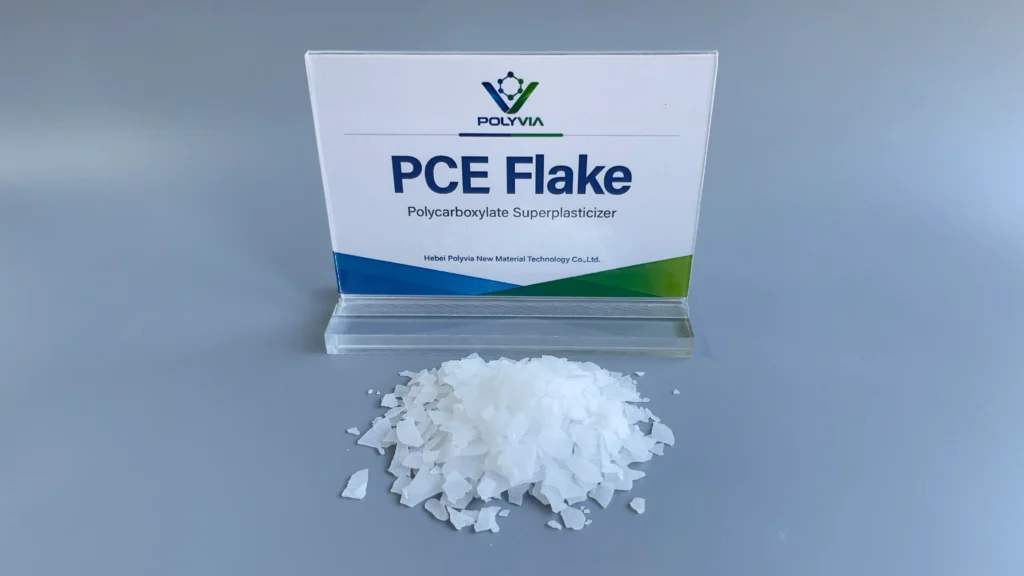
PCE Flake is a concentrated solid form of polycarboxylate ether (PCE) superplasticizer supplied in thin, solid flake-shaped pieces. It is designed to be dissolved in water to prepare an aqueous PCE admixture for concrete production and other compatible cementitious applications.
Unlike ready-to-use Liquid PCE, PCE Flake is supplied as a high-solid-content material. Manufacturers can prepare liquid PCE solutions according to their required concentration and production requirements.
Its main characteristics and advantages include:
- Providing a concentrated solid form of polycarboxylate superplasticizer.
- Allowing manufacturers to prepare aqueous PCE solutions.
- Supporting water reduction in suitable cementitious systems.
- Providing different performance options, including high water reduction and high slump retention.
- Offering flexibility in solution preparation and admixture formulation.
- Reducing the quantity of material that needs to be transported compared with lower-solid-content liquid products, on an equivalent solids basis.
PCE Flake is particularly relevant to:
- Concrete admixture manufacturers.
- PCE solution preparation facilities.
- Ready-mixed concrete supply chains.
- Precast concrete manufacturers.
- Prestressed concrete production.
- Manufacturers that prepare liquid concrete admixtures from concentrated solid materials.
An important distinction is that "flake" describes the physical supply form, not a single standardized polymer structure or performance category.
Different PCE Flake grades can have different polymer characteristics and performance objectives.
How Is PCE Flake Different from PCE Powder and Liquid PCE?
Polycarboxylate ether superplasticizers are available in three main physical forms: powder, flake and liquid. Although all three forms provide polycarboxylate-based dispersing functionality, they differ in physical characteristics, solid content, handling requirements and preparation methods.
One of the most important differences is their solid content.
| Characteristic | PCE Powder | PCE Flake | Liquid PCE |
|---|---|---|---|
| Physical Form | Fine or coarse powder | Solid flakes | Aqueous solution |
| Solid Content | ≥95% or ≥98%, depending on the grade | ≥97% or ≥98%, depending on the grade | 40% ± 1% or 50% ± 1% |
| Product Grades | 840, 850, 860, 870, ES980, PW888 | F980, F970 | HWR, SR, ES, GP, RET, CSR |
| Main Processing Method | Direct dry-mix addition or pre-dissolution, depending on grade | Dissolution before liquid dosing | Direct liquid dosing or controlled dilution |
| Main Handling Consideration | Moisture protection and dry-blend uniformity | Moisture protection and solution preparation | Liquid storage, pumping and dosing |
| Typical Production Role | Dry-mix formulations or preparation of aqueous solutions | Preparation of concentrated liquid PCE | Concrete admixture dosing systems |
1. PCE Powder — High-Solid Dry Form
POLYVIA™ PCE Powder is supplied in fine or coarse powder form, with solid content depending on the individual product grade.
The five fine-powder grades—840, 850, 860, 870 and PW888—have specified solid contents of at least 95%.
ES980 is a coarse-powder early-strength grade with a specified solid content of at least 98%.
Different grades have different performance characteristics and recommended addition methods. The fine-powder grades are suitable for direct dry-mix addition, while coarse-powder ES980 requires pre-dissolution.
2. PCE Flake — High-Solid Flake Form
POLYVIA™ PCE Flake is supplied as a concentrated solid in flake form.
Its two grades have the following specifications:
- F980: ≥98% solid content, High Water Reduction Type.
- F970: ≥97% solid content, High Slump Retention Type.
PCE Flake is designed to be dissolved in water before use as an aqueous PCE admixture.
Its high solid content allows manufacturers to prepare concentrated liquid PCE solutions using a relatively small mass of solid material.
For manufacturers with suitable dissolution facilities, this provides flexibility in preparing liquid admixtures according to their production requirements.
3. Liquid PCE — Aqueous Admixture Form
Liquid PCE is supplied as an aqueous superplasticizer solution.
POLYVIA™ Liquid PCE has two standard solid-content specifications:
- 40% ± 1%.
- 50% ± 1%.
Its six product series are HWR, SR, ES, GP, RET and CSR.
Liquid PCE is suitable for production systems equipped with liquid admixture storage, transfer and dosing facilities.
Unlike PCE Powder and PCE Flake, it does not require a separate solid-to-liquid preparation step before normal liquid dosing.
4. Why Does Physical Form Matter?
The choice between PCE Powder, PCE Flake and Liquid PCE depends on more than solid content.
Manufacturers should consider:
- Transportation cost and shipment efficiency.
- Warehouse space and storage conditions.
- Whether dry blending or liquid dosing is used.
- Availability of solution-preparation equipment.
- Required PCE concentration.
- Production scale and batch consistency.
- Performance characteristics of the selected PCE grade.
PCE Flake provides a practical intermediate option: it is supplied as a concentrated solid but can be converted into an aqueous PCE solution before use.
For manufacturers with suitable dissolution facilities, this provides flexibility in preparing liquid admixtures according to their production requirements.
How Is POLYVIA™ PCE Flake Manufactured?
POLYVIA™ PCE Flake F980 and F970 are manufactured through a bulk polymerization process, followed by curing or solidification, slicing or flake forming, quality inspection and packaging.
This manufacturing route converts the polymer into a controlled solid flake form suitable for subsequent dissolution and preparation of aqueous PCE admixtures.
The manufacturing process consists of several main stages.
1. Raw Material Preparation
The process begins with the preparation and inspection of the raw materials required for PCE polymerization.
Raw material quality and controlled preparation are important for maintaining production consistency and the intended characteristics of the final polymer.
Accurate material preparation provides the foundation for consistent polymerization and subsequent processing.
2. Bulk Polymerization
Bulk polymerization is the primary polymer synthesis stage in POLYVIA™ PCE Flake manufacturing.
During this process, suitable monomers undergo polymerization to form the polycarboxylate-based polymer.
The polymerization process establishes important characteristics of the resulting PCE material, including its molecular architecture and subsequent performance behavior.
Consistent raw material preparation and process control are important for maintaining product quality between production batches.
3. Curing and Solidification
Following bulk polymerization, the material undergoes a curing and solidification stage.
This stage converts the polymer material into a suitable solid form for subsequent slicing or flake forming.
The solidification process must be controlled to obtain material suitable for further processing and consistent finished-product characteristics.
4. Slicing or Flake Forming
After curing and solidification, the material is processed through slicing or flake forming to obtain the required solid flake form.
The objective is to produce a manageable solid product suitable for packaging, transportation, storage and subsequent dissolution.
The final flake appearance and physical characteristics are important aspects of product quality.
5. Quality Inspection
The finished PCE Flake is inspected against the applicable product specifications.
Key quality-control parameters include:
- Solid content.
- Moisture content.
- Appearance.
- Bulk density.
- pH of the specified aqueous solution.
- Chloride content.
- Total alkali content.
- Relevant product performance specifications.
For POLYVIA™ F980 and F970, the applicable technical specifications are maintained separately according to their different product grades.
6. Packaging
After quality inspection, the finished PCE Flake is packaged to protect it against moisture exposure and contamination during transportation and storage.
Moisture protection is particularly important because the product is intended for subsequent dissolution in water.
POLYVIA™ PCE Flake Manufacturing Process
Raw Material Preparation
↓
Bulk Polymerization
↓
Curing / Solidification
↓
Slicing or Flake Forming
↓
Quality Inspection
↓
Packaging
This is the actual manufacturing route used for POLYVIA™ PCE Flake F980 and F970. Specific equipment configurations and process parameters are subject to the manufacturer's production controls.
Manufacturing Method and Technical Literature
Bulk polymerization is also a documented approach in solid PCE manufacturing research. Published studies support its technical feasibility, while reviews discuss its industrial process characteristics and limitations.
However, published research on other manufacturers' processes should not be interpreted as a description of POLYVIA™'s specific equipment, formulation or operating parameters.
What Are the Main Types of POLYVIA™ PCE Flake?
POLYVIA™ offers two confirmed PCE Flake grades: F980 and F970.
They have different performance positioning and technical specifications.
| Product Model | Performance Positioning | Solid Content |
|---|---|---|
| POLYVIA™ F980 | High Water Reduction | ≥98% |
| POLYVIA™ F970 | High Slump Retention | ≥97% |
1. POLYVIA™ F980 — High Water Reduction Type
POLYVIA™ F980 is a high-water-reduction PCE Flake grade with a specified solid content of at least 98%.
It is positioned for applications where reducing water demand while achieving the required workability is the main objective.
Its performance should be evaluated using the intended cementitious materials, solution concentration, dosage and mixing conditions.
2. POLYVIA™ F970 — High Slump Retention Type
POLYVIA™ F970 is a high-slump-retention PCE Flake grade with a specified solid content of at least 97%.
It is designed for applications where maintaining workability over time is an important requirement.
Its suitability should be assessed through time-dependent slump or flow measurements using the actual concrete or cementitious formulation.
3. Understanding the Difference Between F980 and F970
The two grades should not be selected solely according to their solid-content values.
| Selection Factor | F980 | F970 |
|---|---|---|
| Main Performance Focus | High Water Reduction | High Slump Retention |
| Solid Content | ≥98% | ≥97% |
| Moisture Limit | ≤2% | ≤3% |
| Water Reducing Ratio | ≥25% | ≥15% |
| Main Evaluation | Water demand and initial workability | Workability retention over time |
The actual performance must be confirmed through the applicable test method and application-specific trials.
A higher solid content does not automatically mean higher water reduction or better slump retention.
What Are the Technical Specifications of POLYVIA™ PCE Flake?
The following table summarizes the confirmed product specifications.
| Technical Parameter | F980 | F970 |
|---|---|---|
| Appearance | White to light yellow solid flakes | White to light yellow solid flakes |
| Solid Content, % | ≥98.0 | ≥97.0 |
| Bulk Density, kg/m³ | 500 ± 50 | 500 ± 50 |
| Moisture, % | ≤2.0 | ≤3.0 |
| pH, 40% Aqueous Solution at 25°C | 4.0 ± 1.0 | 4.0 ± 1.0 |
| Water Reducing Ratio, % | ≥25 | ≥15 |
| Total Alkali, % | ≤0.3 | ≤0.3 |
Understanding the Specifications
Solid Content
F980 has a specified solid content of at least 98%, while F970 has at least 97%.
These values are important for calculating the mass of PCE solids introduced when preparing an aqueous solution.
Moisture Content
F980 has a maximum moisture content of 2%, while F970 has a maximum of 3%.
Moisture control is important for maintaining consistent product handling and concentration calculations.
Bulk Density
Both grades have a specified bulk density of 500 ± 50 kg/m³.
Bulk density is relevant to packaging, storage volume and material handling.
pH Value
The pH specification is 4.0 ± 1.0, measured using a 40% aqueous solution at 25°C.
The test concentration and temperature must be stated when comparing results.
Water Reducing Ratio
The supplied technical data specify:
- F980: ≥25%.
- F970: ≥15%.
These are specification values, not guaranteed results for every cement or concrete formulation.
Actual water-reduction performance depends on the testing method, reference mixture, dosage and material compatibility.
Total Alkali
Both grades have a specified total alkali content of no more than 0.3%.
This parameter should be evaluated according to the applicable analytical method and relevant concrete formulation requirements.
How Is PCE Flake Dissolved to Prepare Liquid PCE?
PCE Flake must be dissolved in water before it is used as an aqueous liquid admixture.
The dissolution process should be controlled to obtain a homogeneous solution with the intended solid content.
1. Laboratory Dissolution
For laboratory preparation, a general approach is:
- Prepare clean water at the specified temperature.
- Calculate the required PCE Flake quantity.
- Add the flakes under suitable mixing conditions.
- Continue mixing until the material is sufficiently dissolved.
- Check the solution for persistent undissolved material.
- Confirm the final solution mass and concentration.
For POLYVIA™ PCE Flake, 25°C is the established reference temperature for laboratory dissolution guidance.
An approximately one-hour dissolution period is a laboratory reference for preparing a target 50% PCE solution.
Actual dissolution time depends on the grade, flake characteristics, water quality, mixing conditions and equipment.
This should not be interpreted as a universal guaranteed dissolution time for every batch or factory setup.
2. Factory-Scale Dissolution
For larger factory operations, the preparation process may be organized differently.
A practical factory method is:
- Add the required water and PCE Flake according to the planned batch formulation.
- Allow the flakes to soak overnight.
- Continue mixing the following day until a sufficiently uniform solution is obtained.
- Check the solution before production use.
This approach can help manufacturers organize larger solution-preparation batches.
The actual soaking time, water ratio, mixing intensity and equipment should be established through factory trials.
3. Preparing a 50% Solid-Content Solution
The theoretical solid content of the prepared solution can be calculated using mass balance.
For example, consider 25 kg of PCE Flake.
F980 — Minimum 98% Solid Content
Theoretical PCE solids:
25 × 98% = 24.5 kg.
To prepare a nominal 50% solids solution:
24.5 ÷ 0.50 = 49 kg total solution mass.
Required added water:
49 − 25 = 24 kg.
F970 — Minimum 97% Solid Content
Theoretical PCE solids:
25 × 97% = 24.25 kg.
To prepare a nominal 50% solids solution:
24.25 ÷ 0.50 = 48.5 kg total solution mass.
Required added water:
48.5 − 25 = 23.5 kg.
These calculations use the minimum specified solid contents and theoretical mass balance.
Actual preparation should use the measured batch solid content and verified final solution mass.
How Much Liquid PCE Can Be Prepared from 1 MT of PCE Flake?
One of the main advantages of PCE Flake is its high solid content, which allows manufacturers to prepare a substantial quantity of concentrated liquid PCE from a relatively small mass of solid material.
Approximately 1 MT of POLYVIA™ PCE Flake can be used to prepare approximately 2 MT of concentrated aqueous PCE solution, depending on the actual solid content and water addition.
The exact final solid content depends on whether F980 or F970 is used and the actual measured solid content of the batch.
1. F980: 1 MT of PCE Flake + 1 MT of Water
Assuming the minimum specified solid content of 98%:
PCE Flake:
1,000 kg.
Theoretical PCE solids:
1,000 × 98% = 980 kg.
Water added:
1,000 kg.
Total prepared solution:
1,000 + 1,000 = 2,000 kg.
Theoretical final solid content:
980 ÷ 2,000 × 100% = 49%.
Result: Approximately 2 MT of PCE solution at 49% theoretical solid content.
2. F970: 1 MT of PCE Flake + 1 MT of Water
Assuming the minimum specified solid content of 97%:
PCE Flake:
1,000 kg.
Theoretical PCE solids:
1,000 × 97% = 970 kg.
Water added:
1,000 kg.
Total prepared solution:
1,000 + 1,000 = 2,000 kg.
Theoretical final solid content:
970 ÷ 2,000 × 100% = 48.5%.
Result: Approximately 2 MT of PCE solution at 48.5% theoretical solid content.
3. How Much Water Is Needed for a Nominal 50% Solution?
If the target is a nominal 50% solid-content solution, the water quantity should be adjusted according to the actual measured solid content.
| Parameter | F980 | F970 |
|---|---|---|
| PCE Flake Mass | 1,000 kg | 1,000 kg |
| Minimum Solid Content | 98% | 97% |
| Theoretical Solids Mass | 980 kg | 970 kg |
| Target Solution Solid Content | 50% | 50% |
| Total Solution Mass | 1,960 kg | 1,940 kg |
| Required Added Water | 960 kg | 940 kg |
Therefore, using the minimum specified solid contents:
- 1 MT F980 + 960 kg water produces 1.96 MT of nominal 50% solution.
- 1 MT F970 + 940 kg water produces 1.94 MT of nominal 50% solution.
Actual batch calculations should use the measured solid content rather than automatically using the minimum specification.
4. Why Is This Important for Admixture Manufacturers?
This mass-balance relationship helps manufacturers evaluate:
- The quantity of concentrated solid material required.
- The amount of water needed for solution preparation.
- The theoretical output of prepared liquid PCE.
- The difference between 48.5%, 49% and 50% solutions.
- The quantity of PCE solids available for subsequent dosing.
Commercial and technical clarification: Approximately 1 MT of PCE Flake can be used to prepare approximately 2 MT of concentrated aqueous PCE solution. The exact final solid content depends on the product grade, actual measured solid content and preparation ratio.
A theoretically prepared 48.5–49% solution should not be described as an exact 50% solution.
The prepared solution should also be checked for concentration, uniformity and suitability before production use.
How Should Dissolved PCE Flake Solution Be Stored?
The prepared PCE solution should preferably be used on the day of preparation.
Under normal factory storage and handling practices, storage for approximately 6–7 days may be feasible based on established factory experience.
However, this is practical handling guidance rather than a guaranteed universal shelf-life specification.
Actual stability may depend on:
- Storage temperature.
- Water quality.
- Solution concentration.
- Container cleanliness.
- Contamination.
- Microbiological conditions.
- Product characteristics.
Before using a stored solution, inspect its appearance and verify that it remains suitable for the intended application.
Where product performance is critical, compare fresh and stored solution behavior through appropriate testing.
Where Is PCE Flake Used?
PCE Flake is primarily used as a concentrated solid raw material for preparing aqueous PCE admixtures. It is normally dissolved in water before the resulting solution is introduced into concrete production.
Therefore, PCE Flake and ready-to-use Liquid PCE have different supply and processing roles.
PCE Flake provides a concentrated solid input for solution preparation, while the prepared aqueous PCE admixture is subsequently evaluated and dosed into the intended concrete formulation.
Its suitability depends on the selected grade, dissolution quality, prepared solution concentration and requirements of the final cementitious system.
1. Concrete Admixture Manufacturing
Admixture manufacturers can use PCE Flake as a solid raw material for preparing customized aqueous PCE solutions.
The prepared solution can then be evaluated for use in different concrete admixture formulations.
2. Ready-Mixed Concrete
After suitable dissolution and formulation, PCE Flake can provide the basis for an aqueous admixture used in ready-mixed concrete.
The selected grade should match the required water reduction, workability and retention characteristics.
3. Precast and Prestressed Concrete
PCE Flake-derived solutions may be evaluated in precast and prestressed concrete systems where controlled water demand, workability and strength development are important.
The appropriate grade must be established using the actual cement, aggregate, production and curing conditions.
4. High-Performance Concrete
High-performance concrete requires careful control of water demand and fresh-state rheology.
F980 may be evaluated where high water reduction is the primary objective, while F970 may be evaluated where slump retention is a priority.
Actual suitability must be confirmed through concrete trials.
How Should Manufacturers Select the Right PCE Flake Grade?
Selection should begin with the required concrete performance rather than solid content alone.
| Main Requirement | POLYVIA™ Grade | Evaluation Focus |
|---|---|---|
| High water reduction | F980 | Water demand and initial workability |
| High slump retention | F970 | Workability over time |
Before selection, manufacturers should evaluate:
1. Performance Objective
Determine whether high water reduction or high slump retention is the main requirement.
2. Cement Compatibility
Evaluate the selected grade with the actual cement source and binder composition.
3. Solution Preparation
Confirm the intended concentration, water quality, mixing conditions and dissolution procedure.
4. Dosage Basis
Calculate commercial flake mass and actual solids mass separately.
5. Production Process
Consider solution-preparation equipment, batch size, storage arrangements and dosing systems.
6. Final Application
Evaluate the prepared solution in the intended concrete or cementitious formulation.
The final grade and dosage should be established through laboratory testing and production validation.
FREQUENTLY ASKED QUESTIONS
1. What Is PCE Flake Used For?
PCE Flake is used as a concentrated solid raw material for preparing aqueous polycarboxylate superplasticizer solutions. It is mainly used by concrete admixture manufacturers and other producers that prepare liquid PCE formulations for ready-mixed, precast, prestressed and other concrete applications.
2. How Is PCE Flake Manufactured?
POLYVIA™ PCE Flake F980 and F970 are manufactured through bulk polymerization, followed by curing or solidification, slicing or flake forming, quality inspection and packaging. This manufacturing route converts the polymer into a controlled solid flake form suitable for subsequent dissolution and liquid PCE preparation.
3. What Is the Difference Between F980 and F970 PCE Flake?
POLYVIA™ F980 is a high-water-reduction grade with at least 98% solid content and a specified water-reducing ratio of at least 25%. F970 is a high-slump-retention grade with at least 97% solid content and a specified water-reducing ratio of at least 15%. Their suitability should be verified through application-specific testing.
4. How Do You Dissolve PCE Flake in Water?
PCE Flake is added to water under suitable mixing conditions until a sufficiently uniform solution is obtained. For laboratory preparation, 25°C and approximately one hour are established reference conditions for preparing a target 50% solution. Larger factory batches may use overnight soaking followed by mixing the next day. Actual preparation time depends on the grade and equipment.
5. How Much Liquid PCE Can Be Prepared from 1 MT of PCE Flake?
Approximately 1 MT of PCE Flake can be combined with approximately 1 MT of water to prepare around 2 MT of concentrated aqueous PCE solution. Based on minimum specified solid contents, F980 produces a theoretical 49% solution, while F970 produces approximately 48.5%. Exact 50% concentration requires adjusting the added water according to the actual solid content.
6. How Long Can Dissolved PCE Flake Solution Be Stored?
The prepared solution is recommended for same-day use whenever practical. Under normal factory handling and storage practices, storage for approximately 6–7 days may be feasible. Actual stability depends on solution concentration, water quality, storage temperature, container cleanliness and contamination control. This should not be interpreted as a guaranteed shelf life.
7. What Is the Difference Between PCE Flake and PCE Powder?
Both are solid forms of polycarboxylate superplasticizer, but their physical characteristics and processing routes differ. PCE Powder is supplied in fine or coarse powder form, with solid content of at least 95% or 98%, depending on the grade. PCE Flake is supplied in solid flake form, with F980 at ≥98% and F970 at ≥97%. PCE Flake is intended for dissolution before liquid dosing, while selected PCE Powder grades can be incorporated directly into compatible dry-mix formulations.
8. What Is the Difference Between PCE Flake and Liquid PCE?
PCE Flake is supplied as a concentrated solid and must be dissolved before liquid dosing. Liquid PCE is supplied as an aqueous admixture, with POLYVIA™ standard solid-content specifications of 40% ± 1% and 50% ± 1%. PCE Flake allows manufacturers with suitable preparation facilities to produce their own concentrated aqueous PCE solutions, while Liquid PCE can be used directly in compatible liquid dosing systems.
ONCLUSION
PCE Flake is a concentrated solid form of polycarboxylate ether superplasticizer designed for manufacturers that prepare aqueous PCE admixture solutions.
POLYVIA™ F980 and F970 are manufactured through bulk polymerization, followed by curing, slicing or flake forming, quality inspection and packaging.
With solid contents of at least 98% and 97%, respectively, these products provide concentrated materials for preparing aqueous PCE solutions.
Approximately 1 MT of PCE Flake can be used to prepare approximately 2 MT of concentrated liquid PCE solution, depending on the product grade, actual solid content and preparation ratio.
Understanding the manufacturing process, product specifications, dissolution procedures and solution-handling requirements helps manufacturers prepare PCE solutions more consistently and select suitable materials for different concrete production systems.
POLYVIA™ — Advanced PCE Solutions for Concrete and Cementitious Materials.
REFERENCES
- Gao, R. J., Liu, X., Qian, S. S., et al. (2023). Preparation Methods of Solid Polycarboxylate Superplasticizer: A Review. China Powder Science and Technology, 29(4), 61–70. https://doi.org/10.13732/j.issn.1008-5548.2023.04.006
- Liu, X. et al. (2014). Preparation, Characterization and Performances of Powdered Polycarboxylate Superplasticizer with Bulk Polymerization. Materials, 7(9), 6169–6183. https://doi.org/10.3390/ma7096169
- Tao, J., Ni, T., Xia, L., Wang, J., & Liu, Z. (2017). Synthesis of Solid Polycarboxylate Superplasticizer through Bulk Polymerization and Its Performance Evaluation. Chemical Industry and Engineering Progress, 36(8), 3013.
- Yoon, J., Choi, B. I., & Kim, J. H. (2022). Adsorption Properties of Polycarboxylate Ether-Based Superplasticizer on Cement Particles and Their Resultant Dispersion. Frontiers of Structural and Civil Engineering, 16, 506–514. https://doi.org/10.1007/s11709-022-0813-5