
Polycarboxylate Ether (PCE) for Precast Concrete
High-performance PCE superplasticizer for water reduction, controlled workability, early strength and efficient precast production.
Polycarboxylate Ether (PCE) helps precast concrete producers achieve lower water-to-binder ratios while maintaining the flowability required for reliable casting and compaction. The right PCE system can also support early strength, surface quality and shorter production cycles.
Why PCE for Precast Concrete?
Concrete Performance Must Support the Production Cycle
Precast concrete is not only designed for final strength and durability. It must also perform reliably through mixing, casting, compaction, curing, demoulding, lifting and, where applicable, prestressing.
A properly selected PCE superplasticizer for precast concrete helps balance these production requirements.
High Water Reduction
Improve cement dispersion and reduce water demand while maintaining the flowability required for precast production.
Controlled Workability
Maintain suitable concrete rheology through mixing, mould filling, compaction and finishing without relying on excessive additional water.
Early Strength
Support early-age performance through lower water demand and optimized PCE chemistry. Dedicated early-strength PCE can be evaluated for faster production cycles.
Low W/B Concrete
Enable lower water-to-binder ratios required for many high-strength, prestressed and high-performance precast products.
Surface Quality
Stable rheology, controlled air and proper consolidation help produce dense, consistent surfaces with fewer visible defects.
Production Efficiency
Balance workability, setting and strength development according to demoulding, lifting, prestressing and mould-turnover requirements.
How PCE Works in Precast Concrete
From Cement Dispersion to Concrete Performance
01 — Adsorption
PCE molecules adsorb onto cement particle surfaces after introduction into the concrete system.
02 — Particle Dispersion
Polymer side chains create steric repulsion, reducing cement flocculation and improving particle dispersion.
03 — Water Reduction
More efficient dispersion allows the required flowability to be achieved with less mixing water.
04 — Performance Development
The optimized concrete system can combine workability, low W/B ratio, strength development and production efficiency.
PCE does not work independently. Actual performance depends on cement chemistry, SCMs, aggregates, temperature, curing conditions and the complete admixture system.
Practical Challenges in Precast Production
Start with the Production Problem — Not Only the PCE Dosage
Slow Early Strength
Insufficient early strength can delay demoulding, lifting, prestressing and mould reuse.
Technical Direction:
Optimize water reduction, W/B ratio, PCE chemistry and curing conditions around the required demoulding or prestressing strength.
Difficult Casting at Low W/B
High-strength concrete can become difficult to place when water content is reduced.
Technical Direction:
Use PCE to improve cement dispersion and achieve the required flowability without uncontrolled water addition.
Rapid Workability Loss
Unexpected flow or slump loss can affect mould filling and production consistency.
Technical Direction:
Match PCE retention characteristics to cement chemistry, concrete temperature and the actual casting window.
Air, Bleeding or Surface Defects
Entrapped air, segregation or unstable rheology can affect appearance and concrete uniformity.
Technical Direction:
Evaluate PCE together with aggregate grading, mixing, vibration and compatible defoaming technology where required.
Long Demoulding Cycles
Slow strength development can reduce mould utilization and plant output.
Technical Direction:
For fast-cycle production, evaluate early-strength PCE together with concrete formulation and curing optimization.
PCE Across Precast Concrete Products
Different Products — Different Performance Priorities
PCE technology can be applied across a broad range of precast concrete products. However, the optimum chemistry, dosage and workability profile should reflect the production process of each component.
Piles, Prestressed Products & Concrete Poles
Spun Piles · Precast Square Piles · Precast Sheet Piles · Concrete Poles
These production systems commonly prioritize high water reduction, low W/B ratio, early strength and efficient mould turnover.
For PCE in spun pile concrete and other prestressed products, selection should consider demoulding strength, prestressing requirements and the actual curing regime.
Structural Precast Components
Precast Columns · Precast Beams · Floor Slabs · Hollow Core Slabs · Wall Panels · Stairs · Balconies · Lintels
Structural components require a balance between flowability, concrete stability, strength and surface quality.
A suitable PCE superplasticizer for precast beams, columns, hollow core slabs and wall panels helps manage water demand while maintaining the rheology required for consistent casting.
Bridge & Infrastructure Precast
Bridge Box Girders · Precast Bridge Girders · Bridge Deck Slabs · Precast Tunnel Segments
Infrastructure components often combine low W/B ratios, high strength, dense reinforcement and demanding durability requirements.
PCE for precast bridge girders, box girders and tunnel segments should therefore be evaluated as part of the complete high-performance concrete system.
Municipal & Civil Precast
Precast Retaining Wall Panels · Manholes · Culverts · Culvert Boxes · Kerbs · Drainage Channels
For repetitive precast production, stable concrete behavior from batch to batch is critical.
PCE can help control water demand and workability while supporting consistent casting and mechanical performance.
Architectural & Specialty Components
GRC / GFRC Components · GFRC Facade Panels · Precast Fence Posts · Concrete Blocks
Specialty cementitious products may require controlled flow, low water demand and high surface quality.
For GRC and GFRC, PCE compatibility should be validated specifically because fiber content, matrix composition and production rheology can differ substantially from conventional precast concrete.
Selecting PCE for Precast Concrete
Match the PCE to the Production Requirement
There is no single PCE grade that is optimal for every precast process.
| Production Priority | PCE Direction | Typical Applications |
|---|---|---|
| High water reduction | High Water-Reducing PCE | Beams, columns, slabs, panels |
| Controlled workability | Retention-Balanced PCE | Large components, longer casting cycles |
| Early strength | Early-Strength PCE | Spun piles, prestressed products, poles |
| Low W/B / HPC | High-Performance PCE System | Girders, tunnel segments, structural HPC |
The final selection should be based on actual cement compatibility, workability, air content, strength development and production conditions rather than product type alone.
Early Strength & Fast Demoulding
Optimize the Entire Precast Production System
Fast demoulding is important where mould turnover determines production capacity.
PCE can contribute through water reduction and concrete optimization, while dedicated early-strength PCE for precast concrete can be evaluated where accelerated strength development is required.
However, demoulding performance is not controlled by PCE dosage alone.
Cement chemistry · W/B ratio · SCMs · Concrete temperature · Curing temperature · Steam-curing regime · Admixture compatibility
all influence early strength.
For steam-cured precast concrete, the objective should therefore be to achieve the required demoulding strength through coordinated optimization of concrete formulation, PCE chemistry and curing conditions.
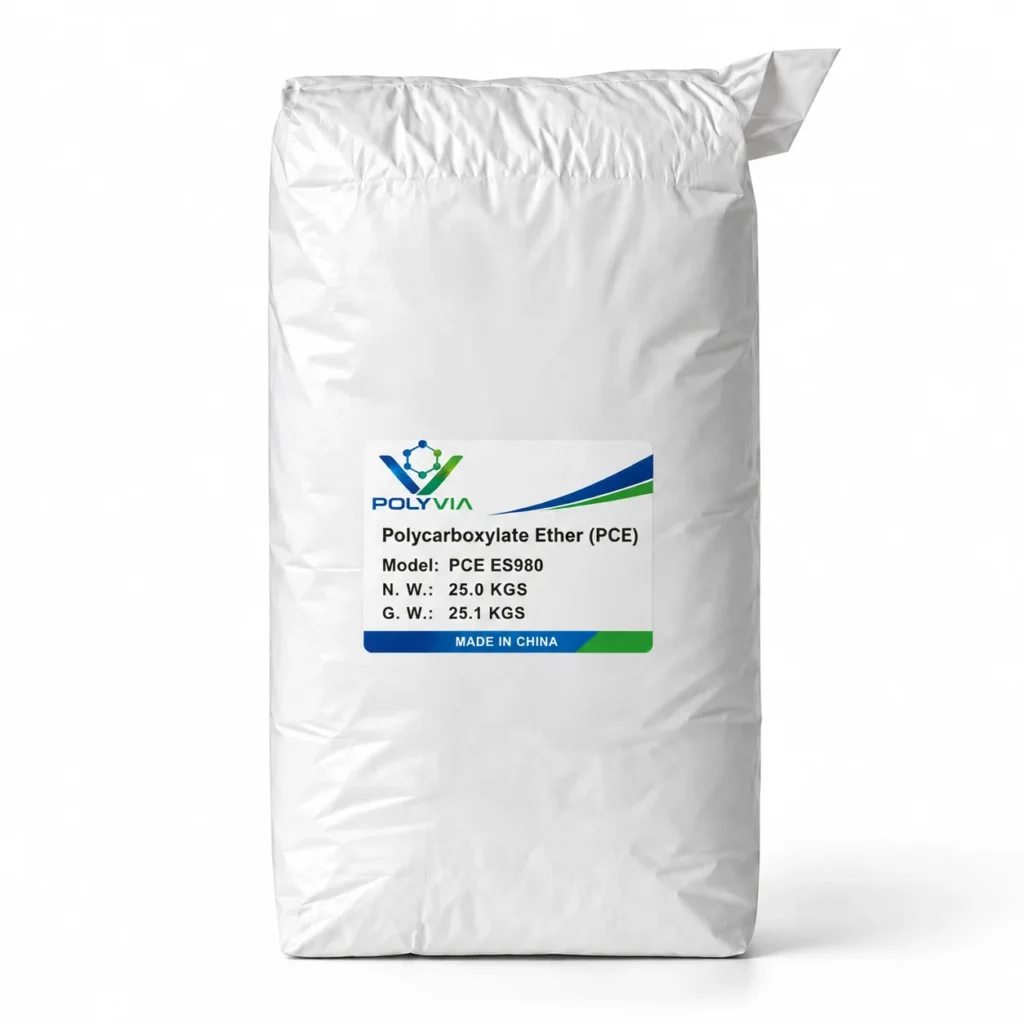
Recommended Technology — POLYVIA ES980
For spun piles, prestressed concrete and other fast-cycle precast systems, POLYVIA ES980 early-strength PCE powder can be evaluated where high water reduction and accelerated early-age performance are required.
Final dosage and curing conditions should be confirmed through plant trials using the customer's actual cementitious materials and production process.
Explore ES980 Early-Strength PCE →
PCE Dosage & Trial Evaluation
Start with a Practical Dosage Window — Then Optimize by Performance
For precast concrete, a typical PCE dosage can be evaluated within 0.10–0.35% by weight of total cementitious materials.
The optimum dosage should be adjusted according to the PCE grade and active concentration, cement and SCM characteristics, W/B ratio, aggregate grading, ambient temperature, curing method, required workability and target early strength.
Typical Trial Range: 0.10–0.35%
01 — Establish the Control Mix
Fix the cementitious materials, aggregate grading, W/B ratio and required fresh and hardened performance.
02 — Select the Initial Dosage
Start within the recommended 0.10–0.35% range, considering the specific PCE grade and formulation requirements.
03 — Evaluate Fresh Concrete
Check slump or flow, workability retention, air content, bleeding, segregation and casting behavior.
04 — Verify Early Strength
Measure compressive strength at the actual demoulding, lifting or prestressing age, rather than relying only on standard 1-day or 28-day results.
05 — Check Finished Components
Evaluate surface finish, dimensional consistency, defects and overall production stability.
06 — Validate Under Plant Conditions
Confirm the selected dosage under actual mixing, casting, vibration and curing conditions before full-scale production.
Practical Note: Increasing PCE dosage does not always produce better concrete. Excessive dosage may cause over-fluidity, segregation, bleeding or setting-related issues depending on the PCE chemistry and cement system. The optimum dosage is the level that achieves the required workability, early strength and production efficiency with stable concrete behavior.
Formulation Compatibility
PCE Is Part of a Complete Concrete System
Cement & SCMs
Cement chemistry, fly ash, slag, silica fume and other mineral additions influence PCE demand, rheology and strength development.
Water-to-Binder Ratio
W/B ratio should be optimized together with workability, strength and production requirements.
Aggregate Grading
Aggregate distribution affects paste demand, rheology, concrete stability and casting behavior.
Temperature
Material and concrete temperature can significantly influence workability retention, setting and admixture response.
Curing Conditions
Ambient, heated and steam curing create different requirements for setting and early-strength development.
Other Admixtures
Defoamers, accelerators, retarders and other functional additives should be checked for compatibility with the selected PCE system.
Typical Precast Evaluation
What Should Be Verified Before Full-Scale Production?
A precast trial should evaluate more than initial flow.
For a meaningful assessment, record:
Fresh Concrete
Flow / slump · Workability retention · Air content · Bleeding · Segregation · Concrete temperature
Production Performance
Mould filling · Compaction · Surface behavior · Setting · Demoulding time
Strength Development
Demoulding-age strength · Prestressing-age strength where applicable · Later-age compressive strength
Curing Conditions
Pre-curing period · Heating profile · Peak temperature · Holding period · Cooling conditions where accelerated curing is used
This creates a direct link between PCE dosage, concrete performance and actual precast productivity.
Frequently Asked Questions
1. What is PCE superplasticizer for precast concrete?
PCE is a polycarboxylate-based high-range water-reducing admixture that improves cement dispersion. It allows precast concrete to achieve required workability at a lower water content.
2. Why is PCE widely used in precast concrete?
PCE combines high water reduction with adjustable workability characteristics, making it suitable for low-W/B, high-strength and production-driven precast concrete systems.
3. Can PCE improve early strength?
PCE can support early strength through water reduction and mix optimization. Dedicated early-strength PCE chemistry can provide additional early-age performance, but results depend on the complete concrete and curing system.
4. Which PCE is suitable for fast demoulding?
An early-strength PCE can be evaluated when fast demoulding is required. Selection should be based on actual demoulding strength, cement compatibility and curing conditions.
5. Can PCE be used in steam-cured precast concrete?
Yes. PCE can be used in steam-cured precast and prestressed concrete, but its performance should be verified under the plant's actual curing temperature and cycle.
6. How is PCE dosage determined for precast concrete?
Dosage should be established through trials based on the specific PCE product, cement chemistry, W/B ratio, SCMs, aggregates, temperature and required concrete performance.
7. Can PCE be used for spun piles and prestressed concrete?
Yes. PCE is suitable for spun pile and prestressed concrete where high water reduction, low W/B ratio and strength development are required. Early-strength PCE can be considered where rapid production cycles are important.
8. Can one PCE grade be used for every precast product?
Not necessarily. Spun piles, hollow core slabs, bridge girders, tunnel segments and GFRC components can have different requirements for workability, early strength, air content, surface quality and curing. PCE should be matched to the actual production system.
Technical Support for Precast Concrete
Optimize PCE Around Your Production Conditions
Every precast plant operates with different raw materials, concrete formulations, curing conditions and production cycles.
POLYVIA supports PCE grade selection, dosage evaluation, compatibility testing and formulation optimization according to actual water reduction, workability, early-strength and production requirements.