
PCE Powder for UHPC
High Water Reduction for Low W/B, High-Flow and High-Strength UHPC
POLYVIA™ PCE Powder for UHPC is a high-performance polycarboxylate ether superplasticizer designed for Ultra-High Performance Concrete (UHPC), helping achieve high flowability at very low water-to-binder ratios through efficient particle dispersion and water reduction.
High Water Reduction · Low W/B · High Flowability · Strength Development
Why UHPC Needs High-Performance PCE Powder
The Core Challenge: Very Low Water, but High Flow
UHPC combines a high concentration of cementitious and ultrafine materials with a very low water-to-binder ratio. Many formulations also contain high-strength micro steel fibers.
A typical UHPC system may include:
Cement · Silica Fume · Ultrafine Powders · Fine Aggregate · Water · PCE Superplasticizer · Steel Fiber
This creates a fundamental formulation challenge:
High Powder Content → High Water Demand → Very Low W/B → High Viscosity → Difficult Mixing & Casting
Adding more water may improve workability, but it can compromise the low W/B ratio required for a dense, high-strength UHPC matrix.
A PCE superplasticizer for UHPC addresses this problem through efficient particle dispersion:
Particle Dispersion → Lower Water Demand → Low W/B → High Flowability → Dense Matrix → Strength Development
The objective is not simply to make UHPC “more fluid.” It is to achieve the required flow with less water.
Key Challenges in UHPC
Balance Water Reduction, Flowability and Strength
High Water Demand
Cement, silica fume and other ultrafine materials create a large specific surface area and increase water demand.
PCE Role: Improve particle dispersion and reduce the water required to achieve the target flow.
Poor Flowability at Low W/B
UHPC typically operates at very low W/B. Without effective dispersion, the matrix can become difficult to flow even when sufficient mixing energy is applied.
PCE Role: Maintain workable flow while preserving a low water-to-binder ratio.
High Viscosity & Difficult Processing
High powder concentration and limited free water can create a sticky matrix, making mixing, discharge, mold filling and finishing more difficult.
PCE Role: Optimize dispersion and rheological behavior for more practical processing.
Strength vs. Workability
Adding extra water is a simple way to increase flow, but it may reduce matrix density and compromise mechanical performance.
PCE Role: Obtain workability through water reduction and dispersion rather than uncontrolled additional water.
Steel Fiber Incorporation
A highly viscous matrix can make uniform incorporation of micro steel fibers more difficult and increase the risk of local fiber agglomeration.
PCE Role: Provide suitable matrix flow for fiber incorporation while maintaining low W/B.
Cracking & Post-Cracking Performance
PCE improves the cementitious matrix, but it does not replace reinforcement.
PCE Superplasticizer → Matrix Optimization
Steel Fiber → Crack Bridging · Tensile Performance · Post-Cracking Toughness
For fiber-reinforced UHPC, PCE chemistry, matrix rheology and fiber reinforcement should therefore be evaluated as one system.
How PCE Works in UHPC
Efficient Dispersion in Ultra-Low W/B Systems
Polycarboxylate ether (PCE) is a high-range water-reducing admixture based on polymer molecules with a comb-like molecular structure.
01 — Adsorption
PCE molecules adsorb onto cementitious particle surfaces.
02 — Steric Dispersion
Polymer side chains create steric hindrance between particles, reducing particle agglomeration.
03 — Lower Water Demand
More effective particle dispersion allows the required flowability to be achieved with less mixing water.
04 — Low W/B + High Flow
The UHPC matrix can maintain practical flow while operating at the low W/B required by the formulation.
05 — Matrix Optimization
Low water content combined with effective particle dispersion supports matrix density, strength development and consistent processing.
This mechanism makes PCE powder particularly suitable for UHPC, RPC and other low-W/B high-performance cementitious systems.
What PCE Powder Contributes to UHPC
High Water Reduction
Reduces water demand and supports UHPC formulations requiring very low water-to-binder ratios.
High Flowability
Provides the fluidity required for mixing, casting, mold filling and fiber incorporation without relying on excessive water.
Strength Development
PCE is not a conventional strength additive. Its contribution to strength comes primarily from enabling efficient dispersion and a lower W/B ratio while maintaining the required workability.
Improved Processing
Optimized matrix rheology can improve mixing, discharge and casting behavior in highly concentrated UHPC systems.
Dry-Mix Compatibility
Powder form enables incorporation into factory-produced UHPC dry mix, pre-bagged UHPC and RPC formulations.
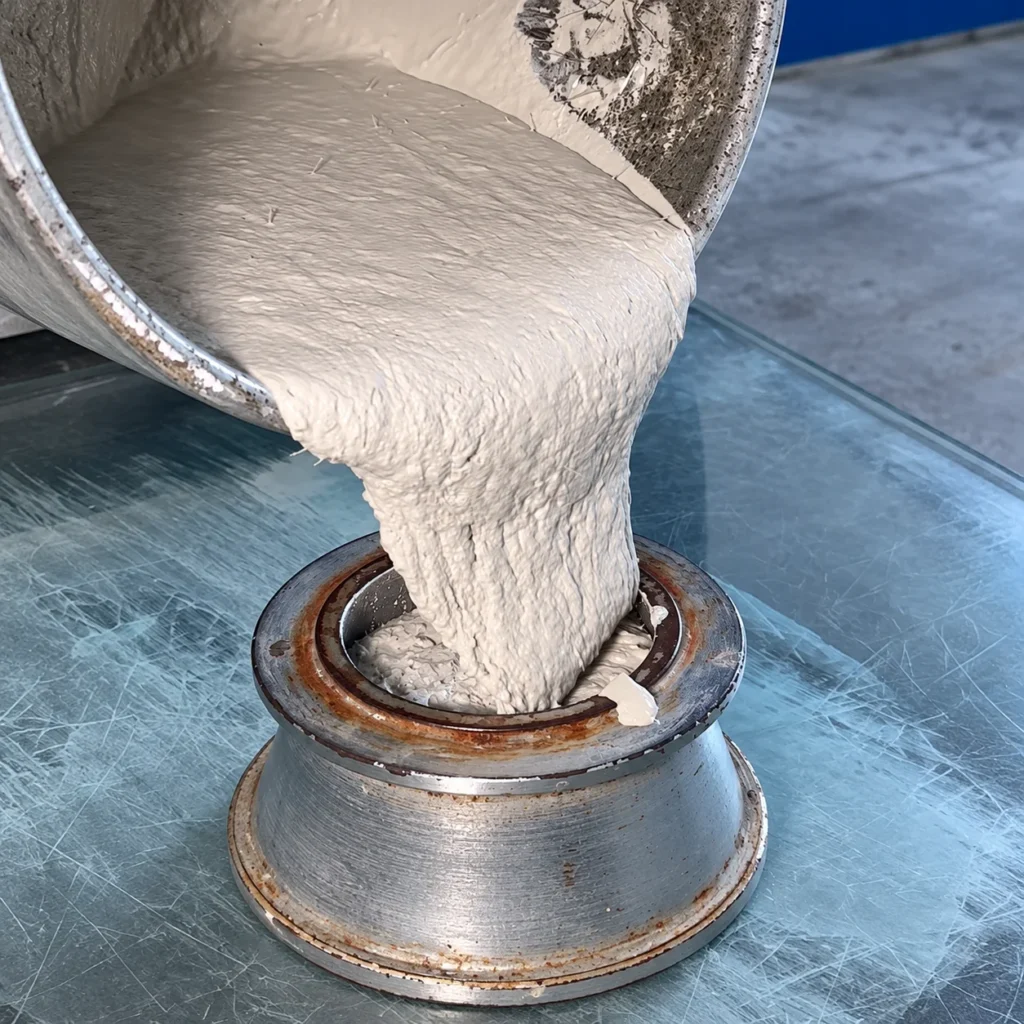
Pure White Appearance
Pure-white PCE powder can also be used in white UHPC and colour-sensitive architectural UHPC where admixture appearance is an important formulation consideration.
High Water Reduction Without Compromising the Intended White Appearance
White UHPC requires the same low water-to-binder ratio, high flowability and efficient particle dispersion as conventional UHPC, while placing additional importance on the color and appearance of the finished surface.
For white UHPC, architectural UHPC and decorative precast UHPC, PCE powder should be selected not only for water-reducing efficiency, but also for its suitability for white cement and light-colored cementitious systems. A suitable PCE powder for white UHPC can help achieve high fluidity at low water demand without introducing unwanted visible coloration from the admixture itself.
POLYVIA™ high-purity PCE powder can be evaluated in white UHPC formulations where high water reduction, flowability, strength development and appearance consistency are required. Final performance should be verified with the actual white cement, supplementary materials, pigments and complete mix design.
Typical White UHPC Applications
White architectural UHPC · Decorative UHPC panels · White precast façades · Thin UHPC elements · Architectural components · Light-colored UHPC products
PCE Powder Dosage for UHPC
Practical Starting Dosage by UHPC System
The optimum PCE dosage for UHPC depends on cement chemistry, silica fume and ultrafine powder content, W/B ratio, target flow, fiber content, temperature, mixing conditions and required strength.
Based on practical formulation and application experience, the following ranges can be used as starting points for trials:
| UHPC System | Typical W/B | Typical Strength Target | PCE Powder Dosage |
|---|---|---|---|
| Precast UHPC, Façade Panels & Bridge Deck Overlays | 0.18–0.22 | 120–150 MPa | 0.15–0.35% |
| Ultra-High-Strength UHPC / RPC | <0.18 | 160–200 MPa | 0.30–0.50% |
| Factory-Premixed Dry UHPC | Formulation-dependent | Project-dependent | 0.10–0.30% |
Recommended initial trial for conventional UHPC: approximately 0.20% by total binder mass.
All dosage percentages are calculated by total binder mass.
These values are practical starting ranges rather than universal limits. Final dosage should be confirmed using the actual cement, silica fume, powders, fibers and production conditions.
More PCE Is Not Necessarily Better
Increasing PCE dosage beyond the optimum level does not necessarily produce proportional improvements in flow or strength.
Overdosage may influence rheology, setting behavior or air characteristics. The optimum dosage should therefore be determined from the required:
W/B · Flow · Viscosity · Working Time · Strength Development · Production Behavior
How to Use PCE Powder in UHPC
Direct Dry Mixing or Pre-Dissolved Addition
PCE powder can be incorporated into UHPC through two practical methods.
Direct Dry Mixing
PCE powder can be uniformly blended with cement, silica fume and other dry components during factory production.
This method is particularly suitable for:
UHPC Dry Mix · Factory Premix · Pre-Bagged UHPC · RPC Dry Formulations
Because PCE is used at a relatively low dosage, uniform distribution throughout the dry formulation is important.
Pre-Dissolved Addition
PCE powder can also be dissolved in the mixing water before addition to the mixer.
This approach is useful for:
Laboratory Trials · Formulation Development · Dosage Optimization · Controlled Performance Evaluation
The appropriate addition method depends on the production process, mixer configuration, formulation and required dosing accuracy.
PCE Selection for UHPC
Match PCE Chemistry to UHPC Performance Targets
UHPC places exceptional demands on particle dispersion because high binder content and very low water-to-binder ratios can rapidly increase viscosity and water demand.
PCE selection should therefore focus on the required balance between water reduction, flowability and early-strength development.
| Performance Priority | Recommended Grade | Why Select It |
|---|---|---|
| Maximum Water Reduction | PCE 870 | High water-reducing efficiency |
| Very Low W/B | PCE 870 | Supports workable UHPC at reduced water content |
| High Flowability | PCE 870 | Promotes efficient particle dispersion |
| General UHPC / RPC | PCE 870 | Suitable for high-performance formulations |
| High Early Strength | ES980 | High water reduction + early-strength development |
| Rapid Demolding | ES980 | Supports faster early strength development |
| Precast UHPC | ES980 | Suitable for early-strength-driven production |
| Short Production Cycles | ES980 | Supports faster production turnaround |
PCE 870 — High Water Reduction
Recommended for UHPC and RPC formulations where high water reduction and efficient particle dispersion are the primary requirements. It supports high flowability at very low W/B ratios without relying on additional mixing water.
ES980 — High Water Reduction + Early Strength
ES980 Early-Strength PCE Powder is recommended when UHPC requires both high water reduction and accelerated early-strength development. It is particularly suitable for precast UHPC, rapid demolding and production systems where early-age strength directly affects manufacturing efficiency.
Selection Principle: Choose PCE 870 when water reduction and flowability are the primary targets. Choose ES980 when high water reduction must be combined with enhanced early-strength performance.
Final grade and dosage should be verified through trials using the actual cement, SCMs, aggregates, fibers, W/B ratio and curing conditions.
PCE × Silica Fume × Steel Fiber
UHPC Works as a Complete Material System
High UHPC performance does not come from PCE alone.
PCE Superplasticizer
Particle Dispersion · Water Reduction · Flowability
Controls water demand and enables workable consistency at very low W/B.
Silica Fume & Ultrafine Powders
Particle Packing · Matrix Densification · Microstructure
Contribute to the highly compact cementitious matrix characteristic of UHPC.
Micro Steel Fiber
Crack Bridging · Tensile Performance · Toughness
Provides distributed reinforcement and contributes to post-cracking mechanical behavior.
Successful UHPC formulation therefore requires coordinated control of:
Particle Packing + PCE Dispersion + W/B + Matrix Rheology + Fiber Reinforcement + Mixing Process
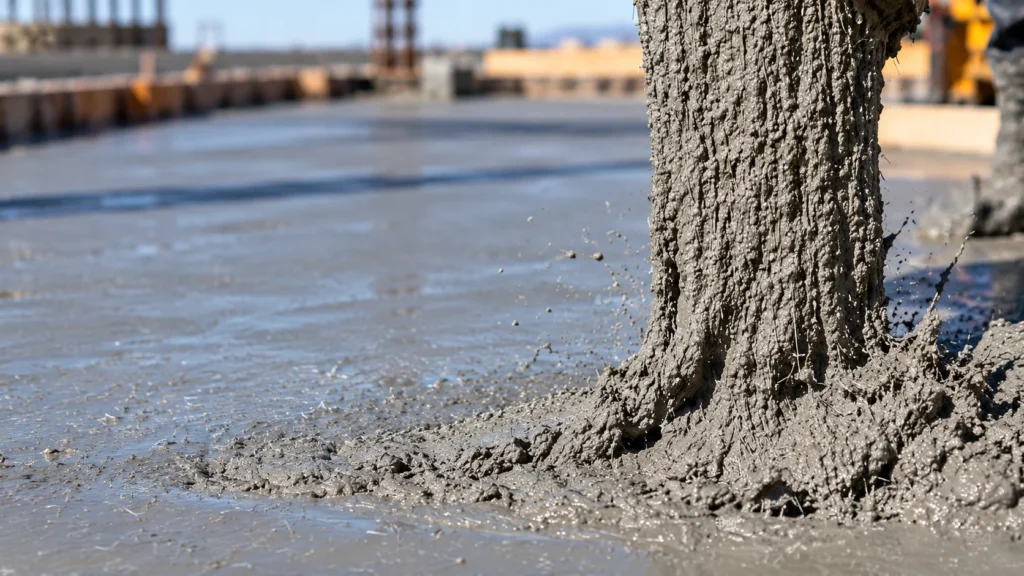
Typical UHPC Applications
PCE Powder for Different UHPC Production Systems
Precast UHPC Components
For precast elements requiring low W/B, high flowability, high strength and controlled production cycles.
UHPC Bridge Components
For bridge elements requiring dense matrices, mechanical performance and reliable casting behavior.
UHPC Bridge Deck Overlays
For low-W/B, high-performance UHPC used in thin bridge deck rehabilitation and overlay systems.
Architectural UHPC & Façade Panels
For architectural components requiring flowability, mold filling, surface quality and dimensional precision.
Fiber-Reinforced UHPC
For UHPC systems incorporating micro steel fibers, where controlled matrix rheology supports fiber dispersion, flowability and casting. In high-strength UHPC targeting approximately 140–200 MPa compressive strength, efficient particle dispersion and very low W/B are critical to mix design and performance.
RPC — Reactive Powder Concrete
For very low W/B reactive powder concrete requiring strong fine-particle dispersion and high water reduction.
White UHPC
For white cement-based and colour-sensitive UHPC requiring high performance with a pure-white powder admixture.
Specialty High-Performance Concrete
For advanced low-W/B cementitious systems requiring controlled water demand, flowability and strength development.
UHPC Mix Optimization
Compatibility Matters as Much as Water Reduction
PCE performance can change significantly with the complete UHPC formulation.
Cement Chemistry
Cement composition, fineness and sulfate balance can influence PCE adsorption and dosage demand.
Silica Fume & Ultrafine Powders
Type, fineness and dosage affect surface area, water demand and rheology.
Water-to-Binder Ratio
Lower W/B generally increases the importance of efficient particle dispersion.
Particle Packing
Quartz powder, fine aggregate and other mineral fractions influence packing density and matrix viscosity.
Steel Fiber
Fiber geometry, content and addition sequence affect flow resistance and processing.
Mixing Process
Mixer type, sequence, mixing time and shear energy can influence PCE efficiency and final consistency.
For this reason, PCE for UHPC should be selected through compatibility testing with the actual raw materials—not by nominal water-reduction rate alone.
Practical UHPC Trial Procedure
From Initial Dosage to Production Validation
01 — Establish the Control Mix
Fix the binder system, powders, aggregates, W/B and fiber configuration.
02 — Select the Starting Dosage
Choose an initial PCE dosage according to the UHPC system and performance target.
03 — Evaluate Fresh Performance
Check flow, viscosity, mixing behavior and workable time.
04 — Optimize PCE & W/B
Adjust dosage to achieve the required flow without uncontrolled additional water.
05 — Verify Strength
Test compressive strength at the required ages, including 1-day strength when early demolding or rapid production is required.
06 — Validate in Production
Confirm mixing, fiber incorporation, casting, surface quality and strength under actual plant conditions.
Technical Support for UHPC
Optimize PCE Around Your Actual UHPC Formulation
Successful UHPC formulation requires the right balance between water reduction, W/B ratio, flowability, rheology, strength development and production requirements.
POLYVIA supports PCE selection according to the actual binder system and performance target.
For technical evaluation, share your:
UHPC Formulation · W/B Ratio · Target Flow · Target Strength · 1-Day Strength Requirement · PCE Addition Method
We can recommend an appropriate PCE grade and starting dosage for laboratory evaluation.
Request a Sample · Request Technical Data · Discuss Your UHPC Mix
Frequently Asked Questions
1. What is the best PCE superplasticizer for UHPC?
The best PCE depends on the required UHPC performance.
For general UHPC and RPC requiring high water reduction, strong particle dispersion and high flowability at very low W/B ratios, PCE 870 is the recommended grade.
For precast UHPC requiring both high water reduction and faster early-strength development, ES980 is recommended, particularly where rapid demolding and shorter production cycles are important.
Final selection should be verified with the actual cement, silica fume, SCMs, W/B ratio and curing conditions.
2. What is the recommended PCE dosage for UHPC?
For UHPC with W/B around 0.18–0.22, a practical starting range is 0.15–0.35% by total binder mass, with approximately 0.20% recommended as an initial trial dosage.
For ultra-high-strength UHPC or RPC with W/B below 0.18, approximately 0.30–0.50% by total binder mass can be evaluated as a starting range.
3. Can PCE powder be directly dry-mixed into UHPC?
Yes. PCE powder can be directly incorporated into factory-produced UHPC dry mix and pre-bagged UHPC, provided that uniform distribution is achieved throughout the dry formulation.
4. Can PCE powder be dissolved in water before use?
Yes. PCE powder can be pre-dissolved in the mixing water. This method is particularly useful for laboratory trials, formulation optimization and controlled dosage evaluation.
5. Does PCE increase UHPC compressive strength?
PCE primarily improves particle dispersion and reduces water demand. By allowing the required flowability to be achieved at a lower W/B ratio, it supports the dense matrix and strength development required in UHPC.
Final compressive strength also depends on the complete mix design, raw materials, curing and production conditions.
6. Why is UHPC still sticky even with high flow?
Flow and viscosity are not the same property. UHPC contains a very high concentration of fine particles, so a mixture can show high spread while still having relatively high plastic viscosity.
PCE chemistry, silica fume, particle grading, W/B and overall rheological design should be evaluated together.
7. How does PCE affect steel fiber dispersion in UHPC?
PCE does not directly disperse steel fibers. It improves matrix flow and rheology, which can make fiber incorporation more uniform and reduce processing difficulties.
Fiber distribution also depends on fiber geometry, dosage, addition sequence and mixing equipment.
8. Is PCE powder suitable for white UHPC?
Yes. PCE powder can be used in white UHPC to achieve high water reduction and flowability at a low water-to-binder ratio. For architectural or decorative white UHPC, the selected PCE should also be compatible with white cement and the intended surface appearance. Final color and performance should be verified with the complete UHPC formulation.