
C1 vs. C2 Tile Adhesive: What Is the Difference?
EN 12004 Classification Explained
Understand C1 and C2 adhesion requirements, the meaning of T and E, and how S1/S2 deformability classifications help interpret tile adhesive performance.
Introduction
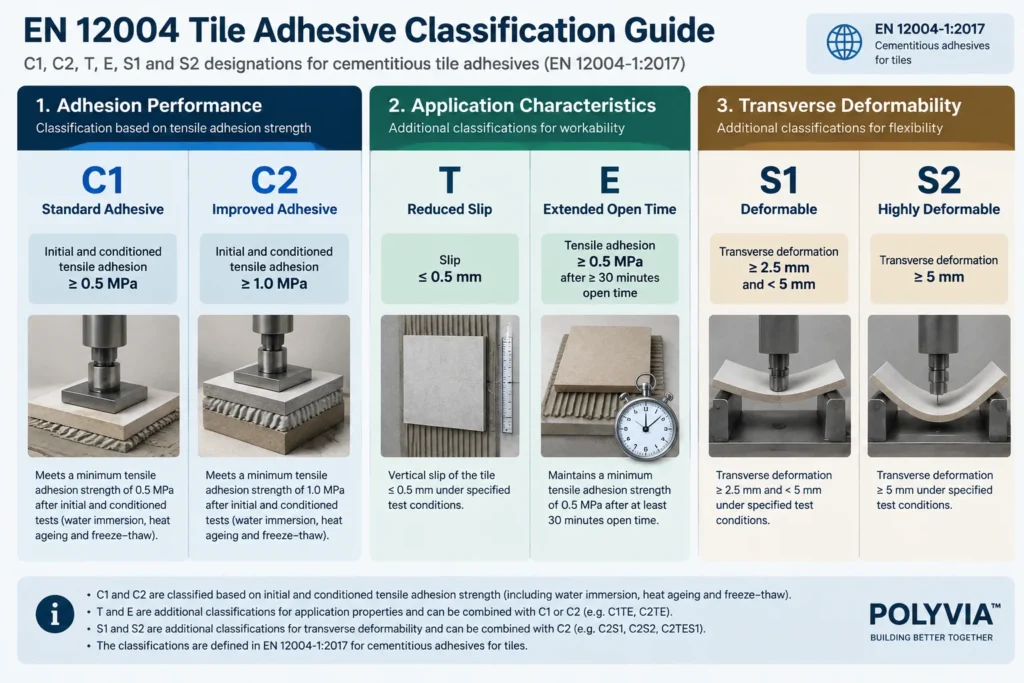
C1 and C2 are performance classifications for cementitious tile adhesives under EN 12004. C1 requires at least 0.5 MPa tensile adhesion, while C2 requires at least 1.0 MPa under specified initial and conditioned test procedures.
Additional designations describe other characteristics: T means reduced slip, E means extended open time, S1 means deformable, and S2 means highly deformable.
These classifications are based on standardized finished-product performance—not cement content, polymer dosage, or manufacturer descriptions.
This guide explains the technical requirements, how the classification system works, and how to interpret designations such as C1TE, C2TE, and C2TES1 on product technical data sheets.
EN 12004 Tile Adhesive Classification: Quick Reference
C1, C2, T, E, S1 and S2 Explained
| Code | Classification | Key Performance Requirement |
|---|---|---|
| C1 | Normal cementitious adhesive | Tensile adhesion ≥0.5 MPa |
| C2 | Improved cementitious adhesive | Tensile adhesion ≥1.0 MPa |
| T | Reduced slip | Slip ≤0.5 mm |
| E | Extended open time | ≥30 minutes, tensile adhesion ≥0.5 MPa |
| S1 | Deformable cementitious adhesive | Transverse deformation ≥2.5 mm and <5 mm |
| S2 | Highly deformable cementitious adhesive | Transverse deformation ≥5 mm |
For C1 and C2, the stated tensile adhesion limits apply to the specified initial, water-immersion, heat-ageing, and freeze–thaw test conditions for normal-setting cementitious adhesives. This table summarizes selected requirements from EN 12004-1:2017.
The most important distinction: C1/C2, T/E, and S1/S2 describe different performance characteristics. They are not a single ranking system.
What Is EN 12004 and How Does the Classification System Work?
EN 12004 is the European standards framework for classifying ceramic tile adhesives according to defined material characteristics and laboratory performance.
The 2017 framework has two principal parts.
EN 12004-1:2017 — Requirements and Classification
Part 1 establishes product characteristics, performance requirements, classification, and the associated assessment and marking framework.
It defines the performance associated with designations such as C1, C2, T, E, S1, and S2.
EN 12004-2:2017 — Test Methods
Part 2 specifies the methods used to determine adhesive characteristics.
It addresses open time, slip, tensile adhesion, shear adhesion for relevant adhesive families, and transverse deformation.
In practical terms:
EN 12004-1 defines the required performance. EN 12004-2 defines how the properties are tested.
These standards do not prescribe universal cement, sand, RDP, or HPMC dosages.
They also do not replace installation-specific design requirements.
1. What Do C, D, and R Mean?
Before interpreting C1 or C2, identify the adhesive family.
Main Adhesive Types Under EN 12004
| Code | Adhesive Family | General Description |
|---|---|---|
| C | Cementitious adhesive | Hydraulic binder-based adhesive, generally prepared by mixing with water or a liquid admixture |
| D | Dispersion adhesive | Adhesive based on an aqueous polymer dispersion |
| R | Reaction resin adhesive | Adhesive that hardens through a chemical reaction |
C1 and C2 belong to the cementitious adhesive family.
D- and R-type products have their own applicable characteristics and requirements. Their numerical classifications should not be interpreted as interchangeable with cementitious adhesive classifications.
This article focuses on cementitious tile adhesives.
C1 vs. C2: The Difference in Tensile Adhesion Performance
The fundamental difference between C1 and C2 is the required level of tensile adhesion under specified test conditions.
C1 — Normal Cementitious Adhesive
Requires at least 0.5 MPa tensile adhesion under the relevant initial and conditioned tests.
C2 — Improved Cementitious Adhesive
Requires at least 1.0 MPa under those same initial and conditioned test categories.
1. C1 and C2 Adhesion Requirements
Table 03. C1 vs. C2 Tensile Adhesion Requirements
| Test Condition | C1 | C2 |
|---|---|---|
| Initial tensile adhesion | ≥0.5 MPa | ≥1.0 MPa |
| After water immersion | ≥0.5 MPa | ≥1.0 MPa |
| After heat ageing | ≥0.5 MPa | ≥1.0 MPa |
| After freeze–thaw cycles | ≥0.5 MPa | ≥1.0 MPa |
| Basic open time, at least 20 minutes | ≥0.5 MPa | ≥0.5 MPa |
Selected EN 12004-1:2017 requirements for normal-setting cementitious adhesives. The corresponding test procedures are specified in EN 12004-2:2017.
The C2 threshold is numerically twice the C1 threshold under the four specified initial and conditioned tensile adhesion tests.
However, this does not mean that every C2 adhesive has exactly twice the measured strength of every C1 adhesive.
The values are minimum classification requirements, not predictions of individual product performance.
2. Why Are Conditioned Adhesion Tests Important?
Initial adhesion alone cannot establish a complete C1 or C2 classification.
The relevant conditioned tests evaluate adhesion following water immersion, heat ageing, and freeze–thaw cycling.
A product may perform well after initial curing but fail one of these conditioning requirements.
For example, consider the following hypothetical test results.
Illustrative C2 Classification Assessment
| Test Condition | Example Result | C2 Threshold | Assessment |
|---|---|---|---|
| Initial adhesion | 1.20 MPa | ≥1.0 MPa | Meets threshold |
| After water immersion | 0.82 MPa | ≥1.0 MPa | Below threshold |
| After heat ageing | 1.10 MPa | ≥1.0 MPa | Meets threshold |
| After freeze–thaw cycles | 1.05 MPa | ≥1.0 MPa | Meets threshold |
Despite three results exceeding 1.0 MPa, the water-conditioned result does not meet the C2 threshold.
The example therefore cannot support complete C2 classification.
Other applicable requirements and the validity of the testing procedures must also be considered.
All values in Table 04 are hypothetical and do not represent POLYVIA™ laboratory measurements.
3. Is C2 Determined by Higher RDP Dosage?
No.
VAE redispersible polymer powder can contribute to the performance of cementitious tile adhesives, but EN 12004 does not prescribe a fixed RDP dosage for C1 or C2.
The measured performance depends on the complete formulation, raw-material compatibility, specimen preparation, and testing conditions.
A product cannot be classified as C2 merely because it contains more RDP, cement, or another additive.
The finished adhesive must demonstrate the applicable C2 performance requirements.
What Do T and E Mean?
T and E are additional characteristics that can be combined with C1 or C2.
They describe application-related properties rather than a higher basic adhesion classification.
1. T — Reduced Slip
T means reduced slip.
The requirement is:
Slip ≤0.5 mm
Slip is determined using the specified test procedure for tile displacement.
The classification is particularly relevant when assessing an adhesive's resistance to tile movement following placement.
However, T does not promise zero movement or independently guarantee suitability for every vertical installation.
The applicable method is described in EN 12004-2:2017, Clause 8.2.
2. E — Extended Open Time
E means extended open time.
The requirement is:
Tensile adhesion ≥0.5 MPa after an open time of at least 30 minutes.
Open time concerns the interval between spreading adhesive and placing a tile.
The standardized test evaluates whether the required adhesion is achieved following the specified placement interval.
For normal-setting C1 and C2 adhesives, the basic open-time requirement is at least 20 minutes, with tensile adhesion ≥0.5 MPa.
An E designation identifies the additional extended-open-time characteristic.
The applicable method is described in EN 12004-2:2017, Clause 8.1.
3. Open Time Is Not Pot Life or Adjustment Time
These terms describe different stages of application.
Open Time vs. Pot Life vs. Adjustment Time
| Term | Meaning |
|---|---|
| Open Time | Interval after spreading adhesive during which subsequent tile placement can satisfy the relevant adhesion requirement |
| Pot Life | Period during which the prepared adhesive mixture remains usable under stated conditions |
| Adjustment Time | Period during which a tile can be repositioned after placement under stated conditions |
A C1TE or C2TE designation does not independently specify pot life or tile adjustment time.
It also does not guarantee identical open-time performance under every jobsite temperature, humidity, or airflow condition.
Those conditions require separate consideration.
What Do S1 and S2 Mean?
S1 and S2 describe the transverse deformability of cementitious tile adhesives.
They are separate from the adhesion strength classifications C1 and C2.
1. S1 — Deformable
An S1 cementitious adhesive has a transverse deformation of:
≥2.5 mm and <5 mm
2. S2 — Highly Deformable
An S2 cementitious adhesive has a transverse deformation of:
≥5 mm
S1 vs. S2 Classification
| Code | Description | Transverse Deformation |
|---|---|---|
| S1 | Deformable adhesive | ≥2.5 mm and <5 mm |
| S2 | Highly deformable adhesive | ≥5 mm |
The relevant test method is specified in EN 12004-2:2017, Clause 8.6.
Older technical publications may cite EN 12002 for transverse deformation testing. The 2017 edition of EN 12004-2 incorporated the method and superseded the earlier EN 12002:2008 standard in the European framework.
3. Is S2 a Higher Adhesion Classification Than S1?
No.
S1 and S2 describe different transverse deformation ranges.
They do not replace the C1 or C2 tensile adhesion requirements.
An adhesive may be classified as C2 without an S1 or S2 designation.
Likewise, an S1 or S2 designation must not be used as a substitute for evidence of the required adhesion class.
4. Does an S1 Designation Guarantee Suitability for Large-Format Tiles?
No.
Deformability can be relevant to installations involving movement and thermal or mechanical stresses.
However, the suitability of a particular adhesive also depends on the substrate, tile dimensions, expected movement, environmental conditions, installation procedure, and applicable project requirements.
The classification identifies a tested material characteristic, not a universal installation approval.
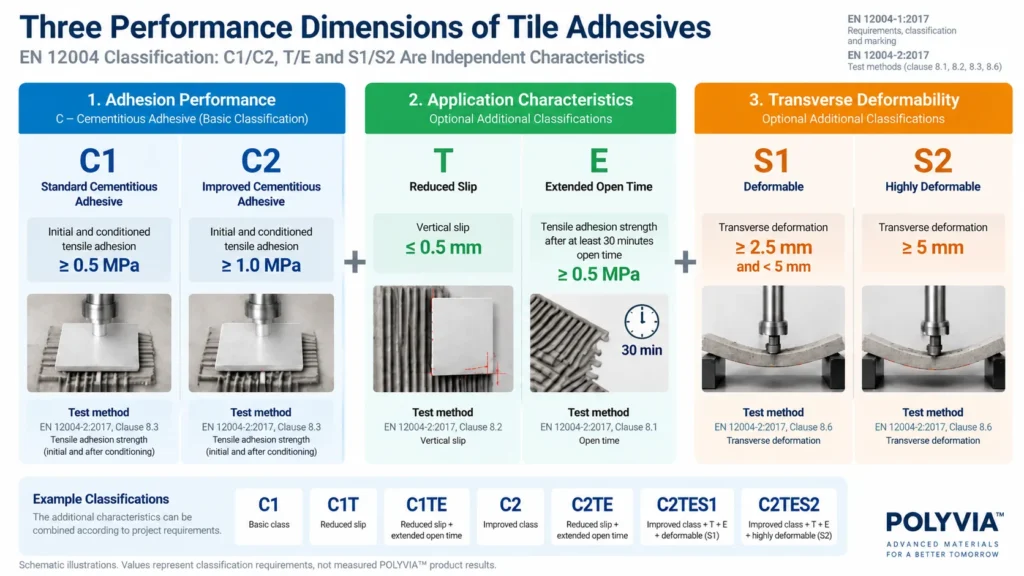
How to Decode C1TE, C2TE and C2TES1
Cementitious tile adhesive designations combine several independent pieces of information.
A useful reading sequence is:
Adhesive Family → Adhesion Classification → Additional Performance Characteristics
1. Common EN 12004 Cementitious Adhesive Designations
Classification Examples
| Designation | Meaning |
|---|---|
| C1 | Normal cementitious adhesive |
| C1T | C1 with reduced slip |
| C1E | C1 with extended open time |
| C1TE | C1 with reduced slip and extended open time |
| C2 | Improved cementitious adhesive |
| C2T | C2 with reduced slip |
| C2E | C2 with extended open time |
| C2TE | C2 with reduced slip and extended open time |
| C2TES1 | C2 with T, E and S1 deformability |
| C2TES2 | C2 with T, E and S2 deformability |
Each designation represents a combination of requirements that must be supported by the applicable tests.
2. Example: What Does C2TES1 Mean?
A product labeled C2TES1 is claiming the following characteristics:
C — Cementitious adhesive.
2 — Improved tensile adhesion classification.
T — Reduced slip.
E — Extended open time.
S1 — Deformable cementitious adhesive.
These characteristics are complementary rather than interchangeable.
The S1 designation does not raise the C2 tensile adhesion threshold, while the C2 classification does not replace S1 deformation testing.
3. What Does F Mean?
F means fast setting.
For the relevant fast-setting cementitious adhesive classifications, the requirements include early tensile adhesion of at least 0.5 MPa within 6 hours.
The basic open-time requirement for the fast-setting classification is at least 10 minutes, with tensile adhesion ≥0.5 MPa under the prescribed procedure.
F should not be confused with E.
Fast setting concerns specified early-age performance, whereas E identifies an extended interval for tile placement after adhesive spreading.
How to Read a Tile Adhesive Technical Data Sheet Correctly
Classification codes are useful only when interpreted alongside the associated product documentation.
A technical data sheet may state a product classification, list individual measured values, or provide application guidance.
These types of information should not be treated as interchangeable.
1. TDS Example 1: C2TE Without an S1 Designation
Suppose a technical data sheet states:
Classification: C2TE — EN 12004
This indicates that the manufacturer is claiming:
- Improved cementitious adhesion performance.
- Reduced slip.
- Extended open time.
However, the designation does not establish S1 or S2 deformability.
The absence of an S1 designation is not proof that the product has no deformability. It means S1 compliance has not been established by the stated classification.
If the project requires S1, request appropriate supporting documentation or select a product with the required verified designation.
2. TDS Example 2: A Product Claims C2 Based Only on Initial Adhesion
Suppose a supplier presents a measured initial adhesion value of 1.30 MPa and describes the product as C2.
That single value is not enough to establish the complete classification.
The relevant conditioned adhesion results and other applicable requirements also need to be verified.
Ask for evidence covering the required properties rather than relying on one favorable number.
3. TDS Example 3: A Product Claims Extended Open Time
Suppose a manufacturer states:
Open Time: 30 Minutes
This may be useful product information, but the interpretation depends on how the value was determined.
For an EN 12004 E classification, the relevant requirement is tensile adhesion ≥0.5 MPa after a placement interval of at least 30 minutes under the specified method.
A marketing statement alone is not equivalent to a standardized test report.
4. Practical TDS Verification Checklist
What to Verify in a Tile Adhesive TDS
| Item | Key Question |
|---|---|
| Adhesive family | Is it C, D or R? |
| Adhesion class | Is C1 or C2 claimed and supported? |
| Conditioned performance | Are the applicable conditioning requirements addressed? |
| T characteristic | Is reduced slip supported by the prescribed test? |
| E characteristic | Is extended open time supported by the prescribed test? |
| S1/S2 characteristic | Is transverse deformation evaluated where claimed? |
| Standard edition | Which standard and edition are referenced? |
| Product identity | Do the test results correspond to the supplied formulation? |
| Application suitability | Does the product documentation address the intended installation? |
A technical data sheet should help identify the product's claimed characteristics, but project-critical requirements may need additional test reports or conformity documentation.
Which Test Methods Support Each Classification?
EN 12004-2:2017 provides test methods for the relevant adhesive characteristics.
EN 12004-2:2017 Test Method Reference
| Property | Relevant Designation | Test Method |
|---|---|---|
| Open time | Basic open time and E | Clause 8.1 |
| Slip | T | Clause 8.2 |
| Tensile adhesion of cementitious adhesives | C1 and C2 | Clause 8.3 |
| Shear adhesion of dispersion adhesives | D family | Clause 8.4 |
| Shear adhesion of reaction resin adhesives | R family | Clause 8.5 |
| Transverse deformation | S1 and S2 | Clause 8.6 |
The standard methods define how the relevant characteristics are evaluated.
They do not establish that a particular commercial adhesive has passed merely because the supplier uses a familiar ingredient system.
1. Classification vs. Measured Performance
A classification threshold and a measured laboratory result are different.
For example:
C2 Requirement: Initial tensile adhesion ≥1.0 MPa.
Measured Value: The numerical result obtained for a specific tested product under the applicable procedure.
The classification requirement defines the minimum threshold. The measured value demonstrates how a particular sample performed.
Where a manufacturer publishes test results, those figures should correspond to identifiable samples and appropriate testing procedures.
2. Classification vs. Certification
Product classification, standardized testing, conformity assessment and third-party certification are related but distinct concepts.
A product designation alone should not be described as independent certification unless supporting documentation establishes that status.
Regulatory and conformity requirements depend on the intended market and product application.
Technical communication should distinguish verified performance from marketing claims.
How Should Manufacturers and Specifiers Select the Appropriate Classification?
EN 12004 provides a structured way to describe tile adhesive performance.
A practical selection process begins with the requirements of the complete tile installation.
Step 01 — Identify the Adhesive Family
Determine whether a cementitious, dispersion or reaction resin adhesive is appropriate for the intended application.
Step 02 — Establish the Required Adhesion Class
Check whether the specification requires C1 or C2 performance.
For C2, the improved initial and conditioned tensile adhesion requirements must be satisfied.
Step 03 — Consider Slip and Open-Time Requirements
Where relevant, evaluate whether the product requires reduced slip (T), extended open time (E), or both.
Step 04 — Determine Whether Deformability Is Required
Assess whether S1 or S2 is specified based on the installation system and expected conditions.
Step 05 — Verify the Product Documentation
Review the applicable test results, classification statements, installation guidance and market-specific requirements.
A product's classification should be considered alongside the substrate, tile type, movement, environmental exposure and installation method.
1. What Is the Role of RDP and HPMC in Classification Development?
VAE redispersible polymer powder and hydroxypropyl methylcellulose are common functional ingredients in cementitious dry-mix mortar formulations.
Their selection may influence properties relevant to finished-adhesive performance.
However, individual additives are not classified as C1, C2, T, E, S1 or S2 merely because they are intended for use in tile adhesives.
These classifications apply to the tested finished adhesive.
POLYVIA™ supplies construction chemical additives for manufacturers developing cementitious tile adhesive systems.
Suitable ingredient grades should be selected through formulation trials and verified using the applicable finished-product performance requirements.
Common Misunderstandings About EN 12004
C1TE Is Not the Same as C2
C1TE retains the C1 adhesion class while adding T and E characteristics.
C2 Does Not Automatically Mean S1
C2 specifies improved adhesion, not a verified transverse deformation classification.
E Does Not Mean a 30-Minute Pot Life
E concerns standardized open-time adhesion after adhesive spreading.
T Does Not Mean Zero Slip
T allows no more than 0.5 mm displacement under the prescribed test.
S2 Does Not Mean Higher Tensile Adhesion Than S1
S1 and S2 distinguish deformability ranges, not C1/C2 adhesion strength classes.
These distinctions help prevent errors when interpreting manufacturer specifications.
Conclusion
EN 12004 provides a performance-based classification framework for ceramic tile adhesives.
For normal-setting cementitious adhesives, C1 requires at least 0.5 MPa, while C2 requires at least 1.0 MPa, under the specified initial and conditioned tensile adhesion test categories.
Additional designations identify different characteristics:
- T: Reduced slip, ≤0.5 mm.
- E: Extended open time, ≥30 minutes with tensile adhesion ≥0.5 MPa.
- S1: Deformable, transverse deformation ≥2.5 mm and <5 mm.
- S2: Highly deformable, transverse deformation ≥5 mm.
Understanding these distinctions makes it easier to interpret combinations such as C1TE, C2TE and C2TES1.
The essential principle is that EN 12004 classifies demonstrated finished-adhesive performance—not a specific cement percentage, polymer powder dosage or reference formulation.
For manufacturers and specifiers, accurate classification begins with defining the required performance and verifying it through the applicable standardized tests.
Frequently Asked Questions
1. What is the difference between C1 and C2 tile adhesive?
C1 is a normal cementitious tile adhesive requiring at least 0.5 MPa tensile adhesion under the specified initial and conditioned tests.
C2 is an improved cementitious adhesive requiring at least 1.0 MPa under those same categories.
These are minimum classification thresholds rather than guaranteed measurements for every commercial product.
2. What does C1TE mean?
C1TE identifies a normal cementitious adhesive with reduced slip (T) and extended open time (E).
T requires slip ≤0.5 mm.
E requires tensile adhesion ≥0.5 MPa after an open time of at least 30 minutes.
C1TE does not automatically meet the C2 adhesion requirements.
3. What does C2TE mean?
C2TE identifies an improved cementitious adhesive with reduced slip and extended open time.
It combines the C2 adhesion requirements with T ≤0.5 mm and E performance of at least 0.5 MPa tensile adhesion after a minimum 30-minute open time.
4. What is the difference between S1 and S2 tile adhesive?
S1 indicates transverse deformation of at least 2.5 mm and less than 5 mm.
S2 indicates transverse deformation of at least 5 mm.
Both designations describe deformability, not tensile adhesion strength.
5. Does C2 tile adhesive always contain more RDP than C1?
No. EN 12004 does not establish a required RDP dosage for either classification.
The adhesive must meet the applicable finished-product performance requirements regardless of its specific ingredient proportions.
6. Does E mean tile adhesive can be used for 30 minutes after mixing?
No. Extended open time refers to the interval after spreading the adhesive and before placing the tile.
It is different from pot life, which describes the usable period of the prepared mixture.
The standardized E requirement involves at least 0.5 MPa tensile adhesion after a minimum 30-minute open time.
7. Is C2TES1 automatically suitable for large-format tiles or exterior applications?
No. C2TES1 identifies improved adhesion, reduced slip, extended open time and S1 deformability.
Suitability for a specific installation additionally depends on tile dimensions, substrate conditions, environmental exposure, movement, project specifications and installation procedures.
8. Which standard is used to test S1 and S2 deformability?
In the 2017 European standards framework, transverse deformation testing is described in EN 12004-2:2017, Clause 8.6.
Older documents may refer to EN 12002, which was superseded by EN 12004-2:2017.
The S1 and S2 classification thresholds are specified in EN 12004-1:2017.
References
1] EN 12004-1:2017. Adhesives for ceramic tiles — Part 1: Requirements, assessment and verification of constancy of performance, classification and marking.
Official standard information:
https://www.nen.nl/en/nen-en-12004-1-2017-en-230833
[2] EN 12004-2:2017. Adhesives for ceramic tiles — Part 2: Test methods.
Official standard information:
https://www.nen.nl/en/nen-en-12004-2-2017-en-230792
[3] ISO 13007-1:2014. Ceramic tiles — Grouts and adhesives — Part 1: Terms, definitions and specifications for adhesives.
Official ISO publication:
https://www.iso.org/standard/60880.html
[4] ISO 13007-2:2013. Ceramic tiles — Grouts and adhesives — Part 2: Test methods for adhesives.
Official ISO publication:
https://www.iso.org/standard/60881.html
Technical Scope
This article summarizes selected classification requirements under EN 12004-1:2017 and the associated test-method framework under EN 12004-2:2017.
Any numerical testing examples are illustrative, not measured POLYVIA™ product results.
The complete relevant standards, product documentation and applicable market requirements should be consulted when performing tests or making formal classification and conformity claims.